


Acts 16:4
Bible text: King James Version (1769 Blayney text) · Public domain
Bible text: King James Version with Strong's numbers · Public domain
Bible text: Berean Standard Bible · Public domain
Bible text: American Standard Version (1901) · Public domain
Bible text: World English Bible, Messianic edition · Public domain
Bible text: Geneva Bible (1599) · Public domain
Bible text: Young's Literal Translation · Public domain
- ὡςhōsWhileG5613PRTParticle or Disjunctive
- δὲdethenG1161CONJConjunction
- διεπορεύοντοdieporeuontothey were passing throughG1279V-INI-3PVerb Imperfect Middle Or Passive Deponent Indicative 3rd Plural
- τὰςtastheG3588T-APFDefinite article Accusative Plural Feminine
- πόλειςpoleiscitiesG4172N-APFNoun Accusative Plural Feminine
- παρεδίδοσανparedidosanthey were deliveringG3860V-IAI-3PVerb Imperfect Active Indicative 3rd Plural
- αὐτοῖςautoisto themG846P-DPMPersonal pronoun Dative Plural Masculine
- φυλάσσεινphulasseinto keepG5442V-PANVerb Present Active Infinitive
- τὰtatheG3588T-APNDefinite article Accusative Plural Neuter
- δόγματαdogmatadecreesG1378N-APNNoun Accusative Plural Neuter
- τὰtawhich [were]G3588T-APNDefinite article Accusative Plural Neuter
- κεκριμέναkekrimenadecided onG2919V-RPP-APNVerb Perfect Passive Participle Accusative Plural Neuter
- ὑπὸhupobyG5259PREPPreposition
- τῶνtōntheG3588T-GPMDefinite article Genitive Plural Masculine
- ἀποστόλωνapostolōnapostlesG652N-GPMNoun Genitive Plural Masculine
- καὶkaiandG2532CONJConjunction
- τῶνtōnof theG3588T-GPMDefinite article Genitive Plural Masculine
- πρεσβυτέρωνpresbuterōneldersG4245N-GPMNoun Genitive Plural Masculine
- τῶνtōnwho [were]G3588T-GPMDefinite article Genitive Plural Masculine
- ἐνeninG1722PREPPreposition
- ἹεροσολύμοιςHi'erosolumoisJerusalemG2414N-DPN-LNoun Dative Plural Neuter Location
English is a literal word-by-word gloss of the Greek, not the KJV's wording. Why?
This is the original text the KJV's translators worked from — each Greek word with its own literal English meaning in this verse, prepared by scholars at Tyndale House, Cambridge. The KJV translates whole sentences, not word by word, so its wording differs: one Greek word can become several English words, and the KJV may choose “charity” where the gloss reads “love”. Both are faithful — they answer different questions. For the KJV's own rendering, switch to the KJV text.
Details
See on the biblical-era maps
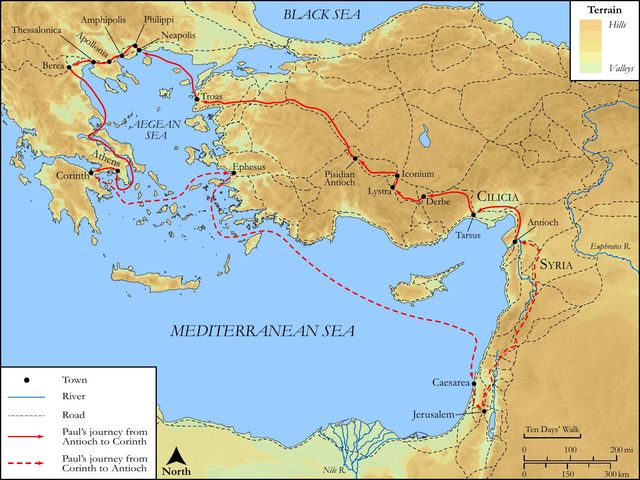
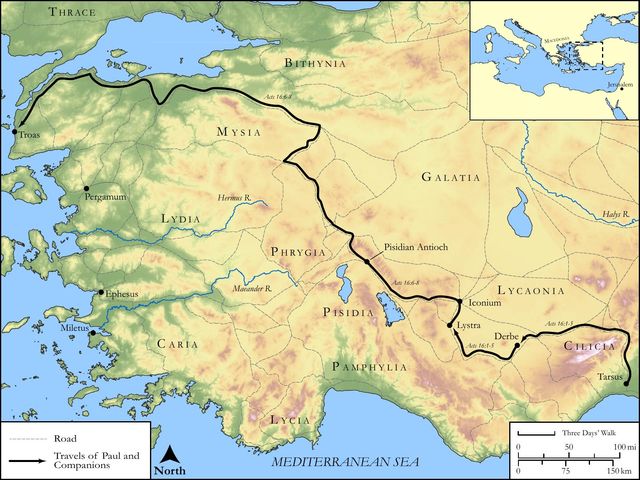
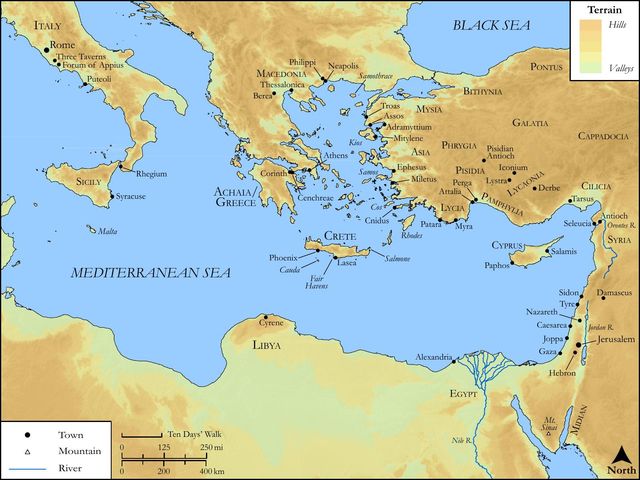
Study this verse
Public-domain commentary
Matthew Henry
From his Commentary on the Whole Bible. Henry comments on passages, not single verses — this entry covers Acts 16:1–5. His three-level outline is real structure in the source text, so it is rendered as structure.
Paul was a spiritual father, and as such a one we have him here adopting Timothy, and taking care of the education of many others who had been begotten to Christ by his ministry: and in all he appears to have been a wise and tender father. Here is,
I.His taking Timothy into his acquaintance and under his tuition.
One thing designed in the book of the Acts is to help us to understand Paul's epistles, two of which are directed to Timothy; it was therefore necessary that in the history of Paul we should have some account concerning him. And we are here accordingly told,
1.That he was a disciple, one that belonged to Christ, and was baptized, probably in his infancy, when his mother became a believer, as Lydia's household was baptized upon her believing, Act 16:15. Him, that was a disciple of Christ, Paul took to be his disciple, that he might further train him up in the knowledge and faith of Christ; he took him to be brought up for Christ.
2.That his mother was a Jewess originally, but believed in Christ; her name was Eunice, his grandmother's name was Lois. Paul speaks of them both with great respect, as women of eminent virtue and piety, and commends them especially for their unfeigned faith (Ti2 1:5), their sincerely embracing and adhering to the doctrine of Christ.
3.That his father was a Greek, a Gentile. The marriage of a Jewish woman to a Gentile husband (though some would make a difference) was prohibited as much as the marriage of a Jewish man to a Gentile wife, Deu 7:3. Thou shalt no more give thy daughter to his son than take his daughter to thy son; yet this seems to have been limited to the nations that lived among them in Canaan, whom they were most in danger of infection from. Now because his father was a Greek he was not circumcised: for the entail of the covenant and the seal of it, as of other entails in that nation, went by the father, not by the mother; so that his father being no Jew he was not obliged to circumcision, nor entitled to it, unless when he grew up he did himself desire it. But, observe, though his mother could not prevail to have him circumcised in his infancy, because his father was of another mind and way, yet she educated him in the fear of God, that though he wanted the sign of the covenant he might not want the thing signified.
4.That he had gained a very good character among the Christians: he was well reported of by the brethren that were at Lystra and Iconium; he had not only an unblemished reputation, and was free from scandal, but he had a bright reputation, and great encomiums were given of him, as an extraordinary young man, and one from whom great things were expected. Not only those in the place where he was born, but those in the neighbouring cities, admired him, and spoke honourably of him. He had a name for good things with good people.
5.That Paul would have him to go forth with him, to accompany him, to give attendance on him, to receive instruction from him, and to join with him in the work of the gospel - to preach for him when there was occasion, and to be left behind in places where he had planted churches. Paul had a great love for him, not only because he was an ingenious young man, and one of great parts, but because he was a serious young man, and one of devout affections: for Paul was always mindful of his tears, Ti2 1:4.
6.That Paul took him and circumcised him, or ordered it to be done. This was strange. Had not Paul opposed those with all his might that were for imposing circumcision upon the Gentile converts? Had he not at this time the decrees of the council at Jerusalem with him, which witnessed against it? He had, and yet circumcised Timothy, not, as those teachers designed in imposing circumcision, to oblige him to keep the ceremonial law, but only to render his conversation and ministry passable, and, if it might be, acceptable among the Jews that abounded in those quarters. He knew Timothy was a man likely to do a great deal of good among them, being admirably qualified for the ministry, if they were not invincibly prejudiced against him; and therefore, that they might not shun him as one unclean, because uncircumcised, he took him and circumcised him. Thus to the Jews he became as a Jew, that he might gain the Jews, and all things to all men, that he might gain some. He was against those who made circumcision necessary to salvation, but used it himself when it was conducive to edification; nor was he rigid in opposing it, as they were in imposing it. Thus, though he went not in this instance according to the letter of the decree, he went according to the spirit of it, which was a spirit of tenderness towards the Jews, and willingness to bring them off gradually from their prejudices. Paul made no difficulty of taking Timothy to be his companion, though he was uncircumcised; but the Jews would not hear him if he were, and therefore Paul will humour them herein. It is probable that it was at this time that Paul laid his hands on Timothy, for the conferring of the gift of the Holy Ghost upon him, Ti2 1:6.
II.His confirming the churches which he had planted (Act 16:4, Act 16:5):
He went through the cities where he had preached the word of the Lord, as he intended (Act 15:36), to enquire into their state. And we are told,
1.That they delivered them copies of the decrees of the Jerusalem synod, to be a direction to them in the government of themselves, and that they might have wherewith to answer the judaizing teachers, and to justify themselves in adhering to the liberty with which Christ had made them free. All the churches were concerned in that decree, and therefore it was requisite they should all have it well attested. Though Paul had for a particular reason circumcised Timothy, yet he would not have that drawn into a precedent; and therefore he delivered the decrees to the churches, to be religiously observed; for they must abide by the rule, and not be drawn from it by a particular example.
2.That this was of very good service to them.
(1.)The churches were hereby established in the faith, Act 16:5. They were confirmed particularly in their opinion against the imposing of the ceremonial law upon the Gentiles; the great assurance and heat wherewith the judaizing teachers pressed the necessity of circumcision, and the plausible arguments they produced for it, had shocked them, so that they began to waver concerning it. But when they saw the testimony, not only of the apostles and elders, but of the Holy Ghost in them, against it, they were established, and did not longer waver about it. Note, Testimonies to truth, though they may not prevail to convince those that oppose it, may be of very good use to establish those that are in doubt concerning it, and to fix them. Nay, the design of this decree being to set aside the ceremonial law, and the carnal ordinances of that, they were by it established in the Christian faith in general, and were the more firmly assured that it was of God, because it set up a spiritual way of serving God, as more suited to the nature both of God and man; and, besides, that spirit of tenderness and condescension which appeared in these letters plainly showed that the apostles and elders were herein under the guidance of him who is love itself.
(2.)They increased in number daily. The imposing of the yoke of the ceremonial law upon their converts was enough to frighten people from them. If they had been disposed to turn Jews, they could have done that long since, before the apostles came among them; but, if they cannot be interested in the Christian privileges without submitting to the Jews' yoke, they will be as they are. But, if they find there is no danger of their being so enslaved, they are ready to embrace Christianity, and join themselves to the church. And thus the church increased in numbers daily; not a day passed but some or other gave up their names to Christ. And it is a joy to those who heartily wish well to the honour of Christ, and the welfare of the church and the souls of men, to see such an increase.
Historical interpretation
Historical reception
2 surviving comments on this verse. Each one is dated, so this reads as a timeline rather than a list.
"And as they went through the cities, they delivered them the decrees for to keep, that were ordained of the Apostles and elders which were at Jerusalem. And so were the Churches established in the faith, and increased in number daily." Dost thou mark fighting, and by fighting, edification? Not warred upon by others, but themselves doing contrary things, so they edified the Church! They introduced a decree not to circumcise, and he circumcises! "And so were the Churches," it says, "established in the faith," and in multitude: "increased," it says, "in number daily." Then he does not continue to tarry with these, as having come to visit them: but how? he goes further.
"And as they went through the cities, they delivered them the decrees for to keep." For until then, there was no need for the Gentiles to keep any such. The beginning of the abrogation was the Gentiles' not keeping these things, and being none the worse for it: nor having any inferiority in respect of faith: anon, of their own will they abandoned the Law. "And so were the Churches established in the faith." Do you mark here also how from going counter (to his own object) a great good results? "And increased in number daily." Do you observe, that the circumcising not only did no harm, but was even of the greatest service?
Continue studying Acts 16:4 across the web’s major study libraries — every link below opens this exact verse, chapter, or book on the destination site.
Read & Compare
 BibleGatewayThis verse in more than 200 translations and 70 languages.
 Bible.comThe YouVersion reader — hundreds of translations, reading plans, and highlights.
 ESV.orgCrossway's official English Standard Version reader.
 NET BibleThe NET translation with 60,000+ translators' notes on every rendering decision.
 STEP BibleTyndale House's free study tool — original text, vocabulary, and scholarly resources.
 BibliaLogos Bible Software's free web reader.
 USCCBThe New American Bible (Revised Edition) with the U.S. bishops' study notes.
Commentaries
 BibleHub CommentariesDozens of classic commentaries on this verse, gathered on one page.
 StudyLightMore than 100 commentary sets — the largest collection on the web.
 BibleRefPlain-English commentary on what this verse means, verse by verse.
 Enduring WordDavid Guzik's free commentary on this chapter, widely used by Bible teachers.
 Bible Study ToolsVerse commentary alongside Greek and Hebrew study aids.
Original Language & Research
- BibleHub InterlinearThe verse word by word — original language, transliteration, and English.
- BibleHub LexiconEvery word's original-language definition and Strong's entry.
 Blue Letter BibleDeep-study tools — Strong's numbers, concordance, and word studies.
 CNTR CollationThe earliest Greek manuscripts of this verse, collated letter by letter.
Sermons, Hymns & Audio


TrulyRandomVerse is not affiliated with these sites and doesn’t control their content. They’re linked because they’re genuinely useful.
Summary
Acts 16:4 captures a crucial moment in Paul's second missionary journey, illustrating the early church's commitment to disseminating and upholding the authoritative decisions made by its leadership. As Paul, Silas, and Timothy traversed various cities, they faithfully delivered the decrees from the Jerusalem Council, ensuring that new and existing congregations understood the unified apostolic teaching regarding Gentile converts and the practical implications for their fellowship, thereby reinforcing doctrinal clarity and ecclesiastical unity across the burgeoning Christian community.
Context
ShowHideLiterary Context
This verse immediately follows the account of Paul's decision to take Timothy with him (Acts 16:1-3) and serves as a direct continuation of the narrative from Acts 15. The preceding chapter details the pivotal Jerusalem Council, where the apostles and elders convened to address the contentious issue of whether Gentile believers needed to be circumcised and adhere to the Mosaic Law for salvation. Acts 15:22-29 records the council's decision, which affirmed salvation by grace through faith for Gentiles, while also establishing practical guidelines to foster unity and avoid offense between Jewish and Gentile Christians. Acts 16:4 demonstrates the practical implementation of this decision, showing Paul and his companions actively communicating these resolutions to the churches they visited, thereby solidifying the theological and practical framework for the expanding Gentile mission.
Historical & Cultural Context
The early church was grappling with its identity as it expanded beyond its Jewish roots. The question of Gentile inclusion, particularly concerning circumcision and adherence to the Mosaic Law, was a significant point of contention, threatening to divide the nascent Christian movement. Jewish believers, steeped in centuries of covenantal law, struggled to accept Gentiles as full members of God's people without requiring these traditional markers. The Jerusalem Council (c. AD 49-50) was a landmark event that provided an authoritative resolution to this conflict. The decrees, outlined in Acts 15:28-29, were a compromise that affirmed the theological truth of salvation by grace while also addressing practical concerns for inter-community fellowship. Paul's mission to deliver these decrees highlights the importance of unified doctrine and practice in a geographically dispersed and culturally diverse church, aiming to prevent schism and ensure consistent understanding of the Gospel.
Key Themes
ShowHideActs 16:4 contributes significantly to several key themes within the book of Acts and the broader New Testament. Firstly, it underscores Apostolic Authority and Unity, demonstrating how the early church's leadership, guided by the Holy Spirit, made binding decisions that were respected and disseminated throughout the Christian communities. This established a precedent for doctrinal consistency and ecclesiastical order. Secondly, it reinforces the theme of Gospel Clarity and Universal reach, affirming that salvation is by grace through faith in Christ, accessible to both Jews and Gentiles without the burden of the Mosaic Law, a truth central to Paul's theology as seen in Galatians 2:16. Thirdly, the verse subtly highlights Practical Wisdom and Fellowship, as the decrees, while affirming grace, also provided guidelines (e.g., abstaining from food offered to idols, from blood, from strangled animals, and from sexual immorality) designed to facilitate harmonious relationships between Jewish and Gentile believers, prioritizing love and unity over legalistic adherence, as also emphasized in Romans 14:13-23.
Exposition and Analysis
ShowHideKey Word Analysis
ShowHideThis word refers to a law (civil, ceremonial, or ecclesiastical), an ordinance, or an authoritative decision. In this context, it specifically denotes the binding resolutions made by the Jerusalem Council, emphasizing their official and foundational nature for the early church's practice and theology. These were not mere suggestions but authoritative pronouncements intended to guide the conduct and doctrine of believers across various congregations.
Meaning "to surrender, i.e. yield up, intrust, transmit." This word highlights the active role of Paul and his companions in formally conveying these decisions. It implies a deliberate and responsible act of transmission, ensuring that the churches received the authoritative teaching directly from the apostles and elders, thereby establishing a chain of accountability and proper dissemination.
Meaning "to distinguish, i.e. decide (mentally or judicially); by implication, to try, condemn, punish; to decree, determine." This term underscores the judicial and authoritative process by which the decrees were established. It signifies that the decisions were not arbitrary but were the result of careful deliberation and judgment by the apostles and elders, carrying the weight of divine guidance and collective wisdom.
Verse Breakdown
ShowHide"And as they went through the cities"
This phrase sets the scene for Paul's ongoing missionary activity. It emphasizes the dynamic and itinerant nature of his ministry, indicating that the delivery of these decrees was an integral part of their evangelistic and church-planting efforts, not a separate, isolated task. It shows the widespread application intended for the council's decisions.
"they delivered them the decrees for to keep"
This clause specifies the action and its purpose. Paul and his team were not just preaching the Gospel but also ensuring the structural and doctrinal integrity of the nascent churches. The "decrees" (dógmata) were authoritative decisions, and the phrase "for to keep" (phylássō) indicates that these were meant to be observed and obeyed, signifying their binding nature for the Christian communities.
"that were ordained of the apostles and elders which were at Jerusalem"
This final part establishes the source and authority of the decrees. It clearly attributes them to the collective wisdom and authority of the leading apostles and elders in Jerusalem, specifically those who had convened at the council. This legitimizes the decrees, grounding them in the recognized leadership of the early church and indicating a unified, Spirit-guided decision-making process.
Literary Devices
ShowHideActs 16:4 effectively uses Narrative Progression to advance the story of the early church's expansion, showing Paul's journey not just as one of evangelism but also of consolidation and organization. The verse employs Authoritative Language through terms like "decrees" (dógmata) and "ordained" (krínō), emphasizing the binding nature of the decisions from Jerusalem and the established hierarchy within the early Christian movement. This also serves as Thematic Reinforcement, reiterating the themes of unity and sound doctrine that were central to the Jerusalem Council's resolution. The concise nature of the verse, despite its significant implications, demonstrates Economical Narration, conveying a great deal of information about the practical outworking of theological decisions in a few words.
Theological and Thematic Connections
ShowHideActs 16:4 profoundly illustrates the early church's commitment to both theological truth and practical unity. The decrees, while affirming salvation by grace for Gentiles, also provided guidelines to foster harmonious fellowship between Jewish and Gentile believers, demonstrating a balance between doctrinal purity and relational wisdom. This reflects a foundational understanding that the Gospel not only transforms individuals but also creates a new community, the church, which must strive for unity in diversity, guided by Spirit-led leadership. The passage underscores the importance of authoritative teaching and its dissemination for the health and growth of the global body of Christ, ensuring that all believers operate from a common understanding of God's will and the implications of the New Covenant.
Reflection and Application
ShowHideActs 16:4 offers timeless principles for the church today. Just as the early church faced internal challenges regarding doctrine and practice, contemporary churches must continually strive for clarity in their theological understanding and unity in their expression of faith. The willingness of Paul and his companions to faithfully deliver the decrees, and the churches' willingness to receive them, highlights the importance of respecting spiritual authority and maintaining accountability within the broader body of Christ. This verse reminds us that true Christian fellowship is built not only on shared belief but also on practical wisdom that seeks to minimize unnecessary offense and maximize love among diverse believers. It calls us to discern what is essential for salvation and what constitutes a matter of conscience or cultural preference, always prioritizing the unity of the Spirit and the advancement of the Gospel.
Questions for Reflection
ShowHideFAQ
ShowHideWhat was the purpose of these "decrees" and why were they so important for the early church?
ShowHideThe "decrees" (Greek: dógmata) were the official, authoritative decisions made by the Jerusalem Council, detailed in Acts 15. Their primary purpose was twofold: first, to clarify the theological truth that Gentile converts did not need to be circumcised or observe the Mosaic Law to be saved, affirming salvation by grace through faith in Jesus Christ alone (as seen in Acts 15:11). This was crucial for maintaining the purity of the Gospel message and preventing legalism. Second, the decrees provided practical guidelines for Gentile believers to foster unity and harmonious fellowship with Jewish Christians. These guidelines, such as abstaining from food offered to idols, from blood, from strangled animals, and from sexual immorality (Acts 15:28-29), were designed to avoid unnecessary offense and bridge cultural gaps, ensuring that the expanding church could grow in unity despite its diverse backgrounds. They were important because they established a unified doctrinal and practical foundation for the global church, preventing schism and enabling the unhindered spread of the Gospel to all nations.
Christ-Centered Fulfillment
ShowHideActs 16:4, by highlighting the dissemination of the Jerusalem decrees, points profoundly to Christ's central role in breaking down barriers and establishing a new covenant community. The very need for these decrees arose from the tension between the Old Covenant's ceremonial law and the New Covenant's universal reach through Christ. The decision that Gentiles did not need to be circumcised for salvation directly reflects the finished work of Christ, who, through His death and resurrection, fulfilled the Law and inaugurated a new way of salvation by grace through faith (Romans 10:4). Christ Himself is our peace, having "broken down in His flesh the dividing wall of hostility" between Jew and Gentile (Ephesians 2:14). The decrees, therefore, were a practical outworking of Christ's unifying power, ensuring that His body, the church, would truly be "one new humanity" (Ephesians 2:15), where there is "neither Jew nor Gentile, neither slave nor free, nor is there male and female, for you are all one in Christ Jesus" (Galatians 3:28). Thus, the apostles and elders, guided by the Holy Spirit, were simply articulating the implications of Christ's redemptive work, ensuring that the church lived out the glorious freedom and unity purchased by the Lamb of God.