


Jeremiah 50:7
- כָּלkolallH3605N-mscNoun Singular Masculine Construct
- מוֹצְאֵיהֶםmotz·'ei·Hem[those who] found themH4672V-Qal-Prtcpl-mp ¦ 3mpVerb Qal Participle Plural Masculine Constructמוֹצְאֵי[those who] foundהֶםthem
- אֲכָלוּם'a·kha·Lumthey devoured themH398V-Qal-Perf-3cp ¦ 3mpVerb Qal Perfect 3rd Plural common genderאֲכָלוּthey devouredםthem
- וְצָרֵיהֶםve·tza·rei·Hemand their opponentsH6862Conj-w ¦ N-mpc ¦ 3mpNoun Plural Masculine Constructוְandצָרֵיopponentsהֶםtheir
- אָמְרוּ'a·me·Ruthey saidH559V-Qal-Perf-3cpVerb Qal Perfect 3rd Plural common gender
- לֹאlo'notH3808NegParticle Negative
- נֶאְשָׁםne'·Shamwe are guiltyH816V-Qal-Imperf-1cpVerb Qal Imperfect 1st Plural common gender
- תַּחַתTa·chatbecauseH8478N-mscNoun Singular Masculine Construct
- אֲשֶׁר'a·SherthatH834RelParticle Relative
- חָטְאוּcha·te·'Uthey have sinnedH2398V-Qal-Perf-3cpVerb Qal Perfect 3rd Plural common gender
- לַיהוָהla·Yah·wehto YahwehH3068Prep-l ¦ N-properNoun Proper TitleלַtoיהוָהYahweh
- נְוֵהne·veh[the] habitation ofH5116N-mscNoun Singular Masculine Construct
- צֶדֶקTze·dekrighteousnessH6664N-msNoun Singular Masculine Absolute
- וּמִקְוֵהu·mik·Vehand [the] hope ofH4723Conj-w ¦ N-mscNoun Singular Masculine Constructוּandמִקְוֵה[the] hope of
- אֲבוֹתֵיהֶם'a·vo·tei·Hemtheir ancestorsH1N-fpc ¦ 3mpNoun Plural Feminine Constructאֲבוֹתֵיancestorsהֶםtheir
- יְהוָהYah·wehYahwehH3068N-properNoun Proper Title
English is a literal word-by-word gloss of the Hebrew, not the KJV's wording. Why?
This is the original text the KJV's translators worked from — each Hebrew word with its own literal English meaning in this verse, prepared by scholars at Tyndale House, Cambridge. The KJV translates whole sentences, not word by word, so its wording differs: one Hebrew word can become several English words, and the KJV may choose “the LORD” where the gloss reads “Yahweh”. Both are faithful — they answer different questions. For the KJV's own rendering, switch to the KJV text.
Details
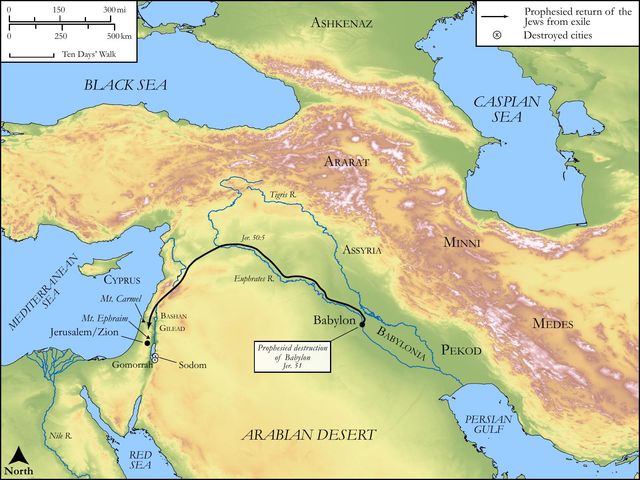
See on the biblical-era map
Study this verse
Public-domain commentary
Matthew Henry
From his Commentary on the Whole Bible. Henry comments on passages, not single verses — this entry covers Jeremiah 50:1–8. His three-level outline is real structure in the source text, so it is rendered as structure.
I.Here is a word spoken against Babylon by him whose works all agree with his word and none of whose words fall to the ground.
The king of Babylon had been very kind of Jeremiah, and yet he must foretel the ruin of that kingdom; for God's prophets must not be governed by favour or affection. Whoever are our friends, if, notwithstanding, they are God's enemies, we dare not speak peace to them.
1.The destruction of Babylon is here spoken of as a thing done, Jer 50:2. let it be published to the nations as a piece of news, true news, and great news, and news they are all concerned in; let them hang out the flag, as is usual on days of triumph, to give notice of it; let all the world take notice of it: Babylon is taken. Let God have the honour of it, let his people have the comfort of it, and therefore do not conceal it. Take care that it be known, that the Lord may be known by those judgments which he executes, Psa 9:16.
2.It is spoken of as a thing done thoroughly. For,
(1.)The very idols of Babylon, which the people would protect with all possible care, and from which they expected protection, shall be destroyed. Bel and Merodach were their two principal deities; they shall be confounded, and the images of them broken to pieces.
(2.)The country shall be laid waste (Jer 50:3) out of the north, from Media, which lay north of Babylon, and from Assyria, through which Cyrus made his descent upon Babylon; thence the nation shall come that shall make her land desolate. Their land was north of the countries that they destroyed, who were therefore threatened with evil from the north (Omne malum ab aquilone - Every evil comes from the north); but God will find out nations yet further north to come upon them. The pomp and power of old Rome were brought down by northern nations, the Goths and Vandals.
II.Here is a word spoken for the people of God, and for their comfort, both the children of Israel and of Judah; for many there were of the ten tribes that associated with those of the two tribes in their return out of Babylon. Now here,
1.It is promised that they shall return to their God first and then to their own land; and the promise of their conversion and reformation is that which makes way for all the other promises, Jer 50:4, Jer 50:5.
(1.)They shall lament after the Lord (as the whole house of Israel did in Samuel's time, Sa1 7:2); they shall go weeping. These tears flow not from the sorrow of the world as those when they went into captivity, but from godly sorrow; they are tears of repentance for sin, tears of joy for the goodness of God, in the dawning of the day of their deliverance, which, for aught that appears, does more towards the bringing of them to mourn for sin than all the calamities of their captivity; that prevails to lead them to repentance when the other did not prevail to drive them to it. Note, It is a good sign that God is coming towards a people in ways of mercy when they begin to be tenderly affected under his hand.
(2.)They shall enquire after the Lord; they shall not sink under their sorrows, but bestir themselves to find out comfort where it is to be had: They shall go weeping to seek the Lord their God. Those that seek the Lord must seek him sorrowing, as Christ's parents sought him, Luk 2:48. And those that sorrow must seek the Lord, and then their sorrow shall soon be turned into joy, for he will be found of those that so seek him. They shall seek the Lord as their God, and shall now have no more to do with idols. When they shall hear that the idols of Babylon are confounded and broken it will be seasonable for them to enquire after their own God and to return to him who lives for ever. Therefore men are deceived in false gods, that they may depend on the true God only.
(3.)They shall think of returning to their own country again; they shall think of it not only as a mercy, but as a duty, because there only is the holy hill of Zion, on which once stood the house of the Lord their God (Jer 50:5): They shall ask the way to Zion with their faces thitherward. Zion was the city of their solemnities; they often thought of it in the depth of their captivity (Psa 137:1); but, now that the ruin of Babylon gave them some hopes of a release, they talk of nothing else but of going back to Zion. Their hearts were upon it before, and now they set their faces thitherward. They long to be there; they set out for Zion, and resolve not to take up short of it. The journey is long and they know not the road, but they will ask the way, for they will press forward till they come to Zion; and, as they are determined not to turn back, so they are in care not to miss the way. This represents the return of poor souls to God. Heaven is the Zion they aim at as their end; on this they have set their hearts; towards this they have set their faces, and therefore they ask the way thither. They do not ask the way to heaven and set their faces towards the world; nor set their faces towards heaven and go on at a venture without asking the way. But in all true converts there are both a sincere desire to attain the end and a constant care to keep in the way; and a blessed sight it is to see people thus asking the way to heaven with their faces thitherward.
(4.)They shall renew their covenant to walk with God more closely for the future: Come, and let us join ourselves to the Lord in a perpetual covenant. They had broken covenant with God, had in effect separated themselves from him, but now they resolve to join themselves to him again, by engaging themselves afresh to be his. Thus, when backsliders return, they must do their first works, must renew the covenant they first made; and it must be a perpetual covenant, that must never be broken; and, in order to that, must never be forgotten; for a due remembrance of it will be the means of a due observance of it.
2.Their present case is lamented as very sad, and as having been long so: "My people" (for he owns them as his now that they are returning to him) "have been lost sheep (Jer 50:6); they have gone from mountain to hill, have been hurried from place to place, and could find no pasture; they have forgotten their resting-place in their own country and cannot find their way to it." And that which aggravated their misery was,
(1.)That they were led astray by their own shepherds, their own princes and priests; they turned them from their duty, and so provoked God to turn them out of their own land. It is bad with a people when their leaders cause them to err, when those that should direct them, and when those that should secure and advance their interests are the betrayers of them.
(2.)That in their wanderings they lay exposed to the beasts of prey, who thought they were entitled to them, as waifs and strays that had no owner (Jer 50:7); it is with them as with wandering sheep, all that found them have devoured them and made a prey of them; and when they did them the greatest injuries they laughed at them, telling them it was what their own prophets had many a time told them they deserved; that was far from justifying those who did them wrong, yet they bantered them with this excuse, We offend not, because they have sinned against the Lord; but they could not pretend that they had sinned against them. And see what notion they had of the Lord they had sinned against, not as the only true and living God, but only as the habitation of justice and the hope of their fathers; they had put a contempt upon the temple and upon the tradition of their ancestors, and therefore deserved to suffer these hard things. And yet it was indeed an aggravation of their sin, and justified God, though it did not justify their adversaries in what was done to them, that they had forsaken the habitation of justice and him that was the hope of their fathers.
3.They are called upon to hasten away, as soon as ever the door of liberty was opened to them (Jer 50:8): "Remove, not only out of the borders, but out of the midst of Babylon; though you be ever so well seated there, think not to settle there, but hasten to Zion, and be as the he-goats before the flocks; strive which shall be foremost, which shall lead in so good a work:" a he-goat is comely in going (Pro 30:31) because he goes first. It is a graceful thing to be forward in a good work and to set others a good example.
Continue studying Jeremiah 50:7 across the web’s major study libraries — every link below opens this exact verse, chapter, or book on the destination site.
Read & Compare
 BibleGatewayThis verse in more than 200 translations and 70 languages.
 Bible.comThe YouVersion reader — hundreds of translations, reading plans, and highlights.
 ESV.orgCrossway's official English Standard Version reader.
 NET BibleThe NET translation with 60,000+ translators' notes on every rendering decision.
 STEP BibleTyndale House's free study tool — original text, vocabulary, and scholarly resources.
 BibliaLogos Bible Software's free web reader.
 USCCBThe New American Bible (Revised Edition) with the U.S. bishops' study notes.
Commentaries
 BibleHub CommentariesDozens of classic commentaries on this verse, gathered on one page.
 StudyLightMore than 100 commentary sets — the largest collection on the web.
 BibleRefPlain-English commentary on what this verse means, verse by verse.
 Enduring WordDavid Guzik's free commentary on this chapter, widely used by Bible teachers.
 Bible Study ToolsVerse commentary alongside Greek and Hebrew study aids.
Original Language & Research
- BibleHub InterlinearThe verse word by word — original language, transliteration, and English.
- BibleHub LexiconEvery word's original-language definition and Strong's entry.
 Blue Letter BibleDeep-study tools — Strong's numbers, concordance, and word studies.
 SefariaThe Hebrew text with Rashi and centuries of Jewish commentary.
Sermons, Hymns & Audio


TrulyRandomVerse is not affiliated with these sites and doesn’t control their content. They’re linked because they’re genuinely useful.
Summary
Jeremiah 50:7 powerfully encapsulates the tragic reality of Judah's exile, vividly depicting their utter devastation by adversaries who, remarkably, justified their actions by asserting that Judah had sinned against the LORD. This profound verse simultaneously affirms the unchanging character of God, identifying Him as "the habitation of justice" and "the hope of their fathers," thereby highlighting His inherent righteousness and enduring covenant faithfulness even amidst the severe judgment brought upon His disobedient people.
Context
ShowHideLiterary Context
Jeremiah 50 initiates a lengthy prophetic oracle, the "Burden Against Babylon" (chapters 50-51), detailing God's impending and decisive judgment upon the very empire that had conquered Judah and taken its people into exile. Within this broader prophetic framework of future retribution against Babylon, Jeremiah 50:7 serves as a crucial theological retrospective. It provides the divine rationale and justification for Judah's devastating defeat and exile, looking back at the immediate consequences of their persistent unfaithfulness. By explaining why Judah suffered, the verse sets the stage for the subsequent promises of restoration for Israel and the pronouncements of judgment against their oppressors. It functions as a sobering reminder of the covenant curses outlined in Deuteronomy 28 and reinforces the consistent prophetic message that rebellion against God inevitably leads to severe judgment.
Historical & Cultural Context
The historical backdrop for Jeremiah 50:7 is the Babylonian Exile, a traumatic period for Judah that began with the destruction of Jerusalem and its temple in 586 BC. For generations, Judah had repeatedly violated the Mosaic covenant, engaging in widespread idolatry, oppression, and spiritual apostasy despite numerous warnings from prophets like Jeremiah. In the ancient Near East, conquering nations typically attributed their military victories to the superiority of their own deities. However, Jeremiah 50:7 presents a remarkable theological inversion: Judah's pagan adversaries are depicted as acknowledging that their actions against Judah were permissible because Judah had offended Yahweh, the God of Israel. This reflects a profound divine orchestration of events, where God utilized even pagan empires as instruments of His righteous judgment against His disobedient people, a theme also powerfully articulated in Isaiah 10:5-7. The phrases "habitation of justice" and "hope of their fathers" would have resonated deeply with a people whose national and spiritual identity was inextricably linked to their covenant with Yahweh and His historical acts of deliverance, particularly during the time of the patriarchs and the Exodus.
Key Themes
ShowHideThis verse contributes significantly to several overarching themes present throughout the book of Jeremiah and the broader Old Testament. Firstly, it underscores the theme of Divine Justice and Judgment, revealing that God's judgment upon His people is not arbitrary but a righteous and necessary response to their persistent sin and covenant breaking. Their suffering is presented as a direct, divinely sanctioned consequence of their rebellion against the Holy One of Israel. Secondly, it highlights the Consequences of Disobedience, illustrating how turning away from God's covenant leads to profound vulnerability and devastation, as vividly captured in the phrase "All that found them have devoured them." This echoes the solemn covenant warnings found throughout the Pentateuch, especially in Leviticus 26 and Deuteronomy 28. Thirdly, the verse powerfully affirms God's Unchanging Character despite His people's unfaithfulness. Even as instruments of His judgment, the adversaries acknowledge that Judah sinned against "the LORD, the habitation of justice, even the LORD, the hope of their fathers." This emphasizes that Yahweh remains the ultimate standard of righteousness and the faithful source of hope, even when His people are in despair. Finally, it touches upon God's Sovereignty, demonstrating His absolute control and ability to use any nation, even pagan ones, to achieve His righteous purposes and fulfill His divine plan.
Exposition and Analysis
ShowHideKey Word Analysis
ShowHideThis primitive root signifies "to eat" in both literal and figurative senses. In Jeremiah 50:7, it is used metaphorically to describe the complete consumption, destruction, and overwhelming defeat of Judah by their enemies. It implies a thorough and devastating subjugation, leaving nothing intact, thereby conveying the totality of their suffering, loss, and the utter helplessness in the face of their oppressors.
This fundamental Hebrew verb means "to miss" a mark, and by extension, "to sin." It encompasses a wide range of moral and spiritual failures, including transgression, offense, and guilt. In this context, it refers to Judah's profound and repeated covenant unfaithfulness against Yahweh, which is presented as the direct cause and divine justification for their calamitous circumstances and the subsequent judgment.
This noun denotes "something waited for," signifying confidence, expectation, or a collection (like a pool of water). In the context of Jeremiah 50:7, it refers to God as the ultimate object of Israel's unwavering trust and future expectation. Despite their present state of despair and judgment, the Lord remains the steadfast anchor of their hope, rooted in His historical faithfulness to their ancestors and His enduring covenant promises for future restoration.
Verse Breakdown
ShowHide"All that found them have devoured them"
This opening clause vividly portrays Judah's utter vulnerability and the complete devastation inflicted upon them by their enemies. The phrase "found them" suggests that Judah was exposed and defenseless, lacking any protection. "Devoured them" is a powerful and visceral metaphor for their total consumption, destruction, and subjugation, indicating that their oppressors left them utterly helpless and completely overwhelmed.
"and their adversaries said, We offend not, because they have sinned against the LORD,"
This is a remarkable and theologically profound statement from the perspective of Judah's enemies. It reveals their chilling self-justification for their destructive actions, asserting that they were not committing an offense against God or universal moral law. Instead, they claimed Judah's suffering was a direct and deserved consequence of their own profound sin against Yahweh. This clause implicitly acknowledges God's sovereignty and righteousness in bringing judgment upon His people, even through pagan instruments.
"the habitation of justice, even the LORD, the hope of their fathers."
This final clause offers a profound and multifaceted theological description of God. "The habitation of justice" portrays Yahweh not merely as possessing justice, but as being the very dwelling place, source, and embodiment of all righteousness and equity. He is the ultimate standard by which all justice is measured and from whom it originates. The emphatic repetition "even the LORD" underscores His unique, singular, and unchanging identity. "The hope of their fathers" connects the present suffering generation to the unwavering faith and promises given to their revered ancestors (Abraham, Isaac, Jacob). Despite the current despair and judgment, God remains the faithful, immutable source of their ultimate confidence and future expectation, demonstrating His enduring covenant faithfulness even in the midst of His righteous wrath.
Literary Devices
ShowHideJeremiah 50:7 employs several powerful literary devices to convey its complex and poignant message. Metaphor is prominently used in "All that found them have devoured them," where the act of "devouring" vividly depicts the complete and destructive conquest of Judah by their adversaries, transforming a physical act of consumption into a spiritual and national catastrophe of overwhelming subjugation. The phrase "the habitation of justice" is a striking example of both Personification and Metaphor, attributing a dwelling place to an abstract quality (justice), thereby emphasizing that God Himself is the very essence, source, and embodiment of all righteousness. Furthermore, the verse contains a profound Paradox and Irony: the enemies, though pagan and ostensibly ignorant of Yahweh, acknowledge that Judah sinned against "the LORD, the habitation of justice" and "the hope of their fathers." This highlights the ironic situation where God's own people have turned from their true source of hope and justice, leading to their downfall, while even their adversaries implicitly recognize God's righteous claim and authority. The Repetition of "the LORD... even the LORD" serves to emphasize the singular, unchanging, and sovereign identity of Yahweh, underscoring His consistent character despite the dire circumstances faced by His people.
Theological and Thematic Connections
ShowHideJeremiah 50:7 stands as a powerful testament to the intricate relationship between divine justice, human sin, and God's enduring character. It underscores the biblical truth that God is inherently righteous and will not tolerate unrepentant sin, even among His chosen people. The "devouring" of Judah serves as a stark reminder that covenant unfaithfulness carries severe consequences, demonstrating God's commitment to upholding His moral order and the terms of His covenant. Yet, in the midst of this profound judgment, the verse also offers a deep theological anchor: God remains "the habitation of justice" and "the hope of their fathers." This signifies that His character is immutable; He is not diminished by human sin, nor does He abandon His ultimate promises. Even when His people fail, His essence as the source of all righteousness and the foundation of all true hope remains steadfast, providing a basis for future restoration and a reminder that genuine, lasting hope is found only in Him, not in human strength, fleeting circumstances, or temporary alliances.
Reflection and Application
ShowHideJeremiah 50:7 calls us to a profound introspection regarding the nature of sin and the unwavering character of God. It serves as a timeless warning that disobedience to God's righteous standards inevitably leads to vulnerability and painful consequences, both individually and collectively. Just as ancient Judah's unfaithfulness exposed them to the "devouring" actions of their adversaries, so too does our own sin create spiritual and practical vulnerabilities in our lives, potentially inviting difficult circumstances or allowing spiritual adversaries to gain ground. This verse compels us to take sin seriously, recognizing that it is not merely a breaking of rules but an offense against the very "habitation of justice." Yet, even in this sobering reality, the verse offers immense comfort and a steadfast anchor for our souls. God, who is just in His judgments, remains eternally "the hope of their fathers"—the unchanging, faithful source of all true hope, even when our circumstances seem bleak or our own failures are evident. Our hope must always be rooted in His immutable character and His covenant promises, not in our fleeting merits or the shifting sands of our experiences. This encourages us to turn to Him in genuine repentance, trusting in His restorative power and perfect justice, knowing that He is both the righteous Judge and the faithful Redeemer who always keeps His word.
Questions for Reflection
ShowHideFAQ
ShowHideHow could God allow pagan nations to "devour" His people?
ShowHideJeremiah 50:7 clarifies that God did not simply "allow" it in a passive sense, but actively used the adversaries as instruments of His righteous judgment. The verse explicitly states the adversaries' justification: "because they have sinned against the LORD." This reveals God's absolute sovereignty over all nations, even those who do not acknowledge Him, to accomplish His divine purposes. When His chosen people repeatedly broke their covenant and turned to idolatry, God, as the "habitation of justice," brought about the consequences He had warned them about in the Law (e.g., Deuteronomy 28). Their suffering was a direct result of their rebellion, intended not for their annihilation, but to bring them to repentance and restore their relationship with Him.
What does "the habitation of justice" mean?
ShowHideThe phrase "the habitation of justice" (Hebrew: nâveh tsedeq) is a profound theological description of God. "Habitation" (nâveh) implies a dwelling place, a home, or a secure pasture, suggesting a place of settledness, security, and origin. "Justice" (tsedeq) refers to righteousness, equity, and moral rightness. Therefore, "the habitation of justice" means that God is not merely just, nor does He simply possess justice as an attribute; rather, He is the very source, essence, and dwelling place of all true righteousness. His intrinsic nature defines what justice is, and it flows perfectly and consistently from Him. He is the ultimate standard and embodiment of perfect righteousness, making Him the unchallengeable Judge of all the earth.
How can God be the "hope of their fathers" when they are in exile and suffering?
ShowHideThis presents a powerful paradox within the verse, highlighting God's unchanging character and His enduring covenant faithfulness. Even in the depths of their suffering and exile, God is affirmed as the "hope of their fathers." The "fathers" (Abraham, Isaac, Jacob) received unconditional promises from God (e.g., Genesis 12:1-3). Despite Israel's current unfaithfulness and the resulting judgment, God remains the faithful One who made those promises. Their hope was not in their own righteousness or strength, but in God's steadfast love and His historical acts of deliverance. Even in judgment, the promise of future restoration and ultimate salvation remained anchored in God's character, providing a basis for future hope beyond their immediate despair, as seen in passages like Jeremiah 29:11.
Christ-Centered Fulfillment
ShowHideJeremiah 50:7, with its stark portrayal of Israel's vulnerability due to sin and God's unwavering identity as "the habitation of justice" and "the hope of their fathers," finds its ultimate and most profound fulfillment in Jesus Christ. Israel's failure to maintain their covenant relationship with God, which led to their "devouring" by adversaries, powerfully foreshadows humanity's universal inability to meet God's righteous standards. All have "sinned" (as highlighted by the Hebrew châṭâʼ), falling tragically short of God's glory and deserving of divine judgment (e.g., Romans 3:23). However, in Christ, God's perfect justice and ultimate hope converge. Jesus is the very embodiment of "the habitation of justice," for He is God incarnate, perfectly righteous and without sin, fulfilling all the demands of God's holy law (e.g., Romans 3:21-26). He did not "offend" but perfectly obeyed, offering Himself as the spotless Lamb of God to take away the sin of the world (e.g., John 1:29). Furthermore, Jesus is the ultimate "hope of their fathers," fulfilling the promises made to Abraham and establishing a new and better covenant (e.g., Hebrews 8:6). Through His sacrificial death and resurrection, He provides the means by which sinful humanity can be reconciled to the "habitation of justice" and inherit the eternal hope promised to the patriarchs (e.g., Colossians 1:27). In Him, the seemingly paradoxical tension of a just God judging sin while remaining the source of hope is gloriously resolved, as His justice is fully satisfied and His hope is eternally realized for all who believe.