


Jeremiah 40:3
Bible text: King James Version (1769 Blayney text) · Public domain
Bible text: King James Version with Strong's numbers · Public domain
Bible text: Berean Standard Bible · Public domain
Bible text: American Standard Version (1901) · Public domain
Bible text: World English Bible, Messianic edition · Public domain
Bible text: Geneva Bible (1599) · Public domain
Bible text: Young's Literal Translation · Public domain
- וַיָּבֵאvai·ya·Ve'and he has brought [it]H935Conj-w ¦ V-Hiphil-ConsecImperf-3msVerb Hiphil Consecutive Imperfect 3rd Singular Masculineוַandיָּבֵאhe has brought [it]
- וַיַּעַשׂvai·Ya·'asand he has doneH6213Conj-w ¦ V-Qal-ConsecImperf-3msVerb Qal Consecutive Imperfect 3rd Singular Masculineוַandיַּעַשׂhe has done
- יְהוָהYah·wehYahwehH3068N-properNoun Proper Title
- כַּאֲשֶׁרka·'a·Sherjust asH834Prep-k ¦ RelParticle Relativeכַּjustאֲשֶׁרas
- דִּבֵּרdi·Berhe saidH1696V-Piel-Perf-3msVerb Piel Perfect 3rd Singular Masculine
- כִּיkiforH3588PrtParticle Conditional
- חֲטָאתֶםcha·ta·Temyou sinnedH2398V-Qal-Perf-2mpVerb Qal Perfect 2nd Plural Masculine
- לַיהוָהla·Yah·wehto YahwehH3068Prep-l ¦ N-properNoun Proper TitleלַtoיהוָהYahweh
- וְלֹאve·lo'and notH3808Conj-w ¦ NegParticle Negativeוְandלֹאnot
- שְׁמַעְתֶּםshe·ma'·Temyou listenedH8085V-Qal-Perf-2mpVerb Qal Perfect 2nd Plural Masculine
- בְּקוֹלוֹbe·ko·Loto his voiceH6963Prep-b ¦ N-msc ¦ 3msNoun Singular Masculine Constructבְּtoקוֹלvoiceוֹhis
- וְהָיָהve·ha·Yahand it has happenedH1961Conj-w ¦ V-Qal-ConsecPerf-3msVerb Qal Consecutive Perfect 3rd Singular Masculineוְandהָיָהit has happened
- לָכֶםla·Khemto <the> youPrep-l ¦ 2mpSuffix Personal 2nd Plural Masculineלָto <the>כֶםyou
- הַדָּבָרha·da·varthe thingH1697Art ¦ N-msNoun Singular Masculine Absoluteהַtheדָּבָרthing
- הַזֶּהha·Zeh<the> thisH2088Art ¦ PrtParticle Demonstrativeהַ<the>זֶּהthis
English is a literal word-by-word gloss of the Hebrew, not the KJV's wording. Why?
This is the original text the KJV's translators worked from — each Hebrew word with its own literal English meaning in this verse, prepared by scholars at Tyndale House, Cambridge. The KJV translates whole sentences, not word by word, so its wording differs: one Hebrew word can become several English words, and the KJV may choose “the LORD” where the gloss reads “Yahweh”. Both are faithful — they answer different questions. For the KJV's own rendering, switch to the KJV text.
Details
See on the biblical-era map
Study this verse
Public-domain commentary
Matthew Henry
From his Commentary on the Whole Bible. Henry comments on passages, not single verses — this entry covers Jeremiah 40:1–6.
The title of this part of the book, which begins the chapter, seems misapplied (The word which came to Jeremiah), for here is nothing of prophecy in this chapter, but it is to be referred to Jer 42:7, where we have a message that God sent by Jeremiah to the captains and the people that remained. The story between is only to introduce that prophecy and show the occasion of it, that it may be the better understood, and Jeremiah, being himself concerned in the story, was the better able to give an account of it.
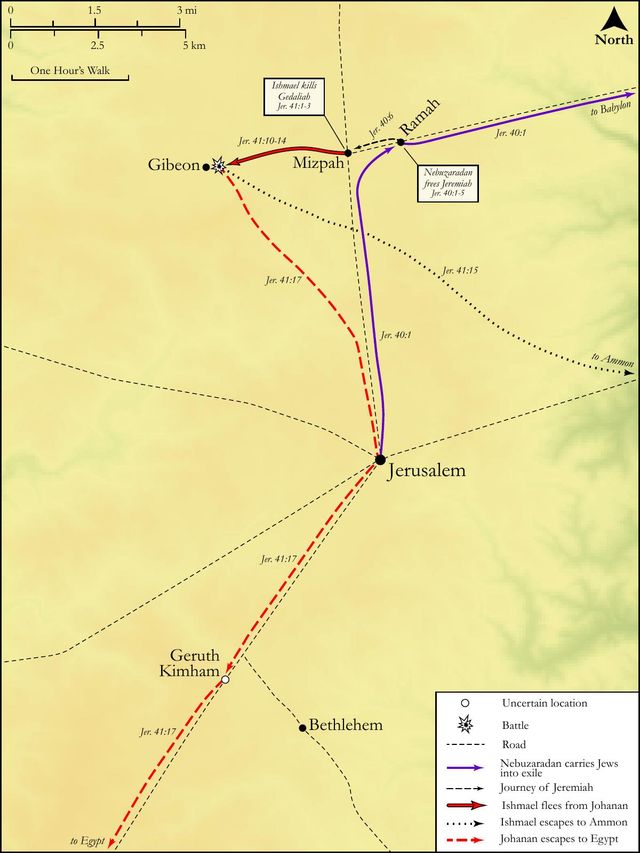
In these verses we have Jeremiah's adhering, by the advice of Nebuzar-adan, to Gedaliah. It should seem that Jeremiah was very honourably fetched out of the court of the prison by the king of Babylon's princes (Jer 39:13, Jer 39:14), but afterwards, being found among the people in the city, when orders were given to the inferior officers to bind all they found that were of any fashion, in order to their being carried captives to Babylon, he, through ignorance and mistake, was bound among the rest and hurried away. Poor man! he seems to have been born to hardship and abuse - man of sorrows indeed! But when the captives were brought manacled to Ramah, not far off, where a council of war, or court-martial, was held for giving orders concerning them, Jeremiah was soon distinguished from the rest, and, by special order of the court, was discharged. 1. The captain of the guard solemnly owns him to be a true prophet (Jer 40:2, Jer 40:3): "The Lord thy God, whose messenger thou has been and in whose name thou hast spoken, has by thee pronounced this evil upon this place; they had fair warning given them of it, but they would not take the warning, and now the Lord hath brought it, and, as by thy mouth he said it, so by my hand he hath done what he said." He seems thus to justify what he had done, and to glory in it, that he had been God's instrument to fulfil that which Jeremiah had been his messenger to foretell; and upon that account it was indeed the most glorious action he had ever done. He tells all the people that were now in chains before him It is because you have sinned against the Lord that this thing has come upon you. The princes of Israel would never be brought to acknowledge this, though it was as evident as if it had been written with a sun-beam; but this heathen prince plainly sees it, that a people that had been so favoured as they had been by the divine goodness would never have been abandoned thus had they not been very provoking. The people of Israel had been often told this from the pulpit by their prophets, and they would not regard it; now they are told it from the bench by the conqueror, whom they dare not contradict and who will make them regard it. Note, Sooner or later men shall be made sensible that their sin is the cause of all their miseries. 2. He gives him free leave to dispose of himself as he thought fit. he loosed him from his chains a second time (Jer 40:4), invited him to come along with him to Babylon, not as a captive, but as a friend, as a companion; and I will set my eye upon thee (so the word is), not only, "I will look well to thee," but "I will show thee respect, will countenance thee, and will see that thou be safe and well provided for." If he was not disposed to go to Babylon, he might dwell where he pleased in his own country, for it was all now at the disposal of the conquerors. He may go to Anathoth if he please, and enjoy the field he has purchased there. A great change with this good man! He that but lately was tossed from one prison to another may now walk at liberty from one possession to another. 3. He advised him to go to Gedaliah and settle with him. This Gedaliah, made governor of the land under the king of Babylon, was an honest Jew, who (it is probably) betimes went over with his friends to the Chaldeans, and approved himself so well that he had this great trust put into his hands, Jer 40:5. While Jeremiah had not yet gone back, but stood considering what he should do, Nebuzar-adan, perceiving him neither inclined to go to Babylon nor determined whither to go, turned the scale for him, and bade him by all means go to Gedaliah. Sudden thoughts sometimes prove wise ones. But when he gave this counsel he did not design to bind him by it, nor will he take ill if he do not follow it: Go wheresoever it seemeth convenient unto thee. It is friendly in such cases to give advice, but unfriendly to prescribe and to be angry if our advice be not take. Let Jeremiah steer what course he pleases, Nebuzar-adan will agree to it, and believe he does for the best. Nor does he only give him his liberty, and an approbation of the measures he shall take, but provides for his support: He gave him victuals and a present, either in clothes or money, and so let him go. See how considerate the captain of the guard was in his kindness to Jeremiah. He set him at liberty, but it was in a country that was laid waste, and in which, as the posture of it now was, he might have perished, though it was his own country, if he had not been thus kindly furnished with necessaries. Jeremiah not only accepted his kindness, but took his advice, and went to Gedaliah, to Mizpah, and dwelt with him, Jer 40:6. Whether we may herein commend his prudence I know not; the event does not commend it, for it did not prove at all to his comfort. However, we may commend his pious affection to the land of Israel, that unless he were forced out of it, as Ezekiel, and Daniel, and other good men were, he would not forsake it, but chose rather to dwell with the poor in the holy land than with princes in an unholy one.
Historical interpretation
Historical reception
1 surviving comment on this verse from the historical church.
And here it is clear that God chose Israel from the beginning as a kindness to the other nations. For the miracles that took place because of them amazed all and clearly taught that their God alone was the true God. And again their misfortunes accused them of their wickedness and proclaimed the righteous verdict of God. Thus, for example, Nebuzaradan said that the Jews deservedly suffered punishment and God had acted justly.
Continue studying Jeremiah 40:3 across the web’s major study libraries — every link below opens this exact verse, chapter, or book on the destination site.
Read & Compare
 BibleGatewayThis verse in more than 200 translations and 70 languages.
 Bible.comThe YouVersion reader — hundreds of translations, reading plans, and highlights.
 ESV.orgCrossway's official English Standard Version reader.
 NET BibleThe NET translation with 60,000+ translators' notes on every rendering decision.
 STEP BibleTyndale House's free study tool — original text, vocabulary, and scholarly resources.
 BibliaLogos Bible Software's free web reader.
 USCCBThe New American Bible (Revised Edition) with the U.S. bishops' study notes.
Commentaries
 BibleHub CommentariesDozens of classic commentaries on this verse, gathered on one page.
 StudyLightMore than 100 commentary sets — the largest collection on the web.
 BibleRefPlain-English commentary on what this verse means, verse by verse.
 Enduring WordDavid Guzik's free commentary on this chapter, widely used by Bible teachers.
 Bible Study ToolsVerse commentary alongside Greek and Hebrew study aids.
Original Language & Research
- BibleHub InterlinearThe verse word by word — original language, transliteration, and English.
- BibleHub LexiconEvery word's original-language definition and Strong's entry.
 Blue Letter BibleDeep-study tools — Strong's numbers, concordance, and word studies.
 SefariaThe Hebrew text with Rashi and centuries of Jewish commentary.
Sermons, Hymns & Audio


TrulyRandomVerse is not affiliated with these sites and doesn’t control their content. They’re linked because they’re genuinely useful.
Summary
Jeremiah 40:3 captures the astonishing declaration of Nebuzaradan, the Babylonian captain of the guard, who attributes the destruction of Jerusalem and the exile of Judah not to Babylonian military might, but to the sovereign hand of the LORD, the God of Israel. This pivotal statement explicitly affirms that the catastrophe is the direct consequence of Judah's persistent sin against Yahweh and their refusal to obey His divine voice, thereby validating the prophetic warnings delivered by Jeremiah and other prophets over many decades.
Context
ShowHideLiterary Context
Jeremiah 40:3 is situated immediately following the devastating fall of Jerusalem in 586 BC and the subsequent Babylonian exile. The preceding chapters, particularly Jeremiah 39, vividly recount the city's final siege, its destruction, the capture and blinding of King Zedekiah, and the specific instructions issued by Nebuchadnezzar regarding Jeremiah. Jeremiah, who had consistently and unpopularly urged submission to Babylon as God's ordained instrument of judgment, is discovered among the captives destined for exile. Nebuzaradan, acting on Nebuchadnezzar's direct orders, singles out Jeremiah, grants him freedom, and offers him the choice of dwelling. This verse, therefore, serves as a profound moment of external, undeniable validation for Jeremiah's long-standing prophetic ministry, coming from the very agent of God's judgment. It effectively transitions the narrative to Jeremiah's subsequent ministry among the remnant left in the land.
Historical & Cultural Context
The destruction of Jerusalem and its sacred Temple in 586 BC marked a catastrophic and traumatic turning point in Israelite history, representing the fulfillment of centuries of prophetic warnings. At this time, the Neo-Babylonian Empire, under Nebuchadnezzar, stood as the preeminent superpower, renowned for its formidable military and its ruthless efficiency in subjugating conquered peoples. Among the nations, the defeat of a nation's army and the razing of its capital were invariably interpreted as the defeat of its patron deities. However, for a high-ranking Babylonian official like Nebuzaradan to explicitly acknowledge the LORD (Yahweh), the God of a seemingly vanquished nation, as the true orchestrator of these events, is profoundly unusual and culturally revolutionary. Nebuzaradan's statement defies conventional understanding, pointing instead to Yahweh's supreme and undeniable sovereignty over all nations and human political machinations, underscoring the unique nature of Israel's God, whose power transcends all earthly boundaries.
Key Themes
ShowHideThis verse powerfully contributes to several overarching themes woven throughout the book of Jeremiah and the broader prophetic corpus. Firstly, it emphatically underscores Divine Sovereignty in Judgment, demonstrating that God is not a passive observer but actively orchestrates historical events, even employing pagan empires as instruments of His righteous wrath, a truth echoed in passages like Isaiah 10:5-6. Secondly, it highlights the severe Consequences of Disobedience, explicitly stating that Judah's suffering is a direct result of their having "sinned against the LORD" and their failure to "obeyed his voice." This reaffirms the covenantal warnings articulated in the Mosaic Law, particularly the solemn curses detailed in Deuteronomy 28:15-68. Finally, the verse stands as a profound testament to Prophetic Fulfillment, validating Jeremiah's decades of unpopular warnings that God would indeed bring judgment upon Judah if they did not repent. Nebuzaradan's words confirm that God's word, spoken through His prophets, is utterly reliable and will always come to pass, whether in judgment or in promise, a principle affirmed in Jeremiah 25:11-12.
Exposition and Analysis
ShowHideKey Word Analysis
ShowHideThis is the Tetragrammaton (YHWH), the personal, covenantal name of Israel's God, often rendered as Jehovah or Yahweh. Nebuzaradan's use of this specific, sacred name, rather than a generic term for deity, is profoundly significant. It indicates a recognition, perhaps even an awe, of the particular God of Israel as the active, sovereign agent behind the destruction, not merely a vague divine force. It points to the self-existent, eternal God who reveals Himself and actively intervenes in human history.
This primitive root verb means "to speak," "to declare," "to command," or "to arrange." In this context, it emphasizes the authoritative, intentional, and deliberate nature of God's communication. It implies that God's judgment was not arbitrary or impulsive but was a direct, precise fulfillment of His previously declared word—His prophecies and covenant warnings. The "saying" of the LORD carries the full weight of divine decree and unchangeable purpose, demonstrating His faithfulness even in judgment.
This primitive root properly means "to miss the mark." By extension, it broadly refers to "to sin," "to forfeit," or "to lack." It encapsulates the full spectrum of Israel's moral and spiritual failure to adhere to God's commands and covenant obligations. Their sin was not merely an oversight or a minor transgression but a deliberate and repeated missing of the target of God's righteous standards, leading to a forfeiture of their blessings and a incurring of divine judgment.
Verse Breakdown
ShowHide"Now the LORD hath brought [it], and done according as he hath said:"
This opening clause is a startling and profound admission from a pagan official. Nebuzaradan explicitly attributes the recent catastrophic events—the destruction of Jerusalem, the Temple, and the subsequent exile—to the direct, intentional, and completed action of the LORD (Yahweh), not to the military might or strategic genius of Babylon. The dual verbs "hath brought [it], and done" emphasize God's active, decisive, and accomplished work. It is a powerful affirmation that these devastating events are a precise fulfillment of God's previously declared word, demonstrating His absolute sovereignty over human history and the nations.
"because ye have sinned against the LORD,"
This clause provides the divine rationale for the judgment, establishing a direct cause-and-effect relationship. The "because" clearly links the "thing" that has come upon Judah to their cumulative transgression. Their sin was not against a generic deity but specifically "against the LORD," the God who had entered into a unique covenant relationship with them, revealed His righteous laws, and patiently called them to faithfulness. This highlights the broken covenant and the profound violation of divine trust.
"and have not obeyed his voice,"
This further specifies the nature of Judah's sin: it was a persistent and willful failure of obedience. "His voice" refers to God's commands, instructions, and the numerous prophetic warnings delivered through His messengers, including Jeremiah. Judah's stubborn refusal to listen and respond to God's word, despite repeated calls to repentance and promises of restoration, sealed their fate. This emphasizes that God's judgment is not arbitrary but a just and necessary response to prolonged, willful rebellion against His revealed will.
"therefore this thing is come upon you."
This concluding clause reiterates the inescapable consequence of their actions. The "thing" refers to the devastating judgment they have just experienced—the siege, famine, destruction of the city and Temple, and the exile. The "therefore" solidifies the logical and theological connection between their disobedience and the calamity. It underscores the certainty of divine retribution when covenant obligations are ignored, and God's voice is continually disregarded, demonstrating the unwavering integrity of God's word.
Literary Devices
ShowHideJeremiah 40:3 is rich with literary and rhetorical significance. The most striking device employed is Irony, as the profound theological truth of God's absolute sovereignty and unwavering justice is articulated not by a prophet or an Israelite, but by Nebuzaradan, a pagan military commander. This unexpected source lends an undeniable weight and external validation to Jeremiah's long-standing message, suggesting that God's hand in history is so evident that even His enemies are compelled to acknowledge it. The verse also prominently employs Cause and Effect, clearly linking Judah's "sin" and "disobedience" as the direct, undeniable causes for "this thing" (the judgment) that "is come upon" them. This rhetorical structure powerfully underscores the moral accountability of the people before God. Furthermore, the verse functions as a powerful statement of Prophetic Fulfillment, confirming that the long-warned-of consequences of covenant breaking have indeed materialized, thereby validating the reliability and certainty of God's word spoken through His prophets.
Theological and Thematic Connections
ShowHideJeremiah 40:3 stands as a stark and enduring reminder of God's unwavering justice and His absolute sovereignty over all creation and human history. It powerfully demonstrates that God is not bound by human expectations, political outcomes, or military might; He uses even the most formidable empires as instruments to accomplish His divine purposes, particularly in executing judgment upon unrepentant sin. This verse affirms God's faithfulness to His covenant, even in judgment, showing that His warnings are as sure and reliable as His promises. It underscores the profound seriousness of sin and the dire consequences of persistent disobedience to God's revealed will, highlighting the principle that divine judgment is a just and necessary response to human rebellion and a testament to God's holy character.
Reflection and Application
ShowHideJeremiah 40:3 offers profound and timeless lessons for believers today. Firstly, it calls us to a deeper, more robust understanding of God's absolute sovereignty. Even in the midst of global chaos, national crises, or profound personal hardships, this verse powerfully reminds us that God remains on His throne, actively orchestrating events according to His perfect will, often using unexpected means and agents to accomplish His purposes. This truth should cultivate a posture of deep trust and unwavering faith, even when circumstances are beyond our control or human comprehension. Secondly, the verse serves as a sober and necessary warning about the pervasive and destructive consequences of sin and disobedience. Just as Judah faced severe judgment for their rebellion, so too does unconfessed and unrepentant sin in our lives create separation from God, hinder our spiritual growth, and bring about undesirable outcomes. It compels us to serious introspection, prompting us to humbly examine areas where we might be neglecting God's voice, knowingly walking in disobedience, or compromising His righteous standards. Finally, it reinforces the utter reliability and faithfulness of God's Word. If God faithfully executed His warnings of judgment with such precision, how much more will He fulfill His glorious promises of salvation, grace, mercy, and restoration for those who turn to Him in faith? This should inspire profound confidence in His promises and motivate us to diligently heed His voice in all matters of life and faith.
Questions for Reflection
ShowHideFAQ
ShowHideWhy is it significant that a pagan official, Nebuzaradan, acknowledges the LORD's role in Judah's destruction?
ShowHideThis is profoundly significant because among the nations, military victory was almost universally attributed to the superior power of the victor's gods over the vanquished's gods. For Nebuzaradan, a high-ranking Babylonian official and a representative of the conquering empire, to explicitly state that the LORD (Yahweh), the God of the defeated Judah, was the one who "hath brought [it], and done according as he hath said," is an extraordinary and counter-cultural theological admission. It demonstrates that God's sovereignty is so undeniable and His hand in history so evident that even those outside His covenant people, and indeed His enemies, are compelled to recognize His active involvement. It serves as a powerful, external validation of the prophetic message of Jeremiah, underscoring that the catastrophe was not merely a geopolitical event but a divine judgment orchestrated by the one true God, who declares the end from the beginning (Isaiah 45:5-7).
Christ-Centered Fulfillment
ShowHideJeremiah 40:3, while detailing a moment of severe judgment for disobedience, finds its ultimate Christ-centered fulfillment in the person and redemptive work of Jesus Christ. The "thing" that came upon Judah—the consequence of sin and disobedience—is a microcosm of the universal human condition. All humanity has "sinned against the LORD, and have not obeyed his voice," and therefore faces the ultimate "thing": spiritual death and separation from God, as Romans 3:23 declares. Jesus, the perfectly obedient Son of God, came into the world not primarily to bring immediate judgment (though He will return in judgment), but to bear the judgment that humanity deserved. He is the "Lamb of God, who takes away the sin of the world!" as proclaimed in John 1:29. On the cross, Christ became sin for us, enduring the "thing" of God's righteous wrath and the curse of the law so that we might be reconciled to God and receive His righteousness (2 Corinthians 5:21). Furthermore, where Israel failed to "obey his voice," Jesus perfectly fulfilled the divine command, demonstrating perfect, unwavering obedience even unto death on a cross (Philippians 2:8). Thus, the ultimate "thing" that God "brought" and "done according as he hath said" is not just judgment for sin, but also salvation, reconciliation, and eternal life through the obedient sacrifice of His Son, fulfilling the promises of restoration that were always interwoven with the warnings of judgment.