


Jeremiah 40:4
Bible text: King James Version (1769 Blayney text) · Public domain
Bible text: King James Version with Strong's numbers · Public domain
Bible text: Berean Standard Bible · Public domain
Bible text: American Standard Version (1901) · Public domain
Bible text: World English Bible, Messianic edition · Public domain
Bible text: Geneva Bible (1599) · Public domain
Bible text: Young's Literal Translation · Public domain
- וְעַתָּהve·'a·Tahand nowH6258Conj-w ¦ AdvAdverbוְandעַתָּהnow
- הִנֵּהhi·Nehhere!H2009PrtParticle Interjection
- פִתַּחְתִּיךָfi·tach·Ti·khaI have set free youH6605V-Piel-Perf-1cs ¦ 2msVerb Piel Perfect 1st Singular common genderפִתַּחְתִּיI have set freeךָyou
- הַיּוֹםhai·Yomthis dayH3117Art ¦ N-msNoun Singular Masculine Absoluteהַthisיּוֹםday
- מִןminfromH4480PrepPreposition
- הָאזִקִּיםha·zi·Kimthe chainsH246Art ¦ N-mpNoun Plural Masculine Absoluteהָtheאזִקִּיםchains
- אֲשֶׁר'a·SherwhichH834RelParticle Relative
- עַל'al[are] onH5921PrepPreposition
- יָדֶךָya·de·Khayour handH3027N-cdc ¦ 2msNoun Dual common gender Constructיָדֶhandךָyour
- אִם'imifH518PrtParticle Conditional
- טוֹבTovit is goodH2895V-Qal-Perf-3msVerb Qal Perfect 3rd Singular Masculine
- בְּעֵינֶיךָbe·'ei·Nei·khain your viewH5869Prep-b ¦ N-fdc ¦ 2msNoun Dual Feminine Constructבְּinעֵינֶיviewךָyour
- לָבוֹאla·Vo'to comeH935Prep-l ¦ V-Qal-InfVerb Qal Infinitive Constructלָtoבוֹאcome
- אִתִּי'i·Tiwith meH854Prep ¦ 1csPreposition Definiteאִתִּwithיme
- בָבֶלva·VelBabylonH894N-properNoun Proper Location
- בֹּאbo'comeH935V-Qal-Imp-2msVerb Qal Imperative 2nd Singular Masculine
- וְאָשִׂיםve·'a·Simso I may setH7760Conj-w ¦ V-Qal-ConjImperf-1csVerb Qal Conjunction+Imperfect 1st Singular common genderוְsoאָשִׂיםI may set
- אֶת'et<obj.>H853DirObjMParticle Object Indicator
- עֵינִי'ei·Nimy eyeH5869N-fsc ¦ 1csNoun Singular Feminine Constructעֵינִeyeיmy
- עָלֶיךָ'a·Lei·khaon youH5921Prep ¦ 2msPreposition Definiteעָלֶיonךָyou
- וְאִםve·'imand ifH518Conj-w ¦ PrtParticle Conditionalוְandאִםif
- רַעra'[is] displeasingH7489V-Qal-Perf-3msVerb Qal Perfect 3rd Singular Masculine
- בְּעֵינֶיךָbe·'ei·Nei·khain your viewH5869Prep-b ¦ N-fdc ¦ 2msNoun Dual Feminine Constructבְּinעֵינֶיviewךָyour
- לָבוֹאla·Vo'to comeH935Prep-l ¦ V-Qal-InfVerb Qal Infinitive Constructלָtoבוֹאcome
- אִתִּי'i·Tiwith meH854Prep ¦ 1csPreposition Definiteאִתִּwithיme
- בָבֶלva·VelBabylonH894N-properNoun Proper Location
- חֲדָלcha·DalrefrainH2308V-Qal-Imp-2msVerb Qal Imperative 2nd Singular Masculine
- רְאֵהre·'EhseeH7200V-Qal-Imp-2msVerb Qal Imperative 2nd Singular Masculine
- כָּלkolallH3605N-mscNoun Singular Masculine Construct
- הָאָרֶץha·'A·retzthe landH776Art ¦ N-fsNoun Singular Feminine Absoluteהָtheאָרֶץland
- לְפָנֶיךָle·fa·Nei·kha[is] <to> before youH6440Prep-l ¦ N-mpc ¦ 2msNoun Plural Masculine Constructלְ[is] <to>פָנֶיbeforeךָyou
- אֶל'eltoH413PrepPreposition
- טוֹבTov[the place] goodH2896Adj-msAdjective Singular Masculine Absolute
- וְאֶלve·'eland toH413Conj-w ¦ PrepPrepositionוְandאֶלto
- הַיָּשָׁרhai·ya·Sharthe [place] rightH3477Art ¦ Adj-msAdjective Singular Masculine Absoluteהַtheיָּשָׁר[place] right
- בְּעֵינֶיךָbe·'ei·Nei·khain your viewH5869Prep-b ¦ N-fdc ¦ 2msNoun Dual Feminine Constructבְּinעֵינֶיviewךָyour
- לָלֶכֶתla·Le·khetto goH1980Prep-l ¦ V-Qal-InfVerb Qal Infinitive Constructלָtoלֶכֶתgo
- שָׁמָּהSha·mahthere towardsH8033Adv ¦ SfxAdverbשָׁמָּthereהtowards
- לֵךְLekhgoH1980V-Qal-Imp-2msVerb Qal Imperative 2nd Singular Masculine
English is a literal word-by-word gloss of the Hebrew, not the KJV's wording. Why?
This is the original text the KJV's translators worked from — each Hebrew word with its own literal English meaning in this verse, prepared by scholars at Tyndale House, Cambridge. The KJV translates whole sentences, not word by word, so its wording differs: one Hebrew word can become several English words, and the KJV may choose “the LORD” where the gloss reads “Yahweh”. Both are faithful — they answer different questions. For the KJV's own rendering, switch to the KJV text.
Details
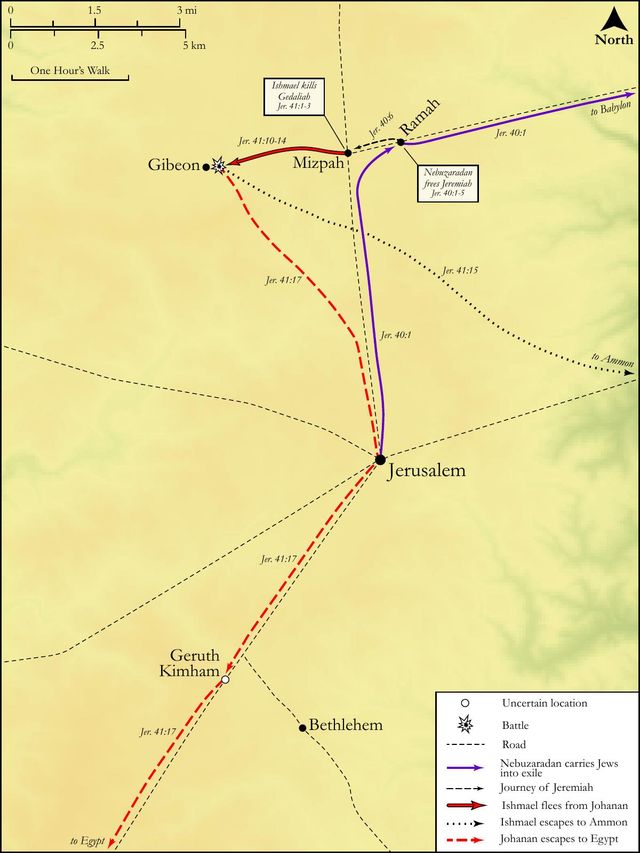
See on the biblical-era map
Study this verse
Public-domain commentary
Matthew Henry
From his Commentary on the Whole Bible. Henry comments on passages, not single verses — this entry covers Jeremiah 40:1–6.
The title of this part of the book, which begins the chapter, seems misapplied (The word which came to Jeremiah), for here is nothing of prophecy in this chapter, but it is to be referred to Jer 42:7, where we have a message that God sent by Jeremiah to the captains and the people that remained. The story between is only to introduce that prophecy and show the occasion of it, that it may be the better understood, and Jeremiah, being himself concerned in the story, was the better able to give an account of it.
In these verses we have Jeremiah's adhering, by the advice of Nebuzar-adan, to Gedaliah. It should seem that Jeremiah was very honourably fetched out of the court of the prison by the king of Babylon's princes (Jer 39:13, Jer 39:14), but afterwards, being found among the people in the city, when orders were given to the inferior officers to bind all they found that were of any fashion, in order to their being carried captives to Babylon, he, through ignorance and mistake, was bound among the rest and hurried away. Poor man! he seems to have been born to hardship and abuse - man of sorrows indeed! But when the captives were brought manacled to Ramah, not far off, where a council of war, or court-martial, was held for giving orders concerning them, Jeremiah was soon distinguished from the rest, and, by special order of the court, was discharged. 1. The captain of the guard solemnly owns him to be a true prophet (Jer 40:2, Jer 40:3): "The Lord thy God, whose messenger thou has been and in whose name thou hast spoken, has by thee pronounced this evil upon this place; they had fair warning given them of it, but they would not take the warning, and now the Lord hath brought it, and, as by thy mouth he said it, so by my hand he hath done what he said." He seems thus to justify what he had done, and to glory in it, that he had been God's instrument to fulfil that which Jeremiah had been his messenger to foretell; and upon that account it was indeed the most glorious action he had ever done. He tells all the people that were now in chains before him It is because you have sinned against the Lord that this thing has come upon you. The princes of Israel would never be brought to acknowledge this, though it was as evident as if it had been written with a sun-beam; but this heathen prince plainly sees it, that a people that had been so favoured as they had been by the divine goodness would never have been abandoned thus had they not been very provoking. The people of Israel had been often told this from the pulpit by their prophets, and they would not regard it; now they are told it from the bench by the conqueror, whom they dare not contradict and who will make them regard it. Note, Sooner or later men shall be made sensible that their sin is the cause of all their miseries. 2. He gives him free leave to dispose of himself as he thought fit. he loosed him from his chains a second time (Jer 40:4), invited him to come along with him to Babylon, not as a captive, but as a friend, as a companion; and I will set my eye upon thee (so the word is), not only, "I will look well to thee," but "I will show thee respect, will countenance thee, and will see that thou be safe and well provided for." If he was not disposed to go to Babylon, he might dwell where he pleased in his own country, for it was all now at the disposal of the conquerors. He may go to Anathoth if he please, and enjoy the field he has purchased there. A great change with this good man! He that but lately was tossed from one prison to another may now walk at liberty from one possession to another. 3. He advised him to go to Gedaliah and settle with him. This Gedaliah, made governor of the land under the king of Babylon, was an honest Jew, who (it is probably) betimes went over with his friends to the Chaldeans, and approved himself so well that he had this great trust put into his hands, Jer 40:5. While Jeremiah had not yet gone back, but stood considering what he should do, Nebuzar-adan, perceiving him neither inclined to go to Babylon nor determined whither to go, turned the scale for him, and bade him by all means go to Gedaliah. Sudden thoughts sometimes prove wise ones. But when he gave this counsel he did not design to bind him by it, nor will he take ill if he do not follow it: Go wheresoever it seemeth convenient unto thee. It is friendly in such cases to give advice, but unfriendly to prescribe and to be angry if our advice be not take. Let Jeremiah steer what course he pleases, Nebuzar-adan will agree to it, and believe he does for the best. Nor does he only give him his liberty, and an approbation of the measures he shall take, but provides for his support: He gave him victuals and a present, either in clothes or money, and so let him go. See how considerate the captain of the guard was in his kindness to Jeremiah. He set him at liberty, but it was in a country that was laid waste, and in which, as the posture of it now was, he might have perished, though it was his own country, if he had not been thus kindly furnished with necessaries. Jeremiah not only accepted his kindness, but took his advice, and went to Gedaliah, to Mizpah, and dwelt with him, Jer 40:6. Whether we may herein commend his prudence I know not; the event does not commend it, for it did not prove at all to his comfort. However, we may commend his pious affection to the land of Israel, that unless he were forced out of it, as Ezekiel, and Daniel, and other good men were, he would not forsake it, but chose rather to dwell with the poor in the holy land than with princes in an unholy one.
Continue studying Jeremiah 40:4 across the web’s major study libraries — every link below opens this exact verse, chapter, or book on the destination site.
Read & Compare
 BibleGatewayThis verse in more than 200 translations and 70 languages.
 Bible.comThe YouVersion reader — hundreds of translations, reading plans, and highlights.
 ESV.orgCrossway's official English Standard Version reader.
 NET BibleThe NET translation with 60,000+ translators' notes on every rendering decision.
 STEP BibleTyndale House's free study tool — original text, vocabulary, and scholarly resources.
 BibliaLogos Bible Software's free web reader.
 USCCBThe New American Bible (Revised Edition) with the U.S. bishops' study notes.
Commentaries
 BibleHub CommentariesDozens of classic commentaries on this verse, gathered on one page.
 StudyLightMore than 100 commentary sets — the largest collection on the web.
 BibleRefPlain-English commentary on what this verse means, verse by verse.
 Enduring WordDavid Guzik's free commentary on this chapter, widely used by Bible teachers.
 Bible Study ToolsVerse commentary alongside Greek and Hebrew study aids.
Original Language & Research
- BibleHub InterlinearThe verse word by word — original language, transliteration, and English.
- BibleHub LexiconEvery word's original-language definition and Strong's entry.
 Blue Letter BibleDeep-study tools — Strong's numbers, concordance, and word studies.
 SefariaThe Hebrew text with Rashi and centuries of Jewish commentary.
Sermons, Hymns & Audio


TrulyRandomVerse is not affiliated with these sites and doesn’t control their content. They’re linked because they’re genuinely useful.
Summary
Jeremiah 40:4 captures a pivotal moment of divine intervention and profound human choice amidst the utter devastation of Judah. Following Jerusalem's catastrophic fall, Nebuzaradan, the captain of Nebuchadnezzar's guard, unexpectedly releases the prophet Jeremiah from his bonds. He then extends an extraordinary offer: Jeremiah can either accompany the Babylonians to Babylon, where he is promised exceptional care and provision, or remain in the desolate land of Judah, free to go wherever he desires. This remarkable act of liberation, orchestrated through the very agents of judgment, underscores God's meticulous protection of His faithful messenger and highlights the unique personal agency granted to Jeremiah in stark contrast to the forced exile of his countrymen.
Context
ShowHideLiterary Context
Jeremiah 40:4 immediately follows the harrowing account of Jerusalem's destruction and the initial stages of the Babylonian exile described in Jeremiah 39. Specifically, Jeremiah 39:11-14 details Nebuchadnezzar's explicit instructions to Nebuzaradan to protect Jeremiah and grant him freedom of choice regarding his residence. The preceding verses in Jeremiah 40:1-3 establish the scene, with Jeremiah initially found in chains among the captives at Ramah before being singled out by the Babylonian commander. This verse, therefore, marks a crucial narrative transition, shifting from the corporate calamity of Judah's judgment to the individual fate and continued prophetic ministry of Jeremiah, signaling a new phase in his life and work, distinct from the national catastrophe.
Historical & Cultural Context
The historical backdrop for Jeremiah 40:4 is the immediate aftermath of the Babylonian conquest of Jerusalem in 586 BC. This period was characterized by immense upheaval, with the destruction of the Temple, the collapse of the Judean monarchy, and the forced deportation of a significant portion of the population to Babylon. The Babylonian Empire, under Nebuchadnezzar, employed a strategic policy of mass deportation to quell rebellions, dismantle national identities, and integrate conquered peoples into their imperial system, as evidenced in accounts like 2 Kings 25:11. Jeremiah, however, had consistently prophesied Judah's defeat and advocated for surrender to Babylon, aligning his message with God's sovereign will for judgment. While this stance led to his persecution and imprisonment by his own people (Jeremiah 37:15), it paradoxically earned him a unique status with the Babylonians. Nebuzaradan's offer reflects not only Nebuchadnezzar's specific directive but also a pragmatic recognition of Jeremiah's perceived non-hostile or even beneficial stance, demonstrating a surprising degree of administrative leniency towards a figure who had consistently spoken truth, even if unpopular.
Key Themes
ShowHideJeremiah 40:4 powerfully illuminates several profound themes. Firstly, Divine Protection and Providence is paramount. Even in the midst of national ruin and personal suffering, God's unwavering hand is evident in preserving His prophet through the most unexpected agents—the very conquering enemies. Jeremiah, who had endured severe persecution from his own countrymen (Jeremiah 38:6), now receives astonishing kindness and freedom from his captors, fulfilling God's earlier promise to protect him (Jeremiah 1:19). Secondly, the theme of Freedom of Choice is central. Nebuzaradan's offer presents Jeremiah with a genuine, uncoerced decision, a stark contrast to the forced exile imposed on the majority of Judeans. The repeated phrasing, "whither it seemeth good and convenient for thee to go, thither go," emphatically underscores the complete liberty granted to Jeremiah, highlighting God's profound respect for human agency even within His sovereign and unfolding plan. Thirdly, Unexpected Grace shines through. The offer of freedom and provision from the empire that had just destroyed his nation is a profound testament to God's surprising and often paradoxical ways of working, demonstrating His ability to use even foreign powers to accomplish His divine purposes and protect His faithful servants.
Exposition and Analysis
ShowHideKey Word Analysis
ShowHideThis primitive root signifies "to open wide," "to loosen," or "to set free." In the context of Jeremiah 40:4, it denotes a complete and decisive act of liberation from physical bonds, specifically the chains that held Jeremiah. It conveys more than a mere temporary release; it implies a full emancipation, granting unhindered movement and the freedom to choose one's path.
This term refers to manacles or fetters, which are literal instruments of physical restraint used to bind captives. Its presence in the verse vividly portrays Jeremiah's initial status as a prisoner, making the subsequent act of "loosing" a highly symbolic and impactful demonstration of freedom from oppression and captivity. The breaking of these chains represents a dramatic shift in his circumstances.
This versatile adjective carries a broad semantic range, encompassing concepts such as "beautiful," "best," "pleasant," "favorable," "right," and "welfare." When Nebuzaradan states, "If it seem good unto thee," he is offering Jeremiah a choice based on what is agreeable, beneficial, or desirable from Jeremiah's personal perspective. This emphasizes the genuine nature of the choice presented, allowing Jeremiah to determine the most suitable course of action for his well-being and future.
Verse Breakdown
ShowHide"And now, behold, I loose thee this day from the chains which [were] upon thine hand"
This opening clause marks the immediate, decisive, and highly significant act of liberation. Nebuzaradan, acting under the direct orders of Nebuchadnezzar, physically frees Jeremiah from the literal bonds of his captivity. The phrase "this day" emphasizes the immediacy and finality of this release, signifying a complete and irreversible change in Jeremiah's status from a bound prisoner to a free man.
"If it seem good unto thee to come with me into Babylon, come; and I will look well unto thee"
This presents the first of two distinct options offered to Jeremiah. The Babylonian captain extends an invitation for Jeremiah to accompany him to Babylon, promising a secure and privileged existence. The phrase "I will look well unto thee" is a strong commitment to his welfare, literally meaning "I will set my eye upon you for good." This remarkable promise of personal care, protection, and provision comes from a conquering general to a prophet of the defeated nation.
"but if it seem ill unto thee to come with me into Babylon, forbear"
This clause introduces the alternative choice: if Jeremiah finds the prospect of going to Babylon undesirable or unsuitable ("ill"), he is explicitly given permission to decline. The word "forbear" (H2308, châdal) means to cease, refrain, or hold back, clearly indicating that there would be no negative consequences or repercussions for choosing not to go to Babylon. This further underscores the genuine and uncoerced freedom of choice extended to Jeremiah.
"behold, all the land [is] before thee: whither it seemeth good and convenient for thee to go, thither go"
This final section expands upon the second option, granting Jeremiah complete and unhindered autonomy within the land of Judah. Despite its recent devastation, the entire land is presented as open for him to traverse and settle. The repetition of "it seemeth good" alongside "convenient" (H3477, yâshâr, meaning "straight" or "right") powerfully reinforces the absolute liberty and personal discretion given to Jeremiah regarding his future residence and movements. He is not merely released but empowered to actively choose and pursue his own path.
Literary Devices
ShowHideThe passage employs several potent literary devices that deepen its meaning and impact. Irony is strikingly evident, as Jeremiah, who suffered severe persecution and imprisonment at the hands of his own people for his prophetic message, now receives unexpected freedom and favor from the very foreign power that brought about his nation's destruction. This paradoxical turn of events highlights the unexpected ways in which divine providence can operate. A strong Contrast is established between Jeremiah's individual liberation and the mass deportation of the Judean population, emphasizing his unique status and God's specific, personal care for His faithful messenger. Furthermore, the repeated emphasis on what "seemeth good" and "convenient" in relation to Jeremiah's choice underscores the profound themes of Free Will and Divine Agency, demonstrating that God works through human decisions and even through the actions of pagan rulers to achieve His overarching purposes. The verse also subtly uses Symbolism; the "chains" represent not only physical bondage but also the broader constraints, suffering, and national captivity Jeremiah endured, while his "loosing" symbolizes God's faithfulness in bringing about freedom, restoration, and new beginnings even in the aftermath of severe judgment.
Theological and Thematic Connections
ShowHideJeremiah 40:4 stands as a profound testament to God's unwavering faithfulness and sovereign care for His chosen servants, even amidst the most devastating circumstances imaginable. It reveals that God's providence is not constrained by human political structures, national calamities, or the actions of hostile empires; rather, He can raise up unexpected agents, even conquering enemies, to fulfill His divine purposes and protect His own. The extraordinary freedom offered to Jeremiah, in stark contrast to the fate of his countrymen, underscores God's personal attention to those who remain faithful to His word. This passage powerfully reminds us that divine grace often manifests in surprising forms and through unlikely channels, challenging our preconceived notions of how God works in the world. It also highlights the crucial theme of human choice within God's overarching plan, where obedience to God's revealed will can lead to unexpected favor and a unique path, even when that path is through a ruined land.
Reflection and Application
ShowHideJeremiah 40:4 offers a powerful and enduring lesson in trusting God's providence, especially when circumstances appear utterly bleak and hopeless. In the midst of national ruin and personal captivity, Jeremiah experiences a profound act of liberation and is granted a genuine, uncoerced choice for his future. This narrative serves as a potent reminder that God is perpetually at work, often in ways we cannot foresee, utilizing unexpected people and circumstances to accomplish His sovereign will and tenderly care for His children. For us today, this verse challenges us to look for God's hand in our own "chains"—whether they be literal difficulties, emotional burdens, spiritual struggles, or societal constraints—and to recognize His omnipotent power to loose us. It also emphasizes the profound dignity of choice that God often grants us, even in the most difficult and constrained situations. We are called not to passively accept our fate but to prayerfully discern and actively choose the path that seems "good and convenient" in light of God's revealed will and our Spirit-informed conscience, trusting implicitly that He will "look well unto" us. This passage encourages us to embrace the freedom God gives us to navigate life's complexities with unwavering faith and intentionality, knowing with certainty that His meticulous care extends to every intricate detail of our lives.
Questions for Reflection
ShowHideFAQ
ShowHideWhy did Nebuzaradan, a Babylonian general, show such exceptional favor to Jeremiah?
ShowHideNebuzaradan's remarkable favor towards Jeremiah was a direct consequence of Nebuchadnezzar's specific command, as explicitly recorded in Jeremiah 39:11-12. Nebuchadnezzar was undoubtedly aware of Jeremiah's consistent prophecies, particularly his message that God's will was for Judah to surrender to Babylon. This message, while considered treasonous by many Judeans, would have been viewed favorably by the Babylonians. They likely perceived Jeremiah as a prophet who spoke truthfully about their impending victory and advocated for submission, making him a figure to be protected and potentially even utilized, rather than punished. This act also profoundly demonstrates God's sovereign hand, using a pagan king to protect and provide for His faithful messenger.
Did Jeremiah choose to go to Babylon or stay in Judah after being released?
ShowHideJeremiah chose to remain in the desolate land of Judah. The subsequent verses, Jeremiah 40:5-6, explicitly state that Jeremiah declined Nebuzaradan's offer to go to Babylon. Instead, he chose to go to Gedaliah, whom the Babylonians had appointed as governor over the remaining people in Judah. His decision to stay in the broken and ravaged land underscores his unwavering commitment to his prophetic calling and his desire to minister among the remnant of his people, even in their state of national ruin.
What is the deeper significance of Jeremiah being given a choice, unlike the other captives?
ShowHideThe choice offered to Jeremiah highlights his unique status as God's specially chosen prophet and the extraordinary divine protection extended to him. While the vast majority of the Judean population, particularly the elite and skilled, were forcibly deported to Babylon as part of the empire's strategic policy to prevent rebellion and integrate conquered peoples, Jeremiah was granted complete autonomy and freedom of movement. This exceptional treatment powerfully underscores God's faithfulness to His promises to Jeremiah (Jeremiah 1:19), demonstrating that even in the midst of severe judgment, God meticulously preserves His faithful servants and provides them with agency. It also serves as a profound illustration of God's sovereignty, as He masterfully works through human authorities, even pagan ones, to achieve His specific and redemptive purposes.
Christ-Centered Fulfillment
ShowHideJeremiah 40:4, with its dramatic portrayal of unexpected liberation and the profound offering of choice, finds its ultimate and most glorious fulfillment in the person and redemptive work of Jesus Christ. Just as Jeremiah was physically loosed from his chains and presented with a path of freedom and provision, so too does Christ come to set humanity free from the far more insidious and binding chains of sin, spiritual death, and the condemnation of the law. Jesus Himself declared, "So if the Son sets you free, you will be free indeed" (John 8:36). His sacrificial death on the cross is the supreme act of "loosing," breaking the spiritual fetters that enslave humanity and offering a genuine, life-altering choice for eternal life and salvation. The "good" and "convenient" path offered to Jeremiah by Nebuzaradan, accompanied by the promise of being "looked well unto," profoundly foreshadows the infinitely greater and more compassionate invitation of Christ: "Come to me, all you who are weary and burdened, and I will give you rest" (Matthew 11:28). In Christ, we are offered not merely a choice between two earthly locations but a choice between eternal life in His glorious presence or continued bondage to the destructive power of sin. His meticulous care for us far surpasses any earthly provision, as He promises to "supply every need of yours according to his riches in glory in Christ Jesus" (Philippians 4:19). Thus, Jeremiah's experience of unexpected grace and divinely orchestrated freedom points forward to the comprehensive, spiritual, and eternal freedom that only Christ can provide, inviting all to walk in the path that is truly good, truly convenient, and eternally right—the path of discipleship under His loving, sovereign gaze.