


Mark 8:38
- ὃςhosWho[ever]G3739R-NSMRelative pronoun Nominative Singular Masculine
- γὰρgarforG1063CONJConjunction
- ἐὰνeanifG1437CONDConjunction
- ἐπαισχυνθῇepaischunthēashall be ashamed ofG1870V-AOS-3SVerb Aorist Passive Deponent Subjunctive 3rd Singular
- μεmeMeG3165P-1ASPersonal pronoun Accusative 1st Singular
- καὶkaiandG2532CONJConjunction
- τοὺςtous<the>G3588T-APMDefinite article Accusative Plural Masculine
- ἐμοὺςemousMyG1473S-1SAPMPossessive pronoun Accusative 1st Person Plural Masculine
- λόγουςlogouswordsG3056N-APMNoun Accusative Plural Masculine
- ἐνeninG1722PREPPreposition
- τῇtēa<the>G3588T-DSFDefinite article Dative Singular Feminine
- γενεᾷgeneagenerationG1074N-DSFNoun Dative Singular Feminine
- ταύτῃtautēthisG3778D-DSFDemonstrative pronoun Dative Singular Feminine
- τῇtēa<the>G3588T-DSFDefinite article Dative Singular Feminine
- μοιχαλίδιmoichalidiadulterousG3428A-DSFAdjective Dative Singular Feminine
- καὶkaiandG2532CONJConjunction
- ἁμαρτωλῷhamartōlōsinfulG268A-DSFAdjective Dative Singular Feminine
- καὶkaialsoG2532CONJConjunction
- ὁhotheG3588T-NSMDefinite article Nominative Singular Masculine
- υἱὸςhuiosSonG5207N-NSM-TNoun Nominative Singular Masculine Title
- τοῦtou<the>G3588T-GSMDefinite article Genitive Singular Masculine
- ἀνθρώπουanthrōpouof ManG444N-GSM-TNoun Genitive Singular Masculine Title
- ἐπαισχυνθήσεταιepaischunthēsetaiwill be ashamed ofG1870V-FOI-3SVerb Future Passive Deponent Indicative 3rd Singular
- αὐτὸνautonhimG846P-ASMPersonal pronoun Accusative Singular Masculine
- ὅτανhotanwhenG3752CONJConjunction
- ἔλθῃelthēHe may comeG2064V-2AAS-3SVerb 2nd Aorist Active Subjunctive 3rd Singular
- ἐνeninG1722PREPPreposition
- τῇtēatheG3588T-DSFDefinite article Dative Singular Feminine
- δόξῃdoxēgloryG1391N-DSFNoun Dative Singular Feminine
- τοῦtouof theG3588T-GSMDefinite article Genitive Singular Masculine
- πατρὸςpatrosFatherG3962N-GSM-TNoun Genitive Singular Masculine Title
- αὐτοῦautouof HimG846P-GSMPersonal pronoun Genitive Singular Masculine
- μετὰmetawithG3326PREPPreposition
- τῶνtōntheG3588T-GPMDefinite article Genitive Plural Masculine
- ἀγγέλωνangelōnangelsG32N-GPMNoun Genitive Plural Masculine
- τῶνtōn<the>G3588T-GPMDefinite article Genitive Plural Masculine
- ἁγίωνhagiōnholyG40A-GPMAdjective Genitive Plural Masculine
English is a literal word-by-word gloss of the Greek, not the KJV's wording. Why?
This is the original text the KJV's translators worked from — each Greek word with its own literal English meaning in this verse, prepared by scholars at Tyndale House, Cambridge. The KJV translates whole sentences, not word by word, so its wording differs: one Greek word can become several English words, and the KJV may choose “charity” where the gloss reads “love”. Both are faithful — they answer different questions. For the KJV's own rendering, switch to the KJV text.
Details
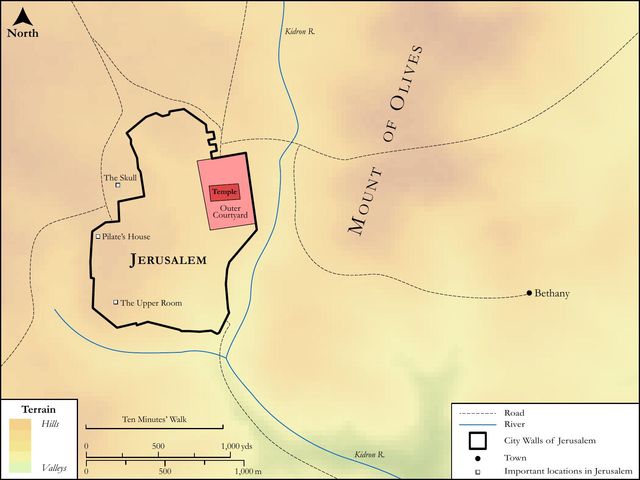
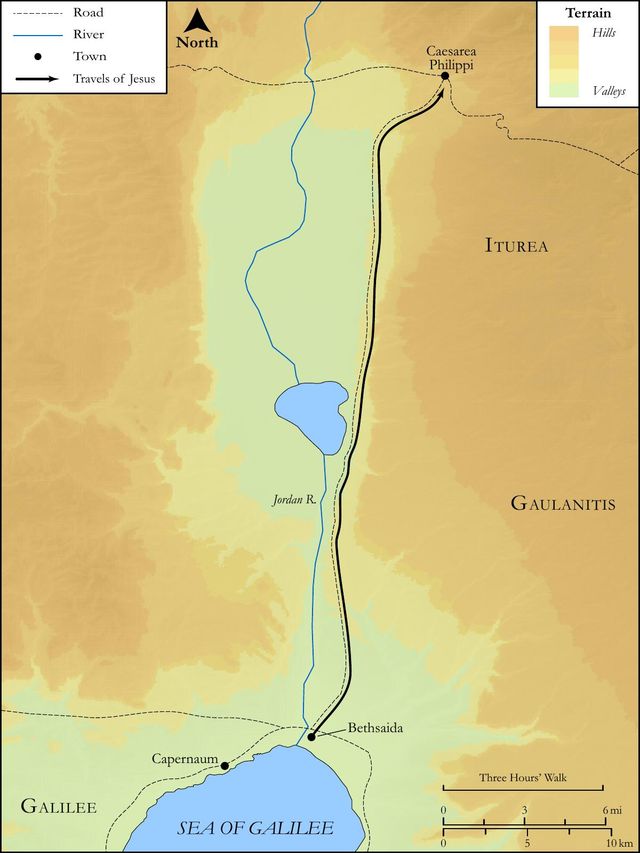
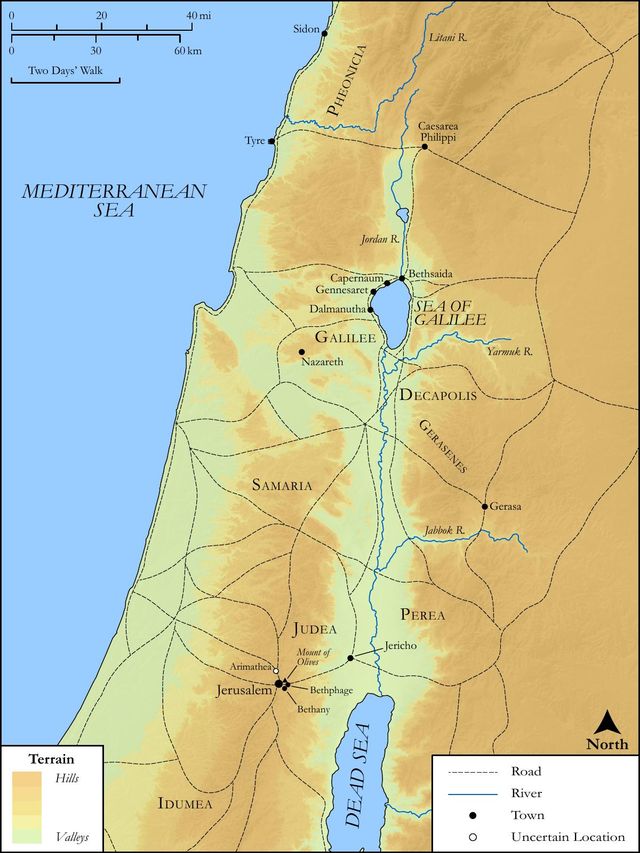
See on the biblical-era map
Study this verse
Public-domain commentary
Matthew Henry
From his Commentary on the Whole Bible. Henry comments on passages, not single verses — this entry covers Mark 8:27–38. His three-level outline is real structure in the source text, so it is rendered as structure.
We have read a great deal of the doctrine Christ preached, and the miracles he wrought, which were many, and strange, and well-attested, of various kinds, and wrought in several places, to the astonishment of the multitudes that were eye-witnesses of them. It is now time for us to pause a little, and to consider what these things mean; the wondrous works which Christ then forbade the publishing of, being recorded in these sacred writings, are thereby published to all the world, to us, to all ages; now what shall we think of them? Is the record of those things designed only for an amusement, or to furnish us with matter for discourse? No, certainly these things are written, that we may believe that Jesus is the Christ the Son of God (Joh 20:31); and this discourse which Christ had with his disciples, will assist us in making the necessary reflections upon the miracles of Christ, and a right use of them. Three things we are here taught to infer from the miracles Christ wrought.
I.They prove that he is the true Messiah, the Son of God, and Saviour of the world:
this the works he did witnessed concerning him; and this his disciples, who were the eye-witnesses of those works, here profess their belief of; which cannot but be a satisfaction to us in making the same inference from them.
1.Christ enquired of them what the sentiments of the people were concerning him; Who did men say that I am? Mar 8:27. Note, Though it is a small thing for us to be judged of men, yet it may sometimes do us good to know what people say of us, not that we may seek our own glory, but that we may hear our faults. Christ asked them, not that he might be informed, but that they might observe it themselves, and inform one another.
2.The account they gave him, was such as plainly intimated the high opinion the people had of him. Though they came short of the truth, yet they were convinced by his miracles that he was an extraordinary person, sent from the invisible world with a divine commission. It is probable that they would have acknowledged him to be the Messiah, if they had not been possessed by their teachers with a notion that the Messiah must be a temporal Prince, appearing in external pomp and power, which the figure Christ made, would not comport with; yet (whatever the Pharisees said, whose copyhold was touched by the strictness and spirituality of his doctrine) none of the people said that he was a Deceiver, but some said that he was John Baptist, others Elias, others one of the prophets, Mar 8:28. All agreed that he was one risen from the dead.
3.The account they gave him of their own sentiments concerning him, intimated their abundant satisfaction in him, and in their having left all to follow him, which now, after some time of trial, they see no reason to repent; But whom say ye that I am? To this they have an answer ready, Thou art the Christ, the Messiah often promised, and long expected, Mar 8:29. To be a Christian indeed, is, sincerely to believe that Jesus is the Christ, and to act accordingly; and that he is so, plainly appears by his wondrous works. This they knew, and must shortly publish and maintain; but for the present they must keep it secret (Mar 8:30), till the proof of it was completed, and they were completely qualified to maintain it, by the pouring out of the Holy Ghost; and then let all the house of Israel know assuredly that God has made this same Jesus, whom ye crucified, both Lord and Christ, Act 2:36.
II.These miracles of Christ take off the offence of the cross, and assure us that Christ was, in it, not conquered, but a Conqueror.
Now that the disciples are convinced that Jesus is the Christ, they may bear to hear of his sufferings, which Christ now begins to give them notice of, Mar 8:31.
1.Christ taught his disciples that he must suffer many things, Though they had got over the vulgar error of the Messiah's being a temporal Prince, so far as to believe their Master to be the Messiah, notwithstanding his present meanness, yet still they retained it, so far as to expect that he would shortly appear in outward pomp and grandeur, and restore the kingdom to Israel; and therefore, to rectify that mistake, Christ here gives them a prospect of the contrary, that he must be rejected of the elders, and the chief priests, and the scribes, who, they expected, should be brought to own and prefer him; that, instead of being crowned, he must be killed, he must be crucified, and after three days he must rise again to a heavenly life, and to be no more in this world. This he spoke openly (Mar 8:32), parrēsia. He said it freely and plainly, and did not wrap it up in ambiguous expressions. The disciples might easily understand it, if they had not been very much under the power of prejudice: or, it intimates that he spoke it cheerfully and without any terror, and would have them to hear it so: he spoke that saying boldly, as one that not only knew he must suffer and die, but was resolved he would, and made it his own act and deed.
2.Peter opposed it; He took him, and began to rebuke him. Here Peter showed more love than discretion, a zeal for Christ and his safety, but not according to knowledge. He took him - proslabomenos. He took hold of him, as it were to stop and hinder him, took him in his arms, and embraced him (so some understand it); he fell on his neck, as impatient to hear that his dear Master should suffer such hard things; or he took him aside privately, and began to rebuke him. This was not the language of the least authority, but of the greatest affection, of that jealousy for the welfare of those we love, which is strong as death. Our Lord Jesus allowed his disciples to be free with him, but Peter here took too great a liberty.
3.Christ checked him for his opposition (Mar 8:33); He turned about, as one offended, and looked on his disciples, to see if the rest of them were of the same mind, and concurred with Peter in this, that, if they did, they might take the reproof to themselves, which he was now about to give to Peter; and he said, Get thee behind me, Satan. Peter little thought to have had such a sharp rebuke for such a kind dissuasive, but perhaps expected as much commendation now for his love as he had lately for his faith. Note, Christ sees that amiss in what we say and do, which we ourselves are not aware of, and knows what manner of spirit we are of, when we ourselves do not.
(1.)Peter spoke as one that did not rightly understand, nor had duly considered, the purposes and counsels of God. When he saw such proofs as he every day saw of the power of Christ, he might conclude that he could not be compelled to suffer; the most potent enemies could not overpower him whom diseases and deaths, whom winds and waves and devils themselves, were forced to obey and yield to: and when he saw so much of the wisdom of Christ every day, he might conclude that he would not choose to suffer but for some very great and glorious purposes; and therefore he ought not thus to have contradicted him, but to have acquiesced. He looked upon his death only as a martyrdom, like that of the prophets, which he thought might be prevented, if either he would take a little care not to provoke the chief priests, or to keep out of the way; but he knew not that the thing was necessary for the glory of God, the destruction of Satan, and the salvation of man, that the Captain of our salvation must be made perfect through sufferings, and so must bring many sons to glory. Note, The wisdom of man is perfect folly, when it pretends to give measures to the divine counsels. The cross of Christ, the great instance of God's power and wisdom, was to some a stumbling-block, and to others foolishness.
(2.)Peter spoke as one that did not rightly understand, nor had duly considered, the nature of Christ's kingdom; he took it to be temporal and human, whereas it is spiritual and divine. Thou savourest not the things that are of God, but those that are of men; ou phroneis - thou mindest not; so the word is rendered, Rom 8:5. Peter seemed to mind more the things that relate to the lower world, and the life that now is, than those which relate to the upper world, and the life to come. Minding the things of men more than the things of God, our own credit, ease, and safety, more than the things of God, and his glory and kingdom, is a very great sin, and the root of much sin, and very common among Christ's disciples; and it will appear in suffering times, those times of temptation, when those in whom the things of men have the ascendant, are in danger of falling off. Non sapis - Thou art not wise (so it may be read) in the things of God, but in the things of men. It is important to consider what generation we appear wise in, Luk 16:8. It seems policy to shun trouble, but if with that we shun duty, it is fleshly wisdom (Co2 1:12), and it will be folly in the end.
III.These miracles of Christ should engage us all to follow him, whatever it cost us, not only as they were confirmations of his mission, but as they were explications of his design, and the tendency of that grace which he came to bring; plainly intimating that by his Spirit he would do that for our blind, deaf, lame, leprous, diseased, possessed souls, which he did for the bodies of those many who in those distresses applied themselves to him. Frequent notice had been taken of the great flocking that there was to him for help in various cases: now this is written, that we may believe that he is the great Physician of souls, and may become his patients, and submit to his regimen; and here he tells us upon what terms we may be admitted; and he called all the people to him, to hear this, who modestly stood at some distance when he was in private conversation with his disciples. This is that which all are concerned to know, and consider, if they expect Christ should heal their souls.
1.They must not be indulgent of the ease of the body; for (Mar 8:34), "Whosoever will come after me for spiritual cures, as these people do for bodily cures, let him deny himself, and live a life of self-denial, mortification, and contempt of the world; let him not pretend to be his own physician, but renounce all confidence in himself and his own righteousness and strength, and let him take up his cross, conforming himself to the pattern of a crucified Jesus, and accommodating himself to the will of God in all the afflictions he lies under; and thus let him continue to follow me;" as many of those did, whom Christ healed. Those that will be Christ's patients must attend on him, converse with him, receive instruction and reproof from him, as those did that followed him, and must resolve they will never forsake him.
2.They must not be solicitous, no, not for the life of the body, when they cannot keep it without quitting Christ, Mar 8:35. Are we invited by the words and works of Christ to follow him? Let us sit down, and count the cost, whether we can prefer our advantages by Christ before life itself, whether we can bear to think of losing our life for Christ's sake and the gospel's. When the devil is drawing away disciples and servants after him, he conceals the worst of it, tells them only of the pleasure, but nothing of the peril, of his service; Ye shall not surely die; but what there is of trouble and danger in the service of Christ, he tells us of it before, tells us we shall suffer, perhaps we shall die, in the cause; and represents the discouragements not less, but greater, than commonly they prove, that it may appear he deals fairly with us, and is not afraid that we should know the worst; because the advantages of his service abundantly suffice to balance the discouragements, if we will but impartially set the one over against the other. In short,
(1.)We must not dread the loss of our lives, provided it be in the cause of Christ (Mar 8:35); Whosoever will save his life, by declining Christ, and refusing to come to him, or by disowning and denying him after he has in profession come to Christ, he shall lose it, shall lose the comfort of his natural life, the root and fountain of his spiritual life, and all his hopes of eternal life; such a bad bargain will he make for himself. But whosoever shall lose his life, shall be truly willing to lose it, shall venture it, shall lay it down when he cannot keep it without denying Christ, he shall save it, he shall be an unspeakable gainer; for the loss of his life shall be made up to him in a better life. It is looked upon to be some kind of recompence to those who lose their lives in the service of their prince and country, to have their memories honoured and their families provided for; but what is that to the recompence which Christ makes in eternal life to all that die for him?
(2.)We must dread the loss of our souls, yea, though we should gain the whole world by it (Mar 8:36, Mar 8:37); For what shall it profit a man, if he should gain the whole world, and all the wealth, honour, and pleasure, in it, by denying Christ, and lose his own soul? "True it is," said Bishop Hooper, the night before he suffered martyrdom, "that life is sweet, and death is bitter, but eternal death is more bitter, and eternal life is more sweet." As the happiness of heaven with Christ, is enough to countervail the loss of life itself for Christ, so the gain of all the world in sin, is not sufficient to countervail the ruin of the soul by sin.
What that is that men do, to save their lives, and gain the world, he tells us (Mar 8:38), and of what fatal consequence it will be to them; Whosoever therefore shall be ashamed of me, and of my words, in this adulterous and sinful generation, of him shall the Son of man be ashamed. Something like this we had, Mat 10:33. But it is here expressed more fully. Note, [1.] The disadvantage that the cause of Christ labours under this world, is, that it is to be owned and professed in an adulterous and sinful generation; such the generation of mankind is, gone a whoring from God, in the impure embraces of the world and the flesh, lying in wickedness; some ages, some places, are more especially adulterous and sinful, as that was in which Christ lived; in such a generation the cause of Christ is opposed and run down, and those that own it, are exposed to reproach and contempt, and every where ridiculed and spoken against. [2.] There are many, who, though they cannot but own that the cause of Christ is a righteous cause, are ashamed of it, because of the reproach that attends the professing of it; they are ashamed of their relation to Christ, and ashamed of the credit they cannot but give to his words; they cannot bear to be frowned upon and despised, and therefore throw off their profession, and go down the stream of a prevailing apostasy. [3.] There is a day coming, when the cause of Christ will appear as bright and illustrious as now it appears mean and contemptible; when the Son of man comes in the glory of his Father with his holy angels, as the true Shechinah, the brightness of his Father's glory, and the Lord of angels. [4.] Those that are ashamed of Christ in this world where he is despised, he will be ashamed of in that world where he is eternally adored. They shall not share with him in his glory then, that were not willing to share with him in his disgrace now.
Historical interpretation
Nine Centuries of Reception
19 surviving comments on this verse. Each one is dated, so this reads as a timeline rather than a list.
Select a marker to jump to its quote. Markers stagger vertically where authors wrote within a few decades of each other.
Or else, as a skilful pilot, foreseeing a storm in a calm, wishes his sailors to be prepared; so also the Lord says, If any one will follow me, &c.
If I avoid suffering, I am ashamed to confess: “Blessed are they who suffer persecution for my name’s sake.” Unhappy, therefore, are they who, by running away, refuse to suffer as God at times requires. “He who shall endure to the end shall be saved.” How then, when you ask me to flee, would I be enduring to the end?
But "whosoever shall be ashamed of Me in the presence of men, of him will I too be ashamed," says He, "in the presence of my Father who is in the heavens."
The faithful are not ashamed that the Son of God was crucified. Hence they are shameless in a good sense through their contempt of shame, and foolish in a happy sense. The crucifixion was indeed a shameful event, viewed humanly. Yes, the Son of God died! This is to be believed precisely amid its being an offense to humanity. The Son was buried!24 He rose from the dead! This fact is made all the more poignant by seeming all the more absurd. But how could any of this be true if he himself was not truly the One he made himself known to be?
How will he confess, fleeing? How flee, confessing? "Of him who shall be ashamed of Me, will I also be ashamed before My Father." If I avoid suffering, I am ashamed to confess.
I am safe, if I am not ashamed of my Lord. "Whosoever," says He, "shall be ashamed of me, of him will I also be ashamed." Other matters for shame find I none which can prove me to be shameless in a good sense, and foolish in a happy one, by my own contempt of shame.
Moreover, how much are they both greater in faith and better in their fear, who, although bound by no crime of sacrifice to idols or of certificate, yet, since they have even thought of such things, with grief and simplicity confess this very thing to God's priests, and make the conscientious avowal, put off from them the load of their minds, and seek out the salutary medicine even for slight and moderate wounds, knowing that it is written, "God is not mocked." God cannot be mocked, nor deceived, nor deluded by any deceptive cunning. Yea, he sins the more, who, thinking that God is like man, believes that he evades the penalty of his crime if he has not openly admitted his crime. Christ says in His precepts, "Whosoever shall be ashamed of me, of him shall the Son of man be ashamed." And does he think that he is a Christian, who is either ashamed or afraid to be a Christian? How can he be one with Christ, who either blushes or fears to belong to Christ? He will certainly have sinned less, by not seeing the idols, and not profaning the sanctity of the faith under the eyes of a people standing round and insulting, and not polluting his hands by the deadly sacrifices, nor defiling his lips with the wicked food. This is advantageous to this extent, that the fault is less, not that the conscience is guiltless. He can more easily attain to pardon of his crime, yet he is not free from crime; and let him not cease to carry out his repentance, and to entreat the Lord's mercy, lest what seems to be less in the quality of his fault, should be increased by his neglect of atonement.
But the discipline of all religion and truth is overturned, unless what is spiritually prescribed be faithfully observed; unless indeed any one should fear in the morning sacrifices, lest by the taste of wine he should be redolent of the blood of Christ. Therefore thus the brotherhood is beginning even to be kept back from the passion of Christ in persecutions, by learning in the offerings to be disturbed concerning His blood and His blood-shedding. Moreover, however, the Lord says in the Gospel, "Whosoever shall be ashamed of me, of him shall the Son of man be ashamed." And the apostle also speaks, saying, "If I pleased men, I should not be the servant of Christ." But how can we shed our blood for Christ, who blush to drink the blood of Christ?
The Son does not divide the glory with the Father, but receives the glory of the Father in its entirety, even as the Father receives all the glory of the Son.
(Hom. in Matt. 55) As if He would say to Peter, Thou indeed dost rebuke Me, who am willing to undergo My passion, but I tell thee, that not only is it wrong to prevent Me from suffering, but neither canst thou be saved unless thou thyself diest. Again He says, Whosoever wishes to come after me; as if He said, I call you to those good things which a man should wish for, I do not force you to evil and burdensome things; for he who does violence to his hearer, often stands in his way; but he who leaves him free, rather draws him to himself. And a man denies himself when he cares not for his body, so that whether it be scourged, or whatever of like nature it may suffer, he bears it patiently.
(ubi sup.) But He says not, a man should not spare himself, but what is more, that he should deny himself, as if he had nothing in common with himself, but face danger, and look upon such things as if another were suffering; and this is really to spare himself; for parents then most truly act kindly to their children, when they give them up to their masters, with an injunction not to spare them. Again, He shows the degree to which a man should deny himself, when He says, And take up his cross, by which He means, even to the most shameful death.
(ubi sup.) And this He says, because it may happen that a man may suffer and yet not follow Christ, that is, when he does not suffer for Christ's sake; for he follows Christ, who walks after Him, and conforms himself to His death, despising those principalities and powers under whose power, before the coming of Christ, he committed sin. Then there follows, For whosoever will save his life shall lose it; but whosoever shall lose his life for my sake and the Gospel's, the same shall save it. I give you these commands, as it were to spare you; for whosoever spares his son, brings him to destruction, but whosoever does not spare him, saves him. It is therefore right to be always prepared for death; for if in the battles of this world, he who is prepared for death fights better than others, though none can restore him to life after death, much more is this the case in spiritual battle, when so great a hope of resurrection is set before him, since he who gives up his soul unto death saves it.
(ubi sup.) As therefore He had said, For who so ever will save his life shall lose it, lest any one should suppose this loss to be equivalent to that salvation, He adds, For what shall it profit a man, if he shall gain the whole world, and lose his own soul, &c. As if He said, Think not that he has saved his soul, who has shunned the perils of the cross; for when a man, at the cost of his soul, that is, his life, gains the whole world, what has he besides, now that his soul is perishing? Has he another soul to give for his soul? For a man can give the price of his house in exchange for the house, but in losing his soul, he has not another soul to give. And it is with a purpose that He says, Or what shall a man give in exchange for his soul? for God, in exchange for our salvation, has given the precious blood of Jesus Christ.
(Hom. in Matt. 56) And He did not declare the names of those who were about to go up, lest the other disciples should feel some touch of human frailty, and He tells it to them beforehand, that they might come with minds better prepared to be taught all that concerned that vision.
He who as God was beyond suffering, suffered in his own flesh as a human being. When he became flesh, being God, he did not in any way cease to be God. Precisely as he entered into the created order, he remained above creation. He remained as giver of the law when he came to serve “under the law.” He retained the inviolable divine dignity precisely when he took on “the form of a slave.” It was precisely as only begotten Son that he became “the firstborn among many brothers,” while still remaining the only begotten. So why should it seem so strange that he should suffer in the flesh according to his humanity, even while transcending suffering according to his divinity? Thus the ever astute Paul says that the Word himself who is “in the form of God” and equal to God the Father “became obedient even unto death, death of the cross.”
(Vict. Ant. e Cat. in Marc.) He then who has learned this, is bound zealously to confess Christ without shame. And this generation is called adulterous, because it has left God the true Bridegroom of the soul, and has refused to follow the doctrine of Christ, but has prostrated itself to the devil and taken up the seeds of impiety, for which reason also it is called sinful. Whosoever therefore amongst them has denied the kingdom of Christ, and the words of God revealed in the Gospel, shall receive a reward befitting His impiety, when He hears in the second advent, I know you not. (Matt. 7:23)
(Orig. in Matt. tom. xii. 33, 35) But in a mystical sense, Christ is life, and the devil is death, and he tastes of death, who dwells in sin; even now every one, according as he has good or evil doctrines, tastes the bread either of life or of death. And indeed, it is a less evil to see death, a greater to taste of it, still worse to follow it, worst of all to be subject to it.
And life is to be taken in this place for the present life, and not for the substance itself of the soul.
Often moreover we overcome greed, but there still remains this obstacle: that we hold to the ways of righteousness with too little guardianship of perfection. For often we despise all things that are passing away, yet we are still hindered by the custom of human respect, so that we are not yet able to express in voice the righteousness we preserve in mind; and we neglect the face of God in defense of justice as much as we fear human faces against justice. But to this wound also an appropriate remedy is added when the Lord says: He who shall be ashamed of me and of my words in this adulterous and sinful generation, of him shall the Son of man be ashamed when he shall come in the glory of his Father with the holy angels.
But behold, now people say to themselves: We no longer are ashamed of the Lord and His words, because we profess Him with open voice. To these I respond that in this Christian people there are some who confess Christ for the reason that they see everyone else is Christian. For if the name of Christ were not in such great glory today, the holy Church would not have so many who profess Christ. Therefore the voice of profession is not sufficient as proof of faith, when the profession of the generality defends it from shame. Yet there is a way for each person to examine himself, to prove himself truly in the confession of Christ: whether he is no longer ashamed of His name, whether with full strength of mind he has subdued human shame. Certainly in a time of persecution the faithful could be ashamed of being stripped of their possessions, cast down from positions of dignity, afflicted with beatings. But in a time of peace, because these things are absent from our persecutions, there is another way in which we are shown to ourselves. We often fear being despised by our neighbors, we disdain to tolerate verbal injuries; if perhaps a quarrel arises with a neighbor, we are ashamed to make satisfaction first. For the carnal heart, while it seeks the glory of this life, rejects humility. And very often the very person who is angry desires to be reconciled with the one who disagrees with him, but is ashamed to go first to make satisfaction. Let us consider the deeds of the Truth, that we may see where the actions of our depravity lie. For if we are members of the supreme Head, we ought to imitate Him to whom we are joined. For what does Paul, that outstanding preacher, say as an example for our instruction? We are ambassadors for Christ, as though God were exhorting through us; we beseech you for Christ's sake, be reconciled to God. Behold, by sinning we have created discord between ourselves and God, and yet God first sent His ambassadors to us, so that we ourselves who sinned might come to peace with God when asked. Therefore let human pride be ashamed, let anyone be confounded who does not first make satisfaction to his neighbor, when after our fault, so that we might be reconciled to Him, God Himself who was offended beseeches us through intervening ambassadors.
(Hom. 32. in Evang.) There are however some, who confess Christ, because they see that all men are Christians; for if the name of Christ were not at this day in such great glory, the Holy Church would not have so many professors. The voice of profession therefore is not sufficient for a trial of faith whilst the profession of the generality defends it from shame. In the time of peace therefore there is another way, by which we may be known to ourselves. We are ever fearful of being despised by our neighbours, we think it shame to bear injurious words; if perchance we have quarrelled with our neighbour, we blush to be the first to give satisfaction; for our carnal heart, in seeking the glory of this life, disdains humility.
"For whoever confesses Me and My words in this adulterous and sinful generation, the Son of Man will also confess him when He comes in the glory of His Father with the holy angels." But behold now men say to themselves: "We no longer are ashamed of the Lord and His words, because we openly confess Him with our voice." To which I reply that in this Christian populace there are some who confess Christ because they observe that all are Christians. Therefore, the voice of profession is not sufficient proof of faith, which is defended from shame by the profession of generality. And yet, let each person examine himself, so that he may truly prove himself in the confession of Christ, if he does not already feel ashamed of His name, if he has fully subdued human shame to the virtue of the mind. Indeed, in times of persecution, the faithful could feel ashamed to be stripped of their possessions, to be deposed from their dignities, to be afflicted with scourges. But in times of peace, since these things are absent from our persecutions, there is another way to show ourselves. We often fear being despised by neighbors, we disdain to tolerate verbal injuries. If perhaps a quarrel happens with a neighbor, we feel ashamed to be the first to make amends. For the carnal heart, while seeking the glory of this life, rejects humility.
After showing to His disciples the mystery of His passion and resurrection, He exhorts them, as well as the multitude, to follow the example of His passion. Wherefore it goes on; And when he had called the people unto him with his disciples also, he said unto them, Whosoever wishes to come after me, let him deny himself.
(ubi sup.) For we deny ourselves, when we avoid what we were of old, and strive to reach that point, whither we are newly called. And the cross is taken up by us, when either our body is pained by abstinence, or our soul afflicted by fellow-feeling for our neighbour.
(in Marc. 2, 36) Or else He says this, because in time of persecution, our life is to be laid aside, but in time of peace, our earthly desires are to be broken, which He implies when He says, For what shall it profit a man, &c. But we are often hindered by a habit of shamefacedness, from expressing with our voice the rectitude which we preserve in our hearts; and therefore it is added, For whosoever shall confess me and my words in this adulterous and sinful generation, him also shall the Son of man confess, when he cometh in the glory of his Father with the holy angels.
(in Marc. 3. 36) Truly it was done with a loving foresight, in order that they, having tasted for a brief moment the contemplation of everlasting joy, might with the greater strength bear up under adversity.
(ubi sup.) Or else the present Church is called the kingdom of God; and some of the disciples were to live in the body until they should see the Church built up, and raised against the glory of the world; for it was right to make some promises concerning this life to the disciples who were uninstructed, that they might be built up with greater strength for the time to come.
He says that Peter savours the things which be of men, in that he in some way savoured carnal affections, for Peter wished that Christ should spare Himself and not be crucified.
For a man who denies another, be it brother or father, does not sympathize with him, nor grieve at his fate, though he be wounded and die; thus we ought to despise our body, so that if it should be wounded or hurt in any way, we should not mind its suffering.
For at that time the cross appeared shameful, because malefactors were fixed to it.
But because after the cross we must have a new strength, He adds, and follow me.
For that faith which only remains in the mind is not sufficient, but the Lord requires also the confession of the mouth; for when the soul is sanctified by faith, the body ought also to be sanctified by confession.
Him then who shall have confessed that his God was crucified, Christ Himself also shall confess, not here, where He is esteemed poor and wretched, but in His glory and with a multitude of Angels.
But because He had spoken of His glory, in order to show that His promises were not vain, He subjoins, Verily I say unto you, That there be some of them that stand here who shall not taste of death, till they have seen the kingdom of God come with power. As if He said, Some, that is, Peter, James, and John, shall not taste of death, until I show them, in my transfiguration, with what glory I am to come in my second advent; for the transfiguration was nothing else, but an announcement of the second coming of Christ, in which also Christ Himself and the Saints will shine.
Intellectual faith does not suffice, but confession of faith with ones mouth is required as well. Since man himself is two-fold, let his sanctification be two-fold as well. The soul is sanctified by faith, but the body is sanctified by confessing. Whosoever therefore shall be ashamed to confess that the Crucified One is his God, of him also shall the Crucified One be ashamed. For the Lord shall judge that man to be an unworthy servant, when He comes with glory, escorted by the angels, and no longer in lowly form. At the second coming He will not appear, as He did before, to be of base origin and circumstance, and an object of scorn. Since He speaks of His own glory, He desires to show that He is not vainly boasting, and says, There be some of them that stand here, namely, Peter, James, and John, who shall not die until I have shown them at the Transfiguration the glory with which I shall appear at the second coming. For the Transfiguration was nothing less than a foreshadowing of the second coming, and as He appeared in radiance then, so will He shine at the second coming, as will also all the righteous.
Continue studying Mark 8:38 across the web’s major study libraries — every link below opens this exact verse, chapter, or book on the destination site.
Read & Compare
 BibleGatewayThis verse in more than 200 translations and 70 languages.
 Bible.comThe YouVersion reader — hundreds of translations, reading plans, and highlights.
 ESV.orgCrossway's official English Standard Version reader.
 NET BibleThe NET translation with 60,000+ translators' notes on every rendering decision.
 STEP BibleTyndale House's free study tool — original text, vocabulary, and scholarly resources.
 BibliaLogos Bible Software's free web reader.
 USCCBThe New American Bible (Revised Edition) with the U.S. bishops' study notes.
Commentaries
 BibleHub CommentariesDozens of classic commentaries on this verse, gathered on one page.
 StudyLightMore than 100 commentary sets — the largest collection on the web.
 BibleRefPlain-English commentary on what this verse means, verse by verse.
 Enduring WordDavid Guzik's free commentary on this chapter, widely used by Bible teachers.
 Bible Study ToolsVerse commentary alongside Greek and Hebrew study aids.
Original Language & Research
- BibleHub InterlinearThe verse word by word — original language, transliteration, and English.
- BibleHub LexiconEvery word's original-language definition and Strong's entry.
 Blue Letter BibleDeep-study tools — Strong's numbers, concordance, and word studies.
 CNTR CollationThe earliest Greek manuscripts of this verse, collated letter by letter.
Sermons, Hymns & Audio


TrulyRandomVerse is not affiliated with these sites and doesn’t control their content. They’re linked because they’re genuinely useful.
Summary
Mark 8:38 presents a profound and sobering declaration from Jesus, warning His disciples and the surrounding crowd about the eternal consequences of denying or being ashamed of Him and His teachings in the face of a morally corrupt and spiritually unfaithful world. It underscores the reciprocal nature of allegiance: just as one may disown Christ in this present age, so too will the Son of Man disown them when He returns in the full splendor and authority of His Father, accompanied by His holy angels, to execute divine judgment.
Context
ShowHideLiterary Context
This potent warning is the climax of a crucial teaching sequence in Mark's Gospel. Immediately preceding this verse, Jesus had, for the first time, explicitly revealed His impending suffering, death, and resurrection (Mark 8:31). Peter's passionate, yet misguided, rebuke of Jesus, and Jesus' stern response, "Get thee behind me, Satan: for thou savourest not the things that be of God, but the things that be of men" (Mark 8:33), set the stage for a deeper exposition on the nature of true discipleship. Following this, Jesus called both His disciples and the general crowd to Him, articulating the radical demands of following Him: self-denial, taking up one's cross daily, and the paradoxical truth that losing one's life for His sake and the gospel's will ultimately lead to saving it (Mark 8:34-37). Verse 38 serves as the ultimate culmination of this discourse, emphasizing the eternal accountability for one's allegiance to Christ in light of His future glorious return.
Historical & Cultural Context
Jesus' ministry was unfolding within a Jewish society under Roman occupation, a context marked by diverse religious factions (Pharisees, Sadducees, Essenes, Zealots) and varying expectations of the Messiah. The phrase "adulterous and sinful generation" echoes Old Testament prophetic denunciations of Israel's spiritual unfaithfulness, often likening idolatry and covenant-breaking to marital infidelity (e.g., Jeremiah 3:8). This description captures the prevailing moral decay and spiritual apostasy of Jesus' contemporary society, characterized by a rejection of God's truth and a pursuit of worldly values and self-preservation. Public confession of Jesus as Messiah carried significant social, religious, and even political risks, potentially leading to ostracization, excommunication from the synagogue, or even persecution. Therefore, the temptation to be "ashamed" of Jesus was a very real and pressing concern for His followers.
Key Themes
ShowHideMark 8:38 powerfully contributes to several overarching themes in the Gospel of Mark and broader New Testament theology. It highlights The Cost of Discipleship, making it unequivocally clear that following Jesus demands courage, unwavering commitment, and a willingness to stand for His truth even in the face of opposition or social pressure. This verse directly addresses the theme of Faithfulness vs. Denial, warning against the profound spiritual danger of being "ashamed" of Jesus and His words, which implies a deliberate act of concealing or renouncing one's faith to avoid discomfort or persecution. Crucially, it introduces the theme of Divine Judgment and Accountability, portraying Jesus, the "Son of Man," not merely as a suffering servant but as the ultimate, authoritative judge. Our earthly faithfulness, or lack thereof, will directly determine how we are acknowledged by Him at His glorious return. Finally, the verse offers a vivid glimpse into the eschatological theme of The Second Coming of Christ, describing His future arrival "in the glory of his Father with the holy angels," thereby underscoring the majesty, authority, and ultimate triumph of His return. This future reality provides both a warning and a profound motivation for present faithfulness, as seen in parallel teachings like Luke 9:26.
Exposition and Analysis
ShowHideKey Word Analysis
ShowHideDerived from epi (upon) and aischýnomai (to be ashamed), this verb signifies a deep sense of disgrace, embarrassment, or fear that causes one to shrink back from openly identifying with someone or something. In this context, it describes a failure to confess Christ or His teachings due to social pressure, fear of human opinion, or a desire for worldly acceptance, rather than a fleeting emotion. It implies a deliberate act of disowning or concealing one's allegiance.
This term refers to a specific period of time or the people living within that period. Here, "this adulterous and sinful generation" refers to the contemporary society of Jesus' day, characterized by its moral corruption, spiritual unfaithfulness, and rejection of divine truth. It is a generation that has turned away from God, much like ancient Israel was described as "adulterous" for its idolatry.
From the base of dokeō (to seem, to think), dóxa denotes splendor, majesty, honor, or praise, often referring to the visible manifestation of God's presence and power. When Jesus speaks of coming "in the glory of his Father," it evokes images of divine majesty, omnipotence, and the radiant presence of God, emphasizing His inherent divinity and ultimate authority as the returning King and Judge.
Verse Breakdown
ShowHide"Whosoever therefore shall be ashamed of me and of my words"
This opening clause sets the condition for the subsequent consequence. The shame described is not merely a private feeling but implies a public reluctance or refusal to identify with Jesus and His teachings. "My words" encompasses the entirety of Jesus' message, His commands, and His claims, which were often counter-cultural and challenging to the prevailing norms of the "adulterous and sinful generation." To be ashamed suggests a compromise of faith driven by fear of human disapproval or persecution.
"in this adulterous and sinful generation;"
This phrase defines the hostile environment in which discipleship is tested. "Adulterous" (Greek: moichalís) metaphorically describes spiritual infidelity to God, echoing Old Testament prophetic language for Israel's unfaithfulness. "Sinful" (Greek: hamartōlós) underscores the moral depravity and rebellion against God's law. Together, they characterize a society deeply entrenched in sin and opposed to divine truth, making the confession of Christ particularly challenging and costly.
"of him also shall the Son of man be ashamed,"
This clause presents the severe, reciprocal consequence. If one denies Christ on earth, Christ will deny them in heaven. The title "Son of Man" (Greek: ho huios tou anthrōpou) is Jesus' preferred self-designation, highlighting both His true humanity and His divine authority, especially as the eschatological judge from Daniel 7:13-14. For the Son of Man to be "ashamed" of someone implies a public disavowal and rejection at the final judgment, signifying exclusion from His kingdom.
"when he cometh in the glory of his Father with the holy angels."
This final clause describes the majestic and awe-inspiring context of the Son of Man's return. "In the glory of his Father" emphasizes the divine splendor and authority with which Jesus will appear, reflecting the very majesty of God. The presence "with the holy angels" further underscores the cosmic scale and divine authority of this event, as angels often accompany divine manifestations and serve as agents of God's judgment (e.g., Matthew 25:31). This vivid imagery contrasts sharply with Jesus' humble first advent and highlights the ultimate accountability awaiting all humanity.
Literary Devices
ShowHideMark 8:38 is rich in literary devices that amplify its profound message. The most prominent is Antithesis, creating a stark contrast between two reciprocal actions: human shame of Jesus versus Jesus' shame of humanity. This parallelism underscores the direct and inescapable consequence of one's allegiance. The phrase "adulterous and sinful generation" employs Metaphor and Prophetic Language, likening the spiritual unfaithfulness and moral decay of Jesus' contemporary society to the marital infidelity often used in the Old Testament to describe Israel's idolatry. This evokes a sense of deep spiritual corruption. The self-designation "Son of Man" is a significant Messianic Title drawn from Daniel 7:13-14, which functions as an Allusion, subtly yet powerfully asserting Jesus' divine authority as the coming judge and king. Finally, the description of His return "in the glory of his Father with the holy angels" utilizes vivid Imagery to paint a majestic and awe-inspiring picture of the Second Coming, contrasting His humble first advent with His future cosmic dominion and judicial power.
Theological and Thematic Connections
ShowHideMark 8:38 is a cornerstone passage for understanding the radical demands of discipleship and the eschatological reality of Christ's return. It profoundly connects the present act of confessing or denying Christ with future eternal consequences, emphasizing that true faith is not merely an internal belief but an outward allegiance, especially in a world hostile to God's truth. The verse highlights the ultimate authority of Jesus as the Son of Man, who will return in divine glory to judge humanity, underscoring the gravity of our choices today. It serves as a powerful call to courageous faithfulness, reminding believers that the temporary discomfort or persecution for Christ's sake pales in comparison to the eternal affirmation or rejection by the Lord Himself.
Reflection and Application
ShowHideMark 8:38 stands as a timeless challenge to every follower of Christ, urging us to examine the depth and sincerity of our commitment. In an increasingly pluralistic and often secularized world, the pressure to conform, to remain silent, or even to deny aspects of biblical truth can be immense. This verse calls us beyond a private faith to a public, courageous confession of Jesus and His teachings, regardless of social cost or personal discomfort. It compels us to consider whether our desire for human approval outweighs our allegiance to Christ. The ultimate question posed by this passage is not merely "Do I believe in Jesus?" but "Am I willing to identify with Him and His words, even when it is unpopular, ridiculed, or costly?" Our faithfulness in the present, though seemingly small, is profoundly significant in the light of Christ's glorious return and the final judgment. This passage reminds us that our eternal destiny is intertwined with our willingness to stand unashamed for the One who was not ashamed to die for us.
Questions for Reflection
ShowHideFAQ
ShowHideWhat does Jesus mean by "this adulterous and sinful generation"?
ShowHideThis phrase is deeply rooted in Old Testament prophetic language, where Israel's unfaithfulness to God's covenant was often metaphorically described as spiritual adultery (e.g., Hosea 1:2). In Mark 8:38, Jesus uses it to characterize the prevailing moral and spiritual condition of His contemporary society. It refers to a generation that has turned away from God, rejected His truth, and is deeply entrenched in sin and rebellion against His will. It signifies a profound spiritual apostasy and a lack of fidelity to God, making it a challenging environment for those who would follow Jesus.
What does it mean for the Son of Man to be "ashamed" of someone?
ShowHideFor Jesus, the "Son of Man," to be "ashamed" of someone carries profound and eternal implications. It signifies a public disavowal and rejection at the final judgment. Just as a person might deny or disown Jesus on earth to avoid social pressure or persecution, Jesus declares that He will reciprocally deny or disown them when He returns in the full glory and authority of His Father. This is not merely a feeling of embarrassment on Jesus' part, but a judicial act of exclusion from His eternal kingdom and blessings. It underscores the critical importance of confessing and remaining faithful to Christ in this life, as our allegiance here directly impacts our standing before Him in the life to come, as also taught in Matthew 10:32-33.
Christ-Centered Fulfillment
ShowHideMark 8:38, while a stern warning, finds its ultimate Christ-centered fulfillment in Jesus Himself. He is the one who, far from being ashamed, perfectly embodied unwavering faithfulness to God and His word, even to the point of death on a cross (Philippians 2:8). Jesus, the Son of Man, willingly endured shame and rejection for our sake, despising the shame of the cross for the joy set before Him (Hebrews 12:2). His willingness to suffer and die, rather than be ashamed of His mission or His Father's will, becomes the foundation for our own ability to stand unashamed. Moreover, the promise of His glorious return "in the glory of his Father with the holy angels" is the very hope that empowers believers to endure. It reminds us that the One who demands our unashamed confession is the same One who will return as sovereign King and righteous Judge, vindicating those who have faithfully confessed Him and bringing them into His eternal glory (Colossians 3:4). Thus, this verse not only warns of judgment but also points to the Christ who makes our unashamed confession possible through His grace and who will ultimately usher His faithful ones into His glorious presence.