


Mark 5:20
Bible text: King James Version (1769 Blayney text) · Public domain
Bible text: Berean Standard Bible · Public domain
Bible text: American Standard Version (1901) · Public domain
Bible text: World English Bible, Messianic edition · Public domain
Bible text: Geneva Bible (1599) · Public domain
Bible text: Young's Literal Translation · Public domain
- ΚαὶKaiAndG2532CONJConjunction
- ἀπῆλθενapēlthenhe departedG565V-2AAI-3SVerb 2nd Aorist Active Indicative 3rd Singular
- καὶkaiandG2532CONJConjunction
- ἤρξατοērxatohe beganG757V-ADI-3SVerb Aorist Middle Deponent Indicative 3rd Singular
- κηρύσσεινkērusseinto proclaimG2784V-PANVerb Present Active Infinitive
- ἐνeninG1722PREPPreposition
- τῇtēatheG3588T-DSFDefinite article Dative Singular Feminine
- ΔεκαπόλειDekapoleiDecapolisG1179N-DSF-LNoun Dative Singular Feminine Location
- ὅσαhosahow muchG3745K-APNCorrelative pronoun Accusative Plural Neuter
- ἐποίησενepoiēsendidG4160V-AAI-3SVerb Aorist Active Indicative 3rd Singular
- αὐτῷautōfor himG846P-DSMPersonal pronoun Dative Singular Masculine
- ὁho<the>G3588T-NSMDefinite article Nominative Singular Masculine
- Ἰησοῦς·IēsousJesusG2424N-NSM-PNoun Nominative Singular Masculine Individual
- καὶkaiandG2532CONJConjunction
- πάντεςpantesallG3956A-NPMAdjective Nominative Plural Masculine
- ἐθαύμαζονethaumazonwere marvelingG2296V-IAI-3PVerb Imperfect Active Indicative 3rd Plural
English is a literal word-by-word gloss of the Greek, not the KJV's wording. Why?
This is the original text the KJV's translators worked from — each Greek word with its own literal English meaning in this verse, prepared by scholars at Tyndale House, Cambridge. The KJV translates whole sentences, not word by word, so its wording differs: one Greek word can become several English words, and the KJV may choose “charity” where the gloss reads “love”. Both are faithful — they answer different questions. For the KJV's own rendering, switch to the KJV text.
Details
See on the biblical-era maps
Study this verse
Public-domain commentary
Matthew Henry
From his Commentary on the Whole Bible. Henry comments on passages, not single verses — this entry covers Mark 5:1–20. His two-level outline is real structure in the source text, so it is rendered as structure.
We have here an instance of Christ's dispossessing the strong man armed, and disposing of him as he pleased, to make it appear that he was stronger than he. This he did when he was come to the other side, whither he went through a storm; his business there was to rescue this poor creature out of the hands of Satan, and when he had done that, he returned. Thus he came from heaven to earth, and returned, in a storm, to redeem a remnant of mankind out of the hands of the devil, though but a little remnant, and did not think his pains ill bestowed.
In Matthew, they were said to be two possessed with devils; here it is said to be a man possessed with an unclean spirit. If there were two, there was one, and Mark doth not say that there was but one; so that this difference cannot give us any just offence; it is probable that one of them was much more remarkable than the other, and said what was said. Now observe here,
I.The miserable condition that this poor creature was in; he was under the power of an unclean spirit, the devil got possession of him, and the effect of it was not, as in many, a silent melancholy, but a raging frenzy; he was raving mad; his condition seems to have been worse than any of the possessed, that were Christ's patients.
1.He had his dwelling among the tombs, among the graves of dead people. Their tombs were out of the cities, in desolate places (Job 3:14); which gave the devil great advantage: for woe to him that is alone. Perhaps the devil drove him to the tombs, to make people fancy that the souls of the dead were turned into daemons, and did what mischief was done, so to excuse themselves from it. The touch of a grave was polluting, Num 19:16. The unclean spirit drives people into that company that is defiling, and so keeps possession of them. Christ, by rescuing souls out of Satan's power, saves the living from among the dead.
2.He was very strong and ungovernable; No man could bind him, as it is requisite both for their own good, and for the safety of others, that those who are distracted should be. Not only cords would not hold him, but chains and fetters of iron would not, Mar 5:3, Mar 5:4. Very deplorable is the case of such as need to be thus bound, and of all miserable people in this world they are most to be pitied; but his case was worst of all, in whom the devil was so strong, that he could not be bound. This sets forth the sad condition of those souls in which the devil has dominion; those children of disobedience, in whom that unclean spirit works. Some notoriously wilful sinners are like this madman; all are herein like the horse and the mule, that they need to be held in with bit and bridle; but some are like the wild ass, that will not be so held. The commands and curses of the law are as chains and fetters, to restrain sinners from their wicked courses; but they break those bands in sunder, and it is an evidence of the power of the devil in them.
3.He was a terror and torment to himself and to all about him, Mar 5:5. The devil is a cruel master to those that are led captive by him, a perfect tyrant; this wretched creature was night and day in the mountains and in the tombs, crying, and cutting himself with stones, either bemoaning his own deplorable case, or in a rage and indignation against heaven. Men in frenzies often wound and destroy themselves; what is a man, when reason is dethroned and Satan enthroned? The worshippers of Baal in their fury cut themselves, like this madman in his. The voice of God is, Do thyself no harm; the voice of Satan is, Do thyself all the harm thou canst; yet God's word is despised, and Satan's regarded. Perhaps his cutting himself with stones was only cutting his feet with the sharp stones he ran barefoot upon.
II.His application to Christ (Mar 5:6); When he saw Jesus afar off, coming ashore, he ran, and worshipped him.
He usually ran upon others with rage, but he ran to Christ with reverence. That was done by an invisible hand of Christ, which could not be done with chains and fetters; his fury was all on a sudden curbed. Even the devil, in this poor creature, was forced to tremble before Christ, and bow to him: or, rather, the poor man came, and worshipped Christ, in a sense of the need he had of his help, the power of Satan in and over him being, for this instant, suspended.
III.The word of command Christ gave to the unclean spirit, to quit his possession (Mar 5:8); Come out of him, thou unclean spirit.
He made the man desirous to be relieved, when he enabled him to run, and worship him, and then put forth his power for his relief. If Christ work in us heartily to pray for a deliverance from Satan, he will work for us that deliverance. Here is an instance of the power and authority with which Christ commanded the unclean spirits, and they obeyed him, Mar 1:27. He said, Come out of the man. The design of Christ's gospel is to expel unclean spirits out of the souls of people; "Come out of the man, thou unclean spirit, that the Holy Spirit may enter, may take possession of the heart, and have dominion in it."
IV.The dread which the devil had of Christ.
The man ran, and worshipped Christ; but it was the devil in the man, that cried with a loud voice (making use of the poor man's tongue), What have I to do with thee? Mar 5:7. Just as that other unclean spirit, Mar 1:24.
1.He calls God the most high God, above all other gods. By the name Elion - the Most High, God was known among the Phoenicians, and the other nations that bordered upon Israel; and by that name the devil calls him.
2.He owns Jesus to be the Son of God. Note, It is no strange thing to hear the best words drop from the worst mouths. There is such a way of saying this as none can attain to but by the Holy Ghost (Co1 12:3); yet it may be said, after a sort, by the unclean spirit. There is no judging of men by their loose sayings; but by their fruits ye shall know them. Piety from the teeth outward is an easy thing. The most fair-spoken hypocrite cannot say better than to call Jesus the Son of God, and yet that the devil did.
3.He disowns any design against Christ; "What have I to do with thee? I have no need of thee, I pretend to none; I desire to have nothing to do with thee; I cannot stand before thee, and would not fall." 4. He deprecates his wrath; I adjure thee, that is, "I earnestly beseech thee, by all that is sacred, I beg of thee for God's sake, by whose permission I have got possession of this man, that, though thou drive me out hence, yet that thou torment me not, that thou do not restrain me from doing mischief somewhere else; though I know I am sentenced, yet let me not be sent to the chains of darkness, or hindered from going to and fro, to devour."
V.The account Christ took from this unclean spirit of his name.
This we had not in Matthew. Christ asked him, What is thy name? Not but that Christ could call all the fallen stars, as well as the morning stars, by their names; but he demands this, that the standers by might be affected with the vast numbers and power of those malignant infernal spirits, as they had reason to be, when the answer was, My name is Legion, for we are many; a legion of soldiers among the Romans consisted, some say, of six thousand men, others of twelve thousand and five hundred; but the number of a legion with them, like that of a regiment with us, was not always the same. Now this intimates that the devils, the infernal powers, are,
1.Military powers; a legion is a number of soldiers in arms. The devils war against God and his glory, Christ and his gospel, men and their holiness and happiness. They are such as we are to resist and wrestle against, Eph 6:12.
2.That they are numerous; he owns, or rather he boasts - We are many; as if he hoped to be too many for Christ himself to deal with. What multitudes of apostate spirits were there, and all enemies to God and man; when here were a legion posted to keep garrison in one poor wretched creature against Christ! Many there are that rise up against us.
3.That they are unanimous; they are many devils, and yet but one legion engaged in the same wicked cause; and therefore that cavil of the Pharisees, which supposed Satan to cast out Satan, and to be divided against himself, was altogether groundless. It was not one of this legion that betrayed the rest, for they all said, as one man, What have I to do with thee?
4.That they are very powerful; Who can stand before a legion? We are not a match for our spiritual enemies, in our own strength; but in the Lord, and in the power of his might, we shall be able to stand against them, though there are legions of them.
5.That there is order among them, as there is in a legion; there are principalities, and powers, and rulers of the darkness of this world, which supposes that there are those of a lower rank; the devil and his angels; the dragon and his; the prince of the devils and his subjects: which makes those enemies the more formidable.
VI.The request of this legion, that Christ would suffer them to go into a herd of swine that was feeding nigh unto the mountains (Mar 5:11), those mountains which the demoniacs haunted, Mar 5:5. Their request was,
1.That he would not send them away out of the country (Mar 5:10); not only that he would not commit them, or confine them, to their infernal prison, and so torment them before the time; but that he would not banish them that country, as justly he might, because in this poor man they had been such a terror to it, and done so much mischief. They seem to have had a particular affection for that country; or, rather, a particular spite to it; and to have liberty to walk to and fro through the rest of the earth, will not serve (Job 1:7), unless the range of those mountains be allowed them for their pasture, Job 39:8. But why would they abide in that country? Grotius saith, Because in that country there were many apostate Jews, who had thrown themselves out of the covenant of God, and had thereby given Satan power over them. And some suggest, that, having by experience got the knowledge of the dispositions and manners of the people of that country, they could the more effectually do them mischief by their temptations.
2.That he would suffer them to enter into the swine, by destroying which they hoped to do more mischief to the souls of all the people in the country, than they could by entering into the body of any particular person, which therefore they did not ask leave to do, for they knew Christ would not grant it.
VII.The permission Christ gave them to enter into the swine, and the immediate destruction of the swine thereby; He gave them leave (Mar 5:13), he did not forbid or restrain them, he let them do as they had a mind. Thus he would let the Gadarenes see what powerful spiteful enemies devils are, that they might thereby be induced to make him their Friend, who alone was able to control and conquer them, and had made it appear that he was so. Immediately the unclean spirits entered into the swine, which by the law were unclean creatures, and naturally love to wallow in the mire, the fittest place for them. Those that, like the swine, delight in the mire of sensual lusts, are fit habitations for Satan, and are, like Babylon, the hold of every foul spirit, and a cage of every unclean and hateful bird (Rev 18:2), as pure souls are habitations of the Holy Spirit. The consequence of the devils entering into the swine, was, that they all ran mad presently, and ran headlong into the adjoining sea, where they were all drowned, to the number of two thousand. The man they possessed did only cut himself, for God had said, He is in your hands, only save his life. But thereby it appeared, that, if he had not been so restrained, the poor man would have drowned himself. See how much we are indebted to the providence of God, and the ministration of good angels, for our preservation from malignant spirits.
VIII.The report of all this dispersed through the country immediately.
They that fed the swine, hastened to the owners, to give an account of their charge, Mar 5:14. This drew the people together, to see what was done: and,
1.When they saw how wonderfully the poor man was cured, they hence conceived a veneration for Christ, Mar 5:15. They saw him that was possessed with the devil, and knew him well enough, by the same token that they had many a time been frightened at the sight of him; and were now as much surprised to see him sitting clothed and in his right mind; when Satan was cast out, he came to himself, and was his own man presently. Note, Those who are grave and sober, and live by rule and with consideration, thereby make it appear that by the power of Christ the devil's power is broken in their souls. The sight of this made them afraid; it astonished them, and forced them to own the power of Christ, and that he is worthy to be feared. But,
2.When they found that their swine were lost, they thence conceived a dislike of Christ, and wished to have rather his room than his company; they prayed him to depart out of their coasts, for they think not any good he can do them sufficient to make them amends for the loss of so many swine, fat swine, it may be, and ready for the market. Now the devils had what they would have; for by no handle do these evil spirits more effectually manage sinful souls than by that of the love of the world. They were afraid of some further punishment, if Christ should tarry among them, whereas, if they would but part with their sins, he had life and happiness for them; but, being loth to quit either their sins or their swine, they chose rather to abandon their Saviour. Thus they do, who, rather than let go a base lust, will throw away their interest in Christ, and their expectations from him. They should rather have argued, "If he has such a power as this over devils and all creatures, it is good having him our Friend; if the devils have leave to tarry in our country (Mar 5:10), let us entreat him to tarry in it too, who alone can control them." But, instead of this, they wished him further off. Such strange misconstructions do carnal hearts make of the just judgments of God; instead of being by them driven to him as they ought, they set him at so much the greater distance; though he hath said, Provoke me not, and I will do you no hurt, Jer 25:6.
IX.An account of the conduct of the poor man after his deliverance.
1.He desired that he might go along with Christ (Mar 5:18), perhaps for fear lest the evil spirit should again seize him; or, rather, that he might receive instruction from him, being unwilling to stay among those heathenish people that desired him to depart. Those that are freed from the evil spirit, cannot but covet acquaintance and fellowship with Christ.
2.Christ would not suffer him to go with him, lest it should savour of ostentation, and to let him know that he could both protect and instruct him at a distance. And besides, he had other work for him to do; he must go home to his friends, and tell them what great things the Lord had done for him, the Lord Jesus had done; that Christ might be honoured, and his neighbours and friends might be edified, and invited to believe in Christ. He must take particular notice rather of Christ's pity than of his power, for that is it which especially he glories in; he must tell them what compassion the Lord had had on him in his misery.
3.The man, in a transport of joy, proclaimed, all the country over, what great things Jesus had done for him, Mar 5:20. This is a debt we owe both to Christ and to our brethren, that he may be glorified and they edified. And see what was the effect of it; All men did marvel, but few went any further. Many that cannot but wonder at the works of Christ, yet do not, as they ought, wonder after him.
Historical interpretation
Seven Centuries of Reception
10 surviving comments on this verse. Each one is dated, so this reads as a timeline rather than a list.
Select a marker to jump to its quote. Markers stagger vertically where authors wrote within a few decades of each other.
Here again the demoniac is the people of the Gentiles, in a most hopeless case, bound neither by the law of nature, nor of God, nor by human fear.
Or they are choked in hell without any touch of mercy by the rushing on of an early death; which evils many persons thus avoid, for by the scourging of the fool, the wise is made more prudent.
But the man who is healed preached in Decapolis, where the Jews, who hang on the letter of the Decalogue, are being turned away from the Roman rule.
But the herdsmen also took to flight, lest they should perish with the swine, and spread the same fear amongst the inhabitants of the town. Wherefore there follows: And they that fed them, &c. The necessity of their loss, however, brought these men to the Saviour; for frequently when God makes men suffer loss in their possessions, he confers a benefit on their souls. Wherefore it goes on: And they came to Jesus, and see him that was tormented by the devil, &c. that is, at the feet of Him from whom he had obtained health; a man, whom before, not even chains could bind, clothed and in his right mind, though he used to be continually naked; and they were amazed; wherefore it says, And they were afraid. This miracle then they find out partly by sight, partly by words; wherefore there follows: And they that saw it told them.
(non occ.) Now the assembly of the devils had prepared itself to resist the Divine power. But when He was approaching Who had power over all things, they proclaim aloud His eminent virtue. Wherefore there follows, But when he saw Jesus afar off, he ran and worshipped him, saying, &c.
(Vict. Ant. e Cat. in Marc. et v. Chrys. Hom. in Matt. 28) Or else, Mark and Luke relate what was most worthy of compassion, and for this reason they put down more at length what had happened to this man; for there follows, no man could bind him, no, not with chains. They therefore simply said, a man possessed of a devil, without taking heed to the number; or else, that he might show the greater virtue in the Worker; for He who had cured one such, might cure many others. Nor is there any discrepancy shown here, for they did not say that there was one alone, for then they would have contradicted Matthew. Now devils dwelt in tombs, wishing to convey a false opinion to many, that the souls of the dead were changed to devils.
(Vict. Ant. e Cat. in Marc. et v. Chrys. Hom. in Matt. 28) Then praying to Him, he subjoins, I adjure thee by God, that thou torment me not. For he considered being cast out to be a torment, or else he was also invisibly tortured. For however bad the devils are, they know that there awaits them at last a punishment for their sins; but that the time of their last punishment was not yet come, they full well knew, especially as they were permitted to mix among men. But because Christ had come upon them as they were doing such dreadful deeds, they thought that, such was the heinousness of their crimes, He would not wait for the last times, to punish them; for this reason they beg that they may not be tormented.
(non occ.) But although he bade others, whom he healed, to tell it to no one, he nevertheless fitly bids this one proclaim it, since all that region, being possessed by devils, remained without God.
Behold, a legion hurls headlong the swine
Of Gerasenes, and once enchained in tombs,
It loudly grunts with pain. From lips possessed
It had cried out: “O Jesus, Son of God,
Offspring of David’s royal line, we know
Who you are and why you have come, what power
Expels us, at your coming filled with dread.”
Has not this voice, Judea, reached your ears?
True, but it has not pierced your darkened mind
And, driven back, has from the threshold fled.
Now sets the evening sun, where he who beholds
The rosy dawn beholds the Lord’s advent.
The fervent gospel word
Has thawed the Scythian frosts and Hyrcanian snows,
So that Rhodopeian Hebrus, freed from ice,
Flows from Caucasian cliffs, a gentler stream.
(Vict. Ant. e Cat. in Marc.) Nevertheless the exact reading contains neither Gadarenes, nor Gerasines, but Gergesenes. For Gadara is a city of Judæa, which has no sea at all about it; and Geraza is a city of Arabia, having neither lake nor sea near it. And that the Evangelists may not be thought to have spoken so manifest a falsehood, well acquainted as they were with the parts around Judæa, Gergese, from which come the Gergesenes, was an ancient city, now called Tiberias, around which is situated a considerable laket. It continues, And when he was come out of the ship, immediately there met him, &c.
(Vict. Ant. e Cat. in Marc.) Lest he should not be believed, if He affirmed there were many, He wishes that they themselves should confess it; wherefore there follows, And he saith unto him, Legion, for we are many. He gives not a fixed number, but a multitude, for such accuracy in the number would not help us to understand it.
(Vict. Ant. e Cat. in Marc.) Luke, however, says, into the abyss. (Luke 8:3.) For the abyss is the separation of this world, for devils deserve to be sent into outer darkness, prepared for the devil and his angels. This Christ might have done, but He allowed them to remain in this world, lest the absence of a tempter should deprive men of the crown of victory.
(Vict. Ant. e Cat. in Marc.) He wished to show publicly the fury which devils entertain against men, and that they would inflict much worse things upon men, if they were not hindered by Divine power; because, again, His compassion would not allow this to be shown on men, He permitted them to enter into the swine, that on them the fury and power of the devils might be made known. There follows: And the unclean spirits went out.
(v. Aur. Cat. in Matt p. 327) The devils entered not into the swine of their own will, but their asking for this concession, was, that it might be shown that they cannot hurt men without Divine permission. They did not ask to be sent into men, because they saw that He, by whose power they were tortured, bore a human form. Nor did they desire to be sent into the flocks, for they are clean animals offered up in the temple of God. But they desired to be sent into the swine, because no animal is more unclean than a hog, and devils always delight in filthiness. It goes on: And forthwith Jesus gave them leave.
(Mor. 6, 37) For when we have perceived ever so little of the Divine knowledge, we are at once unwilling to return to human affairs, and seek for the quiet of contemplation; but the Lord commands that the mind should first toil hard at its work, and afterwards should refresh itself with contemplation.
(in Marc. 2, 21) Geraza is a noted town of Arabia, across the Jordan, near mount Galaad, which the tribe of Manasseh held, not far from the lake of Tiberias, into which the swine were precipitated.
(ubi sup.) And how great is the impiety of the Jews, to say that He cast out devils by the prince of the devils, when the very devils confess that they have nothing in common with Him.
(ubi sup.) For it is a great torment for a devil to cease to hurt a man, and the more severely he possesses him, the more reluctantly he lets him go. For it goes on, For he said unto him, Come out of the man, thou unclean spirit.
(ubi sup.) But by the public declaration of the scourge which the madman suffered, the virtue of the Healer appears more gracious. And even the priests of our time, who know how to cast out devils by the grace of exorcism, are wont to say that the sufferers cannot be cured at all, unless they in confession openly declare, as far as they are able to know, what they have suffered from the unclean spirits in sight, in hearing, in taste, in touch, or any other sense of body or soul, whether awake or asleep. It goes on, And he besought him much that he would not send them away out of the country.
(ubi sup.) And He gave them leave, that by the killing of the swine, the salvation of men might be furthered.
(ubi sup.) Or else, conscious of their own frailty, they judged themselves unworthy of the presence of the Lord. It goes on: And when he was going to the ship, he that had been tormented, &c.
(ubi sup.) Mystically, however, Gerasa or Gergese, as some read it, is interpreted casting out a dweller or a stranger approaching, because the people of the Gentiles both expelled the enemy from the heart, and he who was afar off is made near.
(ubi sup.) Who dwelt in the tombs, because they delighted in dead works, that is, in sins; who were ever raging night and day, because whether in prosperity or in adversity, they were never free from the service of malignant spirits: again, by the foulness of their works, they lay as it were in the tombs, in their lofty pride, they wandered over the mountains, by words of most hardened infidelity, they as it were cut themselves with stones. But he said, My name is Legion, because the Gentile people were enslaved to divers idolatrous forms of worship. Again, that the unclean spirits going out from man enter into swine, which they cast headlong into the sea, implies that now that the people of the Gentiles are freed from the empire of demons, they who have not chosen to believe in Christ, work sacrilegious rites in hidden places.
(ubi sup.) But that the Lord did not admit him, though he wished to be with Him, signifies, that every one after the remission of his sins should remember that he must work to obtain a good conscience, and serve the Gospel for the salvation of others, that at last he may rest in Christ.
Those who were in the ship enquired among themselves, What manner of man is this? and now it is made known Who He is by the testimony of His enemies. For the demoniac came up confessing that He was the Son of God. Proceeding to which circumstance the Evangelist says, And they came over unto the other side, &c.
The Lord indeed asks, not that He Himself required to know, but that the rest might know that there was a multitude of devils dwelling in him.
Also that by fighting with us, they may make us more expert. It goes on, Now there was there about the mountain a great herd of swine feeding.
But amazed at the miracle, which they had heard, they were afraid, and for this reason they beseech him to depart out of their borders; which is expressed in what follows: And they began to pray him to depart out of their coasts; for they feared lest some time or other they should suffer a like thing: for, saddened at the loss of their swine, they reject the presence of the Saviour.
For he feared lest some time or other the devils should find him, and enter into him a second time. But the Lord sends him back to his house, intimating to him, that though He Himself was not present, yet His power would keep him; at the same time also that he might be of use in the healing of others; wherefore it goes on: And he did not suffer him, and saith unto him, Go home to thy friends, &c. See the humility of the Saviour. He said not, Proclaim all things which I have done to you, but, all that the Lord hath done; do thou also, when thou hast done any good thing, take it not to thyself, but refer it to God.
(non occ.) He therefore began to proclaim it, and all wonder, which is that which follows: And he began to publish.
Or by this it is signified that devils enter into those men, who live like swine, rolling themselves in the slough of pleasure; they drive them headlong into the sea down the precipice of perdition, into the sea of an evil life where they are choked.
Continue studying Mark 5:20 across the web’s major study libraries — every link below opens this exact verse, chapter, or book on the destination site.
Read & Compare
 BibleGatewayThis verse in more than 200 translations and 70 languages.
 Bible.comThe YouVersion reader — hundreds of translations, reading plans, and highlights.
 ESV.orgCrossway's official English Standard Version reader.
 NET BibleThe NET translation with 60,000+ translators' notes on every rendering decision.
 STEP BibleTyndale House's free study tool — original text, vocabulary, and scholarly resources.
 BibliaLogos Bible Software's free web reader.
 USCCBThe New American Bible (Revised Edition) with the U.S. bishops' study notes.
Commentaries
 BibleHub CommentariesDozens of classic commentaries on this verse, gathered on one page.
 StudyLightMore than 100 commentary sets — the largest collection on the web.
 BibleRefPlain-English commentary on what this verse means, verse by verse.
 Enduring WordDavid Guzik's free commentary on this chapter, widely used by Bible teachers.
 Bible Study ToolsVerse commentary alongside Greek and Hebrew study aids.
Original Language & Research
- BibleHub InterlinearThe verse word by word — original language, transliteration, and English.
- BibleHub LexiconEvery word's original-language definition and Strong's entry.
 Blue Letter BibleDeep-study tools — Strong's numbers, concordance, and word studies.
 CNTR CollationThe earliest Greek manuscripts of this verse, collated letter by letter.
Sermons, Hymns & Audio


TrulyRandomVerse is not affiliated with these sites and doesn’t control their content. They’re linked because they’re genuinely useful.
Summary
Mark 5:20 powerfully depicts the immediate and zealous obedience of the formerly demon-possessed man, who, rather than following Jesus as he desired, returned to his home region of Decapolis to widely proclaim the miraculous "great things" Jesus had done for him. This public testimony, extending beyond the man's immediate circle, caused widespread astonishment and served as an early, unsolicited Gentile mission, highlighting the transformative power of Christ and the compelling nature of personal witness.
Context
ShowHideLiterary Context
Mark 5:20 concludes the dramatic account of Jesus' encounter with the Gerasene demoniac, a narrative rich in displays of divine authority. Immediately preceding this verse, Jesus has cast out a "legion" of demons from the man, sending them into a herd of swine that subsequently drown in the sea Mark 5:1-13. The local inhabitants, witnessing this astonishing yet terrifying event, implore Jesus to leave their region Mark 5:14-17. The healed man, now restored to his right mind, expresses a desire to follow Jesus Mark 5:18. However, in a surprising turn, Jesus instructs him to return home and share his testimony with his friends and family, emphasizing God's compassion and great work in his life Mark 5:19. Verse 20 reveals the man's profound obedience, not only fulfilling Jesus' command but expanding its scope, transforming him into an immediate and effective evangelist in a largely Gentile territory.
Historical & Cultural Context
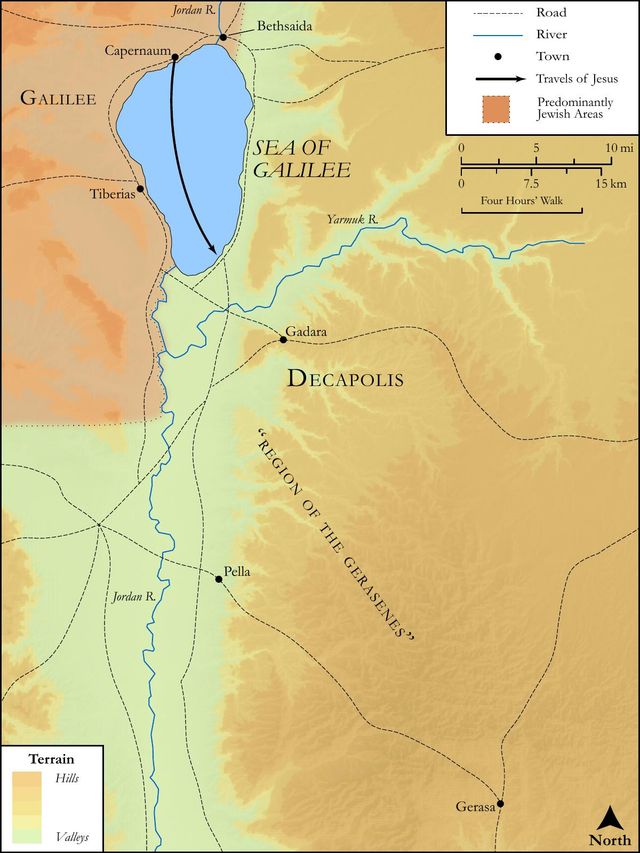
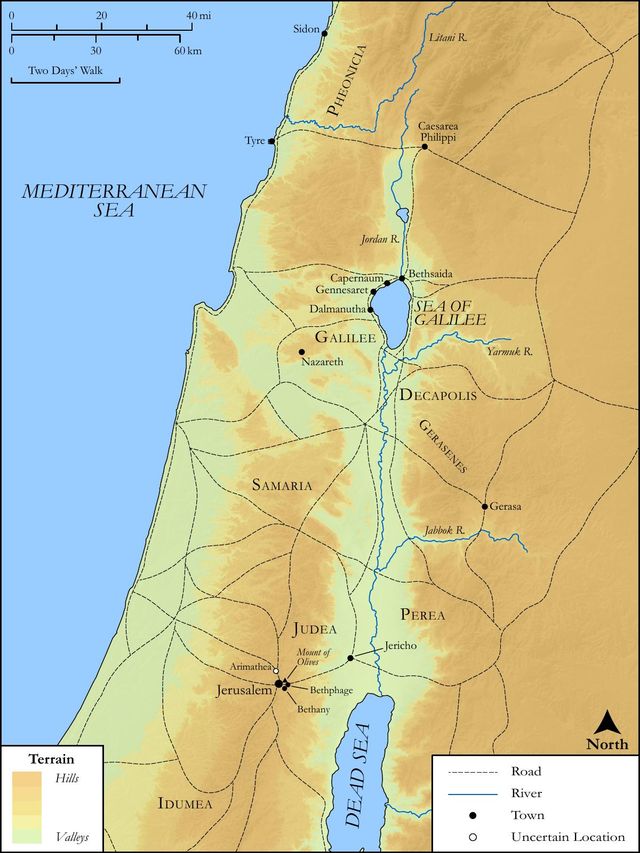
The "Decapolis" (Greek for "Ten Cities") was a confederation of ten Hellenistic cities, primarily Gentile in population, located east of the Jordan River and south of the Sea of Galilee. These cities, including places like Gadara and Gerasa, were centers of Greek life and commerce under Rome, distinct from the predominantly Jewish regions where Jesus typically ministered. The local inhabitants' fear and request for Jesus to depart Mark 5:17 likely stemmed from a combination of awe at His power, economic loss (the swine), and perhaps a cultural discomfort with the disruption of their established order. The healed man's mission into this Gentile territory is significant, as it foreshadows the broader spread of the Gospel beyond Jewish boundaries, a theme central to the early church's mission as seen in Acts.
Key Themes
ShowHideThis verse contributes significantly to several key themes within Mark's Gospel and the broader biblical narrative. It powerfully illustrates Jesus' absolute authority over demonic forces and mental illness, demonstrating His capacity to bring order out of chaos and sanity out of madness, a theme consistently highlighted in Mark. Furthermore, it underscores the power of personal testimony, showing how an individual's transformed life and spoken witness can profoundly impact others, even leading them to "marvel" at God's work. The man's zealous obedience, extending his witness beyond the explicit command to "go home," highlights the theme of spontaneous evangelism fueled by gratitude. Finally, the setting in Decapolis emphasizes the spread of the Gospel to Gentile regions, an early indication that Jesus' redemptive work was not confined to Israel but intended for all nations, a foundational concept for the Great Commission in Matthew 28:19.
Exposition and Analysis
ShowHideKey Word Analysis
ShowHideFrom δέκα (deka, "ten") and πόλις (polis, "city"), this term refers to a specific "ten-city region" in Syria. Its inclusion here is crucial as it identifies the geographical and cultural context of the man's mission—a predominantly Gentile area. This detail highlights the expansive reach of Jesus' impact, extending beyond Jewish territories and setting the stage for the universal call of the Gospel.
This verb means "to herald (as a public crier), especially divine truth (the gospel)." It implies a formal, public, and authoritative proclamation, not merely casual conversation. The man was not just sharing a story; he was acting as a herald, announcing the "great things" Jesus had done, effectively serving as an unsent missionary who publicly declared the good news of his transformation.
Derived from θαῦμα (thauma, "wonder"), this word means "to wonder; by implication, to admire." The people's reaction of marveling indicates profound astonishment and awe at the extraordinary nature of the miracle and the man's undeniable transformation. It signifies a recognition of something beyond the ordinary, pointing to the divine power at work through Jesus.
Verse Breakdown
ShowHide"And he departed"
This phrase indicates the man's immediate and decisive action following Jesus' instruction in Mark 5:19. He did not hesitate but promptly left Jesus' presence to fulfill the command, demonstrating a profound shift from his previous state of wildness and disobedience.
"and began to publish in Decapolis"
This describes the man's primary activity and geographical scope. "Publish" (kērýssō) signifies a public, widespread proclamation, indicating that he became an active and zealous herald of Jesus' work. His choice to publish "in Decapolis" shows his initiative to go beyond his immediate "friends" (as instructed in Mark 5:19) and share his testimony in a broader, largely Gentile region.
"how great things Jesus had done for him"
This is the content of the man's message. His testimony focused on the specific, powerful, and transformative actions of Jesus in his own life—casting out the legion of demons, restoring his sanity, and delivering him from his torment. The emphasis is on "great things," highlighting the extraordinary nature of Jesus' miracle.
"and all [men] did marvel"
This describes the widespread reaction to the man's testimony. The people were astonished and amazed, indicating the undeniable evidence of the man's transformation and the extraordinary power of Jesus. Their "marveling" suggests a profound impact, perhaps leading to curiosity or even belief, setting the stage for future encounters with Jesus in this region.
Literary Devices
ShowHideMark 5:20 employs several powerful literary devices. Irony is evident in Jesus' instruction for the man to go home, yet the man's zealous obedience leads him to "publish in Decapolis," effectively becoming an unsolicited missionary to a wider, Gentile audience. This highlights the transformative power of grace, which often compels individuals to exceed expectations in their devotion. Contrast is also present, juxtaposing the fear and rejection of Jesus by the local townspeople Mark 5:17 with the healed man's eager and effective proclamation of Jesus' goodness. The narrative uses Emphasis through repetition of the idea of "great things" (Mark 5:19-20), underscoring the profound nature of Jesus' work. Furthermore, the man's actions serve as a Foreshadowing of the broader Gentile mission of the early church, demonstrating that the good news of Jesus' power and compassion was not confined to Jewish lands but destined for all peoples.
Theological and Thematic Connections
ShowHideMark 5:20 stands as a foundational text for understanding the power and necessity of personal testimony in the spread of the Gospel. The man, once an outcast and a terror, becomes a living testament to Jesus' transformative power. His story underscores that true evangelism often begins with a personal encounter with Christ, leading to an undeniable change that compels one to share what God has done. This spontaneous, Spirit-empowered witness, even from an unlikely source, can have a profound impact, stirring wonder and opening hearts in regions previously unreceptive to the message. It reveals God's strategy of using transformed individuals to carry His message, demonstrating that the most effective evangelism flows from a grateful heart proclaiming the "great things" of Jesus.
Reflection and Application
ShowHideMark 5:20 offers a profound challenge and encouragement for believers today. The formerly demon-possessed man, who had every reason to be overlooked or silenced, became an immediate and powerful evangelist simply by sharing his personal story of transformation. This teaches us that our most potent tool for witness is often our own testimony—what Jesus "had done for him." We are called not to merely intellectualize faith, but to embody and articulate the living reality of Christ's work in our lives. Just as the man's zeal led him beyond the explicit command to his "friends" to the wider "Decapolis," so too should our gratitude and love for Christ compel us to share His goodness in our homes, workplaces, communities, and beyond, recognizing that our transformed lives are compelling evidence of His power. We are all called to be heralds of the "great things" Jesus has done, trusting that our authentic witness, empowered by the Holy Spirit, can lead others to marvel at His grace and compassion.
Questions for Reflection
ShowHideFAQ
ShowHideWhy did Jesus tell the man to go home instead of letting him follow Him, as others did?
ShowHideJesus' instruction to the man in Mark 5:19 to "Go home to thy friends, and tell them how great things the Lord hath done for thee" was a strategic and unique command tailored to the specific context. Unlike His disciples who were called to leave everything and follow Him, this man was in a Gentile region where Jesus had been asked to depart. By sending the healed man back, Jesus established a living witness in a territory where He Himself would not spend much time. The man's transformed life and personal testimony became a powerful, indigenous missionary presence, preparing hearts for future encounters with the Gospel. It demonstrated that God uses diverse methods and calls individuals to different forms of service, sometimes sending them back to their familiar environments to be a light there.
Christ-Centered Fulfillment
ShowHideThe narrative of the Gerasene demoniac and his subsequent proclamation in Decapolis finds profound Christ-centered fulfillment. The man's deliverance from a "legion" of demons and his restoration to sanity vividly prefigure Christ's ultimate victory over the powers of darkness and sin, a victory fully realized in His death and resurrection (Colossians 2:15). The "great things Jesus had done for him" are a microcosm of the greater work Christ accomplishes for all humanity—delivering us from the bondage of sin, restoring our minds and souls, and bringing us into a right relationship with God (Romans 5:8). The man's zealous mission in Decapolis, a Gentile region, foreshadows the universal scope of the Gospel, demonstrating that Jesus' redemptive work is not limited to one people group but extends to "all nations" (Matthew 28:19). He became an early, living testament to the Lamb of God who takes away the sin of the world (John 1:29), a pre-Pentecost example of a Spirit-empowered witness proclaiming the saving power of Christ to those who had not yet known Him.