


Jeremiah 46:6
Bible text: King James Version (1769 Blayney text) · Public domain
Bible text: Berean Standard Bible · Public domain
Bible text: American Standard Version (1901) · Public domain
Bible text: World English Bible, Messianic edition · Public domain
Bible text: Geneva Bible (1599) · Public domain
Bible text: Young's Literal Translation · Public domain
- אַל'almay notH408NegParticle Negative
- יָנוּסya·Nushe fleeH5127V-Qal-Imperf-3msVerb Qal Imperfect 3rd Singular Masculine
- הַקַּלha·Kalthe swift [one]H7031Art ¦ Adj-msAdjective Singular Masculine Absoluteהַtheקַּלswift [one]
- וְאַלve·'aland may notH408Conj-w ¦ NegParticle Negativeוְandאַלmay not
- יִמָּלֵטyi·ma·Lethe escapeH4422V-Niphal-Imperf-3msVerb Niphal Imperfect 3rd Singular Masculine
- הַגִּבּוֹרha·gi·Borthe warriorH1368Art ¦ N-msNoun Singular Masculine Absoluteהַtheגִּבּוֹרwarrior
- צָפוֹנָהtza·Fo·nahnorth -wardH6828N-fs ¦ SfxNoun Singular Feminine Absoluteצָפוֹנָnorthה-ward
- עַל'alonH5921PrepPreposition
- יַדyad[the] side ofH3027N-cscNoun Singular common gender Construct
- נְהַרne·har[the] river ofH5104N-mscNoun Singular Masculine Construct
- פְּרָתpe·RatEuphratesH6578N-properNoun Proper Location
- כָּשְׁלוּka·she·Luthey will stumbleH3782V-Qal-Perf-3cpVerb Qal Perfect 3rd Plural common gender
- וְנָפָלוּve·na·Fa·luand they will fallH5307Conj-w ¦ V-Qal-ConsecPerf-3cpVerb Qal Consecutive Perfect 3rd Plural common genderוְandנָפָלוּthey will fall
English is a literal word-by-word gloss of the Hebrew, not the KJV's wording. Why?
This is the original text the KJV's translators worked from — each Hebrew word with its own literal English meaning in this verse, prepared by scholars at Tyndale House, Cambridge. The KJV translates whole sentences, not word by word, so its wording differs: one Hebrew word can become several English words, and the KJV may choose “the LORD” where the gloss reads “Yahweh”. Both are faithful — they answer different questions. For the KJV's own rendering, switch to the KJV text.
Details
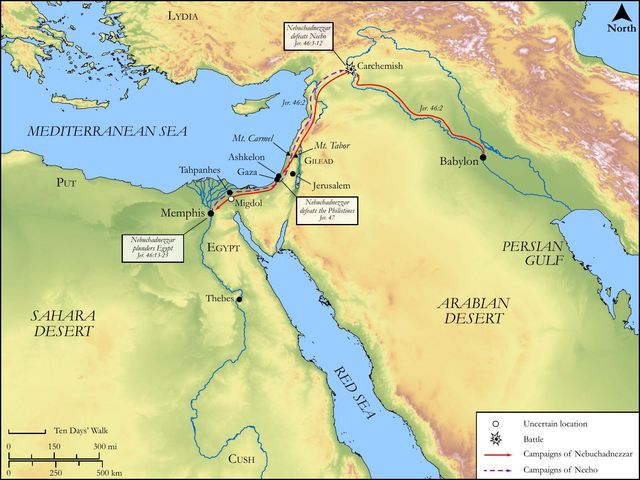
See on the biblical-era map
Study this verse
Public-domain commentary
Matthew Henry
From his Commentary on the Whole Bible. Henry comments on passages, not single verses — this entry covers Jeremiah 46:1–12.
The first verse is the title of that part of this book, which relates to the neighbouring nations, and follows here. It is the word of the Lord which came to Jeremiah against the Gentiles; for God is King and Judge of nations, knows and will call to an account those who know him not nor take any notice of him. Both Isaiah and Ezekiel prophesied against these nations that Jeremiah here has a separate saying to, and with reference to the same events. In the Old Testament we have the word of the Lord against the Gentiles; in the New Testament we have the word of the Lord for the Gentiles, that those who were afar off are made nigh.
He begins with Egypt, because they were of old Israel's oppressors and of late their deceivers, when they put confidence in them. In these verses he foretells the overthrow of the army of Pharaoh-necho, by Nebuchadnezzar, in the fourth year of Jehoiakim, which was so complete a victory to the king of Babylon that thereby he recovered from the river of Egypt to the river Euphrates, all that pertained to the king of Egypt, and so weakened him that he came not again any more out of his land (as we find, Kg2 24:7), and so made him pay dearly for his expedition against the king of Assyria four years before, in which he slew Josiah, Kg2 23:29. This is the event that is here foretold in lofty expressions of triumph over Egypt thus foiled, which Jeremiah would speak of with a particular pleasure, because the death of Josiah, which he had lamented, was now avenged on Pharaoh-necho. Now here,
I.The Egyptians are upbraided with the mighty preparations they made for this expedition, in which the prophet calls to them to do their utmost, for so they would: "Come then, order the buckler, let the weapons of war be got ready," Jer 46:3. Egypt was famous for horses - let them be harnessed and the cavalry well mounted: Get up, you horsemen, and stand forth, etc., Jer 46:4. See what preparations the children of men make, with abundance of care and trouble and at a vast expense, to kill one another, as if they did not die fast enough of themselves. He compares their marching out upon this expedition to the rising of their river Nile (Jer 46:7, Jer 46:8): Egypt now rises up like a flood, scorning to keep within its own banks and threatening to overflow all the neighbouring lands. It is a very formidable army that the Egyptians bring into the field upon this occasion. The prophet summons them (Jer 46:9): Come up, you horses; rage, you chariots. He challenges them to bring all their confederate troops together, the Ethiopians, that descended from the same stock with the Egyptians (Gen 10:6), and were their neighbours and allies, the Libyans and Lydians, both seated in Africa, to the west of Egypt, and from them the Egyptians fetched their auxiliary forces. Let them strengthen themselves with all the art and interest they have, yet it shall be all in vain; they shall be shamefully defeated notwithstanding, for God will fight against them, and against him there is no wisdom nor counsel, Pro 21:30, Pro 21:31. It concerns those that go forth to war not only to order the buckler, and harness the horses, but to repent of their sins, and pray to God for his presence with them, and that they may have it to keep themselves from every wicked thing.
II.They are upbraided with the great expectations they had from this expedition, which were quite contrary to what God intended in bringing them together. They knew their own thoughts, and God knew them, and sat in heaven and laughed at them,; but they knew not the thoughts of the Lord, for he gathers them as sheaves into the floor, Mic 4:11, Mic 4:12. Egypt saith (Jer 46:8): I will go up; I will cover the earth, and none shall hinder me; I will destroy the city, whatever city it is that stands in my way. Like Pharaoh of old, I will pursue, I will overtake. The Egyptians say that they shall have a day of it, but God saith that it shall be his day: The is the day of the Lord God of hosts (Jer 46:10), the day in which he will be exalted in the overthrow of the Egyptians. They meant one thing, but God meant another; they designed it for the advancement of their dignity and the enlargement of their dominion, but God designed it for the great abasement and weakening of their kingdom. It is a day of vengeance for Josiah's death; it is a day of sacrifice to divine justice, to which multitudes of the sinners of Egypt shall fall as victims. Note, When men think to magnify themselves by pushing on unrighteous enterprises, let them expect that God will glorify himself by blasting them and cutting them off.
III.They are upbraided with their cowardice and inglorious flight when they come to an engagement (Jer 46:5, Jer 46:6):
"Wherefore have I seen them, notwithstanding all these mighty and vast preparations and all these expressions of bravery and resolution, when the Chaldean army faces them, dismayed, turned back, quite disheartened, and no spirit left in them." 1. They make a shameful retreat. Even their mighty ones, who, one would think, should have stood their ground, flee a flight, flee by consent, make the best of their way, flee in confusion and with the utmost precipitation; they have neither time nor heart to look back, but fear is round about them, for they apprehend it so. And yet, 2. They cannot make their escape. They have the shame of flying, and yet not the satisfaction of saving themselves by flight; they might as well have stood their ground and died upon the spot; for even the swift shall not flee away. The lightness of their heels shall fail them when it comes to the trial, as well as the stoutness of their hearts; the mighty shall not escape, nay, they are beaten down and broken to pieces. They shall stumble in their flight, and fall towards the north, towards their enemy's country; for such confusion were they in when they took to their feet that instead of making homeward, as men usually do in that case, they made forward. Note, The race is not to the swift nor the battle to the strong. Valiant men are not always victorious.
IV.They are upbraided with their utter inability ever to recover this blow, which should be fatal to their nation, Jer 46:11, Jer 46:12.
The damsel, the daughter of Egypt, that lived in great pomp and state, is sorely wounded by this defeat. Let her now seek for balm in Gilead and physicians there; let her use all the medicines her wise men can prescribe for the healing of this hurt, and the repairing of the loss sustained by this defeat; but all in vain; no cure shall be to them; they shall never be able to bring such a powerful army as this into the field again. "The nations that rang of thy glory and strength have now heard of thy shame, how shamefully thou wast routed and how thou are weakened by it." It needs not be spread by the triumphs of the conquerors, the shrieks and outcries of the conquered will proclaim it: Thy cry hath filled the country about. For, when they fled several ways, one mighty man stumbled upon another and dashed against another, such confusion were they in, so that both together became a pray to the pursuers, an easy prey. A thousand such dreadful accidents there should be, which should fill the country with the cry of those that were overcome. Let not the mighty man therefore glory in his might, for the time may come when it will stand him in no stead.
Continue studying Jeremiah 46:6 across the web’s major study libraries — every link below opens this exact verse, chapter, or book on the destination site.
Read & Compare
 BibleGatewayThis verse in more than 200 translations and 70 languages.
 Bible.comThe YouVersion reader — hundreds of translations, reading plans, and highlights.
 ESV.orgCrossway's official English Standard Version reader.
 NET BibleThe NET translation with 60,000+ translators' notes on every rendering decision.
 STEP BibleTyndale House's free study tool — original text, vocabulary, and scholarly resources.
 BibliaLogos Bible Software's free web reader.
 USCCBThe New American Bible (Revised Edition) with the U.S. bishops' study notes.
Commentaries
 BibleHub CommentariesDozens of classic commentaries on this verse, gathered on one page.
 StudyLightMore than 100 commentary sets — the largest collection on the web.
 BibleRefPlain-English commentary on what this verse means, verse by verse.
 Enduring WordDavid Guzik's free commentary on this chapter, widely used by Bible teachers.
 Bible Study ToolsVerse commentary alongside Greek and Hebrew study aids.
Original Language & Research
- BibleHub InterlinearThe verse word by word — original language, transliteration, and English.
- BibleHub LexiconEvery word's original-language definition and Strong's entry.
 Blue Letter BibleDeep-study tools — Strong's numbers, concordance, and word studies.
 SefariaThe Hebrew text with Rashi and centuries of Jewish commentary.
Sermons, Hymns & Audio


TrulyRandomVerse is not affiliated with these sites and doesn’t control their content. They’re linked because they’re genuinely useful.
Summary
Jeremiah 46:6 presents a vivid and unyielding prophetic declaration, foretelling the catastrophic and inescapable defeat of the formidable Egyptian army. It paints a stark picture of utter military collapse, where even the most agile and powerful warriors are rendered utterly helpless, unable to evade their divinely ordained judgment. This verse profoundly underscores God's absolute and unwavering sovereignty over all nations, highlighting the inherent futility of human strength and strategic prowess when arrayed against His sovereign will, culminating in a decisive and humiliating rout by the strategic river Euphrates.
Context
ShowHideLiterary Context
Jeremiah 46:6 is situated within a comprehensive prophetic oracle against Egypt, specifically detailed in Jeremiah chapter 46. The chapter commences with a precise superscription (Jeremiah 46:1-2), identifying the message's focus on Pharaoh Necho's army at the pivotal Battle of Carchemish. Leading up to verse 6, the prophet vividly describes the Egyptian military's initial preparations for battle, urging them to arm themselves (Jeremiah 46:3-4). However, this call to arms is immediately followed by a rhetorical question highlighting their impending dismay and retreat (Jeremiah 46:5). Verse 6 then delivers the crushing explanation for this disarray: their inherent speed and might will prove utterly useless. The subsequent verses continue to elaborate on the overwhelming nature of the Babylonian assault, metaphorically likening it to a devastating flood (Jeremiah 46:7-8) and deriding Egypt's unreliable allies (Jeremiah 46:9-10). The entire passage builds towards a definitive declaration of Egypt's humiliating defeat and the undeniable execution of God's judgment.
Historical & Cultural Context
The prophecy in Jeremiah 46 centers on the historically significant Battle of Carchemish, which took place around 605 BC. This confrontation was a decisive clash between the formidable Egyptian forces under Pharaoh Necho II and the rapidly ascendant Babylonian empire led by Nebuchadnezzar. Carchemish, located on the Euphrates River, was a critically strategic city, controlling vital trade routes and military access between Mesopotamia and the Levant. Egypt, having recently established its influence in the region following the collapse of the Assyrian Empire, sought to maintain its hegemonic position. However, Babylon's overwhelming victory at Carchemish irrevocably altered the geopolitical landscape, firmly establishing Babylon as the preeminent power among the nations and undeniably fulfilling Jeremiah's prophetic utterance. Culturally, ancient armies, including Egypt's, placed immense value on the prowess of their elite units—their swift charioteers and mighty warriors—making the prophecy of their utter failure particularly devastating and impactful to its original audience.
Key Themes
ShowHideJeremiah 46:6 powerfully contributes to several overarching themes pervasive within the book of Jeremiah and broader biblical theology. Foremost is the theme of Divine Sovereignty and Judgment, demonstrating unequivocally that no human power, regardless of its perceived might or strategic advantage, can ultimately withstand God's decreed judgment. The "swift" and "mighty" of Egypt, symbols of military invincibility, are revealed as utterly powerless against the divine will, echoing the timeless biblical truth that human strength is futile when set against God, as profoundly articulated in Psalm 33:16-17. This passage also powerfully highlights the Futility of Human Pride and Reliance on Self, as Egypt, a dominant and self-assured empire, is brought low despite its perceived invincibility. This serves as a stark and enduring warning against hubris, a theme consistently found throughout Scripture, notably in Proverbs 16:18. Finally, the prophecy reinforces God's ultimate and unassailable Control Over Nations and History, revealing Him as the orchestrator of the rise and fall of empires to fulfill His righteous and sovereign purposes, a truth vividly portrayed in Daniel 2:21.
Exposition and Analysis
ShowHideKey Word Analysis
ShowHideMeaning "light; (by implication) rapid (also adverbial)." This term characterizes the Egyptian soldiers renowned for their agility and speed, likely referring to their charioteers or light infantry, who were typically relied upon for rapid maneuvers, pursuit, or escape. The prophecy starkly declares that even these highly mobile and quick forces will be rendered utterly incapable of fleeing the impending doom, underscoring the absolute and comprehensive nature of their defeat.
Meaning "powerful; by implication, warrior, tyrant; champion, chief, mighty (man, one), strong (man), valiant man." This word designates the elite, robust, and courageous warriors of the Egyptian army—the very backbone of their military might and a source of national pride. The pronouncement that even these formidable individuals cannot escape emphasizes the overwhelming and inescapable nature of the divine judgment. Their strength, usually a guarantee of confidence and victory, is here rendered completely useless.
Meaning "to totter or waver (through weakness of the legs, especially the ankle); by implication, to falter, stumble, faint or fall." This verb vividly portrays the physical and moral collapse of the Egyptian forces. It suggests a profound loss of balance, coordination, and composure, indicating not an orderly retreat but a chaotic, panicked rout where soldiers trip over themselves and each other, unable to maintain their footing or dignity in the face of overwhelming and disorienting defeat.
Verse Breakdown
ShowHide"Let not the swift flee away,"
This clause functions as a rhetorical imperative, not a command to the swift, but a powerful prophetic declaration asserting that their characteristic speed and agility—their usual means of escape—will be rendered utterly ineffective. It dramatically sets the stage for the inevitability of their capture and defeat, emphasizing that their natural advantage will spectacularly fail them in the face of divine judgment.
"nor the mighty man escape;"
Parallel in structure and intent to the preceding clause, this phrase further reinforces the inescapable nature of the impending judgment. Even the most powerful, valiant, and strategically positioned warriors, who might typically break through enemy lines or resist capture, will find no conceivable way out. Their strength, usually their greatest asset and a symbol of their military prowess, will prove completely useless against the overwhelming force arrayed against them by divine decree.
"they shall stumble, and fall"
This vivid phrase describes the chaotic, humiliating, and complete collapse of the Egyptian army. The verb "stumble" (Hebrew, kâshal') suggests a sudden loss of footing, balance, and control, implying disorganization and panic. "Fall" (Hebrew, nâphal') signifies their complete defeat, overthrow, and perhaps even death. Together, these verbs paint a stark picture of disarray, panic, and utter rout, where soldiers are tripping over themselves, collapsing in confusion, and being cut down, rather than executing any semblance of an orderly retreat.
"toward the north by the river Euphrates."
This provides the precise geographical location of their catastrophic downfall, firmly grounding the prophecy in historical and physical reality. The specific mention of "the river Euphrates" directly points to the site of the pivotal Battle of Carchemish, a critical strategic location for the kings of that day. "Toward the north" indicates the direction from which the Babylonian forces advanced and the direction of the Egyptians' flight or their position when they were overwhelmed, confirming the specific and undeniable context of the Babylonian advance from their northern territories.
Literary Devices
ShowHideJeremiah 46:6 masterfully employs several potent Literary Devices to convey its message of impending and inescapable doom. The opening phrases, "Let not the swift flee away, nor the mighty man escape," utilize a powerful Rhetorical Imperative or Prohibitive Language. This is not a literal command to the soldiers, but rather a declarative prophecy of what will not occur, emphatically underscoring the absolute futility of their attempts to escape. This creates a profound sense of Irony, as the very attributes for which these elite soldiers are renowned—their swiftness and their might—are rendered utterly impotent and useless in the face of divine judgment. There is also clear Parallelism in the verse's structure, with the "swift" being unable to "flee away" and the "mighty man" unable to "escape," reinforcing the comprehensive and inescapable nature of the defeat. The vivid, action-oriented imagery of "stumble, and fall" provides compelling Visual Imagery and evokes Pathos, painting a chaotic and humiliating picture of collapse rather than an organized retreat. Finally, the precise mention of "the river Euphrates" and the direction "toward the north" serves as crucial Geographical Specificity, rooting the prophecy in a concrete historical event and lending it undeniable authenticity and predictive power, confirming its fulfillment.
Theological and Thematic Connections
ShowHideJeremiah 46:6 stands as a profound theological statement, serving as an undeniable testament to God's absolute and unchallengeable sovereignty over all nations and the ultimate futility of human strength when it dares to stand in opposition to His divine and immutable will. It powerfully illustrates that no army, no matter how swift, mighty, or technologically advanced, can thwart the predetermined purposes of the Almighty. This prophecy profoundly underscores the consistent biblical principle that God alone raises up and brings down empires according to His righteous and unfolding plan, often using even pagan nations as instruments of His sovereign judgment. The decisive defeat of Egypt, a dominant global power, by the emerging Babylonians, vividly demonstrates that all earthly power and dominion are provisional, ephemeral, and ultimately subject to the divine decree. This humbling truth should compel humanity to recognize its limitations, reminding us to place our unwavering trust not in military might, strategic alliances, or human ingenuity, but in the omnipotent and unfailing Lord our God.
Reflection and Application
ShowHideJeremiah 46:6 offers profound and enduring lessons for contemporary believers navigating a world that often exalts speed, strength, and self-reliance as the ultimate virtues. This verse serves as a sobering and necessary reminder that human capabilities, no matter how impressive, technologically advanced, or strategically brilliant, are ultimately finite, limited, and always subject to God's overarching and sovereign plan. It calls us to a posture of deep humility, urging us to recognize that true security, lasting victory, and authentic peace come not from our own might, cleverness, or accumulated resources, but from absolute and unwavering dependence on God alone. When confronted with seemingly overwhelming challenges, daunting obstacles, or moments of profound uncertainty, we are powerfully encouraged to remember that the Lord is eternally sovereign over all circumstances, all nations, and even the most formidable adversaries. This profound truth can instill within us a deep sense of peace, unshakeable confidence, and steadfast hope, knowing that God's righteous justice will ultimately prevail and His divine purposes will be perfectly accomplished, irrespective of human opposition or perceived strength. It compels us to rigorously examine the true object of our ultimate trust: is it in our own fleeting abilities and finite resources, or in the unfailing, omnipotent power of the Almighty God?
Questions for Reflection
ShowHideFAQ
ShowHideWhat was the significance of the "river Euphrates" in this prophecy?
ShowHideThe "river Euphrates" was a critically important geographical marker in this prophecy, specifically pointing to the precise location of the Battle of Carchemish, which occurred around 605 BC. This battle, fought on the very banks of the Euphrates, was a pivotal and defining moment in the days of Jeremiah, marking a significant shift in regional power. Jeremiah's prophecy, by naming this particular river, powerfully demonstrated the precise, divinely-inspired nature of his foresight, as it accurately predicted the exact place where Egypt's military might would be decisively broken and humiliated by the rising power of Babylon under Nebuchadnezzar. It unequivocally underscores God's meticulous control over historical events and the destinies of nations, proving His prophetic word.
How does this prophecy relate to God's character?
ShowHideThis prophecy profoundly reveals several core attributes of God's character, most notably His absolute Sovereignty and unwavering Justice. It demonstrates beyond doubt that He is the supreme ruler over all nations, orchestrating their rise and fall according to His divine and righteous will, a truth powerfully affirmed in Daniel 4:17. The decisive defeat of Egypt, a proud and powerful nation, vividly showcases His justice in bringing low those who oppose His purposes or rely solely on their own strength and pride, echoing the timeless warning found in Proverbs 16:18. Ultimately, it highlights that no human force, no matter how formidable, can withstand His judgment, thereby affirming His omnipotence, His unwavering commitment to His divine plans, and His ultimate authority over all creation.
Christ-Centered Fulfillment
ShowHideWhile Jeremiah 46:6 directly concerns the historical defeat of Egypt at the hands of Babylon, its profound theological underpinnings find their ultimate and glorious Christ-centered fulfillment in the decisive triumph of God's kingdom through Jesus Christ. The prophecy's stark declaration that no "swift" or "mighty man" can escape divine judgment foreshadows Christ's comprehensive and eternal victory over all spiritual and temporal powers that stand in opposition to God. On the cross, Jesus, the true and ultimate Warrior, decisively disarmed the "principalities and powers" (the spiritual "mighty men" who sought to enslave humanity), making a public spectacle of them and triumphing over them through His sacrificial death (Colossians 2:15). He, the sinless Lamb of God, entered the very domain of death and emerged victoriously, thereby destroying "him who has the power of death, that is, the devil" (Hebrews 2:14). The stumbling and falling of Egypt's proud army by the Euphrates prefigures the ultimate, inescapable, and irreversible judgment that awaits all who stand against God's anointed King. In the New Testament, we are assured that Christ is the one who will return in glory and power to execute final judgment, where no enemy—no matter how swift, mighty, or seemingly invincible—will be able to flee or escape His righteous and consuming wrath (Revelation 19:11-16). Thus, Jeremiah's prophecy, though rooted in ancient history, powerfully points forward to the complete and irreversible victory of God's eternal kingdom, established and consummated in the person and work of Jesus Christ, where all earthly and spiritual opposition will ultimately stumble, fall, and be brought to nothing.