


Jeremiah 49:30
- נֻסוּnu·SufleeH5127V-Qal-Imp-2mpVerb Qal Imperative 2nd Plural Masculine
- נֻּדוּNu·dutake flightH5110V-Qal-Imp-2mpVerb Qal Imperative 2nd Plural Masculine
- מְאֹדme·'OdexceedinglyH3966Adj-msAdjective Numerical Singular Masculine Absolute
- הֶעְמִיקוּhe'·Mi·kumake deepH6009V-Hiphil-Imp-2mpVerb Hiphil Imperative 2nd Plural Masculine
- לָשֶׁבֶתla·She·vetto dwellH3427Prep-l ¦ V-Qal-InfVerb Qal Infinitive Constructלָtoשֶׁבֶתdwell
- יֹשְׁבֵיyo·she·VeiO inhabitants ofH3427V-Qal-Prtcpl-mpVerb Qal Participle Plural Masculine Construct
- חָצוֹרcha·TzorHazorH2674N-properNoun Proper Location
- נְאֻםne·'um[the] utterance ofH5002N-mscNoun Singular Masculine Construct
- יְהוָהYah·wehYahwehH3068N-properNoun Proper Title
- כִּיkithatH3588PrtParticle Conditional
- יָעַץya·'Atzhe has plannedH3289V-Qal-Perf-3msVerb Qal Perfect 3rd Singular Masculine
- עֲלֵיכֶם'a·lei·Khemon youH5921Prep ¦ 2mpPreposition Definiteעֲלֵיonכֶםyou
- נְבוּכַדְרֶאצַּרne·vu·khad·re·TzarNebuchadnezzarH5019N-proper-mNoun Proper Masculine
- מֶלֶךְMe·lekh[the] king ofH4428N-mscNoun Singular Masculine Construct
- בָּבֶלba·VelBabylonH894N-properNoun Proper Location
- עֵצָה'e·Tzaha planH6098N-fsNoun Singular Feminine Absolute
- וְחָשַׁבve·cha·Shavand he has purposedH2803Conj-w ¦ V-Qal-ConsecPerf-3msVerb Qal Consecutive Perfect 3rd Singular Masculineוְandחָשַׁבhe has purposed
- עֲלֵיכֶם'a·lei·khemon youH5921Prep ¦ 2mpPreposition Definiteעֲלֵיonכֶםyou
- מַחֲשָׁבָהma·cha·sha·Vaha purposeH4284N-fsNoun Singular Feminine Absolute
English is a literal word-by-word gloss of the Hebrew, not the KJV's wording. Why?
This is the original text the KJV's translators worked from — each Hebrew word with its own literal English meaning in this verse, prepared by scholars at Tyndale House, Cambridge. The KJV translates whole sentences, not word by word, so its wording differs: one Hebrew word can become several English words, and the KJV may choose “the LORD” where the gloss reads “Yahweh”. Both are faithful — they answer different questions. For the KJV's own rendering, switch to the KJV text.
Details
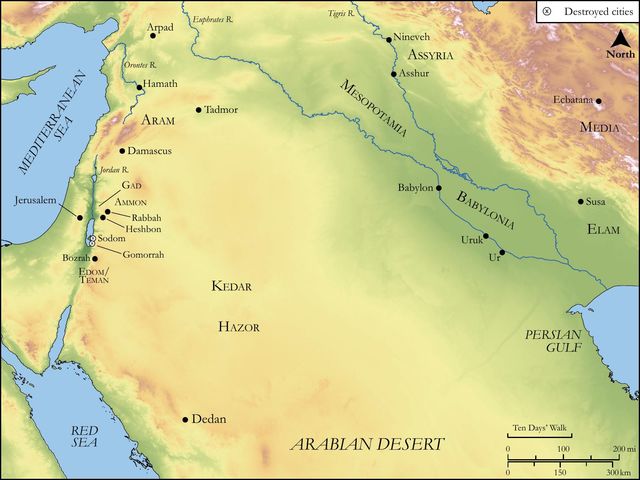
See on the biblical-era map
Study this verse
Public-domain commentary
Matthew Henry
From his Commentary on the Whole Bible. Henry comments on passages, not single verses — this entry covers Jeremiah 49:28–33. His two-level outline is real structure in the source text, so it is rendered as structure.
These verses foretell the desolation that Nebuchadnezzar and his forces should make among the people of Kedar (who descended from Kedar the son of Ishmael, and inhabited a part of Arabia the Stony), and of the kingdoms, the petty principalities, of Hazor, that joined to them, who perhaps were originally Canaanites, of the kingdom of Hazor, in the north of Canaan, which had Jabin for its king, but, being driven thence, settled in the deserts of Arabia and associated themselves with the Kedarenes. Concerning this people we may here observe,
I.What was their present state and posture? They dwelt in tents and had no walls, but curtains (Jer 49:20), no fortified cities; they had neither gates nor bars, Jer 49:31. They were shepherds, and had no treasures, but stock upon land, no money, but flocks and camels. They had no soldiers among them, for they were in no fear of invaders, no merchants, for they dwelt alone, Jer 49:31. Those of other nations neither came among them nor traded with them; but they lived within themselves, content with the products and pleasures of their own country. This was their manner of living, very different from that of the nations that were round about them. And,
1.They were very rich; though they had not trade, no treasures, yet they are here said to be a wealthy nation (Jer 49:31), because they had a sufficiency to answer all the occasions of human life and they were content with it. Note, Those are truly rich who have enough to supply their necessities, and know when they have enough. We need not go to the treasures of kings and provinces, or to the cash of merchants, to look for wealthy people; they may be found among shepherds that dwell in tents.
2.They were very easy: They dwelt without care. Their wealth was such as nobody envied them, or, if any did, they might come peaceably and enjoy the like; and therefore they feared nobody. Note, Those that live innocently and honestly may live very securely, though they have neither gates nor bars.
II.The design of the king of Babylon against them and the descent he make upon them:
He has taken counsel against you and has conceived a purpose against you, Jer 49:30. That proud man resolves it shall never be said that he, who had conquered so many strong cities, will leave those unconquered that dwell in tents. It was strange that that eagle should stoop to catch these flies, that so great a prince should play at such small game; but all is fish that comes to the ambitious covetous man's net. Note, It will not always secure men from suffering wrong to be able to say that they have done no wrong; not to have given offence will not be a defence against such men as Nebuchadnezzar. Yet, how unrighteous soever he was in doing it, God was righteous in directing it. These people had lived inoffensively among their neighbours, as many do, who yet, like them, are guilty before God; and it was to punish them for their offences against him that God said (Jer 49:28): Arise, go up to Kedar, and spoil the men of the east. They will do it to gratify their own covetousness and ambition, but God orders it for the correcting of an unthankful people, and for warning to a careless world to expect trouble when they seem to be most safe. God says to the Chaldeans (Jer 49:31): "Arise, get up to the wealthy nation that dwells without care; go and give them an alarm, that none may imagine their mountain stands so strong that it cannot be moved."
III.The great amazement that this put them into, and the great desolation hereby made among them:
They shall cry unto them; those on the borders shall send the alarm into all parts of the country, which shall be put into the utmost confusion by it; they shall cry, "Fear is on every side - We are surrounded by the enemy." the very terror of which shall drive them all to their feet and they shall none of them have any heart to make resistance. The enemy shall proclaim fear upon them, or against them, on every side. They need not strike a stroke; they shall shout them out of their tents, Jer 49:29. Upon the first alarm, they shall flee, get far off, and dwell deep (Jer 49:30), as the Edomites, Jer 49:8. And it will be found that this fear on every side is not groundless, for their calamity shall be brought from all sides thereof, Jer 49:32. No marvel there are fears on every side when there are foes on every side. The issue will be,
1.What they have will be a prey to the Chaldeans; they shall take to themselves their curtains and vessels; though they are but plain and coarse, and they have better of their own, yet they shall take them for spite, and spoil for spoiling sake. They shall carry away their tents and their flocks, Jer 49:29. Their camels shall be a booty to those that came for nothing else, Jer 49:32.
2.It is not said that any of them shall be slain, for they attempt not to make any resistance and their tents and flocks are accepted as a ransom for their lives; but they shall be dislodged and dispersed; though now they dwell in the utmost corners, out of the way, and therefore they think out of the reach, of danger (by this character those people were distinguished, Jer 9:26, Jer 9:25, Jer 9:23), yet they shall be scattered thence into all winds, into all parts of the world. Note, Privacy and obscurity are not always a protection and security. Many that affect to be strangers to the world may yet by unthought-of providences be forced into it; and those that live most retired may have the same lot with those that thrust themselves forth and lie most exposed.
3.Their country shall lie uninhabited; for, lying remote and out of all high roads, and having neither cities nor lands inviting to strangers, none shall care to succeed them, so that Hazor shall be a desolation for ever, Jer 49:33. If busy men be displaced, many strive to get into their placed, because they lived great; but here are easy quiet men displaced, and no man cared to abide where they did, because they lived meanly.
Continue studying Jeremiah 49:30 across the web’s major study libraries — every link below opens this exact verse, chapter, or book on the destination site.
Read & Compare
 BibleGatewayThis verse in more than 200 translations and 70 languages.
 Bible.comThe YouVersion reader — hundreds of translations, reading plans, and highlights.
 ESV.orgCrossway's official English Standard Version reader.
 NET BibleThe NET translation with 60,000+ translators' notes on every rendering decision.
 STEP BibleTyndale House's free study tool — original text, vocabulary, and scholarly resources.
 BibliaLogos Bible Software's free web reader.
 USCCBThe New American Bible (Revised Edition) with the U.S. bishops' study notes.
Commentaries
 BibleHub CommentariesDozens of classic commentaries on this verse, gathered on one page.
 StudyLightMore than 100 commentary sets — the largest collection on the web.
 BibleRefPlain-English commentary on what this verse means, verse by verse.
 Enduring WordDavid Guzik's free commentary on this chapter, widely used by Bible teachers.
 Bible Study ToolsVerse commentary alongside Greek and Hebrew study aids.
Original Language & Research
- BibleHub InterlinearThe verse word by word — original language, transliteration, and English.
- BibleHub LexiconEvery word's original-language definition and Strong's entry.
 Blue Letter BibleDeep-study tools — Strong's numbers, concordance, and word studies.
 SefariaThe Hebrew text with Rashi and centuries of Jewish commentary.
Sermons, Hymns & Audio


TrulyRandomVerse is not affiliated with these sites and doesn’t control their content. They’re linked because they’re genuinely useful.
Summary
Jeremiah 49:30 delivers an urgent, divinely mandated command to the inhabitants of Hazor: to flee, distance themselves, and seek deep refuge, for Nebuchadrezzar, the formidable king of Babylon, has meticulously planned and purposed their destruction. This prophetic oracle powerfully underscores the LORD's absolute sovereignty over all nations and history, revealing His foreknowledge and active orchestration of events, even employing pagan rulers as instruments of His righteous judgment against those who oppose His will.
Context
ShowHideLiterary Context
This verse is strategically placed within Jeremiah's extensive collection of oracles against foreign nations (chapters 46-51), a section that systematically demonstrates the LORD's universal dominion. Prior to the specific judgment against Hazor, Jeremiah has pronounced divine decrees against powerful entities like Egypt, Philistia, Moab, Ammon, Edom, and Damascus. The prophecy concerning Hazor, found in Jeremiah 49:28-33, immediately follows a warning to Kedar, another nomadic group, and precedes the final oracle against Elam. This placement reinforces a consistent theological message: no nation, regardless of its perceived strength, remoteness, or cultural distinctiveness, is beyond the scope of God's divine judgment or His sovereign plan. The recurring motif throughout these chapters is God's use of Babylon, under Nebuchadrezzar, as His chosen instrument of wrath, a "hammer" against the nations, to execute His predetermined will.
Historical & Cultural Context
Hazor was an ancient and historically significant city in northern Canaan, known for its strategic location. While the original Bronze Age Hazor had been famously destroyed by Joshua (Joshua 11:10-11), scholars debate whether Jeremiah's reference is to a rebuilt city, a specific region, or, more likely, a confederacy of nomadic Arab tribes inhabiting the Transjordanian region during the late 7th to early 6th century BC. Nebuchadrezzar II, the powerful king of the Neo-Babylonian Empire (reigned 605-562 BC), was the dominant geopolitical force of the era, responsible for the destruction of Jerusalem and the Babylonian exile. The cultural context of the ancient Near East often attributed the rise and fall of empires to the will of their respective deities. For Jeremiah, however, there was no ambiguity: it was Yahweh, the God of Israel, who orchestrated these global shifts, using Nebuchadrezzar as His unwitting agent. The command to "dwell deep" resonates with ancient practices of seeking refuge in caves, deserts, or other remote, inaccessible areas during times of invasion.
Key Themes
ShowHideThe prophecy against Hazor significantly contributes to several profound themes within Jeremiah's book and the broader prophetic corpus. Firstly, it powerfully illustrates Divine Sovereignty over Nations, emphasizing that the LORD is not merely the God of Israel but the supreme ruler of all the earth, orchestrating the destinies of empires and peoples (Jeremiah 27:6). Secondly, it underscores the Inevitable Nature of Divine Judgment, portraying judgment not as a mere possibility but as a determined and inescapable outcome once God's decree is issued, often in response to national pride, idolatry, or violence. The precise planning of Nebuchadrezzar is presented as a direct fulfillment of God's "purpose," highlighting the certainty of the impending doom. Thirdly, the urgent command to "Flee, get you far off, dwell deep" highlights Divine Warning and Mercy, demonstrating God's justice intertwined with a form of compassion, offering a chance for escape even when the ultimate judgment is certain. This reflects a consistent biblical pattern where God provides an opportunity to respond to His warnings, even if the overall outcome for the nation is fixed.
Exposition and Analysis
ShowHideKey Word Analysis
ShowHideThis primitive root (H5127) signifies to "flit, vanish away, subside, escape." It conveys a sense of urgent, desperate flight, implying that the danger is imminent and overwhelming, necessitating a swift and complete departure from the threatened area. The command is not merely to move, but to disappear, to make oneself scarce from the impending destruction, highlighting the severity of the threat.
Derived from the root (H6009), meaning "to be (causatively, make) deep (literally or figuratively)." When paired with "dwell" (H3427, yâshab), it suggests seeking refuge in remote, isolated, or profoundly hidden places—such as caves, desolate wildernesses, or inaccessible regions—to escape detection and the reach of the invading forces. It paints a vivid picture of extreme concealment as the only hope for survival.
This noun (H4284) comes from the verb châshab (H2803), meaning "to plot or contrive (usually in a malicious sense)." Machăshâbâh refers to a contrivance, an intention, or a plan. In this context, it emphasizes the deliberate, calculated, and often malevolent intent behind Nebuchadrezzar's actions, highlighting that his campaign against Hazor is not accidental or spontaneous but a well-thought-out strategy, ultimately orchestrated by divine will.
Verse Breakdown
ShowHide"Flee, get you far off, dwell deep, O ye inhabitants of Hazor"
This opening imperative is a direct, urgent command from the LORD to the people of Hazor. "Flee" (נוּס, nûwç) denotes a rapid, desperate escape. "Get you far off" (נוּדוּ מְאֹד, nûddû mᵉʼôd) intensifies the command, urging them to wander or remove themselves to a great distance, implying the need for absolute separation from the threatened locale. "Dwell deep" (הַעְמִיקוּ לָשֶׁבֶת, haʿmîqû lâshevet) suggests seeking profound concealment, perhaps in caves, deserts, or other inaccessible places, indicating the severity of the impending threat and the need for extreme measures of self-preservation.
"saith the LORD;"
This phrase serves as a divine authentication of the preceding command and the subsequent declaration. It signifies that the warning and the impending judgment originate directly from Yahweh (H3068, Yᵉhôvâh), the covenant God of Israel, affirming the absolute authority, certainty, and divine origin of the prophecy.
"for Nebuchadrezzar king of Babylon hath taken counsel against you,"
This clause provides the immediate and compelling reason for the urgent flight. Nebuchadrezzar (H5019, Nᵉbûwkadneʼtstsar), the powerful monarch of Babylon (H894, Bâbel), is identified as the divinely appointed agent of destruction. The phrase "hath taken counsel" (יָעַץ עֵצָה, yâʿats ʿêtsâh - H3289, H6098) indicates that a deliberate, strategic plan has been formulated against Hazor, emphasizing the methodical and determined nature of the Babylonian threat, which is ultimately under God's sovereign hand.
"and hath conceived a purpose against you."
This final clause reinforces the previous one, stressing the complete and malicious intent behind Nebuchadrezzar's actions. "Hath conceived a purpose" (חָשַׁב מַחֲשָׁבָה, châshab machăshâbâh - H2803, H4284) highlights that this is not a random attack but a well-thought-out scheme, a fixed determination to bring about Hazor's downfall. This emphasizes the inevitability of the judgment, as the enemy's plan is already set, ultimately under God's sovereign direction.
Literary Devices
ShowHideJeremiah 49:30 is rich in literary devices that amplify its prophetic impact and underscore the urgency of its message. The most prominent is the use of Imperative Mood, seen in the series of commands: "Flee," "get you far off," and "dwell deep." This creates a sense of immediate and dire necessity, directly conveying the urgency of the situation to the inhabitants of Hazor. The phrase "saith the LORD" functions as a Divine Oracle Formula, a hallmark of prophetic literature, authenticating the message as directly from God and lending it ultimate authority, certainty, and inevitability. The description of Nebuchadrezzar having "taken counsel" and "conceived a purpose" employs Anthropomorphism, attributing human intellectual processes of planning and strategizing to the king, thereby highlighting his deliberate and calculated intent. This also serves as a form of Foreshadowing, as the detailed planning of the enemy indicates the certainty of the impending destruction. The entire verse functions as a powerful Prophetic Warning, a common genre in Jeremiah, designed to alert the recipients to impending judgment and, implicitly, to call for a response, even if the primary purpose here is to declare the certainty of doom.
Theological and Thematic Connections
ShowHideThis verse profoundly illustrates the LORD's absolute sovereignty over all nations and His strategic use of seemingly secular powers to execute His divine will. It reveals that human kings, even those unaware of God's overarching plan like Nebuchadrezzar, are ultimately instruments in the hands of the Almighty to bring about His righteous judgments. The command to "flee" is a stark testament to the severity of divine wrath, yet it also subtly hints at God's mercy in providing a warning, even when judgment is decreed. This echoes a consistent biblical theme: God's justice is always perfectly aligned with His omnipotence, ensuring that His purposes, whether in judgment or salvation, will inevitably come to pass, demonstrating His ultimate control over human history.
Reflection and Application
ShowHideJeremiah 49:30 serves as a timeless reminder that God is actively involved in the affairs of humanity and nations, orchestrating events according to His sovereign will. For us today, this verse compels a deep reflection on the nature of divine warnings and the certainty of God's judgment against unrighteousness. It challenges us to consider whether we are heeding the warnings found in God's Word, or if we are complacent in our spiritual lives, assuming that consequences for sin will not befall us. Just as Hazor was urged to seek refuge from a physical threat, believers are called to seek ultimate refuge in God Himself, who is our unshakeable fortress and deliverer in a world filled with spiritual and temporal dangers. This passage should cultivate a profound sense of awe for God's power and a humble recognition of our need to live in alignment with His righteous commands, trusting that His plans, though sometimes mysterious and often involving difficult circumstances, are always perfect and just.
Questions for Reflection
ShowHideFAQ
ShowHideWho were the inhabitants of Hazor, and why were they singled out for judgment?
ShowHideThe inhabitants of Hazor refer to the people residing in or around the ancient city or region of Hazor. While the original Hazor was a prominent Canaanite city destroyed by Joshua, in Jeremiah's time (late 7th to early 6th century BC), it most likely referred to a confederacy of nomadic Arab tribes or a specific region in northern Transjordan (possibly related to the Hazor mentioned in Nehemiah 11:33). They were singled out for judgment as part of God's broader program of divine judgment against nations that had engaged in pride, idolatry, or opposition to His people and His will. Although their specific sins are not detailed in this verse, the overarching narrative of Jeremiah's prophecies against foreign nations indicates that their practices and defiance of God's moral order warranted this severe prophetic warning and impending destruction by Nebuchadrezzar, who was God's chosen instrument for executing judgment across the region. This demonstrates God's universal justice, holding all nations accountable to His divine standards.
Christ-Centered Fulfillment
ShowHideWhile Jeremiah 49:30 speaks of a historical judgment upon Hazor, its profound theological undercurrents find ultimate fulfillment and transformation in Jesus Christ. The urgent command to "flee" from impending destruction foreshadows the spiritual urgency for all humanity to escape the ultimate judgment for sin. Just as Hazor faced an inescapable earthly foe in Nebuchadrezzar, all humanity faces the inescapable reality of divine judgment for sin (Romans 3:23 and Romans 6:23). However, in Christ, the call to "flee" becomes an invitation to find ultimate refuge not in physical hiding places but in His atoning work. He is the true "deep dwelling" (Psalm 91:1-2), the secure hiding place where believers are protected from the wrath of God (Romans 5:9). The "counsel" and "purpose" of Nebuchadrezzar, though divinely orchestrated, point to the far greater, eternal "purpose" of God in Christ—to redeem a people for Himself (Ephesians 1:11). Jesus, the Lamb of God, bore the full weight of God's judgment on the cross, becoming the ultimate sacrifice that takes away the sin of the world (John 1:29). Thus, the historical judgment on Hazor serves as a stark reminder of God's justice, compelling us to seek the spiritual deliverance and eternal refuge found only in the finished work of our Lord Jesus Christ.