


Jeremiah 49:28
- לְקֵדָרle·ke·Darof KedarH6938Prep-l ¦ N-properNoun Proper LocationלְofקֵדָרKedar
- וּלְמַמְלְכוֹתu·le·mam·le·Khotand of [the] kingdoms ofH4467Conj-w ¦ Prep-l ¦ N-fpcNoun Plural Feminine Constructוּandלְofמַמְלְכוֹת[the] kingdoms of
- חָצוֹרcha·TzorHazorH2674N-properNoun Proper Location
- אֲשֶׁר'a·SherwhichH834RelParticle Relative
- הִכָּהhi·Kahhe attackedH5221V-Hiphil-Perf-3msVerb Hiphil Perfect 3rd Singular Masculine
- נְבוּכַדְרֶאצַּרne·vu·khad·re·tzorNebuchadnezzarH5019N-proper-mNoun Proper Masculine
- מֶלֶךְMe·lekh[the] king ofH4428N-mscNoun Singular Masculine Construct
- בָּבֶלba·VelBabylonH894N-properNoun Proper Location
- כֹּהkohthusH3541AdvAdverb
- אָמַר'a·Marhe saysH559V-Qal-Perf-3msVerb Qal Perfect 3rd Singular Masculine
- יְהוָהYah·wehYahwehH3068N-properNoun Proper Title
- קוּמוּKu·muariseH6965V-Qal-Imp-2mpVerb Qal Imperative 2nd Plural Masculine
- עֲלוּ'a·Lugo upH5927V-Qal-Imp-2mpVerb Qal Imperative 2nd Plural Masculine
- אֶל'elagainstH413PrepPreposition
- קֵדָרke·DarKedarH6938N-properNoun Proper Location
- וְשָׁדְדוּve·sha·de·Duand devastateH7703Conj-w ¦ V-Qal-Imp-2mpVerb Qal Imperative 2nd Plural Masculineוְandשָׁדְדוּdevastate
- אֶת'et<obj.>H853DirObjMParticle Object Indicator
- בְּנֵיbe·nei[the] people ofH1121N-mpcNoun Plural Masculine Construct
- קֶדֶםKe·dem[the] eastH6924N-msNoun Singular Masculine Absolute
English is a literal word-by-word gloss of the Hebrew, not the KJV's wording. Why?
This is the original text the KJV's translators worked from — each Hebrew word with its own literal English meaning in this verse, prepared by scholars at Tyndale House, Cambridge. The KJV translates whole sentences, not word by word, so its wording differs: one Hebrew word can become several English words, and the KJV may choose “the LORD” where the gloss reads “Yahweh”. Both are faithful — they answer different questions. For the KJV's own rendering, switch to the KJV text.
Details
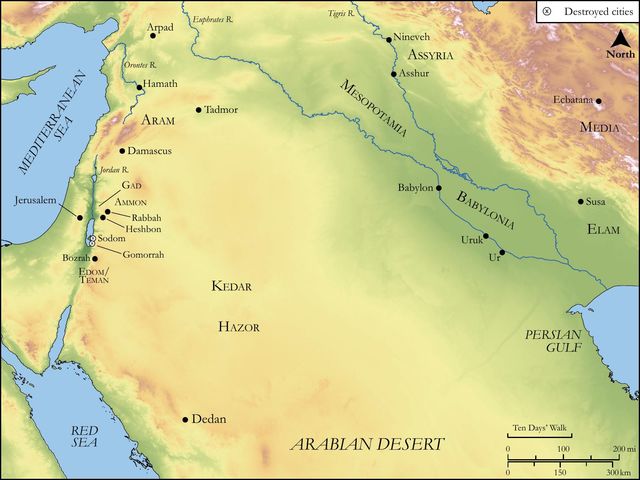
See on the biblical-era map
Study this verse
Public-domain commentary
Matthew Henry
From his Commentary on the Whole Bible. Henry comments on passages, not single verses — this entry covers Jeremiah 49:28–33. His two-level outline is real structure in the source text, so it is rendered as structure.
These verses foretell the desolation that Nebuchadnezzar and his forces should make among the people of Kedar (who descended from Kedar the son of Ishmael, and inhabited a part of Arabia the Stony), and of the kingdoms, the petty principalities, of Hazor, that joined to them, who perhaps were originally Canaanites, of the kingdom of Hazor, in the north of Canaan, which had Jabin for its king, but, being driven thence, settled in the deserts of Arabia and associated themselves with the Kedarenes. Concerning this people we may here observe,
I.What was their present state and posture? They dwelt in tents and had no walls, but curtains (Jer 49:20), no fortified cities; they had neither gates nor bars, Jer 49:31. They were shepherds, and had no treasures, but stock upon land, no money, but flocks and camels. They had no soldiers among them, for they were in no fear of invaders, no merchants, for they dwelt alone, Jer 49:31. Those of other nations neither came among them nor traded with them; but they lived within themselves, content with the products and pleasures of their own country. This was their manner of living, very different from that of the nations that were round about them. And,
1.They were very rich; though they had not trade, no treasures, yet they are here said to be a wealthy nation (Jer 49:31), because they had a sufficiency to answer all the occasions of human life and they were content with it. Note, Those are truly rich who have enough to supply their necessities, and know when they have enough. We need not go to the treasures of kings and provinces, or to the cash of merchants, to look for wealthy people; they may be found among shepherds that dwell in tents.
2.They were very easy: They dwelt without care. Their wealth was such as nobody envied them, or, if any did, they might come peaceably and enjoy the like; and therefore they feared nobody. Note, Those that live innocently and honestly may live very securely, though they have neither gates nor bars.
II.The design of the king of Babylon against them and the descent he make upon them:
He has taken counsel against you and has conceived a purpose against you, Jer 49:30. That proud man resolves it shall never be said that he, who had conquered so many strong cities, will leave those unconquered that dwell in tents. It was strange that that eagle should stoop to catch these flies, that so great a prince should play at such small game; but all is fish that comes to the ambitious covetous man's net. Note, It will not always secure men from suffering wrong to be able to say that they have done no wrong; not to have given offence will not be a defence against such men as Nebuchadnezzar. Yet, how unrighteous soever he was in doing it, God was righteous in directing it. These people had lived inoffensively among their neighbours, as many do, who yet, like them, are guilty before God; and it was to punish them for their offences against him that God said (Jer 49:28): Arise, go up to Kedar, and spoil the men of the east. They will do it to gratify their own covetousness and ambition, but God orders it for the correcting of an unthankful people, and for warning to a careless world to expect trouble when they seem to be most safe. God says to the Chaldeans (Jer 49:31): "Arise, get up to the wealthy nation that dwells without care; go and give them an alarm, that none may imagine their mountain stands so strong that it cannot be moved."
III.The great amazement that this put them into, and the great desolation hereby made among them:
They shall cry unto them; those on the borders shall send the alarm into all parts of the country, which shall be put into the utmost confusion by it; they shall cry, "Fear is on every side - We are surrounded by the enemy." the very terror of which shall drive them all to their feet and they shall none of them have any heart to make resistance. The enemy shall proclaim fear upon them, or against them, on every side. They need not strike a stroke; they shall shout them out of their tents, Jer 49:29. Upon the first alarm, they shall flee, get far off, and dwell deep (Jer 49:30), as the Edomites, Jer 49:8. And it will be found that this fear on every side is not groundless, for their calamity shall be brought from all sides thereof, Jer 49:32. No marvel there are fears on every side when there are foes on every side. The issue will be,
1.What they have will be a prey to the Chaldeans; they shall take to themselves their curtains and vessels; though they are but plain and coarse, and they have better of their own, yet they shall take them for spite, and spoil for spoiling sake. They shall carry away their tents and their flocks, Jer 49:29. Their camels shall be a booty to those that came for nothing else, Jer 49:32.
2.It is not said that any of them shall be slain, for they attempt not to make any resistance and their tents and flocks are accepted as a ransom for their lives; but they shall be dislodged and dispersed; though now they dwell in the utmost corners, out of the way, and therefore they think out of the reach, of danger (by this character those people were distinguished, Jer 9:26, Jer 9:25, Jer 9:23), yet they shall be scattered thence into all winds, into all parts of the world. Note, Privacy and obscurity are not always a protection and security. Many that affect to be strangers to the world may yet by unthought-of providences be forced into it; and those that live most retired may have the same lot with those that thrust themselves forth and lie most exposed.
3.Their country shall lie uninhabited; for, lying remote and out of all high roads, and having neither cities nor lands inviting to strangers, none shall care to succeed them, so that Hazor shall be a desolation for ever, Jer 49:33. If busy men be displaced, many strive to get into their placed, because they lived great; but here are easy quiet men displaced, and no man cared to abide where they did, because they lived meanly.
Continue studying Jeremiah 49:28 across the web’s major study libraries — every link below opens this exact verse, chapter, or book on the destination site.
Read & Compare
 BibleGatewayThis verse in more than 200 translations and 70 languages.
 Bible.comThe YouVersion reader — hundreds of translations, reading plans, and highlights.
 ESV.orgCrossway's official English Standard Version reader.
 NET BibleThe NET translation with 60,000+ translators' notes on every rendering decision.
 STEP BibleTyndale House's free study tool — original text, vocabulary, and scholarly resources.
 BibliaLogos Bible Software's free web reader.
 USCCBThe New American Bible (Revised Edition) with the U.S. bishops' study notes.
Commentaries
 BibleHub CommentariesDozens of classic commentaries on this verse, gathered on one page.
 StudyLightMore than 100 commentary sets — the largest collection on the web.
 BibleRefPlain-English commentary on what this verse means, verse by verse.
 Enduring WordDavid Guzik's free commentary on this chapter, widely used by Bible teachers.
 Bible Study ToolsVerse commentary alongside Greek and Hebrew study aids.
Original Language & Research
- BibleHub InterlinearThe verse word by word — original language, transliteration, and English.
- BibleHub LexiconEvery word's original-language definition and Strong's entry.
 Blue Letter BibleDeep-study tools — Strong's numbers, concordance, and word studies.
 SefariaThe Hebrew text with Rashi and centuries of Jewish commentary.
Sermons, Hymns & Audio


TrulyRandomVerse is not affiliated with these sites and doesn’t control their content. They’re linked because they’re genuinely useful.
Summary
Jeremiah 49:28 presents a divine oracle of judgment specifically directed at Kedar and the kingdoms of Hazor, prominent nomadic and semi-nomadic peoples of the Arabian desert. The prophecy declares that Nebuchadrezzar, the formidable king of Babylon, will serve as God's chosen instrument to decisively strike and plunder these "men of the east." This pronouncement powerfully underscores God's absolute sovereignty over all nations and His unwavering intention to bring accountability and judgment upon those who may dwell in perceived security, demonstrating that no people group or geographical location is beyond His divine reach or ultimate authority.
Context
ShowHideLiterary Context
This verse is strategically placed within Jeremiah's extensive collection of prophecies against foreign nations, a section spanning Jeremiah 46-51. Preceding this oracle are pronouncements against powerful entities like Egypt, Philistia, Moab, Ammon, Edom (Jeremiah 49:7-22), and Damascus (Jeremiah 49:23-27). The inclusion of Kedar and Hazor, seemingly more remote desert tribes, broadens the scope of God's judgment, emphasizing its universality. By moving from major empires to lesser-known nomadic groups, the text reinforces the theological message that God's sovereign reach extends to every corner of the earth, ensuring that no nation, regardless of its size or isolation, can escape His divine scrutiny and judgment. This comprehensive sweep highlights the prophet's consistent theme of divine control over all earthly affairs.
Historical & Cultural Context
Kedar was a renowned and influential confederation of Arab tribes, tracing their lineage back to Ishmael (Genesis 25:13). They were distinguished by their black goat-hair tents, vast flocks, and significant involvement in the lucrative caravan trade routes spanning the northern Arabian desert, east of Judah. Their nomadic lifestyle and remote geographical location often afforded them a sense of independence and security from the major empires of the ancient Near East. Hazor, in this specific context, likely refers not to the well-known Hazor in northern Israel, but to a more settled or fortified center associated with these desert peoples, possibly a key trading hub or a specific clan within the broader Kedarite confederation. The explicit mention of Nebuchadrezzar king of Babylon firmly dates this prophecy to the late 7th and early 6th centuries BC, a period marked by the Babylonian Empire's rapid and brutal expansion. Nebuchadrezzar served as God's unwitting instrument of judgment against numerous nations, including Judah itself (Jeremiah 25:9), making his inclusion here a testament to God's orchestrating hand in geopolitical events.
Key Themes
ShowHideThe central theme resonating throughout this prophecy is Divine Sovereignty and Universal Judgment. God's absolute authority is unequivocally displayed as He orchestrates global events, employing even pagan rulers like Nebuchadrezzar to fulfill His divine purposes. This underscores that no nation, irrespective of its perceived strength, isolation, or independence, is exempt from divine accountability. A related theme is the Futility of False Security. Kedar and Hazor likely placed their trust in their geographical remoteness, their nomadic agility, or their material wealth derived from trade. However, the prophecy serves as a stark warning that such earthly securities are ultimately ephemeral and powerless against the unstoppable will of the Almighty. The detailed nature of the judgment—to "smite" and "spoil"—along with the explicit naming of the conqueror, also highlights the Certainty of Prophetic Fulfillment. This reinforces the conviction that what God declares will inevitably come to pass, a truth consistently demonstrated throughout Jeremiah's oracles, including the detailed predictions against Babylon itself found in Jeremiah 50-51.
Exposition and Analysis
ShowHideKey Word Analysis
ShowHideMeaning "dusky" (of the skin or the tent). This term refers to a son of Ishmael, but more broadly, to a prominent confederation of nomadic Arab tribes. These tribes were known for their black goat-hair tents, which may explain the "dusky" etymology. In this context, Kedar represents the independent, desert-dwelling peoples often considered beyond the reach of major empires, yet they are explicitly named as targets of divine judgment, signifying God's universal dominion.
A primitive root meaning "to strike (lightly or severely, literally or figuratively); beat, kill, make (slaughter), slay, smite." This verb denotes a decisive, forceful, and often destructive military action. When applied to Nebuchadrezzar's actions against Kedar, it signifies a comprehensive and devastating conquest, involving significant loss of life and complete subjugation, rather than a mere skirmish or minor raid.
This phrase combines H1121 (bên, meaning "a son," but broadly "men" or "people") and H6924 (qedem, meaning "the front," or "the East"). Collectively, it refers to the nomadic tribes inhabiting the eastern deserts, beyond the settled lands of Judah. The use of "men" (bên) in this context emphasizes their identity as a distinct people group, while "of the east" highlights their geographical location and perceived isolation. This designation underscores that God's judgment extends even to these distant and seemingly untouchable peoples.
Verse Breakdown
ShowHide"¶ Concerning Kedar, and concerning the kingdoms of Hazor,"
This opening clause functions as a formal superscription, immediately identifying the specific recipients of the prophetic oracle. Kedar signifies the broader nomadic Arab confederation, while "the kingdoms of Hazor" likely points to specific settlements, fortified places, or allied tribal groups within the Kedarite sphere, indicating a comprehensive and targeted judgment against both the nomadic and potentially more settled aspects of these desert peoples.
"which Nebuchadrezzar king of Babylon shall smite,"
This phrase explicitly names the divinely appointed instrument of judgment. Nebuchadrezzar, the powerful monarch of the neo-Babylonian Empire, is presented not as an autonomous conqueror but as an agent fulfilling the Lord's predetermined will. The verb "smite" (Hebrew: nâkâh') conveys the severity and destructive nature of the military action, emphasizing a decisive defeat and subjugation.
"thus saith the LORD;"
This is a quintessential prophetic formula, serving as an emphatic declaration of divine authority. It affirms that the preceding and subsequent words are not merely Jeremiah's human insights or political observations, but a direct, authoritative utterance from Yahweh (H3068, Yᵉhôvâh'), the sovereign God who speaks and acts in history. This phrase lends absolute certainty and weight to the prophecy.
"Arise ye, go up to Kedar, and spoil the men of the east."
This clause presents a direct divine command, likely addressed to Nebuchadrezzar's forces, or perhaps a broader call to those who would execute or witness the judgment. The imperatives "Arise ye" and "go up" denote the initiation of a military campaign, while "spoil" (Hebrew: shâdad') explicitly commands the plundering and laying waste of their resources and possessions. This signifies a thorough and devastating conquest, stripping the targeted peoples of their wealth and security.
Literary Devices
ShowHideJeremiah 49:28 masterfully employs several significant literary devices to convey its powerful message. The most prominent is the Prophetic Oracle, immediately established by the authoritative formula "thus saith the LORD," which asserts the divine origin and certainty of the pronouncement. This divine declaration is followed by a Divine Imperative in the commands "Arise ye, go up... and spoil," which are not mere predictions but active decrees from God, highlighting His direct and decisive involvement in the unfolding of historical events. The naming of specific geographical entities like Kedar and Hazor, alongside the historical figure Nebuchadrezzar and his kingdom, grounds the prophecy in a concrete reality, providing Historical Specificity and serving as a Foreshadowing of impending, tangible events. Furthermore, the collective term "men of the east" functions as a Synecdoche, where a part (the nomadic desert tribes) represents the whole broader group of peoples inhabiting that region, underscoring the comprehensive reach of God's judgment. The contrast between Kedar's perceived independence and the certainty of their subjugation also subtly introduces Irony, as their remote location offers no true security against divine decree.
Theological and Thematic Connections
ShowHideThis prophecy powerfully articulates God's absolute and universal sovereignty, demonstrating that His dominion extends far beyond the borders of Israel to encompass all nations, even those perceived as remote or independent like Kedar and Hazor. It underscores that no earthly power, however mighty or isolated, can escape divine accountability. God uses human agents, even pagan kings like Nebuchadrezzar, as instruments to execute His righteous judgment, revealing His meticulous control over the course of human history and the rise and fall of empires. This serves as a stark reminder that all nations are ultimately subject to the will of the Almighty, and their pride or perceived security will not shield them from the consequences of their actions. It is a testament to the truth that God's plan is unfolding, and all earthly powers, wittingly or unwittingly, serve His ultimate purposes.
Reflection and Application
ShowHideJeremiah 49:28 serves as a profound reminder that God remains actively engaged in the affairs of nations, orchestrating events and holding all peoples accountable. In a world often characterized by geopolitical shifts, conflicts, and the rise and fall of powerful figures, this verse encourages believers to fix their gaze not on transient earthly powers or the perceived security of human systems, but on the unshakeable sovereignty of the Lord. It calls us to trust that God is working His purposes, even through seemingly chaotic or destructive events, and that His justice will ultimately prevail. For us, this means living with a deep sense of divine oversight, understanding that our lives and the nations we inhabit are under His ultimate authority, prompting both reverence and a call to intercession for leaders and nations. It challenges us to examine where we place our own trust and security, ensuring it rests in the unchanging character and promises of God rather than in fleeting human constructs or material possessions.
Questions for Reflection
ShowHideFAQ
ShowHideWhat was the significance of Kedar and Hazor in Jeremiah's time?
ShowHideKedar was a prominent and wealthy confederation of nomadic Arab tribes, tracing their lineage back to Ishmael, and known for their extensive flocks and involvement in lucrative trade routes across the Arabian desert. Their distinctive black goat-hair tents were a hallmark of their identity. Hazor, in this specific context of the "men of the east," likely refers to a more settled or fortified location associated with these desert peoples, perhaps a key trading post or a specific clan within the Kedarite sphere. Their significance lay in their perceived independence and remoteness from the major empires, making them a surprising target for a prophecy of judgment. This underscores God's universal reach, demonstrating that even those thought to be beyond direct control or consequence were explicitly named as targets of Babylonian conquest, orchestrated by God's sovereign hand.
Christ-Centered Fulfillment
ShowHideWhile Jeremiah 49:28 directly concerns the historical judgment of Kedar and Hazor by Nebuchadrezzar, its Christ-centered fulfillment lies in the broader theological truths it reveals about God's universal sovereignty and ultimate judgment. Just as God used an earthly king to execute judgment upon seemingly untouchable nations, so too will He, through Christ, bring about the ultimate and final judgment of all nations and peoples (Matthew 25:31-33). The "men of the east" and their eventual plundering foreshadow the breaking of all earthly powers and the establishment of Christ's eternal kingdom, which will have no end and will ultimately supersede all human dominion (Daniel 7:13-14). Furthermore, the inclusion of these remote "men of the east" in God's prophetic scope hints at the universal scope of salvation, where people from every tribe, tongue, and nation, including those once alienated from God, will be brought into His fold through the redemptive work of the Lamb of God, who takes away the sin of the world (Revelation 7:9-10). Thus, the judgment pronounced here ultimately points to Christ as the one who holds all authority in heaven and on earth, the ultimate King who will judge the living and the dead and establish a kingdom of righteousness and peace that endures forever.