


Jeremiah 49:33
- וְהָיְתָהve·ha·ye·Tahand it will becomeH1961Conj-w ¦ V-Qal-ConsecPerf-3fsVerb Qal Consecutive Perfect 3rd Singular Feminineוְandהָיְתָהit will become
- חָצוֹרcha·TzorHazorH2674N-properNoun Proper Location
- לִמְעוֹןlim·'on<into> a habitation ofH4583Prep-l ¦ N-mscNoun Singular Masculine Constructלִ<into>מְעוֹןa habitation of
- תַּנִּיםta·NimjackalsH8577N-mpNoun Plural Masculine Absolute
- שְׁמָמָהshe·ma·Maha desolationH8077N-fsNoun Singular Feminine Absolute
- עַד'aduntilH5704PrepPreposition
- עוֹלָםo·LamperpetuityH5769N-msNoun Singular Masculine Absolute
- לֹאlo'notH3808NegParticle Negative
- יֵשֵׁבye·Shevhe will dwellH3427V-Qal-Imperf-3msVerb Qal Imperfect 3rd Singular Masculine
- שָׁםshamthereH8033AdvAdverb
- אִישׁ'IshanyoneH376N-msNoun Singular Masculine Absolute
- וְלֹאve·lo'and notH3808Conj-w ¦ NegParticle Negativeוְandלֹאnot
- יָגוּרya·Gurhe will sojournH1481V-Qal-Imperf-3msVerb Qal Imperfect 3rd Singular Masculine
- בָּהּbahin <the> itPrep-b ¦ 3fsSuffix Personal 3rd Singular Feminineבָּin <the>הּit
- בֶּןbena child ofH1121N-mscNoun Singular Masculine Construct
- אָדָם'a·DamhumankindH120N-msNoun Singular Masculine Absolute
English is a literal word-by-word gloss of the Hebrew, not the KJV's wording. Why?
This is the original text the KJV's translators worked from — each Hebrew word with its own literal English meaning in this verse, prepared by scholars at Tyndale House, Cambridge. The KJV translates whole sentences, not word by word, so its wording differs: one Hebrew word can become several English words, and the KJV may choose “the LORD” where the gloss reads “Yahweh”. Both are faithful — they answer different questions. For the KJV's own rendering, switch to the KJV text.
Details
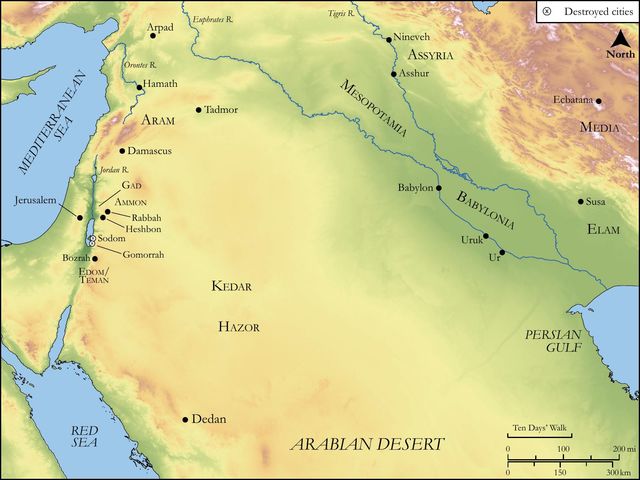
See on the biblical-era map
Study this verse
Public-domain commentary
Matthew Henry
From his Commentary on the Whole Bible. Henry comments on passages, not single verses — this entry covers Jeremiah 49:28–33. His two-level outline is real structure in the source text, so it is rendered as structure.
These verses foretell the desolation that Nebuchadnezzar and his forces should make among the people of Kedar (who descended from Kedar the son of Ishmael, and inhabited a part of Arabia the Stony), and of the kingdoms, the petty principalities, of Hazor, that joined to them, who perhaps were originally Canaanites, of the kingdom of Hazor, in the north of Canaan, which had Jabin for its king, but, being driven thence, settled in the deserts of Arabia and associated themselves with the Kedarenes. Concerning this people we may here observe,
I.What was their present state and posture? They dwelt in tents and had no walls, but curtains (Jer 49:20), no fortified cities; they had neither gates nor bars, Jer 49:31. They were shepherds, and had no treasures, but stock upon land, no money, but flocks and camels. They had no soldiers among them, for they were in no fear of invaders, no merchants, for they dwelt alone, Jer 49:31. Those of other nations neither came among them nor traded with them; but they lived within themselves, content with the products and pleasures of their own country. This was their manner of living, very different from that of the nations that were round about them. And,
1.They were very rich; though they had not trade, no treasures, yet they are here said to be a wealthy nation (Jer 49:31), because they had a sufficiency to answer all the occasions of human life and they were content with it. Note, Those are truly rich who have enough to supply their necessities, and know when they have enough. We need not go to the treasures of kings and provinces, or to the cash of merchants, to look for wealthy people; they may be found among shepherds that dwell in tents.
2.They were very easy: They dwelt without care. Their wealth was such as nobody envied them, or, if any did, they might come peaceably and enjoy the like; and therefore they feared nobody. Note, Those that live innocently and honestly may live very securely, though they have neither gates nor bars.
II.The design of the king of Babylon against them and the descent he make upon them:
He has taken counsel against you and has conceived a purpose against you, Jer 49:30. That proud man resolves it shall never be said that he, who had conquered so many strong cities, will leave those unconquered that dwell in tents. It was strange that that eagle should stoop to catch these flies, that so great a prince should play at such small game; but all is fish that comes to the ambitious covetous man's net. Note, It will not always secure men from suffering wrong to be able to say that they have done no wrong; not to have given offence will not be a defence against such men as Nebuchadnezzar. Yet, how unrighteous soever he was in doing it, God was righteous in directing it. These people had lived inoffensively among their neighbours, as many do, who yet, like them, are guilty before God; and it was to punish them for their offences against him that God said (Jer 49:28): Arise, go up to Kedar, and spoil the men of the east. They will do it to gratify their own covetousness and ambition, but God orders it for the correcting of an unthankful people, and for warning to a careless world to expect trouble when they seem to be most safe. God says to the Chaldeans (Jer 49:31): "Arise, get up to the wealthy nation that dwells without care; go and give them an alarm, that none may imagine their mountain stands so strong that it cannot be moved."
III.The great amazement that this put them into, and the great desolation hereby made among them:
They shall cry unto them; those on the borders shall send the alarm into all parts of the country, which shall be put into the utmost confusion by it; they shall cry, "Fear is on every side - We are surrounded by the enemy." the very terror of which shall drive them all to their feet and they shall none of them have any heart to make resistance. The enemy shall proclaim fear upon them, or against them, on every side. They need not strike a stroke; they shall shout them out of their tents, Jer 49:29. Upon the first alarm, they shall flee, get far off, and dwell deep (Jer 49:30), as the Edomites, Jer 49:8. And it will be found that this fear on every side is not groundless, for their calamity shall be brought from all sides thereof, Jer 49:32. No marvel there are fears on every side when there are foes on every side. The issue will be,
1.What they have will be a prey to the Chaldeans; they shall take to themselves their curtains and vessels; though they are but plain and coarse, and they have better of their own, yet they shall take them for spite, and spoil for spoiling sake. They shall carry away their tents and their flocks, Jer 49:29. Their camels shall be a booty to those that came for nothing else, Jer 49:32.
2.It is not said that any of them shall be slain, for they attempt not to make any resistance and their tents and flocks are accepted as a ransom for their lives; but they shall be dislodged and dispersed; though now they dwell in the utmost corners, out of the way, and therefore they think out of the reach, of danger (by this character those people were distinguished, Jer 9:26, Jer 9:25, Jer 9:23), yet they shall be scattered thence into all winds, into all parts of the world. Note, Privacy and obscurity are not always a protection and security. Many that affect to be strangers to the world may yet by unthought-of providences be forced into it; and those that live most retired may have the same lot with those that thrust themselves forth and lie most exposed.
3.Their country shall lie uninhabited; for, lying remote and out of all high roads, and having neither cities nor lands inviting to strangers, none shall care to succeed them, so that Hazor shall be a desolation for ever, Jer 49:33. If busy men be displaced, many strive to get into their placed, because they lived great; but here are easy quiet men displaced, and no man cared to abide where they did, because they lived meanly.
Continue studying Jeremiah 49:33 across the web’s major study libraries — every link below opens this exact verse, chapter, or book on the destination site.
Read & Compare
 BibleGatewayThis verse in more than 200 translations and 70 languages.
 Bible.comThe YouVersion reader — hundreds of translations, reading plans, and highlights.
 ESV.orgCrossway's official English Standard Version reader.
 NET BibleThe NET translation with 60,000+ translators' notes on every rendering decision.
 STEP BibleTyndale House's free study tool — original text, vocabulary, and scholarly resources.
 BibliaLogos Bible Software's free web reader.
 USCCBThe New American Bible (Revised Edition) with the U.S. bishops' study notes.
Commentaries
 BibleHub CommentariesDozens of classic commentaries on this verse, gathered on one page.
 StudyLightMore than 100 commentary sets — the largest collection on the web.
 BibleRefPlain-English commentary on what this verse means, verse by verse.
 Enduring WordDavid Guzik's free commentary on this chapter, widely used by Bible teachers.
 Bible Study ToolsVerse commentary alongside Greek and Hebrew study aids.
Original Language & Research
- BibleHub InterlinearThe verse word by word — original language, transliteration, and English.
- BibleHub LexiconEvery word's original-language definition and Strong's entry.
 Blue Letter BibleDeep-study tools — Strong's numbers, concordance, and word studies.
 SefariaThe Hebrew text with Rashi and centuries of Jewish commentary.
Sermons, Hymns & Audio


TrulyRandomVerse is not affiliated with these sites and doesn’t control their content. They’re linked because they’re genuinely useful.
Summary
Jeremiah 49:33 delivers a severe prophetic judgment against Hazor, declaring its complete and permanent desolation. This pronouncement signifies that the once-inhabited stronghold will be reduced to an uninhabitable wasteland, fit only for wild creatures, with no human presence ever returning. It serves as a stark testament to God's universal sovereignty and the certainty of His word, demonstrating that no nation, however secure or proud, is exempt from divine accountability.
Context
ShowHideLiterary Context
Jeremiah 49:33 concludes a specific oracle against Kedar and Hazor, found in Jeremiah 49:28-33, which is part of a larger collection of prophecies against foreign nations in Jeremiah 46-51. This section immediately follows pronouncements against Ammon, Edom, and Damascus, underscoring God's comprehensive authority over all peoples, not just Israel. The placement of this oracle at the end of the Kedar and Hazor section emphasizes the finality and severity of the judgment, serving as a climactic declaration of ruin for a people who felt secure in their remote and fortified dwelling. The prophet's consistent message throughout these chapters is that all nations are subject to the divine will and judgment of the Lord, who raises up and casts down kingdoms according to His righteous purposes, as seen in His commission to Jeremiah to "root out, and to pull down, and to destroy, and to throw down, to build, and to plant" nations and kingdoms in Jeremiah 1:10.
Historical & Cultural Context
The Hazor mentioned here is widely understood by scholars not to be the prominent northern Israelite city of Hazor (destroyed centuries earlier), but rather an Arabian settlement or stronghold associated with the nomadic tribe of Kedar. Kedar was a powerful and influential Arabian tribe, known for its wealth from trade and its formidable military strength. They were often depicted as dwelling in tents and moving with their flocks, but also having fortified encampments or trading posts like Hazor. This Hazor was likely a strategic oasis or a fortified center that provided security and a base for their activities, giving them a sense of invulnerability. The prophecy's focus on its utter desolation would have been particularly devastating to a people who prided themselves on their self-sufficiency and the perceived impregnability of their dwelling places. The judgment against Hazor, therefore, targets not just a physical location but the very foundation of Kedarite pride and security.
Key Themes
ShowHideThis verse powerfully contributes to several overarching themes in Jeremiah and the prophetic literature. Firstly, it highlights Divine Sovereignty and Universal Judgment, demonstrating that God's authority extends far beyond Judah to encompass all nations. His judgment is impartial and righteous, falling upon those who live in pride, oppose His will, or engage in injustice, reinforcing the idea that "the Lord reigns" over all the earth, as proclaimed in Psalm 97:1. Secondly, the imagery of "a dwelling for dragons" and "a desolation for ever" emphasizes Utter and Irreversible Desolation. This signifies a complete and permanent ruin, where human habitation ceases, and the land reverts to a wild, uninhabitable state, a common prophetic motif for divine judgment on rebellious cities, as seen in the prophecies against Babylon in Isaiah 13:20-22. Finally, the definitive language ("shall be," "shall no man abide") underscores the Certainty and Reliability of God's Prophetic Word. What God declares will undoubtedly come to pass, serving as a powerful reminder of His faithfulness to His pronouncements, whether of blessing or judgment, and affirming that "the word of our God will stand forever" as declared in Isaiah 40:8.
Exposition and Analysis
ShowHideKey Word Analysis
ShowHideA collective form of the Hebrew word for "village" or "enclosure." In this context, it refers to a specific place in Arabia, likely a fortified settlement or prominent center associated with the Kedarites. Its naming here highlights its significance as a target of divine judgment, emphasizing that even seemingly secure and remote places are not beyond God's reach.
From a root meaning "to abide" or "to dwell." It signifies an abode, a habitation, or a lair. It can refer to a home for humans, a dwelling place for God (like the Tabernacle or Temple), or a lair for animals. Here, its transformation from a human dwelling to a "dwelling for dragons" powerfully conveys the reversal of its status from a place of human life and order to one of wildness and desolation.
An intensive form meaning a "marine or land monster," often translated as "sea-serpent," "jackal," or "whale." In prophetic contexts, especially when describing desolation, it commonly refers to large, wild, desert creatures like jackals, wild dogs, or hyenas. The imagery of a place becoming a "dwelling for dragons" vividly portrays its utter ruin and abandonment by humans, indicating it will be overrun by scavengers and wild beasts, a symbol of complete and irreversible desolation.
Verse Breakdown
ShowHide"And Hazor shall be a dwelling for dragons"
This clause immediately sets the tone of severe judgment. Hazor, once a place of human habitation and presumably a center of activity for the Kedarites, is prophesied to become a lair for wild, desolate creatures. The term "dragons" (tannîyn) here most likely refers to jackals or other desert scavengers, painting a vivid picture of a place so utterly ruined and abandoned that it becomes a habitat for the wild, untamed elements of nature. This is a powerful reversal of its intended purpose as a human dwelling.
"and a desolation for ever"
This phrase intensifies the preceding declaration, emphasizing the permanence and completeness of Hazor's ruin. "Desolation" (shᵉmâmâh) signifies a state of waste, emptiness, and devastation. The addition of "for ever" (l'olam) indicates that this state of ruin is not temporary but perpetual, implying that the city will never be rebuilt or re-inhabited by humans. This highlights the irreversible nature of God's judgment once it is fully executed.
"there shall no man abide there, nor any son of man dwell in it"
This final clause explicitly confirms the absolute and eternal abandonment of Hazor by humanity. The repetition of "no man" (ʼîysh) and "nor any son of man" (bên ʼâdâm) serves as an emphatic declaration that human life will utterly cease in this place. The terms "abide" (yâshab) and "dwell" (gûwr) reinforce the idea that no one will settle, reside, or even sojourn there. This complete cessation of human presence underscores the severity and finality of the divine judgment, leaving no hope for future recovery or repopulation.
Literary Devices
ShowHideJeremiah 49:33 employs several powerful literary devices to convey its message of utter ruin. Imagery is central, with the vivid picture of "Hazor shall be a dwelling for dragons." This evokes a sense of wildness, abandonment, and decay, transforming a human settlement into a habitat for creatures associated with desolation and wasteland. The term "dragons" (tannîyn), though often translated as such, more accurately refers to jackals or wild dogs, making the imagery even more stark and realistic in a desert context. Hyperbole is also evident in the phrase "a desolation for ever" and "there shall no man abide there, nor any son of man dwell in it." While perhaps not literally meaning for all eternity in a cosmic sense, the expression emphasizes a permanent and irreversible state of ruin, beyond human repair or repopulation, underscoring the severity and finality of God's judgment. This prophetic Foreshadowing serves as a warning to other nations and peoples, illustrating the inevitable consequences of pride and rebellion against divine sovereignty. The definitive and absolute language used throughout the verse is characteristic of Prophetic Language, which often employs strong, unyielding declarations to convey the certainty of God's word and His unchallengeable authority.
Theological and Thematic Connections
ShowHideJeremiah 49:33 stands as a profound testament to the universal scope of God's justice and sovereignty. It underscores the theological truth that the Lord is not merely the God of Israel but the sovereign ruler over all nations, holding every people accountable for their actions, pride, and rebellion. The utter desolation prophesied for Hazor serves as a powerful reminder that human power, security, and wealth are transient and ultimately subject to divine decree. This judgment is a manifestation of God's righteousness, demonstrating that sin and defiance, whether from Judah or distant Arabian tribes, will ultimately face consequences. It calls all humanity to humility and recognition of God's supreme authority, for He is the one who "brings princes to nothing and makes the rulers of the earth as emptiness" (Isaiah 40:23).
Reflection and Application
ShowHideJeremiah 49:33, while a prophecy of ancient judgment, holds timeless truths for contemporary reflection and application. It serves as a potent reminder that all human endeavors, no matter how grand, secure, or self-sufficient, are ultimately fragile before the sovereign power of God. The fate of Hazor compels us to consider the impermanence of earthly kingdoms, wealth, and perceived security, urging us to place our trust not in fleeting human strength or material possessions, but in the eternal and unchanging God. It challenges any sense of national or personal pride that elevates itself against divine authority, reminding us that accountability before God is universal. Furthermore, the unwavering fulfillment of such prophecies strengthens our faith in the absolute reliability of God's Word, encouraging us to live in accordance with His revealed truth, knowing that His promises and warnings are equally certain.
Questions for Reflection
ShowHideFAQ
ShowHideWhich Hazor is mentioned in Jeremiah 49:33, and why is it significant?
ShowHideThe Hazor mentioned in Jeremiah 49:33 is generally understood by scholars to be an Arabian settlement or stronghold associated with the nomadic tribe of Kedar, not the well-known Israelite city of Hazor in northern Galilee. This distinction is crucial because the prophecy immediately follows an oracle against Kedar in Jeremiah 49:28, placing it firmly within the context of God's judgment against Arabian peoples. Its significance lies in its likely role as a fortified center or trading post for the Kedarites, symbolizing their pride, wealth, and perceived invulnerability. Its prophesied utter desolation underscores God's universal sovereignty, demonstrating that even remote and seemingly secure nations are subject to His divine judgment, much like other nations faced judgment in the broader collection of oracles against the nations in Jeremiah 46-51, such as Egypt in Jeremiah 46 and Babylon in Jeremiah 50.
What does "dwelling for dragons" mean in this context?
ShowHideThe KJV translation "dragons" for the Hebrew word tannîyn (H8577) in Jeremiah 49:33 does not refer to mythical, fire-breathing creatures. In biblical Hebrew, tannîyn can refer to large marine creatures (like whales or sea monsters) or, more commonly in terrestrial contexts, to large desert predators and scavengers such as jackals, wild dogs, or hyenas. Therefore, "a dwelling for dragons" vividly portrays a place that has been utterly abandoned by humans and has reverted to a wild, desolate state, becoming a habitat for these untamed desert animals. This imagery is a powerful symbol of complete ruin and uninhabitable wasteland, similar to descriptions of other doomed cities in prophetic literature, signifying that the place will be utterly devoid of human life and given over to the wilderness, as seen in the prophecy against Babylon in Isaiah 13:21-22.
Christ-Centered Fulfillment
ShowHideWhile Jeremiah 49:33 pronounces a specific judgment on an ancient nation, its deeper theological currents find profound Christ-centered fulfillment. The prophecy of Hazor's utter desolation, where no man or "son of man" would dwell, speaks to the ultimate consequences of sin and rebellion against God's sovereign rule. In Christ, we see the ultimate "Son of Man" (Daniel 7:13), who did not come to bring desolation but to bear it. He took upon Himself the full weight of divine judgment for humanity's sin, experiencing ultimate abandonment and desolation on the cross, crying out, "My God, my God, why have you forsaken me?" (Matthew 27:46). Through His sacrifice, Christ transforms the prospect of eternal desolation for humanity into an offer of eternal life and dwelling with God. He is the one who establishes a new, eternal dwelling place, a "new heaven and a new earth" (Revelation 21:1), where there will be no more curse, no more desolation, and where God Himself will "dwell with them" (Revelation 21:3). Thus, the judgment on Hazor foreshadows the universal need for redemption from spiritual desolation, a redemption fully accomplished in the person and work of Jesus Christ, who invites all to find their true and secure dwelling in Him, the cornerstone of God's eternal kingdom (Ephesians 2:20-22).