


Jeremiah 9:11
Bible text: King James Version (1769 Blayney text) · Public domain
Bible text: Berean Standard Bible · Public domain
Bible text: American Standard Version (1901) · Public domain
Bible text: World English Bible, Messianic edition · Public domain
Bible text: Geneva Bible (1599) · Public domain
Bible text: Young's Literal Translation · Public domain
- וְנָתַתִּיve·na·ta·Tiand I will makeH5414Conj-w ¦ V-Qal-ConsecPerf-1csVerb Qal Consecutive Perfect 1st Singular common genderוְandנָתַתִּיI will make
- אֶת'et<obj.>H853DirObjMParticle Object Indicator
- יְרוּשָׁלִַםye·ru·sha·LimJerusalemH3389N-properNoun Proper Location
- לְגַלִּיםle·ga·Liminto heaps of stonesH1530Prep-l ¦ N-mpNoun Plural Masculine Absoluteלְintoגַלִּיםheaps of stones
- מְעוֹןme·'ona habitation ofH4583N-mscNoun Singular Masculine Construct
- תַּנִּיםta·NimjackalsH8577N-mpNoun Plural Masculine Absolute
- וְאֶתve·'Etand <obj.>H853Conj-w ¦ DirObjMParticle Object Indicatorוְandאֶת<obj.>
- עָרֵי'a·Rei[the] cities ofH5892N-mpcNoun Plural Masculine Construct
- יְהוּדָהye·hu·DahJudahH3063N-properNoun Proper Location
- אֶתֵּן'e·TenI will makeH5414V-Qal-Imperf-1csVerb Qal Imperfect 1st Singular common gender
- שְׁמָמָהshe·ma·Maha wasteH8077N-fsNoun Singular Feminine Absolute
- מִבְּלִיmi·be·Libecause notH1097Prep-m ¦ N-msNoun Singular Masculine Absoluteמִbecauseבְּלִיnot
- יוֹשֵׁבyo·ShevinhabitantH3427V-Qal-Prtcpl-msVerb Qal Participle Singular Masculine Absolute
English is a literal word-by-word gloss of the Hebrew, not the KJV's wording. Why?
This is the original text the KJV's translators worked from — each Hebrew word with its own literal English meaning in this verse, prepared by scholars at Tyndale House, Cambridge. The KJV translates whole sentences, not word by word, so its wording differs: one Hebrew word can become several English words, and the KJV may choose “the LORD” where the gloss reads “Yahweh”. Both are faithful — they answer different questions. For the KJV's own rendering, switch to the KJV text.
Details
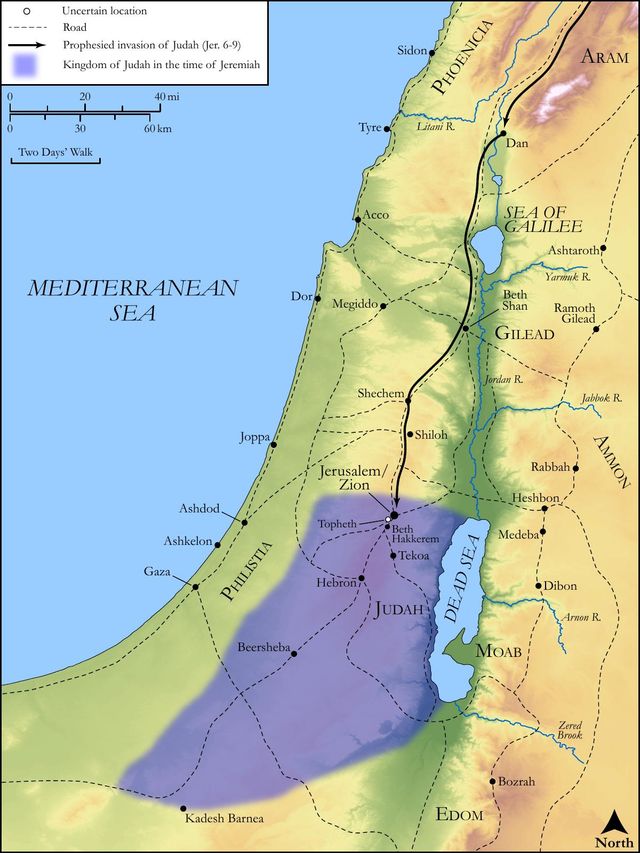
See on the biblical-era map
Study this verse
Public-domain commentary
Matthew Henry
From his Commentary on the Whole Bible. Henry comments on passages, not single verses — this entry covers Jeremiah 9:1–11. His four-level outline is real structure in the source text, so it is rendered as structure.
The prophet, being commissioned both to foretel the destruction coming upon Judah and Jerusalem and to point out the sin for which that destruction was brought upon them, here, as elsewhere, speaks of both very feelingly: what he said of both came from the heart, and therefore one would have thought it would reach to the heart.
I.He abandons himself to sorrow in consideration of the calamitous condition of his people, which he sadly laments, a one that preferred Jerusalem before his chief joy and her grievances before his chief sorrows.
1.He laments the slaughter of the persons, the blood shed and the lives lost (Jer 9:1): "O that my head were waters, quite melted and dissolved with grief, that so my eyes might be fountains of tears, weeping abundantly, continually, and without intermission, still sending forth fresh floods of tears as there still occur fresh occasions for them!" The same word in Hebrew signifies both the eye and a fountain, as if in this land of sorrows our eyes were designed rather for weeping than seeing. Jeremiah wept much, and yet wished he could weep more, that he might affect a stupid people and rouse them to a due sense of the hand of God gone out against them. Note, It becomes us, while we are here in this vale of tears, to conform to the temper of the climate and to sow in tears. Blessed are those that mourn, for they shall be comforted hereafter; but let them expect that while they are here the clouds will still return after the rain. While we find our hearts such fountains of sin, it is fit that our eyes should be fountains of tears. But Jeremiah's grief here is upon the public account: he would weep day and night, not so much for the death of his own near relations, but for the slain of the daughter of his people, the multitudes of his countrymen that fell by the sword of war. Note, When we hear of the numbers of the slain in great battles and sieges we ought to be much affected with the intelligence, and not to make a light matter of it; yea, though they be not of the daughter of our people, for, whatever people they are of, they are of the same human nature with us, and there are so many precious lives lost, as dear to them as ours to us, and so many precious souls gone into eternity.
2.He laments the desolations of the country. This he brings in (v. 10), for impassioned mourners are not often very methodical in their discourses: "Not only for the towns and cities, but for the mountains, will I take up a weeping and wailing" (not barren mountains, but the fruitful hills with which Judea abounded), and for the habitations of the wilderness, or rather the pastures of the plain, that used to be clothed with flocks or covered over with corn, and a goodly sight it was; but now they are burnt up by the Chaldean army (which, according to the custom of war, destroyed to the custom of war, destroyed the forage and carried off all the cattle), so that no one dares to pass through them, for fear of meeting with some parties of the enemy, no one cares to pass through them, every thing looks so melancholy and frightful, no one has any business to pass through them, for they hear not the voice of the cattle there as usual, the bleating of the sheep and the lowing of the oxen, that grateful music to the owners; nay, both the fowl of the heavens and the beasts have fled. either frightened away by the rude noises and terrible fires which the enemies make, or forced away because there is no subsistence for them. Note, God has many ways of turning a fruitful land into barrenness for the wickedness of those that dwell therein; and the havoc war makes in a country cannot but be for a lamentation to all tender spirits, for it is a tragedy which destroys the stage it is acted on.
II.He abandons himself to solitude, in consideration of the scandalous character and conduct of his people.
Though he dwells in Judah where God is known, in Salem where his tabernacle is, yet he is ready to cry out, Woe is me that I sojourn in Mesech! Psa 120:5. While all his neighbours are fleeing to the defenced cities, and Jerusalem especially, in dread of the enemies' rage (Jer 4:5, Jer 4:6) he is contriving to retire into some desert, in detestation of his people's sin (Jer 9:2): "O that I had in the wilderness a lodging-place of wayfaring men, such a lonely cottage to dwell in as they have in the deserts of Arabia, which are uninhabited, for travellers to repose themselves in, that I might leave my people and go from them!" Not only because of the ill usage they gave him (he would rather venture himself among the wild beasts of the desert than among such treacherous barbarous people), but principally because his righteous soul was vexed from day to day, as Lot's was in Sodom, with the wickedness of their conversation, Pe2 2:7, Pe2 2:8. This does not imply any intention or resolution that he had thus to retire. God had cut him out work among them, which he must not quit for his own ease. We must not go out of the world, bad as it is, before our time. If he could not reform them, he could bear a testimony against them; if he could not do good to many, yet he might to some. but it intimates the temptation he was in to leave them, involves a threatening that they should be deprived of his ministry, and especially expresses the holy indignation he had against their abominable wickedness, which continued notwithstanding all the pains he had taken with them to reclaim them. It made him even weary of his life to see them dishonouring God as they did and destroying themselves. Time was when the place which God had chosen to put his name there was the desire and delight of good men. David, in a wilderness, longed to be again in the courts of God's house; but now Jeremiah, in the courts of God's house (for there he was when he said this), wishes himself in a wilderness. Those have made themselves very miserable that have made God's people and ministers weary of them and willing to get from them. Now, to justify his willingness to leave them, he shows,
1.What he himself had observed among them.
(1.)He would not think of leaving them because they were poor and in distress, but because they were wicked.
[1.]They were filthy: They are all adulterers, that is, the generality of them are, Jer 5:8. They all either practised this sin or connived at those that did. Lewdness and uncleanness constituted that crying sin of Sodom at which righteous Lot was vexed in soul, and it is a sin that renders men loathsome in the eyes of God and all good men; it makes men an abomination.
[2.]They were false. This is the sin that is most enlarged upon here. Those that had been unfaithful to their God were so to one another, and it was a part of their punishment as well as their sin, for even those that love to cheat, yet hate to be cheated. First, Go into their solemn meetings for the exercises of religion, for the administration of justice, or for commerce - to church, to court, or to the exchange - and they are an assembly of treacherous men; they are so by consent, they strengthen one another's hands in doing any thing that is perfidious. There they will cheat deliberately and industriously, with design, with a malicious design, for (Jer 9:3) they bend their tongues, like their bow, for lies, with a great deal of craft; their tongues are fitted for lying, as a bow that is bent is for shooting, and are as constantly used for that purpose. Their tongue turns as naturally to a lie as the bow to the strong. But they are not valiant for the truth upon the earth. Their tongues are like a bow strung, with which they might do good service if they would use the art and resolution which they are so much masters of in the cause of truth; but they will not do so. They appear not in defence of the truths of God, which were delivered to them by the prophets; but even those that could not deny them to be truths were content to see them run down. In the administration of justice they have not courage to stand by an honest cause that has truth on its side, if greatness and power be on the other side. Those that will be faithful to the truth must be valiant for it, and not be daunted by the opposition given to it, nor fear the face of man. They are not valiant for the truth in the land, the land which has truth for the glory of it. Truth has fallen in the land, and they dare not lend a hand to help it up, Isa 59:14, Isa 59:15. We must answer, another day, not only for our enmity in opposing truth, but for our cowardice in defending it. Secondly, Go into their families, and you will find they will cheat their own brethren (every brother will utterly supplant); they will trip up one another's heels if they can, for they lie at the catch to seek all advantages against those they hope to make a hand of. Jacob had his name from supplanting; it is the word here used; they followed him in his name, but not in his true character, without guile. So very false are they that you cannot trust in a brother, but must stand as much upon your guard as if you were dealing with a stranger, with a Canaanite that has balances of deceit in his hand. Things have come to an ill pass indeed when a man cannot put confidence in his own brother. Thirdly, Go into company and observe both their commerce and their conversation, and you will find there is nothing of sincerity or common honesty among them. Nec hospes ab hospite tutus - The host and the guest are in danger from each other. The best advice a wise man can give you is to take heed every one of his neighbour, nay, of his friend (so some read it), of him whom he has befriended and who pretends friendship to him. No man thinks himself bound to be either grateful or sincere. Take them in their conversation and every neighbour will walk with slander; they care not what ill they say one of another, though ever so false; that way that the slander goes they will go; they will walk with it. They will walk about from house to house too, carrying slanders along with them, all the ill-natured stories they can pick up or invent to make mischief. Take them in their trading and bargaining, and they will deceive every one his neighbour, will say any thing, though they know it to be false, for their own advantage. Nay, they will lie for lying sake, to keep their tongues in use to it, for they will not speak the truth, but will tell a deliberate lie and laugh at it when they have done.
(2.)That which aggravates the sin on this false and lying generation is,
[1.]That they are ingenious to sin: They have taught their tongue to speak lies, implying that through the reluctances of natural conscience they found it difficult to bring themselves to it. Their tongue would have spoken truth, but they taught it to speak lies, and by degrees have made themselves masters of the art of lying, and have got such a habit of it that use has made it a second nature to them. They learnt it when they were young (for the wicked are estranged from the womb, speaking lies, Psa 58:3), and now they have grown dexterous at it.
[2.]That they are industrious to sin: They weary themselves to commit iniquity; they put a force upon their consciences to bring themselves to it; they tire out their convictions by offering them continual violence, and they take a great deal of pains, till they have even spent themselves in bringing about their malicious designs. They are wearied with their sinful pursuits and yet not weary of them. The service of sin is a perfect drudgery; men run themselves out of breath in it, and put themselves to a great deal of toil to damn their own souls.
[3.]That they grow worse and worse (Jer 9:3): They proceed from evil to evil, from one sin to another, from one degree of sin to another. They began with less sins. Nemo repente fit turpissimus - No one reaches the height of vice at once. They began with equivocating and bantering, but at last came to downright lying. And they are now proceeding to greater sins yet, for they know not me, saith the Lord; and where men have no knowledge of God, or no consideration of what they have known of him, what good can be expected from them? Men's ignorance of God is the cause of all their ill conduct one towards another.
2.The prophet shows what God had informed him of their wickedness, and what he had determined against them.
(1.)God had marked their sin. He could tell the prophet (and he speaks of it with compassion) what sort of people they were that he had to deal with. I know thy works, and where thou dwellest, Rev 2:13. So here (Jer 9:6): "Thy habitation is in the midst of deceit, all about thee are addicted to it; therefore stand upon thy guard." If all men are liars, it concerns us to beware of men,. and to be wise as serpents. They are deceitful men; therefore there is little hope of thy doing any good among them; for, make things ever so plain, they have some trick or other wherewith to shuffle off their convictions. This charge is enlarged upon, Jer 9:8. Their tongue was a bow bent (Jer 9:3), plotting and preparing mischief; here it is an arrow shot out, putting in execution what they had projected. It is as a slaying arrow (so some readings of the original have it); their tongue has been to many an instrument of death. They speak peaceably to their neighbours, against whom they are at the same time lying in wait; as Joab kissed Abner when he was about to kill him, and Cain, that he might not be suspected of any ill design, talked with his brother, freely and familiarly. Note, Fair words, when they are not attended with good intentions, are despicable, but, when they are intended as a cloak and cover for wicked intentions they are abominable. While they did all this injury to one another they put a great contempt upon God: "Not only they know not me, but (Jer 9:6) through deceit, through the delusions of the false prophets, they refuse to know me; they are so cheated into a good opinion of their own ways, the ways of their own heart, that they desire not the knowledge of my ways." Or, "They are so wedded to this sinful course which they are in, and so bewitched with that, and its gains, that they will by no means admit the knowledge of God, because that would be a check upon them in their sins." This is the ruin of sinners: they might be taught the good knowledge of the Lord and they will not learn it; and where no knowledge of God is, what good can be expected? Hos 4:1.
(2.)He had marked them for ruin, Jer 9:7, Jer 9:9, Jer 9:11. Those that will not know God as their lawgiver shall be made to know him as their judge. God determines here to bring his judgments upon them, for the refining of some and the ruining of the rest.
[1.]Some shall be refined (Jer 9:7): "Because they are thus corrupt, behold I will melt them and try them, will bring them into trouble and see what that will do towards bringing them to repentance, whether the furnace of affliction will purify them from their dross, and whether, when they are melted, they will be new-cast in a better mould." He will make trial of less afflictions before he brings upon them utter destruction; for he desires not the death of sinners. They shall not be rejected as reprobate silver till the founder has melted in vain, Jer 6:29, Jer 6:30. For how shall I do for the daughter of my people? He speaks as one consulting with himself what to do with them that might be for the best, and as one that could not find in his heart to cast them off and give them up to ruin till he had first tried all means likely to bring them to repentance. Or, "How else shall I do for them? They have grown so very corrupt that there is no other way with them but to put them into the furnace; what other course can I take with them? Isa 5:4, Isa 5:5. It is the daughter of my people, and I must do something to vindicate my own honour, which will be reflected upon if I connive at their wickedness. I must do something to reduce and reform them." A parent corrects his own children because they are his own. Note, When God afflicts his people, it is with a gracious design to mollify and reform them; it is but when need is and when he knows it is the best method he can use.
[2.]The rest shall be ruined (Jer 9:9): Shall I not visit for these things? Fraud and falsehood are sins which God hates and which he will reckon for. "Shall not my soul be avenged on such a nation as this, that is so universally corrupt, and, by its impudence in sin, even dares and defies divine vengeance? The sentence is passed, the decree has gone forth (Jer 9:11): I will make Jerusalem heaps of rubbish, and lay it in such ruins that it shall be fit for nothing but to be a den of dragons; and the cities of Judah shall be a desolation." God makes them so, for he gives the enemy warrant and power to do it: but why is the holy city made a heap? The answer is ready, Because it has become an unholy one?
Historical interpretation
Historical reception
1 surviving comment on this verse from the historical church.
(Verse 11) And I will make Jerusalem a heap of sand (or in exile) and a dwelling place of dragons, and I will make the cities of Judah desolate; because there is no inhabitant. When ecclesiastical men and teachers have failed, then Jerusalem is given into exile, or into a heap of sand, so that the heretic's speech prevails in it, and it becomes a dwelling place of dragons, and its cities are reduced to solitude, and there is no habitation of divine discourse in it, and he who says: I will dwell and walk in them, and I will be their God (Leviticus 26:12).
Continue studying Jeremiah 9:11 across the web’s major study libraries — every link below opens this exact verse, chapter, or book on the destination site.
Read & Compare
 BibleGatewayThis verse in more than 200 translations and 70 languages.
 Bible.comThe YouVersion reader — hundreds of translations, reading plans, and highlights.
 ESV.orgCrossway's official English Standard Version reader.
 NET BibleThe NET translation with 60,000+ translators' notes on every rendering decision.
 STEP BibleTyndale House's free study tool — original text, vocabulary, and scholarly resources.
 BibliaLogos Bible Software's free web reader.
 USCCBThe New American Bible (Revised Edition) with the U.S. bishops' study notes.
Commentaries
 BibleHub CommentariesDozens of classic commentaries on this verse, gathered on one page.
 StudyLightMore than 100 commentary sets — the largest collection on the web.
 BibleRefPlain-English commentary on what this verse means, verse by verse.
 Enduring WordDavid Guzik's free commentary on this chapter, widely used by Bible teachers.
 Bible Study ToolsVerse commentary alongside Greek and Hebrew study aids.
Original Language & Research
- BibleHub InterlinearThe verse word by word — original language, transliteration, and English.
- BibleHub LexiconEvery word's original-language definition and Strong's entry.
 Blue Letter BibleDeep-study tools — Strong's numbers, concordance, and word studies.
 SefariaThe Hebrew text with Rashi and centuries of Jewish commentary.
Sermons, Hymns & Audio


TrulyRandomVerse is not affiliated with these sites and doesn’t control their content. They’re linked because they’re genuinely useful.
Summary
Jeremiah 9:11 is a stark prophetic declaration of God's impending judgment upon Jerusalem and the cities of Judah, portraying a future of utter devastation. It vividly describes the once-thriving capital being reduced to mere ruins, a desolate haunt for wild creatures, while the surrounding towns are left completely uninhabited. This pronouncement underscores the severe consequences of the nation's persistent unfaithfulness, idolatry, and rejection of God's covenant, serving as a powerful testament to divine justice against prolonged rebellion.
Context
ShowHideLiterary Context
This verse is deeply embedded within a broader section of Jeremiah's prophecies (chapters 7-10) that deliver uncompromising judgment against Judah and Jerusalem for their profound spiritual corruption. Following a powerful and confrontational sermon delivered at the temple gate, where Jeremiah exposes the people's false security in the temple while they engage in widespread idolatry, oppression, and covenant breaking (as detailed in Jeremiah 7:1-15), the prophet continues to lament the nation's spiritual blindness and impending doom. Specifically, Jeremiah 9:10 immediately precedes this verse, depicting the land's desolation and the mournful wailing of shepherds, thereby setting the somber stage for the specific pronouncement of Jerusalem's catastrophic fate. The subsequent verses, such as Jeremiah 9:12-16, further elaborate on the precise reasons for this severe judgment, attributing it directly to their abandonment of God's law and their stubborn adherence to idolatry.
Historical & Cultural Context
Jeremiah's prophetic ministry unfolded during the tumultuous final decades of the Kingdom of Judah, spanning the reigns of Josiah, Jehoiakim, and Zedekiah (roughly late 7th to early 6th century BCE). This era was characterized by intense political instability, with Judah precariously positioned between the rising imperial power of Babylon and the declining empires of Assyria and Egypt. Spiritually, it was a period of profound apostasy, despite Josiah's earlier, significant reforms. The populace had largely reverted to syncretistic worship, incorporating abhorrent pagan practices, including child sacrifice (a practice vehemently condemned in Jeremiah 7:31), alongside pervasive oppression. Jerusalem, as the capital and the revered religious center housing the Temple, was widely perceived by its inhabitants as inviolable and divinely protected. However, Jeremiah's message directly challenged this dangerous false sense of security, asserting that God's covenant blessings were strictly conditional upon obedience. He declared that their persistent sin would inevitably lead to the very destruction they deemed impossible. The vivid imagery of "heaps" and a "den of dragons" would have resonated deeply with an ancient audience, who were intimately familiar with the common and tragic fate of conquered cities, which were routinely reduced to rubble and abandoned to wild animals.
Key Themes
ShowHideJeremiah 9:11 powerfully contributes to several overarching themes that permeate the book of Jeremiah. Foremost among these is the theme of Divine Judgment, which unequivocally demonstrates God's righteous wrath against unrepentant sin and covenant infidelity. This judgment is presented not as arbitrary, but as a just and inevitable consequence of Judah's persistent rebellion, as highlighted in passages like Jeremiah 7:24. The verse also profoundly emphasizes the theme of Utter Desolation and Abandonment, portraying a complete and devastating reversal of God's promises of blessing and fruitfulness for the land. The chilling imagery of a "den of dragons" and the phrase "without an inhabitant" vividly communicate the extreme extent of this ruin, reflecting the dire warnings of the Deuteronomic curses (e.g., Deuteronomy 28:15-68). Finally, it underscores the severe Consequences of Idolatry and Disobedience, serving as a stark and enduring reminder that turning away from the Lord inevitably leads to destruction—a message consistently echoed throughout Jeremiah's prophetic ministry, as seen in passages like Jeremiah 2:13.
Exposition and Analysis
ShowHideKey Word Analysis
ShowHideMeaning "something rolled, i.e. a heap of stone or dung (plural ruins)." In this context, "heaps" refers to the accumulated debris and rubble of a city that has been utterly destroyed, signifying complete ruin and abandonment. It paints a vivid picture of Jerusalem reduced to a mound of broken stones and waste, a stark and tragic contrast to its former glory and vibrant life.
Meaning "an abode, of God (the Tabernacle or the Temple), men (their home) or animals (their lair); hence, a retreat (asylum)." Here, it specifically denotes a lair or dwelling place for wild animals. The transformation of Jerusalem, once revered as the dwelling place of God and His chosen people, into a "den" for wild creatures profoundly emphasizes its complete desolation, the loss of human habitation, and the withdrawal of divine presence.
Meaning "a marine or land monster, i.e. sea-serpent or jackal; dragon, sea-monster, serpent, whale." While often translated as "jackals" or "wild dogs" in contexts of desolation due to their association with ruins and desolate places, "dragons" evokes a more fearsome, primeval, and untamed imagery of wild and dangerous creatures. This particular choice amplifies the horror and completeness of the desolation, suggesting a place so utterly ruined and dangerous that only the most fearsome or wild creatures would dare inhabit it.
Verse Breakdown
ShowHide"And I will make Jerusalem heaps"
This initial clause declares God's direct and sovereign agency in the impending destruction of Jerusalem. The verb "make" (H5414, nâthan) signifies His active and intentional role in bringing about this severe judgment. Jerusalem, once the proud capital and spiritual heart of the kingdom, will be reduced to mere mounds of rubble and ruins, standing as a stark testament to its utter collapse and destruction.
"and a den of dragons"
This phrase further elaborates on the prophesied state of Jerusalem. It will not merely be ruined but will become a habitat for wild, desolate creatures, specifically "dragons" (often understood as jackals or other wild beasts of the wilderness). This chilling imagery profoundly emphasizes the complete abandonment of the city by human inhabitants and its tragic transformation into a wild, untamed, and dangerous wasteland.
"and I will make the cities of Judah desolate"
The scope of God's judgment extends beyond Jerusalem to encompass all the surrounding cities within the territory of Judah. God explicitly declares His intention to render them "desolate" (H8077, shᵉmâmâh), meaning laid waste, ruined, and completely uninhabited. This signifies a widespread, comprehensive, and devastating judgment affecting the entire kingdom.
"without an inhabitant."
This final, emphatic phrase underscores the absolute and complete nature of the desolation. The cities of Judah will be so utterly destroyed and abandoned that no human being will remain to dwell within them. The explicit absence of an "inhabitant" (H3427, yâshab, related to dwelling) confirms the complete cessation of human life, activity, and presence in these once-populous and thriving areas.
Literary Devices
ShowHideJeremiah 9:11 masterfully employs several potent literary devices to convey the profound severity and totality of God's judgment. Imagery is central, with vivid pictures of "heaps" of rubble and a "den of dragons" painting a visceral and chilling scene of utter destruction and abandonment. These images are not merely descriptive but serve as powerful Symbolism for the complete reversal of Judah's fortunes and the devastating loss of its covenant blessings. The tragic transformation of a once-vibrant capital into a haunt for wild beasts profoundly symbolizes the deep spiritual decay and covenant infidelity that inevitably led to such catastrophic physical ruin. The repetition of "I will make" acts as a form of Anaphora, powerfully emphasizing God's sovereign hand and unwavering resolve in executing this judgment. Furthermore, the stark contrast between Jerusalem's former glory and its prophesied state of desolation creates a powerful sense of Irony and tragic loss, underscoring the devastating and irreversible consequences of national sin.
Theological and Thematic Connections
ShowHideJeremiah 9:11 stands as a powerful and enduring testament to God's unwavering justice and the severe, unavoidable consequences of covenant unfaithfulness. It reveals that while God is infinitely merciful and slow to anger, His divine patience has definitive limits, and persistent rebellion against His revealed will inevitably leads to righteous judgment. This judgment is never arbitrary but is a direct and just consequence of Judah's pervasive idolatry, deep moral corruption, and their stubborn rejection of repeated prophetic warnings. The profound desolation described in this verse serves as a dramatic and terrifying fulfillment of the curses explicitly outlined in the Mosaic Covenant, underscoring the conditional nature of the blessings promised to Israel. Ultimately, this passage powerfully highlights God's absolute holiness and His unyielding commitment to upholding His righteous standards, even when it necessitates the painful discipline of His own chosen people.
Reflection and Application
ShowHideJeremiah 9:11, though a prophecy of ancient judgment, carries profound and timeless implications for believers today. It serves as a solemn and urgent reminder of the seriousness of sin and the certainty of divine justice. For us, it calls for a deep and honest introspection into our own lives, our families, and our communities: are we truly living in humble obedience to God's word, or are we, like ancient Judah, harboring idols in our hearts, practicing a superficial faith, or compromising on righteousness? This verse challenges any false sense of security, reminding us that God's favor is not an entitlement but is profoundly contingent upon a genuine, repentant, and obedient relationship with Him. It compels us to consider the long-term, often devastating, consequences of spiritual apathy, moral compromise, and unaddressed sin, urging us to actively pursue holiness, justice, and truth in all aspects of our lives. Ultimately, it underscores the vital importance of diligently heeding God's warnings, embracing true repentance, and seeking His will above all else, lest we invite a different, yet equally real, form of spiritual desolation into our lives and relationships.
Questions for Reflection
ShowHideFAQ
ShowHideWhat was the primary reason for God's severe judgment on Jerusalem and Judah as declared in Jeremiah 9:11?
ShowHideThe primary reason for God's severe judgment, as powerfully declared in Jeremiah 9:11, was the persistent and unrepentant sin of the people of Judah and Jerusalem. This included widespread idolatry, where they worshipped other gods and engaged in abhorrent pagan practices (as seen in Jeremiah 7:18), pervasive injustice, where they oppressed the vulnerable and neglected the poor, and a general, deliberate abandonment of God's covenant law. Despite repeated and earnest warnings delivered through prophets like Jeremiah, they stubbornly refused to repent and turn back to the Lord, ultimately leading God to execute the severe curses outlined in the Mosaic Covenant (as detailed in Deuteronomy 28).
Does this prophecy mean God no longer cares for His people or His land?
ShowHideNo, this prophecy does not mean God no longer cares for His people or His land. Rather, it powerfully demonstrates His absolute holiness, His unwavering commitment to justice, and His covenant faithfulness. While the immediate consequence was devastating judgment, the very book of Jeremiah itself also contains profound prophecies of future restoration and hope for Judah, such as the glorious promise of a new covenant (e.g., Jeremiah 31:31-34) and a joyful return from exile (e.g., Jeremiah 29:10-14). The judgment was a severe but ultimately redemptive disciplinary act, intended to purify and ultimately restore a faithful remnant of His people, thereby fulfilling His long-term redemptive purposes for Israel and for all humanity.
Christ-Centered Fulfillment
ShowHideWhile Jeremiah 9:11 pronounces a devastating judgment upon Jerusalem and Judah for their unfaithfulness, its Christ-centered fulfillment points to a deeper spiritual reality and the ultimate, divine solution to humanity's pervasive sin problem. The physical desolation of Jerusalem powerfully foreshadows the spiritual desolation that sin inevitably brings, creating a profound separation between humanity and a holy God. Yet, in Christ, we behold the very Lamb of God who takes away the sin of the world, offering a glorious way out of spiritual ruin and into reconciliation. Jesus Himself, with profound sorrow, lamented over Jerusalem's impending destruction in Luke 19:41-44, echoing Jeremiah's lament, but also offering the path to peace if they had only recognized the time of their divine visitation. Ultimately, the judgment upon Jerusalem serves as a stark and sobering reminder of the wages of sin (Romans 6:23), which Jesus, in His infinite love, bore on the cross, becoming a curse for us (Galatians 3:13). Through His sacrificial death and glorious resurrection, Christ offers not desolation, but a new spiritual dwelling place, a heavenly Jerusalem (Hebrews 12:22-24), where there is no more curse, no more desolation, but only eternal life and the glorious, unhindered presence of God for all who believe in Him (Revelation 21:1-4).