


Zechariah 12:9
Bible text: King James Version (1769 Blayney text) · Public domain
Bible text: Berean Standard Bible · Public domain
Bible text: American Standard Version (1901) · Public domain
Bible text: World English Bible, Messianic edition · Public domain
Bible text: Geneva Bible (1599) · Public domain
Bible text: Young's Literal Translation · Public domain
- וְהָיָהve·ha·Yahand it will beH1961Conj-w ¦ V-Qal-ConsecPerf-3msVerb Qal Consecutive Perfect 3rd Singular Masculineוְandהָיָהit will be
- בַּיּוֹםbai·Yomon the dayH3117Prep-b ¦ N-msNoun Singular Masculine Absoluteבַּon theיּוֹםday
- הַהוּאha·Hu'<the> thatH1931Art ¦ Pro-3msPronoun Personal 3rd Singular Masculineהַ<the>הוּאthat
- אֲבַקֵּשׁ'a·va·KeshI will seekH1245V-Piel-Imperf-1csVerb Piel Imperfect 1st Singular common gender
- לְהַשְׁמִידle·hash·Midto destroyH8045Prep-l ¦ V-Hiphil-InfVerb Hiphil Infinitive Constructלְtoהַשְׁמִידdestroy
- אֶת'et<obj.>H853DirObjMParticle Object Indicator
- כָּלkolallH3605N-mscNoun Singular Masculine Construct
- הַגּוֹיִםha·go·Yimthe nationsH1471Art ¦ N-mpNoun Plural Masculine Absoluteהַtheגּוֹיִםnations
- הַבָּאִיםha·ba·'Imthat are comingH935Art ¦ V-Qal-Prtcpl-mpVerb Qal Participle Plural Masculine Absoluteהַthatבָּאִיםare coming
- עַל'alonH5921PrepPreposition
- יְרוּשָׁלִָםye·ru·sha·LimJerusalemH3389N-properNoun Proper Location
English is a literal word-by-word gloss of the Hebrew, not the KJV's wording. Why?
This is the original text the KJV's translators worked from — each Hebrew word with its own literal English meaning in this verse, prepared by scholars at Tyndale House, Cambridge. The KJV translates whole sentences, not word by word, so its wording differs: one Hebrew word can become several English words, and the KJV may choose “the LORD” where the gloss reads “Yahweh”. Both are faithful — they answer different questions. For the KJV's own rendering, switch to the KJV text.
Details
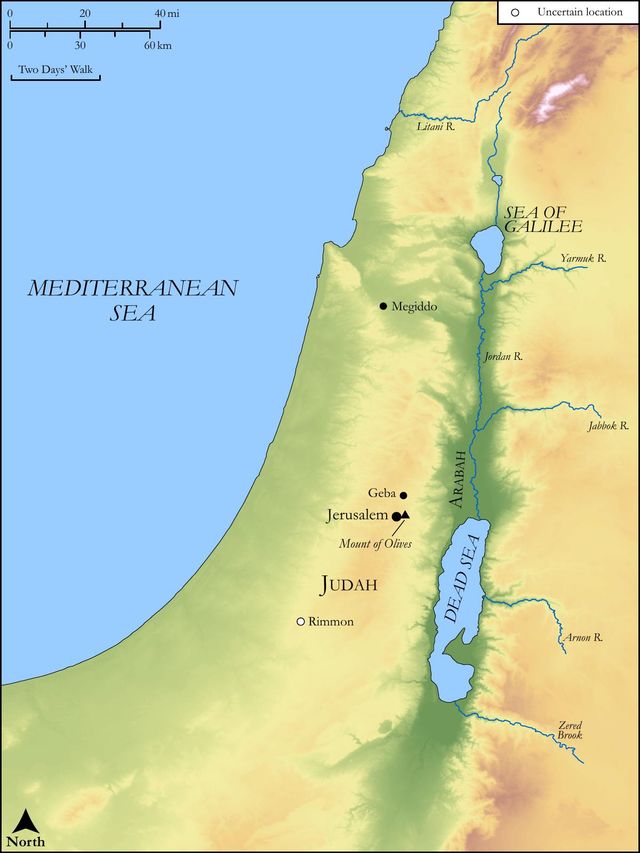
See on the biblical-era map
Study this verse
Public-domain commentary
Matthew Henry
From his Commentary on the Whole Bible. Henry comments on passages, not single verses — this entry covers Zechariah 12:9–14. His four-level outline is real structure in the source text, so it is rendered as structure.
The day here spoken of is the day of Jerusalem's defence and deliverance, that glorious day when God will appear for the salvation of his people, which, if it do refer to the successes which the Jews had against their enemies in the time of the Maccabees, yet certainly looks further, to the gospel-day, to Christ's victories over the powers of darkness and the great salvation he has wrought for his chosen. Now we have here an account of two remarkable works designed in that day.
I.A glorious work of God to be wrought for his people:
"I will seek to destroy all the nations that come against Jerusalem, Zac 12:9. Nations come against Jerusalem, many and mighty nations; but they shall all be destroyed, their power shall be broken, and their attempts baffled; the mischief they intend shall return upon their own head." God will seek to destroy them, not as if he were at a loss for ways and means to bring it about (Infinite Wisdom was never nonplussed), but his seeking to do it intimates that he is very earnest and intent upon it (he is jealous for Zion with great jealousy, and has the day of vengeance in his heart) and that he overrules means and instruments, and all the motions and operations of second causes, in order to it. He is framing evil against them; when he seems to be setting them up he is seeking to destroy them. In Christ's first coming, he sought to destroy him that had the power of death, and did destroy him, bruised the serpent's head, and broke all the powers of darkness that fought against God's kingdom among men and against the faithful friends and subjects of that kingdom; he spoiled them, and made a show of them openly. In his second coming, he will complete their destruction, when he shall put down all opposing rule, principality, and power, and death itself shall be swallowed up in that victory. The last enemy shall be destroyed of all that fought against Jerusalem.
II.A gracious work of God to be wrought in his people, in order to the work that is to be wrought for them.
When he seeks to destroy their enemies he will pour upon them the Spirit of grace and supplication. Note, When God intends great mercy for his people the first thing he does is to set them a praying; thus he seeks to destroy their enemies by stirring them up to seek to him that he would do it for them; because, though he has proposed it and promised it, and it is for his own glory to do it, yet he will for this be enquired of by the house of Israel, Eze 36:37. Ask, and it shall be given. This honour will he have to himself, and this honour will he put upon prayer and upon praying people. And it is a happy presage to the distressed church of deliverance approaching, and is, as it were, the dawning of its day, when his people are stirred up to cry mightily to him for it. But this promise has reference to, and is performed in, the graces of the Spirit given to all believers, as that Isa 44:3, I will pour my Spirit upon thy seed, which was fulfilled when Jesus was glorified, Joh 7:39. It is a promise of the Spirit, and with him of all spiritual blessings in heavenly things by Christ. Now observe here,
1.On whom these blessings are poured out.
(1.)On the house of David, on the great men; for they are no more, and no better, than the grace of God makes them. It was promised (Zac 12:8) that the house of David should be as the angel of the Lord. Now, in order to that, the Spirit of grace is poured upon them; for the more the saints have of the Spirit of grace the more like they are to the holy angels. When God was about to appear for the land, he poured his Spirit of grace upon the house of David, the leading men of the land. It bodes well to a people when princes and great men go before the rest in that which is good, as Ch2 20:5. The house of David is all summed up in Jesus Christ, the Son of David; and upon him, as the head, the Spirit of grace is poured out, from him to be diffused to all his members; from his fulness we receive, and grace for grace.
(2.)On the inhabitants of Jerusalem, the common people; for the operations of the Spirit are the same upon the mean and weak Christians that they are upon the strong and more grown. The inhabitants of Jerusalem cannot influence public affairs by their powers and policies, as the great men of the house of David may, yet they may do good service by their prayers, and therefore upon them the Spirit shall be poured out. The church is Jerusalem, the heavenly Jerusalem; all true believers, that have their conversation in the heaven, are inhabitants of this Jerusalem, and to them this promise belongs. God will pour his Spirit upon them. This is the earnest which all that believe in Christ shall receive; thus they are sanctified; thus they are sealed.
2.What these blessings are: I will pour upon them the Spirit. That includes all good things, as it qualifies us for the favour of God, and all his other gifts. He will pour out the Spirit,
(1.)As a Spirit of grace, to sanctify us and to make us gracious.
(2.)As a Spirit of supplications, inclining us to, instructing and assisting us in, the duty of prayer. Note, Wherever the Spirit is given as a Spirit of grace, he is given as a Spirit of sanctification. Wherever he is a Spirit of adoption, he teaches to cry, Abba, Father. As soon as ever Paul was converted, Behold, he prays, Act 9:11. You may as soon find a living man without breath as a living saint without prayer. There is a more plentiful effusion of the Spirit of prayer now under the gospel than was under the law; and the further the work of sanctification is carried in us the better is the work of supplication carried on by us.
3.What the effect of them will be: I will pour upon them the Spirit of grace. One would think that it should follow, "And they shall look on him whom they have believed, and shall rejoice" (and it is true that that is one of the fruits of the pouring out of the Spirit, whence we read of the joy of the Holy ghost), but it follows, They shall mourn; for there is a holy mourning, that is the effect of the pouring out of the Spirit, a mourning for sin, which is of use to quicken faith in Christ and qualify for joy in God. It is here made the matter of a promise that they shall mourn, for there is a mourning that will end in rejoicing and has a blessing entailed upon it. This mourning is a fruit of the Spirit of grace, an evidence of a work of grace in the soul, and a companion of the Spirit of supplication, as it expresses lively affections working in prayer; hence prayers and tears are often put together, Kg2 20:5. Jacob, that wrestler with God, wept and made supplication. But here it is a mourning for sin that is the effect of the pouring out of the Spirit.
(1.)It is a mourning grounded upon a sight of Christ: They shall look on me whom they have pierced, and shall mourn for him. Here,
[1.]It is foretold that Christ should be pierced, and this scripture is quoted as that which was fulfilled when Christ's side was pierced upon the cross; see Joh 19:37.
[2.]He is spoken of as one whom we have pierced; it is spoken primarily of the Jews, who persecuted him to death (and we find that those who pierced him are distinguished from the other kindreds of the earth that shall wail because of him, Rev 1:7); yet it is true of us all as sinners, we have pierced Christ, inasmuch as our sins were the cause of his death, for he was wounded for our transgressions, and they are the grief of his soul; he is broken with the whorish heart of sinners, who therefore are said to crucify him afresh and put him to open shame.
[3.]Those that truly repent of sin look upon Christ as one whom they have pierced, who was pierced for their sins and is pierced by them; and this engages them to look unto him, as those that are deeply concerned for him.
[4.]This is the effect of their looking to Christ; it makes them mourn. This was particularly fulfilled in those to whom Peter preached Christ crucified; when they heard it those who had had a hand in piercing him were pricked to the heart, and cried out, What shall we do? It is fulfilled in all those who sorrow for sin after a godly sort; they look to Christ, and mourn for him, not so much for his sufferings as for their own sins that procured them. Note, The genuine sorrows of a penitent soul flow from the believing sight of a pierced Saviour. Looking by faith upon the cross of Christ will set us a mourning for sin after a godly sort.
(2.)It is a great mourning. [1.] it is like the mourning of a parent for the death of a beloved child. They shall mourn for sin as one mourns for an only son, in whose grave the hopes of his family are buried, and shall be inwardly in bitterness as one that is in bitterness for his first-born, as the Egyptians were when there was a cry throughout all their land for the death of their first-born. The sorrow of children for the death of their parents is sometimes counterfeited, is often small, and soon wears off and is forgotten; but the sorrow of parents for a child, for a son, for an only son, for a first-born, is natural, sincere, unforced, and unaffected, it is secret and lasting; such are the sorrows of a true penitent, flowing purely from love to Christ above any other. [2.] It is like the mourning of a people for the death of a wise and good prince. It shall be like the mourning of Hadadrimmon in the valley of Megiddon, where good king Josiah was slain, for whom there was a general lamentation (Zac 12:11), and perhaps the greater because they were told that it was their sin that provoked God to deprive them of so great a blessing; therefore they cried out, The crown has fallen from our head. Woe unto us, for we have sinned! Lam 5:16. Christ is our King; our sins were his death, and, for that reason, ought to be our grief.
(3.)It is a general universal mourning (Zac 12:12): The land shall mourn. The land itself put on mourning at the death of Christ, for there was then darkness over all the land, and the earth trembled; but this is a promise that, in consideration of the death of Christ, multitudes shall be effectually brought to sorrow for sin and turn to God; it shall be such a universal gracious mourning as was when all the house of Israel lamented after the Lord, Sa1 7:2. Some think this is yet to have its complete accomplishment in the general conversion of the Jewish nation.
(4.)It is also a private particular mourning. There shall be not only a mourning of the land, by its representatives in a general assembly (as Jdg 2:5, when the place was called Bochim - A place of weepers), but it shall spread itself into all corners of the land: Every family apart shall mourn (Zac 12:12), all the families that remain, Zac 12:14. All have contributed to the guilt, and therefore all shall share in the grief. Note, The exercises of devotion should be performed by private families among themselves, besides their joining in public assemblies for religious worship. National fasts must be observed, not only in our synagogues, but in our houses. In the mourning here foretold the wives mourn apart by themselves, in their own apartment, as Esther and her maids. And some think it intimates their denying themselves the use even of lawful delights in a time of general humiliation Co1 7:5. Four several families are here specified as examples to others in this mourning: - [1.] Two of them are royal families: the house of David, in Solomon, and the house of Nathan, another son of David, brother to Solomon, from whom Zerubbabel descended, as appears by Christ's genealogy, Luk 3:27-31. The house of David, particularly that of Nathan, which is now the chief branch of that house, shall go before in this good work. The greatest princes must not think themselves exempted from the law of repentance, but rather obliged most solemnly to express it, for the exciting of others, as Hezekiah humbled himself (Ch2 32:26), the princes and the king (Ch2 12:6), and the king of Nineveh, Jon 3:6. [2.] Two of them are sacred families (Zac 12:13), the family of the house of Levi, which was God's tribe, and in it particularly the family of Shimei, which was a branch of the tribe of Levi (Ch1 6:17), and probably some of the descendants of that family were now of note for preachers to the people or ministers to the altar. As the princes must mourn for the sins of the magistracy, so must the priests for the iniquity of the holy things. In times of general tribulation and humiliation the Lord's ministers are concerned to weep between the porch and the altar (Joe 2:17), and not only there, but in their houses apart; for in what families should godliness, both in the form and in the power of it, be found, if not in ministers' families?
Historical interpretation
Historical reception
1 surviving comment on this verse from the historical church.
(Verse 9) And it shall come to pass in that day, that I will seek to destroy all the nations that come against Jerusalem. And I will pour out upon the house of David and upon the inhabitants of Jerusalem the spirit of grace and of supplications. LXX: And it shall come to pass in that day, that I will seek to destroy all the nations that come against Jerusalem, and I will pour out upon the house of David, and upon the inhabitants of Jerusalem, the spirit of grace and of mercy. In that day, when the Lord protects the inhabitants of Jerusalem, the Lord will seek to destroy all the nations that come against Jerusalem. But He will crush not for destruction, but for correction, so that they may cease to wage war against Jerusalem and begin to be of Jerusalem. For if He created all things out of nothing, He did not create them in order to destroy what He created; but so that through His mercy, those things which were created may be saved. Hence, in the book of Wisdom, which is attributed to Solomon (if anyone, however, is pleased to receive the book), we find it written: He created all things that they might exist, and the generations of the world might be preserved; and there will be no deadly poison for them (Wisdom 1). For just as the Lord came to seek what was lost and saved the human race, so he also destroyed the nations, because the nations were adversaries. Therefore it follows: I will pour out upon the house of David and upon the inhabitants of Jerusalem the spirit of grace and mercy. Concerning this grace, Paul also writes: The love of God has been poured out into our hearts (or yours) through the Holy Spirit, who has been given to us (Rom. V, 5). And in the aforementioned volume it is contained: Who shall explore the things that are in heaven, unless you have given wisdom, and sent your Holy Spirit from on high? And thus the paths of those who are on earth have been corrected, and men have been taught what pleases you (Wisdom 9:16). And in Isaiah God speaks: I have given my Spirit upon you (Isaiah 42:1). And again, the same Scripture mentions: I have given my Spirit upon him (ibid). However, the word effusion implies a sense of abundance or generosity, as is evident in what we have said: 'The love of God has been poured out into our hearts' (Romans 5:5). And in another place, speaking as if in the person of God, it is said: 'I will pour out my Spirit on all people' (Joel 2:28). The Apostle also speaks of the spirit of grace in his letter to the Hebrews: 'How much more severely do you think someone deserves to be punished who has trampled the Son of God underfoot, who has treated as an unholy thing the blood of the covenant that sanctified them, and who has insulted the Spirit of grace?' (Hebrews 10:29). And the Holy Spirit is said to have different graces. And the greeting of the Apostle: Grace (he says) be multiplied unto you, and peace (I Tim. I, 1): that after he hath forgiven us our sins, then peace may by mercy follow. These things the Jews partly already accomplished, and more fully commemorate in the consummation of the world. But we understand and approve that they are daily fulfilled after the advent of Christ.
Continue studying Zechariah 12:9 across the web’s major study libraries — every link below opens this exact verse, chapter, or book on the destination site.
Read & Compare
 BibleGatewayThis verse in more than 200 translations and 70 languages.
 Bible.comThe YouVersion reader — hundreds of translations, reading plans, and highlights.
 ESV.orgCrossway's official English Standard Version reader.
 NET BibleThe NET translation with 60,000+ translators' notes on every rendering decision.
 STEP BibleTyndale House's free study tool — original text, vocabulary, and scholarly resources.
 BibliaLogos Bible Software's free web reader.
 USCCBThe New American Bible (Revised Edition) with the U.S. bishops' study notes.
Commentaries
 BibleHub CommentariesDozens of classic commentaries on this verse, gathered on one page.
 StudyLightMore than 100 commentary sets — the largest collection on the web.
 BibleRefPlain-English commentary on what this verse means, verse by verse.
 Enduring WordDavid Guzik's free commentary on this chapter, widely used by Bible teachers.
 Bible Study ToolsVerse commentary alongside Greek and Hebrew study aids.
Original Language & Research
- BibleHub InterlinearThe verse word by word — original language, transliteration, and English.
- BibleHub LexiconEvery word's original-language definition and Strong's entry.
 Blue Letter BibleDeep-study tools — Strong's numbers, concordance, and word studies.
 SefariaThe Hebrew text with Rashi and centuries of Jewish commentary.
Sermons, Hymns & Audio


TrulyRandomVerse is not affiliated with these sites and doesn’t control their content. They’re linked because they’re genuinely useful.
Summary
Zechariah 12:9 declares God's unwavering resolve to decisively intervene and annihilate all nations that gather to attack Jerusalem "in that day." This verse is a powerful prophetic statement, emphasizing divine sovereignty over global affairs and His ultimate protection of His chosen city and people, signaling a climactic future confrontation where God Himself will be the primary aggressor against His adversaries.
Context
ShowHideLiterary Context
Zechariah 12 is a pivotal chapter within the "Burden of the Word of the LORD concerning Israel" (Zechariah 12:1), which spans chapters 9-14. This section shifts from earlier visions to a more direct prophetic oracle concerning the future of Jerusalem and Judah. The immediate preceding verses (Zechariah 12:1-8) vividly describe Jerusalem's impregnable nature in the "latter days," portraying it as a "cup of trembling" and a "burdensome stone" for all surrounding nations. God promises to make the clans of Judah like "a blazing pot among wood" and "a flaming torch among sheaves," enabling them to consume their enemies. The context builds towards a climactic confrontation where human efforts against Jerusalem will prove futile, culminating in God's direct and forceful intervention as declared in Zechariah 12:9. This verse serves as the culmination of the divine defense outlined in the preceding passage, solidifying God's ultimate victory.
Historical & Cultural Context
Zechariah prophesied during the post-exilic period (c. 520-518 BC), a time when the Jewish people had returned from Babylonian captivity and were rebuilding the temple in Jerusalem. While the immediate historical context was one of restoration and nascent national identity under Persian rule, the prophet's gaze extends far beyond this. The concept of "that day" (Hebrew: bayyôm hahû') is a common prophetic idiom referring to a future, divinely appointed time, often associated with the "Day of the LORD." This period would involve both judgment for God's enemies and salvation for His people. Culturally, Jerusalem held immense significance as the capital, the site of the Temple, and the spiritual heart of Israel. Attacks on Jerusalem were seen as direct affronts to God Himself. The imagery of nations gathering against a city was a familiar motif in Israel's history, but Zechariah recontextualizes it to highlight God's unique and overwhelming power in defending His sanctuary and people, transcending typical geopolitical conflicts.
Key Themes
ShowHideZechariah 12:9 contributes significantly to several major themes found throughout Zechariah and broader prophetic literature. First, it underscores the theme of Divine Protection of Jerusalem, emphasizing God's unwavering commitment to defend His holy city against all aggressors, a promise echoed in passages like Psalm 46. Second, it highlights God's Sovereignty and Judgment over the nations. The Lord is not a passive observer but an active, decisive participant in history, orchestrating the downfall of those who oppose His will and His people, a truth consistently affirmed from Genesis 12:3 to Revelation 20:9. Third, the verse points to an Eschatological Conflict, a future, ultimate confrontation between the nations and Jerusalem. This scenario finds parallels in other end-times prophecies, such as the invasion described in Ezekiel 38-39 and the final battle in Revelation 16:16. Finally, it reinforces the theme of God's Decisive Victory, assuring that His intervention will result in the complete and utter destruction of Jerusalem's adversaries, securing His people's ultimate peace and triumph.
Exposition and Analysis
ShowHideKey Word Analysis
ShowHideThis term, while literally meaning a 24-hour period, is used figuratively in prophetic contexts to denote a significant, divinely appointed period of time. In Zechariah 12:9, "in that day" refers to a specific future epoch, often called the "Day of the LORD," which will be characterized by God's decisive intervention in human history, bringing judgment upon His enemies and salvation to His people. It signifies a climactic moment in God's redemptive plan.
This primitive root means "to search out," "to strive after," or "to desire." When applied to God, as here, it conveys a strong sense of active intent and resolute purpose. It's not a passive observation but an intentional, determined pursuit of an objective. God will actively and purposefully "seek to destroy" the nations, indicating His direct and unswerving will to accomplish this judgment.
This term refers to "foreign nations" or "Gentiles." In the Old Testament, it often denotes those peoples outside of Israel, frequently depicted as hostile to God's chosen people. The use of "all the nations" emphasizes the universal scope of the opposition against Jerusalem, highlighting the magnitude of the final conflict and the comprehensive nature of God's judgment against all who stand against His divine purposes.
Verse Breakdown
ShowHide"And it shall come to pass in that day,"
This opening phrase sets the stage for a future, divinely ordained event. The "day" is not a literal 24-hour period but a significant, climactic epoch in God's redemptive history, often associated with the "Day of the LORD." It signals a specific time when God's ultimate plan will unfold with decisive action.
"that I will seek to destroy"
This is a powerful declaration of divine intent. The "I" refers unequivocally to the LORD God. The phrase "seek to destroy" (Hebrew: biqqaš lĕhašmîd) indicates God's active, purposeful, and determined resolve to bring about utter desolation and annihilation upon His adversaries. It highlights His sovereignty and His direct involvement in the impending judgment.
"all the nations that come against Jerusalem."
This specifies the targets of God's judgment: every single nation that dares to oppose and attack His holy city. "Jerusalem" here represents not just a physical city but also God's people and His divine purposes on earth. The phrase "all the nations" underscores the global and comprehensive nature of this final confrontation and the universal scope of God's righteous judgment against those who defy Him.
Literary Devices
ShowHideZechariah 12:9 employs several potent literary devices to convey its message. The most prominent is Prophetic Idiom, specifically the phrase "in that day." This phrase is a common eschatological marker in Old Testament prophecy, signaling a future, climactic period of divine intervention, often encompassing both judgment and salvation. It creates a sense of anticipation and underscores the ultimate, divinely determined nature of the events. Another device is Anthropomorphism, where God is described with human-like actions, "I will seek to destroy." This attributes human intention and active pursuit to God, making His resolve more relatable and emphasizing His personal involvement in the judgment. While God does not "seek" in the sense of searching for something unknown, it conveys His deliberate and purposeful action. Finally, the phrase "all the nations that come against Jerusalem" can be seen as a form of Hyperbole or Symbolism. While it may refer to a literal coalition, it also symbolically represents the totality of worldly opposition to God's kingdom and His people. This amplifies the scale of the conflict and the absolute nature of God's victory.
Theological and Thematic Connections
ShowHideZechariah 12:9 stands as a profound testament to God's unwavering commitment to His covenant people and His ultimate sovereignty over all earthly powers. It reveals a God who is not passive in the face of opposition to His purposes, but one who actively intervenes to defend His own and execute justice. This divine protection of Jerusalem, both literally and symbolically as God's spiritual dwelling, underscores the inviolability of His promises and the certainty of His ultimate triumph over all forms of evil. The "day" of judgment is a recurring motif, signifying the culmination of human rebellion and the decisive manifestation of God's righteous wrath and redemptive power. This passage assures believers that despite the fiercest opposition, God's kingdom will ultimately prevail, and His people will be eternally secure under His sovereign hand.
Reflection and Application
ShowHideZechariah 12:9 offers immense comfort and a call to trust in God's ultimate control, even amidst global turmoil and apparent threats to God's people. In a world fraught with geopolitical tensions and spiritual opposition, this verse reminds us that there is a divine hand at work, orchestrating history toward His sovereign ends. It encourages believers to look beyond immediate circumstances and place their hope in the God who actively defends His own and will decisively defeat all who oppose Him. This truth should inspire courage, knowing that our ultimate security rests not in human strength or political maneuvering, but in the omnipotent God who "seeks to destroy" His adversaries. It also prompts us to live with an eschatological awareness, understanding that current events, however chaotic, are unfolding within God's larger redemptive narrative, culminating in His glorious triumph.
Questions for Reflection
ShowHideFAQ
ShowHideWhat does "in that day" specifically refer to in Zechariah 12:9?
ShowHide"In that day" (Hebrew: bayyôm hahû') is a common prophetic idiom in the Old Testament. It does not refer to a literal 24-hour period but rather to a significant, divinely appointed future epoch. This period is often associated with the "Day of the LORD," a time when God will decisively intervene in human history to bring about His ultimate purposes. It encompasses both judgment for His enemies and salvation and restoration for His people. While its precise timing within human history is debated among scholars, it consistently points to a climactic moment of God's sovereign action, as seen in other prophetic books like Joel 3:14.
Is the destruction of "all the nations" a literal, physical event or symbolic?
ShowHideThe prophecy in Zechariah 12:9, like many prophetic texts, contains elements that are both literal and symbolic. While it foretells a literal, physical gathering of nations against Jerusalem, and a literal, physical destruction of those forces by God, the phrase "all the nations" can also carry symbolic weight, representing the totality of human rebellion and opposition against God and His people throughout history. The ultimate fulfillment of such prophecies often involves a dramatic, decisive intervention by God that has tangible, devastating consequences for His adversaries, as described in Revelation 19:11-21. The emphasis is on the comprehensive nature of God's victory.
Christ-Centered Fulfillment
ShowHideZechariah 12:9, with its declaration of God's decisive destruction of nations opposing Jerusalem, finds its ultimate and most profound fulfillment in the person and work of Jesus Christ. While the immediate context points to a future earthly conflict, the deeper theological reality is that all opposition to God's kingdom is ultimately opposition to His Anointed One. The "day" of God's judgment on the nations culminates in the glorious return of Christ, who will personally lead the charge against His enemies. Just as Zechariah prophesies God "seeking to destroy" those who come against Jerusalem, the New Testament reveals Jesus as the divine warrior who will "strike down the nations" with the sword of His mouth (Revelation 19:15). The final gathering of hostile forces, whether literal armies or spiritual powers, will be met by the invincible power of the Lamb of God, who is also the Lion of Judah. His victory at the cross already disarmed the powers and authorities (Colossians 2:15), and His second coming will complete the final destruction of all those who refuse to bow the knee to Him (Philippians 2:10-11). Thus, Zechariah's prophecy foreshadows Christ's ultimate triumph over all His adversaries, securing eternal peace and protection for His redeemed people, the true spiritual Jerusalem (Hebrews 12:22).