


Luke 3:18
Bible text: King James Version (1769 Blayney text) · Public domain
Bible text: Berean Standard Bible · Public domain
Bible text: American Standard Version (1901) · Public domain
Bible text: World English Bible, Messianic edition · Public domain
Bible text: Geneva Bible (1599) · Public domain
Bible text: Young's Literal Translation · Public domain
- ΠολλὰPollaManyG4183A-APNAdjective Accusative Plural Neuter
- μὲνmenindeedG3303PRTParticle or Disjunctive
- οὖνounthereforeG3767CONJConjunction
- καὶkaiotherG2532CONJConjunction
- ἕτεραheterathingsG2087A-APNAdjective Accusative Plural Neuter
- παρακαλῶνparakalōnexhortingG3870V-PAP-NSMVerb Present Active Participle Nominative Singular Masculine
- εὐηγγελίζετοeuēngelizetohe was evangelisingG2097V-IMI-3SVerb Imperfect Middle Indicative 3rd Singular
- τὸνtontheG3588T-ASMDefinite article Accusative Singular Masculine
- λαόνlaonpeopleG2992N-ASMNoun Accusative Singular Masculine
English is a literal word-by-word gloss of the Greek, not the KJV's wording. Why?
This is the original text the KJV's translators worked from — each Greek word with its own literal English meaning in this verse, prepared by scholars at Tyndale House, Cambridge. The KJV translates whole sentences, not word by word, so its wording differs: one Greek word can become several English words, and the KJV may choose “charity” where the gloss reads “love”. Both are faithful — they answer different questions. For the KJV's own rendering, switch to the KJV text.
Details
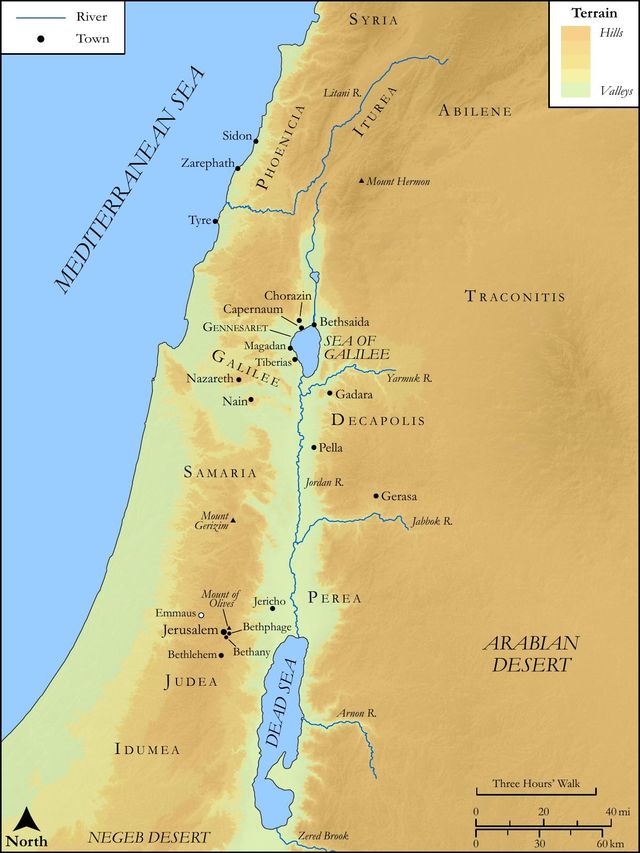
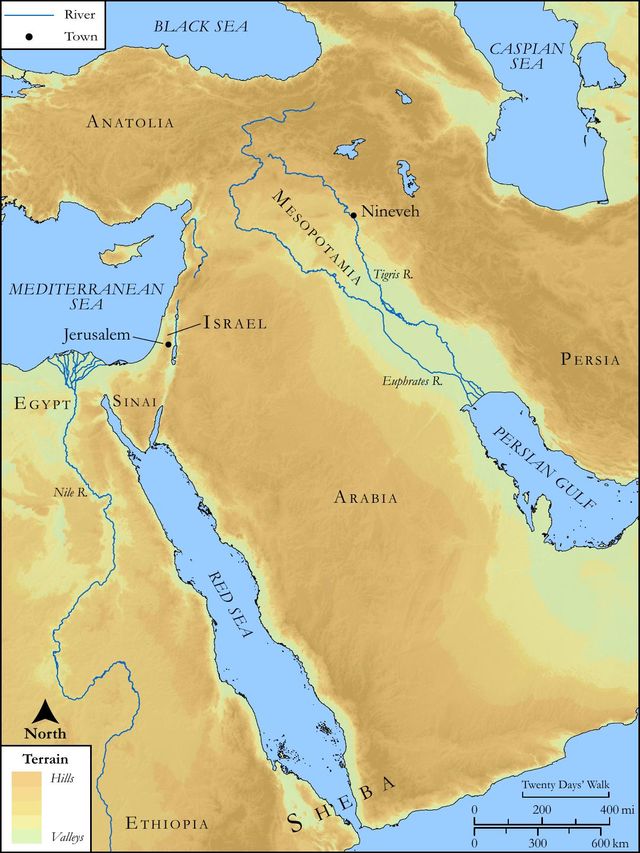
See on the biblical-era maps

Study this verse
Public-domain commentary
Matthew Henry
From his Commentary on the Whole Bible. Henry comments on passages, not single verses — this entry covers Luke 3:15–20. His four-level outline is real structure in the source text, so it is rendered as structure.
We are now drawing near to the appearance of our Lord Jesus publicly; the Sun will not be long after the morning-star. We are here told,
I.How the people took occasion, from the ministry and baptism of John, to think of the Messiah, and to think of him as at the door, as now come. Thus the way of the Lord was prepared, and people were prepared to bid Christ welcome; for, when men's expectations are raised, that which they are in expectation of becomes doubly acceptable. Now when they observed what an excellent doctrine John Baptist preached, what a divine power went along with it, and what a tendency it had to reform the world,
1.They began presently to consider that now was the time for the Messiah to appear. The sceptre was departed from Judah, for they had no king but Caesar; nay, and the law-giver too was gone from between his feet, for Herod had lately slain the sanhedrim. Daniel's seventy weeks were now expiring; and therefore it was but three or four years after this that they looked that the kingdom of heaven should appear immediately, Luk 19:11. Never did the corrupt state of the Jews more need a reformation, nor their distressed state more need a deliverance, than now.
2.Their next thought was, "Is not his he that should come?" All thinking men mused, or reasoned, in their hearts, concerning John, whether he were the Christ or not. He had indeed none of the external pomp and grandeur in which they generally expected the Messiah to appear; but his life was holy and strict, his preaching powerful and with authority, and therefore "why may we not think that he is the Messiah, and that he will shortly throw off this disguise, and appear in more glory?" Note, That which puts people upon considering, reasoning with themselves, prepares the way for Christ.
II.How John disowned all pretensions to the honour of being himself the Messiah, but confirmed them in their expectations of him that really was the Messiah, Luk 3:16, Luk 3:17. John's office, as a crier or herald, was to give notice that the kingdom of God and the King of that kingdom were at hand; and therefore, when he had told all manner of people severally what they must do ("You must do this, and you must do that"), he tells them one thing more which they must all do: they must expect the Messiah now shortly to appear. And this serves as an answer to their musings and debates concerning himself. Though he knew not their thoughts, yet, in declaring this, he answered them.
1.He declares that the utmost he could do was to baptize them with water. He had no access to the Spirit, nor could command that or work upon that; he could only exhort them to repent, and assure them of forgiveness, upon repentance; he could not work repentance in them, nor confer remission on them.
2.He consigns them, and turns them over, as it were, to Jesus Christ, for whom he was sent to prepare the way, and to whom he was ready to transfer all the interest he had in the affections of the people, and would have them no longer to debate whether John was the Messiah or no, but to look for him that was really so.
(1.)John owns the Messiah to have a greater excellency than he had, and that he was in all things preferable to him; he is one the latchet of whose shoe he does not think himself worthy to loose; he does not think himself worthy to be the meanest of his servants, to help him on and off with his shoes. John was a prophet, yea more than a prophet, more so than any of the Old Testament prophets; but Christ was a prophet more than John, for it was both by the Spirit of Christ, and of the grace of Christ, that all the prophets prophesied, and John among the rest, Pe1 1:10, Pe1 1:11. This was a great truth which John came to preach; but the manner of his expressing it bespeaks his humility, and in it he not only does justice to the Lord Jesus, but does him honour too: "He is one whom I am not worthy to approach, or draw nigh to, no not as a servant." Thus highly does it become us to speak of Christ, and thus humbly of ourselves.
(2.)He owns him to have a greater energy than he had: "He is mightier than I, and does that which I cannot do, both for the comfort of the faithful and for the terror of hypocrites and dissemblers." They thought that a wonderful power went along with John; but what was that compared with the power which Jesus would come clothed with?
[1.]John can do no more than baptize with water, in token of this, that they ought to purify and cleanse themselves; but Christ can, and will, baptize with the Holy Ghost; he can give the Spirit to cleanse and purify the heart, not only as water washes off the dirt on the outside, but as fire purges out the dross that is within, and melts down the metal, that it may be cast into a new mould.
[2.]John can only preach a distinguishing doctrine, and by word and sign separate between the precious and the vile; but Christ hath his fan in his hand, with which he can, and will, perfectly separate between the wheat and the chaff. He will thoroughly purge his floor; it is his own, and therefore he will purge it, and will cast out of his church the unbelieving impenitent Jews, and confirm in his church all that faithfully follow him.
[3.]John can only speak comfort to those that receive the gospel, and, like other prophets, say to the righteous that it shall be well with them; but Jesus Christ will give them comfort. John can only promise them that they shall be safe; but Christ will make them so: he will gather the wheat into his garner; good, serious, solid people he will gather now into his church on earth, which shall be made up of such, and he will shortly gather them into his church in heaven, where they shall be for ever sheltered.
[4.]John can only threaten hypocrites, and tell the barren trees that they shall be hewn down and cast into the fire; but Christ can execute that threatening; those that are as chaff, light, and vain, and worthless, he will burn with fire unquenchable. John refers here to Mal 3:18; Mal 4:1, Mal 4:2. Then, when the floor is purged, ye shall return, and discern between the righteous and the wicked, for the day comes that shall burn as an oven.
The evangelist concludes his account of John's preaching with an et caetera (Luk 3:18): Many other things in his exhortation preached he unto the people, which are not recorded. First, John was an affectionate preacher. He was parakalōn - exhorting, beseeching; he pressed things home upon his hearers, followed his doctrine close, as one in earnest. Secondly, He was a practical preacher. Much of his preaching was exhortation, quickening them to their duty, directing them in it, and not amusing them with matters of nice speculation. Thirdly, He was a popular preacher. Though he had scribes and Pharisees, men of polite learning, attending his ministry, and Sadducees, men of free thought, as they pretended, yet he addressed himself to the people, pros ton laon - to the laity, and accommodated himself to their capacity, as promising himself best success among them. Fourthly, He was an evangelical preacher, for so the word here used signifies, euēngelizeto - he preached the gospel to the people; in all his exhortations, he directed people to Christ, and excited and encouraged their expectations of him. When we press duty upon people, we must direct them to Christ, both for righteousness and strength. Fifthly, He was a copious preacher: Many other things he preached, polla men kai hetera - many things, and different. He preached a great deal, shunned not to declare the whole counsel of God; and he varied in his preaching, that those who were not reached, and touched, and wrought upon, by one truth, might be by another.
III.How full a stop was put to John's preaching.
When he was in the midst of his usefulness, going on thus successfully, he was imprisoned by the malice of Herod (Luk 3:19, Luk 3:20): Herod the tetrarch being reproved by him, not only for living in incest with his brother Philip's wife, but for the many other evils which Herod had done (for those that are wicked in one instance are commonly so in many others), he could not bear it, but contracted an antipathy to him for his plain dealing, and added this wickedness to all the rest, which was indeed above all, that he shut up John in prison, put that burning and shining light under a bushel. Because he could not bear his reproofs, others should be deprived of the benefit of his instructions and counsels. Some little good he might do to those who had access to him, when he was in prison; but nothing to what he might have done if he had had liberty to go about all the country, as he had done. We cannot think of Herod's doing this without the greatest compassion and lamentation, nor of God's permitting it without admiring the depth of the divine counsels, which we cannot account for. Must he be silenced who is the voice of one crying in the wilderness? Must such a preacher be shut up in prison who ought to have been set up in the courts of the temple? But thus the faith of his disciples must be tried; thus the unbelief of those who rejected him must be punished; thus he must be Christ's forerunner in suffering as well as preaching; and thus, having been for about a year and a half preparing people for Christ, he must now give way to him, and, the Sun being risen, the morning-star must of course disappear.
Historical interpretation
Ten Centuries of Reception
7 surviving comments on this verse. Each one is dated, so this reads as a timeline rather than a list.
Select a marker to jump to its quote. Markers stagger vertically where authors wrote within a few decades of each other.
John having announced the coming of Christ, was preaching the baptism of the Holy Spirit, and the other things which the Gospel history has handed down to us. But besides these he is declared to have announced others in the following words, And many other things in his exhortation preached he unto the people.
And as in the Gospel according to St. John it is related of Christ that He spoke many other things, so also in this place we must understand Luke to say the same of John the Baptist, since certain things are announced by John too great to be entrusted to writing.
One who teaches the word of the gospel proclaims not just one thing but many.… Therefore John also preached "other things" to the people, which have not been recorded. But consider how many things there are that have been recorded. He proclaimed Christ. He pointed him out. He preached the baptism of the Holy Spirit. He taught the tax collectors salvation and the soldiers discipline. He taught that the threshing floor was being cleansed, trees cut down, and the rest, which the account in the Gospel narrates. Hence, apart from these things that have been written down, he is shown to have proclaimed other things which are not written down. For the Scripture says, "He also proclaimed many other things to the people and encouraged them."
(non occ.) He is called the tetrarch, to distinguish him from the other Herod, in whose reign Christ was born, and who was king, but this Herod was tetrarch. Now his wife was the daughter of Aretas, king of Arabia, but he had sacrilegiously married his brother Philip's wife, though she had offspring by his brother. For those only were allowed to do this whose brothers died without issue. For this the Baptist had censured Herod. First indeed he heard him attentively, for he knew that his words were weighty and full of consolation, but the desire of Herodias compelled him to despise the words of John, and he then thrust him into prison. And so it follows, And he added this above all, that he shut up John in prison.
(Mor. 15. sup. Job 20.) The fire of hell is here wonderfully expressed, for our earthly fire is kept up by heaping wood upon it, and cannot live unless supplied with fuel, but on the contrary the fire of hell, though a bodily fire, and burning bodily the wicked who are put into it, is not kept up by wood, but once made remains unquenchable.
But John was not imprisoned in those days. According to St. John's Gospel it was not till after some miracles had been performed by our Lord, and after His baptism had been noised abroad; but according to Luke he had been seized beforehand by the redoubled malice of Herod, who, when he saw so many flock to the preaching of John, and the soldiers believing, the publicans repenting, and whole multitudes receiving baptism, on the contrary not only despised John, but having put him in prison, slew him.
For his exhortation was the telling of good things, and therefore is fitly called the Gospel.
(ordin.) For before that Luke relates any of the acts of Jesus, he says that John was taken by Herod, to show that he alone was in an especial manner going to describe those of our Lord's acts, which were performed since the year in which John was taken or put to death.
Continue studying Luke 3:18 across the web’s major study libraries — every link below opens this exact verse, chapter, or book on the destination site.
Read & Compare
 BibleGatewayThis verse in more than 200 translations and 70 languages.
 Bible.comThe YouVersion reader — hundreds of translations, reading plans, and highlights.
 ESV.orgCrossway's official English Standard Version reader.
 NET BibleThe NET translation with 60,000+ translators' notes on every rendering decision.
 STEP BibleTyndale House's free study tool — original text, vocabulary, and scholarly resources.
 BibliaLogos Bible Software's free web reader.
 USCCBThe New American Bible (Revised Edition) with the U.S. bishops' study notes.
Commentaries
 BibleHub CommentariesDozens of classic commentaries on this verse, gathered on one page.
 StudyLightMore than 100 commentary sets — the largest collection on the web.
 BibleRefPlain-English commentary on what this verse means, verse by verse.
 Enduring WordDavid Guzik's free commentary on this chapter, widely used by Bible teachers.
 Bible Study ToolsVerse commentary alongside Greek and Hebrew study aids.
Original Language & Research
- BibleHub InterlinearThe verse word by word — original language, transliteration, and English.
- BibleHub LexiconEvery word's original-language definition and Strong's entry.
 Blue Letter BibleDeep-study tools — Strong's numbers, concordance, and word studies.
 CNTR CollationThe earliest Greek manuscripts of this verse, collated letter by letter.
Sermons, Hymns & Audio


TrulyRandomVerse is not affiliated with these sites and doesn’t control their content. They’re linked because they’re genuinely useful.
Summary
Luke 3:18 serves as a concise summary statement, underscoring the profound and extensive nature of John the Baptist's ministry beyond the specific events detailed in the preceding verses. It highlights that John's prophetic role involved a broad array of messages and teachings, all delivered with a compelling call to repentance and preparation, thereby setting the stage for the imminent arrival of the Messiah.
Context
ShowHideLiterary Context
This verse concludes Luke's detailed account of John the Baptist's public ministry, which began with his appearance in the wilderness, fulfilling ancient prophecies regarding the preparation of the Lord's way (Luke 3:2-4). Prior to this summary, Luke meticulously records John's stern call for repentance, his baptism, and his direct challenges to various groups—including the crowds, tax collectors, and soldiers—who sought guidance on how to live out their repentance (Luke 3:7-14). The narrative then pivots to the people's speculation about John's identity as the Messiah, which John unequivocally refutes by pointing to the "one mightier than I" who would baptize with the Holy Spirit and fire (Luke 3:15-17). Thus, Luke 3:18 functions as a concluding remark, emphasizing that the preceding examples are merely illustrative of a much larger, more comprehensive ministry of exhortation.
Historical & Cultural Context
John the Baptist emerged during a period of intense messianic expectation within Judea, a region under Roman occupation. The Jewish people yearned for a deliverer who would free them from foreign rule and restore the Davidic kingdom. Prophetic figures, often appearing in the wilderness, held significant cultural weight, evoking memories of Moses and Elijah. John's ascetic lifestyle and wilderness ministry resonated with these expectations, drawing large crowds to the Jordan River for a baptism of repentance—a ritual that, while not new, was given new emphasis by John as a sign of moral cleansing and preparation for God's imminent judgment and kingdom. His direct challenges to societal norms and figures of authority, such as Herod Antipas, reflect the prophetic tradition of rebuking the powerful, a dangerous but necessary role in a society grappling with religious and political tensions.
Key Themes
ShowHideLuke 3:18 reinforces several key themes prevalent in Luke Chapter 3. Foremost is the Extensiveness of John's Ministry, indicating that his impact was far broader than the specific anecdotes recounted, highlighting his widespread influence and consistent message. Another crucial theme is the Nature of True Repentance, which John preached not as a mere ritual, but as a transformative change of heart evidenced by concrete actions, as seen in his instructions to various groups in Luke 3:10-14. This ties into the overarching theme of Preparation for the Messiah, as John's entire ministry, including his "exhortation," was divinely appointed to "prepare the way of the Lord" (Luke 3:4), making the hearts of the people ready for Jesus Christ's arrival and the inauguration of God's kingdom.
Exposition and Analysis
ShowHideKey Word Analysis
ShowHideMeaning "to call near, i.e. invite, invoke (by imploration, hortation or consolation)." This word signifies more than mere teaching; it implies a passionate appeal, a strong urging, and often includes elements of comfort, encouragement, admonition, or entreaty. John's "exhortation" was not just informative but transformative, compelling his hearers to respond with action and a change of life in preparation for the coming Messiah.
Meaning "to announce good news ('evangelize') especially the gospel." While John's message included stern warnings and calls to repentance, the use of euangelízō here suggests that even his challenging words were ultimately part of "good news." His message prepared people for the "good news" of the coming Kingdom of God and the Messiah, offering hope for forgiveness and spiritual renewal to those who truly repented.
Meaning "(singular) much (in any respect) or (plural) many." This word emphasizes the sheer volume and variety of John's teachings. It indicates that Luke's account is a selective summary, and John's ministry encompassed a vast range of additional instructions, warnings, and prophetic declarations, all aimed at preparing the people for the Lord.
Verse Breakdown
ShowHide"And many other things"
This introductory phrase immediately signals that the preceding account of John's ministry is not exhaustive but rather a representative selection. It implies a vast, multifaceted, and ongoing ministry that extended far beyond the specific examples of his interactions with tax collectors, soldiers, and the general populace. The scope of his teaching and influence was considerable.
"in his exhortation preached he"
This clause describes the nature and method of John's communication. His message was characterized as "exhortation" (parakaléō), indicating a dynamic, persuasive, and urgent appeal rather than a dispassionate lecture. He "preached" (euangelízō), signifying that even his calls to repentance were framed within the context of announcing the "good news" of God's impending kingdom and the Messiah's arrival. This highlights the compelling and prophetic authority with which he spoke.
"unto the people"
This final phrase identifies the recipients of John's extensive ministry. He addressed the general populace (laós), indicating that his message was broad in its reach, not confined to a select group. It underscores his public role as a prophet sent to prepare the entire nation for the coming of the Lord, making his message accessible and applicable to all who would listen.
Literary Devices
ShowHideLuke 3:18 primarily functions as a Summary Statement, serving to conclude the detailed account of John the Baptist's ministry. This device allows the author to convey the extensive nature of John's work without needing to enumerate every teaching or interaction. By stating "many other things," Luke employs Implication of Extensiveness, suggesting a breadth and depth to John's preaching that transcends the specific examples provided. This literary choice emphasizes the profound and wide-ranging impact John had on the people, reinforcing his significance as the divinely appointed forerunner to Jesus.
Theological and Thematic Connections
ShowHideLuke 3:18 underscores the comprehensive nature of prophetic ministry and the divine intentionality behind John the Baptist's role as the forerunner. It reveals that God's preparation for Christ's advent was thorough, involving a sustained and multifaceted call to repentance that touched many lives. John's "exhortation" was not merely informative but transformative, designed to challenge the complacent, comfort the contrite, and direct all people towards the coming Messiah. This verse implicitly affirms the importance of a holistic gospel message that encompasses both the call to repentance and the announcement of good news, preparing hearts for God's redemptive work.
Reflection and Application
ShowHideLuke 3:18, in its concise declaration, offers profound insights for contemporary believers. It reminds us that spiritual preparation is rarely a one-time event but an ongoing process, often requiring "many other things" in terms of teaching, conviction, and transformation. Just as John's exhortation prepared a people for Christ's first coming, our lives should be characterized by continuous spiritual readiness for His return and for living out His kingdom principles in the present. This involves not only hearing the "good news" but also responding to the "exhortation" to live repentant, Christ-honoring lives. It challenges us to consider the depth and breadth of our own engagement with God's Word—are we only seeking comfortable truths, or are we open to the full counsel of God, which often includes challenging calls to repentance and radical obedience? Our spiritual growth, like the preparation for the Messiah, demands a comprehensive embrace of God's truth, leading to tangible changes in our attitudes and actions.
Questions for Reflection
ShowHideFAQ
ShowHideWhat does "many other things" imply about John the Baptist's ministry?
ShowHide"Many other things" (G4183 polýs, G2087 héteros) implies that Luke's Gospel provides only a summary of John the Baptist's extensive and impactful ministry. It suggests that John's preaching was far more comprehensive and varied than the specific examples recorded in Luke 3:7-14. He likely delivered numerous other messages, warnings, and encouragements, all aimed at preparing the people for the coming Messiah. This phrase highlights the profound and widespread influence John had on the populace.
What was the primary goal of John's "exhortation" (G3870 parakaléō)?
ShowHideJohn's "exhortation" was primarily aimed at calling people to repentance and preparing them for the arrival of the Messiah. While it included elements of comfort and good news (as indicated by euangelízō, "preached"), its core purpose was to provoke a genuine change of heart and life. He urged people to demonstrate their repentance through concrete actions, thereby making them ready to receive the one who would baptize with the Holy Spirit and fire (Luke 3:16). His message was a passionate appeal for spiritual readiness in anticipation of God's kingdom.
How does John the Baptist's ministry, as summarized here, relate to the ministry of Jesus?
ShowHideJohn's ministry was entirely preparatory for Jesus. He was the divinely appointed forerunner, whose role was to "prepare the way of the Lord" (Luke 3:4). His call to repentance and his baptism were foundational steps to ready people's hearts for the greater work of Jesus, who would bring the ultimate baptism of the Holy Spirit and fire (Luke 3:16). John's "exhortation" laid the groundwork, revealing sin and the need for a Savior, thereby creating a spiritual hunger that only Jesus, the Lamb of God, could satisfy (John 1:29).
Christ-Centered Fulfillment
ShowHideLuke 3:18, summarizing the extensive "exhortation" of John the Baptist, finds its ultimate Christ-centered fulfillment in the person and ministry of Jesus. John's comprehensive preaching, though vital, was merely the overture to the grand symphony of God's redemptive plan. He prepared the way for the one who would not just preach about the kingdom, but embody it; not just call for repentance, but provide the means for true forgiveness through His atoning sacrifice (Matthew 1:21). John's baptism of water pointed to the greater baptism with the Holy Spirit and fire that Jesus would inaugurate, empowering believers for new life and mission (Acts 1:5). The "good news" John "preached" was fully realized in Christ, who is the very embodiment of the gospel, offering not just a call to repentance but the power to live a transformed life (Romans 1:16). Thus, John's "many other things" ultimately served to magnify the singular, perfect, and all-sufficient work of Jesus, the Christ, the true Lamb of God who takes away the sin of the world (John 1:29).