


Luke 14:6
Bible text: King James Version (1769 Blayney text) · Public domain
Bible text: Berean Standard Bible · Public domain
Bible text: American Standard Version (1901) · Public domain
Bible text: World English Bible, Messianic edition · Public domain
Bible text: Geneva Bible (1599) · Public domain
Bible text: Young's Literal Translation · Public domain
- καὶkaiAndG2532CONJConjunction
- οὐκouknotG3756PRT-NNegative Particle Negative
- ἴσχυσανischusanthey were ableG2480V-AAI-3PVerb Aorist Active Indicative 3rd Plural
- ἀνταποκριθῆναιantapokrithēnaito replyG470V-AONVerb Aorist Passive Deponent Infinitive
- αὐτῷautōto himG846P-DSMPersonal pronoun Dative Singular Masculine
- πρὸςprostoG4314PREPPreposition
- ταῦταtautathese thingsG3778D-APNDemonstrative pronoun Accusative Plural Neuter
English is a literal word-by-word gloss of the Greek, not the KJV's wording. Why?
This is the original text the KJV's translators worked from — each Greek word with its own literal English meaning in this verse, prepared by scholars at Tyndale House, Cambridge. The KJV translates whole sentences, not word by word, so its wording differs: one Greek word can become several English words, and the KJV may choose “charity” where the gloss reads “love”. Both are faithful — they answer different questions. For the KJV's own rendering, switch to the KJV text.
Details
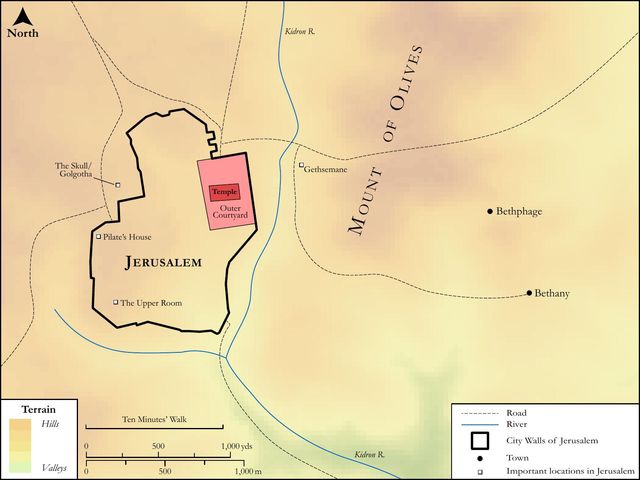
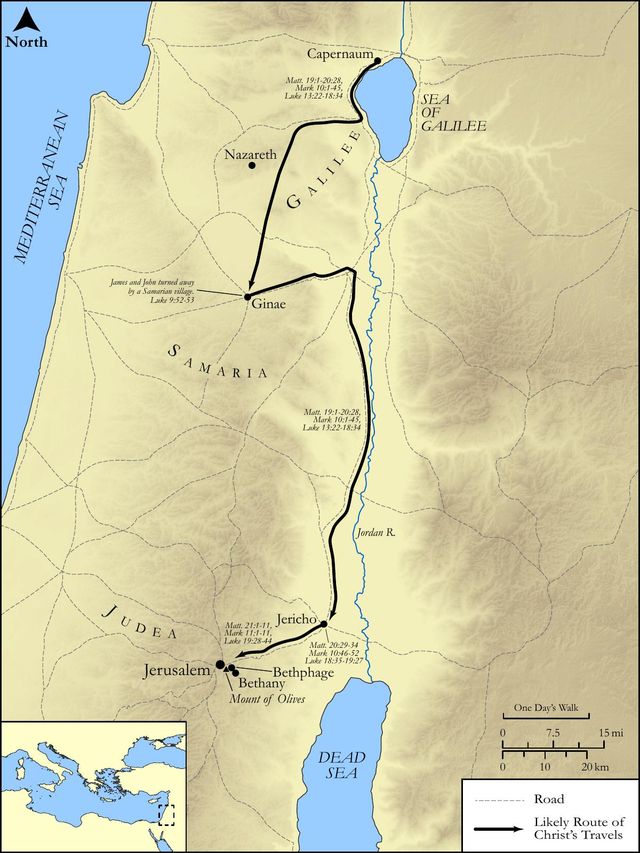
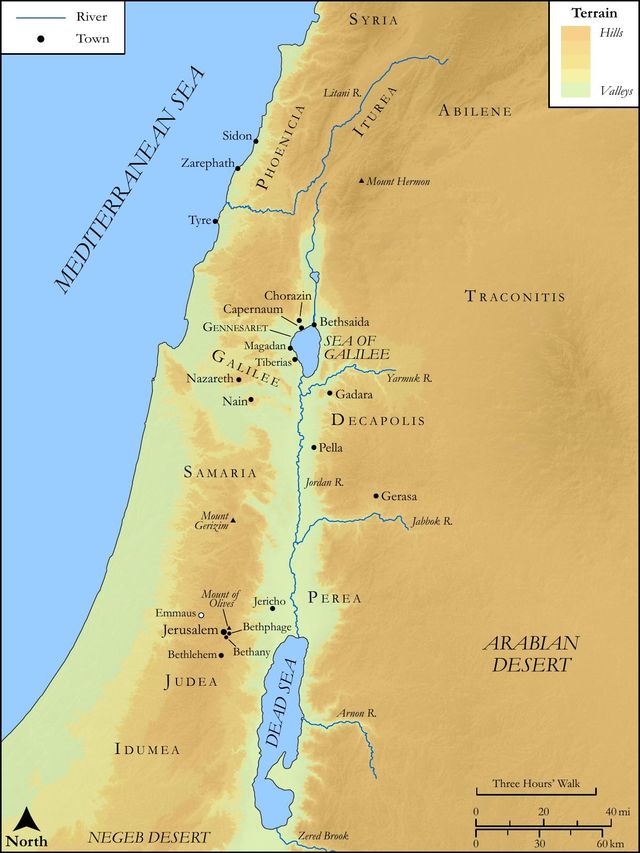
See on the biblical-era maps
Study this verse
Public-domain commentary
Matthew Henry
From his Commentary on the Whole Bible. Henry comments on passages, not single verses — this entry covers Luke 14:1–6.
In this passage of story we find,
I.That the Son of man came eating and drinking, conversing familiarly with all sorts of people; not declining the society of publicans, though they were of ill fame, nor of Pharisees, though they bore him ill will, but accepting the friendly invitations both of the one and the other, that, if possible, he might do good to both. Here he went into the house of one of the chief Pharisees, a ruler, it may be, and a magistrate in his country, to eat bread on the sabbath day, Luk 14:1. See how favourable God is to us, that he allows us time, even on his own day, for bodily refreshments; and how careful we should be not to abuse that liberty, or turn it into licentiousness. Christ went only to eat bread, to take such refreshment as was necessary on the sabbath day. Our sabbath meals must, with a particular care, be guarded against all manner of excess. On sabbath days we must do as Moses and Jethro did, eat bread before God (Exo 18:12), and, as is said of the primitive Christians, on the Lord's day, must eat and drink as those that must pray again before we go to rest, that we may not be unfit for that.
II.That he went about doing good.
Wherever he came he sought opportunities to do good, and not only improved those that fell in his way. Here was a certain man before him who had the dropsy, Luk 14:2. We do not find that he offered himself, or that his friends offered him to be Christ's patient, but Christ prevented him with the blessings of his goodness, and before he called he answered him. Note, It is a happy thing to be where Christ is, to be present before him, though we be not presented to him. This man had the dropsy, it is probable, in a high degree, and appeared much swoln with it; probably he was some relation of the Pharisee's, that now lodged in his house, which is more likely than that he should be an invited guest at the table.
III.That he endured the contradiction of sinners against himself:
They watched him, Luk 14:1. The Pharisee that invited him, it should seem, did it with a design to pick some quarrel with him; if it were so, Christ knew it, and yet went, for he knew himself a match for the most subtle of them, and knew how to order his steps with an eye to his observers. Those that are watched had need to be wary. It is, as Dr. Hammond observes, contrary to all laws of hospitality to seek advantage against one that you invited to be your guest, for such a one you have taken under your protection. These lawyers and Pharisees, like the fowler that lies in wait to ensnare the birds, held their peace, and acted very silently. When Christ asked them whether they thought it lawful to heal on the sabbath day (and herein he is said to answer them, for it was an answer to their thoughts, and thoughts are words to Jesus Christ), they would say neither yea nor nay, for their design was to inform against him, not to be informed by him. They would not say it was lawful to heal, for then they would preclude themselves from imputing it to him as a crime; and yet the thing was so plain and self-evident that they could not for shame say it was not lawful. Note, Good men have often been persecuted for doing that which even their persecutors, if they would but give their consciences leave to speak out, could not but own to be lawful and good. Many a good work Christ did, for which they cast stones at him and his name.
IV.That Christ would not be hindered from doing good by the opposition and contradiction of sinners.
He took him, and healed him, and let him go, Luk 14:4. Perhaps he took him aside into another room, and healed him there, because he would neither proclaim himself, such was his humility, nor provoke his adversaries, such was his wisdom, his meekness of wisdom. Note, Though we must not be driven off from our duty by the malice of our enemies, yet we should order the circumstances of it so as to make it the least offensive. Or, He took him, that is, he laid hands on him, to cure him; epilabomenos, complexus - he embraced him, took him in his arms, big and unwieldy as he was (for so dropsical people generally are), and reduced him to shape. The cure of a dropsy, as much as any disease, one would think, should be gradual; yet Christ cured even that disease, perfectly cured it, in a moment. He then let him go, lest the Pharisees should fall upon him for being healed, though he was purely passive; for what absurdities would not such men as they were be guilty of?
V.That our Lord Jesus did nothing but what he could justify, to the conviction and confusion of those that quarrelled with him, Luk 14:5, Luk 14:6. He still answered their thoughts, and made them hold their peace for shame who before held their peace for subtlety, by an appeal to their own practice, as he had been used to do upon such occasions, that he might show them how in condemning him they condemned themselves: which of you shall have an ass or an ox fallen into a pit, by accident, and will not pull him out on the sabbath day, and that straightway, not deferring it till the sabbath be over, lest it perish? Observe, It is not so much out of compassion to the poor creature that they do it as a concern for their own interest. It is their own ox, and their own ass, that is worth money, and they will dispense with the law of the sabbath for the saving of. Now this was an evidence of their hypocrisy, and that it was not out of any real regard to the sabbath that they found fault with Christ for healing on the sabbath day (that was only the pretence), but really because they were angry at the miraculous good works which Christ wrought, and the proof he thereby gave of his divine mission, and the interest he thereby gained among the people. Many can easily dispense with that, for their own interest, which they cannot dispense with for God's glory and the good of their brethren. This question silenced them: They could not answer him again to these things, Luk 14:6. Christ will be justified when he speaks, and every mouth must be stopped before him.
Historical interpretation
Seven Centuries of Reception
6 surviving comments on this verse. Each one is dated, so this reads as a timeline rather than a list.
Select a marker to jump to its quote. Markers stagger vertically where authors wrote within a few decades of each other.
First, Christ cures the man with dropsy. The abundant flow of the flesh had oppressed the functions of his soul and had quenched the glow of his spirit. Then, Christ teaches humility. At the feast, Christ gently opposes the longing for a better seat, so that the humanity of persuasion excludes the harshness of coercion, reason promotes the effect of persuasion, and correction chastises pride. He joins humanity to this, as if at the next threshold. The boundaries of the Lord’s saying differentiated this, if it is conferred on the poor and the weak. There is a greedy disposition in those who would be rewarded for hospitality.
A Pharisee, of higher rank than usual, invited Jesus to a banquet. Although he knew their bad intentions, he went with him and ate in their company. He did not submit to this act of condescension to honor his host. He rather instructed his fellow guests by words and miraculous deeds that might lead them to the acknowledgment of the true service, even that taught us by the gospel. He knew that even against their will he would make them eyewitnesses of his power and his suprahuman glory. Perhaps they might believe that he is God and the Son of God, who took on our likeness but was unchanged and did not cease to be what he had been.
Although our Lord knew the malice of the Pharisees, yet He became their guest, that He might benefit by His words and miracles those who were present. Whence it follows, And it came to pass, as he went into the house of one of the chief Pharisees to eat bread on the sabbath day, that they watched him; to see whether He would despise the observance of the law, or do any thing that was forbidden on the sabbath day. When then the man with the dropsy came into the midst of them, He rebukes by a question the insolence of the Pharisees, who wished to detect Him; as it is said, And, behold, there was a certain man before him which had the dropsy. And Jesus answering, &c.
Disregarding then the snares of the Jews, He cures the dropsical, who from fear of the Pharisees did not ask to be healed on account of the sabbath, but only stood up, that when Jesus beheld him, He might have compassion on him and heal him. And the Lord knowing this, asked not whether he wished to be made whole, but forthwith healed him. Whence it follows; And he took him, and healed him, and let him go. Wherein our Lord took no thought not to offend the Pharisees, but only that He might benefit him who needed healing. For it becomes us, when a great good is the result, not to care if fools take offence.
But seeing the Pharisees awkwardly silent, Christ baffles their determined impudence by some important considerations. As it follows; And he answered and said unto them, Which of you shall have an ass or an ox fallen into a pit, and will not straightway pull him out on the sabbath day?
(14 Mor. c. 6.) Rightly then is the dropsical man healed in the Pharisees' presence, for by the bodily infirmity of the one, is expressed the mental disease of the other.
When it is said that Jesus answered, there is a reference to the words which went before, And they watched him. For the Lord knew the thoughts of men.
But they who were asked, are rightly silent, for they perceived that whatever they said, would be against themselves. For if it is lawful to heal on the sabbath day, why did they watch the Saviour whether He would heal? If it is not lawful, why do they take care of their cattle on the sabbath? Hence it follows, But they held their peace.
By these words He so refutes His watchers, the Pharisees, as to condemn them also of covetousness, who in the deliverance of animals consult their own desire of wealth. How much more then ought Christ to deliver a man, who is much better than cattle!
By a suitable example then He settles the question, showing that they violate the sabbath by a work of covetousness, who contend that he does so by a work of charity. Hence it follows, And they could not answer him again to these things. Mystically, the dropsical man is compared to him who is weighed down by an overflowing stream of carnal pleasures. For the disease of dropsy derives the name from a watery humour.
In this example also He well refers to the ox and the ass; so as to represent either the wise and the foolish, or both nations; that is, the Jew oppressed by the burden of the law, the Gentile not subject to reason. For the Lord rescues from the pit of concupiscence all who are sunk therein.
But by His question He exposes their folly. For while God blessed the sabbath, (Gen. 2:1.) they forbade to do good on the sabbath; but the day which does not admit the works of the good is accursed.
As though He said, If the law forbids to have mercy on the sabbath-day, have no care of thy son when in danger on the sabbath-day. But why speak I of a son, when thou dost not even neglect an ox if thou seest it in danger?
Continue studying Luke 14:6 across the web’s major study libraries — every link below opens this exact verse, chapter, or book on the destination site.
Read & Compare
 BibleGatewayThis verse in more than 200 translations and 70 languages.
 Bible.comThe YouVersion reader — hundreds of translations, reading plans, and highlights.
 ESV.orgCrossway's official English Standard Version reader.
 NET BibleThe NET translation with 60,000+ translators' notes on every rendering decision.
 STEP BibleTyndale House's free study tool — original text, vocabulary, and scholarly resources.
 BibliaLogos Bible Software's free web reader.
 USCCBThe New American Bible (Revised Edition) with the U.S. bishops' study notes.
Commentaries
 BibleHub CommentariesDozens of classic commentaries on this verse, gathered on one page.
 StudyLightMore than 100 commentary sets — the largest collection on the web.
 BibleRefPlain-English commentary on what this verse means, verse by verse.
 Enduring WordDavid Guzik's free commentary on this chapter, widely used by Bible teachers.
 Bible Study ToolsVerse commentary alongside Greek and Hebrew study aids.
Original Language & Research
- BibleHub InterlinearThe verse word by word — original language, transliteration, and English.
- BibleHub LexiconEvery word's original-language definition and Strong's entry.
 Blue Letter BibleDeep-study tools — Strong's numbers, concordance, and word studies.
 CNTR CollationThe earliest Greek manuscripts of this verse, collated letter by letter.
Sermons, Hymns & Audio


TrulyRandomVerse is not affiliated with these sites and doesn’t control their content. They’re linked because they’re genuinely useful.
Summary
Luke 14:6 serves as the climactic conclusion to a tense Sabbath encounter, revealing the profound wisdom and unassailable authority of Jesus. Following His healing of a man afflicted with dropsy and a penetrating rhetorical question challenging the legalistic interpretations of Sabbath law, the religious leaders gathered could offer no logical or justifiable rebuttal. This verse succinctly captures their intellectual and spiritual defeat, highlighting Jesus' superior understanding of God's heart for mercy over rigid adherence to external regulations.
Context
ShowHideLiterary Context
This verse is the culmination of a pivotal interaction recounted in Luke 14:1-6. The narrative opens with Jesus being invited to a Sabbath meal at the house of a prominent Pharisee, where He is closely watched by the legal experts and Pharisees. The immediate trigger for the confrontation is the presence of a man with dropsy, whom Jesus deliberately heals. This act, performed on the Sabbath, directly challenges the prevailing legalistic interpretations of the day. Jesus then poses a direct question to His observers: "Is it lawful to heal on the sabbath day?" When they remain silent, He presses further with a compelling analogy about rescuing an animal from a pit on the Sabbath, found in Luke 14:5. The phrase "these things" in verse 6 directly refers to both the healing act and Jesus' unanswerable rhetorical question, which exposed the hypocrisy and inconsistency of their rigid Sabbath rules. The silence of the Pharisees and lawyers in Luke 14:6 underscores their inability to counter Jesus' wisdom, setting the stage for His subsequent parables on humility and hospitality in Luke 14:7-24.
Historical & Cultural Context
The setting is a Sabbath meal, a common social and religious occasion in ancient Israel, particularly among the elite. The Pharisees were a prominent Jewish sect known for their strict adherence to the Mosaic Law and their extensive oral traditions, which often added layers of interpretation and regulation to the written law. Their interpretations of Sabbath observance were particularly stringent, prohibiting almost any form of "work," including healing, unless a life was in immediate danger. This cultural backdrop explains why Jesus' healing act was so controversial. The presence of "lawyers" (often scribes or experts in Mosaic Law) further emphasizes the official scrutiny Jesus was under. The analogy of an ox or ass falling into a pit (a common occurrence in an agrarian society) was designed to appeal to their practical common sense and expose the hypocrisy of their rules: they would rescue an animal for economic reasons, but condemn a healing act for humanitarian reasons. This incident reflects the broader conflict between Jesus' compassionate, spirit-of-the-law approach and the Pharisees' legalistic, letter-of-the-law interpretation, a recurring theme throughout the Gospels, as seen in Matthew 12:1-14.
Key Themes
ShowHideThis passage significantly contributes to several key themes in Luke's Gospel and the broader New Testament. Firstly, it highlights Jesus' Divine Authority and Wisdom, demonstrating His unparalleled ability to silence His opponents not through force, but through irrefutable logic and truth that exposed their spiritual blindness. His wisdom transcends human understanding and legalistic frameworks, as also seen in Matthew 7:28-29. Secondly, it powerfully critiques Legalism and Hypocrisy, exposing the flaw in a system that prioritizes rigid rules over genuine compassion and the true intent of God's Law. The Pharisees' silence is a stark admission of their inconsistency and lack of mercy, reflecting Jesus' frequent condemnation of outward piety without inward righteousness, as articulated in Matthew 23:23-28. Thirdly, the incident clarifies the True Purpose of the Sabbath, reaffirming Jesus' teaching that the Sabbath was made for humanity's benefit, not as an oppressive burden. It is lawful and good to do acts of mercy and kindness on the Sabbath, even if it superficially appears to be "work." This aligns with Jesus' declaration in Mark 2:27-28 that "The sabbath was made for man, and not man for the sabbath: Therefore the Son of man is Lord also of the sabbath."
Exposition and Analysis
ShowHideKey Word Analysis
ShowHideThis word signifies having strength, power, or ability. In this context, it denotes the intellectual and argumentative capacity of the Pharisees and lawyers. Their inability to "ischýō" means they lacked the mental and logical strength to formulate a valid counter-argument. It's not merely that they chose not to answer, but that they were genuinely incapable of doing so, highlighting the unassailable nature of Jesus' reasoning.
This is the absolute negative particle in Greek, indicating a definitive and objective negation. When combined with "ischýō," it emphasizes the complete absence of ability on their part. It's a strong denial of their capacity to respond, reinforcing the finality of their defeat in the debate.
This compound verb combines "anti" (against) and "apokrinomai" (to answer), meaning "to answer against," "to contradict," or "to dispute." It implies not just a simple reply, but a counter-argument or a rebuttal. The fact that they "could not answer again" means they were utterly unable to offer any logical or scriptural refutation to Jesus' points, signifying their intellectual and theological defeat.
Verse Breakdown
ShowHide"And they could not answer him again"
This phrase powerfully conveys the intellectual and spiritual checkmate Jesus imposed upon His adversaries. Despite their collective legal expertise and their desire to trap Him, the Pharisees and lawyers found themselves utterly without a valid response. Their inability to "answer against" Jesus' reasoning signifies that His arguments were not merely clever, but fundamentally true and rooted in a deeper understanding of God's will than their own rigid interpretations. It highlights their defeat and Jesus' unassailable wisdom.
"to these things"
This refers directly to the immediate context: Jesus' healing of the man with dropsy on the Sabbath and, more specifically, His rhetorical question in Luke 14:5 about rescuing an animal from a pit on the Sabbath. Jesus' question exposed the glaring inconsistency in their legalistic framework: they would readily perform "work" to save an animal (an economic asset) but condemned an act of mercy to save a human life. Their silence was an admission that their rules were arbitrary and lacked genuine compassion, failing to align with the spirit of the Law.
Literary Devices
ShowHideLuke 14:6 effectively employs several literary devices. The Silence of the Pharisees and lawyers is a potent device, speaking volumes about their inability to refute Jesus. It functions as an admission of defeat, highlighting the unassailable nature of Jesus' logic and authority. This silence is also deeply Ironic, as these religious leaders, who prided themselves on their knowledge of the Law and their ability to debate, are rendered speechless by a carpenter from Nazareth. Furthermore, the entire preceding interaction, culminating in this verse, serves as a form of Contrast, pitting Jesus' compassionate, spirit-of-the-law approach against the Pharisees' rigid, letter-of-the-law legalism. The verse underscores the Rhetorical Power of Jesus' question in Luke 14:5, which was so perfectly framed that it left no room for a legitimate counter-argument, forcing their silence.
Theological and Thematic Connections
ShowHideLuke 14:6 underscores a fundamental theological truth: God's Law, properly understood, is not a burden of arbitrary rules but a guide for life rooted in love, mercy, and justice. Jesus consistently challenged the prevailing legalism of His day, demonstrating that true righteousness goes beyond outward observance to encompass the heart's disposition and acts of compassion. The inability of the Pharisees to answer Him reveals their spiritual blindness to the true intent of the Sabbath and, by extension, the entire Law. Their silence is a testament to the divine wisdom of Jesus, which cuts through human tradition and exposes hypocrisy, calling all to a deeper, more merciful understanding of God's will.
Reflection and Application
ShowHideThe silence of the religious leaders in Luke 14:6 serves as a powerful mirror for believers today, prompting us to examine our own hearts and practices. Are we, like the Pharisees, sometimes more concerned with external adherence to rules or traditions than with embodying the compassionate heart of God? This verse challenges us to prioritize mercy over rigid legalism, to seek genuine understanding of God's Word over superficial interpretations, and to allow Christ's wisdom to shape our actions and attitudes. It reminds us that true faith is not merely about what we avoid doing, but about what we actively do in love and service to others, especially those in need. When we encounter situations that test our understanding of God's commands, we are called to lean into the spirit of the Law—love God and love neighbor—rather than getting entangled in human-made regulations that might obscure divine compassion.
Questions for Reflection
ShowHideFAQ
ShowHideWhy were the Pharisees and lawyers unable to answer Jesus?
ShowHideThey were unable to answer because Jesus' arguments, particularly His rhetorical question about rescuing an animal from a pit on the Sabbath (found in Luke 14:5), exposed a profound inconsistency and hypocrisy in their legalistic interpretations of the Sabbath law. They would readily perform "work" to save an animal (an economic asset) on the Sabbath, but condemned Jesus for healing a human being (an act of pure compassion). Their silence was an admission that their rules were arbitrary, lacked genuine mercy, and could not stand against the unassailable logic and divine wisdom of Jesus, who consistently prioritized human need and God's compassionate heart over rigid, man-made traditions.
What is the significance of their silence?
ShowHideThe silence of the Pharisees and lawyers is highly significant. It represents their intellectual and spiritual defeat. It was not merely a lack of words, but a complete inability to formulate a valid counter-argument or a justifiable defense of their position. In a culture where public debate and rhetorical skill were highly valued, their silence indicated that Jesus had presented an irrefutable truth that left them without a response. This highlights Jesus' supreme authority and wisdom, demonstrating that His understanding of God's Law superseded their human traditions. Their silence also underscores the spiritual blindness that can result from legalism, where adherence to the letter of the law overshadows the spirit of love and mercy, a theme Jesus often addressed, as seen in Matthew 23:1-36.
Christ-Centered Fulfillment
ShowHideLuke 14:6, with its depiction of Jesus silencing His legalistic opponents, powerfully foreshadows His ultimate fulfillment of the Law and His role as the compassionate Lord. The Pharisees' inability to answer Him underscores the inadequacy of a system based purely on human interpretation and external adherence. Jesus, as the incarnate Word, perfectly embodies the spirit of the Law, revealing that God's heart is for mercy and redemption, not rigid regulation. His healing on the Sabbath, and the subsequent silence of His accusers, points to His authority over all creation, including the Sabbath itself, as declared in Mark 2:28: "[The Son of man is Lord also of the sabbath](/mark/2-28 "Mark 2:28 - The Son of Man is Lord of the Sabbath)." This incident anticipates His greater work of healing humanity from the spiritual sickness of sin, a work that transcends all human laws and traditions. Just as He brought physical healing and liberation from a debilitating illness on the Sabbath, He offers spiritual liberation and eternal life through His atoning sacrifice, fulfilling the law's demands and providing the ultimate rest for our souls, as invited in Matthew 11:28-30. His victory over the arguments of His adversaries here prefigures His ultimate triumph over sin, death, and the law's condemnation through His resurrection, offering a righteousness that surpasses that of the scribes and Pharisees (Matthew 5:20).