


Genesis 18:18
Bible text: King James Version (1769 Blayney text) · Public domain
Bible text: Berean Standard Bible · Public domain
Bible text: American Standard Version (1901) · Public domain
Bible text: World English Bible, Messianic edition · Public domain
Bible text: Geneva Bible (1599) · Public domain
Bible text: Young's Literal Translation · Public domain
- וְאַבְרָהָםve·'Av·ra·Hamand AbrahamH85Conj-w ¦ N-proper-mNoun Proper MasculineוְandאַבְרָהָםAbraham
- הָיוֹha·Yocertainly <to become>H1961V-Qal-InfAbsVerb Qal Infinitive Absolute
- יִהְיֶהyih·Yehhe will becomeH1961V-Qal-Imperf-3msVerb Qal Imperfect 3rd Singular Masculine
- לְגוֹיle·Goy<into> a nationH1471Prep-l ¦ N-msNoun Singular Masculine Absoluteלְ<into>גוֹיa nation
- גָּדוֹלga·DolgreatH1419Adj-msAdjective Singular Masculine Absolute
- וְעָצוּםve·'a·Tzumand mightyH6099Conj-w ¦ Adj-msAdjective Singular Masculine Absoluteוְandעָצוּםmighty
- וְנִבְרְכוּve·Niv·re·khuand they will be blessedH1288Conj-w ¦ V-Niphal-ConsecPerf-3cpVerb Niphal Consecutive Perfect 3rd Plural common genderוְandנִבְרְכוּthey will be blessed
- בוֹvoby <the> himPrep-b ¦ 3msSuffix Personal 3rd Singular Masculineבby <the>וֹhim
- כֹּלkolallH3605N-mscNoun Singular Masculine Construct
- גּוֹיֵיgo·Yei[the] nations ofH1471N-mpcNoun Plural Masculine Construct
- הָאָרֶץha·'A·retzthe earthH776Art ¦ N-fsNoun Singular Feminine Absoluteהָtheאָרֶץearth
English is a literal word-by-word gloss of the Hebrew, not the KJV's wording. Why?
This is the original text the KJV's translators worked from — each Hebrew word with its own literal English meaning in this verse, prepared by scholars at Tyndale House, Cambridge. The KJV translates whole sentences, not word by word, so its wording differs: one Hebrew word can become several English words, and the KJV may choose “the LORD” where the gloss reads “Yahweh”. Both are faithful — they answer different questions. For the KJV's own rendering, switch to the KJV text.
Details
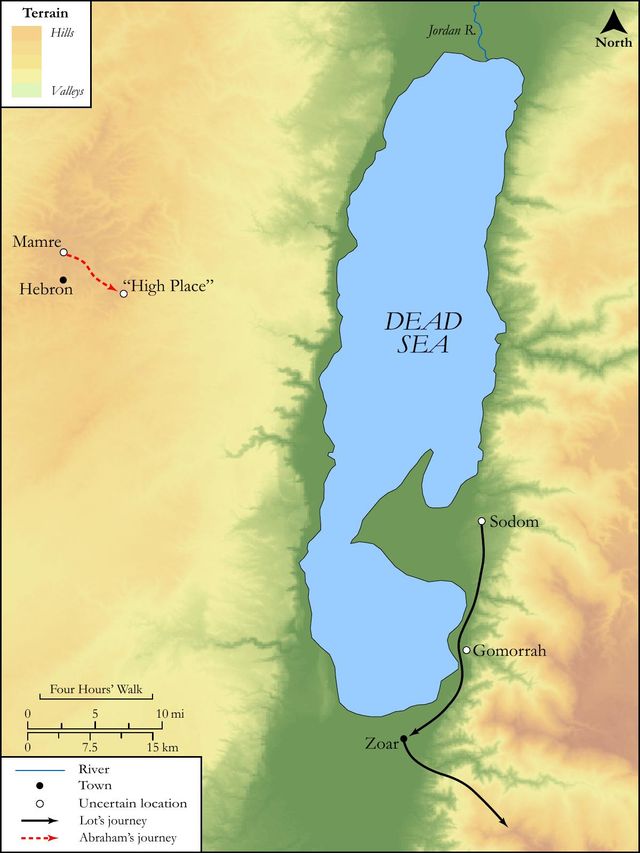
See on the biblical-era maps


Study this verse
Public-domain commentary
Matthew Henry
From his Commentary on the Whole Bible. Henry comments on passages, not single verses — this entry covers Genesis 18:16–22. His four-level outline is real structure in the source text, so it is rendered as structure.
The messengers from heaven had now despatched one part of their business, which was an errand of grace to Abraham and Sarah, and which they delivered first; but now they have before them work of another nature. Sodom is to be destroyed, and they must do it, Gen 19:13. Note, As with the Lord there is mercy, so he is the God to whom vengeance belongs. Pursuant to their commission, we here find, 1. That they looked towards Sodom (Gen 18:16); they set their faces against it in wrath, as God is said to look unto the host of the Egyptians, Exo 14:24. Note, Though God has long seemed to connive at sinners, from which they have inferred that the Lord does not see, does not regard, yet, when the day of his wrath comes, he will look towards them. 2. That they went towards Sodom (Gen 18:22), and accordingly we find two of them at Sodom, Gen 19:1. Whether the third was the Lord, before whom Abraham yet stood, and to whom he drew near (Gen 18:23), as most think, or whether the third left them before they came to Sodom, and the Lord before whom Abraham stood was the shechinah, or that appearance of the divine glory which Abraham had formerly seen and conversed with, is uncertain. However, we have here,
I.The honour Abraham did to his guests:
He went with them to bring them on the way, as one that was loth to part with such good company, and was desirous to pay his utmost respects to them. This is a piece of civility proper to be shown to our friends; but it must be done as the apostle directs (Jo3 1:6), after a godly sort.
II.The honour they did to him; for those that honour God he will honour.
God communicated to Abraham his purpose to destroy Sodom, and not only so, but entered into a free conference with him about it. Having taken him, more closely than before, into covenant with himself (ch. 17), he here admits him into more intimate communion with himself than ever, as the man of his counsel. Observe here,
1.God's friendly thoughts concerning Abraham, Gen 18:17-19, where we have his resolution to make known to Abraham his purpose concerning Sodom, with the reasons of it. If Abraham had not brought them on their way, perhaps he would not have been thus favoured; but he that loves to walk with wise men shall be wise, Pro 13:20. See how God is pleased to argue with himself: Shall I hide from Abraham (or, as some read it, Am I concealing from Abraham) that thing which I do? "Can I go about such a thing, and not tell Abraham?" Thus does God, in his counsels, express himself, after the manner of men, with deliberation. But why must Abraham be of the cabinet-council? The Jews suggest that because God had granted the land of Canaan to Abraham and his seed therefore he would not destroy those cities which were a part of that land, without his knowledge and consent. But God here gives two other reasons: -
(1.)Abraham must know, for he is a friend and a favourite, and one that God has a particular kindness for and great things in store for. He is to become a great nation; and not only so, but in the Messiah, who is to come from his loins, All nations of the earth shall be blessed. Note, The secret of the Lord is with those that fear him, Psa 25:14; Pro 3:32. Those who by faith live a life of communion with God cannot but know more of his mind than other people, though not with a prophetical, yet with a prudential practical knowledge. They have a better insight than others into what is present (Hos 14:9; Psa 107:43), and a better foresight of what is to come, at least so much as suffices for their guidance and for their comfort.
(2.)Abraham must know, for he will teach his household: I know Abraham very well, that he will command his children and his household after him, Gen 18:19. Consider this,
[1.]As a very bright part of Abraham's character and example. He not only prayed with his family, but he taught them as a man of knowledge, nay, he commanded them as a man in authority, and was prophet and king, as well as priest, in his own house. Observe, First, God having made the covenant with him and his seed, and his household being circumcised pursuant to that, he was very careful to teach and rule them well. Those that expect family blessings must make conscience of family duty. If our children be the Lord's, they must be nursed for him; if they wear his livery, they must be trained up in his work. Secondly, Abraham took care not only of his children, but of his household; his servants were catechized servants. Masters of families should instruct and inspect the manners of all under their roof. The poorest servants have precious souls that must be looked after. Thirdly, Abraham made it his care and business to promote practical religion in his family. He did not fill their heads with matters of nice speculation, or doubtful disputation; but he taught them to keep the way of the Lord, and to do judgment and justice, that is, to be serious and devout in the worship of God and to be honest in their dealings with all men. Fourthly, Abraham, herein, had an eye to posterity, and was in care not only that his household with him, but that his household after him, should keep the way of the Lord, that religion might flourish in his family when he was in his grave. Fifthly, His doing this was the fulfilling of the conditions of the promises which God had made him. Those only can expect the benefit of the promises that make conscience of their duty.
[2.]As the reason why God would make known to him his purpose concerning Sodom, because he was communicative of his knowledge, and improved it for the benefit of those that were under his charge. Note, To him that hath shall be given, Mat 13:12; Mat 25:29. Those that make a good use of their knowledge shall know more.
2.God's friendly talk with Abraham, in which he makes known to him purpose concerning Sodom, and allows him a liberty of application to him about the matter.
(1.)He tells him of the evidence there was against Sodom: The cry of Sodom is great, Gen 18:20. Note, Some sins, and the sins of some sinners, cry aloud to heaven for vengeance. The iniquity of Sodom was crying iniquity, that is, it was so very provoking that it even urged God to punish.
(2.)The enquiry he would make upon this evidence: I will go down now and see, Gen 18:21. Not as if there were any thing concerning which God is in doubt, or in the dark; but he is pleased thus to express himself after the manner of men,
[1.]To show the incontestable equity of all his judicial proceedings. Men are apt to suggest that his way is not equal; but let them know that his judgments are the result of an eternal counsel, and are never rash or sudden resolves. He never punishes upon report, or common fame, or the information of others, but upon his own certain and infallible knowledge.
[2.]To give example to magistrates, and those in authority, with the utmost care and diligence to enquire into the merits of a cause, before they give judgment upon it.
[3.]Perhaps the decree is here spoken of as not yet peremptory, that room and encouragement might be given to Abraham to make intercession for them. Thus God looked if there were any to intercede, Isa 59:16.
Continue studying Genesis 18:18 across the web’s major study libraries — every link below opens this exact verse, chapter, or book on the destination site.
Read & Compare
 BibleGatewayThis verse in more than 200 translations and 70 languages.
 Bible.comThe YouVersion reader — hundreds of translations, reading plans, and highlights.
 ESV.orgCrossway's official English Standard Version reader.
 NET BibleThe NET translation with 60,000+ translators' notes on every rendering decision.
 STEP BibleTyndale House's free study tool — original text, vocabulary, and scholarly resources.
 BibliaLogos Bible Software's free web reader.
 USCCBThe New American Bible (Revised Edition) with the U.S. bishops' study notes.
Commentaries
 BibleHub CommentariesDozens of classic commentaries on this verse, gathered on one page.
 StudyLightMore than 100 commentary sets — the largest collection on the web.
 BibleRefPlain-English commentary on what this verse means, verse by verse.
 Enduring WordDavid Guzik's free commentary on this chapter, widely used by Bible teachers.
 Bible Study ToolsVerse commentary alongside Greek and Hebrew study aids.
Original Language & Research
- BibleHub InterlinearThe verse word by word — original language, transliteration, and English.
- BibleHub LexiconEvery word's original-language definition and Strong's entry.
 Blue Letter BibleDeep-study tools — Strong's numbers, concordance, and word studies.
 SefariaThe Hebrew text with Rashi and centuries of Jewish commentary.
Sermons, Hymns & Audio


TrulyRandomVerse is not affiliated with these sites and doesn’t control their content. They’re linked because they’re genuinely useful.
Summary
Genesis 18:18 encapsulates a pivotal moment in God's ongoing covenant with Abraham, where the Lord reaffirms His divine purpose for the patriarch: to become a vast and powerful nation through whom an unparalleled, universal blessing will extend to all peoples across the earth. This profound declaration, made as God deliberates revealing His judgment plans for Sodom, underscores Abraham's unique and foundational role in God's unfolding redemptive narrative for humanity.
Context
ShowHideLiterary Context
This verse is deeply embedded within a significant narrative found in Genesis 18, where the Lord, appearing in human form with two angels, visits Abraham at the oaks of Mamre. Following the miraculous announcement of Sarah's impending pregnancy (Genesis 18:10-15), the narrative shifts to a profound divine soliloquy in Genesis 18:17 where God asks, "Shall I hide from Abraham that thing which I do?" Genesis 18:18, along with Genesis 18:19, serves as God's explicit rationale for confiding in Abraham. It establishes Abraham's unique status not merely as a recipient of promises but as a co-laborer in God's plan, entrusted with the knowledge of divine judgment due to his future role as the progenitor of a nation committed to righteousness and justice.
Historical & Cultural Context
In the days of the patriarchs, the concept of a "nation" was intrinsically linked to a specific land, a shared lineage, and a distinct identity, often defined by its patron deity and military strength. God's promise to Abraham of becoming a "great and mighty nation" would have resonated deeply with the aspirations of a nomadic patriarch, offering a vision of stability, numerous descendants, and significant influence—a stark contrast to his current childless state and transient lifestyle. Furthermore, the idea of one nation being a source of blessing for "all the nations" was revolutionary, transcending typical tribal or nationalistic rivalries and hinting at a universal scope of divine favor previously unknown. This promise set Abraham apart from other tribal leaders and established a unique trajectory for his descendants.
Key Themes
ShowHideGenesis 18:18 powerfully reinforces several overarching themes found throughout the book of Genesis and the broader Pentateuch. It highlights God's unwavering faithfulness to His covenant promises, first articulated in Genesis 12:1-3, demonstrating His commitment to bring about His purposes despite human limitations. The verse also emphasizes the divine election and unique destiny of Israel, portraying them as a nation chosen not for their own sake alone, but as a conduit of blessing to the entire world. Most significantly, it underscores the universal scope of God's redemptive plan, revealing that His ultimate desire extends beyond a single lineage or nation to encompass all of humanity, a theme that finds its ultimate fulfillment in the New Testament (e.g., Romans 4:13).
Exposition and Analysis
ShowHideThe declaration in Genesis 18:18 is a profound statement, revealing critical aspects of God's character and His unfolding redemptive plan. It is not merely a reaffirmation but an expansion of previous promises, setting the stage for the future of Abraham's lineage and its global impact.
Key Word Analysis
ShowHideDerived from a root meaning "to grow, be great," this word signifies greatness in various senses: size, importance, power, or influence. Here, applied to "nation," it denotes not just numerical vastness but also significant political, moral, and spiritual stature. It speaks to the future prominence and impact of Abraham's descendants on the world stage, indicating a nation of considerable renown and strength.
This term, often translated "nation," specifically refers to a foreign nation or Gentile people, but in this context, it refers to Abraham's future descendants as a distinct and numerous people group. The use of this word here, especially in conjunction with "all the nations of the earth," sets up a powerful contrast and connection: Abraham's lineage will become a distinct "nation" among the "nations" of the world, serving as the channel through which blessing flows to them.
A primitive root meaning "to kneel," this word fundamentally conveys the idea of conferring benefit, favor, or divine empowerment. When God blesses, He imparts spiritual and material good, prosperity, and well-being. The passive form used here ("shall be blessed") indicates that the nations will receive this benefit, emphasizing God as the active agent of blessing, channeled through Abraham. This blessing is not merely material but encompasses spiritual favor, reconciliation, and the ultimate good of salvation.
Verse Breakdown
ShowHide"Seeing that Abraham shall surely become a great and mighty nation"
This clause serves as God's justification for revealing His plans to Abraham. It reiterates and amplifies the promise of numerous descendants and national prominence first given in Genesis 12:2. The phrase "surely become" (a Hebrew infinitive absolute construction) emphasizes the absolute certainty and divine guarantee of this future reality. It speaks to the formation of Israel as a distinct, powerful, and numerous entity, chosen by God for His specific purposes.
"and all the nations of the earth shall be blessed in him?"
This rhetorical question, posed by God to Himself, underscores the universal scope of His redemptive plan. The blessing promised through Abraham is not exclusive to his physical descendants but is intended for "all the nations" (gôwy) of the entire "earth" (ʼerets). This is a pivotal declaration, expanding the covenant beyond a particular family or nation to encompass global humanity. The phrase "in him" indicates that Abraham is the designated channel or instrument through whom this universal blessing will flow, foreshadowing a spiritual lineage that transcends ethnic boundaries.
Literary Devices
ShowHideGenesis 18:18 employs several significant literary devices. The verse functions as a Divine Soliloquy, where God speaks aloud His rationale and intentions, granting the reader privileged insight into His thoughts and purposes. This enhances the sense of divine sovereignty and deliberation. The rhetorical question at the end, "and all the nations of the earth shall be blessed in him?", serves as a form of Emphasis and Affirmation, underscoring the universal and profound nature of the promise. It is also a powerful instance of Prophecy and Foreshadowing, looking forward to the establishment of the nation of Israel and, more profoundly, to the ultimate spiritual blessing that would come through Abraham's "seed" to all humanity. The repetition of "nation" (gôwy) in both parts of the verse creates a subtle Contrast and Connection, highlighting that Abraham's particular nation is destined to be the conduit of blessing for all other nations.
Theological and Thematic Connections
ShowHideGenesis 18:18 stands as a cornerstone of biblical theology, illustrating the progressive unfolding of God's covenant with humanity, moving from a particular individual to a universal scope. It reveals God's unwavering commitment to His promises and His expansive desire for the redemption of all peoples. This verse powerfully demonstrates that God's election of Abraham and his descendants was never an end in itself, but a means to a greater, global purpose: to bring His blessing to the entire world. It establishes a foundational missional imperative, showing that God's heart has always been for all nations, a theme that culminates in the New Testament's Great Commission.
Reflection and Application
ShowHideThe profound declaration in Genesis 18:18 offers enduring truths for contemporary believers, anchoring our faith in God's unchanging character and His expansive redemptive plan. Just as God faithfully fulfilled His promises to Abraham, demonstrating His unwavering commitment across generations, we are reminded of the absolute trustworthiness of His Word today. His promises are not contingent on our perfect performance but on His sovereign will and covenant faithfulness. The universal scope of the blessing, extending to "all the nations," foreshadows the boundless nature of the gospel, which transcends all ethnic, social, or national barriers, embracing "whosoever believes" in Christ (John 3:16). Consequently, believers in Christ, regardless of their background, are spiritually connected to Abraham, becoming heirs to the promise of blessing through faith (Galatians 3:29), thereby participating in God's grand redemptive narrative for the entire world. This calls us to embrace a global vision for God's kingdom and to live as channels of His blessing in our own contexts.
Questions for Reflection
ShowHideFAQ
ShowHideHow does this verse relate to the concept of election?
ShowHideThis verse is a foundational text for understanding God's sovereign election. It demonstrates God's specific choice of Abraham and his descendants to be the unique channel through which His redemptive purposes would unfold. However, it simultaneously clarifies that this election is not for exclusive privilege but for universal purpose. God chose one (Abraham and his lineage) for the ultimate benefit of many ("all the nations of the earth"). This highlights that divine election is intrinsically missional, intended to facilitate the spread of God's blessing and knowledge to all humanity, rather than to create an insular, favored group.
Christ-Centered Fulfillment
ShowHideGenesis 18:18 finds its ultimate and most glorious fulfillment in Jesus Christ. The promise that "all the nations of the earth shall be blessed in him" is not merely a prophecy about a national lineage, but a direct pointer to the Messiah, the singular "seed" of Abraham (Galatians 3:16). As the true and perfect descendant of Abraham, Christ embodies and extends this universal blessing, bringing salvation, reconciliation, and spiritual adoption to people from every tribe, tongue, and nation (Revelation 7:9). Through His atoning work on the cross, His resurrection, and His ascension, the spiritual benefits intended for the world are made accessible to all who believe, regardless of their physical lineage (Romans 10:12-13). Thus, in Christ, God's ancient promise to Abraham is fully realized, establishing a new covenant where all who come by faith become spiritual heirs to Abraham's faith and recipients of God's abundant grace (Ephesians 2:11-22).