


Revelation 18:1
Bible text: King James Version (1769 Blayney text) · Public domain
Bible text: King James Version with Strong's numbers · Public domain
Bible text: Berean Standard Bible · Public domain
Bible text: American Standard Version (1901) · Public domain
Bible text: World English Bible, Messianic edition · Public domain
Bible text: Geneva Bible (1599) · Public domain
Bible text: Young's Literal Translation · Public domain
- ΚαὶKaiandG2532CONJConjunction
- μετὰmetaAfterG3326PREPPreposition
- ταῦταtautathese thingsG3778D-APNDemonstrative pronoun Accusative Plural Neuter
- εἶδονeidonI sawG1492V-2AAI-1SVerb 2nd Aorist Active Indicative 1st Singular
- ἄλλονallonanotherG243A-ASMAdjective Accusative Singular Masculine
- ἄγγελονangelonangelG32N-ASMNoun Accusative Singular Masculine
- καταβαίνονταkatabainontadescendingG2597V-PAP-ASMVerb Present Active Participle Accusative Singular Masculine
- ἐκekout ofG1537PREPPreposition
- τοῦtou<the>G3588T-GSMDefinite article Genitive Singular Masculine
- οὐρανοῦouranouheavenG3772N-GSMNoun Genitive Singular Masculine
- ἔχονταechontahavingG2192V-PAP-ASMVerb Present Active Participle Accusative Singular Masculine
- ἐξουσίανexousianauthorityG1849N-ASFNoun Accusative Singular Feminine
- μεγάληνmegalēngreatG3173A-ASFAdjective Accusative Singular Feminine
- καὶkaiandG2532CONJConjunction
- ἡhētheG3588T-NSFDefinite article Nominative Singular Feminine
- γῆgēearthG1093N-NSFNoun Nominative Singular Feminine
- ἐφωτίσθηephōtisthēwas illuminatedG5461V-API-3SVerb Aorist Passive Indicative 3rd Singular
- ἐκekfromG1537PREPPreposition
- τῆςtēstheG3588T-GSFDefinite article Genitive Singular Feminine
- δόξηςdoxēsgloryG1391N-GSFNoun Genitive Singular Feminine
- αὐτοῦautouof himG846P-GSMPersonal pronoun Genitive Singular Masculine
English is a literal word-by-word gloss of the Greek, not the KJV's wording. Why?
This is the original text the KJV's translators worked from — each Greek word with its own literal English meaning in this verse, prepared by scholars at Tyndale House, Cambridge. The KJV translates whole sentences, not word by word, so its wording differs: one Greek word can become several English words, and the KJV may choose “charity” where the gloss reads “love”. Both are faithful — they answer different questions. For the KJV's own rendering, switch to the KJV text.
Details
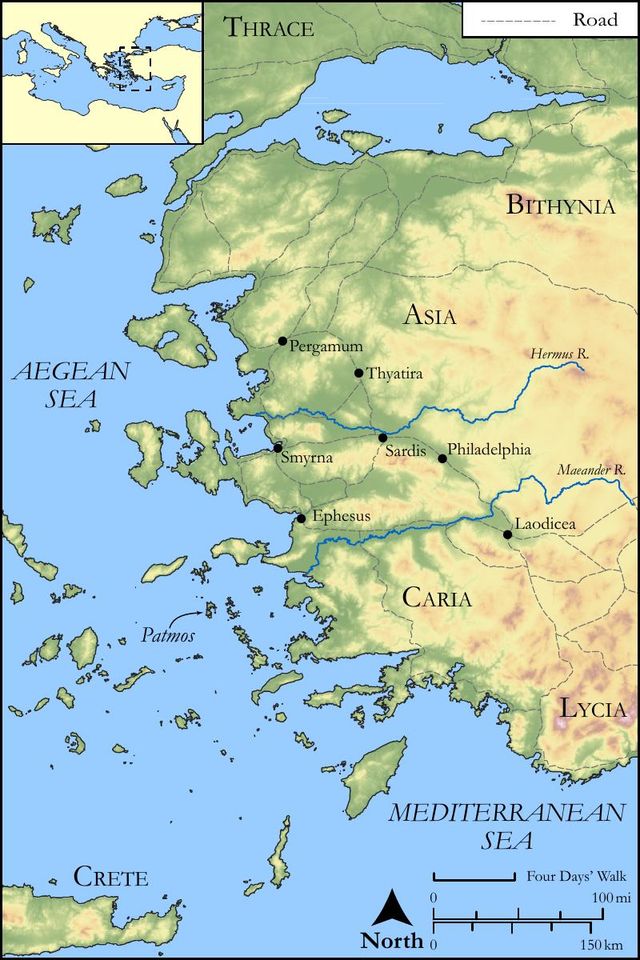
See on the biblical-era maps

Study this verse
Public-domain commentary
Matthew Henry
From his Commentary on the Whole Bible. Henry comments on passages, not single verses — this entry covers Revelation 18:1–8.
The downfall and destruction of Babylon form an event so fully determined in the counsels of God, and of such consequence to his interests and glory, that the visions and predictions concerning it are repeated. 1. Here is another angel sent from heaven, attended with great power and lustre, Rev 18:1. He had not only light in himself, to discern the truth of his own prediction, but to inform and enlighten the world about that great event; and not only light to discern it, but power to accomplish it. 2. This angel publishes the fall of Babylon, as a thing already come to pass; and this he does with a mighty strong voice, that all might hear the cry, and might see how well this angel was pleased to be the messenger of such tidings. Here seems to be an allusion to the prediction of the fall of pagan Babylon (Isa 21:9), where the word is repeated as it is here: has fallen, has fallen. Some have thought a double fall is hereby intended, first her apostasy, and then her ruin; and they think the words immediately following favour their opinion; She has become the habitation of devils, and the hold of every foul spirit, and the cage of every unclean and hateful bird, Rev 18:2. But this is also borrowed from Isa 21:9, and seems to describe not so much her sin of entertaining idols (which are truly called devils) as her punishment, it being a common notion that unclean spirits, as well as ominous and hateful birds, used to haunt a city or house that lay in its ruins. 3. The reason of this ruin is declared (Rev 18:3); for, though God is not obliged to give any account of his matters, yet he is pleased to do so, especially in those dispensations of providence that are most awful and tremendous. The wickedness of Babylon had been very great; for she had not only forsaken the true God herself, and set up idols, but had with great art and industry drawn all sorts of men into the spiritual adultery, and by her wealth and luxury had retained them in her interest. 4. Fair warning is given to all that expect mercy from God, that they should not only come out of her, but be assisting in her destruction, Rev 18:4, Rev 18:5. Here observe, (1.) God may have a people even in Babylon, some who belong to the election of grace. (2.) God's people shall be called out of Babylon, and called effectually. (3.) Those that are resolved to partake with wicked men in their sins must receive of their plagues. (4.) When the sins of a people reach up to heaven, the wrath of God will reach down to the earth. (5.) Though private revenge is forbidden, yet God will have his people act under him, when called to it, in pulling down his and their inveterate and implacable enemies, Rev 18:6. (6.) God will proportion the punishment of sinners to the measure of their wickedness, pride, and security, Rev 18:7. (7.) When destruction comes on a people suddenly, the surprise is a great aggravation of their misery, Rev 18:8.
Historical interpretation
Four Centuries of Reception
4 surviving comments on this verse. Each one is dated, so this reads as a timeline rather than a list.
Select a marker to jump to its quote. Markers stagger vertically where authors wrote within a few decades of each other.
This angel possesses great power. For it is speaking of the destruction of the world’s wisdom, which is also signified by the destruction of Jericho, and of the ruin of the earthly kingdom. By indicating that a stronger one has come against the strong one in order to expel the false appearance of truth and by covering over the faintness of the world’s wisdom, it gives witness that now the true light of wisdom has come. Moreover, to the wise of this world and to the kings of the earth who rely upon their own strength it further demonstrates that [this light] is unconquered in both power and wisdom.… I think that this signifies the coming of our Lord, Jesus Christ, who in Isaiah is called the angel of great counsel. In his first advent, he said, “Repent, for the kingdom of heaven is at hand,” and brought to naught the work of worldly power. And the earth was made bright by his splendor, for he is himself “the true Light that enlightens everyone coming into this world.”
This passage reveals the brilliance and brightness of the holy powers, which greatly surpasses the light of the stars and the heavenly bodies.
After these things, I saw another angel coming down from heaven, having great authority, etc. This strong angel illuminating the earth can also be understood as the Lord incarnate and the doctors of the Church; who, endowed with heavenly light, proclaim the fall of the world, saying: The kingdom of heaven is at hand (Matt. 3, 4).
He says that this one is the illuminated and enlightens the earth by his glory.
Continue studying Revelation 18:1 across the web’s major study libraries — every link below opens this exact verse, chapter, or book on the destination site.
Read & Compare
 BibleGatewayThis verse in more than 200 translations and 70 languages.
 Bible.comThe YouVersion reader — hundreds of translations, reading plans, and highlights.
 ESV.orgCrossway's official English Standard Version reader.
 NET BibleThe NET translation with 60,000+ translators' notes on every rendering decision.
 STEP BibleTyndale House's free study tool — original text, vocabulary, and scholarly resources.
 BibliaLogos Bible Software's free web reader.
 USCCBThe New American Bible (Revised Edition) with the U.S. bishops' study notes.
Commentaries
 BibleHub CommentariesDozens of classic commentaries on this verse, gathered on one page.
 StudyLightMore than 100 commentary sets — the largest collection on the web.
 BibleRefPlain-English commentary on what this verse means, verse by verse.
 Enduring WordDavid Guzik's free commentary on this chapter, widely used by Bible teachers.
 Bible Study ToolsVerse commentary alongside Greek and Hebrew study aids.
Original Language & Research
- BibleHub InterlinearThe verse word by word — original language, transliteration, and English.
- BibleHub LexiconEvery word's original-language definition and Strong's entry.
 Blue Letter BibleDeep-study tools — Strong's numbers, concordance, and word studies.
 CNTR CollationThe earliest Greek manuscripts of this verse, collated letter by letter.
Sermons, Hymns & Audio


TrulyRandomVerse is not affiliated with these sites and doesn’t control their content. They’re linked because they’re genuinely useful.
Summary
Revelation 18:1 introduces a pivotal moment in John's apocalyptic vision, immediately following the detailed description of "Babylon the Great" in the preceding chapter. This verse presents the dramatic appearance of a mighty angel descending from heaven, distinguished by immense authority and a radiant glory that illuminates the entire earth. His arrival signals the imminent and undeniable judgment upon the corrupt system symbolized by Babylon, emphasizing the divine origin, power, and righteousness behind the impending pronouncement of its downfall.
Context
ShowHideLiterary Context
Revelation 18:1 serves as a crucial transition point in John's prophetic narrative. It directly follows the detailed exposition of "Babylon the Great" in Revelation 17, which unveils her identity as a harlot riding the beast, symbolizing a corrupt religious and political system that has seduced the nations and persecuted the saints. The phrase "after these things" (Greek: meta tauta) indicates a chronological and thematic progression from the description of Babylon's character and alliances to the unfolding of her inevitable destruction. This verse sets the stage for the pronouncement of Babylon's fall, which immediately follows in Revelation 18:2-3, underscoring the divine certainty and finality of this judgment.
Historical & Cultural Context
The imagery of a powerful angel descending from heaven with illuminating glory draws upon Old Testament prophetic traditions, where divine messengers often appear with overwhelming splendor to deliver God's decrees (e.g., Daniel 10:5-6). In the Roman world of John's time, imperial power and glory were often displayed through grand processions and magnificent architecture, designed to impress and intimidate. The angel's glory, however, eclipses any earthly display, serving as a divine counter-narrative that asserts God's ultimate sovereignty over all human empires, including the oppressive Roman Empire which many early Christians would have associated with the symbolic "Babylon." The "earth being lightened" would have evoked images of divine revelation and the breaking in of heavenly truth, contrasting with the moral and spiritual darkness of the pagan world.
Key Themes
ShowHideThis verse powerfully contributes to several overarching themes in Revelation. Firstly, it highlights Divine Sovereignty and Judgment, asserting God's absolute control over history and His unwavering commitment to justice against all forms of evil. The angel's "great power" (Greek: exousía) underscores the irresistible force of God's decrees. Secondly, the theme of Divine Revelation and Illumination is prominent, as the earth is "lightened with his glory." This not only signifies the angel's divine origin but also suggests that God's truth and righteous judgment are being made undeniably clear to all, leaving no room for ignorance or excuse. This foreshadows the ultimate triumph of God's light over darkness, culminating in the New Jerusalem where the glory of God will be its light. Finally, it reinforces the Certainty of Babylon's Fall, presenting the angel's arrival as the definitive sign that the time for this long-prophesied event has arrived, fulfilling the warnings found throughout the prophetic literature, such as in Isaiah 13 and Jeremiah 50-51.
Exposition and Analysis
ShowHideKey Word Analysis
ShowHideMeaning "a messenger; especially an 'angel'; by implication, a pastor." In this context, the term denotes a divine messenger, a celestial being dispatched from God's presence. The emphasis here is on the angel's role as an emissary bearing a message of ultimate divine judgment, distinguishing him as "another" (G243, állos) from previous angels in Revelation, suggesting a unique and particularly significant commission.
Meaning "privilege, i.e. (subjectively) force, capacity, competency, freedom, or (objectively) mastery (concretely, magistrate, superhuman, potentate, token of control), delegated influence." This word signifies not merely strength, but inherent authority and the right to act. The angel's "great power" (G3173, mégas + G1849, exousía) indicates that he is endowed with immense, delegated divine authority, making his pronouncement undeniable and his actions irresistible. This power is derived from God Himself, underscoring the divine origin and inevitability of Babylon's judgment.
Meaning "glory (as very apparent), in a wide application (literal or figurative, objective or subjective):--dignity, glory(-ious), honour, praise, worship." When applied to God or His heavenly agents, dóxa refers to a visible manifestation of divine splendor, majesty, and inherent brightness. The earth being "lightened" (G5461, phōtízō) with this glory implies a pervasive, undeniable illumination, making the angel's divine nature and the truth of his message unmistakably clear, leaving no room for doubt or obscurity regarding the impending judgment.
Verse Breakdown
ShowHide"And after these things I saw another angel"
This phrase establishes the continuity of John's visions, indicating a new, distinct phase following the revelations concerning Babylon in the preceding chapter. The term "another angel" (Greek: allos angelos) suggests a unique and particularly significant messenger, distinct from those previously seen, who is about to deliver a momentous divine decree. John's act of "seeing" (Greek: eídō) emphasizes the visionary nature of the revelation, confirming its divine origin and direct communication to the prophet.
"come down from heaven,"
This detail immediately establishes the angel's divine origin and the celestial source of his message. His descent "from heaven" (Greek: ek ouranou) signifies that the authority and message he carries are not earthly or human, but directly from God's throne, making the impending judgment an act of divine will and not a mere earthly event. This underscores the unchallengeable nature of what is to follow.
"having great power;"
This clause highlights the extraordinary authority and might vested in this particular angel. The "great power" (Greek: megas exousia) indicates that he is not merely a messenger but an agent endowed with the capacity and right to execute divine judgment. This power is a direct reflection of God's own omnipotence, ensuring the effectiveness and certainty of the angel's mission. It signals that the forces of evil will be utterly overwhelmed.
"and the earth was lightened with his glory."
This is a profound visual and symbolic statement. The "glory" (Greek: dóxa) radiating from the angel is a visible manifestation of divine presence, purity, and truth. The fact that "the earth was lightened" (Greek: ephōtisthe hē gē) by this glory implies a pervasive, undeniable illumination that dispels all darkness and deception. It signifies that God's truth, righteousness, and imminent judgment are being made manifest to all inhabitants of the earth, leaving no one in ignorance of the divine verdict against Babylon.
Literary Devices
ShowHideRevelation 18:1 is rich with Symbolism and Imagery. The "angel" is not merely a physical being but a symbolic representation of divine agency and the direct intervention of God's will in human affairs. His descent "from heaven" symbolizes the divine origin and unchallengeable authority of the message he carries, contrasting with the earthly and corrupt nature of Babylon. The phrase "great power" is a symbol of God's omnipotence, delegated to His messenger, indicating the irresistible force of the impending judgment. Most powerfully, the "earth was lightened with his glory" employs vivid Imagery of light. This light symbolizes divine truth, purity, and the undeniable manifestation of God's presence and righteous judgment. It stands in stark contrast to the spiritual darkness and deception associated with Babylon, signifying that God's verdict will be revealed in full clarity, leaving no room for doubt or obscurity. This Contrast between divine light and earthly darkness is a recurring motif throughout Revelation.
Theological and Thematic Connections
ShowHideRevelation 18:1 underscores the profound theological truth of God's ultimate sovereignty and His unwavering commitment to justice. The appearance of this mighty angel, imbued with divine power and glory, serves as a powerful declaration that no earthly power, however entrenched or seemingly invincible, can stand against the righteous judgment of God. This verse reminds believers that despite the apparent triumph of evil in the world, God remains in control, and His divine will for justice will inevitably be executed. It offers immense comfort and assurance to those who have suffered under oppressive practices, knowing that their vindication will come from a just and powerful God.
Reflection and Application
ShowHideRevelation 18:1 invites believers to contemplate the profound reality of God's divine justice and His ultimate triumph over all forms of evil. In a world often characterized by injustice, corruption, and the apparent prosperity of the wicked, this verse serves as a powerful reminder that God sees, God knows, and God will act. The angel's descent with "great power" and illuminating "glory" assures us that God's judgment is not arbitrary or hidden, but a clear, powerful, and righteous intervention that will expose and dismantle all that opposes Him. For us today, this means we can live with confident hope, trusting that our God is sovereign over all circumstances, and that His light will ultimately dispel every shadow. It calls us to align ourselves with His truth and justice, living as beacons of His light in a world that desperately needs it, knowing that His kingdom will ultimately prevail.
Questions for Reflection
ShowHideFAQ
ShowHideWhat is the significance of "another angel" in Revelation 18:1?
ShowHideThe phrase "another angel" (Greek: allos angelos) is significant because it distinguishes this particular messenger from the numerous other angels mentioned throughout Revelation. While many angels deliver messages or execute judgments, this angel is presented as unique in his authority and the visible manifestation of his glory. He is not just an angel, but another angel of particular importance, specifically commissioned to announce the final, decisive judgment upon Babylon, a task of immense theological and eschatological weight. His distinct appearance underscores the gravity and finality of the message he is about to deliver, marking a new, climactic phase in God's unfolding plan.
How does the "lightening of the earth with his glory" relate to other biblical passages about God's glory?
ShowHideThe "lightening of the earth with his glory" in Revelation 18:1 is a powerful visual that connects to numerous biblical themes of divine manifestation. In the Old Testament, God's glory often appeared as a radiant light (e.g., the Shekinah glory in the tabernacle and temple, as seen in Exodus 40:34-35 and 1 Kings 8:10-11). Prophets like Isaiah foresaw a time when the earth would be filled with the knowledge of the glory of the Lord (e.g., Isaiah 6:3 and Habakkuk 2:14). In the New Testament, Jesus is described as the "radiance of God's glory" (Hebrews 1:3), and the New Jerusalem will have no need for sun or moon because "the glory of God gives it light" (Revelation 21:23). Thus, the angel's glory in Revelation 18:1 is a temporary, yet powerful, manifestation of this divine light breaking into the earthly realm to reveal God's truth and execute His judgment, foreshadowing the ultimate and eternal reign of God's glory.
Christ-Centered Fulfillment
ShowHideWhile Revelation 18:1 focuses on an angel's role in announcing judgment, its deeper Christ-centered fulfillment lies in the ultimate authority and glory of Jesus Christ, who is the true agent of God's final judgment and the source of all divine illumination. The "great power" (Greek: exousía) wielded by this angel is a delegated authority that ultimately belongs to Christ, who declared that "all authority in heaven and on earth has been given to me" (Matthew 28:18). Just as the earth is "lightened with his glory," so too is Christ the "light of the world" (John 8:12), whose glory illuminates the truth and exposes darkness. The judgment against Babylon, announced by this angel, is a prefigurement of Christ's final triumph over all evil and His establishment of a kingdom of righteousness. He is the one who will return "with power and great glory" (Matthew 24:30) to execute judgment and bring about the new heavens and new earth, where His glory will be the perpetual light, fulfilling the promise that "the city has no need of sun or moon to shine on it, for the glory of God gives it light, and the Lamb is its lamp" (Revelation 21:23). Thus, this angel's powerful appearance serves as a vivid preview of the ultimate, glorious, and decisive intervention of Christ Himself.