


Galatians 5:21
Bible text: King James Version (1769 Blayney text) · Public domain
Bible text: King James Version with Strong's numbers · Public domain
Bible text: Berean Standard Bible · Public domain
Bible text: American Standard Version (1901) · Public domain
Bible text: World English Bible, Messianic edition · Public domain
Bible text: Geneva Bible (1599) · Public domain
Bible text: Young's Literal Translation · Public domain
- φθόνοιphthonoienvyingsG5355N-NPMNoun Nominative Plural Masculine
- φόνοιphonoimurdersG5408N-NPMNoun Nominative Plural Masculine
- μέθαιmethaidrunkennessesG3178N-NPFNoun Nominative Plural Feminine
- κῶμοιkōmoicarousingG2970N-NPMNoun Nominative Plural Masculine
- καὶkaiandG2532CONJConjunction
- τὰta<the> [things]G3588T-NPNDefinite article Nominative Plural Neuter
- ὅμοιαhomoialikeG3664A-NPNAdjective Nominative Plural Neuter
- τούτοις·toutoisas theseG3778D-DPNDemonstrative pronoun Dative Plural Neuter
- ἃhawhichG3739R-APNRelative pronoun Accusative Plural Neuter
- προλέγωprolegōI forewarnG4302V-PAI-1SVerb Present Active Indicative 1st Singular
- ὑμῖνhuminyouG4771P-2DPPersonal pronoun Dative 2nd Plural
- καθὼςkathōseven asG2531CONJConjunction
- καὶkaialsoG2532CONJConjunction
- προεῖπονproeiponI warned beforeG4277V-2AAI-1SVerb 2nd Aorist Active Indicative 1st Singular
- ὅτιhotithatG3754CONJConjunction
- οἱhoithoseG3588T-NPMDefinite article Nominative Plural Masculine
- τὰtasuchG3588T-APNDefinite article Accusative Plural Neuter
- τοιαῦταtoiautathingsG5108D-APNDemonstrative pronoun Accusative Plural Neuter
- πράσσοντεςprassontesdoingG4238V-PAP-NPMVerb Present Active Participle Nominative Plural Masculine
- βασιλείανbasileiankingdomG932N-ASFNoun Accusative Singular Feminine
- θεοῦtheouGod’sG2316N-GSM-TNoun Genitive Singular Masculine Title
- οὐounotG3756PRT-NNegative Particle Negative
- κληρονομήσουσινklēronomēsousinwill inheritG2816V-FAI-3PVerb Future Active Indicative 3rd Plural
English is a literal word-by-word gloss of the Greek, not the KJV's wording. Why?
This is the original text the KJV's translators worked from — each Greek word with its own literal English meaning in this verse, prepared by scholars at Tyndale House, Cambridge. The KJV translates whole sentences, not word by word, so its wording differs: one Greek word can become several English words, and the KJV may choose “charity” where the gloss reads “love”. Both are faithful — they answer different questions. For the KJV's own rendering, switch to the KJV text.
Details
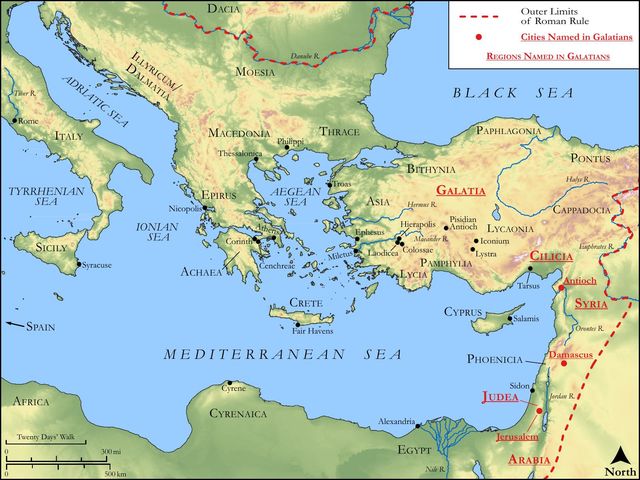
See on the biblical-era maps

Study this verse
Public-domain commentary
Matthew Henry
From his Commentary on the Whole Bible. Henry comments on passages, not single verses — this entry covers Galatians 5:13–26. His three-level outline is real structure in the source text, so it is rendered as structure.
In the latter part of this chapter the apostle comes to exhort these Christians to serious practical godliness, as the best antidote against the snares of the false teachers. Two things especially he presses upon them: -
I.That they should not strive with one another, but love one another.
He tells them (Gal 5:13) that they had been called unto liberty, and he would have them to stand fast in the liberty wherewith Christ had made them free; but yet he would have them be very careful that they did not use this liberty as an occasion to the flesh - that they did not thence take occasion to indulge themselves in any corrupt affections and practices, and particularly such as might create distance and disaffection, and be the ground of quarrels and contentions among them: but, on the contrary, he would have them by love to serve one another, to maintain that mutual love and affection which, notwithstanding any minor differences there might be among them, would dispose them to all those offices of respect and kindness to each other which the Christian religion obliged them to. Note,
1.The liberty we enjoy as Christians is not a licentious liberty: though Christ has redeemed us from the curse of the law, yet he has not freed us from the obligation of it; the gospel is a doctrine according to godliness (Ti1 6:3), and is so far from giving the least countenance to sin that it lays us under the strongest obligations to avoid and subdue it.
2.Though we ought to stand fast in our Christian liberty, yet we should not insist upon it to the breach of Christian charity; we should not use it as an occasion of strife and contention with our fellow Christians, who may be differently minded from us, but should always maintain such a temper towards each other as may dispose us by love to serve one another. To this the apostle endeavours to persuade these Christians, and there are two considerations which he sets before them for this purpose: - (1.) That all the law is fulfilled in one word, even in this, Thou shalt love thy neighbour as thyself, Gal 5:14. Love is the sum of the whole law; as love to God comprises the duties of the first table, so love to our neighbour those of the second. The apostle takes notice of the latter here, because he is speaking of their behaviour towards one another; and, when he makes use of this as an argument to persuade them to mutual love, he intimates both that this would be a good evidence of their sincerity in religion and also the most likely means of rooting out those dissensions and divisions that were among them. It will appear that we are the disciples of Christ indeed when we have love one to another (Joh 13:35); and, where this temper is kept up, if it do not wholly extinguish those unhappy discords that are among Christians, yet at least it will so far accommodate them that the fatal consequences of them will be prevented. (2.) The sad and dangerous tendency of a contrary behaviour (Gal 5:15): But, says he, if instead of serving one another in love, and therein fulfilling the law of God, you bite and devour one another, take heed that you be not consumed one of another. If, instead of acting like men and Christians, they would behave themselves more like brute beasts, in tearing and rending one another, they could expect nothing as the consequence of it, but that they would be consumed one of another; and therefore they had the greatest reason not to indulge themselves in such quarrels and animosities. Note, Mutual strifes among brethren, if persisted in, are likely to prove a common ruin; those that devour one another are in a fair way to be consumed one of another. Christian churches cannot be ruined but by their own hands; but if Christians, who should be helps to one another and a joy one to another, be as brute beasts, biting and devouring each other, what can be expected but that the God of love should deny his grace to them, and the Spirit of love should depart from them, and that the evil spirit, who seeks the destruction of them all, should prevail?
II.That they should all strive against sin; and happy would it be for the church if Christians would let all their quarrels be swallowed up of this, even a quarrel against sin-if, instead of biting and devouring one another on account of their different opinions, they would all set themselves against sin in themselves and the places where they live. This is what we are chiefly concerned to fight against, and that which above every thing else we should make it our business to oppose and suppress. To excite Christians hereunto, and to assist them herein, the apostle shows,
1.That there is in every one a struggle between the flesh and the spirit (Gal 5:17): The flesh (the corrupt and carnal part of us) lusts (strives and struggles with strength and vigour) against the spirit: it opposes all the motions of the Spirit, and resists every thing that is spiritual. On the other hand, the spirit (the renewed part of us) strives against the flesh, and opposes the will and desire of it: and hence it comes to pass that we cannot do the things that we would. As the principle of grace in us will not suffer us to do all the evil which our corrupt nature would prompt us to, so neither can we do all the good that we would, by reason of the oppositions we meet with from that corrupt and carnal principle. Even as in a natural man there is something of this struggle (the convictions of his conscience and the corruption of his own heart strive with one another; his convictions would suppress his corruptions, and his corruptions silence his convictions), so in a renewed man, where there is something of a good principle, there is a struggle between the old nature and the new nature, the remainders of sin and the beginnings of grace; and this Christians must expect will be their exercise as long as they continue in this world.
2.That it is our duty and interest in this struggle to side with the better part, to side with our convictions against our corruptions and with our graces against our lusts. This the apostle represents as our duty, and directs us to the most effectual means of success in it. If it should be asked, What course must we take that the better interest may get the better? he gives us this one general rule, which, if duly observed, would be the most sovereign remedy against the prevalence of corruption; and that is to walk in the Spirit (Gal 5:16): This I say, then, Walk in the Spirit, and you shall not fulfil the lust of the flesh. By the Spirit here may be meant either the Holy Spirit himself, who condescends to dwell in the hearts of those whom he has renewed and sanctified, to guide and assist them in the way of their duty, or that gracious principle which he implants in the souls of his people and which lusts against the flesh, as that corrupt principle which still remains in them does against it. Accordingly the duty here recommended to us is that we set ourselves to act under the guidance and influence of the blessed Spirit, and agreeably to the motions and tendency of the new nature in us; and, if this be our care in the ordinary course and tenour of our lives, we may depend upon it that, though we may not be freed from the stirrings and oppositions of our corrupt nature, we shall be kept from fulfilling it in the lusts thereof; so that though it remain in us, yet it shall not obtain a dominion over us. Note, The best antidote against the poison of sin is to walk in the Spirit, to be much in conversing with spiritual things, to mind the things of the soul, which is the spiritual part of man, more than those of the body, which is his carnal part, to commit ourselves to the guidance of the word, wherein the Holy Spirit makes known the will of God concerning us, and in the way of our duty to act in a dependence on his aids and influences. And, as this would be the best means of preserving them from fulfilling the lusts of the flesh, so it would be a good evidence that they were Christians indeed; for, says the apostle (Gal 5:18), If you be led by the Spirit, you are not under the law. As if he had said, "You must expect a struggle between flesh and spirit as long as you are in the world, that the flesh will be lusting against the spirit as well as the spirit against the flesh; but if, in the prevailing bent and tenour of your lives, you be led by the Spirit, - if you act under the guidance and government of the Holy Spirit and of that spiritual nature and disposition he has wrought in you, - if you make the word of God your rule and the grace of God your principle, - it will hence appear that you are not under the law, not under the condemning, though you are still under the commanding, power of it; for there is now no condemnation to those that are in Christ Jesus, who walk not after the flesh, but after the Spirit; and as many as are led by the Spirit of God, they are the sons of God," Rom 8:1-14.
3.The apostle specifies the works of the flesh, which must be watched against and mortified, and the fruits of the Spirit, which must be cherished and brought forth (Gal 5:19, etc.); and by specifying particulars he further illustrates what he is here upon.
(1.)He begins with the works of the flesh, which, as they are many, so they are manifest. It is past dispute that the things he here speaks of are the works of the flesh, or the product of corrupt and depraved nature; most of them are condemned by the light of nature itself, and all of them by the light of scripture. The particulars he specifies are of various sorts; some are sins against the seventh commandment, such as adultery, fornication, uncleanness, lasciviousness, by which are meant not only the gross acts of these sins, but all such thoughts, and words, and actions, as have a tendency towards the great transgression. Some are sins against the first and second commandments, as idolatry and witchcraft. Others are sins against our neighbour, and contrary to the royal law of brotherly love, such as hatred, variance, emulations, wrath, strife, which too often occasion seditions, heresies, envyings, and sometimes break out into murders, not only of the names and reputation, but even of the very lives, of our fellow-creatures. Others are sins against ourselves, such as drunkenness and revellings; and he concludes the catalogue with an et cetera, and gives fair warning to all to take care of them, as they hope to see the face of God with comfort. Of these and such like, says he, I tell you before, as I have also told you in times past, that those who do such things, how much soever they may flatter themselves with vain hopes, shall not inherit the kingdom of God. These are sins which will undoubtedly shut men out of heaven. The world of spirits can never be comfortable to those who plunge themselves in the filth of the flesh; nor will the righteous and holy God ever admit such into his favour and presence, unless they be first washed and sanctified, and justified in the name of our Lord Jesus, and by the Spirit of our God, Co1 6:11.
(2.)He specifies the fruits of the Spirit, or the renewed nature, which as Christians we are concerned to bring forth, Gal 5:22, Gal 5:23. And here we may observe that as sin is called the work of the flesh, because the flesh, or corrupt nature, is the principle that moves and excites men to it, so grace is said to be the fruit of the Spirit, because it wholly proceeds from the Spirit, as the fruit does from the root: and whereas before the apostle had chiefly specified those works of the flesh which were not only hurtful to men themselves but tended to make them so to one another, so here he chiefly takes notice of those fruits of the Spirit which had a tendency to make Christians agreeable one to another, as well as easy to themselves; and this was very suitable to the caution or exhortation he had before given (Gal 5:13), that they should not use their liberty as an occasion to the flesh, but by love serve one another. He particularly recommends to us, love, to God especially, and to one another for his sake, - joy, by which may be understood cheerfulness in conversation with our friends, or rather a constant delight in God, - peace, with God and conscience, or a peaceableness of temper and behaviour towards others, - long-suffering, patience to defer anger, and a contentedness to bear injuries, - gentleness, such a sweetness of temper, and especially towards our inferiors, as disposes us to be affable and courteous, and easy to be entreated when any have wronged us, - goodness (kindness, beneficence), which shows itself in a readiness to do good to all as we have opportunity, - faith, fidelity, justice, and honesty, in what we profess and promise to others, - meekness, wherewith to govern our passions and resentments, so as not to be easily provoked, and, when we are so, to be soon pacified, - and temperance, in meat and drink, and other enjoyments of life, so as not to be excessive and immoderate in the use of them. Concerning these things, or those in whom these fruits of the Spirit are found, the apostle says, There is no law against them, to condemn and punish them. Yea, hence it appears that they are not under the law, but under grace; for these fruits of the Spirit, in whomsoever they are found, plainly show that such are led by the Spirit, and consequently that they are not under the law, as Gal 5:18. And as, by specifying these works of the flesh and fruits of the Spirit, the apostle directs us both what we are to avoid and oppose and what we are to cherish and cultivate, so (Gal 5:24) he informs us that this is the sincere care and endeavour of all real Christians: And those that are Christ's, says he (those who are Christians indeed, not only in show and profession, but in sincerity and truth), have crucified the flesh with the affections and lusts. As in their baptism they were obliged hereunto (for, being baptized into Christ, they were baptized into his death, Rom 6:3), so they are now sincerely employing themselves herein, and, in conformity to their Lord and head, are endeavouring to die unto sin, as he had died for it. They have not yet obtained a complete victory over it; they have still flesh as well as Spirit in them, and that has its affections and lusts, which continue to give them no little disturbance, but as it does not now reign in their mortal bodies, so as that they obey it in the lusts thereof (Rom 6:12), so they are seeking the utter ruin and destruction of it, and to put it to the same shameful and ignominious, though lingering death, which our Lord Jesus underwent for our sakes. Note, If we should approve ourselves to be Christ's, such as are united to him and interested in him, we must make it our constant care and business to crucify the flesh with its corrupt affections and lusts. Christ will never own those as his who yield themselves the servants of sin. But though the apostle here only mentions the crucifying of the flesh with the affections and lusts, as the care and character of real Christians, yet, no doubt, it is also implied that, on the other hand, we should show forth those fruits of the Spirit which he had just before been specifying; this is no less our duty than that, nor is it less necessary to evidence our sincerity in religion. It is not enough that we cease to do evil, but we must learn to do well. Our Christianity obliges us not only to die unto sin, but to live unto righteousness; not only to oppose the works of the flesh, but to bring forth the fruits of the Spirit too. If therefore we would make it appear that we do indeed belong to Christ, this must be our sincere care and endeavour as well as the other; and that it was the design of the apostle to represent both the one and the other of these as our duty, and as necessary to support our character as Christians, may be gathered from what follows (Gal 5:25), where he adds, If we live in the Spirit, let us also walk in the Spirit; that is, "If we profess to have received the Spirit of Christ, or that we are renewed in the Spirit of Christ, or that we are renewed in the spirit of our minds, and endued with a principle of spiritual life, let us make it appear by the proper fruits of the Spirit in our lives." He had before told us that the Spirit of Christ is a privilege bestowed on all the children of God, Gal 4:6. "Now," says he, "if we profess to be of this number, and as such to have obtained this privilege, let us show it by a temper and behaviour agreeable hereunto; let us evidence our good principles by good practices." Our conversation will always be answerable to the principle which we are under the guidance and government of: as those that are after the flesh do mind the things of the flesh, so those that are after the Spirit do mind the things of the Spirit, Rom 8:5. If therefore we would have it appear that we are Christ's, and that we are partakers of his Spirit, it must be by our walking not after the flesh, but after the spirit. We must set ourselves in good earnest both to mortify the deeds of the body, and to walk in newness of life.
4.The apostle concludes this chapter with a caution against pride and envy, Gal 5:26. He had before been exhorting these Christians by love to serve one another (Gal 5:13), and had put them in mind of what would be the consequence if, instead of that, they did bite and devour one another, Gal 5:15. Now, as a means of engaging them to the one and preserving them from the other of these, he here cautions them against being desirous of vain-glory, or giving way to an undue affectation of the esteem and applause of men, because this, if it were indulged, would certainly lead them to provoke one another and to envy one another. As far as this temper prevails among Christians, they will be ready to slight and despise those whom they look upon as inferior to them, and to be put out of humour if they are denied that respect which they think is their due from them, and they will also be apt to envy those by whom their reputation is in any danger of being lessened: and thus a foundation is laid for those quarrels and contentions which, as they are inconsistent with that love which Christians ought to maintain towards each other, so they are greatly prejudicial to the honour and interest of religion itself. This therefore the apostle would have us by all means to watch against. Note,
(1.)The glory which comes from men is vain-glory, which, instead of being desirous of, we should be dead to.
(2.)An undue regard to the approbation and applause of men is one great ground of the unhappy strifes and contentions that exist among Christians.
Historical interpretation
Three Centuries of Reception
8 surviving comments on this verse. Each one is dated, so this reads as a timeline rather than a list.
Select a marker to jump to its quote. Markers stagger vertically where authors wrote within a few decades of each other.
Wherefore also it comes to pass, that the "most perfect" among them addict themselves without fear to all those kinds of forbidden deeds of which the Scriptures assure us that "they who do such things shall not inherit the kingdom of God." For instance, they make no scruple about eating meats offered in sacrifice to idols, imagining that they can in this way contract no defilement.
It is after displaying to the Galatians these pernicious works that he professes to warn them beforehand, even as he had "told them in time past, that they which do such things should not inherit the kingdom of God," even because they bore not the image of the heavenly, as they had borne the image of the earthy; and so, in consequence of their old conversation, they were to be regarded as nothing else than flesh and blood.
Those, furthermore, who commit those sins whereof the apostle says, "They who do such things shall not inherit the kingdom of God"
Answer me now, thou that accusest thine own flesh, and supposest that this is said of it as of an enemy and adversary. Let it be allowed that adultery and fornication proceed, as you assert, from the flesh; yet hatred, variance, emulations, strife, heresies, and witchcraft, these arise merely from a depraved moral choice. And so it is with the others also, for how can they belong to the flesh? you observe that he is not here speaking of the flesh, but of earthly thoughts, which trail upon the ground. Wherefore also he alarms them by saying, that "they which practice such things shall not inherit the kingdom of God." If these things belonged to nature and not to a bad moral choice, his expression, "they practice," is inappropriate, it should be, "they suffer." And why should they be cast out of the kingdom, for rewards and punishments relate not to what proceeds from nature but from choice?
(Verses 19-21.) The works of the flesh are evident, which are: fornication, impurity, debauchery, idolatry, witchcraft, hostility, quarreling, jealousy, anger, selfish ambition, dissension, factions, envy, drunkenness, orgies, and things like these. I warn you, as I warned you before, that those who practice such things will not inherit the kingdom of God. Now when we explained about the flesh and the spirit earlier, we said there are three possible interpretations: that there are those who are carnal, who are like infants and unable to receive solid food in Christ and the nourishment of mature age; or that there are those who are carnal, who follow only the Jewish way and the literal interpretation of the history; or that, according to the simple sense, flesh and spirit coexist in the makeup of a person, and, according to the difference in substance, they are either the works of the flesh or of the spirit. Now therefore, the works of the flesh which are mentioned here, namely fornication, uncleanness, lasciviousness, and other things which follow, seem to me to pertain more to the simple understanding of the flesh and spirit than to the flesh of the Law, and to be referred to little ones in Christ, although it is expressed in that place where we translated the word from the tenth of Origen's Stromate word for word, what can also be thought about them. But what he says: But the works of the flesh are evident, or shows that they are known to everyone: because they are inherently known to be evil and to be avoided, to the extent that even those who do them, desire to hide what they do. Certainly, these things are clear only to those who believe in Christ. For many of the pagans boast in their own shame and believe that if they have fulfilled their pleasure, they have achieved some kind of victory over vices. But it is also elegantly stated that He accomplished works in the flesh and fruits in the spirit: for vices end and perish within themselves, while virtues sprout and abound in abundance. And let us not think that the soul has no function if vices are attributed to the flesh and virtues to the spirit. Because the soul (as we have said above) is placed in a certain middle part and is joined to the flesh, and it is said about it: My spirit will not remain in these men, because they are flesh (Gen. VI, 3); or it is united to the spirit and passes into the name of spirit. For he who is joined to the Lord is one spirit (I Cor. VI, 17). Therefore, the first work of the flesh is fornication. He clearly stated this in the beginning, so that we do not have doubt about the middle parts. For whatever a man does, is outside the body; but he who commits fornication, sins in his own body. And we are not our own: for we are bought with a price, let us glorify and bear God in our body. In this is a fornicator of greater crime: because he takes away the members of Christ and makes them the members of a harlot. For there shall be two in one flesh. He who is not faithful, nor believes in Christ, makes his members the members of a harlot; he who believes and commits fornication, makes his members the members of a harlot. On the contrary, an unbeliever in fornication either does violence to himself or builds a temple to an idol, I do not know. For indeed, through vices or even the greatest demons are cultivated. This one thing I know: that whoever commits fornication after the faith of Christ violates the temple of God. According to the works of the flesh, it is called uncleanness, and it is followed by lust. For as in the old Law concerning unspeakable crimes that are done in secret, and it is most disgraceful to even mention them (lest both the mouth of the speaker and the ears of the hearers be defiled), the Scripture has generally included them, saying: 'Make the children of Israel be reverent and worthy of respect, free from all uncleanness' (Lev. XV, 31). So in this place, it has named the other extraordinary pleasures, as well as the very works of marriage, if they are not done reverently and with modesty, as if under the eyes of God, so that only to their own children will they serve, uncleanness and lust. Fourth, in the catalog of the works of the flesh, idolatry holds a place. For whoever once allows themselves to indulge in luxury and pleasure does not look towards the Creator. Moreover, all idolatry, revelry, gluttony, catering to the desires of the belly, and those things that lie beneath the belly, are enjoyed. And lest it should happen that sorcery and the practices of evil were not seen as prohibited in the new Testament, they are also mentioned among the works of the flesh. For often it happens that both loving and being loved occurs through the use of magical arts. Enmity, which arises after the infliction of harm, declares who is guilty, as a clear evidence of the crime. For as much as it lies within us, we ought to have no enemies, but rather be at peace with all. However, if by speaking the truth, we earn enemies, it is not so much that we are their enemies, as they are enemies of the truth. For what is said in Genesis to Abraham, 'I will be an enemy to your enemies and I will oppose those who oppose you', should be understood as not so much Abraham being their enemy, but rather they being enemies of Abraham's virtues and religion, through which he worshipped and revered God after trampling upon the idols and having come to know God. Moreover, what is commanded to the people of Israel, that they be enemies with Madian forever, and perpetuate the discord to future generations (Num. XXXI), it is said as if to those who were under the control of a tutor and deserved to be punished in another way: 'You shall have hatred for your enemy' (Matth. V, 43). Or certainly not so much of persons as of manners, there has been a disagreement made: just as God wisely placed enmity between the serpent and the woman, so that their friendship would be useless to man, through which he was cast out of paradise, in the same way in the lives of the Israelites and the Madianites, there is more dissimilarity than that they are two condemned nations. In the seventh place among the works of the flesh, contention holds a certain quasi-sacred and prominent position among the number of vices. However, it is not fitting for the servant of the Lord to engage in quarrels, but rather to be gentle towards all, a teacher, patient, instructing with gentleness even those who argue against him (2 Timothy 2:24-25). After contention, the eighth place is filled by emulation, which is more significantly and notably referred to by the Greek word ζῆλος. Indeed, I do not know who among us lacks that particular evil. For they were jealous, even Joseph's brothers: and Mary, Aaron the prophet of God and priest, were deceived by such a passion against Moses (Gen. XXXVII, Num. XII): to the extent that the one of whom the Scripture narrated, saying: But Miriam the prophetess took a timbrel (Exod. XV. 20), etc., afterwards having been cast out of the camp, she became defiled with the stain of leprosy, and marked out a longer repentance by a seven-day separation (Num. XII). Then anger follows, which does not accomplish the justice of God (James 1), and it is a kind of madness. Between irritability and anger, there is this difference: that the irritable person is always angry, while the angry person is only temporarily provoked. And I do not know who can possess the kingdom of God: for the one who is angry is separated from the kingdom (Matthew 5). Moreover, the quarrels, which the Greeks signify as something different, they call ἐριθείας (since rixa is called μάχη) are prohibited from the kingdom of God. But contention is when someone is always ready to contradict, delights in the anger of others, and engages in quarrels like a woman, provoking the one who disagrees. This is called 'φιλονεικία' among the Greeks. There are also divisions of the flesh: when someone, with the same feeling and opinion, says 'I am of Paul,' 'and I of Apollos,' 'and I of Cephas,' 'and I of Christ' (1 Corinthians 1:12). And this same dissension is found within households: between husband and wife, father and son, brother and brother, master and servant, soldier and comrade, craftsman and fellow craftsman. Sometimes it happens that even in the explanations of Scriptures there arises dissension, from which heresies also, which are now put forth in the work of the flesh, bubble up. For if the wisdom of the flesh is hostile to God (Rom. VIII) (but all doctrines of falsehood that are contrary to God are hostile), consequently, heresies are also hostile to God and are attributed to the works of the flesh. Αἵρεσις, however, means choice in Greek: namely, each person chooses for themselves the discipline that they believe is better. Therefore, whoever understands Scripture in a way contrary to the meaning demanded by the Holy Spirit by whom it was written, even though they may not have departed from the Church, they can be called a heretic and they are focused on the works of the flesh, choosing what worsens. Envy follows heresies, which we cannot think is the same as zeal. Because zeal can be understood in a good sense, when someone strives to imitate those things that are better. Envy, however, is tormented by the happiness of others, and it is divided into two passions: either when someone sees himself as something in which he does not want another to be, or when he sees another as better and is upset that he is not like that person. A certain person, skillfully translating a Greek verse, composed an elegiac meter about envy, saying:
There is nothing more unjust than envy: it immediately gnaws at the author himself and torments his soul. Blessed Cyprian wrote a very excellent book on Zeal and Envy: whoever reads it will not hesitate to include envy among the works of the flesh. However, there is a difference between an envious person and a person who is envied: the envious person envies someone who is more fortunate. The envied person, on the other hand, is the one who suffers envy from someone else. Intoxication holds the fourteenth place among the works of the flesh. Indeed, the drunken will not inherit the kingdom of God. And the Lord said to the disciples: Take heed, lest your hearts be weighed down with carousing, drunkenness, and cares of this life (Luke 21:34). Wine confuses a man's senses: his feet stumble, his mind wavers, his desire is kindled. Hence the Apostle cries out: And do not get drunk with wine, for that is debauchery (Ephesians 5:18). Everyone has the power to decide for themselves. I follow the Apostle: in wine there is debauchery, in wine there is drunkenness. But drunkenness and excess are counted among the works of the flesh, and he cannot deny it who is overcome by these passions. And though some may criticize me in that book, which I wrote about the preservation of virginity, for saying that young women should avoid wine as if it were poison, I do not regret my opinion. For in that work, wine is more of a curse than a creation of God for us, and we allowed the virgin, who was fervent with the heat of her own youth, the indulgence of drinking a little more so that she would not drink too little and suffer harm. Moreover, we knew that wine is consecrated into the blood of Christ, and it was commanded to Timothy to drink wine. However, drunkenness can occur from both wine and other types of alcoholic beverages that are made in different ways; from which it is also said about the holy ones: He shall not drink wine or strong drink (Luke 1:15). Strong drink is interpreted as drunkenness. And so that no one, not drinking wine, would think that he should drink something else, the cause is excluded; since everything that can cause intoxication is equally removed with wine. The fifteenth, which is also the last, of the works of the flesh, is revelry. For the people ate and drank, and they rose up to play (Exod. XXXII, 6). Drunkenness is always accompanied by debauchery. Indeed, a certain noble and eloquent orator, when describing a person awakened from sleep while intoxicated, said: “Neither awakened could he sleep, nor intoxicated could he stay awake.” With this sentiment, he expressed that in a way, the person was neither alive nor dead. It would be lengthy to repeat all the works of the flesh and to make a list of vices. Therefore, he concluded everything in his speech, saying these and similar things. Oh, if only we could avoid these things as easily as we understand them. I foretell to you, as I have foretold before: those who do such things will not inherit the kingdom of God. Where he had previously said: Sin shall not reign, he said, in your mortal body, to obey its desires (Rom. VI, 12). All these things have sin, in which we have perhaps lingered too much in distinguishing them. Therefore, in the soul in which sin reigns, the kingdom of God cannot reign. For what participation is there between righteousness and iniquity? What communication is there between light and darkness? What agreement is there between Christ and Belial (II Cor. VI, 14, 15)? And we think that we will attain the kingdom of God if we are free from fornication, idolatry, and sorceries. Behold, enmities, strife, anger, quarrels, dissensions, drunkenness, and other things that we consider small, they exclude us from the kingdom of God. It does not matter whether one person or many are excluded from happiness, since they are all similarly excluded. In Latin codices, adultery, impurity, and murder are also written in this catalogue of vices. But it should be known that no more than fifteen acts of the flesh are named, about which we have already discussed.
It would have been a long task to enumerate all the works of the flesh and make a catalog of vices, so Paul has wrapped this all up in one phrase: “and the like.” I wish that we could avoid these vices as easily as we can see them!
Let no one suppose that envy is the same thing as jealousy. For they are indeed neighbors and because of that very neighborhood either of them is often freely substituted for the other.… But because each is distinguished here they require us to make a distinction. Jealousy is the mind’s anguish when someone achieves something that two or more were seeking but which can be had only by one. Jealousy is cured by peace, in which all may obtain that which is sought and thus become one. Envy on the other hand is the grief one feels in one’s mind when an unworthy person appears to have obtained something, even if it is not being sought by others. Envy is overcome by meekness, when all who yearn appeal to the judgment of God and do not resist his will, trusting rather in the justice of what he does than in one’s own estimate of what people deserve.
Since God is righteous, such people do not obtain the kingdom of heaven so long as they do such things. But since God is merciful, the wicked, if they cease doing revolting things by which they try God’s patience and turn to God in humble amendment, they do without doubt obtain the kingdom of God.
Continue studying Galatians 5:21 across the web’s major study libraries — every link below opens this exact verse, chapter, or book on the destination site.
Read & Compare
 BibleGatewayThis verse in more than 200 translations and 70 languages.
 Bible.comThe YouVersion reader — hundreds of translations, reading plans, and highlights.
 ESV.orgCrossway's official English Standard Version reader.
 NET BibleThe NET translation with 60,000+ translators' notes on every rendering decision.
 STEP BibleTyndale House's free study tool — original text, vocabulary, and scholarly resources.
 BibliaLogos Bible Software's free web reader.
 USCCBThe New American Bible (Revised Edition) with the U.S. bishops' study notes.
Commentaries
 BibleHub CommentariesDozens of classic commentaries on this verse, gathered on one page.
 StudyLightMore than 100 commentary sets — the largest collection on the web.
 BibleRefPlain-English commentary on what this verse means, verse by verse.
 Enduring WordDavid Guzik's free commentary on this chapter, widely used by Bible teachers.
 Bible Study ToolsVerse commentary alongside Greek and Hebrew study aids.
Original Language & Research
- BibleHub InterlinearThe verse word by word — original language, transliteration, and English.
- BibleHub LexiconEvery word's original-language definition and Strong's entry.
 Blue Letter BibleDeep-study tools — Strong's numbers, concordance, and word studies.
 CNTR CollationThe earliest Greek manuscripts of this verse, collated letter by letter.
Sermons, Hymns & Audio


TrulyRandomVerse is not affiliated with these sites and doesn’t control their content. They’re linked because they’re genuinely useful.
Summary
Galatians 5:21 concludes Paul's sobering enumeration of the "works of the flesh," explicitly warning the Galatian believers and all subsequent generations that a life persistently characterized by such sinful practices, including envy, murder, drunkenness, and revelry, stands in stark opposition to God's will and disqualifies one from inheriting the kingdom of God. This verse underscores the critical truth that genuine faith in Christ necessitates a transformed life, moving away from unrepentant indulgence in sin towards Spirit-led righteousness.
Context
ShowHideLiterary Context
This verse is the culmination of Paul's comprehensive list of "works of the flesh" initiated in Galatians 5:19. It immediately follows a detailed catalog of vices, including sexual immorality, idolatry, hostility, and division, serving as the final, emphatic warning before Paul transitions to describing the "fruit of the Spirit" in Galatians 5:22-23. The entire chapter, Galatians 5, is a pivotal section in Paul's letter, contrasting the legalistic attempts to achieve righteousness with the true freedom found in Christ, which manifests as a life guided by the Holy Spirit. Paul's argument is that true Christian liberty is not a license for sin but an empowerment for righteousness, and the works of the flesh are diametrically opposed to this Spirit-led walk.
Historical & Cultural Context
The Galatian churches were composed of both Jewish and Gentile converts, grappling with the pervasive influence of "Judaizers" who insisted on adherence to Mosaic Law, including circumcision, for salvation. Paul's letter vigorously defends salvation by grace through faith alone, apart from works of the Law. In this context, Paul addresses the potential misunderstanding that freedom from the Law means freedom to sin. The "works of the flesh" listed, such as "drunkenness" and "revellings," were common practices among the Greeks and Romans, often associated with pagan festivals and a general lack of moral restraint. Paul's warning directly challenges the prevailing cultural norms that might have tempted new converts, emphasizing that a commitment to Christ demands a radical departure from such lifestyles, which are incompatible with the kingdom of God.
Key Themes
ShowHideGalatians 5 is central to Paul's exposition on Christian liberty and the Spirit-filled life. A key theme is the contrast between flesh and Spirit, highlighting that believers are called to "walk by the Spirit, and you will not gratify the desires of the flesh" (Galatians 5:16). This verse contributes to the theme of discipleship and transformation, underscoring that genuine faith produces a changed life, marked by a rejection of the sinful behaviors characteristic of the old self. Furthermore, it reinforces the theme of divine judgment and inheritance, clearly stating the eternal consequences for those who persist in unrepentant sin, thereby emphasizing the seriousness of one's moral conduct in light of God's kingdom, which is ultimately a spiritual reality entered through faith in Christ.
Exposition and Analysis
ShowHideKey Word Analysis
ShowHideThis term denotes ill-will or spite arising from a grudging attitude towards another's possessions, success, or advantages. It is an internal, destructive sin that often fuels external actions and is rooted in a self-centered desire for what others have, directly opposing the love and joy of the Spirit.
Apparently a primary word, this refers to intoxication, the state of being drunk. It signifies a loss of self-control due to alcohol consumption, leading to impaired judgment and often facilitating other sinful behaviors, standing in stark contrast to the Spirit's call to sobriety and self-control.
Derived from a word meaning "to lie down," this term describes a carousal, riotous feasting, or boisterous parties, often associated with pagan festivals and unrestrained indulgence in food, drink, and sensual pleasure. It signifies a lack of self-control and a pursuit of worldly gratification that disregards moral boundaries and the reverence due to God.
From klēronómos (heir), this verb means to be an heir to, or to obtain by inheritance. In this context, it refers to receiving the spiritual blessings and eternal life associated with God's kingdom, underscoring that a lifestyle of "works of the flesh" disqualifies one from this divine inheritance, which is reserved for those who are truly children of God.
Verse Breakdown
ShowHide"Envyings, murders, drunkenness, revellings, and such like:"
This clause completes the comprehensive list of "works of the flesh" begun in Galatians 5:19. It adds specific vices that highlight both internal attitudes (envy) and external behaviors (murder, drunkenness, revelry), demonstrating the pervasive nature of sin. The phrase "and such like" indicates that the list is not exhaustive but representative of a broader category of behaviors contrary to God's Spirit.
"of the which I tell you before, as I have also told [you] in time past,"
Paul emphasizes his consistent teaching on this matter. This is not new information but a foundational truth he has repeatedly communicated to them, underscoring the importance and seriousness of the warning. It serves to reinforce his apostolic authority and the unchanging nature of divine truth regarding holy living.
"that they which do such things shall not inherit the kingdom of God."
This is the stark consequence for those who habitually "practice" (Greek: prássō, implying continuous action) these works of the flesh. "Inherit the kingdom of God" refers to participation in God's redemptive reign, both presently and eternally. The negative declaration signifies that a lifestyle characterized by unrepentant indulgence in these sins reveals a spiritual state incompatible with God's kingdom, indicating a lack of genuine transformation by the Holy Spirit.
Literary Devices
ShowHidePaul employs Enumeration by listing a series of specific sins, creating a comprehensive and vivid picture of the "works of the flesh." This technique serves to clarify what behaviors are antithetical to a Spirit-led life and to underscore the gravity of these actions. The phrase "and such like" functions as a Synecdoche or Merism, where a representative part (the listed sins) stands for the whole (all ungodly behaviors), indicating that the list is illustrative rather than exhaustive. The strong declarative statement, "shall not inherit the kingdom of God," uses Apostolic Authority and Warning to convey the absolute and serious consequences of living according to the flesh, serving as a powerful deterrent and a call to repentance and spiritual transformation.
Theological and Thematic Connections
ShowHideGalatians 5:21 powerfully articulates the biblical principle that while salvation is by grace through faith, true faith inevitably leads to a transformed life, a life that progressively departs from the "works of the flesh." This verse underscores the holiness of God and the necessity of sanctification for those who claim to be His children. It is not about earning salvation through good works, but about demonstrating the reality of salvation by the fruit it produces. The warning about not inheriting the kingdom of God highlights the eschatological implications of present conduct, emphasizing that persistent, unrepentant sin reveals a heart that has not truly submitted to Christ's Lordship and the Spirit's transforming power. This aligns with the broader New Testament teaching that a life characterized by ungodliness is incompatible with the nature of God's kingdom and the new creation in Christ.
Reflection and Application
ShowHideGalatians 5:21 serves as a profound call to introspection and a serious examination of our lives. It compels us to honestly assess whether our daily choices and character genuinely reflect the indwelling Holy Spirit or if we are still entangled in the destructive patterns of the flesh. This verse is not intended to foster legalism or despair for those who stumble, but rather to provide a sober warning against a lifestyle of unrepentant, habitual sin. For believers, it is a powerful reminder that our salvation, freely given by grace, is accompanied by a divine call to holiness and a new way of living, empowered by the Spirit. It challenges us to actively mortify the deeds of the flesh and to cultivate the fruit of the Spirit, recognizing that our transformed lives are a testament to God's saving power and our ultimate destiny in His kingdom. This passage encourages us to seek God's grace for repentance and transformation whenever we recognize these "works of the flesh" in ourselves, striving for a life that honors God and reflects His character.
Questions for Reflection
ShowHideFAQ
ShowHideDoes this verse mean that if a Christian commits one of these sins, they are automatically condemned and lose their salvation?
ShowHideNo, this verse does not imply that a single instance of sin leads to automatic condemnation or loss of salvation for a true believer. The Greek word prássō (G4238), translated "do" or "practice," implies habitual, continuous action rather than an isolated stumble. Paul is warning against a lifestyle characterized by unrepentant indulgence in these "works of the flesh," which demonstrates a lack of genuine spiritual transformation and a heart that has not truly submitted to Christ's Lordship. True believers, though they may stumble, will be grieved by their sin and seek repentance, empowered by the Holy Spirit to pursue righteousness (1 John 1:9). The warning is for those whose lives are defined by these sins, showing no evidence of the Spirit's work or a desire for change. As Romans 8:13 states, "For if ye live after the flesh, ye shall die: but if ye through the Spirit do mortify the deeds of the body, ye shall live."
What is the "kingdom of God" that one might not inherit?
ShowHideThe "kingdom of God" (Greek: basileía tou theou) refers to God's sovereign rule and reign, both present and future. In the New Testament, it signifies God's redemptive activity in the world through Christ, establishing His spiritual dominion in the hearts of believers now, and culminating in the full manifestation of His glorious reign in the new heavens and new earth (Revelation 21:1-4). To "inherit" it means to participate fully in its blessings, its life, and its eternal realities. Those who live according to the flesh demonstrate that they are not subjects of this kingdom, as their lives are contrary to its King and His righteous standards. This inheritance is not earned by works but is a gift received by grace through faith, which then manifests in a transformed life (Ephesians 2:8-10), indicating a genuine spiritual birth and allegiance to God's reign.
Christ-Centered Fulfillment
ShowHideWhile Galatians 5:21 issues a stern warning about the consequences of living by the flesh, its ultimate fulfillment and resolution are found in Christ. The inability to "inherit the kingdom of God" through the works of the flesh highlights humanity's fallen state and desperate need for a Savior. Jesus Christ, through His perfect life, atoning death, and glorious resurrection, has provided the only means by which we can be delivered from the power of sin and granted access to God's kingdom. He is the one who perfectly fulfilled the Law and bore the penalty for our sins, including "envyings, murders, drunkenness, revellings, and such like" (2 Corinthians 5:21). Through faith in Him, believers are not only forgiven but also receive the Holy Spirit, who empowers them to "walk by the Spirit" (Galatians 5:16) and produce the "fruit of the Spirit," which stands in direct opposition to the works of the flesh (Galatians 5:22-23). Thus, Christ is not only our escape from the condemnation of the flesh but also our empowerment to live a new life that truly reflects the values and character of God's kingdom, ensuring our inheritance through Him (Colossians 1:13-14) and enabling us to live as true citizens of His eternal reign.