


1 Thessalonians 1:4
Bible text: King James Version (1769 Blayney text) · Public domain
Bible text: Berean Standard Bible · Public domain
Bible text: American Standard Version (1901) · Public domain
Bible text: World English Bible, Messianic edition · Public domain
Bible text: Geneva Bible (1599) · Public domain
Bible text: Young's Literal Translation · Public domain
- εἰδότεςeidotesknowingG1492V-RAP-NPMVerb Perfect Active Participle Nominative Plural Masculine
- ἀδελφοὶadelphoibrothersG80N-VPMNoun Vocative Plural Masculine
- ἠγαπημένοιēgapēmenoibelovedG25V-RPP-VPMVerb Perfect Passive Participle Vocative Plural Masculine
- ὑπὸhupobyG5259PREPPreposition
- θεοῦtheouGodG2316N-GSM-TNoun Genitive Singular Masculine Title
- τὴνtēntheG3588T-ASFDefinite article Accusative Singular Feminine
- ἐκλογὴνeklogēnelectionG1589N-ASFNoun Accusative Singular Feminine
- ὑμῶν·humōnof youG4771P-2GPPersonal pronoun Genitive 2nd Plural
English is a literal word-by-word gloss of the Greek, not the KJV's wording. Why?
This is the original text the KJV's translators worked from — each Greek word with its own literal English meaning in this verse, prepared by scholars at Tyndale House, Cambridge. The KJV translates whole sentences, not word by word, so its wording differs: one Greek word can become several English words, and the KJV may choose “charity” where the gloss reads “love”. Both are faithful — they answer different questions. For the KJV's own rendering, switch to the KJV text.
Details
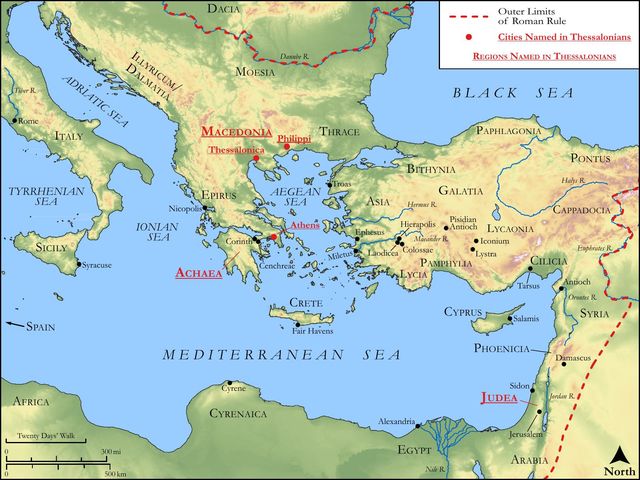
See on the biblical-era maps

Study this verse
Public-domain commentary
Matthew Henry
From his Commentary on the Whole Bible. Henry comments on passages, not single verses — this entry covers 1 Thessalonians 1:2–5. His four-level outline is real structure in the source text, so it is rendered as structure.
I.The apostle begins with thanksgiving to God.
Being about to mention the things that were matter of joy to him, and highly praiseworthy in them, and greatly for their advantage, he chooses to do this by way of thanksgiving to God, who is the author of all that good that comes to us, or is done by us, at any time. God is the object of all religious worship, of prayer and praise. And thanksgiving to God is a great duty, to be performed always or constantly; even when we do not actually give thanks to God by our words, we should have a grateful sense of God's goodness upon our minds. Thanksgiving should be often repeated; and not only should we be thankful for the favours we ourselves receive, but for the benefits bestowed on others also, upon our fellow-creatures and fellow-christians. The apostle gave thanks not only for those who were his most intimate friends, or most eminently favoured of God, but for them all.
II.He joined prayer with his praise or thanksgiving.
When we in every thing by prayer and supplication make our requests known to God, we should join thanksgiving therewith, Phi 4:6. So when we give thanks for any benefit we receive we should join prayer. We should pray always and without ceasing, and should pray not only for ourselves, but for others also, for our friends, and should make mention of them in our prayers. We may sometimes mention their names, and should make mention of their case and condition; at least, we should have their persons and circumstances in our minds, remembering them without ceasing. Note, As there is much that we ought to be thankful for on the behalf of ourselves and our friends, so there is much occasion of constant prayer for further supplies of good.
III.He mentions the particulars for which he was so thankful to God; namely,
1.The saving benefits bestowed on them. These were the grounds and reasons of his thanksgiving.
(1.)Their faith and their work of faith. Their faith he tells them (Th1 1:8) was very famous, and spread abroad. This is the radical grace; and their faith was a true and living faith, because a working faith. Note, Wherever there is a true faith, it will work: it will have an influence upon heart and life; it will put us upon working for God and for our own salvation. We have comfort in our own faith and the faith of others when we perceive the work of faith. Show me thy faith by thy works, Jam 2:18.
(2.)Their love and labour of love. Love is one of the cardinal graces; it is of great use to us in this life and will remain and be perfected in the life to come. Faith works by love; it shows itself in the exercise of love to God and love to our neighbour; as love will show itself by labour, it will put us upon taking pains in religion.
(3.)Their hope and the patience of hope. We are saved by hope. This grace is compared to the soldier's helmet and sailor's anchor, and is of great use in times of danger. Wherever there is a well-grounded hope of eternal life, it will appear by the exercise of patience; in a patient bearing of the calamities of the present time and a patient waiting for the glory to be revealed. For, if we hope for that we see not, then do we with patience wait for it, Rom 8:25.
2.The apostle not only mentions these three cardinal graces, faith, hope and love, but also takes notice,
(1.)Of the object and efficient cause of these graces, namely, our Lord Jesus Christ.
(2.)Of the sincerity of them: being in the sight of God even our Father. The great motive to sincerity is the apprehension of God's eye as always upon us; and it is a sign of sincerity when in all we do we endeavour to approve ourselves to God, and that is right which is so in the sight of God. Then is the work of faith, or labour of love, or patience of hope, sincere, when it is done under the eye of God.
(3.)He mentions the fountain whence these graces flow, namely, God's electing love: Knowing, brethren beloved, your election of God, Th1 1:4. Thus he runs up these streams to the fountain, and that was God's eternal election. Some by their election of God would understand only the temporary separation of the Thessalonians from the unbelieving Jews and Gentiles in their conversion; but this was according to the eternal purpose of him who worketh all things according to the counsel of his own will, Eph 1:11. Speaking of their election, he calls them, brethren beloved; for the original of the brotherhood that is between Christians and the relation wherein they stand one to another is election. And it is a good reason why we should love one another, because we are all beloved of God, and were beloved of him in his counsels when there was not any thing in us to merit his love. The election of these Thessalonians was known to the apostles, and therefore might be known to themselves, and that by the fruits and effects thereof - their sincere faith, and hope, and love, by the successful preaching of the gospel among them. Observe,
[1.]All those who in the fulness of time are effectually called and sanctified were from eternity elected and chosen to salvation.
[2.]The election of God is of his own good pleasure and mere grace, not for the sake of any merit in those who are chosen.
[3.]The election of God may be known by the fruits thereof.
[4.]Whenever we are giving thanks to God for his grace either to ourselves or others, we should run up the streams to the fountain, and give thanks to God for his electing love, by which we are made to differ.
3.Another ground or reason of the apostle's thanksgiving is the success of his ministry among them. He was thankful on his own account as well as theirs, that he had not laboured in vain. He had the seal and evidence of his apostleship hereby, and great encouragement in his labours and sufferings. Their ready acceptance and entertainment of the gospel he preached to them were an evidence of their being elected and beloved of God. It was in this way that he knew their election. It is true he had been in the third heavens; but he had not searched the records of eternity, and found their election there, but knew this by the success of the gospel among them (Th1 1:5), and he takes notice with thankfulness,
(1.)That the gospel came to them also not in word only, but in power; they not only heard the sound of it, but submitted to the power of it. It did not merely tickle the ear and please the fancy, not merely fill their heads with notions and amuse their minds for awhile, but it affected their hearts: a divine power went along with it for convincing their consciences and amending their lives. Note, By this we may know our election, if we not only speak of the things of God by rote as parrots, but feel the influence of these things in our hearts, mortifying our lusts, weaning us from the world, and raising us up to heavenly things.
(2.)It came in the Holy Ghost, that is, with the powerful energy of the divine Spirit. Note, Wherever the gospel comes in power, it is to be attributed to the operation of the Holy Ghost; and unless the Spirit of God accompany the word of God, to render it effectual by his power, it will be to us but as a dead letter; and the letter killeth, it is the Spirit that giveth life.
(3.)The gospel came to them in much assurance. Thus did they entertain it by the power of the Holy Ghost. They were fully convinced of the truth of it, so as not to be easily shaken in mind by objections and doubts; they were willing to leave all for Christ, and to venture their souls and everlasting condition upon the verity of the gospel revelation. The word was not to them, like the sentiments of some philosophers about matters of opinion and doubtful speculation, but the object of their faith and assurance. Their faith was the evidence of things not seen; and the Thessalonians thus knew what manner of men the apostle and his fellow-labourers were among them, and what they did for their sake, and with what good success.
Historical interpretation
Nine Centuries of Reception
2 surviving comments on this verse. Each one is dated, so this reads as a timeline rather than a list.
Select a marker to jump to its quote. Markers stagger vertically where authors wrote within a few decades of each other.
"Knowing, brethren beloved of God, your election, how that our Gospel came not unto you in word only, but also in power, and in the Holy Ghost, and in much assurance; even as ye know what manner of men we showed ourselves among you for your sake."
Knowing what? How "we showed ourselves among you"? Here he also touches upon his own good actions, but covertly. For he wishes first to enlarge upon their praises, and what he says is something of this sort. I knew that you were men of great and noble sort, that you were of the Elect. For this reason we also endure all things for your sake. For this, "what manner of men we showed ourselves among you," is the expression of one showing that with much zeal and much vehemence we were ready to give up our lives for your sake; and for this thanks are due not to us, but to you, because ye were elect. On this account also he says elsewhere, "And these things I endure for the Elect's sake." (2 Tim. ii. 10) For what would not one endure for the sake of God's beloved ones? And having spoken of his own part, he all but says, For if you were both beloved and elect, we suffer all things with reason. For not only did his praise of them confirm them, but his reminding them that they too themselves had displayed a fortitude corresponding to their zeal.
So Paul says, brothers, beloved by God, not only generally, insofar as God gives existence to all of nature, but specifically, insofar as you are each called to an eternal reward: “Yet I have loved Jacob” (Mal. 1:3). “All those consecrated to him were in his hand” (Deut. 33:3).
of your election, as if implying: I am certain that you are among the elect, although you did not merit this election; rather you are freely chosen by God. And I know this because God granted me abundant evidence of this in preaching, that is, that those to whom I preach are chosen by God, for God gives them the grace to listen profitably to the word preached to them; or else, God gives me the grace to preach rewardingly to them.
Continue studying 1 Thessalonians 1:4 across the web’s major study libraries — every link below opens this exact verse, chapter, or book on the destination site.
Read & Compare
 BibleGatewayThis verse in more than 200 translations and 70 languages.
 Bible.comThe YouVersion reader — hundreds of translations, reading plans, and highlights.
 ESV.orgCrossway's official English Standard Version reader.
 NET BibleThe NET translation with 60,000+ translators' notes on every rendering decision.
 STEP BibleTyndale House's free study tool — original text, vocabulary, and scholarly resources.
 BibliaLogos Bible Software's free web reader.
 USCCBThe New American Bible (Revised Edition) with the U.S. bishops' study notes.
Commentaries
 BibleHub CommentariesDozens of classic commentaries on this verse, gathered on one page.
 StudyLightMore than 100 commentary sets — the largest collection on the web.
 BibleRefPlain-English commentary on what this verse means, verse by verse.
 Enduring WordDavid Guzik's free commentary on this chapter, widely used by Bible teachers.
 Bible Study ToolsVerse commentary alongside Greek and Hebrew study aids.
Original Language & Research
- BibleHub InterlinearThe verse word by word — original language, transliteration, and English.
- BibleHub LexiconEvery word's original-language definition and Strong's entry.
 Blue Letter BibleDeep-study tools — Strong's numbers, concordance, and word studies.
 CNTR CollationThe earliest Greek manuscripts of this verse, collated letter by letter.
Sermons, Hymns & Audio


TrulyRandomVerse is not affiliated with these sites and doesn’t control their content. They’re linked because they’re genuinely useful.
Summary
In 1 Thessalonians 1:4, the Apostle Paul articulates a profound assurance to the Thessalonian believers, declaring his conviction that they are "brethren beloved, your election of God." This verse, embedded within Paul's opening thanksgiving, serves as a foundational statement of divine grace, highlighting God's sovereign initiative in their salvation and establishing the deep, affectionate bond between the apostles and the nascent church. It underscores that their faith and transformation are not accidental but are the visible evidence of God's prior, loving choice.
Context
ShowHideLiterary Context
This verse is situated at the heart of Paul's opening salutation and thanksgiving in his first letter to the Thessalonians. Following the standard apostolic greeting in 1 Thessalonians 1:1, Paul immediately launches into a prayer of gratitude for the Thessalonian believers in 1 Thessalonians 1:2. Verse 4, "Knowing, brethren beloved, your election of God," serves as the theological bedrock for the preceding statement in 1 Thessalonians 1:3, where he commends their "work of faith, and labour of love, and patience of hope." Paul's "knowing" of their election is not based on presumption but on the observable evidence of their transformed lives, which he then elaborates upon in the subsequent verses (1 Thessalonians 1:5-10). Thus, verse 4 functions as the divine explanation for their genuine conversion and enduring faith.
Historical & Cultural Context
The church in Thessalonica was relatively new, having been founded by Paul, Silas, and Timothy during Paul's second missionary journey, as recounted in Acts 17:1-9. This establishment was met with significant Jewish opposition, forcing Paul and his companions to leave prematurely. The Thessalonian believers, comprised of both Jews and a "great multitude" of God-fearing Greeks (Acts 17:4), faced ongoing persecution and social pressure for their conversion to Christ. In this context of external hostility and internal newness, Paul's affirmation of their "election of God" would have been incredibly encouraging and stabilizing. It assured them that their suffering was not a sign of divine abandonment but rather a confirmation of their genuine standing with God, reinforcing their identity and perseverance amidst trials.
Key Themes
ShowHideThe central theme in 1 Thessalonians 1:4 is God's Sovereign Election. This refers to God's gracious, pre-temporal choice of individuals for salvation, underscoring that salvation originates entirely from God's initiative and not human merit or decision. This truth provides immense security and comfort, assuring believers that their faith is part of God's deliberate and unchanging plan. Closely related is the theme of Divine Love and Assurance. The phrase "brethren beloved" highlights God's deep, initiating love for them, which undergirds their election. Paul's "knowing" their election implies that the visible fruits of their faith, love, and hope, as mentioned in 1 Thessalonians 1:3, served as compelling evidence of God's prior choice. This assurance, a recurring motif in Paul's epistles, offers stability and confidence to believers, particularly in the face of doubt or persecution.
Exposition and Analysis
ShowHideKey Word Analysis
ShowHideThis primary verb, used here in the perfect tense, signifies a settled, assured knowledge, not merely a guess or hope. It implies a deep, intuitive understanding or perception that has come to a full realization. Paul's "knowing" is based on observable evidence of the Thessalonians' transformed lives and the powerful working of the Holy Spirit among them, confirming God's prior action.
Derived from the verb "agapao," meaning "to love in a social or moral sense," this term, when applied to God's love, denotes a selfless, unconditional, and initiating affection. Here, it emphasizes that the Thessalonians are not just "brethren" (fellow believers) but "beloved" by God Himself. This divine love is the very foundation and motivation for their election.
From "eklegomai" (to pick out, choose), this noun refers to a "selection" or "choice." In a theological context, it specifically denotes God's sovereign act of choosing individuals for salvation. It highlights the divine initiative in salvation, emphasizing that salvation is not merely a human decision but primarily a divine, purposeful act flowing from God's eternal will.
Verse Breakdown
ShowHide"Knowing, brethren beloved"
Paul begins with an emphatic declaration of his confident perception ("knowing"). This knowledge is directed towards the Thessalonians, whom he addresses with deep affection and spiritual kinship ("brethren beloved"). The term "beloved" (ἠγαπημένοι) is a perfect passive participle, indicating that they have been and continue to be the objects of God's love, a love that is both past and ongoing. Paul's confidence stems from observing the genuine fruit of their faith, which serves as a visible sign of God's work in them.
"your election"
This phrase points to the core theological truth of the verse: God's sovereign choice. "Election" (ἐκλογὴ) signifies a deliberate, divine selection. It is not something they earned or initiated, but something God did for them. The possessive "your" emphasizes that this election is personal and specific to the Thessalonian believers, distinguishing them as those uniquely chosen by God.
"of God"
The preposition "of" (ὑπὸ) here denotes agency, clearly attributing the source and power of their election to God alone. This final phrase unequivocally establishes that their salvation and spiritual standing are not of human origin or effort but are entirely the result of God's gracious, sovereign, and eternal purpose. It underscores the divine initiative and omnipotence in the work of salvation.
Literary Devices
ShowHidePaul employs several literary devices to convey his message. The overall Pastoral Tone is evident, as Paul, Silas, and Timothy address the Thessalonians with genuine affection ("brethren beloved"), reflecting their deep care for the church. There is a strong sense of Assurance and Confidence in Paul's opening word "Knowing," which sets a firm foundation for the rest of the letter, affirming the Thessalonians' true standing before God despite their trials. The phrase "election of God" functions as a powerful Theological Declaration, succinctly articulating a core doctrine of divine sovereignty in salvation. This declaration serves as both an encouragement and a theological anchor for a young church facing persecution, reminding them that their faith is rooted in God's unchanging purpose.
Theological and Thematic Connections
ShowHideThe doctrine of election, as presented in 1 Thessalonians 1:4, is a cornerstone of biblical theology, emphasizing God's sovereign grace and initiative in salvation. It teaches that God, in His infinite wisdom and love, chose a people for Himself before the foundation of the world, not based on any foreseen merit or human decision, but purely according to His good pleasure. This truth provides profound comfort and security to believers, assuring them that their salvation is rooted in God's unchangeable character and eternal purpose, rather than their fluctuating performance or uncertain human will. It cultivates humility, gratitude, and a deep sense of belonging to a divine plan that transcends human understanding.
Reflection and Application
ShowHideFor believers today, 1 Thessalonians 1:4 offers profound comfort and a powerful call to humility and perseverance. To know that one's salvation is ultimately "of God" fosters deep gratitude and trust, removing the burden of earning divine favor or maintaining salvation through personal effort. This truth liberates us to serve God out of love and thankfulness, rather than fear or obligation. It encourages unwavering perseverance in faith, even amidst trials and doubts, because our standing is rooted in God's unchanging character and eternal choice, not our fleeting circumstances. Furthermore, this verse reminds us that the true marks of election are visible in a transformed life—in a "work of faith, and labour of love, and patience of hope" (1 Thessalonians 1:3), which then becomes a powerful testimony to the world, much like the Thessalonians' example. It calls us to live lives worthy of our high calling, demonstrating the reality of God's electing grace through our actions and attitudes.
Questions for Reflection
ShowHideFAQ
ShowHideDoes "election" mean that God arbitrarily chooses some people for salvation and excludes others, regardless of their desire for Him?
ShowHideThe biblical concept of "election" in 1 Thessalonians 1:4 and other passages (e.g., Ephesians 1:4) emphasizes God's sovereign initiative and grace in salvation. It means that God, in His eternal counsel, chose a people for Himself, not based on any foreseen merit or human works, but purely out of His merciful love and good pleasure. This divine choice ensures that salvation is entirely a gift of grace and not a human achievement. While election highlights God's sovereignty, the Bible also consistently presents the universal call to repentance and faith (John 3:16, Acts 17:30). These two truths—God's sovereign election and humanity's responsibility to respond in faith—are held in tension within Scripture, revealing the depth of God's plan. Election does not negate human responsibility but rather ensures that salvation is ultimately God's work, providing assurance to those who believe.
Christ-Centered Fulfillment
ShowHideThe "election of God" in 1 Thessalonians 1:4 finds its ultimate fulfillment and meaning in Jesus Christ. Believers are not chosen in isolation, but "in Christ before the foundation of the world" (Ephesians 1:4). Jesus Himself is the "Chosen One" of God, the Messiah through whom all divine purposes are accomplished (Luke 9:35). God's electing love is perfectly expressed and actualized through His Son's sacrificial death and resurrection, which provides the means for the elect to be reconciled to God. Therefore, election is not a cold, impersonal decree, but a warm, relational act of God's love, centered on His beloved Son. Those whom God elects are brought into union with Christ, becoming part of His body, sharing in His life, and being conformed to His image (Romans 8:29). The evidence of their election, as seen in the Thessalonians' faith, love, and hope, is the fruit of the Holy Spirit's work, applying the redemptive work of Christ to their lives. Thus, election is not merely about being chosen by God, but being chosen for Christ, to live in Christ, and ultimately to glorify Christ.