


Jeremiah 52:15
- וּמִדַּלּוֹתu·mi·da·Lotand some of [the] poor people ofH1803Conj-w ¦ Prep-m ¦ N-fpcNoun Plural Feminine Constructוּandמִsome ofדַּלּוֹת[the] poor people of
- הָעָםha·'Amthe peopleH5971Art ¦ N-msNoun Singular Masculine Absoluteהָtheעָםpeople
- וְאֶתve·'Etand <obj.>H853Conj-w ¦ DirObjMParticle Object Indicatorוְandאֶת<obj.>
- יֶתֶרYe·ter[the] rest ofH3499N-mscNoun Singular Masculine Construct
- הָעָםha·'Amthe peopleH5971Art ¦ N-msNoun Singular Masculine Absoluteהָtheעָםpeople
- הַנִּשְׁאָרִיםha·nish·'a·Rimwho remainedH7604Art ¦ V-Niphal-Prtcpl-mpVerb Niphal Participle Plural Masculine Absoluteהַwhoנִּשְׁאָרִיםremained
- בָּעִירba·'Irin the cityH5892Prep-b ¦ N-fsNoun Singular Feminine Absoluteבָּin theעִירcity
- וְאֶתve·'Etand <obj.>H853Conj-w ¦ DirObjMParticle Object Indicatorוְandאֶת<obj.>
- הַנֹּפְלִיםha·no·fe·Limthose [who] had fallenH5307Art ¦ V-Qal-Prtcpl-mpVerb Qal Participle Plural Masculine Absoluteהַthoseנֹּפְלִים[who] had fallen
- אֲשֶׁר'a·SherwhoH834RelParticle Relative
- נָפְלוּna·fe·Luthey had fallenH5307V-Qal-Perf-3cpVerb Qal Perfect 3rd Plural common gender
- אֶל'eltoH413PrepPreposition
- מֶלֶךְMe·lekh[the] king ofH4428N-mscNoun Singular Masculine Construct
- בָּבֶלba·VelBabylonH894N-properNoun Proper Location
- וְאֵתve·'Etand <obj.>H853Conj-w ¦ DirObjMParticle Object Indicatorוְandאֵת<obj.>
- יֶתֶרYe·ter[the] rest ofH3499N-mscNoun Singular Masculine Construct
- הָאָמוֹןha·'a·Monthe craftsmanH525Art ¦ N-msNoun Singular Masculine Absoluteהָtheאָמוֹןcraftsman
- הֶגְלָהheg·Lahhe took into exileH1540V-Hiphil-Perf-3msVerb Hiphil Perfect 3rd Singular Masculine
- נְבוּזַרְאֲדָןne·vu·zar·'a·DanNebuzaradanH5018N-proper-mNoun Proper Masculine
- רַבrav[the] chief ofH7227N-mscNoun Singular Masculine Construct
- טַבָּחִיםta·ba·Chim[the] bodyguardsH2876N-mpNoun Plural Masculine Absolute
English is a literal word-by-word gloss of the Hebrew, not the KJV's wording. Why?
This is the original text the KJV's translators worked from — each Hebrew word with its own literal English meaning in this verse, prepared by scholars at Tyndale House, Cambridge. The KJV translates whole sentences, not word by word, so its wording differs: one Hebrew word can become several English words, and the KJV may choose “the LORD” where the gloss reads “Yahweh”. Both are faithful — they answer different questions. For the KJV's own rendering, switch to the KJV text.
Details
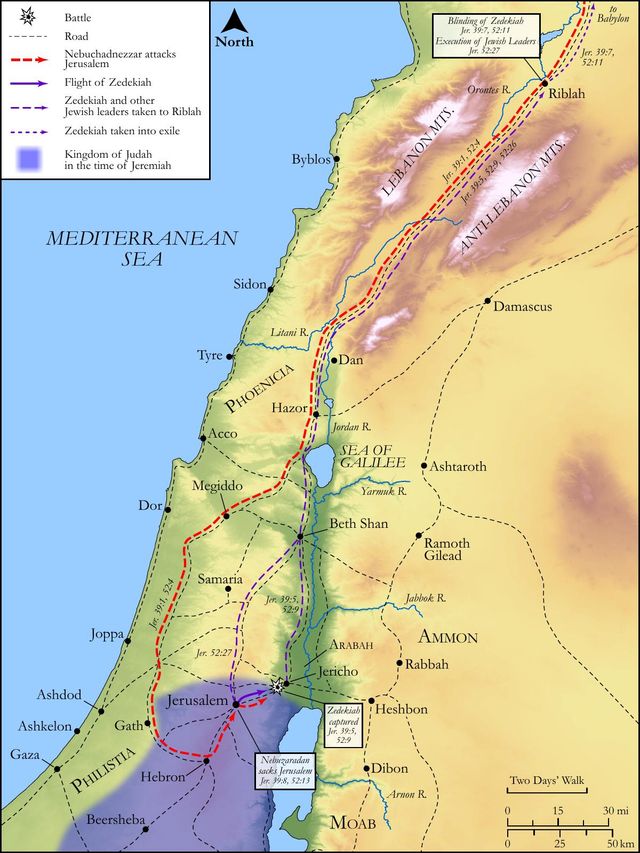
See on the biblical-era map
Study this verse
Public-domain commentary
Matthew Henry
From his Commentary on the Whole Bible. Henry comments on passages, not single verses — this entry covers Jeremiah 52:12–23.
We have here an account of the woeful havoc that was made by the Chaldean army, a month after the city was taken, under the command of Nebuzaradan, who was captain of the guard, or general of the army, in this action. In the margin he is called the chief of the slaughter-men, or executioners; for soldiers are but slaughter-men, and God employs them as executioners of his sentence against a sinful people. Nebuzaradan was chief of those soldiers, but, in the execution he did, we have reason to fear he had no eye to God, but he served the king of Babylon and his own designs, now that he came into Jerusalem, into the very bowels of it, as captain of the slaughter-men there. And, 1. He laid the temple in ashes, having first plundered it of every thing that was valuable: He burnt the house of the Lord, that holy and beautiful house, where their fathers praised him, Isa 64:11. 2. He burnt the royal palace, probably that which Solomon built after he had built the temple, which was, ever since, the king's house. 3. He burnt all the houses of Jerusalem, that is, all the houses of the great men, or those particularly; if any escaped, it was only some sorry cottages for the poor of the land. 4. He broke down all the walls of Jerusalem, to be revenged upon them for standing in the way of his army so long. Thus, of a defenced city, it was made a ruin, Isa 25:2. 5. He carried away many into captivity (Jer 52:15); he took away certain of the poor of the people, that is, of the people in the city, for the poor of the land (the poor of the country) he left for vine-dressers and husbandmen. He also carried off the residue of the people that remained in the city, that had escaped the sword and famine, and the deserters, such as he thought fit, or rather such as God thought fit; for he had already determined some for the pestilence, some for the sword, some for famine, and some for captivity, Jer 15:2. But, 6. Nothing is more particularly and largely related here than the carrying away of the appurtenances of the temple. All that were of great value were carried away before, the vessels of silver and gold, yet some of that sort remained, which were now carried away, Jer 52:19. But most of the temple-prey that was now seized was of brass, which, being of less value, was carried off last. When the gold was gone, the brass soon went after it, because the people repented not, according to Jeremiah's prediction, Jer 27:19, etc. When the walls of the city were demolished, the pillars of the temple were pulled down too, and both in token that God, who was the strength and stay both of their civil and their ecclesiastical government, had departed from them. No walls can protect those, nor pillars sustain those, from whom God withdraws. These pillars of the temple were not for support (for there was nothing built upon them), but for ornament and significancy. They were called Jachin - He will establish; and Boaz - In him is strength; so that the breaking of these signified that God would no longer establish his house nor be the strength of it. These pillars are here very particularly described (Jer 52:21-23, from Kg1 7:15), that the extraordinary beauty and stateliness of them may affect us the more with the demolishing of them. All the vessels that belonged to the brazen altar were carried away; for the iniquity of Jerusalem, like that of Eli's house, was not to be purged by sacrifice or offering, Sa1 3:14. It is said (Jer 52:20), The brass of all these vessels was without weight; so it was in the making of them (Kg1 7:47), the weight of the brass was not then found out (Ch2 4:18), and so it was in the destroying of them. Those that made great spoil of them did not stand to weigh them, as purchasers do, for, whatever they weighted, it was all their own.
Historical interpretation
Historical reception
1 surviving comment on this verse from the historical church.
And as Isaiah said before, “Except the Lord of Sabaoth had left us a seed, we would have been as Sodom and would have been made like to Gomorrah.” Here again he shows another thing, that not even those few were saved by their own resources. They too would have perished and met with Sodom’s fate, that is, they would have had to undergo utter destruction. They (of Sodom) were destroyed root and branch and left not even the slightest remnant of themselves. They too, he means, would have been like these, unless God had used much kindness to them and had saved them by faith. This happened also in the case of the visible captivity, the majority having been taken away captive and perished and some few only being saved.
Continue studying Jeremiah 52:15 across the web’s major study libraries — every link below opens this exact verse, chapter, or book on the destination site.
Read & Compare
 BibleGatewayThis verse in more than 200 translations and 70 languages.
 Bible.comThe YouVersion reader — hundreds of translations, reading plans, and highlights.
 ESV.orgCrossway's official English Standard Version reader.
 NET BibleThe NET translation with 60,000+ translators' notes on every rendering decision.
 STEP BibleTyndale House's free study tool — original text, vocabulary, and scholarly resources.
 BibliaLogos Bible Software's free web reader.
 USCCBThe New American Bible (Revised Edition) with the U.S. bishops' study notes.
Commentaries
 BibleHub CommentariesDozens of classic commentaries on this verse, gathered on one page.
 StudyLightMore than 100 commentary sets — the largest collection on the web.
 BibleRefPlain-English commentary on what this verse means, verse by verse.
 Enduring WordDavid Guzik's free commentary on this chapter, widely used by Bible teachers.
 Bible Study ToolsVerse commentary alongside Greek and Hebrew study aids.
Original Language & Research
- BibleHub InterlinearThe verse word by word — original language, transliteration, and English.
- BibleHub LexiconEvery word's original-language definition and Strong's entry.
 Blue Letter BibleDeep-study tools — Strong's numbers, concordance, and word studies.
 SefariaThe Hebrew text with Rashi and centuries of Jewish commentary.
Sermons, Hymns & Audio


TrulyRandomVerse is not affiliated with these sites and doesn’t control their content. They’re linked because they’re genuinely useful.
Summary
Jeremiah 52:15 meticulously records the final, comprehensive deportation of the remaining inhabitants of Jerusalem and Judah by Nebuzaradan, the Babylonian captain of the guard, following the city's devastating destruction. This systematic removal encompassed not only the most vulnerable and those who had survived the siege but also the defectors who had previously surrendered to Babylon, underscoring the thoroughness of God's judgment and the catastrophic culmination of Judah's persistent rebellion against Him.
Context
ShowHideLiterary Context
Jeremiah 52 functions as a crucial historical appendix to the prophetic book of Jeremiah, serving to validate and concretize the numerous prophecies of judgment and exile proclaimed throughout the preceding chapters. This chapter largely parallels the account found in 2 Kings 25, confirming the historical accuracy and devastating severity of the events Jeremiah had foretold. By placing this detailed historical record at the very end of the book, the author provides a somber, undeniable conclusion, demonstrating the irrefutable fulfillment of God's warnings regarding the consequences of Judah's persistent idolatry, covenant unfaithfulness, and rejection of His prophets. It leaves the reader with no doubt that the prophetic words of Jeremiah were indeed from the Lord, brought to fruition through the actions of a foreign power.
Historical & Cultural Context
The events described in Jeremiah 52:15 occurred in 586 BC, marking the third and final major deportation of the Jewish people to Babylon. This followed the complete destruction of Jerusalem and its sacred Temple, a catastrophic blow that effectively ended the Judean kingdom. Nebuzaradan, identified as the "captain of the guard," was a highly significant and fearsome Babylonian official, likely the commander of Nebuchadnezzar's elite bodyguard and chief executioner. He was entrusted with the grim and strategic task of overseeing the systematic removal of the remaining population. This deportation was not merely punitive; it was a calculated policy designed to dismantle Judah's national identity, prevent future rebellions, and integrate skilled or useful populations into the vast Babylonian empire, thereby solidifying Babylon's dominion over the conquered territories and neutralizing any potential for resurgence.
Key Themes
ShowHideThis verse powerfully contributes to several foundational themes prevalent throughout the Book of Jeremiah and the broader Old Testament narrative. Firstly, it vividly illustrates the Thoroughness of Divine Judgment, demonstrating that God's justice is comprehensive and inescapable, encompassing all segments of society—the impoverished, the surviving citizens, and even those who sought to escape judgment by defecting. Secondly, it serves as a stark and undeniable testament to the Consequences of Covenant Disobedience, acting as a direct fulfillment of the curses outlined in the Mosaic Covenant, particularly those concerning exile and dispersion (e.g., Deuteronomy 28:49-57). The exile was the ultimate disciplinary action for Judah's persistent rebellion and rejection of God's repeated warnings through His prophets. Lastly, despite the profound devastation, the verse implicitly points to God's Sovereign Control over history. Even through the actions of a pagan king and his general, God was meticulously working out His redemptive purposes, disciplining His people to bring them to repentance and preserve a remnant for future restoration, as promised in passages like Jeremiah 29:10-14.
Exposition and Analysis
ShowHideKey Word Analysis
ShowHideThis proper noun refers to the Babylonian general, whose name is often interpreted as "Nabu has given a seed" or "Nabu has given an heir." His presence in this verse signifies the direct and authoritative hand of the conquering Babylonian empire in executing the divine judgment upon Judah. As "captain of the guard" (H2876, ṭabbâch'), he was a high-ranking military official, often associated with the king's personal security and the execution of royal decrees, underscoring the strategic and systematic nature of the population's removal.
This primitive root (H1540) means "to denude (especially in a disgraceful sense); by implication, to exile (captives being usually stripped); figuratively, to reveal." In this context, it powerfully conveys the act of forced removal and displacement from one's homeland. The implication of being "stripped" or "denuded" suggests the profound loss of dignity, identity, and national existence that accompanied the exile, a deeply humiliating and traumatic experience for the Judeans.
This verb (H5307), meaning "to fall," "to cease," or "to die," is used twice in the phrase "those that fell away, that fell to the king of Babylon." It specifically describes those who defected or surrendered to the Babylonians during the siege, perhaps hoping for clemency or a better fate by aligning themselves with the conquering power. The repetition emphasizes their deliberate choice to abandon their people and king, yet ultimately, even their defection did not spare them from the general decree of exile, highlighting the thoroughness of the Babylonian policy.
Verse Breakdown
ShowHide"Then Nebuzaradan the captain of the guard carried away captive"
This opening clause introduces the primary agent of the deportation, Nebuzaradan, a high-ranking Babylonian official. His title, "captain of the guard," is a translation of a Hebrew term that can also mean "chief of the slaughterers" or "executioners," emphasizing his authority and the grim, decisive nature of his mission to dismantle the Judean state and its population. The phrase "carried away captive" denotes the forced removal and displacement of people from their homeland, a common and brutal practice of ancient Near Eastern empires to subjugate conquered territories.
"[certain] of the poor of the people, and the residue of the people that remained in the city"
This part specifies two distinct groups subjected to exile. "The poor of the people" refers to the poorest, often those left behind after earlier deportations of the elite and skilled workers. "The residue of the people that remained in the city" refers to the general populace who had survived the prolonged siege, famine, and destruction of Jerusalem. This highlights the comprehensive nature of the deportation, affecting various social strata, not just the wealthy or the rebellious leadership.
"and those that fell away, that fell to the king of Babylon, and the rest of the multitude."
This final segment identifies two more categories of exiles. "Those that fell away, that fell to the king of Babylon" refers to defectors or deserters who had surrendered to the Babylonians during the siege, perhaps in response to Jeremiah's prophecies urging surrender (e.g., Jeremiah 21:9). Even these individuals, who had seemingly chosen the path of least resistance or sought to preserve their lives by cooperating with the enemy, were not exempt from exile, demonstrating the conqueror's absolute control and the universality of the judgment. "And the rest of the multitude" serves as a comprehensive catch-all phrase, emphasizing that virtually all remaining inhabitants were subjected to deportation, leaving Judah largely desolate and depopulated.
Literary Devices
ShowHideJeremiah 52:15 masterfully employs several literary devices to underscore the severity, comprehensiveness, and finality of the Babylonian conquest and the resulting judgment. Enumeration is prominently featured, as the verse meticulously lists the various categories of people deported: "the poor of the people," "the residue of the people that remained in the city," "those that fell away," and "the rest of the multitude." This detailed cataloging emphasizes the exhaustive nature of the judgment, leaving no segment of society untouched. The powerful Repetition of the verb "fell" in "those that fell away, that fell to the king of Babylon" serves to highlight the specific action of defection and subtly reinforces the broader idea of Judah's ultimate "fall" as a nation. Furthermore, the entire verse functions as a profound example of Fulfillment, serving as the historical culmination of the numerous prophecies of judgment, destruction, and exile that permeate the Book of Jeremiah, thereby validating the divine origin and authoritative nature of Jeremiah's prophetic message.
Theological and Thematic Connections
ShowHideJeremiah 52:15 stands as a stark and undeniable testament to the consequences of persistent national sin and covenant unfaithfulness. It illustrates divine judgment as a thorough, inescapable, and comprehensive reality when God's warnings are ignored and His covenant repeatedly violated. The deportation of diverse segments of society—from the most vulnerable poor to the defectors who sought to save themselves—underscores that no one was exempt from the collective consequences of Judah's rebellion. This devastating event, while seemingly a triumph of a pagan empire, was not arbitrary but rather a meticulously executed fulfillment of God's declared will, a disciplinary act intended to purify His people and prepare them for future restoration. It powerfully highlights God's absolute sovereignty over nations and history, demonstrating His ability to use even pagan empires as instruments to achieve His righteous purposes and bring about His ultimate plan for His people.
Reflection and Application
ShowHideJeremiah 52:15 offers a profoundly sobering reflection on the gravity of sin and the unwavering nature of God's justice. For contemporary believers, this historical account serves as a powerful reminder that while we live under the new covenant of grace, the spiritual principles of sowing and reaping, and the seriousness of rebellion against God, remain eternally true. It calls us to consider the thoroughness of God's judgment, not only in a national sense but also in our individual lives when we persistently disregard His Word or seek to compromise our faith. Just as the exile was a refining fire for Judah, God may allow difficult circumstances to enter our lives, not as punishment, but as loving discipline designed to draw us back to Him, to purify our hearts, and to deepen our dependence. This verse encourages a posture of profound humility, unwavering obedience, and a deep reverence for God's commands, recognizing that true security, lasting peace, and genuine blessing are found not in human strategies, political alliances, or self-preservation, but in faithful adherence to the Lord. It also reminds us that even in the midst of profound loss, brokenness, and seemingly chaotic circumstances, God remains absolutely sovereign, working out His ultimate purposes for redemption and restoration.
Questions for Reflection
ShowHideFAQ
ShowHideWho was Nebuzaradan and what was his significance in the Babylonian conquest?
ShowHideNebuzaradan (Hebrew: Nᵉbûwzarʼădân) was a high-ranking and highly significant general in the Babylonian army under King Nebuchadnezzar. His title, "captain of the guard" (or "chief of the executioners/butchers"), indicates his authority over the royal bodyguard and his crucial role in carrying out the king's most sensitive and often brutal commands. In the context of the fall of Jerusalem, Nebuzaradan was the primary executor of Nebuchadnezzar's will and God's judgment. He was personally responsible for overseeing the systematic destruction of the Temple and the city walls, the plundering of Jerusalem's treasures, and the comprehensive deportation of the remaining Judean population to Babylon, as vividly described in Jeremiah 39:9-10 and Jeremiah 52:12-16. His actions marked the definitive and irreversible end of the Kingdom of Judah as an independent entity.
Why were different groups of people, including "the poor" and "those that fell away," taken into captivity?
ShowHideThe Babylonian strategy of deportation was comprehensive and meticulously planned, aiming to completely dismantle the conquered nation's identity, eliminate any potential for future rebellion, and integrate useful populations into their vast empire. By taking various segments of the population, including "the poor of the people," "the residue of the people that remained in the city," and "those that fell away," Nebuchadnezzar ensured that no significant group was left behind to form a resistance movement or rebuild the nation. The "poor" might have been considered less useful for the empire, yet their removal contributed to the utter desolation of the land, preventing any semblance of organized life. "Those that fell away" refers to defectors or deserters who had surrendered to the Babylonians during the siege, perhaps hoping for leniency or a better fate by cooperating with the conquerors. Their inclusion in the general deportation demonstrates that Babylonian policy was absolute and uncompromising; even those who cooperated were subject to the conqueror's will, underscoring the finality and thoroughness of the judgment upon Judah. This comprehensive approach ensured that Judah's capacity for self-governance, military threat, and national identity was utterly neutralized, as prophesied by Jeremiah (e.g., Jeremiah 27:6-8).
Christ-Centered Fulfillment
ShowHideJeremiah 52:15, with its grim depiction of a people carried away into physical captivity due to their persistent sin and rebellion, finds profound Christ-centered fulfillment in the New Testament. The literal exile of Judah serves as a powerful foreshadowing of humanity's universal spiritual captivity to sin, death, and the dominion of darkness—a bondage from which no one, whether "poor" (those without spiritual resources) or "defector" (those attempting to escape judgment on their own terms or through human strategies), can truly escape by their own efforts. Just as Nebuzaradan led the people into a literal, inescapable exile, sin leads all humanity into a spiritual one, separated from God's holy presence and under the condemnation of His righteous law. However, Jesus Christ is the ultimate deliverer from this spiritual bondage. He is the Lamb of God who takes away the sin of the world, bearing the full weight of God's judgment and the curse of the law on the cross (Galatians 3:13). Through His atoning sacrifice and victorious resurrection, He inaugurated a new covenant (Hebrews 8:6-13), not of physical exile, but of spiritual liberation, reconciliation with God, and eternal life. Those who "fall away" from their own futile efforts to save themselves and "fall to" Christ in faith are not carried into further captivity but are miraculously brought into God's glorious kingdom, becoming citizens of a heavenly Jerusalem (Hebrews 12:22-24), freed from the ultimate judgment that sin demands. Thus, the devastating exile in Jeremiah points forward to the glorious freedom, spiritual restoration, and new life offered exclusively through Jesus Christ, the one who delivers us from the domain of darkness and transfers us into His beloved kingdom (Colossians 1:13-14).