


Jeremiah 52:30
Bible text: King James Version (1769 Blayney text) · Public domain
Bible text: King James Version with Strong's numbers · Public domain
Bible text: Berean Standard Bible · Public domain
Bible text: American Standard Version (1901) · Public domain
Bible text: World English Bible, Messianic edition · Public domain
Bible text: Geneva Bible (1599) · Public domain
Bible text: Young's Literal Translation · Public domain
- בִּשְׁנַתbish·Natin yearH8141Prep-b ¦ N-fscNoun Singular Feminine Constructבִּinשְׁנַתyear
- שָׁלֹשׁsha·LoshthreeH7969Adj-csAdjective Numerical Singular common gender Absolute
- וְעֶשְׂרִיםve·'es·Rimand twentyH6242Conj-w ¦ Adj-mpAdjective Numerical Plural Masculine Absoluteוְandעֶשְׂרִיםtwenty
- לִנְבוּכַדְרֶאצַּרlin·vu·khad·re·Tzarof NebuchadnezzarH5019Prep-l ¦ N-proper-mNoun Proper MasculineלִofנְבוּכַדְרֶאצַּרNebuchadnezzar
- הֶגְלָהheg·Lahhe took into exileH1540V-Hiphil-Perf-3msVerb Hiphil Perfect 3rd Singular Masculine
- נְבוּזַרְאֲדָןne·vu·zar·'a·DanNebuzaradanH5018N-proper-mNoun Proper Masculine
- רַבrav[the] chief ofH7227N-mscNoun Singular Masculine Construct
- טַבָּחִיםta·ba·Chim[the] bodyguardsH2876N-mpNoun Plural Masculine Absolute
- יְהוּדִיםye·hu·DimJewsH3064N-mpNoun Gentilic Plural Masculine Absolute
- נֶפֶשׁNe·feshperson[s]H5315N-fsNoun Singular Feminine Absolute
- שְׁבַעshe·Va'sevenH7651Adj-cscAdjective Numerical Singular common gender Construct
- מֵאוֹתme·'othundred<s>H3967Adj-fpAdjective Numerical Plural Feminine Absolute
- אַרְבָּעִים'ar·ba·'ImfortyH705Adj-mpAdjective Numerical Plural Masculine Absolute
- וַחֲמִשָּׁהva·cha·mi·Shahand fiveH2568Conj-w ¦ Adj-csAdjective Numerical Singular common gender Absoluteוַandחֲמִשָּׁהfive
- כָּלkoleveryH3605N-mscNoun Singular Masculine Construct
- נֶפֶשׁNe·feshpersonH5315N-fsNoun Singular Feminine Absolute
- אַרְבַּעַת'ar·Ba·'at[was] fourH702Adj-cscAdjective Numerical Singular common gender Construct
- אֲלָפִים'a·la·Fimthousand<s>H505Adj-cpAdjective Numerical Plural common gender Absolute
- וְשֵׁשׁve·Sheshand sixH8337Conj-w ¦ Adj-csAdjective Numerical Singular common gender Absoluteוְandשֵׁשׁsix
- מֵאוֹתme·'othundred<s>H3967Adj-fpAdjective Numerical Plural Feminine Absolute
English is a literal word-by-word gloss of the Hebrew, not the KJV's wording. Why?
This is the original text the KJV's translators worked from — each Hebrew word with its own literal English meaning in this verse, prepared by scholars at Tyndale House, Cambridge. The KJV translates whole sentences, not word by word, so its wording differs: one Hebrew word can become several English words, and the KJV may choose “the LORD” where the gloss reads “Yahweh”. Both are faithful — they answer different questions. For the KJV's own rendering, switch to the KJV text.
Details
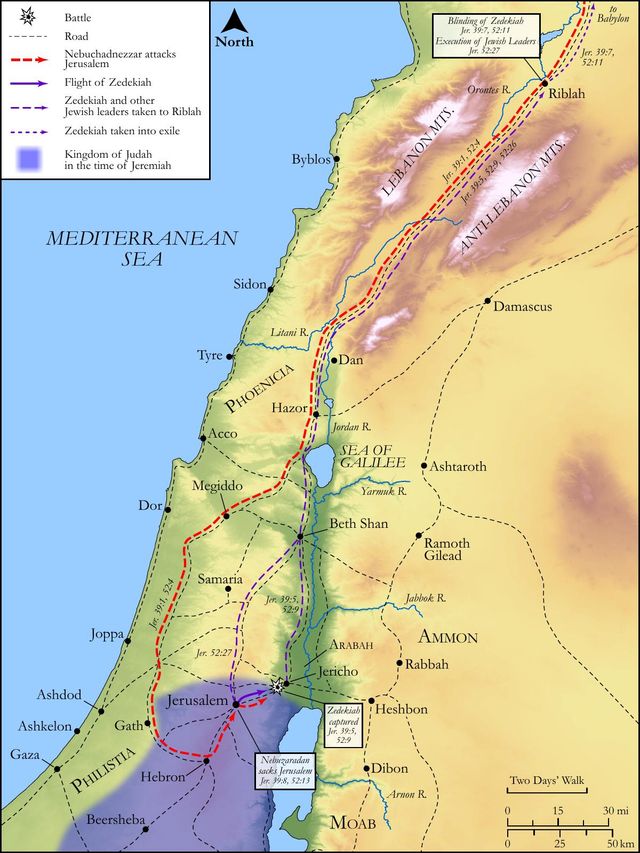
See on the biblical-era map
Study this verse
Public-domain commentary
Matthew Henry
From his Commentary on the Whole Bible. Henry comments on passages, not single verses — this entry covers Jeremiah 52:24–30.
We have here a very melancholy account, 1. Of the slaughter of some great men, in cold blood, at Riblah, seventy-two in number (according to the number of the elders of Israel, Num 11:24, Num 11:25), so they are computed, Kg2 25:18, Kg2 25:19. We read there of five out of the temple, two out of the city, five out of the court, and sixty out of the country. The account here agrees with that, except in one article; there it is said that there were five, here there were seven, of those that were near the king, which Dr. Lightfoot reconciles thus, that he took away seven of those that were near the king, but two of them were Jeremiah himself and Ebed-melech, who were both discharged, as we have read before, so that there were only five of them put to death, and so the number was reduced to seventy-two, some of all ranks, for they had all corrupted their way; and it is probable that such were made examples of as had been most forward to excite and promote the rebellion against the king of Babylon. Seraiah the chief priest is put first, whose sacred character could not exempt him from this stroke; how should it, when he himself had profaned it by sin? Seraiah the prince was a quiet prince (Jer 51:59), but perhaps Seraiah the priest was not so, but unquiet and turbulent, by which he had made himself obnoxious to the king of Babylon. The leaders of this people had caused them to err, and now they are in a particular manner made monuments of divine justice. 2. Of the captivity of the rest. Come and see how Judah was carried away captive out of his own land (Jer 52:27), and how it spued them out as it spued out the Canaanites that went before them, which God had told them it would certainly do if they trod in their steps and copied out their abominations, Lev 18:28. Now here is an account, (1.) Of two captivities which we had an account of before, one in the seventh year of Nebuchadnezzar (the same with that which is said to be in his eighth year, Kg2 24:12), another in his eighteenth year, the same with that which is said (Jer 52:12) to be in his nineteenth year. But the sums here are very small, in comparison with what we find expressed concerning the former (Kg2 24:14, Kg2 24:16), when there were 18,000 carried captive, whereas here they are said to be 3023; they are also small in comparison with what we may reasonably suppose concerning the latter; for, when all the residue of the people were carried away (Jer 52:15), one would think there should be more than 832 souls; therefore Dr. Lightfoot conjectures that, these accounts being joined to the story of the putting to death of the great men at Riblah, all that are here said to be carried away were put to death as rebels. (2.) Of a third captivity, not mentioned before, which was in the twenty-third year of Nebuchadnezzar, four years after the destruction of Jerusalem (Jer 52:30): Then Nebuzaradan came, and carried away 745 Jews; it is probable that this was done in revenge of the murder of Gedaliah, which was another rebellion against the king of Babylon, and that those who were now taken were aiders and abetters of Ishmael in that murder, and were not only carried away, but put to death for it; yet this is uncertain. If this be the sum total of the captives (all the persons were 4600, Jer 52:30), we may see how strangely they were reduced from what they had been, and may wonder as much how they came to be so numerous again as afterwards we find them; for it should seem that, as at first in Egypt, so again in Babylon, the Lord made them fruitful in the land of their affliction, and the more they were oppressed the more they multiplied. And the truth is, this people were often miracles both of judgment and mercy.
Continue studying Jeremiah 52:30 across the web’s major study libraries — every link below opens this exact verse, chapter, or book on the destination site.
Read & Compare
 BibleGatewayThis verse in more than 200 translations and 70 languages.
 Bible.comThe YouVersion reader — hundreds of translations, reading plans, and highlights.
 ESV.orgCrossway's official English Standard Version reader.
 NET BibleThe NET translation with 60,000+ translators' notes on every rendering decision.
 STEP BibleTyndale House's free study tool — original text, vocabulary, and scholarly resources.
 BibliaLogos Bible Software's free web reader.
 USCCBThe New American Bible (Revised Edition) with the U.S. bishops' study notes.
Commentaries
 BibleHub CommentariesDozens of classic commentaries on this verse, gathered on one page.
 StudyLightMore than 100 commentary sets — the largest collection on the web.
 BibleRefPlain-English commentary on what this verse means, verse by verse.
 Enduring WordDavid Guzik's free commentary on this chapter, widely used by Bible teachers.
 Bible Study ToolsVerse commentary alongside Greek and Hebrew study aids.
Original Language & Research
- BibleHub InterlinearThe verse word by word — original language, transliteration, and English.
- BibleHub LexiconEvery word's original-language definition and Strong's entry.
 Blue Letter BibleDeep-study tools — Strong's numbers, concordance, and word studies.
 SefariaThe Hebrew text with Rashi and centuries of Jewish commentary.
Sermons, Hymns & Audio


TrulyRandomVerse is not affiliated with these sites and doesn’t control their content. They’re linked because they’re genuinely useful.
Summary
Jeremiah 52:30 provides a final, precise historical record of a specific, smaller deportation of Jews to Babylon. Occurring in the 23rd year of King Nebuchadrezzar's reign, this verse details Nebuzaradan, the captain of the guard, carrying away 745 persons, bringing the documented total of exiles in this chapter to 4,600. This stark enumeration serves as a concluding testament to the devastating fulfillment of Jeremiah's prophecies of judgment and exile against Judah.
Context
ShowHideLiterary Context
Jeremiah 52 serves as a historical appendix to the prophetic book, providing a factual account of Jerusalem's fall and the subsequent deportations, thereby validating the prophecies of judgment delivered by Jeremiah throughout the preceding chapters. Verses 28-30 specifically enumerate three distinct waves of exile. While Jeremiah 52:28 details the first deportation in Nebuchadnezzar's seventh year (597 BC), and Jeremiah 52:29 describes the second in his eighteenth year (586 BC) following the destruction of Jerusalem, verse 30 records a third, smaller, and later deportation. This chronological and numerical precision underscores the historical veracity of the events that brought Jeremiah's dire warnings to fruition. The chapter concludes with the account of Jehoiachin's release and elevation, offering a glimmer of hope amidst the desolation, but the preceding verses firmly establish the reality of the exile.
Historical & Cultural Context
The period described in Jeremiah 52:30 falls within the Babylonian exile, a critical era in Israelite history. Nebuchadrezzar (more commonly known as Nebuchadnezzar II) was the powerful king of the Neo-Babylonian Empire, which had conquered Judah. His "23rd year" (c. 582/581 BC) places this event approximately five years after the final destruction of Jerusalem and the Temple in 586 BC. This particular deportation is often linked by scholars to the aftermath of the assassination of Gedaliah, the Babylonian-appointed governor of Judah, as recorded in Jeremiah 41. The subsequent flight of many remaining Jews to Egypt, against God's explicit command through Jeremiah (Jeremiah 43), likely prompted this final punitive action by Nebuzaradan, the "captain of the guard" (chief executioner and commander of the imperial bodyguard), to suppress any lingering rebellion or to secure the region further. The meticulous record-keeping of deportees was a common practice of Assyria and Babylon, reflecting their administrative control and the systematic nature of their conquests.
Key Themes
ShowHideThis verse powerfully contributes to several overarching themes in Jeremiah and the broader biblical narrative. Firstly, it highlights the Fulfillment of Prophecy, serving as a concrete demonstration that God's warnings through Jeremiah regarding Judah's persistent sin and impending judgment were indeed carried out (Jeremiah 25:8-11). Secondly, it reinforces the theme of Divine Justice and Sovereignty, showing that even in the midst of national catastrophe orchestrated by a foreign power, God remains in control, using nations like Babylon as instruments of His righteous judgment against His disobedient people (Jeremiah 27:6-8). Finally, the detailed enumeration of the exiles, though grim, underscores the Historical Veracity of the biblical account, emphasizing that these were real events affecting real people, not mere allegories. This precision lends weight to the theological claims embedded within the narrative.
Exposition and Analysis
ShowHideKey Word Analysis
ShowHideThis primitive root signifies "to denude," "to exile," or "to reveal." In the context of Jeremiah 52:30, it primarily conveys the act of forced removal from one's homeland, emphasizing the stripping away of identity, security, and freedom that accompanies exile. The term also carries a connotation of disgrace, as captives were often stripped or shamed, highlighting the humiliation inherent in Judah's punishment.
Derived from a word meaning "butcher," this title for Nebuzaradan underscores his formidable and often brutal role. He was not merely a military commander but specifically the chief executioner and commander of the imperial bodyguard. This indicates his direct involvement in carrying out the king's most severe orders, including the systematic removal of populations, making him a figure of immense power and fear in the eyes of the conquered.
This widely used Hebrew term literally means "breathing creature" or "soul," and extends to denote "life," "body," or "self." In this verse, "persons" (plural) refers to individuals, emphasizing the human element of the deportation. It highlights that the numbers represent actual lives, each with their own story and suffering, rather than mere statistics, grounding the historical record in the reality of human experience.
Verse Breakdown
ShowHide"In the three and twentieth year of Nebuchadrezzar"
This clause provides a precise chronological marker, dating this specific deportation to approximately 582/581 BC. This level of historical detail is characteristic of the biblical record, anchoring the events firmly within the known timeline of the Neo-Babylonian Empire and the reign of its most famous king. It signifies a distinct historical moment, separate from the previous major deportations.
"Nebuzaradan the captain of the guard carried away captive of the Jews seven hundred forty and five persons"
This identifies the specific agent of the deportation, Nebuzaradan, and his high-ranking, authoritative role. It specifies the group being exiled ("of the Jews") and provides the exact number of individuals taken in this particular wave (745). This detail points to a targeted, perhaps punitive, action rather than a general removal, likely in response to specific events such as the assassination of Gedaliah.
"all the persons [were] four thousand and six hundred"
This concluding statement provides a cumulative total of all persons deported as recorded in Jeremiah 52:28-30. This sum (3,023 + 832 + 745 = 4,600) suggests that the chapter is presenting a specific, perhaps limited, count of exiles—likely adult males or heads of households—rather than the entire population of Judah, which would have been much larger. It serves as a final, sobering summation of the human cost of the exile described in this historical appendix.
Literary Devices
ShowHideJeremiah 52:30 employs Historical Precision through its meticulous enumeration of dates, names, and numbers. The specific mention of "the three and twentieth year of Nebuchadrezzar," "Nebuzaradan," and the exact figures "seven hundred forty and five persons" and "four thousand and six hundred" lends an undeniable air of factual accuracy and verifiability to the account. This detailed record-keeping serves to authenticate the prophetic message of Jeremiah, demonstrating that the dire warnings he delivered were not abstract pronouncements but concrete realities that unfolded in history. Furthermore, there is an element of Understatement in the stark presentation of these numbers. While precise, the cold statistics of "persons" carried away belie the immense suffering, loss, and trauma experienced by individuals and families uprooted from their homes and exiled to a foreign land. The clinical reporting of numbers stands in stark contrast to the profound human tragedy it represents, leaving the reader to contemplate the full weight of the judgment.
Theological and Thematic Connections
ShowHideJeremiah 52:30, as the concluding detail of the deportations, powerfully underscores God's unwavering commitment to His covenant, both in blessing and in judgment. It serves as a final, undeniable witness to the fulfillment of His word concerning Judah's persistent idolatry and rebellion. While the immediate context is one of severe judgment and national catastrophe, it simultaneously highlights God's sovereignty over all nations and historical events, using even a pagan king like Nebuchadrezzar as an instrument of His divine will. This final count of exiles, though small, signifies the completeness of the judgment, leaving no doubt that the promised exile had fully materialized. Yet, within this narrative of judgment, the seeds of future hope and restoration, also promised by Jeremiah, are implicitly preserved for the faithful remnant.
Reflection and Application
ShowHideJeremiah 52:30 stands as a stark reminder that God's warnings are not idle threats but expressions of His righteous character and His commitment to justice. The meticulous historical detail of this final deportation, even small in number, emphasizes the completeness of Judah's judgment due to their persistent rebellion and refusal to heed prophetic warnings. For believers today, this serves as a powerful call to serious introspection: Are we truly listening to God's Word, or are we, like Judah, allowing our hearts to harden against His truth? The consequences of disobedience, though perhaps not as immediate or national in scope, are nonetheless real in individual lives. This verse challenges us to consider the gravity of sin and the patience of God, who warns repeatedly before bringing judgment. It also reminds us that even in the darkest moments of human history, God remains sovereign, working His purposes through all circumstances, even through the actions of seemingly hostile powers. Our response, therefore, should be one of humility, repentance, and diligent adherence to His revealed will, trusting in His ultimate plan for redemption and restoration.
Questions for Reflection
ShowHideFAQ
ShowHideWhy is there a discrepancy between the total number of exiles in Jeremiah 52:28-30 (4,600) and other biblical accounts of the exile, such as 2 Kings 24:14 (10,000 exiles in 597 BC)?
ShowHideThe numbers in Jeremiah 52:28-30 are generally understood to represent a specific count, likely of adult males or heads of households, rather than the entire population of exiles. The account in 2 Kings 24:14 refers to the initial, larger deportation in 597 BC, which included "all the princes and all the mighty men of valor, ten thousand captives, and all the craftsmen and the smiths." This larger figure likely encompasses women, children, and a broader demographic. Jeremiah's account, particularly in chapter 52, appears to be a selective, perhaps administrative, record focusing on a specific category of individuals, possibly those registered for forced labor or military service. The discrepancy is not a contradiction but rather a difference in the scope or criteria of the census being reported, with Jeremiah providing a more focused, perhaps punitive, tally of the "Jews" carried away captive in these distinct waves.
Christ-Centered Fulfillment
ShowHideJeremiah 52:30, detailing the finality of Judah's exile, points forward to Christ in profound ways, primarily through the themes of judgment, substitution, and ultimate restoration. The physical exile of Judah was a consequence of their sin and rebellion, a tangible manifestation of God's righteous judgment. This foreshadows the spiritual exile and separation from God that humanity experiences due to sin (Isaiah 59:2). However, Christ, the true Israel, uniquely experienced the ultimate "exile" and separation from God on the cross, bearing the full weight of divine judgment for humanity's sin (2 Corinthians 5:21). His cry, "My God, my God, why have you forsaken me?" (Matthew 27:46), echoes the profound sense of abandonment inherent in the Babylonian captivity, yet it was a voluntary, substitutionary act. Through His suffering and resurrection, Christ provides the means for a spiritual "return" from the exile of sin, bringing believers into a new covenant relationship with God (Hebrews 8:6-13). The promise of a remnant returning from Babylon (Jeremiah 29:10) finds its ultimate fulfillment in the spiritual remnant, the Church, gathered from all nations into Christ, who is the true and everlasting temple where God dwells with His people (Ephesians 2:19-22). Thus, the historical judgment of Judah anticipates the greater redemption found in the person and work of Jesus Christ.