


Jeremiah 6:9
Bible text: King James Version (1769 Blayney text) · Public domain
Bible text: King James Version with Strong's numbers · Public domain
Bible text: Berean Standard Bible · Public domain
Bible text: American Standard Version (1901) · Public domain
Bible text: World English Bible, Messianic edition · Public domain
Bible text: Geneva Bible (1599) · Public domain
Bible text: Young's Literal Translation · Public domain
- כֹּהkohthusH3541AdvAdverb
- אָמַר'a·Marhe saysH559V-Qal-Perf-3msVerb Qal Perfect 3rd Singular Masculine
- יְהֹוָהYah·wehYahwehH3068N-properNoun Proper Title
- צְבָאוֹתtze·va·'otof hostsH6635N-fpNoun Plural Feminine Absolute
- עוֹלֵלo·Lelthoroughly <glean>H5953V-Piel-InfVerb Piel Infinitive Construct
- יְעוֹלְלוּye·'o·Lupeople will gleanH5953V-Piel-Imperf-3mpVerb Piel Imperfect 3rd Plural Masculine
- כַגֶּפֶןkha·Ge·fenlike <the> vineH1612Prep-k ¦ N-csNoun Singular common gender Absoluteכַlike <the>גֶּפֶןvine
- שְׁאֵרִיתshe·'e·Rit[the] remnant ofH7611N-fscNoun Singular Feminine Construct
- יִשְׂרָאֵלYis·ra·'ElIsraelH3478N-properNoun Proper Location
- הָשֵׁבha·ShevreturnH7725V-Hiphil-InfAbsVerb Hiphil Infinitive Absolute
- יָדְךָya·de·Khayour handH3027N-csc ¦ 2msNoun Singular common gender Constructיָדְhandךָyour
- כְּבוֹצֵרke·vo·Tzerlike a grape gathererH1219Prep-k ¦ V-Qal-Prtcpl-msVerb Qal Participle Singular Masculine Absoluteכְּlikeבוֹצֵרa grape gatherer
- עַל'aloverH5921PrepPreposition
- סַלְסִלּוֹתsal·si·LotbranchesH5552N-fpNoun Plural Feminine Absolute
English is a literal word-by-word gloss of the Hebrew, not the KJV's wording. Why?
This is the original text the KJV's translators worked from — each Hebrew word with its own literal English meaning in this verse, prepared by scholars at Tyndale House, Cambridge. The KJV translates whole sentences, not word by word, so its wording differs: one Hebrew word can become several English words, and the KJV may choose “the LORD” where the gloss reads “Yahweh”. Both are faithful — they answer different questions. For the KJV's own rendering, switch to the KJV text.
Details
See on the biblical-era map
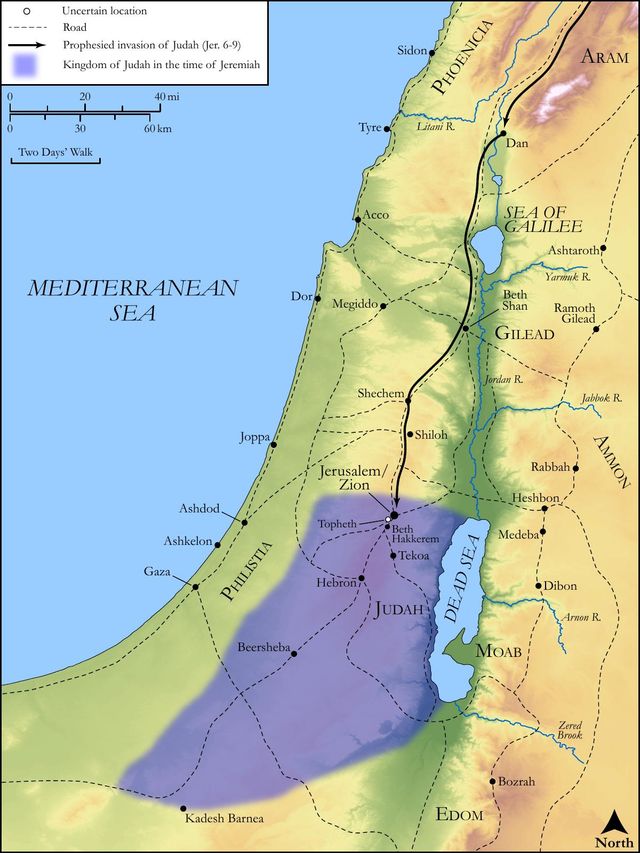
Study this verse
Public-domain commentary
Matthew Henry
From his Commentary on the Whole Bible. Henry comments on passages, not single verses — this entry covers Jeremiah 6:9–17. His three-level outline is real structure in the source text, so it is rendered as structure.
The heads of this paragraph are the very same with those of the last; for precept must be upon precept and line upon line.
I.The ruin of Judah and Jerusalem is here threatened.
We had before the haste which the Chaldea army made to the war (Jer 6:4, Jer 6:5); now here we have the havoc made by the war. How lamentable are the desolations here described! The enemy shall so long quarter among them, and be so insatiable in their thirst after blood and treasure, that they shall seize all they can meet with, and what escapes them at one time shall fall into their hands another (Jer 6:9): They shall thoroughly glean the remnant of Israel as a vine; as the grape-gatherer, who is resolved to leave none behind, still turns back his hand into the baskets, to put more in, till he has gathered all, so that they be picked up by the enemy, though dispersed, though hid, and none of them shall escape their eye and hand. Perhaps the people, being given to covetousness (Jer 6:13), had not observed that law of God which forbade them to glean all their grapes (Lev 19:10), and now they themselves shall be in like manner thoroughly gleaned and shall either fall by the sword or go into captivity. This is explained Jer 6:11, Jer 6:12, where God's fury and his hand are said to be poured out and stretched out, in the fury and by the hand of the Chaldeans; for even wicked men are often made use of as God's hand (Psa 17:14), and in their anger we may see God angry. Now see on whom the fury is poured out in full vials - upon the children abroad, or in the streets, where they are playing (Zac 8:5) or whither they run out innocently to look about them: the sword of the merciless Chaldeans shall not spare them, Jer 9:21. The children perish in the calamity which the fathers' sins have procured. The execution shall likewise reach the assembly of young men, their merry meetings, their clubs which they keep up to strengthen one another's hands in wickedness; they shall be cut off together. Nor shall those only fall into the enemies' hands who meet for lewdness (Jer 5:7), but even the husband with the wife shall be taken, these two in bed together, and neither left, but both taken prisoners. And, as they have no compassion for the weak but fair sex, so they have none for the decrepit but venerable age: The old with the full of days, whose deaths can contribute no more to their safety than their lives to their service, who are not in a capacity to do them either good or harm, shall be either cut off or carried off. Their houses shall then be turned to others (Jer 6:12); the conquerors shall dwell in their habitations, use their goods, and live upon their stores; their fields and vines shall fall together into their hands, as was threatened, Deu 28:30, etc. For God stretches out his hand upon the inhabitants of the land, and none can go out of the reach of it. Now as to this denunciation of God's wrath,
1.The prophet justifies himself in preaching thus terribly, for herein he dealt faithfully (Jer 6:11): "I am full of the fury of the Lord, full of the thoughts and apprehensions of it, and am carried out with a powerful impulse, by the spirit of prophecy, to speak of it thus vehemently." He took no delight in threatening, nor was it any pleasure to him with such sermons as these to make those about him uneasy; but he could not contain himself; he was weary with holding in; he suppressed it as long as he could, as long as he durst, but he was so full of power by the Spirit of the Lord of hosts that he must speak, whether they will hear or whether they will forbear. Note, When ministers preach the terrors of the Lord according to the scripture we have no reason to be displeased at them; for they are but messengers, and must deliver their message, pleasing or unpleasing.
2.He condemns the false prophets who preached plausibly, for therein they flattered people and dealt unfaithfully (Jer 6:13, Jer 6:14): The priest and the prophet, who should be their watchmen and monitors, have dealt falsely, have not been true to their trust not told the people their faults and the danger they were in; they should have been their physicians, but they murdered their patients by letting them have their will, by giving them every thing that had a mind to, and flattering them into an opinion that they were in no danger (Jer 6:14): They have healed the hurt of the daughter of my people slightly, or according to the cure of some slight hurt, skinning over the wound and never searching it to the bottom, applying lenitives only, when there was need of corrosives, soothing people in their sins, and giving them opiates to make them easy for the present, while the disease was preying upon the vitals. They said, "Peace peace - all shall be well." (if there were some thinking people among them, who were awake, and apprehensive of danger, they soon stopped their mouths with their priestly and prophetical authority, boldly averring that neither church nor state was in any danger), when there is no peace, because they went on in their idolatries and daring impieties. Note, Those are to be reckoned our false friends (that is, our worst and most dangerous enemies) who flatter us in a sinful way.
II.The sin of Judah and Jerusalem, which provoked God to bring this ruin upon them and justified him in it, is here declared.
1.They would by no means bear to be told of their faults, nor of the danger they were in. God bids the prophet give them warning of the judgment coming (Jer 6:9), "but," says he, "to whom shall I speak and give warning? I cannot find out any that will so much as give me a patient hearing. I may give warning long enough, but these is nobody that will take warning. I cannot speak that they may hear, cannot speak to any purpose, or with any hope of success; for their ear is uncircumcised, it is carnal and fleshly, indisposed to receive the voice of God, so that they cannot hearken. They have, as it were, a thick skin grown over the organs of hearing, so that divine things might to as much purpose be spoken to a stone as to them. Nay, they are not only deaf to it, but prejudiced against it; therefore they cannot hear, because they are resolved that they will not: The word of the Lord is unto them a reproach; both the reproofs and the threatenings of the word are so;" they reckoned themselves wronged and affronted by both, and resented the prophet's plain-dealing with them as they would the most causeless slander and calumny. This was kicking against the pricks (Act 9:5), as the lawyers against the word of Christ, Luk 11:45, Thus saying, thou repoachest us also. Note, Those reproofs that are counted reproaches, and hated as such, will certainly be turned into the heaviest woes. When it is here said, They have no delight in the word, more is implied than is expressed; "they have an antipathy to it; their hearts rise at it; it exasperates them, and enrages their corruptions, and they are ready to fly in the face and pull out the eyes of their reprovers." And how can those expect that the word of the Lord should speak any comfort to them who have no delight in it, but would rather be any where than within hearing of it?
2.They were inordinately set upon the world, and wholly carried away by the love of it (Jer 6:13): "From the least of them even to the greatest, old and young, rich and poor, high and low, those of all ranks, professions, and employments, every one is given to covetousness, greedy of filthy lucre, all for what they can get, per fas per nefas - right or wrong;" and this made them oppressive and violent (Jer 6:6, Jer 6:7), for of those evils, as well as others, the love of money is the bitter root. Nay, and this hardened their hearts against the word of God and his prophets. It was the covetous Pharisees that derided Christ, Luk 16:14.
3.They had become impudent in sin and were past shame. After such a high charge of flagrant crimes proved upon them, it was very proper to ask (Jer 6:15), Were they ashamed when they had committed all these abominations, which are such a reproach to their reason and religion? Did they blush at the conviction, and acknowledge that confusion of face belonged to them? If so, there is some hope of them yet. But, alas! there did not appear so much as this colour of virtue among them; their hearts were so hardened that they were not at all ashamed, neither could they blush, they had so brazened their faces. They even gloried in their wickedness, and openly confronted the convictions which should have humbled them and brought them to repentance. They resolved to face it out against God himself and not to own their guilt. Some refer this to the priests and prophets, who had healed the people slightly and told them that they should have peace, and yet were not ashamed of their treachery and falsehood, no, not when the event disproved them and gave them the lie. Those that are shameless are graceless and their case is hopeless. But those that will not submit to a penitential shame, nor take that to themselves as their due, shall not escape an utter ruin; for so it follows: Therefore they shall fall among those that fall; they shall have their portion with those that are quite undone; and, when God visits the nation in wrath, they shall be sure to be cast down and be made to tremble, because they would not blush. Note, Those that sin and cannot blush for it are in an evil case now, and it will be worse with them shortly. At first they hardened themselves and would not blush, afterwards they were so hardened that they could not. Quod unum habebant in malis bonum perdunt, peccandi verecundiam - they have lost the only good property which once blended itself with many bad ones, that is, shame for having done amiss. - Senec. De Vit. Beat.
III.They are put in mind of the good counsel which had been often given them, but in vain. They had a great deal said to them to little purpose,
1.By way of advice concerning their duty, Jer 6:16. God had been used to say to them, Stand in the ways and see. That is,
(1.)He would have them to consider, not to proceed rashly, but to do as travellers in the road, who are in care to find the right way which will bring them to their journey's end, and therefore pause and enquire for it. If they have any reason to think that they have missed their way, they are not easy till they have obtained satisfaction. O that men would be thus wise for their souls, and would ponder the path of their feet, as those that believe lawful and unlawful are of no less consequence to us than the right way and the wrong are to a traveller!
(2.)He would have them to consult antiquity, the observations and experiences of those that went before them: "Ask for the old paths, enquire of the former age (Job 8:8), ask thy father, thy elders (Deu 32:7), and thou wilt find that the way of godliness and righteousness has always been the way which God has owned and blessed and in which men have prospered. Ask for the old paths, the paths prescribed by the law of God, the written word, that true standard of antiquity. Ask for the paths that the patriarchs travelled in before you, Abraham, and Isaac, and Jacob; and, as you hope to inherit the promises made to them, tread in their steps. Ask for the old paths, Where is the good way?" We must not be guided merely by antiquity, as if the plea of prescription and long usage were alone sufficient to justify our path. No; there is an old way which wicked men have trodden, Job 22:15. But, when we ask for the old paths, it is only in order to find out the good way, the highway of the upright. Note, The way of religion and godliness is a good old way, the way that all the saints in all ages have walked in.
(3.)He would have them to resolve to act according to the result of these enquiries: "When you have found out which is the good way, walk therein, practise accordingly, keep closely to that way, proceed, and persevere in it." Some make this counsel to be given them with reference to the struggles that were between the true and false prophets, between those that said they should have peace and those that told them trouble was at the door; they pretended they knew not which to believe: "Stand in the way," says God, "and see, and enquire, which of these two agrees with the written word and the usual methods of God's providence, which of these directs you to the good way, and do accordingly." (4.) He assures them that, if they do thus, it will secure the welfare and satisfaction of their own souls: "Walk in the good old way and you will find your walking in that way will be easy and pleasant; you will enjoy both your God and yourselves, and the way will lead you to true rest. Though it cost you some pains to walk in that way, you will find an abundant recompence at your journey's end." (5.) He laments that this good counsel, which was so rational in itself and so proper for them, could not find acceptance: "But they said, We will not walk therein, not only we will not be at the pains to enquire which is the good way, the good old way; but when it is told us, and we have nothing to say to the contrary but that it is the right way, yet we will not deny ourselves and our humours so far as to walk in it." Thus multitudes are ruined for ever by downright wilfulness.
2.By way of admonition concerning their danger. Because they would not be ruled by fair reasoning, God takes another method with them; by less judgments he threatens greater, and sends his prophets to give them this explication of them, and to frighten them with an apprehension of the danger they were in (Jer 6:17); Also I set watchmen over you. God's ministers are watchmen, and it is a great mercy to have them set over us in the Lord. Now observe here,
(1.)The fair warning given by these watchmen. This was the burden of their song; they cried again and again, Hearken to the sound of the trumpet. God, in his providence, sounds the trumpet (Zac 9:14); the watchmen hear it themselves and are affected with it (Jer 4:19), and they are to call upon others to hearken to it too, to hear the Lord's controversy, to observe the voice of Providence, to improve it, and answer the intentions of it.
(2.)This fair warning slighted: "But they said, We will not hearken; we will not hear, we will not heed, we will not believe; the prophets may as well save themselves and us the trouble." The reason why sinners perish is because they do not hearken to the sound of the trumpet; and the reason why they do not is because they will not; and they have no reason to give why they will not but because they will not, that is, they are herein most unreasonable. One may more easily deal with ten men's reasons than one man's will.
Historical interpretation
Two Centuries of Reception
3 surviving comments on this verse. Each one is dated, so this reads as a timeline rather than a list.
Select a marker to jump to its quote. Markers stagger vertically where authors wrote within a few decades of each other.
And another prophet, Jeremiah, says, “Turn to the Lord your God, as a grape gatherer to his basket, and you shall find mercy.” The sayings in the Holy Scriptures regarding repentance are many, yes, countless. God always desires that the human race turn from all its sins.
God invites us to knowledge also, when he says by Jeremiah, “If you had walked in the way of God, you would have dwelled forever in peace.” … God grants pardon to those who have erred. He says, “Turn, turn, as a grape gatherer returns to his basket.” Do you see the goodness of justice in that it advises us to repent? And through Jeremiah, he provides further enlightenment in the truth for those who have erred” “Thus says the Lord, stand in the roads, and look. Ask for the eternal paths of the Lord. Look for the good path, and walk in it, and you shall find purification for your souls.” He leads us to repentance in order to promote our salvation.
(Verse 9) Thus says the Lord of hosts, they will gather the remnants of Israel like grapes in a vineyard. Turn your hand like a grape harvester into the basket. LXX: For thus says the Lord of hosts: Gather, gather the remnants of Israel like grapes in a vineyard. Return like a grape harvester to your basket. Some interpret these words in a positive way, others in a negative way. In a positive way, when Jerusalem has been devastated, the remnants will be saved. In such an evil way, not even a single cluster, and a small bunch remains in the vineyard, everything will be gathered: and whatever you find, gather it like a harvester in a basket; so that as he presses the grapes in the winepress: you may likewise drag captives into Babylon.
Continue studying Jeremiah 6:9 across the web’s major study libraries — every link below opens this exact verse, chapter, or book on the destination site.
Read & Compare
 BibleGatewayThis verse in more than 200 translations and 70 languages.
 Bible.comThe YouVersion reader — hundreds of translations, reading plans, and highlights.
 ESV.orgCrossway's official English Standard Version reader.
 NET BibleThe NET translation with 60,000+ translators' notes on every rendering decision.
 STEP BibleTyndale House's free study tool — original text, vocabulary, and scholarly resources.
 BibliaLogos Bible Software's free web reader.
 USCCBThe New American Bible (Revised Edition) with the U.S. bishops' study notes.
Commentaries
 BibleHub CommentariesDozens of classic commentaries on this verse, gathered on one page.
 StudyLightMore than 100 commentary sets — the largest collection on the web.
 BibleRefPlain-English commentary on what this verse means, verse by verse.
 Enduring WordDavid Guzik's free commentary on this chapter, widely used by Bible teachers.
 Bible Study ToolsVerse commentary alongside Greek and Hebrew study aids.
Original Language & Research
- BibleHub InterlinearThe verse word by word — original language, transliteration, and English.
- BibleHub LexiconEvery word's original-language definition and Strong's entry.
 Blue Letter BibleDeep-study tools — Strong's numbers, concordance, and word studies.
 SefariaThe Hebrew text with Rashi and centuries of Jewish commentary.
Sermons, Hymns & Audio


TrulyRandomVerse is not affiliated with these sites and doesn’t control their content. They’re linked because they’re genuinely useful.
Summary
Jeremiah 6:9 presents a powerful prophetic oracle from the LORD of hosts, employing a vivid agricultural metaphor to underscore the comprehensive and inescapable nature of Judah's impending judgment. Likening the nation to a vine, the divine decree announces that the remaining inhabitants, the "remnant of Israel," will be meticulously "gleaned" by an invading force, much like a diligent grapegatherer repeatedly passes his hand through the vine to collect every last cluster. This imagery conveys the thoroughness of the coming destruction and exile, ensuring no part of the rebellious nation remains untouched by divine discipline.
Context
ShowHideLiterary Context
Jeremiah 6:9 is strategically placed within a section of Jeremiah's prophecies (chapters 6-10) that intensifies the warnings of imminent judgment against Judah and Jerusalem. The preceding verses, particularly Jeremiah 6:1-8, depict the rapid approach of a formidable enemy from the north, urging the people of Benjamin to flee Jerusalem, which is portrayed as a city ripe for siege and destruction due to its pervasive sin. The Lord's lament over Jerusalem's obstinacy and refusal to be disciplined, articulated in Jeremiah 6:8, directly sets the stage for the severe and exhaustive judgment described in verse 9. Following this oracle, the chapter continues to detail the spiritual blindness and moral decay of the people and their leaders, emphasizing their rejection of God's word and the inevitable consequences (e.g., Jeremiah 6:10-15). Thus, the agricultural metaphor of gleaning in verse 9 serves as a powerful and vivid illustration of the exhaustive nature of the judgment that will befall a nation unwilling to repent.
Historical & Cultural Context
The historical setting for Jeremiah's prophetic ministry spans the late 7th and early 6th centuries BCE, a period of immense geopolitical upheaval marked by the decline of the Assyrian Empire and the ascendance of Babylon. Judah, under kings like Jehoiakim and Zedekiah, found itself precariously positioned between these shifting powers, often making ill-advised political alliances that defied God's counsel. Spiritually, the nation was deeply entrenched in idolatry, oppression, and a superficial adherence to religious rituals, despite repeated and fervent warnings from prophets like Jeremiah. The agricultural imagery of the "vine" and "grapegathering" would have resonated profoundly with ancient Israel, an agrarian society where vineyards were ubiquitous and viticulture was central to the economy and culture. The process of "gleaning" was a well-understood practice, referring to the meticulous final collection of what remained after the main harvest, often designated for the poor or for a second pressing (Leviticus 19:10). Here, however, this familiar practice is repurposed to describe the thorough, almost predatory, removal of the population by an invading army, specifically the Babylonians, who would eventually carry the people into exile.
Key Themes
ShowHideJeremiah 6:9 contributes significantly to several key themes prevalent throughout the book of Jeremiah. Foremost is the Thoroughness of Divine Judgment, emphasizing that God's discipline, though delayed by His patience, would be utterly comprehensive, leaving no segment of the unrepentant nation untouched. This starkly contrasts with earlier prophetic concepts of a preserving remnant for restoration. The verse also powerfully highlights Divine Sovereignty and Justice, as the declaration "Thus saith the LORD of hosts" underscores that this calamity is not random but a direct, intentional act of God, who uses foreign armies as instruments of His righteous judgment, a theme echoed in passages like Jeremiah 25:9. Furthermore, the Agricultural Metaphor of the vine and grapegathering serves as a potent means of communicating the intensity and deliberateness of this judgment, transforming an image typically associated with abundance and blessing into one of desolation and removal. This imagery is a common biblical motif, often used to depict Israel's relationship with God, as seen in Isaiah 5:1-7, but here it signifies destruction rather than cultivation.
Exposition and Analysis
ShowHideKey Word Analysis
ShowHideThis primitive root (H5953) signifies "to effect thoroughly," specifically "to glean" or gather after the main harvest. The repetition of this verb in the Hebrew text ("throughly glean") intensifies its meaning, conveying an action that is exhaustive and complete, leaving virtually nothing behind. In a negative sense, it can also mean to maltreat or abuse, suggesting the harshness and severity of the "gleaning" by the invading army.
Derived from an unused root meaning "to bend," this word (H1612) refers specifically to a vine, especially the grape vine, known for its twining growth and capacity for fruitfulness. In biblical literature, the vine frequently symbolizes Israel, representing its potential for a fruitful relationship under God's covenant care. Here, however, the vine is subject to a devastating "harvest" of judgment, indicating a profound failure to produce righteous fruit and fulfill its covenant obligations.
This term (H1219) comes from a root meaning "to clip off" or "to gather grapes." It describes someone engaged in the meticulous and diligent work of harvesting the grapes from a vineyard. The comparison of the invading forces to a "grapegatherer" emphasizes the methodical, thorough, and complete nature of their work in carrying away the inhabitants of Judah into exile, much as a diligent worker ensures no grapes are left on the vine.
Verse Breakdown
ShowHide"Thus saith the LORD of hosts,"
This opening phrase functions as a solemn divine oracle formula, asserting the absolute authority, sovereignty, and certainty of the message that follows. "The LORD of hosts" (Hebrew: Yᵉhôvâh tsâbâʼ) emphasizes God's supreme power and command over all armies, both earthly and heavenly, underscoring that the impending judgment is not a random calamity but a deliberate, intentional act of the Almighty, who directs the course of nations.
"They shall throughly glean the remnant of Israel as a vine:"
This clause introduces the central and powerful metaphor of the verse. "They" refers to the invading foreign forces, divinely appointed as instruments of God's judgment (likely the Babylonians). "Throughly glean" (a forceful repetition of the Hebrew verb ʻâlal) stresses the exhaustive and relentless nature of the removal; just as a vine is meticulously stripped of its grapes, so too will Judah be emptied of its inhabitants. The "remnant of Israel" here does not carry the typical hopeful connotation of a preserved, faithful group, but rather refers to those who have survived previous phases of judgment and are now subject to the final, comprehensive sweep into exile.
"turn back thine hand as a grapegatherer into the baskets."
This imperative, directed at the "grapegatherer" (the invading army), reinforces the divine command for utter thoroughness. It vividly depicts the relentless action of repeatedly reaching into the vine to ensure every last grape (representing a person) is collected and put "into the baskets" (symbolizing captivity or exile). This striking image conveys the intensity, precision, and completeness of the impending deportation, leaving no one behind.
Literary Devices
ShowHideJeremiah 6:9 is profoundly enriched by its use of Imagery and a compelling Simile. The comparison of the "remnant of Israel" to a "vine" and the invading forces to a "grapegatherer" forms a striking simile that renders the abstract concept of divine judgment tangible and deeply relatable to an agrarian society. The act of "throughly gleaning" evokes a vivid mental picture of meticulous, exhaustive removal, transforming a common agricultural practice into a powerful metaphor for devastating national judgment and deportation. Furthermore, the verse functions as a direct Divine Oracle, beginning with the authoritative formula "Thus saith the LORD of hosts." This prophetic utterance establishes the divine origin and unalterable certainty of the prophecy, underscoring God's active involvement in human history and His sovereign control over the fate of nations, even using foreign powers to accomplish His righteous purposes.
Theological and Thematic Connections
ShowHideThis verse powerfully articulates God's unwavering justice and His commitment to holding His covenant people accountable for their persistent sin and rebellion. The imagery of a thorough gleaning signifies that divine judgment, when it comes, will be comprehensive and inescapable for those who refuse to repent. It underscores that God's patience has limits, and His love is perfectly balanced with His righteousness. While the concept of a "remnant" often carries a hopeful connotation of preservation and restoration in other prophetic contexts, here it highlights the severity of judgment, where even those who remain after initial calamities will be swept away. This passage serves as a sobering reminder that covenant relationship demands obedience and faithfulness, and persistent disobedience invites severe divine discipline, not out of arbitrary wrath, but out of a just response to unrepentant sin that threatens the very fabric of the covenant.
Reflection and Application
ShowHideJeremiah 6:9 stands as a profound and sobering warning, not just for ancient Judah, but for all who claim to be God's people across generations. It compels us to soberly consider the consequences of spiritual complacency, persistent disobedience, and the rejection of divine warnings. While believers today live under the New Covenant of grace, the enduring principles of God's justice and His expectation of genuine repentance remain foundational. This verse challenges us to examine our own lives: are we truly bearing fruit for God's glory, or are we, like the barren vine, ripe for a different kind of "gleaning"—a spiritual pruning that removes unfruitful aspects of our lives? It calls us to respond with humility and urgency to the gentle promptings of the Holy Spirit and the clear commands of Scripture, understanding that God's boundless love does not negate His perfect justice. Ultimately, it invites us to cling to the mercy offered in Christ, recognizing that true security and spiritual flourishing lie not in outward religious observance but in a heart fully yielded to God and transformed by His grace.
Questions for Reflection
ShowHideFAQ
ShowHideDoes this verse mean God is always looking to punish His people?
ShowHideNo, this verse does not suggest God is always looking to punish His people. Instead, it highlights the severe consequences of persistent and unrepentant rebellion against God's covenant and repeated warnings. In Jeremiah's time, Judah had a long history of spiritual infidelity, idolatry, and oppression, despite numerous prophetic calls to return to the Lord. This "gleaning" is a divine judgment, a corrective measure, not an arbitrary act of wrath. God's primary desire is for His people to repent and live in covenant faithfulness, as evidenced by His patience and repeated sending of prophets to call them back (e.g., Jeremiah 7:25). The severity of the judgment described here reflects the depth of Judah's sin and their stubborn refusal to heed His loving correction, demonstrating that God's justice is as real as His mercy.
Christ-Centered Fulfillment
ShowHideWhile Jeremiah 6:9 speaks of a judgment on an unfaithful Israel, its imagery and underlying theological principles find profound Christ-centered fulfillment. The "vine" motif, often used to represent Israel's relationship with God and its covenant fruitfulness, is powerfully reinterpreted by Jesus Himself in John 15:1, where He declares, "I am the true vine, and my Father is the vinedresser." This shifts the focus from a nation that failed to bear fruit to Christ as the perfect, fruitful Vine, through whom all true spiritual life and fruitfulness must come. The "gleaning" of judgment foreshadows the ultimate separation of the righteous from the unrighteous, a theme Jesus speaks of in parables like the wheat and the weeds (e.g., Matthew 13:30) and the separation of sheep and goats (e.g., Matthew 25:32-33). While Jeremiah's gleaning was for physical exile, the New Testament speaks of a spiritual gleaning, where those who are not "in the vine" (Christ) will be cut off and gathered for judgment (John 15:6). Conversely, for those who are united with the true Vine, Christ has borne the full "gleaning" of divine wrath on the cross, taking upon Himself the judgment due to humanity, so that all who believe might escape the ultimate "gleaning" of condemnation and instead receive eternal life and abundant fruitfulness through Him (Romans 8:1).