


Matthew 16:19
Bible text: King James Version (1769 Blayney text) · Public domain
Bible text: King James Version with Strong's numbers · Public domain
Bible text: Berean Standard Bible · Public domain
Bible text: American Standard Version (1901) · Public domain
Bible text: World English Bible, Messianic edition · Public domain
Bible text: Geneva Bible (1599) · Public domain
Bible text: Young's Literal Translation · Public domain
- καὶkaiandG2532CONJConjunction
- δώσωdōsōI will giveG1325V-FAI-1SVerb Future Active Indicative 1st Singular
- σοιsoito youG4771P-2DSPersonal pronoun Dative 2nd Singular
- τὰςtastheG3588T-APFDefinite article Accusative Plural Feminine
- κλεῖδαςkleidaskeysG2807N-APFNoun Accusative Plural Feminine
- τῆςtēsof theG3588T-GSFDefinite article Genitive Singular Feminine
- βασιλείαςbasileiaskingdomG932N-GSFNoun Genitive Singular Feminine
- τῶνtōnof theG3588T-GPMDefinite article Genitive Plural Masculine
- οὐρανῶνouranōnheavensG3772N-GPMNoun Genitive Plural Masculine
- καὶkaiandG2532CONJConjunction
- ὃhowhateverG3739R-ASNRelative pronoun Accusative Singular Neuter
- ἐὰνeanifG1437CONDConjunction
- δήσῃςdēsēsyou shall bindG1210V-AAS-2SVerb Aorist Active Subjunctive 2nd Singular
- ἐπὶepionG1909PREPPreposition
- τῆςtēstheG3588T-GSFDefinite article Genitive Singular Feminine
- γῆςgēsearthG1093N-GSFNoun Genitive Singular Feminine
- ἔσταιestaiwill beG1510V-FDI-3SVerb Future Middle Deponent Indicative 3rd Singular
- δεδεμένονdedemenonboundG1210V-RPP-NSNVerb Perfect Passive Participle Nominative Singular Neuter
- ἐνeninG1722PREPPreposition
- τοῖςtoistheG3588T-DPMDefinite article Dative Plural Masculine
- οὐρανοῖςouranoisheavensG3772N-DPMNoun Dative Plural Masculine
- καὶkaiandG2532CONJConjunction
- ὃhowhateverG3739R-ASNRelative pronoun Accusative Singular Neuter
- ἐὰνeanmaybeG1437CONDConjunction
- λύσῃςlusēsyou shall looseG3089V-AAS-2SVerb Aorist Active Subjunctive 2nd Singular
- ἐπὶepionG1909PREPPreposition
- τῆςtēstheG3588T-GSFDefinite article Genitive Singular Feminine
- γῆςgēsearthG1093N-GSFNoun Genitive Singular Feminine
- ἔσταιestaiwill beG1510V-FDI-3SVerb Future Middle Deponent Indicative 3rd Singular
- λελυμένονlelumenonloosedG3089V-RPP-NSNVerb Perfect Passive Participle Nominative Singular Neuter
- ἐνeninG1722PREPPreposition
- τοῖςtoistheG3588T-DPMDefinite article Dative Plural Masculine
- οὐρανοῖςouranoisheavensG3772N-DPMNoun Dative Plural Masculine
English is a literal word-by-word gloss of the Greek, not the KJV's wording. Why?
This is the original text the KJV's translators worked from — each Greek word with its own literal English meaning in this verse, prepared by scholars at Tyndale House, Cambridge. The KJV translates whole sentences, not word by word, so its wording differs: one Greek word can become several English words, and the KJV may choose “charity” where the gloss reads “love”. Both are faithful — they answer different questions. For the KJV's own rendering, switch to the KJV text.
Details
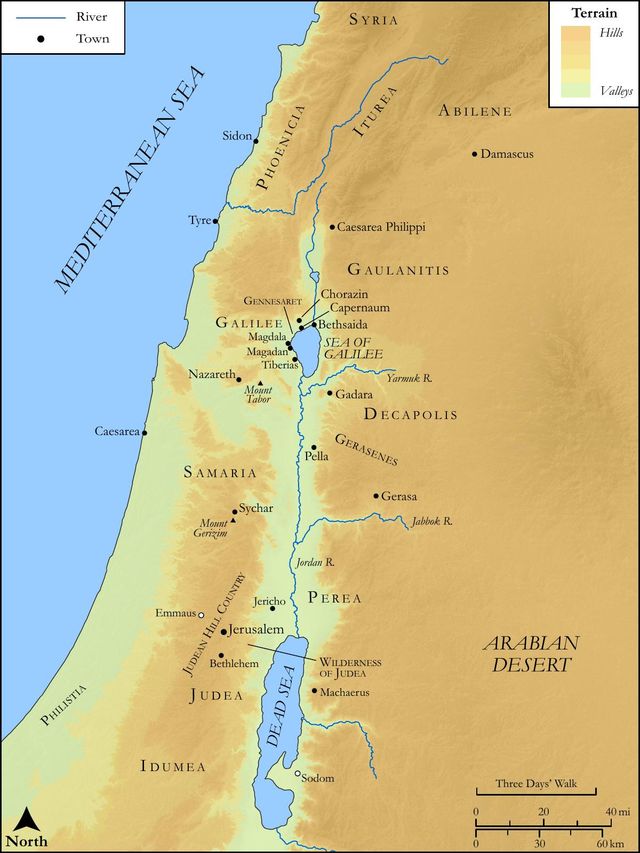
See on the biblical-era maps
Study this verse
Public-domain commentary
Matthew Henry
From his Commentary on the Whole Bible. Henry comments on passages, not single verses — this entry covers Matthew 16:13–20. His four-level outline is real structure in the source text, so it is rendered as structure.
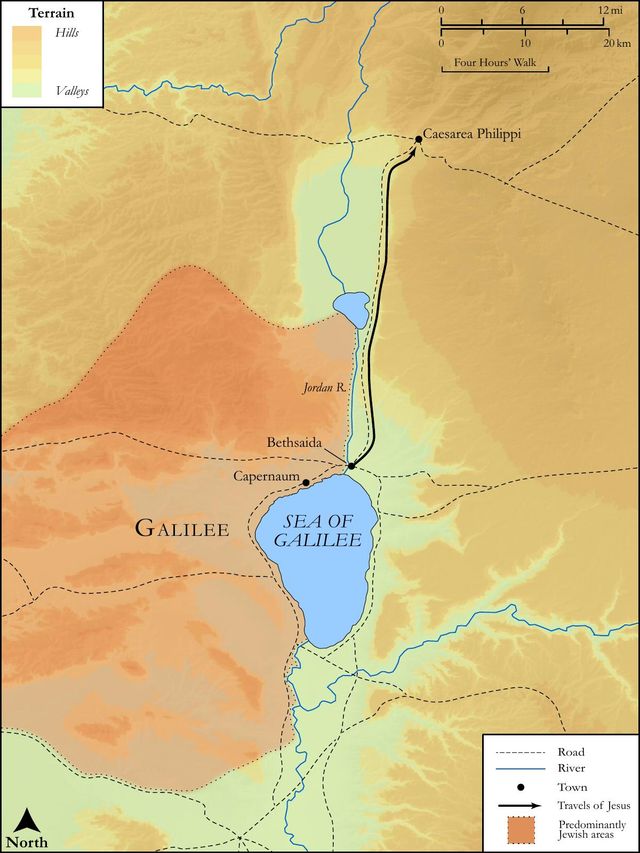
We have here a private conference which Christ had with his disciples concerning himself. It was in the coasts of Cesarea Philippi, the utmost borders of the land of Canaan northward; there in that remote corner, perhaps, there was less flocking after him than in other places, which gave him leisure for this private conversation with his disciples. Note, When ministers are abridged in their public work, they should endeavour to do the more in their own families.
Christ is here catechising his disciples.
I.He enquires what the opinions of others were concerning him; Who do men say that I, the Son of man, am?
1.He calls himself the Son of man; which may be taken either,
(1.)As a title common to him with others. He was called, and justly, the Son of God, for so he was (Luke i. 35); but he called himself the Son of man; for he is really and truly "Man, made of a woman." In courts of honour, it is a rule to distinguish men by their highest titles; but Christ, having now emptied himself, though he was the Son of God, will be known by the style and title of the Son of man. Ezekiel was often so called to keep him humble; Christ called himself so, to show that he was humble. Or,
(2.)As a title peculiar to him as Mediator. He is made known, in Daniel's vision, as the Son of man, Dan. vii. 13. I am the Messiah, that Son of man that was promised. But,
2.He enquires what people's sentiments were concerning him: "Who do men say that I am? The Son of man?" (So I think it might better be read). "Do they own me for the Messiah?" He asks not, "Who do the scribes and Pharisees say that I am?" They were prejudiced against him, and said that he was a deceiver and in league with Satan; but, "Who do men say that I am?" He referred to the common people, whom the Pharisees despised. Christ asked this question, not as one that knew not; for if he knows what men think, much more what they say; nor as one desirous to hear his own praises, but to make the disciples solicitous concerning the success of their preaching, by showing that he himself was so. The common people conversed more familiarly with the disciples than they did with their Master, and therefore from them he might better know what they said. Christ had not plainly said who he was, but left people to infer it from his works, John x. 24, 25. Now he would know what inferences the people drew from them, and from the miracles which his apostles wrought in his name.
3.To this question the disciples have him an answer (v. 14), Some say, thou art John the Baptist, &c. There were some that said, he was the Son of David (ch. xii. 23), and the great Prophet, John vi. 14. The disciples, however, do not mention that opinion, but only such opinions as were wide of the truth, which they gathered up from their countrymen. Observe,
(1.)They are different opinions; some say one thing, and others another. Truth is one; but those who vary from that commonly vary one from another. Thus Christ came eventually to send division, Luke xii. 51. Being so noted a Person, every one would be ready to pass his verdict upon him, and, "Many men, many minds;" those that were not willing to own him to be the Christ, wandered in endless mazes, and followed the chase of every uncertain guess and wild hypothesis.
(2.)They are honourable opinions, and bespeak the respect they had for him, according to the best of their judgment. These were not the sentiments of his enemies, but the sober thoughts of those that followed him with love and wonder. Note, It is possible for men to have good thoughts of Christ, and yet not right ones, a high opinion of him, and yet not high enough.
(3.)They all suppose him to be one risen from the dead; which perhaps arose from a confused notion they had of the resurrection of the Messiah, before his public preaching, as of Jonas. Or their notions arose from an excessive value for antiquity; as if it were not possible for an excellent man to be produced in their own age, but it must be one of the ancients returned to life again.
(4.)They are all false opinions, built upon mistakes, and wilful mistakes. Christ's doctrines and miracles bespoke him to be an extraordinary Person; but because of the meanness of his appearance, so different from what they expected, they would not own him to be the Messiah, but will grant him to be any thing rather than that.
[1.]Some say, thou art John the Baptist. Herod said so (ch. xiv. 2), and those about him would be apt to say as he said. This notion might be strengthened by an opinion they had, that those who died as martyrs, should rise again before others; which some think the second of the seven sons refers to, in his answer to Antiochus, 2 Macc. vii. 9, The King of the world shall raise us up, who have died for his laws, unto everlasting life.
[2.]Some Elias; taking occasion, no doubt, from the prophecy of Malachi (ch. iv. 5), Behold, I will send you Elijah. And the rather, because Elijah (as Christ) did many miracles, and was himself, in his translation, the greatest miracle of all.
[3.]Others Jeremias: they fasten upon him, either because he was the weeping prophet, and Christ was often in tears; or because God had set him over the kingdoms and nations (Jer. i. 10), which they thought agreed with their notion of the Messiah.
[4.]Or, one of the prophets. This shows what an honourable idea they entertained of the prophets; and yet they were the children of them that persecuted and slew them, ch. xxiii. 29. Rather than they would allow Jesus of Nazareth, one of their own country, to be such an extraordinary Person as his works bespoke him to be, they would say, "It was not he, but one of the old prophets."
II.He enquires what their thoughts were concerning him; "But who say ye that I am? v.
15. Ye tell me what other people say of me; can ye say better?" 1. The disciples had themselves been better taught than others; had, by their intimacy with Christ, greater advantages of getting knowledge than others had. Note, It is justly expected that those who enjoy greater plenty of the means of knowledge and grace than others, should have a more clear and distinct knowledge of the things of God than others. Those who have more acquaintance with Christ than others, should have truer sentiments concerning him, and be able to give a better account of him than others. 2. The disciples were trained up to teach others, and therefore it was highly requisite that they should understand the truth themselves: "Ye that are to preach the gospel of the kingdom, what are your notions of him that sent you?" Note, Ministers must be examined before they be sent forth, especially what their sentiments are of Christ, and who they say that he is; for how can they be owned as ministers of Christ, that are either ignorant or erroneous concerning Christ? This is a question we should every one of us be frequently putting to ourselves, "Who do we say, what kind of one do we say, that the Lord Jesus is? Is he precious to us? Is he in our eyes the chief of ten thousand? Is he the Beloved of our souls?" It is well or ill with us, according as our thoughts are right or wrong concerning Jesus Christ.
Well, this is the question; now let us observe,
(1.)Peter's answer to this question, v. 16. To the former question concerning the opinion others had of Christ, several of the disciples answered, according as they had heard people talk; but to this Peter answers in the name of all the rest, they all consenting to it, and concurring in it. Peter's temper led him to be forward in speaking upon all such occasions, and sometimes he spoke well, sometimes amiss; in all companies there are found some warm, bold men, to whom a precedency of speech falls of course; Peter was such a one: yet we find other of the apostles sometimes speaking as the mouth of the rest; as John (Mark ix. 38), Thomas, Philip, and Jude, John xiv. 5, 8, 22. So that this is far from being a proof of such primacy and superiority of Peter above the rest of the apostles, as the church of Rome ascribes to him. They will needs advance him to be a judge, when the utmost they can make of him, is, that he was but foreman of the jury, to speak for the rest, and that only pro hâc vice—for this once; not the perpetual dictator or speaker of the house, only chairman upon this occasion.
Peter's answer is short, but it is full, and true, and to the purpose; Thou art the Christ, the Son of the Living God. Here is a confession of the Christian faith, addressed to Christ, and so made an act of devotion. Here is a confession of the true God as the living God, in opposition to dumb and dead idols, and of Jesus Christ, whom he hath sent, whom to know is life eternal. This is the conclusion of the whole matter.
[1.]The people called him a Prophet, that Prophet (John vi. 14); but the disciples own him to be the Christ, the anointed One; the great Prophet, Priest, and King of the church; the true Messiah promised to the fathers, and depended on by them as He that shall come. It was a great thing to believe this concerning one whose outward appearance was so contrary to the general idea the Jews had of the Messiah.
[2.]He called himself the Son of Man; but they owned him to be the Son of the living God. The people's notion of him was, that he was the ghost of a dead man, Elias, or Jeremias; but they know and believe him to be the Son of the living God, who has life in himself, and has given to his Son to have life in himself, and to be the Life of the world. If he be the Son of the living God, he is of the same nature with him: and though his divine nature was now veiled with the cloud of flesh, yet there were those who looked through it, and saw his glory, the glory as of the Only-Begotten of the Father, full of grace and truth. Now can we with an assurance of faith subscribe to this confession? Let us then, with a fervency of affection and adoration, go to Christ, and tell him so; Lord Jesus, thou art the Christ, the Son of the living God.
(2.)Christ's approbation of his answer (v. 17-19); in which Peter is replied to, both as a believer and as an apostle.
[1.]As a believer, v. 17. Christ shows himself well pleased with Peter's confession, that it was so clear and express, without ifs or ands, as we say. Note, The proficiency of Christ's disciples in knowledge and grace is very acceptable to him; and Christ shows him whence he received the knowledge of this truth. At the first discovery of this truth in the dawning of the gospel day, it was a mighty thing to believe it; all men had not this knowledge, had not this faith. But,
First, Peter had the happiness of it; Blessed art thou, Simon Bar-jona. He reminds him of his rise and original, the meanness of his parentage, the obscurity of his extraction; he was Bar-jonas—The son of a dove; so some. Let him remember the rock out of which he was hewn, that he may see he was not born to this dignity, but preferred to it by the divine favour; it was free grace that made him to differ. Those that have received the Spirit must remember who is their Father, 1 Sam. x. 12. Having reminded him of this, he makes him sensible of his great happiness as a believer; Blessed art thou. Note, True believers are truly blessed, and those are blessed indeed whom Christ pronounces blessed; his saying they are so, makes them so. "Peter, thou art a happy man, who thus knowest the joyful sound," Ps. lxxxix. 15. Blessed are your eyes, ch. xiii. 16. All happiness attends the right knowledge of Christ.
Secondly, God must have the glory of it; "For flesh and blood have not revealed it to thee. Thou hadst this neither by the invention of thy own wit and reason, nor by the instruction and information of others; this light sprang neither from nature nor from education, but from my Father who is in heaven." Note, 1. The Christian religion is a revealed religion, has its rise in heaven; it is a religion from above, given by inspiration of God, not the learning of philosophers, nor the politics of statesmen. 2. Saving faith is the gift of God, and, wherever it is, is wrought by him, as the Father of our Lord Jesus Christ, for his sake, and upon the score of his mediation, Phil. i. 29. Therefore thou art blessed, because my Father has revealed it to thee. Note, The revealing of Christ to us and in us is a distinguishing token of God's good will, and a firm foundation of true happiness; and blessed are they that are thus highly favoured.
Perhaps Christ discerned something of pride and vain-glory in Peter's confession; a subtle sin, and which is apt to mingle itself even with our good duties. It is hard for good men to compare themselves with others, and not to have too great a conceit of themselves; to prevent which, we should consider that our preference to others is no achievement of our own, but the free gift of God's grace too us, and not to others; so that we have nothing to boast of, Ps. cxv. 1; 1 Cor. iv. 7.
[2.]Christ replies to him as an apostle or minister, v. 18, 19. Peter, in the name of the church, had confessed Christ, and to him therefore the promise intended for the church is directed. Note, There is nothing lost by being forward to confess Christ; for those who honour him, he will honour.
Upon occasion of this great confession made of Christ, which is the church's homage and allegiance, he signed and published this royal, this divine charter, by which that body politic is incorporated. Such is the communion between Christ and the church, the Bridegroom and the spouse. God had a church in the world from the beginning, and it was built upon the rock of the promised Seed, Gen. iii. 15. But now, that promised Seed being come, it was requisite that the church should have a new charter, as Christian, and standing in relation to a Christ already come. Now here we have that charter; and a thousand pities it is, that this word, which is the great support of the kingdom of Christ, should be wrested and pressed into the service of antichrist. But the devil has employed his subtlety to pervert it, as he did that promise, Ps. xci. 11, which he perverted to his own purpose, ch. iv. 6, and perhaps both that scripture and this he thus perverted because they stood in his way, and therefore he owed them a spite.
Now the purport of this charter is,
First, To establish the being of the church; I say also unto thee. It is Christ that makes the grant, he who is the church's Head, and Ruler, to whom all judgment is committed, and from whom all power is derived; he who makes it pursuant to the authority received from the Father, and his undertaking for the salvation of the elect. The grant is put into Peter's hand; "I say it to thee." The Old Testament promises relating to the church were given immediately to particular persons, eminent for faith and holiness, as to Abraham and David; which yet gave no supremacy to them, much less to any of their successors; so the New-Testament charter is here delivered to Peter as an agent, but to the use and behoof of the church in all ages, according to the purposes therein specified and contained. Now it is here promised,
1.That Christ would build his church upon a rock. This body politic is incorporated by the style and title of Christ's church. It is a number o the children of men called out of the world, and set apart from it, and dedicated to Christ. It is not thy church, but mine. Peter remembered this, when he cautioned ministers not to lord it over God's heritage. The church is Christ's peculiar, appropriated to him. The world is God's, and they that dwell therein; but the church is a chosen remnant, that stands in relation to God through Christ as Mediator. It bears him image and superscription.
(1.)The Builder and Maker of the church is Christ himself; I will build it. The church is a temple which Christ is the Builder of, Zech. vi. 11-13. Herein Solomon was a type of Christ, and Cyrus, Isa. xliv. 28. The materials and workmanship are his. By the working of his Spirit with the preaching of his word he adds souls to his church, and so builds it up with living stones, 1 Pet. ii. 5. Ye are God's building; and building is a progressive work; the church in this world is but in fieri—in the forming, like a house in the building. It is a comfort to all those who wish well to the church, that Christ, who has divine wisdom and power, undertakes to build it.
(2.)The foundation on which it is built is, this Rock. Let the architect do his part ever so well, if the foundation be rotten, the building will not stand; let us therefore see what the foundation is, and it must be meant of Christ, for other foundation can no man lay. See Isa. xxviii. 16.
[1.]The church is built upon a rock; a firm, strong, and lasting foundation, which time will not waste, nor will it sink under the weight of the building. Christ would not build his house upon the sand, for he knew that storms would arise. A rock is high, Ps. lxi. 2. Christ's church does not stand upon a level with this world; a rock is large, and extends far, so does the church's foundation; and the more large, the more firm; those are not the church's friends that narrow its foundation.
[2.]It is built upon this rock; thou art Peter, which signifies a stone or rock; Christ gave him that name when he first called him (John i. 42), and here he confirms it; "Peter, thou dost answer thy name, thou art a solid, substantial disciple, fixed and stayed, and one that there is some hold of. Peter is thy name, and strength and stability are with thee. Thou art not shaken with the waves of men's fluctuating opinions concerning me, but established in the present truth," 2 Pet. i. 12. From the mention of this significant name, occasion is taken for this metaphor of building upon a rock.
First, Some by this rock understand Peter himself as an apostle, the chief, though not the prince, of the twelve, senior among them, but not superior over them. The church is built upon the foundation of the apostles, Eph. ii. 20. The first stones of that building were laid in and by their ministry; hence their names are said to be written in the foundations of the new Jerusalem, Rev. xxi. 14. Now Peter being that apostle by whose hand the first stones of the church were laid, both in Jewish converts (Acts ii.), and in the Gentile converts (Acts x.), he might in some sense be said to be the rock on which it was built. Cephas was one that seemed to be a pillar, Gal. ii. 9. But it sounds very harsh, to call a man that only lays the first stone of a building, which is a transient act, the foundation on which it is built, which is an abiding thing. Yet if it were so, this would not serve to support the pretensions of the Bishop of Rome; for Peter had no such headship as he claims, much less could he derive it to his successors, least of all to the Bishops of Rome, who, whether they are so in place or no, is a question, but that they are not so in the truth of Christianity, is past all question.
Secondly, Others, by this rock, understand Christ; "Thou art Peter, thou hast the name of a stone, but upon this rock, pointing to himself, I will build my church." Perhaps he laid his hand on his breast, as when he said, Destroy this temple (John ii. 19), when he spoke of the temple of his body. Then he took occasion from the temple, where he was, so to speak of himself, and gave occasion to some to misunderstand him of that; so here he took occasion from Peter, to speak of himself as the Rock, and gave occasion to some to misunderstand him of Peter. But this must be explained by those many scriptures which speak of Christ as the only Foundation of the church; see 1 Cor. iii. 11; 1 Pet. ii. 6. Christ is both its Founder and its Foundation; he draws souls, and draws them to himself; to him they are united, and on him they rest and have a constant dependence.
Thirdly, Others by this rock understand this confession which Peter made of Christ, and this comes all to one with understanding it of Christ himself. It was a good confession which Peter witnessed, Thou art the Christ, the Son of the living God; the rest concurred with him in it. "Now," saith Christ, "this is that great truth upon which I will build my church." 1. Take away this truth itself, and the universal church falls to the ground. If Christ be not the Son of God, Christianity is a cheat, and the church is a mere chimera; our preaching is vain, your faith is vain, and you are yet in your sins, 1 Cor. xv. 14-17. If Jesus be not the Christ, those that own him are not of the church, but deceivers and deceived. 2. Take away the faith and confession of this truth from any particular church, and it ceases to be a part of Christ's church, and relapses to the state and character of infidelity. This is articulus stantis et cadentis ecclesia—that article, with the admission or the denial of which the church either rises or falls; "the main hinge on which the door of salvation turns;" those who let go this, do not hold the foundation; and though they may call themselves Christians, they give themselves the lie; for the church is a sacred society, incorporated upon the certainty and assurance of this great truth; and great it is, and has prevailed.
2.Christ here promises to preserve and secure his church, when it is built; The gates of hell shall not prevail against it; neither against this truth, nor against the church which is built upon it.
(1.)This implies that the church has enemies that fight against it, and endeavour its ruin overthrow, here represented by the gates of hell, that is, the city of hell; (which is directly opposite to this heavenly city, this city of the living God), the devil's interest among the children of men. The gates of hell are the powers and policies of the devil's kingdom, the dragon's head and horns, by which he makes war with the Lamb; all that comes out of hell-gates, as being hatched and contrived there. These fight against the church by opposing gospel truths, corrupting gospel ordinances, persecuting good ministers and good Christians; drawing or driving, persuading by craft or forcing by cruelty, to that which is inconsistent with the purity of religion; this is the design of the gates of hell, to root out the name of Christianity (Ps. lxxxiii. 4), to devour the man-child (Rev. xii. 9), to raze this city to the ground.
(2.)This assures us that the enemies of the church shall not gain their point. While the world stands, Christ will have a church in it, in which his truths and ordinances shall be owned and kept up, in spite of all the opposition of the powers of darkness; They shall not prevail against it, Ps. cxxix. 1, 2. This gives no security to any particular church, or church-governors that they shall never err, never apostatize or be destroyed; but that somewhere or other the Christian religion shall have a being, though not always in the same degree of purity and splendour, yet so as that the entail of it shall never be quite cut off. The woman lives, though in a wilderness (Rev. xii. 14), cast down but not destroyed (2 Cor. iv. 9). Corruptions grieving, persecutions grievous, but neither fatal. The church may be foiled in particular encounters, but in the main battle it shall come off more than a conqueror. Particular believers are kept by the power of God, through faith, unto salvation, 1 Pet. i. 5.
Secondly, The other part of this charter is, to settle the order and government of the church, v. 19. When a city or society is incorporated, officers are appointed and empowered to act for the common good. A city without government is a chaos. Now this constituting of the government of the church, is here expressed by the delivering of the keys, and, with them, a power to bind and loose. This is not to be understood of any peculiar power that Peter was invested with, as if he were sole door-keeper of the kingdom of heaven, and had that key of David which belongs only to the Son of David; no, this invests all the apostles and their successors with a ministerial power to guide and govern the church of Christ, as it exists in particular congregations or churches, according to the rules of the gospel. Claves regni cælorum in B. Petro apostolo cuncti suscepimus sacerdotes—All we that are priests, received, in the person of the blessed apostle Peter, the keys of the kingdom of heaven; so Ambrose De Dignit. Sacerd. Only the keys were first put into Peter's hand, because he was the first that opened the door of faith to the Gentiles, Acts x. 28. As the king, in giving a charter to a corporation, empowers the magistrates to hold courts in his name, to try matters of fact, and determine therein according to law, confirming what is so done regularly as if done in any of the superior courts; so Christ, having incorporated his church, hath appointed the office of the ministry for the keeping up of order and government, and to see that his laws be duly served; I will give thee the keys. He doth not say, "I have given them," or "I do now;" but "I will do it," meaning after his resurrection; when he ascended on high, he gave those gifts, Ephes. iv. 8; then this power was actually given, not to Peter only, but to all the rest, ch. xxviii. 19, 20; John xx. 21. He doth not say, The keys shall be given, but, I will give them; for ministers derive their authority from Christ, and all their power is to be used in his name, 1 Cor. v. 4.
Now, 1. The power here delegated is a spiritual power; it is a power pertaining to the kingdom of heaven, that is, to the church, that part of it which is militant here on earth, to the gospel dispensation; that is it about which the apostolical and ministerial power is wholly conversant. It is not any civil, secular power that is hereby conveyed, Christ's kingdom is not of this world; their instructions afterward were in things pertaining to the kingdom of God, Acts i. 3.
2.It is the power of the keys that is given, alluding to the custom of investing men with authority in such a place, by delivering to them the keys of the place. Or as the master of the house gives the keys to the steward, the keys of the stores where the provisions are kept, that he may give to every one in the house his portion of meat in due season (Luke xii. 42), and deny it as there is occasion, according to the rules of the family. Ministers are stewards, 1 Cor. iv. 1; Tit. i. 7. Eliakim, who had the key of the house of David, was over the household, Isa. xxii. 22.
3.It is a power to bind and loose, that is (following the metaphor of the keys), to shut and open. Joseph, who was lord of Pharaoh's house, and steward of the stores, had power to bind his princes, and to teach his senators wisdom, Ps. cv. 21, 22. When the stores and treasures of the house are shut up from any, they are bound, interdico tibi aquâ et igne—I forbid thee the use of fire and water; when they are opened to them again, they are loosed from that bond, are discharged from the censure, and restored to their liberty.
4.It is a power which Christ has promised to own the due administration of; he will ratify the sentences of his stewards with his own approbation; It shall be bound in heaven, and loosed in heaven: not that Christ hath hereby obliged himself to confirm all church-censures, right or wrong; but such as are duly passed according to the word, clave non errante—the key turning the right way, such are sealed in heaven; that is, the word of the gospel, in the mouth of faithful ministers, is to be looked upon, not as the word of man, but as the word of God, and to be received accordingly, 1 Thess. ii. 13; John xii. 20.
Now the keys of the kingdom of heaven are,
(1.)The key of doctrine, called the key of knowledge. "Your business shall be to explain to the world the will of God, both as to truth and duty; and for this you shall have your commissions, credentials, and full instructions to bind and loose:" these, in the common speech of the Jews, at that time, signified to prohibit and permit; to teach or declare a thing to be unlawful was to bind; to be lawful, was to loose. Now the apostles had an extraordinary power of this kind; some things forbidden by the law of Moses were now to be allowed, as the eating of such and such meats; some things allowed there were now to be forbidden, as divorce; and the apostles were empowered to declare this to the world, and men might take it upon their words. When Peter was first taught himself, and then taught others, to call nothing common or unclean, this power was exercised. There is also an ordinary power hereby conveyed to all ministers, to preach the gospel as appointed officers; to tell people, in God's name, and according to the scriptures, what is good, and what the Lord requires of them: and they who declare the whole counsel of God, use these keys well, Acts xx. 27.
Some make the giving of the keys to allude to the custom of the Jews in creating a doctor of the law, which was to put into his hand the keys of the chest where the book of the law was kept, denoting his being authorized to take and read it; and the binding and loosing, to allude to the fashion about their books, which were in rolls; they shut them by binding them up with a string, which they untied when they opened them. Christ gives his apostles power to shut or open the book of the gospel to people, as the case required. See the exercise of this power, Acts xiii. 46; xviii. 6. When ministers preach pardon and peace to the penitent, wrath and the curse to the impenitent, in Christ's name, they act then pursuant to this authority of binding and loosing.
(2.)The key of discipline, which is but the application of the former to particular persons, upon a right estimate of their characters and actions. It is not legislative power that is hereby conferred, but judicial; the judge doth not make the law, but only declares what is law, and upon an impartial enquiry into the merits of the cause, gives sentence accordingly. Such is the power of the keys, wherever it is lodged, with reference to church-membership and the privileges thereof.
[1.]Christ's ministers have a power to admit into the church; "Go, disciple all nations, baptizing them; those who profess faith in Christ, and obedience to him, admit them and their seed members of the church by baptism." Ministers are to let in to the wedding-feast those that are bidden; and to keep out such as are apparently unfit for so holy a communion.
[2.]They have a power to expel and cast out such as have forfeited their church-membership, that is binding; refusing to unbelievers the application of gospel promises and the seals of them; and declaring to such as appear to be in the gall of bitterness and bond of iniquity, that they have no part or lot in the matter, as Peter did to Simon Magus, though he had been baptized; and this is a binding over to the judgment of God.
[3.]They have a power to restore and to receive in again, upon their repentance, such as had been thrown out; to loose those whom they had bound; declaring to them, that, if their repentance be sincere, the promise of pardon belongs to them. The apostles had a miraculous gift of discerning spirits; yet even they went by the rule of outward appearances (as Acts viii. 21; 1 Cor. v. 1; 2 Cor. ii. 7; 1 Tim. i. 20), which ministers may still make a judgment upon, if they be skilful and faithful.
Lastly, Here is the charge which Christ gave his disciples, to keep this private for the present (v. 20); They must tell no man that he was Jesus the Christ. What they had professed to him, they must not yet publish to the world, for several reasons; 1. Because this was the time of preparation for his kingdom: the great thing now preached, was, that the kingdom of heaven was at hand; and therefore those things were now to be insisted on, which were proper to make way for Christ; as the doctrine of repentance; not this great truth, in and with which the kingdom of heaven was to be actually set up. Every thing is beautiful in its season, and it is good advice, Prepare thy work, and afterwards build, Prov. xxiv. 27. 2. Christ would have his Messiahship proved by his works, and would rather they should testify of him than that his disciples should, because their testimony was but as his own, which he insisted not on. See John v. 31, 34. He was so secure of the demonstration of his miracles, that he waived other witnesses, John x. 25, 38. 3. If they had known that he was Jesus the Christ, they would not have crucified the Lord of glory, 1 Cor. ii. 8. 4. Christ would not have the apostles preach this, till they had the most convincing evidence ready to allege in confirmation of it. Great truths may suffer damage by being asserted before they can be sufficiently proved. Now the great proof of Jesus being the Christ was his resurrection: by that he was declared to be the Son of God, with power; and therefore the divine wisdom would not have this truth preached, till that could be alleged for proof of it. 5. It was requisite that the preachers of so great a truth should be furnished with greater measures of the Spirit than the apostles as yet had; therefore the open asserting of it was adjourned till the Spirit should be poured out upon them. But when Christ was glorified and the Spirit poured out, we find Peter proclaiming upon the house-tops what was here spoken in a corner (Acts ii. 36), That God hath made this same Jesus both Lord and Christ; for, as there is a time to keep silence, so there is a time to speak.
Historical interpretation
Eighteen Centuries of Reception
14 surviving comments on this verse. Each one is dated, so this reads as a timeline rather than a list.
Select a marker to jump to its quote. Markers stagger vertically where authors wrote within a few decades of each other.
If, because the Lord has said to Peter, "Upon this rock will I build My Church," "to thee have I given the keys of the heavenly kingdom; " or, "Whatsoever thou shale have bound or loosed in earth, shall be bound or loosed in the heavens," you therefore presume that the power of binding and loosing has derived to you, that is, to every Church akin to Peter, what sort of man are you, subverting and wholly changing the manifest intention of the Lord, conferring (as that intention did) this (gift) personally upon Peter? "On thee," He says, "will I build My Church; "and," I will give to thee the keys," not to the Church; and, "Whatsoever thou shall have loosed or bound," not what they shall have loosed or bound.
See how great power has that rock upon which the Church is built, that its sentences are to continue firm as though God gave sentence by it.
Let him then be without blame who binds or looses another, that he may be found worthy to bind or loose in heaven. Moreover, to him who shall be able by his virtues to shut the gates of hell, are given in reward the keys of the kingdom of heaven. For every kind of virtue when any has begun to practise it, as it were opens itself before Him, the Lord, namely, opening it through His grace, so that the same virtue is found to be both the gate, and the key of the gate. But it may be that each virtue is itself the kingdom of heaven.
By asking, Whom do men say that the Son of Man is? He implied that something ought to be thought respecting Him beyond what appeared, for He was the Son of Man. And in thus enquiring after men's opinion respecting Himself, we are not to think that He made confession of Himself; for that which He asked for was something concealed, to which the faith of believers ought to extend itself. We must hold that form of confession, that we so mention the Son of God as not to forget the Son of Man, for the one without the other offers us no hope of salvation; and therefore He said emphatically, Whom do men say that the Son of Man is?
This is the true and unalterable faith, that from God came forth God the Son, who has eternity out of the eternity of the Father. That this God took unto Him a body and was made man is a perfect confession. Thus He embraced all in that He here expresses both His nature and His name, in which is the sum of virtues.
This confession of Peter met a worthy reward, for that he had seen the Son of God in the man. Whence it follows, Jesus answered and said unto him, Blessed art thou, Simon Barjonas, for flesh and blood has not revealed this unto thee, but my Father who is in heaven.
Otherwise; He is blessed, because to have looked and to have seen beyond human sight is matter of praise, not beholding that which is of flesh and blood, but seeing the Son of God by the revelation of the heavenly Father; and he was held worthy to be the first to acknowledge the divinity which was in Christ.
But in this bestowing of a new name is a happy foundation of the Church, and a rock worthy of that building, which should break up the laws of hell, burst the gates of Tartarus, and all the shackles of death. And to show the firmness of this Church thus built upon a rock, He adds, And the gates of hell shall not prevail against it.
(Hom. liv.) He adds 'of Philip,' to distinguish it from the other Cæsarea, of Strato. And He asks this question in the former place, leading His disciples far out of the way of the Jews, that being set free from all fear, they might say freely what was in their mind.
He says not, Whom do the Scribes and Pharisees say that I am? but, Whom do men say that I am? searching into the minds of the common people, which were not perverted to evil. For though their opinion concerning Christ was much below what it ought to have been, yet it was free from wilful wickedness; but the opinion of the Pharisees concerning Christ was full of much malice.
The disciples having recounted the opinion of the common people, He then by a second question invites them to higher thoughts concerning Him, and therefore it follows, Jesus saith unto them, Whom say ye that I am? You who are with Me always, and have seen greater miracles than the multitudes, ought not to agree in the opinion of the multitudes. For this reason He did not put this question to them at the commencement of His preaching, but after He had done many signs; then also He spoke many things to them concerning His Deity.
When the Lord enquires concerning the opinion of the multitudes, all the disciples answer; but when all the disciples are asked, Peter as the mouth and head of the Apostles answers for all, as it follows, Simon Peter answered and said, Thou art Christ, the Son of the living God.
It would be without meaning to say, Thou art the son of Jonas, unless he intended to show that Christ is as naturally the Son of God, as Peter is the son of Jonas, that is, of the same substance as him that begot him.
And truly if Peter had not confessed that Christ was in a peculiar sense born of the Father, there had been no need of revelation; nor would he have been worthy of this blessing for confessing Christ to be one of many adopted sons; for before this they who were with Him in the ship had said, Truly thou art the Son of God. (John 1:49.) Nathanael also said, Rabbi, thou art the Son of God. Yet were not these blessed because they did not confess such sonship as does Peter here, but thought Him one among many, not in the true sense a son; or, if chief above all, yet not the substance of the Father. But see how the Father reveals the Son, and the Son the Father; from none other comes it to confess the Son than of the Father, and from none other to confess the Father than of the Son; so that from this place even it is manifest that the Son is of the same substance, and to be worshipped together with the Father. Christ then proceeds to show that many would hereafter believe what Peter had now confessed, whence He adds, And I say unto thee, that thou art Peter,
That is, On this faith and confession I will build my Church. Herein showing that many should believe what Peter had confessed, and raising his understanding, and making him His shepherd.
Then He speaks of another honour of Peter, when He adds, And I will give thee the keys of the kingdom of heaven; as much as to say, As the Father hath given thee to know Me, I also will give something unto thee, namely, the keys of the kingdom of heaven.
See how Christ leads Peter to a high understanding concerning himself. These things that He here promises to give him, belong to God alone, namely to forgive sins, and to make the Church immoveable amidst the storms of so many persecutions and trials.
Then He mentions also another honor. "And I also will give thee the keys of the heavens." But what is this, "And I also will give thee?" "As the Father hath given thee to know me, so will I also give thee."
And He said not, "I will entreat the Father" (although the manifestation of His authority was great, and the largeness of the gift unspeakable), but, "I will give thee." What dost Thou give? tell me. "The keys of the heavens, that whatsoever thou shalt bind on earth, shall be bound in Heaven, and whatsoever thou shalt loose on earth, shall be loosed in Heaven." How then is it not "His to give to sit on His right hand, and on His left," when He saith, "I will give thee"?
Seest thou how He, His own self, leads Peter on to high thoughts of Him, and reveals Himself, and implies that He is Son of God by these two promises? For those things which are peculiar to God alone, (both to absolve sins, and to make the church incapable of overthrow in such assailing waves, and to exhibit a man that is a fisher more solid than any rock, while all the world is at war with him), these He promises Himself to give; as the Father, speaking to Jeremiah, said, He would make him as "a brazen pillar, and as a wall;" but him to one nation only, this man in every part of the world.
I would fain inquire then of those who desire to lessen the dignity of the Son, which manner of gifts were greater, those which the Father gave to Peter, or those which the Son gave him? For the Father gave to Peter the revelation of the Son; but the Son gave him to sow that of the Father and that of Himself in every part of the world; and to a mortal man He entrusted the authority over all things in Heaven, giving him the keys; who extended the church to every part of the world, and declared it to be stronger than heaven. "For heaven and earth shall pass away, but my word shall not pass away." How then is He less, who hath given such gifts, hath effected such things?
And these things I say, not dividing the works of Father and Son ("for all things are made by Him, and without Him was nothing made which was made"): but bridling the shameless tongue of them that dare so to speak.
But see, throughout all, His authority: "I say unto thee, Thou art Peter; I will build the Church; I will give thee the keys of Heaven."
Peter was for twenty-four years Bishop of the Church of Rome. We cannot doubt that, amongst other things necessary for the instruction of the church, he himself delivered to them the treasury of the sacred books, which, no doubt, had even then begun to be read under his presidency and teaching.
(Verse 19.) And I will give you the keys to the kingdom of heaven. And whatever you bind on earth will be bound in heaven, and whatever you loose on earth will be loosed in heaven. The bishops and priests who do not understand this passage, arrogantly assume to themselves something of the Pharisees, either to condemn the innocent or to release the guilty; whereas with God, it is not the judgment of priests, but the life of the accused that is sought. In Leviticus (Chapter 14), we read about leprosy, where they are commanded to show themselves to the priests, and if they have leprosy, then they become unclean by the priest: not that priests make lepers and unclean; but so that they have knowledge of who is leprous and who is not, and they can discern who is clean and who is unclean. So just as the priest there makes the leper clean or unclean, so here the bishop and priest bind or loose, not those who are innocent or guilty; but according to their office, when they hear the varieties of sins, they know who should be bound and who should be loosed.
This Philip was the brother of Herod, the tetrarch of Ituræa, and the region of Trachonitis, who gave to the city, which is now called Panæas, the name of Cæsarea in honour of Tiberius Cæsar.
Beautifully is the question put, Whom do men say that the Son of Man is? For they who speak of the Son of Man, are men: but they who understood His divine nature are called not men but Gods.
He says not, Whom, do men say that I am? but, Whom do men say that the Son of Man is? that He should not seem to ask ostentatiously concerning Himself. Observe, that wherever the Old Testament has 'Son of Man,' the phrase in the Hebrew is 'Son of Adam,'
It was as easy for the multitudes to be wrong in supposing Him to be Elias and Jeremias, as Herod in supposing Him to be John the Baptist; whence I wonder that some interpreters should have sought for the causes of these several errors.
Observe how by this connection of the discourse the Apostles are not styled men but Gods. For when He had said, Whom say ye that the Son of Man is? Ho adds, Whom say ye that I am? as much as to say, They being men think of Me as man, ye who are Gods, whom do you think Me?
He calls Him the living God, in comparison of those gods who are esteemed gods, but are dead; such, I mean, as Saturn, Jupiter, Venus, Hercules, and the other monsters of idols.
This return Christ makes to the Apostle for the testimony which Peter had spoken concerning Him, Thou art Christ, the Son of the living God. The Lord said unto him, Blessed art thou, Simon Bar-jonas? Why? Because flesh and blood has not revealed this unto thee, but My Father. That which flesh and blood could not reveal, was revealed by the grace of the Holy Spirit. By his confession then he obtains a title, which should signify that he had received a revelation from the Holy Spirit, whose son he shall also be called; for Barjonas in our tongue signifies The son of a dove. Others take it in the simple sense, that Peter is the son of Johnq, according to that question in another place, Simon, son of John, lovest thou me? (John 21:15.) affirming that it is an error of the copyists in writing here Barjonas for Barjoannas, dropping one syllable. Now Joanna is interpreted 'The grace of God.' But either name has its mystical interpretation; the dove signifies the Holy Spirit; and the grace of God signifies the spiritual gift.
Compare what is here said, flesh and blood hath not revealed it unto thee, with the Apostolic declaration, Immediately I was not content with flesh and blood, (Gal. 1:16.) meaning there by this expression the Jews; so that here also the same thing is shown in different words, that not by the teaching of the Pharisees, but by the grace of God, Christ was revealed to him the Son of God.
As much as to say, You have said to me, Thou art Christ, the Son of the living God, therefore I say unto thee, not in a mere speech, and that goes not on into operation; but I say unto thee, and for Me to speak is to make it sor, that thou art Peter. For as from Christ proceeded that light to the Apostles, whereby they were called the light of the world, and those other names which were imposed upon them by the Lord, so upon Simon who believed in Christ the Rock, He bestowed the name of Peter (Rock.)
And pursuing the metaphor of the rock, it is rightly said to him as follows: And upon this rock I will build my Church.
I suppose the gates of hell to mean vice and sin, or at least the doctrines of heretics by which men are ensnared and drawn into hell.
Let none think that this is said of death, implying that the Apostles should not be subject to the condition of death, when we see their martyrdoms so illustrious.
Bishops and Presbyters; not understanding this passage, assume to themselves something of the lofty pretensions of the Pharisees, and suppose that they may either condemn the innocent, or absolve the guilty; whereas what will be enquired into before the Lord will be not the sentence of the Priests, but the life of him that is being judged. We read in Leviticus of the lepers, how they are commanded to show themselves to the Priests, and if they have the leprosy, then they are made unclean by the Priest; not that the Priest makes them leprous and unclean, but that the Priest has knowledge of what is leprosy and what is not leprosy, and can discern who is clean, and who is unclean. In the same way then as there the Priest makes the leper unclean, here the Bishop or Presbyter binds or looses not those who are without sin, or guilt, but in discharge of his function when he has heard the varieties of their sins, he knows who is to be bound, and who loosed.
For Christ is a rock which is never disturbed or worn away. Therefore Peter gladly received his name from Christ to signify the established and unshaken faith of the church.… The devil is the gateway of death who always hastens to stir up against the holy church calamities and temptations and persecutions. But the faith of the apostle, which was founded upon the rock of Christ, abides always unconquered and unshaken. And the very keys of the kingdom of the heavens have been handed down so that one whom he has bound on earth has been bound in heaven, and one whom he has set free on earth he has also set free in heaven.
(Concil. Con. ii. Collat. 8.) How is it that some do presume to say that these things are said only of the living? Know they not that the sentence of anathema is nothing else but separation? They are to be avoided who are held of grievous faults, whether they are among the living, or not. For it is always behoveful to fly from the wicked. Moreover there are divers letters read of Augustine of religious memory, who was of great renown among the African bishops, which affirmed that heretics ought to be anathematized even after death. (vid. Aug. Ep. 185. 4.) Such an ecclesiastical tradition other African Bishops also have preserved. And the Holy Roman Church also has anathematized some Bishops after death, although no accusation had been brought against their faith in their lifetimeu.
He enquires the opinions of His disciples and of those without, not because He was ignorant of them; His disciples He asks, that He may reward with due reward their confession of a right faith, and the opinions of those without He enquires, that having the wrong opinions first set forth, it might be proved that the disciples had received the truth of their confession not from common opinion, but out of the hidden treasure of the Lord's revelation.
And by a remarkable distinction it was that the Lord Himself puts forward the lowliness of the humanity which He had taken upon Him, while His disciple shows us the excellence of His divine eternity.
The gates of hell are the torments and promises of the persecutors. Also, the evil works of the unbelievers, and vain conversation, are gates of hell, because they show the path of destruction.
For as with a zeal beyond the others he had confessed the King of heaven, he is deservedly entrusted more than the others with the keys of the heavenly kingdom, that it might be clear to all, that without that confession and faith none ought to enter the kingdom of heaven. By the keys of the kingdom He means discernment and power; power, by which he binds and looses, discernment, by which he separates the worthy from the unworthy.
But this power of binding and loosing, though it seems given by the Lord to Peter alone, is indeed given also to the other Apostles, and is even now in the^ Bishops and Presbyters in every Church. (vid. Matt. 18:18.) But Peter received in a special manner the keys of the kingdom of heaven, and a supremacy of judicial power, that all the faithful throughout the world might understand that all who in any manner separate themselves from the unity of the faith, or from communion with him, such should neither be able to be loosed from the bonds of sin, nor to enter the gate of the heavenly kingdom.
. He spoke as God, with authority, "I will give unto thee." For as the Father gave you the revelation, so I give you the keys. By "keys" understand that which binds or looses transgressions, namely, penance or absolution; for those who, like Peter, have been deemed worthy of the grace of the episcopate, have the authority to absolve or to bind. Even though the words "I will give unto thee" were spoken to Peter alone, yet they were given to all the apostles. Why? Because He said, "Whose soever sins ye remit, they are remitted." Also, the words "I will give" indicate a future time, namely, after the Resurrection. "The heavens" also mean the virtues, and the keys to the heavens are labors. For by laboring we enter into each of the virtues as if by means of keys that are used to open. If I do not labor but only know the good, I possess only the key of knowledge but remain outside. That man is bound in the heavens, that is, in the virtues, who does not walk in them, but he who is diligent in acquiring virtues is loosed in them. Therefore let us not have sins, so that we may not be bound by the chains of our own sins.
(non occ.) As soon as the Lord had taken His disciples out of the teaching of the Pharisees, He then suitably proceeds to lay deep the foundations of the Gospel doctrine; and to give this the greater solemnity, it is introduced by the name of the place, When Jesus came into the coasts of Cæsarea Philippi.
(ap. Anselm.) When about to confirm the disciples in the faith, He would first take away from their minds the errors and opinions of others, whence it follows, And he asked his disciples, saying, Whom do men say that the Son of Man is?
(non occ.) So by this instance of the Apostles, the followers of the Bishops are instructed, that whatever opinions they may hear out of doors concerning their Bishops, they should tell them to them.
(interlin.) That is, shall not separate it from the love and faith of Me.
(interlin.) It follows, And whatsoever thou shalt bind; that is, whomsoever thou shalt judge unworthy of forgiveness while he lives, shall be judged unworthy with God; and whatsoever thou shalt loose, that is, whomsoever thou shalt judge worthy to be forgiven while he lives, shall obtain forgiveness of his sins from God.
(ap. Anselm.) This power was committed specially to Peter, that we might thereby be invited to unity. For He therefore appointed him the head of the Apostles, that the Church might have one principal Vicar of Christ, to whom the different members of the Church should have recourse, if ever they should have dissensions among them. But if there were many heads in the Church, the bond of unity would be broken. Some say that the words upon earth denote that power was not given to men to bind and loose the dead, but the living; for he who should loose the dead would do this not upon earth, but after the earth.
I myself am convinced by the Petrine claims, nor looking around the world does there seem much doubt which (if Christianity is true) is the True Church, the temple of the Spirit* dying but living, corrupt but holy, self-reforming and rearising. But for me that Church of which the Pope is the acknowledged head on earth has as chief claim that it is the one that has (and still does) ever defended the Blessed Sacrament, and given it most honour, and put it (as Christ plainly intended) in the prime place. 'Feed my sheep' was His last charge to St Peter; and since His words are always first to be understood literally, I suppose them to refer primarily to the Bread of Life. It was against this that the W. European revolt (or Reformation) was really launched – 'the blasphemous fable of the Mass' – and faith/works a mere red herring. I suppose the greatest reform of our time was that carried out by St Pius X surpassing anything, however needed, that the Council will achieve. I wonder what state the Church would now be but for it.
* Not that one should forget the wise words of Charles Williams, that it is our duty to tend the accredited and established altar, though the Holy Spirit may send the fire down somewhere else. God cannot be limited (even by his own Foundations) – of which St Paul is the first & prime example – and may use any channel for His grace. Even to love Our Lord, and certainly to call him Lord, and God, is a grace, and may bring more grace. Nonetheless, speaking institutionally and not of individual souls the channel must eventually run back into the ordained course, or run into the sands and perish. Besides the Sun there may be moonlight (even bright enough to read by); but if the Sun were removed there would be no Moon to see. What would Christianity now be if the Roman Church has in fact been destroyed?
Continue studying Matthew 16:19 across the web’s major study libraries — every link below opens this exact verse, chapter, or book on the destination site.
Read & Compare
 BibleGatewayThis verse in more than 200 translations and 70 languages.
 Bible.comThe YouVersion reader — hundreds of translations, reading plans, and highlights.
 ESV.orgCrossway's official English Standard Version reader.
 NET BibleThe NET translation with 60,000+ translators' notes on every rendering decision.
 STEP BibleTyndale House's free study tool — original text, vocabulary, and scholarly resources.
 BibliaLogos Bible Software's free web reader.
 USCCBThe New American Bible (Revised Edition) with the U.S. bishops' study notes.
Commentaries
 BibleHub CommentariesDozens of classic commentaries on this verse, gathered on one page.
 StudyLightMore than 100 commentary sets — the largest collection on the web.
 BibleRefPlain-English commentary on what this verse means, verse by verse.
 Enduring WordDavid Guzik's free commentary on this chapter, widely used by Bible teachers.
 Bible Study ToolsVerse commentary alongside Greek and Hebrew study aids.
Original Language & Research
- BibleHub InterlinearThe verse word by word — original language, transliteration, and English.
- BibleHub LexiconEvery word's original-language definition and Strong's entry.
 Blue Letter BibleDeep-study tools — Strong's numbers, concordance, and word studies.
 CNTR CollationThe earliest Greek manuscripts of this verse, collated letter by letter.
Sermons, Hymns & Audio


TrulyRandomVerse is not affiliated with these sites and doesn’t control their content. They’re linked because they’re genuinely useful.
Summary
Matthew 16:19 stands as a monumental declaration by Jesus to Peter, immediately following Peter's confession of Christ's divine identity. In this verse, Jesus bestows upon Peter, and by extension the church, profound authority symbolized by "the keys of the kingdom of heaven" and the power to "bind" and "loose" on earth with heavenly ratification. This passage fundamentally defines the church's stewardship of the gospel, its role in spiritual discernment, and its exercise of discipline, all under the sovereign will of God.
Context
ShowHideLiterary Context
This verse is situated at a pivotal moment in Jesus' ministry, following His disciples' journey to Caesarea Philippi. The preceding verses establish the crucial dialogue where Jesus asks His disciples, "Whom do men say that I the Son of man am?" Matthew 16:13. Peter's inspired confession, "Thou art the Christ, the Son of the living God" Matthew 16:16, elicits Jesus' blessing and the foundational statement, "Thou art Peter, and upon this rock I will build my church; and the gates of hell shall not prevail against it" Matthew 16:18. Verse 19 then elaborates on the specific authority granted to Peter, detailing the practical implications of the church's establishment and its operational power. This sequence highlights the divine revelation of Christ's identity as the bedrock upon which the church is built, and the subsequent delegation of authority necessary for its mission.
Historical & Cultural Context
The imagery of "keys" and the concepts of "binding and loosing" were deeply rooted in Jewish culture. In Israel, keys symbolized authority, stewardship, and access, often held by a chief steward who managed a household or city. For instance, the prophet Isaiah speaks of Eliakim receiving "the key of the house of David" Isaiah 22:22, signifying governmental authority. The terms "binding and loosing" were common rabbinic legal phrases. Rabbis used "bind" (אסר, asar) to declare something forbidden, unlawful, or to excommunicate, and "loose" (התיר, hittir) to declare something permitted, lawful, or to absolve. These terms were not about literal physical actions but referred to authoritative pronouncements regarding religious law, doctrine, and community membership. Jesus' use of these terms would have been immediately understood by His Jewish audience as granting judicial and legislative authority within the nascent community of His followers.
Key Themes
ShowHideMatthew 16:19 contributes significantly to several overarching themes within the Gospel of Matthew and the broader New Testament. Foremost is the theme of Christ's Authority and Delegation, where Jesus, as the ultimate authority, empowers His disciples to carry out His mission. This verse also underscores the Nature and Authority of the Church, presenting it not merely as a human organization but as a divinely established entity with a heaven-backed mandate. The concept of the "kingdom of heaven" is central to Matthew's Gospel, and here, the church is depicted as having a crucial role in facilitating entry into and upholding the principles of this kingdom. Finally, the verse speaks to Stewardship and Responsibility, emphasizing that the authority granted comes with the weighty duty of faithful administration of God's truth and justice on earth. This authority, while initially given to Peter, is later extended to the broader community of disciples, as seen in Matthew 18:18, demonstrating the collective responsibility of the church.
Exposition and Analysis
ShowHideKey Word Analysis
ShowHideFrom a primary verb meaning "to shut," this noun refers to a key, literally or figuratively. In this context, it signifies authority, access, and the power to open or close, to admit or deny entry. It represents the steward's power to manage the affairs of a house or kingdom, granting or restricting access to its resources and privileges.
A primary verb meaning "to bind" in various applications, literally or figuratively. In the rabbinic context, as used here, it means to forbid, to declare unlawful, or to excommunicate. It implies the authority to impose obligations or prohibitions based on divine truth.
A primary verb meaning "to loosen" (literally or figuratively). In contrast to "bind," in the rabbinic sense, it means to permit, to declare lawful, or to absolve. It implies the authority to release from obligations, to pronounce something permissible, or to forgive sins in the context of church discipline.
Verse Breakdown
ShowHide"And I will give unto thee the keys of the kingdom of heaven:"
This clause is a direct promise from Jesus to Peter, granting him symbolic authority. The "keys" represent the power to unlock or lock, to open or close access to the "kingdom of heaven." This signifies Peter's unique role in initiating the church's mission, particularly in opening the door of faith—first to the Jews on the Day of Pentecost Acts 2:41 and subsequently to the Gentiles through Cornelius Acts 10:44-48. It is an authority of stewardship, not absolute dominion.
"and whatsoever thou shalt bind on earth shall be bound in heaven:"
This grants Peter, and by extension the church, judicial and legislative authority. "Binding" refers to declaring something forbidden, unlawful, or imposing a spiritual obligation or prohibition. The phrase "shall be bound in heaven" indicates that decisions made on earth, when aligned with God's will and truth, receive divine ratification and are upheld in the heavenly realm. This speaks to the church's authority in matters of doctrine, moral conduct, and discipline.
"and whatsoever thou shalt loose on earth shall be loosed in heaven."
This parallels the previous clause, granting the complementary authority to "loose." "Loosing" refers to declaring something permitted, lawful, or absolving from a spiritual obligation or sin. Similarly, "shall be loosed in heaven" signifies divine endorsement of such earthly declarations when they reflect God's will. This power is crucial for the church's role in proclaiming forgiveness, releasing from spiritual bondage, and administering restoration within the community of believers.
Literary Devices
ShowHideMatthew 16:19 is rich in Symbolism and employs a significant Rabbinic Idiom. The "keys of the kingdom of heaven" are a powerful Metaphor for authority and access, drawing on the understanding of a steward's role in Israel. Just as a steward holds the keys to a house or city, controlling entry and managing its affairs, Peter is entrusted with the responsibility of facilitating entry into the spiritual kingdom and overseeing its spiritual administration. The phrases "bind" and "loose" are not literal commands for physical actions but are a well-known Idiom from Jewish legal discourse, referring to the authoritative declaration of what is permissible or forbidden, lawful or unlawful, within the community. This idiom underscores the church's role in discerning and applying God's truth, exercising discipline, and proclaiming the gospel. The Parallelism between "bind on earth...bound in heaven" and "loose on earth...loosed in heaven" emphasizes the divine backing and heavenly validation of the church's Spirit-led decisions.
Theological and Thematic Connections
ShowHideThis passage profoundly shapes our understanding of the church's authority and mission. It establishes that the church, founded on the confession of Christ, is not merely a human institution but a divinely commissioned body. The authority granted, particularly in "binding and loosing," signifies the church's mandate to declare God's truth, to administer discipline, and to proclaim the terms of entry into the kingdom of heaven. This authority is not arbitrary but is to be exercised in accordance with God's revealed will, ensuring that what is declared on earth is consistent with heavenly decree. It underscores the church's vital role as a steward of the gospel and a community that reflects God's justice and mercy.
Reflection and Application
ShowHideMatthew 16:19 calls believers and the church to a profound sense of responsibility and humility in exercising the authority entrusted by Christ. It reminds us that the "keys of the kingdom" are not for personal power or arbitrary rule, but for the faithful stewardship of God's truth and the advancement of His kingdom. For the church, this means diligently upholding sound doctrine, exercising compassionate yet firm church discipline, and boldly proclaiming the gospel, which alone unlocks the kingdom for those who believe. Individually, it encourages us to live in alignment with kingdom principles, recognizing that our actions and declarations, when rooted in Christ's authority and guided by the Holy Spirit, have eternal significance. It challenges us to discern God's will, to speak truth in love, and to participate actively in the mission of inviting others into God's reign.
Questions for Reflection
ShowHideFAQ
ShowHideWhat does "the keys of the kingdom of heaven" mean in a practical sense for the church?
ShowHidePractically, "the keys of the kingdom of heaven" symbolize the church's authority to open the door of salvation to people through the proclamation of the gospel and to admit them into the community of faith. It also signifies the church's stewardship over the doctrines and practices of the kingdom, guiding believers in understanding and living out God's will. Peter's actions in Acts 2 (opening the kingdom to the Jews) and Acts 10 (opening it to the Gentiles) exemplify this initial "key-holding" function.
Does "binding and loosing" give the church unlimited power to make any rules it wants?
ShowHideNo, the authority to "bind and loose" is not unlimited or arbitrary. It is an authority to declare what is consistent with God's revealed will and what is not, based on Scripture and guided by the Holy Spirit. The phrase "shall be bound/loosed in heaven" implies that the church's decisions are ratified in heaven only when they align with God's pre-established divine decrees and character. This authority is primarily exercised in matters of doctrine, moral teaching, and church discipline, ensuring the purity and witness of the body of Christ. It's about discerning and applying God's truth, not creating new truth.
Christ-Centered Fulfillment
ShowHideMatthew 16:19 finds its ultimate Christ-centered fulfillment in Jesus Himself, who is the true and ultimate possessor of all authority and the one who holds "the keys of hell and of death" Revelation 1:18. While Peter is given the keys to the kingdom, it is Christ who is the door John 10:9 and the one who opens and no one shuts, and shuts and no one opens Revelation 3:7. The authority to "bind and loose" is a delegated authority, flowing directly from Christ's supreme headship over His church Ephesians 1:22-23. The church's power to declare forgiveness or judgment, to admit or exclude, is entirely dependent on its alignment with the will and finished work of Christ. It is through Christ's atoning sacrifice that the kingdom of heaven is made accessible, and it is by His Spirit that the church is empowered to proclaim this truth and administer its implications. Thus, the church's authority is not its own, but a participation in the ongoing reign and redemptive work of its living Head, Jesus Christ, who is the one true key-holder and the ultimate binder and looser.