


Luke 9:46
Bible text: King James Version (1769 Blayney text) · Public domain
Bible text: Berean Standard Bible · Public domain
Bible text: American Standard Version (1901) · Public domain
Bible text: World English Bible, Messianic edition · Public domain
Bible text: Geneva Bible (1599) · Public domain
Bible text: Young's Literal Translation · Public domain
- ΕἰσῆλθενEisēlthenCame upG1525V-2AAI-3SVerb 2nd Aorist Active Indicative 3rd Singular
- δὲdethenG1161CONJConjunction
- διαλογισμὸςdialogismosan argumentG1261N-NSMNoun Nominative Singular Masculine
- ἐνenamongG1722PREPPreposition
- αὐτοῖςautoisthemG846P-DPMPersonal pronoun Dative Plural Masculine
- τὸtothisG3588T-NSNDefinite article Nominative Singular Neuter
- τίςtiswhoG5101I-NSMInterrogative pronoun Nominative Singular Masculine
- ἂνanmaybeG302PRTParticle or Disjunctive
- εἴηeiēwould beG1510V-PAO-3SVerb Present Active Optative 3rd Singular
- μείζωνmeizōngreaterG3173A-NSM-CAdjective Nominative Singular Masculine Comparative
- αὐτῶνautōnof themG846P-GPMPersonal pronoun Genitive Plural Masculine
English is a literal word-by-word gloss of the Greek, not the KJV's wording. Why?
This is the original text the KJV's translators worked from — each Greek word with its own literal English meaning in this verse, prepared by scholars at Tyndale House, Cambridge. The KJV translates whole sentences, not word by word, so its wording differs: one Greek word can become several English words, and the KJV may choose “charity” where the gloss reads “love”. Both are faithful — they answer different questions. For the KJV's own rendering, switch to the KJV text.
Details
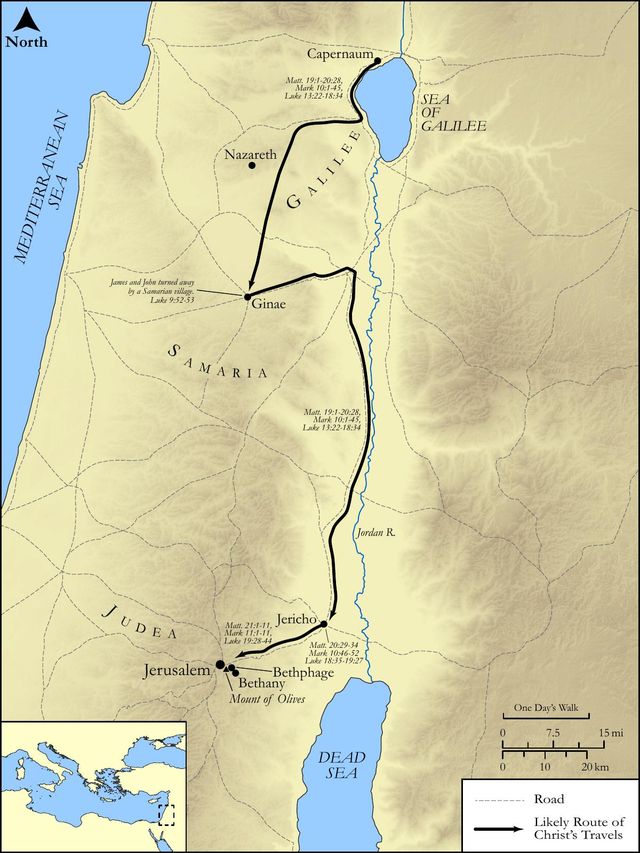
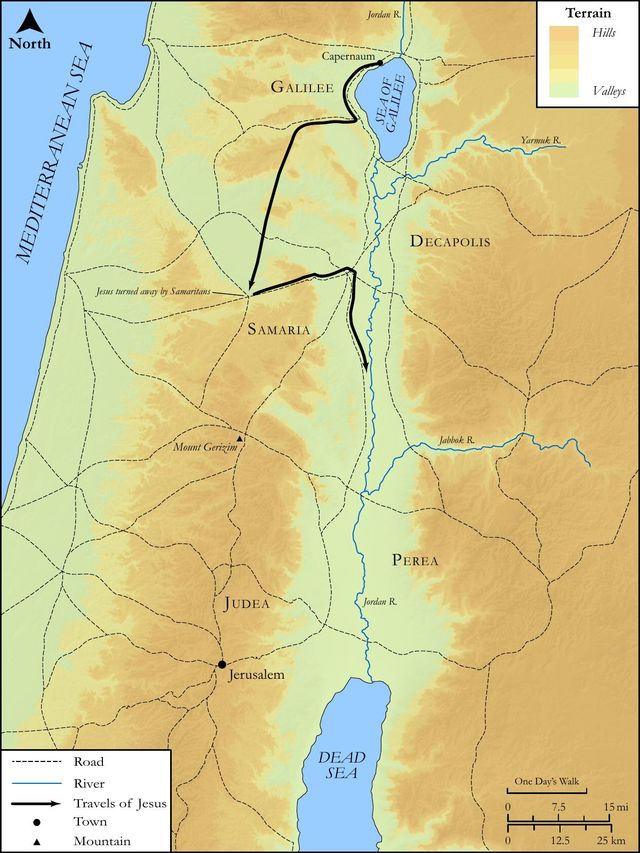
See on the biblical-era maps

Study this verse
Public-domain commentary
Matthew Henry
From his Commentary on the Whole Bible. Henry comments on passages, not single verses — this entry covers Luke 9:43–50. His three-level outline is real structure in the source text, so it is rendered as structure.
We may observe here, I. The impression which Christ's miracles made upon all that beheld them (Luk 9:43): They were all amazed at the mighty power of God, which they could not but see in all the miracles Christ wrought. Note, The works of God's almighty power are amazing, especially those that are wrought by the hand of the Lord Jesus; for he is the power of God, and his name is Wonderful. Their wonder was universal: they wondered every one. The causes of it were universal: they wondered at all things which Jesus did; all his actions had something uncommon and surprising in them.
II.The notice Christ gave to his disciples of his approaching sufferings:
The Son of man shall be delivered into the hands of men, wicked men, men of the worst character; they shall be permitted to abuse him at their pleasure. That is here implied which is expressed by the other evangelists: They shall kill him. But that which is peculiar here is,
1.The connection of this with what goes next before, of the admiration with which the people were struck at beholding Christ's miracles (Luk 9:43): While they all wondered at all things which Jesus did, he said this to his disciples. They had a fond conceit of his temporal kingdom, and that he should reign, and they with him, in secular pomp and power; and now they thought that this mighty power of his would easily effect the thing, and his interest gained by his miracles in the people would contribute to it; and therefore Christ, who knew what was in their hearts, takes this occasion to tell them again, what he had told them before, that he was so far from having men delivered into his hands that he must be delivered into the hands of men, so far from living in honour that he must die in disgrace; and all his miracles, and the interest he has by them gained in the hearts of the people, will not be able to prevent it.
2.The solemn preface with which it is introduced: "Let these sayings sink down into your ears; take special notice of what I say, and mix faith with it; let not the notions you have of the temporal kingdom of the Messiah stop your ears against it, nor make you unwilling to believe it. Admit what I say, and submit to it." Let it sink down into your hearts; so the Syriac and Arabic read it. The word of Christ does us no good, unless we let it sink down into our heads and hearts.
3.The unaccountable stupidity of the disciples, with reference to this prediction of Christ's sufferings. It was said in Mark, They understood not that saying. It was plain enough, but they would not understand it in the literal sense, because it agreed not with their notions; and they could not understand it in any other, and were afraid to ask him lest they should be undeceived and awaked out of their pleasing dream. But it is here added that it was hidden from them, that they perceived it not, through the weakness of faith and the power of prejudice. We cannot think that it was in mercy hidden from them, lest they should be swallowed up with overmuch sorrow at the prospect of it; but that it was a paradox, because they made it so to themselves.
III.The rebuke Christ gave to his disciples for their disputing among themselves which should be greatest, Luk 9:46-48.
This passage we had before, and, the more is the pity, we shall meet with the like again. Observe here,
1.Ambition of honour, and strife for superiority and precedency, are sins that most easily beset the disciples of our Lord Jesus, for which they deserve to be severely rebuked; they flow from corruptions which they are highly concerned to subdue and mortify, Luk 9:46. They that expect to be great in this world commonly aim high, and nothing will serve them short of being greatest; this exposes them to a great deal of temptation and trouble, which they are safe from that are content to be little, to be least, to be less than the least.
2.Jesus Christ is perfectly acquainted with the thoughts and intents of our hearts: He perceived their thoughts, Luk 9:47. Thoughts are words to him, and whispers are loud cries. It is a good reason why we should keep up a strict government of our thoughts because Christ takes a strict cognizance of them.
3.Christ will have his disciples to aim at that honour which is to be obtained by a quiet and condescending humility, and not at that which is to be obtained by a restless and aspiring ambition. Christ took a child, and set him by him, Luk 9:47 (for he always expressed a tenderness and kindness for little children), and he proposed this child to them for an example.
(1.)Let them be of the temper of this child, humble and quiet, and easy to itself; let them not affect worldly pomp, or grandeur, or high titles, but be as dead to them as this child; let them bear no more malice to their rivals and competitors than this child did. Let them be willing to be the least, if that would contribute any thing to their usefulness, to stoop to the meanest office whereby they might do good.
(2.)Let them assure themselves that this was the way to preferment; for this would recommend them to the esteem of their brethren: they that loved Christ would therefore receive them in his name, because they did most resemble him, and they would likewise recommend themselves to his favour, for Christ would take the kindnesses done to them as done to himself: Whosoever shall receive one such child, a preacher of the gospel that is of such a disposition as this, he placeth his respect aright, and receiveth me; and whosoever receiveth me, in such a minister, receiveth him that sent me; and what greater honour can any man attain to in this world than to be received by men as a messenger of God and Christ, and to have God and Christ own themselves received and welcomed in him? This honour have all the humble disciples of Jesus Christ, and thus they shall be truly great that are least among them.
IV.The rebuke Christ gave to his disciples for discouraging one that honoured him and served him, but was not of their communion, not only not one of the twelve, nor one of the seventy, but not one of those that ever associated with them, or attended on them, but, upon occasional hearing of Christ, believed in him, and made use of his name with faith and prayer in a serious manner, for the casting out of devils. Now,
1.This man they rebuked and restrained; they would not let him pray and preach, though it was to the honour of Christ, though it did good to men and weakened Satan's kingdom, because he did not follow Christ with them; he separated from their church, was not ordained as they were, paid them no respect, nor gave them the right hand of fellowship. Now, if ever any society of Christians in this world had reason to silence those that were not of their communion, the twelve disciples at this time had; and yet,
2.Jesus Christ chid them for what they did, and warned them not to do the like again, nor any that profess to be successors of the apostles: "Forbid him not (Luk 9:50), but rather encourage him, for he is carrying on the same design that you are, though, for reasons best known to himself, he does not follow with you; and he will meet you in the same end, though he does not accompany you in the same way. You do well to do as you do, but it does not therefore follow that he does ill to do as he does, and that you do well to put him under an interdict, for he that is not against us is for us, and therefore ought to be countenanced by us." We need not lose any of our friends, while we have so few, and so many enemies. Those may be found faithful followers of Christ, and, as such, may be accepted of him, though they do not follow with us. See Mar 9:38, Mar 9:39. O what a great deal of mischief to the church, even from those that boast of relation to Christ, and pretend to envy for his sake, would be prevented, if this passage of story were but duly considered!
Historical interpretation
Seven Centuries of Reception
9 surviving comments on this verse. Each one is dated, so this reads as a timeline rather than a list.
Select a marker to jump to its quote. Markers stagger vertically where authors wrote within a few decades of each other.
For he who receives the followers of Christ, receives Christ; and he who receives the image of God, receives God; but because we cannot see the image of God, it has been made present to us by the incarnation of the Word, that the divine nature which is above us, may be reconciled to us.
For John loving much, and therefore much beloved, thinks that they should be excluded from the privilege who did not practise obedience.
Now John is not blamed, because he did this from love, but he is taught to know the difference between the strong and the weak. And therefore our Lord though He rewards the stronger, yet does not exclude the weak; as it follows, And Jesus said unto him, Forbid him not, for he that is not against you is for you. True, O Lord. For both Joseph and Nicodemus, through fear Thy secret disciples, when the time came, did not refuse their offices. But still since Thou saidst elsewhere, He that is not with me is against me, and he that gathereth not with me scattereth, (Luke 11:23.) explain unto us lest the two seem contrary to one another. And it seems to me, if any one considers the Searcher of hearts, he cannot doubt that every man's action is distinguished by the motive of his heart.
Now why does He in this place say that they are not to be hindered, who by the imposition of hands can subdue the unclean spirits, when according to Matthew, He says to these, I never knew you? (Matt. 7:23.) But we ought to perceive that there is no difference of opinion, but that the decision is this, that not only the official works but works of virtue are required in a priest, and that the name of Christ is so great, that even to the unholy it serves to give defence, but not grace. Let no one then claim to himself the grace of cleansing a man, because in him the power of the eternal Name has worked. For not by thy merits, but by his own hatred, the devil is conquered.
(Hom. 41. in Matt.) For in the other place when He said, He that is not with me is against me, He shows the Devil and the Jews to be opposed to Him; but here He shows that he who in Christ's name cast out devils, is partly on their side.
What kind of type and representation did he make the child he had taken? He made the child a representation of an innocent and humble life. The mind of a child is empty of fraud, and his heart is sincere. His thoughts are simple. He does not covet rank and does not know what is meant by one man being higher than another is.…Christ brought forward the child as a pattern of simplicity and innocence, and set him by him. He showed him as in an object lesson, that he accepts and loves those who are like the child. He thinks they are worthy of standing at his side, as being like-minded with him and anxious to walk in his steps.
(non occ.) The devil lays plots of various kinds for them that love the best way of life. And if indeed by carnal allurements he can gain possession of a man's heart, He sharpens his love of pleasure; but if a man has escaped these snares, he excites in him a desire of glory, and this passion for vain-glory had seized some one of His apostles. Hence it is said, Then there arose a reasoning among them, which of them should be the greatest. For to have such thoughts, belongs to him who desires to be superior to the rest; but I think it improbable that all the disciples gave way to this weakness; and therefore suppose that the Evangelist, not to seem to lay the charge to any individual, expresses himself indefinitely, saying, that there arose a reasoning among them.
But our Lord, Who knew how to save, seeing in the hearts of the disciples the thought that had risen up thereupon as it were a certain root of bitterness, plucks it up by the roots before it received growth. For when passions first begin in us, they are easily subdued; but having gained strength, they are with difficulty eradicated. Hence it follows, And Jesus perceiving the thought of their heart, &c. Let him who thinks Jesus to be mere man, know that he has erred; for the Word, although made flesh, remained God. For it is God alone Who is able to search into the heart and reins. But in taking a child, and placing it beside Him, He did it for the Apostles' sake and ours. For the disease of vain-glory feeds generally on those who have the preeminence among other men. But a child has a pure mind and unspotted heart, and abides in simplicity of thought; he courts not honours, nor knows the limits of each one's power, nor shuns seeming to be inferior to others, bearing no moroseness in his mind or heart. Such the Lord embraces and loves, and thinks them worthy to be near Him, as those who had chosen to taste of the things which are His; for He says, Learn of me, for I am meek and lowly of heart. Hence it follows, And he says unto them, Whosoever shall receive a child in my name, receiveth me. As if He were to say, Seeing that there is one and the same reward to those that honour the saints, whether perchance such an one be the least, or one distinguished for honours and glory, for in him is Christ received, how vain is it to seek to have the preeminence?
Now He still more plainly conveys the meaning of the preceding words, saying, For he that is least among you all, the same shall be great; in which He speaks of the modest man who from honesty thinks nothing high of himself.
The passion and lust of pride attacked some of the holy apostles. The mere argument about who of them was the greatest is the mark of an ambitious person, eager to stand at the head of the rest. Christ, who did not sleep, knows how to deliver. He saw this thought in the disciple's mind, springing up, in the words of Scripture, like some bitter plant. He saw the weeds, the work of the wicked sower. Before it grew up tall, struck its root down deep, grew strong, and took possession of the heart, he tears up the evil by the very root.…In what way does the Physician of souls amputate pride's passion? How does he deliver the beloved disciple from being the prey of the enemy and from a thing hateful to God and man? "He took a child," it says, "and set it by him." He made the event a means of benefiting both the holy apostles themselves and us their successors. This illness, as a rule, preys upon all those who are in any respect superior to other people.
Christ calls him least whom lowly things please and who from modesty does not think highly of himself. This person pleases Christ. It is written that "every one that exalts himself shall be humbled, and he that humbles himself shall be exalted." Christ himself somewhere says, "Blessed are the poor in spirit, for theirs is the kingdom of heaven." The ornament of a sanctified soul is a poor and humble mind.… Let the illness of pride be far from those who love Christ. Let us rather consider our companions as better than we are and be anxious to decorate ourselves with the humility of mind that is well pleasing to God. Being simpleminded, as fits saints, we will be with Christ who honors simplicity.
But a thought entered among them about who was the greatest among them. Because they had seen Peter, James, and John being taken up the mountain separately, and believed some mystery was revealed to them there; and also because the keys of the kingdom of heaven had been promised to Peter earlier, and that the Church was to be built upon him, they thought either these three were preferred over the others, or among all the apostles, Peter was preeminent. There are those who think this thought was stirred in the disciples by the fact that the Lord, according to Matthew, took a coin from the mouth of a fish and gave it to those who collected the tribute for himself and Peter, as if implying that they were superior to the others, since Peter was equated with the Lord in the obligation to pay the tribute. However, a diligent reader will find this question among them happened even before the tribute coin was collected. Matthew records this event in Capernaum. But Mark says: "And they came to Capernaum. When they were in the house, he asked them, 'What were you discussing on the way?' But they were silent. For on the way they had argued with one another about who was the greatest" (Mark IX). Whether this was the occasion or some other, or both, possibly prompted, Jesus, seeing their thoughts and understanding the causes of their error, wants to heal their desire for glory with the remedy of humility.
Or, because they saw Peter, James, and John, taken apart to the mount, and the keys of the kingdom of heaven promised to Peter, they were angry that these three, or Peter, should have precedence over all; or because in the payment of the tribute they saw Peter made equal to the Lord, they supposed he was to be placed before the rest. But the attentive reader will find that the question was raised among them before the payment of the penny. For in truth Matthew relates that this took place at Capernaum; but Mark says, And he came to Capernaum, and being in the house, he asked them, What was it that ye disputed among yourselves in the way? But they held their peace; for by the way they had disputed among themselves who should be the greatest. (Mat. 18:24, Mark 9:33.)
Now herein He either teaches, that the poor of Christ are to be received by those who wish to be greater simply for His honour, or He persuades men that they are children in malice. Hence when He said, Whoever shall receive that child, he adds, in my name; that in truth they may pursue with diligence and reason for Christ's name that form of virtue which the child observes, with only nature for its guide. But because He also teaches that He is received in the child, and He Himself was born unto us a child; lest it should be thought that this was all which was seen, He subjoined, And whoever shall receive me, receiveth him that sent me; wishing verily to be believed, that as was the Father, such and so great was He.
Therefore in heretics and false catholics, it becomes us to abhor, and forbid not the common sacraments in which they are with us, and not against us, but the divisions contrary to peace and truth, wherein they are against us as following not the Lord.
Mark also the reverence of the disciples in what follows, And they feared to ask him of that saying. For fear is the first step to reverence.
Now it seems that this feeling was excited by the circumstance of their not being able to cure the demoniac. And while they were disputing thereupon, one said, It was not owing to my weakness, but another's, that he could not be cured; and so thereby was kindled a strife among them, which was the greatest.
Because then our Lord had said, He who is least among you all, the same shall be great, John feared, lest perhaps they had done wrong in hindering a certain man by their own power. For a prohibition does not show the probitor to be inferior, but to be one who thinks himself somewhat superior. Hence it is added, And John answered and said, Master, we saw one casting out devils in thy name, and we forbad him. Not indeed from envy, but to distinguish the working of miracles, for he had not received the power of working miracles with them, nor had the Lord sent him as He did them; nor did he follow Jesus in all things. Hence he adds, because he followeth not with us.
Marvel then at the power of Christ, how His grace works by means of the unworthy and those who are not His disciples: as also men are sanctified through the priests, although the priests be not holy.
Continue studying Luke 9:46 across the web’s major study libraries — every link below opens this exact verse, chapter, or book on the destination site.
Read & Compare
 BibleGatewayThis verse in more than 200 translations and 70 languages.
 Bible.comThe YouVersion reader — hundreds of translations, reading plans, and highlights.
 ESV.orgCrossway's official English Standard Version reader.
 NET BibleThe NET translation with 60,000+ translators' notes on every rendering decision.
 STEP BibleTyndale House's free study tool — original text, vocabulary, and scholarly resources.
 BibliaLogos Bible Software's free web reader.
 USCCBThe New American Bible (Revised Edition) with the U.S. bishops' study notes.
Commentaries
 BibleHub CommentariesDozens of classic commentaries on this verse, gathered on one page.
 StudyLightMore than 100 commentary sets — the largest collection on the web.
 BibleRefPlain-English commentary on what this verse means, verse by verse.
 Enduring WordDavid Guzik's free commentary on this chapter, widely used by Bible teachers.
 Bible Study ToolsVerse commentary alongside Greek and Hebrew study aids.
Original Language & Research
- BibleHub InterlinearThe verse word by word — original language, transliteration, and English.
- BibleHub LexiconEvery word's original-language definition and Strong's entry.
 Blue Letter BibleDeep-study tools — Strong's numbers, concordance, and word studies.
 CNTR CollationThe earliest Greek manuscripts of this verse, collated letter by letter.
Sermons, Hymns & Audio


TrulyRandomVerse is not affiliated with these sites and doesn’t control their content. They’re linked because they’re genuinely useful.
Summary
Luke 9:46 captures a poignant moment among Jesus' disciples, revealing their persistent struggle with pride and worldly ambition despite being in the immediate presence of the Messiah. Following Jesus' second prophecy of His suffering and death, the disciples, instead of grappling with the profound implications of His sacrifice, engaged in a dispute about their own status, debating "which of them should be greatest," thereby exposing a fundamental misunderstanding of the true nature of God's kingdom and the path to genuine spiritual greatness.
Context
ShowHideLiterary Context
This verse is strategically placed immediately after Jesus' second explicit prediction of His suffering, death, and resurrection in Luke 9:44. Luke notes that the disciples "did not understand this saying; its meaning was concealed from them, so that they could not perceive it" (Luke 9:45). The stark juxtaposition of Jesus' profound revelation of self-sacrificial love and the disciples' subsequent argument about personal status highlights their spiritual immaturity and their inability to grasp the upside-down values of the Kingdom of God. This dispute then directly prompts Jesus' teaching on humility, where He uses a child as an object lesson to redefine greatness in Luke 9:47-48.
Historical & Cultural Context
Among the Greeks and Romans, and within Jewish society of Jesus' time, honor, status, and social hierarchy were paramount. People constantly vied for positions of prominence, whether in the synagogue, at feasts, or within social circles. Disciples of a rabbi often expected to share in their master's prestige, and if Jesus were indeed the Messiah, they anticipated positions of power in His earthly kingdom. Their "reasoning" reflects these deeply ingrained cultural norms and their expectation of a political, conquering Messiah who would establish an earthly throne, rather than a suffering servant. This cultural backdrop makes their ambition understandable, yet it also underscores the radical nature of Jesus' counter-cultural teachings on humility and service.
Key Themes
ShowHideThis verse powerfully contributes to several overarching themes in Luke's Gospel and the broader New Testament. Firstly, it highlights the tension between worldly ambition and spiritual values, a recurring challenge for believers. The disciples' focus on "greatness" as defined by human standards stands in stark contrast to Jesus' consistent emphasis on humility, servanthood, and self-denial. Secondly, it underscores the disciples' profound misunderstanding of Jesus' kingdom. They, like many of their contemporaries, envisioned a political kingdom, failing to grasp its spiritual, counter-cultural, and ultimately sacrificial nature, as Jesus later explains in Luke 17:20-21. Finally, this incident sets the stage for Jesus' crucial teaching on the nature of true greatness, which He immediately addresses by presenting a child as the paradigm of humility, redefining greatness not by power or position, but by humble service and welcoming the vulnerable, a theme echoed throughout His ministry and epitomized by His own life.
Exposition and Analysis
ShowHideKey Word Analysis
ShowHideMeaning "to enter (literally or figuratively)." While often translated as "come in" or "enter," in this context, when paired with "reasoning," it conveys the idea of a thought or dispute "entering" or "arising" among them. It suggests the inception or emergence of this contentious discussion.
Meaning "discussion, i.e. (internal) consideration (by implication, purpose), or (external) debate." This word implies more than a casual thought; it suggests an active deliberation, an internal argument, or even an external dispute among the disciples. It points to a contentious and perhaps prolonged discussion about status.
An irregular comparative of megas, meaning "larger (literally or figuratively, specially, in age)." Here, it signifies superiority in rank, importance, or status. The disciples were not debating who was physically largest, but who held the highest position of authority or honor within their nascent community.
Verse Breakdown
ShowHide"Then there arose a reasoning among them"
This phrase indicates the sudden emergence of a contentious discussion or debate. The "reasoning" (dialogismós) was not a quiet contemplation but an active, perhaps heated, exchange of opinions. It highlights the internal strife and self-centeredness that surfaced within the group of Jesus' closest followers, immediately after a profound revelation from their Lord.
"which of them should be greatest"
This clause reveals the specific content and motivation behind their "reasoning." The disciples were preoccupied with their own hierarchical standing, seeking to establish who among them held the highest rank or most significant position. This aspiration for preeminence stands in stark contrast to the humble, self-sacrificial path Jesus had just described for Himself, underscoring their failure to grasp the true nature of His kingdom and their own roles within it.
Literary Devices
ShowHideThe verse employs Dramatic Irony, as the audience is aware of Jesus' impending suffering and the true nature of His kingdom, while the disciples remain oblivious, focused on worldly status. This creates a poignant contrast between the divine reality and human shortsightedness. There is also significant Juxtaposition, placing the disciples' self-serving ambition directly after Jesus' profound prophecy of His sacrificial death, highlighting the vast chasm between their understanding and His divine purpose. Furthermore, the verse serves as Foreshadowing, setting the stage for Jesus' subsequent teaching on true greatness through humility and service, which becomes a foundational principle of the Kingdom of God.
Theological and Thematic Connections
ShowHideLuke 9:46 serves as a timeless theological mirror, reflecting the persistent human struggle with pride and the desire for preeminence, even among those committed to spiritual pursuits. It underscores the radical nature of God's kingdom, where conventional notions of greatness are inverted, and true authority is found in humble service rather than worldly power. The disciples' ambition reveals a fundamental misunderstanding of the Messiah's mission and the values He embodies, highlighting that spiritual maturity is not automatic but requires a continuous transformation of the heart away from self-exaltation and towards Christ-like self-denial. This incident reminds us that the pursuit of status can blind us to the profound truths of God's redemptive plan and distract us from the call to sacrificial love.
Reflection and Application
ShowHideLuke 9:46 offers a profound challenge for every believer and every church community. It forces us to confront our own motives: are we serving God and others out of a genuine desire to glorify Him and build His kingdom, or are we subtly seeking personal recognition, influence, or a higher position? The disciples' dispute reminds us that even those closest to Jesus can fall prey to the insidious sin of pride, demonstrating that spiritual proximity does not automatically equate to spiritual humility. True greatness, as Jesus teaches, is not about being served but about serving, not about accumulating power but about emptying oneself for the sake of others. This verse calls us to a radical self-examination, urging us to crucify our ambition for worldly acclaim and embrace the humble path of Christ, finding our true identity and significance in Him alone.
Questions for Reflection
ShowHideFAQ
ShowHideWhy were the disciples so focused on who would be "greatest" when Jesus had just spoken of His suffering?
ShowHideThe disciples were deeply influenced by the cultural expectations of their time, which valued status, honor, and hierarchical position. They likely envisioned Jesus establishing an earthly kingdom where they, as His closest followers, would hold prominent roles. Their focus on "greatness" stemmed from a fundamental misunderstanding of the nature of Jesus' kingdom—which is spiritual and heavenly, not earthly and political—and His mission, which involved suffering and sacrifice, not immediate worldly conquest. Their human ambition temporarily overshadowed their spiritual comprehension, a common struggle for even devoted followers.
Did Jesus explicitly answer who was the "greatest" among them?
ShowHideNo, Jesus did not identify one of them as "greatest" in the way they expected. Instead, He radically redefined what "greatness" means in the Kingdom of God. Immediately following this verse, in Luke 9:47-48, Jesus takes a child and places him beside Himself, stating, "Whoever receives this little child in My name receives Me, and whoever receives Me receives Him who sent Me. For he who is least among you all will be great." He completely inverted their worldly understanding, teaching that true greatness is found in humility, servanthood, and welcoming the vulnerable, rather than in power or position.
How does this passage apply to leadership and ambition within the church today?
ShowHideThis passage serves as a perpetual warning against pride and worldly ambition in all forms of Christian leadership and service. It reminds us that the church is not a corporation or a political entity, but a spiritual body called to embody Christ's humility. Leaders and members alike are called to be servants, prioritizing the needs of others and the glory of God above personal gain or recognition. The pursuit of power or status within the church contradicts the very essence of Christ's teaching and can lead to division and spiritual barrenness. True influence and effectiveness in God's kingdom come through humble, self-sacrificial service, mirroring the example of the Lord Jesus Himself.
Christ-Centered Fulfillment
ShowHideThe disciples' argument over who "should be greatest" in Luke 9:46 stands in stark contrast to the very essence of Christ's nature and mission, revealing His ultimate fulfillment of true greatness. While the disciples were consumed with self-exaltation, Jesus was already on the path to the cross, embodying the ultimate act of self-abasement. He, who was God in the flesh, did not cling to His divine prerogatives but "emptied Himself, by taking the form of a servant, being born in the likeness of men" (Philippians 2:7). Jesus' entire life was a living commentary on true greatness: He came "not to be served but to serve, and to give His life as a ransom for many" (Mark 10:45). His act of washing the disciples' feet in John 13:1-17 perfectly illustrates that the King of the Universe defines greatness through humble service, becoming the "least" to exalt others. Thus, Jesus Himself is the perfect embodiment and fulfillment of the "greatest" in God's kingdom, not through asserting power, but through radical, self-giving love that culminates in His sacrificial death and resurrection.