


Mark 9:33
- ΚαὶKaiAndG2532CONJConjunction
- ἦλθονēlthonthey cameG2064V-2AAI-3PVerb 2nd Aorist Active Indicative 3rd Plural
- εἰςeistoG1519PREPPreposition
- Καφαρναούμ·KapharnaoumCapernaumG2584N-ASF-LNoun Accusative Singular Feminine Location
- καὶkaiAndG2532CONJConjunction
- ἐνeninG1722PREPPreposition
- τῇtēatheG3588T-DSFDefinite article Dative Singular Feminine
- οἰκίᾳoikiahouseG3614N-DSFNoun Dative Singular Feminine
- γενόμενοςgenomenoshaving beenG1096V-2ADP-NSMVerb 2nd Aorist Middle Deponent Participle Nominative Singular Masculine
- ἐπηρώταepērōtaHe was askingG1905V-IAI-3SVerb Imperfect Active Indicative 3rd Singular
- αὐτούς·autousthemG846P-APMPersonal pronoun Accusative Plural Masculine
- τίtiWhatG5101I-ASNInterrogative pronoun Accusative Singular Neuter
- ἐνenonG1722PREPPreposition
- τῇtēatheG3588T-DSFDefinite article Dative Singular Feminine
- ὁδῷhodōwayG3598N-DSFNoun Dative Singular Feminine
- πρὸςprostoG4314PREPPreposition
- ἑαυτοὺςhe'autousyourselvesG1438F-2APMReflexive pronoun Accusative 2nd Plural Masculine
- διελογίζεσθε;dielogizesthewere you discussing?G1260V-INI-2PVerb Imperfect Middle Or Passive Deponent Indicative 2nd Plural
English is a literal word-by-word gloss of the Greek, not the KJV's wording. Why?
This is the original text the KJV's translators worked from — each Greek word with its own literal English meaning in this verse, prepared by scholars at Tyndale House, Cambridge. The KJV translates whole sentences, not word by word, so its wording differs: one Greek word can become several English words, and the KJV may choose “charity” where the gloss reads “love”. Both are faithful — they answer different questions. For the KJV's own rendering, switch to the KJV text.
Details
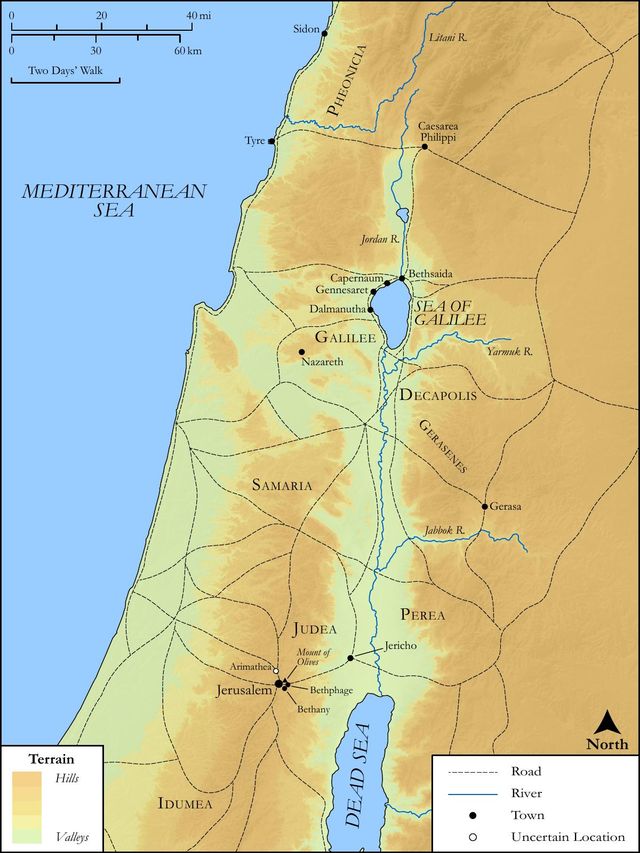
See on the biblical-era map
Study this verse
Public-domain commentary
Matthew Henry
From his Commentary on the Whole Bible. Henry comments on passages, not single verses — this entry covers Mark 9:30–40. His three-level outline is real structure in the source text, so it is rendered as structure.
Here, I. Christ foretels his own approaching sufferings. He passed through Galilee with more expedition than usual, and would not that any man should know of it (Mar 9:30); because he had done many mighty and good works among them in vain, they shall not be invited to see them and have the benefit of them, as they have been. The time of his sufferings drew nigh, and therefore he was willing to be private awhile, and to converse only with his disciples, to prepare them for the approaching trial, Mar 9:31. He said to them, The Son of man is delivered by the determinate council and fore-knowledge of God into the hands of men (Mar 9:31), and they shall kill him. He had been delivered into the hands of devils, and they had worried him, it had not been so strange; but that men, who have reason, and should have love, that they should be thus spiteful to the Son of man, who came to redeem and save them, is unaccountable. But still it is observable that when Christ spoke of his death, he alway spoke of his resurrection, which took away the reproach of it from himself, and should have taken away the grief of it from his disciples. But they understood not that saying, Mar 9:32. The words were plain enough, but they could not be reconciled to the thing, and therefore would suppose them to have some mystical meaning which they did not understand, and they were afraid to ask him; not because he was difficult of access, or stern to those who consulted him, but either because they were loth to know the truth, or because they expected to be chidden for their backwardness to receive it. Many remain ignorant because they are ashamed to enquire.
II.He rebukes his disciples for magnifying themselves.
When he came to Capernaum, he privately asked his disciples what it was they disputed among themselves by the way, Mar 9:33. He knew very well what the dispute was, but he would know it from them, and would have them to confess their fault and folly in it. Note,
1.We must all expect to be called to an account by our Lord Jesus, concerning what passes while we are in the way in this state of passage and probation.
2.We must in a particular manner be called to an account about our discourses among ourselves; for by our words we must be justified or condemned.
3.As our other discourses among ourselves by the way, so especially our disputes, will be all called over again, and we shall be called to an account about them.
4.Of all disputes, Christ will be sure to reckon with his disciples for their disputes about precedency and superiority: that was the subject of the debate here, who should be the greater, Mar 9:34. Nothing could be more contrary to the two great laws of Christ's kingdom, lessons of his school, and instructions of his example, which are humility and love, than desiring preferment in the world, and disputing about it. This ill temper he took all occasions to check, both because it arose from a mistaken notion of his kingdom, as if it were of this world, and because it tended so directly to be debasing of the honour, and the corrupting of the purity, of his gospel, and, he foresaw, would be so much the bane of the church.
Now, (1.) They were willing to cover this fault (Mar 9:34); they held their peace. As they would not ask (Mar 9:32), because they were ashamed to own their ignorance, so here they would not answer because they were ashamed to own their pride. (2.) He was willing to amend this fault in them, and to bring them to a better temper; and therefore sat down, that he might have a solemn and full discourse with them about this matter; he called the twelve to him, and told them, [1.] That ambition and affectation of dignity and dominion, instead of gaining them preferment in his kingdom, would but postpone their preferment; If any man desire and aim to be first, he shall be last; he that exalteth himself, shall be abased, and men's pride shall bring them low. [2.] That there is no preferment to be had under him, but an opportunity for, and an obligation to, so much the more labour and condescension; If any man desire to be first, when he is so, he must be much the more busy and serviceable to every body. He that desires the office of a bishop, desires a good work, for he must, as St. Paul did, labour the more abundantly, and make himself the servant of all. [3.] That those who are most humble and self-denying, do most resemble Christ, and shall be most tenderly owned by him. This he taught them by a sign; He took a child in his arms, that had nothing of pride and ambition in it. "Look you," saith he; "whosoever shall receive one like this child, receives me. Those of a humble, meek, mild disposition are such as I will own and countenance, and encourage every body else to do so too, and will take what is done to them as done to myself; and so will my Father too, for he who thus receiveth me, receiveth him that sent me, and it shall be placed to his account, and repaid with interest."
III.He rebukes them for vilifying all but themselves; while they are striving which of them should be greatest, they will not allow those who are not in communion with them to be any thing. Observe,
1.The account which John gave him, of the restraint they had laid upon one from making use of the name of Christ, because he was not of their society. Though they were ashamed to own their contests for preferment, they seem to boast of this exercise of their authority, and expected their Master would not only justify them in it, but commend them for it; and hoped he would not blame them for desiring to be great, when they would thus use their power for maintaining the honour of the sacred college. Master, saith John, we saw one casting out devils in thy name, but he followeth not us, Mar 9:38.
(1.)It was strange that the one who was not a professed disciple and follower of Christ, should yet have power to cast out devils, in his name, for that seemed to be peculiar to those whom he called, Mar 6:7. But some think that he was a disciple of John, who made use of the name of the Messiah, not as come, but as near at hand, not knowing that Jesus was he. It should rather seem that he made use of the name of Jesus, believing him to be the Christ, as the other disciples did. And why not he receive that power from Christ, whose Spirit, like the wind, blows where it listeth, without such an outward call as the apostles had? And perhaps there were many more such. Christ's grace is not tied to the visible church.
(2.)It was strange that one who cast out devils in the name of Christ, did not join himself to the apostles, and follow Christ with them, but should continue to act in separation from them. I know of nothing that could hinder him from following them, unless because he was loth to leave all to follow them; and if so, that was an ill principle. The thing did not look well, and therefore the disciples forbade him to make use of Christ's name as they did, unless he would follow him as they did. This was like the motion Joshua made concerning Eldad and Medad, that prophesied in the camp, and went not up with the rest to the door of the tabernacle; "My lord Moses, forbid them (Num 11:28); restrain them, silence them, for it is a schism." Thus apt are we to imagine that those do not follow Christ at all, who do not follow him with us, and that those do nothing well, who do not just as we do. But the Lord knows them that are his, however they are dispersed; and this instance gives us a needful caution, to take heed lest we be carried, by an excess of zeal for the unity of the church, and for that which we are sure is right and good, to oppose that which yet may tend to the enlargement of the church, and the advancement of its true interests another way.
2.The rebuke he gave to them for this (Mar 9:39); Jesus said, "Forbid him not, nor any other that does likewise." This was like the check Moses gave to Joshua; Enviest thou for my sake? Note, That which is good, and doeth good, must not be prohibited, though there be some defect or irregularity in the manner of doing it. Casting out devils, and so destroying Satan's kingdom, doing this in Christ's name, and so owning him to be sent of God, and giving honour to him as the Fountain of grace, preaching down sin, and preaching up Christ, are good things, very good things, which ought not to be forbidden to any, merely because they follow not with us. If Christ be preached, Paul therein doth, and will rejoice, though he be eclipsed by it, Phi 1:18. Two reasons Christ gives why such should not be forbidden.
(1.)Because we cannot suppose that any man who makes use of Christ's name in working miracles, should blaspheme his name, as the scribes and Pharisees did. There were those indeed that did in Christ's name cast out devils, and yet in other respects were workers of iniquity; but they did not speak evil of Christ.
(2.)Because those that differed in communion, while they agreed to fight against Satan under the banner of Christ, ought to look upon one another as on the same side, notwithstanding that difference. He that is not against us is on our part. As to the great controversy between Christ an Beelzebub, he had said, He that is not with me is against me, Mat 12:30. He that will not own Christ, owns Satan. But as to those that own Christ, though not in the same circumstances, that follow him, though not with us, we must reckon that though these differ from us, they are not against us, and therefore are on our part, and we must not be any hindrance to their usefulness.
Historical interpretation
Seven Centuries of Reception
6 surviving comments on this verse. Each one is dated, so this reads as a timeline rather than a list.
Select a marker to jump to its quote. Markers stagger vertically where authors wrote within a few decades of each other.
Or else, the folly which is connected with the softness of the flesh, is healed by fasting; anger and laziness are healed by prayer. Each wound has its own medicine, which must be applied to it; that which is used for the heel will not cure the eye; by fasting, the passions of the body, by prayer, the plagues of the soul, are healed.
Capernaum means the city of consolation, and agrees with the former sentence, which He had spoken: And after that he is killed, he shall arise the third day. There follows: And being in the house he asked them, What was it that ye disputed among yourselves by the way? But they held their peace.
It was fit also that they should dispute concerning the chief place by the way; the dispute is like the place where it is held; for lofty station is only entered upon to be quitted: as long as a man keeps it, it is slippery, and it is uncertain at what stage, that is, on what day, it will end.
Where it is to be observed, that the disciples disputed by the way concerning the chief place, but Christ Himself sat down to teach humility; for princes toil while the humble repose.
(Vict. Ant. e Cat. in Marc.) Matthew however says, that the disciples came to Jesus, saying, Who is the greatest in the kingdom of heaven? (Matt. 18:1) The reason is, that he did not begin the narrative from its commencement, but omitted our Saviour's knowledge of the thoughts and words of His disciples; unless we understand Him to mean, that even what they thought and said, when away from Christ, was said unto Him, since it was as well known to Him as if it had been said to Him. It goes on: For by the way they had disputed among themselves, who should be the greatest. (Luke 9:46. Vulg.) But Luke says, that "the thought entered into the disciples which of them should be the greatest;" for the Lord laid open their thought and intention from their private discourse1 according to the Gospel narrative.
(Vict. Ant. e Cat. in Marc.) The disciples indeed wished to receive honour at the hands of the Lord; they also had a desire to be made great by Christ, for the greater a man is, the more worthy of honour he becomes, for which reason He did not throw an obstacle in the way of that desire, but brought in humility.
(in Marc. 3, 39) He always mingles together sorrowful and joyful things, that sorrow should not by its suddenness frighten the Apostles, but be borne by them with prepared minds.
(ubi sup.) This ignorance of the disciples proceeds not so much from slowness of intellect, as from love for the Saviour, for they were as yet carnal, and ignorant of the mystery of the cross, they could not therefore believe that He whom they had recognised as the true God, was about to die; being accustomed then to hear Him often talk in figures, and shrinking from the event of His death, they would have it, that something was conveyed figuratively in those things, which he spoke openly concerning His betrayal and passion. It goes on: And they came to Capernaum.
(ubi sup.) The reason why the dispute concerning the chief place arose amongst the disciples seems to have been, that Peter, James, and John, were led apart from the rest into the mountain, and that something secret was there entrusted to them, also that the keys of the kingdom of heaven were promised to Peter, according to Matthew. Seeing however the thoughts of the disciples, the Lord takes care to heal the desire of glory by humility; for He first, by simply commanding humility, admonishes them that a high station was not to be aimed at. Wherefore it goes on: And he sat down, and called the twelve, and saith unto them, If any man desire to be first, the same shall be last of all, and servant of all.
(ubi sup.) By which, He either simply shows, that those who would become greater must receive the poor of Christ in honour of Him, or He would persuade them to be in malice children, to keep simplicity without arrogance, charity without envy, devotedness without anger. Again, by taking the child into His arms, He implies that the lowly are worthy of His embrace and love. He adds also, In my name, that they might, with the fixed purpose of reason, follow for His name's sake that mould of virtue to which the child keeps, with nature for his guide. And because He taught that He Himself was received in children, lest it should be thought that there was nothing in Him but what was seen, he added, And whosoever shall receive me, receiveth not me, but Him that sent me; thus wishing, that we should believe Him to be of the same nature and of equal greatness with His Father.
And they came to Capernaum. When they were in the house, he asked them, "What were you discussing on the way?" But they kept silent. For they had been disputing among themselves on the way about who was the greatest. The disciples’ dispute seems to have arisen about primacy because they had seen Peter, James, and John taken apart onto a mountain, and it was believed that some secret had been entrusted to them there. But also, to Peter, according to what Matthew narrates, the keys of the kingdom of heaven were promised, and the Church of the Lord was to be built upon the rock of faith from which he had taken his name. Therefore, they were questioning whether those three, or Peter alone among all the apostles, was preeminent.
It is after miracles that the Lord inserts a discourse concerning His Passion, lest it should be thought that He suffered because He could not help it; wherefore it is said, And they departed thence, and passed through Galilee: and he would not that any man should know it. For he taught his disciples, and said unto them, The Son of man is delivered into the hands of men, and they shall kill him.
After, however, saying what was sorrowful, He adds what ought to rejoice them; wherefore it goes on: And after that he is killed, he shall rise the third day; in order that we may learn that joys come on after struggles. There follows: But they understood not that saying, and were afraid to ask him.
For His wish is not that we should usurp for ourselves chief places, but that we should attain to lofty heights by lowliness. He next admonishes them by the example of a child's innocence; wherefore there follows: And he took a child, and set him in the midst of them.
See, how great is humility, for it wins for itself the indwelling of the Father, and of the Son, and also of the Holy Ghost.
Continue studying Mark 9:33 across the web’s major study libraries — every link below opens this exact verse, chapter, or book on the destination site.
Read & Compare
 BibleGatewayThis verse in more than 200 translations and 70 languages.
 Bible.comThe YouVersion reader — hundreds of translations, reading plans, and highlights.
 ESV.orgCrossway's official English Standard Version reader.
 NET BibleThe NET translation with 60,000+ translators' notes on every rendering decision.
 STEP BibleTyndale House's free study tool — original text, vocabulary, and scholarly resources.
 BibliaLogos Bible Software's free web reader.
 USCCBThe New American Bible (Revised Edition) with the U.S. bishops' study notes.
Commentaries
 BibleHub CommentariesDozens of classic commentaries on this verse, gathered on one page.
 StudyLightMore than 100 commentary sets — the largest collection on the web.
 BibleRefPlain-English commentary on what this verse means, verse by verse.
 Enduring WordDavid Guzik's free commentary on this chapter, widely used by Bible teachers.
 Bible Study ToolsVerse commentary alongside Greek and Hebrew study aids.
Original Language & Research
- BibleHub InterlinearThe verse word by word — original language, transliteration, and English.
- BibleHub LexiconEvery word's original-language definition and Strong's entry.
 Blue Letter BibleDeep-study tools — Strong's numbers, concordance, and word studies.
 CNTR CollationThe earliest Greek manuscripts of this verse, collated letter by letter.
Sermons, Hymns & Audio


TrulyRandomVerse is not affiliated with these sites and doesn’t control their content. They’re linked because they’re genuinely useful.
Summary
Mark 9:33 opens a crucial moment in Jesus' ministry following His second passion prediction and the disciples' failure to heal a demon-possessed boy. Upon arriving in Capernaum and entering a private residence, Jesus directly confronts His disciples about a dispute they had engaged in during their journey, setting the stage for a profound teaching on the true nature of greatness and leadership within the Kingdom of God, contrasting their worldly ambitions with His call to humble service.
Context
ShowHideLiterary Context
This verse immediately follows a series of significant events that underscore the disciples' spiritual incomprehension despite their proximity to Jesus. Just prior, Jesus had led Peter, James, and John up the Mount of Transfiguration, where His divine glory was revealed, a moment meant to strengthen their faith and prepare them for His suffering. Immediately after descending, they encountered a demon-possessed boy whom the remaining disciples were unable to heal, prompting Jesus to lament their lack of faith and teach on the power of prayer and fasting (Mark 9:14-29). Most critically, Jesus had just delivered His second explicit prediction of His suffering, death, and resurrection (Mark 9:30-32), a truth the disciples not only failed to grasp but were afraid to ask about, indicating a deep-seated spiritual blindness. Their subsequent dispute about greatness on the journey to Capernaum highlights the profound disconnect between Jesus' kingdom agenda and their earthly aspirations.
Historical & Cultural Context
Capernaum served as Jesus' primary base of operations in Galilee, a bustling fishing village on the northwest shore of the Sea of Galilee. It was a strategic location for His ministry, featuring a synagogue where He taught and a customs house. The "house" mentioned in the verse likely refers to Peter's house, which often served as a private retreat for Jesus and His disciples. In the Jewish culture of the time, concepts of honor, status, and hierarchy were deeply ingrained. Disciples often vied for positions of prominence near their rabbi, expecting earthly rewards and power in a messianic kingdom. This cultural expectation directly fueled the disciples' dispute, as they anticipated a political, earthly kingdom where positions of authority would be granted based on perceived merit or loyalty, rather than the radical humility Jesus was about to unveil.
Key Themes
ShowHideMark 9:33 introduces and reinforces several critical themes found throughout the Gospel. The most prominent is the Disciples' Misunderstanding of Jesus' mission and the nature of His kingdom. Despite repeated teachings, their minds remained fixed on worldly power and status, demonstrating a persistent spiritual dullness that Jesus patiently addresses. This verse also highlights Jesus' Divine Omniscience and Gentle Confrontation. His question, "What was it that ye disputed among yourselves by the way?", reveals His full awareness of their private conversation, yet He chooses to invite their confession rather than immediately condemning them. This approach sets the stage for a pivotal teaching moment, emphasizing His pastoral method of leading His followers to truth. Ultimately, this verse serves as a direct Preparation for Teaching on True Greatness, leading into Jesus' radical redefinition of leadership as humble service (Mark 9:35-37). This theme is consistently echoed in other Gospels, such as when Jesus teaches that the first shall be last and that the Son of Man came not to be served but to serve.
Exposition and Analysis
ShowHideKey Word Analysis
ShowHideThis word (G1260) comes from dia (through) and logízomai (to reckon, consider). It means "to reckon thoroughly," "to deliberate," or "to discuss." While it can imply a thoughtful consideration, in this context, coupled with the disciples' shame, it strongly suggests a heated debate or argument. It indicates that their conversation was not a casual chat but an earnest, perhaps even contentious, discussion about their relative importance or rank within the group, reflecting their internal struggle for preeminence.
This verb (G1905) means "to ask for," "to inquire," or "to question." Jesus' use of this term is significant. Rather than stating what He already knew, He asked them. This is not an inquiry born of ignorance, but a pedagogical question designed to draw out their confession and prepare them for a transformative lesson. It demonstrates His patient and gentle approach, inviting self-reflection and ownership of their actions, rather than immediate condemnation.
This reflexive pronoun (G1438) emphasizes that the dispute was internal to the group of disciples, "among themselves." It highlights the self-centered nature of their argument, focusing on their own positions and aspirations rather than on Jesus' teachings or the needs of others. The inclusion of this word underscores the private, self-referential nature of their ambition, which Jesus then brings into the light for correction.
Verse Breakdown
ShowHide"And he came to Capernaum:"
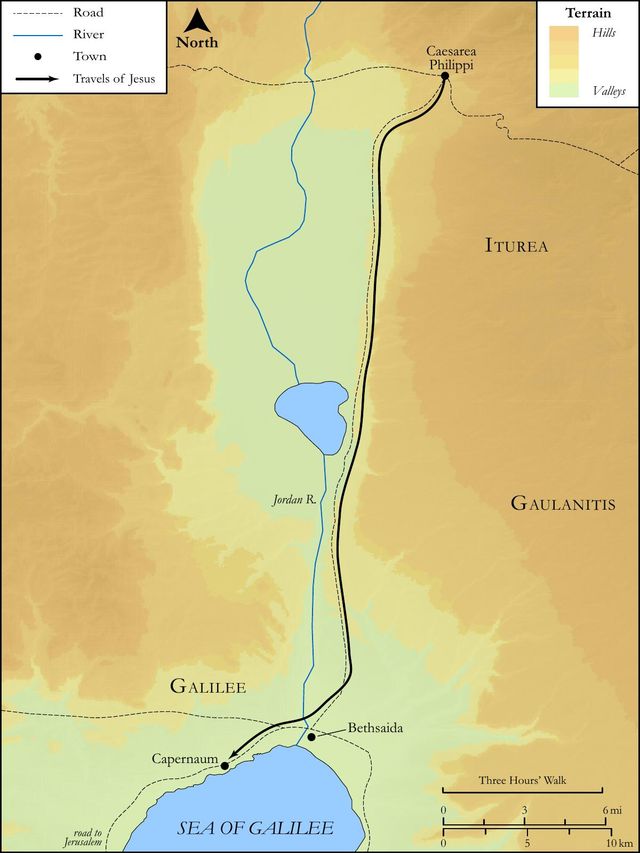
This clause marks a geographical and contextual shift. Capernaum was Jesus' Galilean home base, a place of familiarity and often, privacy. The transition from the journey (where the dispute occurred) to the house in Capernaum sets the scene for a private, intimate confrontation, away from the crowds, allowing for a focused teaching moment with His inner circle.
"and being in the house he asked them,"
The setting "in the house" signifies a move from public ministry to private instruction. This was a common pattern for Jesus, where He would often withdraw with His disciples to explain parables or address their specific questions. His act of "asking" them, despite His omniscience, is a deliberate pedagogical choice. It creates an opportunity for the disciples to acknowledge their actions and for Jesus to address the underlying spiritual issue directly, rather than merely stating His knowledge.
"What was it that ye disputed among yourselves by the way?"
This direct question from Jesus is piercing and revealing. The phrase "by the way" refers to their journey from the region of Caesarea Philippi back to Capernaum. The content of their dispute—"what was it"—is the focus. Their silence and shame in the subsequent verse (Mark 9:34) confirm the contentious and self-serving nature of their argument. Jesus' question exposes their worldly ambition immediately after He had predicted His own suffering and servanthood, highlighting the stark contrast between His kingdom values and their earthly desires.
Literary Devices
ShowHideMark 9:33 employs several powerful literary devices. The primary device is Interrogation, as Jesus directly questions His disciples. This is not a genuine inquiry for information, but a rhetorical question designed to elicit a response and expose their inner thoughts, serving as a pedagogical tool. The verse also utilizes Foreshadowing, as the disciples' dispute about greatness immediately precedes Jesus' profound teaching on humility and servanthood in the subsequent verses. This contrast sets up the coming lesson, highlighting the disciples' need for it. Furthermore, there is a strong element of Dramatic Irony. The audience knows (and Jesus knows) what the disciples were disputing, but the disciples themselves are shamed into silence, revealing their guilt and the profound disconnect between their worldly aspirations and the sacrificial path Jesus is leading them on. This irony underscores the spiritual blindness of the disciples despite their close proximity to the Son of God.
Theological and Thematic Connections
ShowHideMark 9:33 serves as a poignant illustration of the persistent human struggle with pride and ambition, even within the closest circles of spiritual leadership. The disciples, despite witnessing miracles and hearing Jesus' teachings on humility and suffering, remained preoccupied with earthly status and power. This highlights a universal theological truth: our natural inclination is often towards self-exaltation rather than self-denial. Jesus' gentle yet direct confrontation underscores His divine knowledge of the human heart and His patient commitment to transforming His followers' worldly mindsets into kingdom-oriented ones. This incident is a foundational moment for Jesus' subsequent teaching, redefining greatness not through worldly metrics but through humble service and child-like faith, a radical paradigm shift for His disciples and for all who follow Him.
Reflection and Application
ShowHideMark 9:33 offers a profound mirror for contemporary believers and the church. We, like the disciples, often find ourselves entangled in "disputes by the way"—private or unspoken competitions for recognition, influence, or status, even within spiritual communities. This verse challenges us to honestly examine our motives: Are we seeking to serve Christ and others, or are we subtly (or not so subtly) seeking personal advancement? Jesus' approach—knowing their hearts yet patiently inviting their confession—reminds us that He is fully aware of our inner struggles and desires to guide us toward a kingdom mindset. It calls us to cultivate radical humility, to prioritize service over self-promotion, and to embrace the counter-cultural values of God's kingdom where true greatness is found in becoming last and servant of all. This passage compels us to ask ourselves: What are our "disputes by the way," and how willing are we to lay down our ambitions at the feet of the One who came to serve?
Questions for Reflection
ShowHideFAQ
ShowHideWhy did Jesus ask the disciples what they were disputing if He already knew?
ShowHideJesus' question was not born out of ignorance but out of a pedagogical and pastoral purpose. As the Son of God, He possessed divine omniscience and knew precisely what they had been discussing. His question was an invitation for the disciples to acknowledge their actions and to confess their prideful thoughts. It was a gentle, yet direct, confrontation designed to create an opportunity for self-reflection and repentance, preparing their hearts for the crucial lesson on humility and servanthood that He was about to deliver (Mark 9:35-37). This approach highlights Jesus' patient and transformative method of discipleship.
What was the nature of the disciples' dispute "by the way"?
ShowHideAlthough Mark 9:33 does not explicitly state the content of their dispute, the very next verse (Mark 9:34) reveals that "they had disputed among themselves, who should be the greatest." This indicates that the disciples were arguing about their relative status, rank, or position within Jesus' nascent kingdom. They were likely vying for preeminence, perhaps imagining who would sit at Jesus' right and left hand in a future earthly kingdom, a theme that re-emerges later in Mark 10:35-45. This ambition stood in stark contrast to Jesus' recent prediction of His suffering and death (Mark 9:30-32), demonstrating their profound misunderstanding of His mission.
Why is Capernaum significant in this verse?
ShowHideCapernaum was Jesus' primary base of operations during His Galilean ministry. It was a bustling town on the Sea of Galilee, a strategic location for teaching and healing. The mention of Capernaum signifies a return to a familiar, often private, setting. The phrase "being in the house" suggests a withdrawal from the public crowds into a more intimate space, likely Peter's house, which often served as a gathering place for Jesus and His disciples. This private setting allowed Jesus to address the sensitive issue of their dispute without public exposure, creating a focused environment for personal instruction and spiritual formation, away from the distractions of external ministry (Mark 2:1-2).
Christ-Centered Fulfillment
ShowHideMark 9:33, though seemingly a simple narrative detail, profoundly points to the person and work of Christ. The disciples' dispute about greatness stands in stark contrast to the very nature of the One who asks the question. Jesus, the Lord of Glory, had just descended from the Mount of Transfiguration, where His divine majesty was revealed, yet He was on His way to Jerusalem to suffer and die. His second passion prediction (Mark 9:30-32) immediately precedes this scene, highlighting His ultimate act of self-emptying love. While the disciples were consumed with worldly ambition, Christ's entire life was a living demonstration of humility and servanthood, fulfilling the prophecy of the Suffering Servant in Isaiah 53. His omniscience, evident in His knowing their private dispute, reveals Him not just as a wise teacher but as the divine Son of God who searches the hearts of humanity. He does not condemn their pride immediately but patiently calls them to self-reflection, embodying the very grace and truth He preaches. Ultimately, this passage sets the stage for Jesus to redefine greatness through His own example, demonstrating that true kingship in His kingdom is found not in lording over others, but in becoming a servant of all (Mark 10:42-45), culminating in His ultimate act of servanthood on the cross, where He became the Lamb of God who takes away the sin of the world. His life, death, and resurrection are the ultimate fulfillment of the call to humility and sacrificial love that He now extends to His disciples.