


John 3:28
Bible text: King James Version (1769 Blayney text) · Public domain
Bible text: Berean Standard Bible · Public domain
Bible text: American Standard Version (1901) · Public domain
Bible text: World English Bible, Messianic edition · Public domain
Bible text: Geneva Bible (1599) · Public domain
Bible text: Young's Literal Translation · Public domain
- αὐτοὶautoiYourselvesG846P-NPMPersonal pronoun Nominative Plural Masculine
- ὑμεῖςhumeisyou yourselvesG4771P-2NPPersonal pronoun Nominative 2nd Plural
- μοιmoito meG3165P-1DSPersonal pronoun Dative 1st Singular
- μαρτυρεῖτεmartureitebear witnessG3140V-PAI-2PVerb Present Active Indicative 2nd Plural
- ὅτιhotithatG3754CONJConjunction
- εἶπονeiponI saidG2036V-2AAI-1SVerb 2nd Aorist Active Indicative 1st Singular
- οὐκoukNotG3756PRT-NNegative Particle Negative
- εἰμὶeimiamG1510V-PAI-1SVerb Present Active Indicative 1st Singular
- ἐγὼegōI myselfG1473P-1NSPersonal pronoun Nominative 1st Singular
- ὁhotheG3588T-NSMDefinite article Nominative Singular Masculine
- χριστόςchristosChristG5547N-NSM-TNoun Nominative Singular Masculine Title
- ἀλλ᾽all᾽butG235CONJConjunction
- ὅτιhotiforG3754CONJConjunction
- ἀπεσταλμένοςapestalmenossentG649V-RPP-NSMVerb Perfect Passive Participle Nominative Singular Masculine
- εἰμὶeimiI amG1510V-PAI-1SVerb Present Active Indicative 1st Singular
- ἔμπροσθενemprosthenbeforeG1715PREPPreposition
- ἐκείνουekeinouHimG1565D-GSMDemonstrative pronoun Genitive Singular Masculine
English is a literal word-by-word gloss of the Greek, not the KJV's wording. Why?
This is the original text the KJV's translators worked from — each Greek word with its own literal English meaning in this verse, prepared by scholars at Tyndale House, Cambridge. The KJV translates whole sentences, not word by word, so its wording differs: one Greek word can become several English words, and the KJV may choose “charity” where the gloss reads “love”. Both are faithful — they answer different questions. For the KJV's own rendering, switch to the KJV text.
Details
See on the biblical-era maps
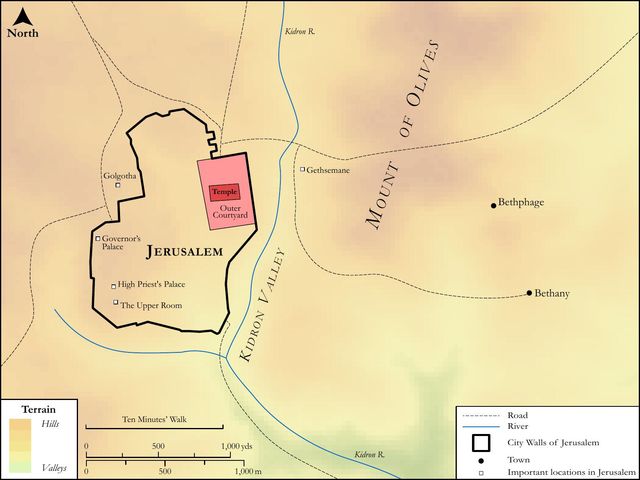
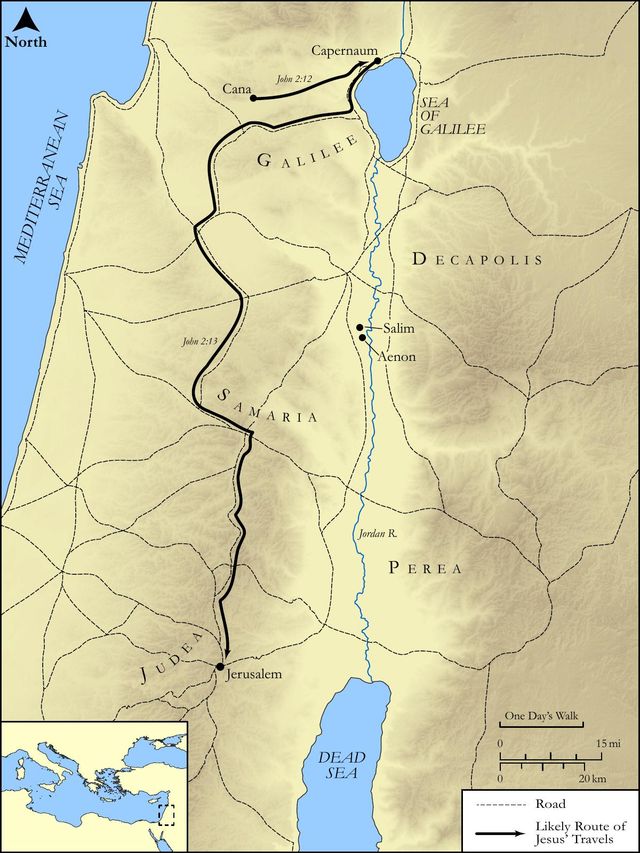
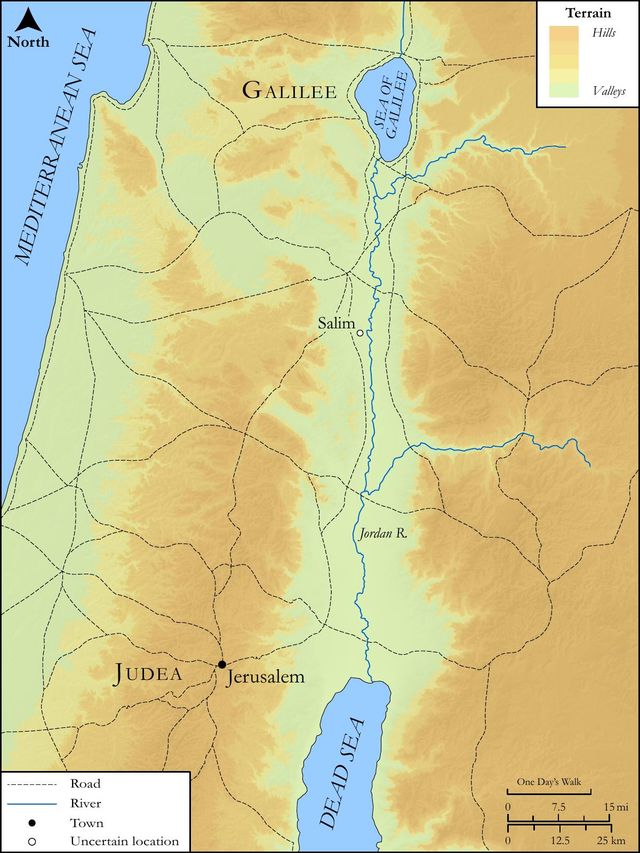
Study this verse
Public-domain commentary
Matthew Henry
From his Commentary on the Whole Bible. Henry comments on passages, not single verses — this entry covers John 3:22–36. His four-level outline is real structure in the source text, so it is rendered as structure.
In these verses we have,
I.Christ's removal into the land of Judea (v. 22), and there he tarried with his disciples. Observe,
1.Our Lord Jesus, after he entered upon his public work, travelled much, and removed often, as the patriarchs in their sojournings. As it was a good part of his humiliation that he had no certain dwelling-place, but was, as Paul, in journeyings often, so it was an instance of his unwearied industry, in the work for which he came into the world, that he went about in prosecution of it; many a weary step he took to do good to souls. The Sun of righteousness took a large circuit to diffuse his light and heat, Ps. xix. 6.
2.He was not wont to stay long at Jerusalem. Though he went frequently thither, yet he soon returned into the country; as here. After these things, after he had had this discourse with Nicodemus, he came into the land of Judea; not so much for greater privacy (though mean and obscure places best suited the humble Jesus in his humble state) as for greater usefulness. His preaching and miracles, perhaps, made most noise at Jerusalem, the fountain-head of news, but did least good there, where the most considerable men of the Jewish church had so much the ascendant.
3.When he came into the land of Judea his disciples came with him; for these were they that continued with him in his temptations. Many that flocked to him at Jerusalem could not follow his motions into the country, they had no business there; but his disciples attended him. If the ark remove, it is better to remove and go after it (as those did, Josh. iii. 3) than sit still without it, though it be in Jerusalem itself.
4.There he tarried with them, dietribe—He conversed with them, discoursed with them. He did not retire into the country for his ease and pleasure, but for more free conversation with his disciples and followers. See Cant. vii. 11, 12. Note, Those that are ready to go with Christ shall find him as ready to stay with them. It is supposed that he now staid five or six months in this country. 5. There he baptized; he admitted disciples, such as believed in him, and had more honesty and courage than those had at Jerusalem, ch. ii. 24. John began to baptize in the land of Judea (Matt. iii. 1), therefore Christ began there, for John had said, There comes one after me. He himself baptized not, with his own hand, but his disciples by his orders and directions, as appears, ch. iv. 2. But his disciples' baptizing was his baptizing. Holy ordinances are Christ's, though administered by weak men.
II.John's continuance in his work, as long as his opportunities lasted, v. 23, 24. Here we are told,
1.That John was baptizing. Christ's baptism was, for substance, the same with John's, for John bore witness to Christ, and therefore they did not at all clash or interfere with one another. But,
(1.)Christ began the work of preaching and baptizing before John laid it down, that he might be ready to receive John's disciples when he should be taken off, and so the wheels might be kept going. It is a comfort to useful men, when they are going off the stage, to see those rising up who are likely to fill up their place.
(2.)John continued the work of preaching and baptizing though Christ had taken it up; for he would still, according to the measure given to him, advance the interests of God's kingdom. There was still work for John to do, for Christ was not yet generally known, nor were the minds of people thoroughly prepared for him by repentance. From heaven John had received his command, and he would go on in his work till he thence received his countermand, and would have his dismission from the same hand that gave him his commission. He does not come in to Christ, lest what had formerly passed should look like a combination between them; but he goes on with his work, till Providence lays him aside. The greater gifts of some do not render the labours of others, that come short of them, needless and useless; there is work enough for all hands. They are sullen that will sit down and do nothing when they see themselves out-shone. Though we have but one talent, we must account for that: and, when we see ourselves going off, must yet go on to the last.
2.That he baptized in Enon near Salim, places we find nowhere else mentioned, and therefore the learned are altogether at a loss where to find them. Wherever it was, it seems that John removed from place to place; he did not think that there was any virtue in Jordan, because Jesus was baptized there, which should engage him to stay there, but as he saw cause he removed to other waters. Ministers must follow their opportunities. He chose a place where there was much water, hydata polla—many waters, that is, many streams of water; so that wherever he met with any that were willing to submit to his baptism water was at hand to baptize them with, shallow perhaps, as is usual where there are many brooks, but such as would serve his purpose. And in that country plenty of water was a valuable thing.
3.That thither people came to him and were baptized. Though they did not come in such vast crowds as they did when he first appeared, yet now he was not without encouragement, but there were still those that attended and owned him. Some refer this both to John and to Jesus: They came and were baptized; that is, some came to John, and were baptized by him, some to Jesus, and were baptized by him, and, as their baptism was one, so were their hearts.
4.It is noted (v. 24) that John was not yet cast into prison, to clear the order of the story, and to show that these passages are to come in before Matt. vi. 12. John never desisted from his work as long as he had his liberty; nay, he seems to have been the more industrious, because he foresaw his time was short; he was not yet cast into prison, but he expected it ere long, ch. ix. 4.
III.A contest between John's disciples and the Jews about purifying, v.
25. See how the gospel of Christ came not to send peace upon earth, but division. Observe, 1. Who were the disputants: some of John's disciples, and the Jews who had not submitted to his baptism of repentance. Penitents and impenitents divide this sinful world. In this contest, it should seem, John's disciples were the aggressors, and gave the challenge; and it is a sign that they were novices, who had more zeal than discretion. The truths of God have often suffered by the rashness of those that have undertaken to defend them before they were able to do it. 2. What was the matter in dispute: about purifying, about religious washing. (1.) We may suppose that John's disciples cried up his baptism, his purifying, as instar omnium—superior to all others, and gave the preference to that as perfecting and superseding all the purifications of the Jews, and they were in the right; but young converts are too apt to boast of their attainments, whereas he that finds the treasure should hide it till he is sure that he has it, and not talk of it too much at first. (2.) No doubt the Jews with as much assurance applauded the purifyings that were in use among them, both those that were instituted by the law of Moses and those that were imposed by the tradition of the elders; for the former they had a divine warrant, and for the latter the usage of the church. Now it is very likely that the Jews in this dispute, when they could not deny the excellent nature and design of John's baptism, raised an objection against it from Christ's baptism, which gave occasion for the complaint that follows here (v. 26): "Here is John baptizing in one place." say they, "and Jesus at the same time baptizing in another place; and therefore John's baptism, which his disciples so much applaud, is either," [1.] "Dangerous, and of ill consequence to the peace of the church and state, for you see it opens a door to endless parties. Now that John has begun, we shall have every little teacher set up for a baptist presently. Or," [2.] "At the best it is defective and imperfect. If John's baptism, which you cry up thus, have any good in it, yonder the baptism of Jesus goes beyond it, so that for your parts you are shaded already by a greater light, and your baptism is soon gone out of request." Thus objections are made against the gospel from the advancement and improvement of gospel light, as if childhood and manhood were contrary to each other, and the superstructure were against the foundation. There was no reason to object Christ's baptism against John's, for they consisted very well together.
IV.A complaint which John's disciples made to their master concerning Christ and his baptizing, v.
26. They, being nonplussed by the fore-mentioned objection, and probably ruffled and put into a heat by it, come to their master, and tell him, "Rabbi, he that was with thee, and was baptized of thee, is now set up for himself; he baptizeth, and all men come to him; and wilt thou suffer it?" Their itch for disputing occasioned this. It is common for men, when they find themselves run aground in the heat of disputation, to fall foul upon those that do them no harm. If these disciples of John had not undertaken to dispute about purifying, before they understood the doctrine of baptism, they might have answered the objection without being put into a passion. In their complaint, they speak respectfully to their own master, Rabbit; but speak very slightly of our Saviour, though they do not name him. 1. They suggest that Christ's setting up a baptism of his own was a piece of presumption, very unaccountable; as if John, having first set up this rite of baptizing, must have the monopoly of it, and, as it were, a patent for the invention: "He that was with thee beyond Jordan, as a disciple of thine, behold, and wonder, the same, the very same, baptizes, and takes thy work out of thy hand." Thus the voluntary condescensions of the Lord Jesus, as that of his being baptized by John, are often unjustly and very unkindly turned to his reproach. 2. They suggest that it was a piece of ingratitude to John. He to whom thou barest witness baptizes; as if Jesus owed all his reputation to the honourable character John gave of him, and yet had very unworthily improved it to the prejudice of John. But Christ needed not John's testimony, ch. v. 36. He reflected more honour upon John than he received from him, yet thus it is incident to us to think that others are more indebted to us than really they are. And besides, Christ's baptism was not in the least an impeachment, but indeed the greatest improvement, of John's baptism, which was but to lead the way to Christ's. John was just to Christ, in bearing witness to him; and Christ's answering his testimony did rather enrich than impoverish John's ministry. 3. They conclude that it would be a total eclipse to John's baptism: "All men come to him; they that used to follow with us now flock after him, it is therefore time for us to look about us." It was not indeed strange that all men came to him. As far as Christ is manifested he will be magnified; but why should John's disciples grieve at this? Note, Aiming at the monopoly of honour and respect has been in all ages the bane of the church, and the shame of its members and ministers; as also a vying of interests, and a jealousy of rivalship and competition. We mistake if we think that the excelling gifts and graces, and labours and usefulness, of one, are a diminution and disparagement to another that has obtained mercy to be faithful; for the Spirit is a free agent, dispensing to every one severally as he will. Paul rejoiced in the usefulness even of those that opposed him, Phil. i. 18. We must leave it to God to choose, employ, and honour his own instruments as he pleaseth, and not covet to be placed alone.
V.Here is John's answer to this complaint which his disciples made, v.
27, &c. His disciples expected that he would have resented this matter as they did; but Christ's manifestation to Israel was no surprise to John, but what he looked for; it was not disturbance to him, but what he wished for. He therefore checked the complaint, as Moses, Enviest thou for my sake? and took this occasion to confirm the testimonies he had formerly borne to Christ as superior to him, cheerfully consigning and turning over to him all the interest he had in Israel. In this discourse here, the first minister of the gospel (for so John was) is an excellent pattern to all ministers to humble themselves and to exalt the Lord Jesus.
1.John here abases himself in comparison with Christ, v. 27-30. The more others magnify us, the more we must humble ourselves, and fortify ourselves against the temptation of flattery and applause, and the jealousy of our friends for our honour, by remembering our place, and what we are, 1 Cor. iii. 5.
(1.)John acquiesces in the divine disposal, and satisfies himself with that (v. 27): A man can receive nothing except it be given him from heaven, whence every good gift comes (James i. 17), a general truth very applicable in this case. Different employments are according to the direction of divine Providence, different endowments according to the distribution of the divine grace. No man can take any true honour to himself, Heb. v. 4. We have as necessary and constant a dependence upon the grace of God in all the motions and actions of the spiritual life as we have upon the providence of God in all the motions and actions of the natural life: now this comes in here as a reason,
[1.]Why we should not envy those that have a larger share of gifts than we have, or move in a larger sphere of usefulness. John reminds his disciples that Jesus would not have thus excelled him except he had received it from heaven, for, as man and Mediator, he received gifts; and, if God gave him the Spirit without measure (v. 34), shall they grudge at it? The same reason will hold as to others. If God is pleased to give to others more ability and success than to us, shall we be displeased at it, and reflect upon him as unjust, unwise, and partial? See Matt. xx. 15.
[2.]Why we should not be discontented, though we be inferior to others in gifts and usefulness, and be eclipsed by their excellencies. John was ready to own that it was the gift, the free gift, of heaven, that made him a preacher, a prophet, a baptist: it was God that gave him the interest he had in the love and esteem of the people; and, if now his interest decline, God's will be done! He that gives may take. What we receive from heaven we must take as it is given. Now John never received a commission for a standing perpetual office, but only for a temporary one, which must soon expire; and therefore, when he has fulfilled his ministry, he can contentedly see it go out of date. Some give quite another sense of these words: John had taken pains with his disciples, to teach them the reference which his baptism had to Christ, who should come after him, and yet be preferred before him, and do that for them which he could not do; and yet, after all, they dote upon John, and grudge this preference of Christ above him: Well saith John, I see a man can receive (that is, perceive) nothing, except it be given him from heaven. The labour of ministers if all lost labour, unless the grace of God make it effectual. Men do not understand that which is made most plain, nor believe that which is made most evident, unless it be given them from heaven to understand and believe it.
(2.)John appeals to the testimony he had formerly given concerning Christ (v. 28): You can bear me witness that I said, again and again, I am not the Christ, but I am sent before him. See how steady and constant John was in his testimony to Christ, and not as a reed shaken with the wind; neither the frowns of the chief priests, nor the flatteries of his own disciples, could make him change his note. Now this serves here, [1.] As a conviction to his disciples of the unreasonableness of their complaint. They had spoken of the witness which their master bore to Jesus (v. 26): "Now," saith John, "do you not remember what the testimony was that I did bear? Call that to mind, and you will see your own cavil answered. Did I not say, I am not the Christ? Why then do you set me up as a rival with him that is? Did I not say, I am sent before him? Why then does it seem strange to you that I should stand by and give way to him?" [2.] It is a comfort to himself that he had never given his disciples any occasion thus to set him up in competition with Christ; but, on the contrary, had particularly cautioned them against this mistake, though he might have made a hand of it for himself. It is a satisfaction to faithful ministers when they have done what they could in their places to prevent any extravagances that their people ran into. John had not only not encouraged them to hope that he was the Messiah, but had plainly told them the contrary, which was now a satisfaction to him. It is a common excuse for those who have undue honour paid them, Si populus vult decipi, decipiatur—If the people will be deceived, let them; but that is an ill maxim for those to go by whose business it is to undeceive people. The lip of truth shall be established.
(3.)John professes the great satisfaction he had in the advancement of Christ and his interest. He was so far from regretting it, as his disciples did, that he rejoiced in it. This he expresses (v. 29) by an elegant similitude.
[1.]He compares our Saviour to the bridegroom: "He that hath the bride is the bridegroom. Do all men come to him? It is well, whither else should they go? Has he got the throne in men's affections? Who else should have it? It is his right; to whom should the bride be brought but to the bridegroom?" Christ was prophesied of in the Old Testament as a bridegroom, Ps. xlv. The Word was made flesh, that the disparity of nature might not be a bar to the match. Provision is made for the purifying of the church, that the defilement of sin might be no bar. Christ espouses his church to himself; he has the bride, for he has her love, he has her promise; the church is subject to Christ. As far as particular souls are devoted to him in faith and love, so far the bridegroom has the bride.
[2.]He compares himself to the friend of the bridegroom, who attends upon him, to do him honour and service, assists him in prosecuting the match, speaks a good word for him, uses his interest on his behalf, rejoices when the match goes on, and most of all when the point is gained, and he has the bride. All that John had done in preaching and baptizing was to introduce him; and, now that he was come, he had what he wished for: The friend of the bridegroom stands, and hears him; stands expecting him, and waiting for him; rejoices with joy because of the bridegroom's voice, because he is come to the marriage after he had been long expected. Note, First, Faithful ministers are friends of the bridegroom, to recommend him to the affections and choice of the children of men; to bring letters and messages from him, for he courts by proxy; and herein they must be faithful to him. Secondly, The friends of the bridegroom must stand, and hear the bridegroom's voice; must receive instructions from him, and attend his orders; must desire to have proofs of Christ speaking in them, and with them (2 Cor. xiii. 3); that is the bridegroom's voice. Thirdly, The espousing of souls to Jesus Christ, in faith and love, is the fulfilling of the joy of every good minister. If the day of Christ's espousals be the day of the gladness of his heart (Cant. iii. 11), it cannot but be of their too who love him and wish well to his honour and kingdom. Surely they have no greater joy.
(4.)He owns it highly fit and necessary that the reputation and interest of Christ should be advanced, and his own diminished (v. 30): He must increase, but I must decrease. If they grieve at the growing greatness of the Lord Jesus, they will have more and more occasion to grieve, as those have that indulge themselves in envy and emulation. John speaks of Christ's increase and his own decrease, not only as necessary and unavoidable, which could not be helped and therefore must be borne, but as highly just and agreeable, and affording him entire satisfaction.
[1.]He was well pleased to see the kingdom of Christ getting ground: "He must increase. You think he has gained a great deal, but it is nothing to what he will gain." Note, The kingdom of Christ is, and will be, a growing kingdom, like the light of the morning, like the grain of mustard-seed.
[2.]He was not at all displeased that the effect of this was the diminishing of his own interest: I must decrease. Created excellencies are under this law, they must decrease. I have seen an end of all perfection. Note, First, The shining forth of the glory of Christ eclipses the lustre of all other glory. The glory that stands in competition with Christ, that of the world and the flesh, decreases and loses ground in the soul as the knowledge and love of Christ increase and get ground; but it is here spoken of that which is subservient to him. As the light of the morning increases, that of the morning star decreases. Secondly, If our diminution or abasement may but in the least contribute to the advancement of Christ's name, we must cheerfully submit to it, and be content to be any thing, to be nothing, so that Christ may be all.
2.John Baptist here advances Christ, and instructs his disciples concerning him, that, instead of grieving that so many come to him, they might come to him themselves.
(1.)He instructs them concerning the dignity of Christ's person (v. 31): He that cometh from above, that cometh from heaven, is above all. Here,
[1.]He supposes his divine origin, that he came from above, from heaven, which bespeaks not only his divine extraction, but his divine nature. He had a being before his conception, a heavenly being. None but he that came from heaven was fit to show us the will of heaven, or the way to heaven. When God would save man, he sent from above.
[2.]Hence he infers his sovereign authority: he is above all, above all things and all persons, God over all, blessed for evermore. It is daring presumption to dispute precedency with him. When we come to speak of the honours of the Lord Jesus, we find they transcend all conception and expression, and we can say but this, He is above all. It was said of John Baptist, There is not a greater among them that are born of women. But the descent of Christ from heaven put such a dignity upon him as he was not divested of by his being made flesh; still he was above all. This he further illustrates by the meanness of those who stood in competition with him: He that is of the earth, is earthly, ho on ek tes ges, ek tes ges esti—He that is of the earth is of the earth; he that has his origin of the earth has his food out of the earth, has his converse with earthly things, and his concern is for them. Note, First, Man has his rise out of the earth; not only Adam at first, but we also still are formed out of the clay, Job xxxiii. 6. Look to the rock whence we were hewn. Secondly, Man's constitution is therefore earthly; not only his body frail and mortal, but his soul corrupt and carnal, and its bent and bias strong towards earthly things. The prophets and apostles were of the same mould with other men; they were but earthen vessels, though they had a rich treasure lodged in them; and shall these be set up as rivals with Christ? Let the potsherds strive with the potsherds of the earth; but let them not cope with him that came from heaven.
(2.)Concerning the excellency and certainty of his doctrine. His disciples were displeased that Christ's preaching was admired, and attended upon, more than his; but he tells them that there was reason enough for it. For,
[1.]He, for his part, spoke of the earth, and so do all those that are of the earth. The prophets were men and spoke like men; of themselves they could not speak but of the earth, 2 Cor. iii. 5. The preaching of the prophets and of John was but low and flat compared with Christ's preaching; as heaven is high above the earth, so were his thoughts above theirs. By them God spoke on earth, but in Christ he speaketh from heaven.
[2.]But he that cometh from heaven is not only in his person, but in his doctrine, above all the prophets that ever lived on earth; none teacheth like him. The doctrine of Christ is here recommended to us,
First, As infallibly sure and certain, and to be entertained accordingly (v. 32): What he hath seen and heard, that he testifieth. See here, 1. Christ's divine knowledge; he testified nothing but what he had seen and heard, what he was perfectly apprized of and thoroughly acquainted with. What he discovered of the divine nature and of the invisible world was what he had seen; what he revealed of the mind of God was what he had heard immediately from him, and not at second hand. The prophets testified what was made known to them in creams and visions by the mediation of angels, but not what they had seen and heard. John was the crier's voice, that said, "Make room for the witness, and keep silence while the charge is given," but then leaves it to the witness to give in his testimony himself, and the judge to give the charge himself. The gospel of Christ is not a doubtful opinion, like an hypothesis or new notion in philosophy, which every one is at liberty to believe or not; but it is a revelation of the mind of God, which is of eternal truth in itself, and of infinite concern to us. 2. His divine grace and goodness: that which he had seen and heard he was pleased to make known to us, because he knew it nearly concerned us. What Paul had seen and heard in the third heavens he could not testify (2 Cor. xii. 4), but Christ knew how to utter what he had seen and heard. Christ's preaching is here called his testifying, to denote, (1.) The convincing evidence of it; it was not reported as news by hearsay, but it was testified as evidence given in court, with great caution and assurance. (2.) The affectionate earnestness of the delivery of it: it was testified with concern and importunity, as Acts xviii. 5.
From the certainty of Christ's doctrine, John takes occasion, [1.] To lament the infidelity of the most of men: though he testifies what is infallibly true, yet no man receiveth his testimony, that is, very few, next to none, none in comparison with those that refuse it. They receive it not, they will not hear it, they do not heed it, or give credit to it. This he speaks of not only as a matter of wonder, that such a testimony should not be received (Who hath believed our report? How stupid and foolish are the greatest part of mankind, what enemies to themselves!) but as matter of grief; John's disciples grieved that all men came to Christ (v. 26); they thought his followers too many. But John grieves that no man came to him; he thought them too few. Note, The unbelief of sinners is the grief of saints. It was for this that St. Paul had great heaviness, Rom. ix. 2. [2.] He takes occasion to commend the faith of the chosen remnant (v. 33): He that hath received his testimony (and some such there were, though very few) hath set to his seal that God is true. God is true, though we do not set our seal to it; let God be true, and every man a liar; his truth needs not our faith to support it, but by faith we do ourselves the honour and justice to subscribe to his truth, and hereby God reckons himself honoured. God's promises are all yea and amen; by faith we put our amen to them, as Rev. xxii. 20. Observe, He that receives the testimony of Christ subscribes not only to the truth of Christ, but to the truth of God, for his name is the Word of God; the commandments of God and the testimony of Christ are put together, Rev. xii. 17. By believing in Christ we set to our seal, First, That God is true to all the promises which he has made concerning Christ, that which he spoke by the mouth of all his holy prophets; what he swore to our fathers is all accomplished, and not one iota or tittle of it fallen to the ground, Luke i. 70, &c. Acts xiii. 32, 33. Secondly, That he is true to all the promises he has made in Christ; we venture our souls upon God's veracity, being satisfied that he is true; we are willing to deal with him upon trust, and to quit all in this world for a happiness in reversion and out of sight. By this we greatly honour God's faithfulness. Whom we give credit to we give honour to.
Secondly, It is recommended to us as a divine doctrine; not his own, but his that sent him (v. 34): For he whom God hath sent speaketh the word of God, which he was sent to speak, and enabled to speak; for God giveth not the Spirit by measure unto him. The prophets were as messengers that brought letters from heaven; but Christ came under the character of an ambassador, and treats with us as such; for, 1. He spoke the words of God, and nothing he said savoured of human infirmity; both substance and language were divine. He proved himself sent of God (ch. iii. 2), and therefore his words are to be received as the words of God. By this rule we may try the spirits: those that speak as the oracles of God, and prophesy according to the proportion of faith, are to be received as sent of God. 2. He spoke as no other prophet did; for God giveth not the Spirit by measure to him. None can speak the words of God without the Spirit of God, 1 Cor. ii. 10, 11. The Old-Testament prophets had the Spirit, and in different degrees, 2 Kings ii. 9, 10. But, whereas God gave them the Spirit by measure (1 Cor. xii. 4), he gave him to Christ without measure; all fulness dwelt in him, the fulness of the Godhead, an immeasurable fulness. The Spirit was not in Christ as in a vessel, but as in a fountain, as in a bottomless ocean. "The prophets that had the Spirit in a limited manner, only with respect to some particular revelation, sometimes spoke of themselves; but he that had the Spirit always residing in him, without stint, always spoke the words of God." So Dr. Whitby.
(3.)Concerning the power and authority he is invested with, which gives him the pre-eminence above all others, and a more excellent name than they.
[1.]He is the beloved Son of the Father (v. 35): The Father loveth the Son. The prophets were faithful as servants, but Christ as a Son; they were employed as servants, but Christ beloved as a son, always his delight, Prov. viii. 30. The Father was well pleased in him; not only he did love him, but he doth love him; he continued his love to him even in his estate of humiliation, loved him never the less for his poverty and sufferings.
[2.]He is Lord of all. The Father, as an evidence of his love for him, hath given all things into his hand. Love is generous. The Father took such a complacency and had such a confidence in him that he constituted him the great feoffee in trust for mankind. Having given him the Spirit without measure, he gave him all things; for he was hereby qualified to be master and manager of all. Note, It is the honour of Christ, and the unspeakable comfort of all Christians, that the Father hath given all things into the hands of the Mediator. First, All power; so it is explained, Matt. xxviii. 18. All the works of creation being put under his feet, all the affairs of redemption are put into his hand; he is Lord of all. Angels are his servants; devils are his captives. He has power over all flesh, the heathen given him for his inheritance. The kingdom of providence is committed to his administration. He has power to settle the terms of the covenant of peace as the great plenipotentiary, to govern his church as the great lawgiver, to dispense divine favours as the great almoner, and to call all to account as the great Judge. Both the golden sceptre and the iron rod are given into his hand. Secondly, All grace is given into his hand as the channel of conveyance; all things, all those good things which God intended to give to the children of men; eternal life, and all its preliminaries. We are unworthy that the Father should give those things into our hands, for we have made ourselves the children of his wrath; he hath therefore appointed the Son of his love to be trustee for us, and the things he intended for us he gives into his hands, who is worthy, and has merited both honours for himself and favours for us. They are given into his hands, by him to be given into ours. This is a great encouragement to faith, that the riches of the new covenant are deposited in so sure, so kind, so good a hand, the hand of him that purchased them for us, and us for himself, who is able to keep all that which both God and believers have agreed to commit to him.
[3.]He is the object of that faith which is made the great condition of eternal happiness, and herein he has the pre-eminence above all others: He that believeth on the Son, hath life, v. 36. We have here the application of what he had said concerning Christ and his doctrine; and it is the conclusion of the whole matter. If God has put this honour upon the Son, we must by faith give honour to him. As God offers and conveys good things to us by the testimony of Jesus Christ, whose word is the vehicle of divine favours, so we receive and partake of those favours by believing the testimony, and entertaining that word as true and good; this way of receiving fitly answers that way of giving. We have here the sum of that gospel which is to be preached to every creature, Mark xvi. 16. Here is,
First, The blessed state of all true Christians: He that believes on the Son hath everlasting life. Note, 1. It is the character of every true Christian that he believes on the Son of God; not only believes him, that what he saith is true, but believes on him, consents to him, and confides in him. The benefit of true Christianity is no less than everlasting life; this is what Christ came to purchase for us and confer upon us; it can be no less than the happiness of an immortal soul in an immortal God. 2. True believers, even now, have everlasting life; not only they shall have it hereafter, but they have it now. For, (1.) They have very good security for it. The deed by which it passeth is sealed and delivered to them, and so they have it; it is put into the hands of their guardian for them, and so they have it, though the use be not yet transferred into possession. They have the Son of God, and in him they have life; and the Spirit of God, the earnest of this life. (2.) They have the comfortable foretastes of it, in present communion with God and the tokens of his love. Grace is glory begun.
Historical interpretation
Two Centuries of Reception
5 surviving comments on this verse. Each one is dated, so this reads as a timeline rather than a list.
Select a marker to jump to its quote. Markers stagger vertically where authors wrote within a few decades of each other.
That Christ is the Bridegroom, having the Church as His bride, from which spiritual children were to be born. In Joel: "Blow with the trumpet in Sion; sanctify a fast, and call a healing; assemble the people, sanctify the Church, gather the elders, collect the little ones that suck the breast; let the Bridegroom go forth of His chamber, and the bride out of her closet." Also in Jeremiah: "And I will take away from the cities of Judah, and from the streets of Jerusalem, the voice of the joyous, and the voice of the glad; the voice of the bridegroom, and the voice of the bride." Also in the eighteenth Psalm: "And he is as a bridegroom going forth from his chamber; he exulted as a giant to run his course. From the height of heaven is his going forth, and his circuit even to the end of it; and there is nothing which is hid from his heat." Also in the Apocalypse: "Come, I will show thee the new bride, the Lamb's wife. And he took me in the Spirit to a great mountain, and he showed me the holy city Jerusalem descending out of heaven from God, having the glory of God." Also in the Gospel according to John: "Ye are my witnesses, that I said to them who were sent from Jerusalem to me, that I am not the Christ, but that I am sent before Him. For he who has the bride is the bridegroom; but the friend of the bridegroom is he who standeth and heareth him with joy, and rejoiceth because of the voice of the bridegroom." The mystery of this matter was shown in Jesus the son of Nave, when he was bidden to put his shoes from off him, doubt less because he himself was not the bridegroom. For it was in the law, that whoever should refuse marriage should put off his shoe, but that he should be shod who was to be the bridegroom: "And it happened, when Jesus was in Jericho, he looked around with his eyes, and saw a man standing before his face, and holding a javelin in his hand, and said, Art thou for us or for our enemies? And he said, I am the leader of the host of the Lord; now draw near. And Jesus fell on his rice to the earth, and said to him, Lord, what dost Thou command unto Thy servant. And the leader of the Lord's host said, Loose thy shoe from thy feet, for the place whereon thou standest is holy ground." Also, in Exodus, Moses is bidden to put off his shoe, because he, too, was not the bridegroom: "And there appeared unto him the angel of the Lord in a flame of fire out of a bush; and he saw that the bush burned with fire, but the bush was not consumed. And Moses said, I will pass over and see this great sight, why the bush is not consumed. But when He saw that he drew near to see, the Lord God called him from the bush, saying, Moses, Moses. And he said, What is it? And He said, Draw not nigh hither, unless thou hast loosed thy shoe from off thy feet; for the place on which thou standest is holy ground. And He said unto him, I am the God of thy father, the God of Abraham, and the God of Isaac, and the God of Jacob." This was also made plain in the Gospel according to John: "And John answered them, I indeed baptize with water, but there standeth One in the midst of you whom ye know not: He it is of whom I said, The man that cometh after me is made before me, the latchet of whose shoe I am not worthy to unloose." Also according to Luke: "Let your loins be girt, and your lamps burning, and ye like to men that wait for their master when he shall come from the wedding, that when he cometh and knocketh, they may open unto him. Blessed are those servants whom their Lord, when He cometh, shall find watching." Also in the Apocalypse: "The Lord God omnipotent reigneth: let us be glad and rejoice, and let us give to Him the honour of glory; for the marriage of the Lamb is come, and His wife hath made herself ready."
(Hom. xxix. 2) And see; the very argument by which they thought to have overthrown Christ, To whom, thou barest witness, he turns against them; Ye yourselves bear me witness, that I said, I am not the Christ; as if he said, If ye think my witness true, ye must acknowledge Him more worthy of honour than myself. He adds, But that I was sent before Him; that is to say, I am a servant, and perform the commission of the Father which sent me; my witness is not from favour or partiality; I say that which was given me to say.
"Ye yourselves bear me witness that I said, I am not the Christ, but that I am sent before Him."
"If then ye hold to my testimony, (and ye even now produce it when ye say, 'to whom thou barest witness,') He is not only not diminished by receiving my witness, but rather is increased by it; besides, the testimony was not mine, but God's. So that if I seem to you to be trustworthy, I said this among other things, that 'I am sent before Him.'" Seest thou how he shows little by little that this Voice was divine? For what he saith is of this kind: "I am a servant, and say the words of Him that sent me, not flattering Christ through human favor, but serving His Father who sent me. I gave not the testimony as a gift, but what I was sent to speak, I spake. Do not then because of this suppose that I am great, for it shows that He is great. He is Lord of all things."
"Ye yourselves bear me witness that I said I am not the Christ." Thou art not the Christ; but what if thou art greater than He since thou didst baptize Him? "I am sent:" I am the herald, He is the Judge.
He brings his disciples to the recollection of the words which they have already often heard, partly reproving them rightly, as steeped in forgetfulness of things profitable, and slumbering in respect to this so most dread doctrine, partly persuading them to remember the Divine Scripture, as having been nourished in zeal for the knowledge of these things; Whom it preaches as the Christ to come, whom again as the Baptist the forerunner. For thus would they, having received knowledge of each, be in no wise angry, seeing them in the state befitting each. I shall need then, saith he, no other witnesses to this, I have my own disciples as ear-witnesses, I confessed my state of servitude, when I fore-announced, I was sent, I am not the Christ. Let Him overcome, prevail, shine forth yet more as Lord and God.
Continue studying John 3:28 across the web’s major study libraries — every link below opens this exact verse, chapter, or book on the destination site.
Read & Compare
 BibleGatewayThis verse in more than 200 translations and 70 languages.
 Bible.comThe YouVersion reader — hundreds of translations, reading plans, and highlights.
 ESV.orgCrossway's official English Standard Version reader.
 NET BibleThe NET translation with 60,000+ translators' notes on every rendering decision.
 STEP BibleTyndale House's free study tool — original text, vocabulary, and scholarly resources.
 BibliaLogos Bible Software's free web reader.
 USCCBThe New American Bible (Revised Edition) with the U.S. bishops' study notes.
Commentaries
 BibleHub CommentariesDozens of classic commentaries on this verse, gathered on one page.
 StudyLightMore than 100 commentary sets — the largest collection on the web.
 BibleRefPlain-English commentary on what this verse means, verse by verse.
 Enduring WordDavid Guzik's free commentary on this chapter, widely used by Bible teachers.
 Bible Study ToolsVerse commentary alongside Greek and Hebrew study aids.
Original Language & Research
- BibleHub InterlinearThe verse word by word — original language, transliteration, and English.
- BibleHub LexiconEvery word's original-language definition and Strong's entry.
 Blue Letter BibleDeep-study tools — Strong's numbers, concordance, and word studies.
 CNTR CollationThe earliest Greek manuscripts of this verse, collated letter by letter.
Sermons, Hymns & Audio


TrulyRandomVerse is not affiliated with these sites and doesn’t control their content. They’re linked because they’re genuinely useful.
Summary
In John 3:28, John the Baptist offers a profound and humble testimony to his disciples, unequivocally stating his true identity and mission. He reminds them that he is not the long-awaited Messiah, the Christ, but rather the divinely appointed messenger sent specifically to prepare the way for Him. This declaration serves to correct any misconceptions, quell potential rivalry, and firmly direct all attention and allegiance towards Jesus, underscoring John's unwavering commitment to his prophetic role as the forerunner.
Context
ShowHideLiterary Context
This verse is situated within a pivotal moment in John the Baptist's ministry, immediately following a report from his disciples concerning Jesus's burgeoning popularity and baptizing ministry (John 3:26). John's disciples express concern that "all men come to him," indicating a sense of competition or perhaps even jealousy. John's response in John 3:27-30 serves as a theological correction and a clear affirmation of his subordinate, yet crucial, role. He uses this opportunity not to defend his own diminishing influence, but to reiterate the core message of his entire ministry: to point to the One who is greater. His testimony here echoes his earlier declarations when questioned by Jewish authorities in John 1:19-23, demonstrating a consistent and unwavering witness to the truth.
Historical & Cultural Context
First-century Judea was a land rife with messianic expectation. The Jewish people eagerly awaited the arrival of the Messiah, a deliverer who would restore Israel's glory and usher in God's kingdom. Various figures arose claiming to be prophets or even the Messiah, leading to confusion and false hopes. John the Baptist's ministry, characterized by a call to repentance and baptism in the Jordan River, drew large crowds and was widely seen as a significant prophetic movement, leading many to wonder if he himself was the Christ (Luke 3:15). Against this backdrop, John's clear and public denial of being the Christ was crucial. It distinguished him from false claimants and established the legitimacy of Jesus as the true Messiah, fulfilling ancient prophecies about a forerunner who would prepare the way for the Lord (e.g., Malachi 3:1 and Isaiah 40:3).
Key Themes
ShowHideJohn 3:28 powerfully contributes to several key themes within the Gospel of John and broader biblical theology. Foremost is the theme of John's Humility and Integrity. Despite his immense popularity and prophetic authority, John consistently refused to seek glory for himself, instead deflecting all attention to Jesus. This highlights the virtue of true spiritual leadership, which prioritizes God's glory over personal acclaim. Another significant theme is the Distinction Between John and Jesus. John's explicit denial of being the Christ firmly establishes Jesus's unique identity as the Son of God and the Messiah, preventing any confusion or conflation of their roles. Furthermore, the verse underscores the theme of Divine Appointment and Purpose. John's statement, "I am sent before him," emphasizes that his ministry was not self-initiated but divinely ordained, serving a specific, preparatory purpose within God's redemptive plan. This highlights the sovereignty of God in raising up individuals for particular tasks in His kingdom.
Exposition and Analysis
ShowHideKey Word Analysis
ShowHideFrom the root martys (witness), this verb means "to be a witness, to testify." In this context, John appeals to his disciples' own memory and experience, indicating that his consistent message throughout his ministry has been a testimony to his true identity and mission. It implies a public, verifiable declaration.
Meaning "Anointed One," this is the Greek equivalent of the Hebrew "Messiah." It refers to the long-awaited deliverer, king, and savior prophesied in the Old Testament. John's explicit denial of this title for himself is a definitive statement about his identity and, by implication, a powerful affirmation of Jesus as the true Messiah.
Derived from apo (from) and stellō (to send), this verb signifies being "sent out" or "dispatched" with a specific mission or authority. It underscores the divine origin and purpose of John's ministry, emphasizing that he was not merely a self-appointed prophet but one commissioned by God to precede and announce the coming of Jesus.
Verse Breakdown
ShowHide"Ye yourselves bear me witness"
John appeals directly to the recollection and personal experience of his disciples. He is not introducing new information but reminding them of a truth he has consistently proclaimed. This serves to validate his current statement, grounding it in their shared history and his unwavering integrity. It implies that his message has always been clear and publicly known.
"that I said, I am not the Christ"
This is the core of John's denial. He explicitly refutes any notion that he is the Messiah, the Anointed One. This statement is crucial for clarifying his identity and preventing any confusion among his followers or the broader public. It demonstrates his profound humility and commitment to truth, refusing to accept a title or role that was not his.
"but that I am sent before him"
This clause clarifies John's actual, divinely appointed role. He is not the main event, but the herald, the forerunner. The phrase "sent before him" highlights his preparatory mission, echoing Old Testament prophecies about a messenger who would precede the Lord. His ministry was designed to prepare hearts and minds for the one who was truly coming.
Literary Devices
ShowHideJohn 3:28 employs several effective literary devices. Direct Testimony is central, as John appeals to his disciples' personal knowledge, lending credibility and weight to his words. There is a clear Contrast established between John's identity ("I am not the Christ") and his true mission ("I am sent before him"). This juxtaposition highlights the distinct roles of the forerunner and the Messiah. The verse also functions as a form of Prophetic Fulfillment, as John's role as the one "sent before him" directly aligns with Old Testament prophecies concerning the messenger who would prepare the way for the Lord. Furthermore, the statement demonstrates Humility as a character trait, showcasing John's consistent self-effacement in the face of Christ's growing prominence.
Theological and Thematic Connections
ShowHideJohn the Baptist's testimony in John 3:28 is a profound theological statement about the nature of divine calling and the singular identity of Jesus Christ. It underscores the principle that true ministry is always God-centered and Christ-exalting, never self-promoting. John's humility in denying the messianic title, despite popular speculation, serves as a powerful model for all who serve God, emphasizing that our purpose is to point others to Christ, not to ourselves. His divinely appointed role as the forerunner highlights God's meticulous plan for salvation, where every individual has a specific, ordained part to play in the unfolding drama of redemption, all ultimately converging on the person and work of Jesus.
Reflection and Application
ShowHideJohn the Baptist's unwavering testimony in John 3:28 provides a timeless blueprint for authentic Christian living and ministry. In a world often driven by self-promotion and the pursuit of personal glory, John's humility shines as a beacon. His resolute refusal to claim a title that was not his, and his consistent redirection of attention to Jesus, challenges us to examine our own motives and ambitions. Are we seeking to build our own platforms, or are we faithfully pointing others to the Savior? Like John, we are called to be witnesses, to testify to the truth of Christ, and to prepare hearts for His presence. This means understanding our unique, God-given roles, embracing them with integrity, and always ensuring that Christ increases while we decrease. Our lives, words, and actions should serve as a clear signpost, directing all glory and honor to the One who truly deserves it.
Questions for Reflection
ShowHideFAQ
ShowHideWhy was John the Baptist's denial of being the Christ so important?
ShowHideJohn's denial was critically important for several reasons. First, it prevented confusion and false messianic expectations among the people who were already wondering if he was the Messiah (Luke 3:15). Second, it firmly established the unique identity of Jesus as the true Christ, the Anointed One, ensuring that the focus remained on Him. Third, it demonstrated John's profound humility and integrity, validating his prophetic ministry as one truly sent by God, not by his own ambition. His consistent testimony, as seen in John 1:20, provided a clear distinction between himself and the coming Savior.
What does "sent before him" signify about John's role?
ShowHideThe phrase "sent before him" (Greek: apostéllō) signifies that John's ministry was divinely commissioned and had a specific, preparatory purpose. He was not the ultimate fulfillment of God's promises but the herald, the messenger, whose task was to prepare the way for the Lord (Malachi 3:1). This involved preaching repentance, baptizing, and identifying Jesus as the Lamb of God (John 1:29). His role was to clear the path, both spiritually and physically, for the Messiah's public ministry, ensuring that when Jesus appeared, people would recognize Him.
Christ-Centered Fulfillment
ShowHideJohn the Baptist's testimony in John 3:28 finds its ultimate fulfillment in the person and work of Jesus Christ. John, as the divinely appointed forerunner, perfectly embodies the Old Testament prophetic tradition that consistently pointed forward to the coming Messiah. His denial of being the Christ serves to magnify Jesus's singular and unparalleled identity as the Son of God, the Anointed One who alone can save. John's mission to be "sent before him" was fulfilled as he prepared the way for Jesus's ministry of teaching, healing, and ultimately, His atoning death and resurrection. Every aspect of John's life and message, from his baptism of repentance to his identification of Jesus as the Lamb of God who takes away the sin of the world, served to illuminate Christ. Thus, John's humble witness ensures that all glory and worship are directed to Jesus, the author and perfecter of our faith, who truly is the Christ, the Savior of the world.