


Mark 10:37
- οἱhoi<the>G3588T-NPMDefinite article Nominative Plural Masculine
- δὲdeAndG1161CONJConjunction
- εἶπανeipanthey saidG2036V-2AAI-3PVerb 2nd Aorist Active Indicative 3rd Plural
- αὐτῷ·autōto HimG846P-DSMPersonal pronoun Dative Singular Masculine
- δὸςdosdo grantG1325V-2AAM-2SVerb 2nd Aorist Active Imperative 2nd Singular
- ἡμῖνhēminto usG3165P-1DPPersonal pronoun Dative 1st Plural
- ἵναinathatG2443CONJConjunction
- εἷςheisoneG1520A-NSMAdjective Nominative Singular Masculine
- σουsouof [us]G4771P-2GSPersonal pronoun Genitive 2nd Singular
- ἐκekatG1537PREPPreposition
- δεξιῶνdexiōnright [hand]G1188A-GPNAdjective Genitive Plural Neuter
- καὶkaiandG2532CONJConjunction
- εἷςheisoneG1520A-NSMAdjective Nominative Singular Masculine
- ἐξexatG1537PREPPreposition
- ἀριστερῶνaristerōnleft [hand]G710A-GPNAdjective Genitive Plural Neuter
- σουsouof youG4771P-2GSPersonal pronoun Genitive 2nd Singular
- καθίσωμενkathisōmenlet us sitG2523V-AAS-1PVerb Aorist Active Subjunctive 1st Plural
- ἐνeninG1722PREPPreposition
- τῇtēatheG3588T-DSFDefinite article Dative Singular Feminine
- δόξῃdoxēgloryG1391N-DSFNoun Dative Singular Feminine
- σουsouof YouG4771P-2GSPersonal pronoun Genitive 2nd Singular
English is a literal word-by-word gloss of the Greek, not the KJV's wording. Why?
This is the original text the KJV's translators worked from — each Greek word with its own literal English meaning in this verse, prepared by scholars at Tyndale House, Cambridge. The KJV translates whole sentences, not word by word, so its wording differs: one Greek word can become several English words, and the KJV may choose “charity” where the gloss reads “love”. Both are faithful — they answer different questions. For the KJV's own rendering, switch to the KJV text.
Details
See on the biblical-era map

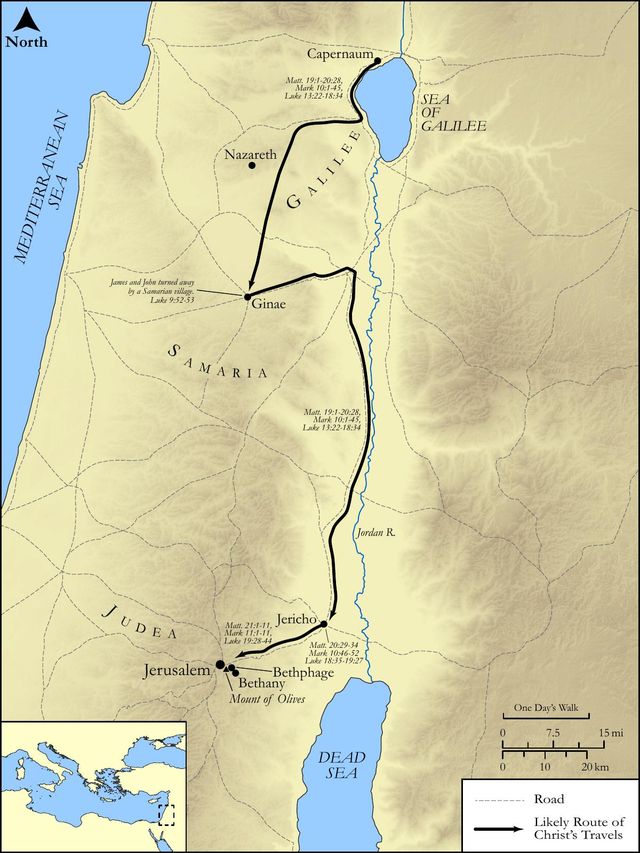
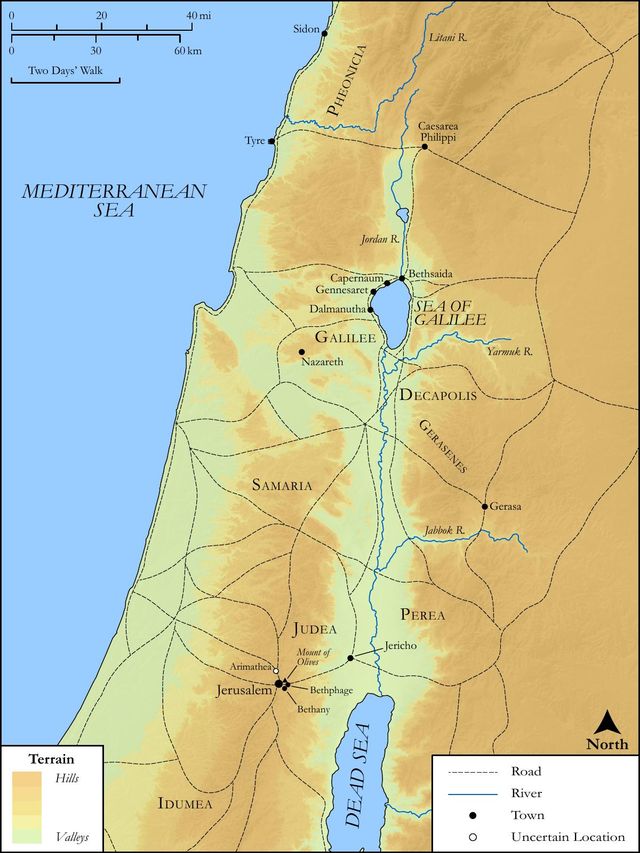
Study this verse
Public-domain commentary
Matthew Henry
From his Commentary on the Whole Bible. Henry comments on passages, not single verses — this entry covers Mark 10:32–45. His three-level outline is real structure in the source text, so it is rendered as structure.
Here is, I. Christ's prediction of his own sufferings; this string he harped much upon, though in the ears of his disciples it sounded very harsh and unpleasing.
1.See here how bold he was; when they were going up to Jerusalem, Jesus went before them, as the captain of our salvation, that was now to be made perfect through sufferings, Mar 10:32. Thus he showed himself forward to go on with his undertaking, even when he came to the hardest part of it. Now that the time was at hand, he said, Lo, I come; so far was he from drawing back, that now, more than ever, he pressed forward. Jesus went before them, and they were amazed. They began now to consider what imminent danger they ran themselves into, when they went to Jerusalem; how very malicious the Sanhedrim which sat there was against their Master and them; and they were ready to tremble at the thought of it. To hearten them, therefore, Christ went before them. "Come," saith he, "surely you will venture where your Master ventures." Note, When we see ourselves entering upon sufferings, it is encouraging to see our Master go before us. Or, He went before them, and therefore they were amazed; they admired to see with what cheerfulness and alacrity he went on, though he knew he was going to suffer and die. Note, Christ's courage and constancy in going on with his undertaking for our salvation, are, and will be, the wonder of all his disciples.
2.See here how timorous and faint-hearted his disciples were; As they followed, they were afraid, afraid for themselves, as being apprehensive of their own danger; and justly might they be ashamed of their being thus afraid. Their Master's courage should have put spirit into them.
3.See here what method he took to silence their fears. He did not go about to make the matter better than it was, nor to feed them with hopes that he might escape the storm, but told them again what he had often told them before, the things that should happen to him. He knew the worst of it, and therefore went on thus boldly, and he will let them know the worst of it. Come, be not afraid; for,
(1.)There is no remedy, the matter is determined, and cannot be avoided.
(2.)It is only the Son of man that shall suffer; their time of suffering was now at hand, he will now provide for their security.
(3.)He shall rise again; the issue of his sufferings will be glorious to himself, and advantageous to all that are his, Mar 10:33, Mar 10:34. The method and particulars of Christ's sufferings are more largely foretold here than in any other of the predictions - that he shall first be delivered up by Judas to the chief priests and the scribes; that they shall condemn him to death, but, not having the power to put him to death, shall deliver him to the Gentiles, to the Roman powers, and they shall mock him, and scourge him, and spit upon him, and kill him. Christ had a perfect foresight, not only of his own death, but of all the aggravating circumstances of it; and yet he thus went forth to meet it.
II.The check he gave to two of his disciples for their ambitious request.
This story is much the same here as we had it Mat 20:20. Only there they are said to have made their request by their mother, here they are said to make it themselves; she introduced them, and presented their petition, and then they seconded it, and assented to it.
Note, 1. As, on the one hand, there are some that do not use, so, on the other hand, there are some that abuse, the great encouragements Christ has given us in prayer. He hath said, Ask, and it shall be given you; and it is a commendable faith to ask for the great things he has promised; but it was a culpable presumption in these disciples to make such a boundless demand upon their Master; We would that thou shouldest do for us whatsoever we shall desire. We had much better leave it to him to do for us what he sees fit, and he will do more than we can desire, Eph 3:20.
2.We must be cautious how we make general promises. Christ would not engage to do for them whatever they desired, but would know from them what it was they did desire; What would ye that I should do for you? He would have them go on with their suit, that they might be made ashamed of it.
3.Many have been led into a snare by false notions of Christ's kingdom, as if it were of this world, and like the kingdoms of the potentates of this world. James and John conclude, If Christ rise again, he must be a king, and if he be a king, his apostles must be peers, and one of these would willingly be the Primus par regni - The first peer of the realm, and the other next him, like Joseph in Pharaoh's court, or Daniel in Darius's.
4.Worldly honour is a glittering thing, with which the eyes of Christ's own disciples have many a time been dazzled. Whereas to be good should be more our care than to look great, or to have the pre-eminence.
5.Our weakness and short-sightedness appear as much in our prayers as in any thing. We cannot order our speech, when we speak to God, by reason of darkness, both concerning him and concerning ourselves. It is folly to prescribe to God, and wisdom to subscribe.
6.It is the will of Christ that we should prepare for sufferings, and leave it to him to recompense us for them. He needs not be put in mind, as Ahasuerus did, of the services of his people, nor can he forget their work of faith and labour of love. Our care must be, that we may have wisdom and grace to know how to suffer with him, and then we may trust him to provide in the best manner how we shall reign with him, and when, and where, and what, the degrees of our glory shall be.
III.The check he gave to the rest of the disciples, for their uneasiness at it.
They began to be much displeased, to have indignation about James and John, Mar 10:41. They were angry at them for affecting precedency, not because it did so ill become the disciples of Christ, but because each of them hoped to have it himself. When the Cynic trampled on Alexander's foot-cloth, with Calco fastum Alexandri - Now I tread on Alexander's pride, he was seasonably checked with Sed majori fastu - But with a greater pride of thine own. So these discovered their own ambition, in their displeasure at the ambition of James and John; and Christ took this occasion to warn them against it, and all their successors in the ministry of the gospel, Mar 10:42-44. He called them to him in a familiar way, to give them an example of condescension, then when he was reproving their ambition, and to teach them never to bid their disciples keep their distance. He shows them,
1.That dominion was generally abused in the world (Mar 10:42); That they seemed to rule over the Gentiles, that have the name and title of rulers, they exercise lordship over them, that is all they study and aim at, not so much to protect them, and provide for their welfare, as to exercise authority upon them; they will be obeyed, aim to be arbitrary, and to have their will in every thing. Sic volo, sic jubeo, stat pro ratione voluntas - Thus I will, thus I command; my good pleasure is my law. Their care is, what they shall get by their subjects to support their own pomp and grandeur, not what they shall do for them.
2.That therefore it ought not to be admitted into the church; "It shall not be so among you; those that shall be put under your charge, must be as sheep under the charge of the shepherd, who is to tend them and feed them, and be a servant to them, not as horses under the command of the driver, that works them and beats them, and gets his pennyworths out of them. He that affects to be great and chief, that thrusts himself into a secular dignity and dominion, he shall be servant of all, he shall be mean and contemptible in the eyes of all that are wise and good; he that exalteth himself shall be abased." Or rather, "He that would be truly great and chief, he must lay out himself to do good to all, must stoop to the meanest services, and labour in the hardest services. Those not only shall be most honoured hereafter, but are most honourable now, who are most useful." To convince them of this, he sets before them his own example (Mar 10:45); "The Son of man submits first to the greatest hardships and hazards, and then enters into his glory, and can you expect to come to it any other way; or to have more ease and honour than he has?" (1.) He takes upon him the form of a servant, comes not to be ministered to, and waited upon, but to minister, and wait to be gracious. (2.) He comes obedient to death, and to its dominion, for he gives his life a ransom for many; did he die for the benefit of good people, and shall not we study to live for their benefit?
Historical interpretation
Seven Centuries of Reception
4 surviving comments on this verse. Each one is dated, so this reads as a timeline rather than a list.
Select a marker to jump to its quote. Markers stagger vertically where authors wrote within a few decades of each other.
(v. Chrys. ubi sup.) The disciples hearing Christ oftentimes speaking of His kingdom, thought that this kingdom was to be before His death, and therefore now that His death was foretold to them, they came to Him, that they might immediately be made worthy of the honours of the kingdom: wherefore it is said, And James and John, the sons of Zebedee, came unto him, saying, Master, we would that thou shouldest do for us whatsoever we shall desire. For ashamed of the human weakness which they felt, they came to Christ, taking Him apart from the disciples; but our Saviour, not from ignorance of what they wanted to ask, but from a wish of making them answer Him, puts this question to them; And he said unto them, What would ye that I should do for you?
(ubi sup.) Or we may fitly say that both took place; for seeing themselves honoured above the rest, they thought that they could easily obtain the foregoing petition; and that they might the more easily succeed in their request, they took their mother with them, that they might pray unto Christ together with her.
(ubi sup.) Or else He says, Ye know not what ye ask; as if He said, Ye speak of honours, but I am discoursing of wrestlings and toil; for this is not a time of rewards, but of blood, of battles, and dangers. Wherefore He adds, Can ye drink of the cup that I drink of, and be baptized with the baptism that I am baptized withal? He draws them on by way of question, that by communication with Himself, their eagerness might increase.
(ubi sup.) And they answered thus quickly, because they expected that what they had asked would be listened to; it goes on: And Jesus said unto them, Ye shall indeed drink of the cup that I drink of, and with the baptism that I am baptized withal shall ye be baptized; t at is, ye shall be worthy of martyrdom, and suffer even as I.
(ubi sup.) Where two questions are raised, one is, whether a seat on His right hand is prepared for any one; the other, whether the Lord of all has it not in His power to give it to those for whom it is prepared. To the first then we say, that no one sits on His right hand or on His left, for that throne is inaccessible to a creature. How then did He say, To sit on my right hand or on my left is not mine to give you, as though it belonged to some who were to sit there? He however answers the thoughts of those who asked Him, condescending to their meaning; for they did not know that lofty throne and seat, which is on the right hand of the Father, but sought one thing alone, that is, to possess the chief place, and to be set over others. And since they had heard it said of the Apostles, that they were to sit on twelve thrones, they begged for a place higher than all the rest, not knowing what was said. To the second question we must say, that such a gift does not transcend the power of the Son of God, but what is said by Matthew (Matt. 20:23), it is prepared by My Father, is the same as if it were said, "by Me," wherefore also Mark did not say here, by My Father. What therefore Christ says here is this, Ye shall die, He says, for Me, but this is not enough to enable you to obtain the highest place, for if another person comes possessing besides martyrdom all other virtues, he will possess much more than you; for the chief place is prepared for those, who by works are enabled to become the first. Thus then the Lord instructed them not to trouble themselves vainly and absurdly for high places; at the same time He would not have them made sad.
Ponder how profound this is. They were conferring with him about glory. He intended to precede loftiness with humility and, only through humility, to ready the way for loftiness itself. For, of course, even those disciples who wanted to sit, the one on his right, the other on his left, were looking to glory. They were on the lookout, but did not see by what way. In order that they might come to their homeland in due order, the Lord called them back to the narrow way. For the homeland is on high and the way to it is lowly. The homeland is life in Christ; the way is dying with Christ. The way is suffering with Christ; the goal is abiding with him eternally. Why do you seek the homeland if you are not seeking the way to it?
(ubi sup.) Or else, they know not what they ask, who seek from the Lord a seat of glory, which they do not yet merit.
(ubi sup.) A question is raised, however, how James and John drank the cup of martyrdom, or how they were baptized with the baptism of the Lord, when the Scripture relates, that only James the Apostle was beheaded by Herod whilst John finished his life by a natural death. But if we read ecclesiastical histories, in which it is related, that he also on account of the witness which he bore was cast into a cauldron of burning oil, and was immediately sent away to the island of Patmos, we shall then see that the spirit of martyrdom was in him, and that John drank the cup of confession, which the Three Children also drank in the furnace of fire, though the persecutor did not spill their blood. It goes on: But to sit on my right hand and on my left hand is not mine to give, but it shall be given to them for whom it is prepared.
(ubi sup.) Or else, it is not mine to give to you, that is, to proud persons, for such as yet they were. It is prepared for other persons, and be ye other, that is, lowly, and it is prepared for you.
Now the abovementioned disciples thought that He was going up to Jerusalem, to reign there, and then to suffer what He had foretold. And with these thoughts, they desired to sit on the right and the left hand; wherefore there follows, They said unto him, Grant unto us that we may sit, one on thy right hand, the other on thy left hand, in thy glory.
It will not be as ye think, that I am to reign as a temporal king in Jerusalem, but all these things, that is, these which belong to My kingdom, are beyond your understanding; for to sit on My right hand is so great a thing that it surpasses the Angelic orders.
But by the cup and baptism, He means the cross; the cup, that is, as being a potion by Him sweetly received, but baptism as the cause of the cleansing of our sins. And they answer Him, without understanding what He had said; wherefore it goes on: And they said unto him, We can; for they thought that He spoke of a visible cup, and of the baptism of which the Jews made use, that is, the washings before their meals.
Continue studying Mark 10:37 across the web’s major study libraries — every link below opens this exact verse, chapter, or book on the destination site.
Read & Compare
 BibleGatewayThis verse in more than 200 translations and 70 languages.
 Bible.comThe YouVersion reader — hundreds of translations, reading plans, and highlights.
 ESV.orgCrossway's official English Standard Version reader.
 NET BibleThe NET translation with 60,000+ translators' notes on every rendering decision.
 STEP BibleTyndale House's free study tool — original text, vocabulary, and scholarly resources.
 BibliaLogos Bible Software's free web reader.
 USCCBThe New American Bible (Revised Edition) with the U.S. bishops' study notes.
Commentaries
 BibleHub CommentariesDozens of classic commentaries on this verse, gathered on one page.
 StudyLightMore than 100 commentary sets — the largest collection on the web.
 BibleRefPlain-English commentary on what this verse means, verse by verse.
 Enduring WordDavid Guzik's free commentary on this chapter, widely used by Bible teachers.
 Bible Study ToolsVerse commentary alongside Greek and Hebrew study aids.
Original Language & Research
- BibleHub InterlinearThe verse word by word — original language, transliteration, and English.
- BibleHub LexiconEvery word's original-language definition and Strong's entry.
 Blue Letter BibleDeep-study tools — Strong's numbers, concordance, and word studies.
 CNTR CollationThe earliest Greek manuscripts of this verse, collated letter by letter.
Sermons, Hymns & Audio


TrulyRandomVerse is not affiliated with these sites and doesn’t control their content. They’re linked because they’re genuinely useful.
Summary
In Mark 10:37, James and John, two of Jesus' inner circle, boldly request the most esteemed positions—to sit at His right and left hands—in His coming "glory." This pivotal moment immediately follows Jesus' third explicit prophecy of His suffering, death, and resurrection, starkly revealing the disciples' profound misunderstanding of the true nature of His kingdom, which they still perceived through a lens of earthly power and political triumph rather than spiritual sacrifice and humble service.
Context
ShowHideLiterary Context
This audacious request from James and John is strategically placed within Mark's Gospel. It occurs immediately after Jesus' third and most detailed prediction of His impending suffering, rejection, death, and resurrection in Jerusalem (Mark 10:32-34). Despite Jesus' clear pronouncements about the path of suffering He would take, the disciples, including James and John, appear to have either overlooked or fundamentally misinterpreted His words, clinging instead to a more conventional expectation of a conquering Messiah. Their request also serves as a stark contrast to Jesus' subsequent teaching on servant leadership (Mark 10:42-45), highlighting the chasm between worldly ambition and the values of God's kingdom. The indignation of the other ten disciples (Mark 10:41) further emphasizes the widespread misunderstanding of Jesus' mission among His followers.
Historical & Cultural Context
The desire to sit at the "right hand" and "left hand" of a king or ruler was a deeply significant cultural aspiration in the ancient Near East, including Jewish society. These positions were reserved for the most trusted advisors, chief ministers, or closest confidantes, signifying the highest possible honor, authority, and proximity to power, second only to the monarch himself. During Jesus' time, many Jews eagerly anticipated a Messiah who would liberate them from Roman oppression and establish a glorious, earthly kingdom, restoring Israel's political sovereignty. James and John, like many of their contemporaries, likely envisioned Jesus' "glory" as the inauguration of such a political kingdom, where they hoped to secure positions of immense prestige and influence, reflecting a common, yet misguided, Messianic expectation.
Key Themes
ShowHideMark 10:37 powerfully contributes to several overarching themes in the Gospel. Firstly, it underscores the Misunderstanding of Christ's Kingdom, revealing the disciples' persistent struggle to grasp the spiritual, sacrificial, and counter-cultural nature of Jesus' reign, contrasting sharply with their worldly aspirations for power and prestige. Secondly, it highlights the conflict between Worldly Ambition vs. Spiritual Truth, as James and John's desire for personal exaltation stands in direct opposition to Jesus' consistent teaching on humility, self-denial, and service as the pathway to true greatness, as seen in passages like Mark 9:35 and Mark 10:43-45. Lastly, the verse sets up the theme of Glory Through Suffering, as the "glory" the disciples sought was one of earthly triumph, while Jesus' true path to glory involved the ultimate suffering of the cross, a concept He explicitly articulated in Mark 8:31.
Exposition and Analysis
ShowHideKey Word Analysis
ShowHideThis verb, used in a wide application, means "to give" or "to bestow." Here, it reflects a direct request, almost a demand, for a specific privilege. James and John are not asking for a general blessing but for a precise, advantageous position, indicating their clear intent and expectation of receiving what they perceive as their due.
Meaning "to seat down" or "to sit (down)," this word implies taking a permanent, established position of authority. It speaks to their desire for a fixed, influential role within Jesus' anticipated kingdom, not merely a temporary honor, but a lasting place of power and prominence.
From a root meaning "to seem" or "to appear," dóxa signifies "glory" in the sense of splendor, honor, renown, or majesty. While it can refer to divine majesty, in this context, James and John likely interpreted it through a worldly, political lens, envisioning a visible, earthly kingdom of power and prestige, rather than the spiritual triumph of the cross and resurrection that Jesus had in mind.
Verse Breakdown
ShowHide"They said unto him"
This identifies the speakers as James and John, the sons of Zebedee, who, along with Peter, formed Jesus' inner circle. Their direct address to Jesus underscores their boldness and their belief in their privileged relationship with Him.
"Grant unto us that we may sit"
This phrase expresses their explicit request. The verb "grant" (δίδωμι) indicates a desire for Jesus to bestow a favor or privilege upon them. The desire to "sit" (καθίζω) implies a fixed, authoritative position, not merely a temporary visit, revealing their ambition for a permanent role in His kingdom.
"one on thy right hand, and the other on thy left hand"
These specific positions were universally understood in the ancient world as places of supreme honor, authority, and proximity to the ruler. To sit at the king's right or left hand meant to be his chief advisor, closest confidante, or co-regent, signifying the highest possible status within the court. This reveals the magnitude of their worldly ambition.
"in thy glory."
This final phrase specifies the context of their desired positions. They envision Jesus' "glory" as the inauguration of His Messianic kingdom, but their understanding of this glory is clearly earthly and political, focused on visible power and prestige, rather than the redemptive suffering and spiritual triumph that Jesus was preparing to undergo.
Literary Devices
ShowHideThe passage employs several significant literary devices. Irony is prominent, as the disciples make this request for positions of glory immediately after Jesus' third and most explicit prophecy of His suffering and death. Their ambition stands in stark contrast to the path of humility and sacrifice Jesus has just described, highlighting their profound spiritual blindness. Symbolism is also at play, with "right hand" and "left hand" serving as powerful symbols of ultimate honor, authority, and proximity to power in ancient courts. The term "glory" itself, while a theological concept, is used by the disciples to symbolize their worldly expectation of a triumphant, political kingdom, contrasting with Jesus' deeper, spiritual understanding of glory achieved through the cross. Finally, the passage uses Contrast to emphasize the tension between the disciples' worldly ambitions and Jesus' divine mission, setting the stage for His subsequent teaching on true greatness through humble service.
Theological and Thematic Connections
ShowHideThe request of James and John in Mark 10:37 serves as a profound theological touchstone, revealing the persistent human struggle to reconcile our desires for worldly recognition and power with the counter-cultural demands of God's kingdom. It underscores that true greatness in God's eyes is not found in seeking positions of authority or honor, but in humble service and self-sacrifice, mirroring Christ's own example. This incident forces us to confront our own motivations for ministry and service, challenging us to align our ambitions with God's divine will, which often involves a path of suffering and humility before ultimate exaltation. The disciples' misunderstanding highlights the radical redefinition of power and glory that Jesus brought, shifting the focus from earthly dominion to spiritual transformation and servant leadership.
Reflection and Application
ShowHideThe ambition of James and John in Mark 10:37 remains a timeless mirror for believers today, prompting us to deeply examine our own hearts and motivations. In a world that constantly values status, influence, and outward success, this passage challenges us to ask whether our pursuit of "glory" aligns with God's kingdom values. Are we seeking personal exaltation, recognition, or power within our churches, workplaces, or communities, or are we genuinely committed to humble service, even when it involves sacrifice and obscurity? True discipleship, as Jesus taught, involves embracing a path of self-denial and putting the needs of others before our own. This passage calls us to re-evaluate our understanding of "greatness," shifting our focus from earthly accolades to the quiet, often unseen, acts of service that truly reflect the heart of Christ. It reminds us that God's kingdom operates on an upside-down economy where the last are first, and the greatest are those who serve.
Questions for Reflection
ShowHideFAQ
ShowHideWhy did James and John make such a seemingly inappropriate request?
ShowHideJames and John, like most of the disciples, were still operating under a conventional Jewish understanding of the Messiah's kingdom. They envisioned Jesus establishing an earthly, political kingdom that would overthrow Roman rule and restore Israel's sovereignty. In this context, securing positions at the king's right and left hand would mean immense power and prestige. Their request, though revealing their spiritual immaturity and worldly ambition, stemmed from a genuine, albeit misguided, belief in Jesus' coming reign and a desire to be prominent within it. They simply had not yet grasped the spiritual, suffering, and sacrificial nature of Jesus' true kingdom, despite His repeated teachings on the matter, such as His passion predictions in Mark 8:31 and Mark 10:32-34.
What is the significance of sitting at the "right hand" and "left hand"?
ShowHideIn ancient Near Eastern cultures, including Jewish society, sitting at the "right hand" or "left hand" of a king or ruler signified the highest possible positions of honor, authority, and trust. The right hand was typically considered the primary position of favor and power. These were the seats reserved for chief advisors, trusted ministers, or even co-regents, indicating that those occupying them shared in the ruler's authority and prestige. James and John's request, therefore, was for the ultimate positions of influence and leadership within Jesus' anticipated kingdom, reflecting a desire for supreme status and power.
Christ-Centered Fulfillment
ShowHideThe misguided ambition of James and John in Mark 10:37 finds its profound Christ-centered fulfillment not in the granting of earthly seats of power, but in Jesus' radical redefinition of glory and authority through His own suffering and exaltation. While the disciples sought positions of honor in an earthly kingdom, Jesus' true "glory" was revealed on the cross—a glory achieved through perfect obedience, self-emptying, and sacrificial love (Philippians 2:5-8). The "cup" and "baptism" He challenged them with in Mark 10:38 were metaphors for His impending suffering and death, which He willingly embraced. It is through this path of humility and suffering that Jesus ultimately attained the true seat of honor: being exalted by God and seated at the Father's right hand in heavenly places (Ephesians 1:20-23; Hebrews 1:3). Thus, the true fulfillment of "sitting in glory" is not found in demanding a position, but in sharing in Christ's suffering, which ultimately leads to sharing in His true, spiritual glory (Romans 8:17; 2 Timothy 2:12). Jesus' life and ultimate sacrifice demonstrate that genuine authority and honor in God's kingdom are not grasped but are graciously bestowed upon those who, like Him, humble themselves and serve others.