


Mark 10:42
Bible text: King James Version (1769 Blayney text) · Public domain
Bible text: King James Version with Strong's numbers · Public domain
Bible text: Berean Standard Bible · Public domain
Bible text: American Standard Version (1901) · Public domain
Bible text: World English Bible, Messianic edition · Public domain
Bible text: Geneva Bible (1599) · Public domain
Bible text: Young's Literal Translation · Public domain
- ὉHo<the>G3588T-NSMDefinite article Nominative Singular Masculine
- δὲdenowG1161CONJConjunction
- προσκαλεσάμενοςproskalesamenoshaving called nearG4341V-ADP-NSMVerb Aorist Middle Deponent Participle Nominative Singular Masculine
- αὐτοὺςautousthemG846P-APMPersonal pronoun Accusative Plural Masculine
- ὁho<the>G3588T-NSMDefinite article Nominative Singular Masculine
- ἸησοῦςIēsousJesusG2424N-NSM-PNoun Nominative Singular Masculine Individual
- λέγειlegeisaysG3004V-PAI-3SVerb Present Active Indicative 3rd Singular
- αὐτοῖς·autoisto themG846P-DPMPersonal pronoun Dative Plural Masculine
- οἴδατεoidateYou knowG1492V-RAI-2PVerb Perfect Active Indicative 2nd Plural
- ὅτιhotithatG3754CONJConjunction
- οἱhoithoseG3588T-NPMDefinite article Nominative Plural Masculine
- δοκοῦντεςdokountesbeing accountedG1380V-PAP-NPMVerb Present Active Participle Nominative Plural Masculine
- ἄρχεινarcheinto rule overG757V-PANVerb Present Active Infinitive
- τῶνtōntheG3588T-GPNDefinite article Genitive Plural Neuter
- ἐθνῶνethnōnGentilesG1484N-GPNNoun Genitive Plural Neuter
- κατακυριεύουσινkatakurieuousinexercise lordship overG2634V-PAI-3PVerb Present Active Indicative 3rd Plural
- αὐτῶνautōnthemG846P-GPNPersonal pronoun Genitive Plural Neuter
- καὶkaiandG2532CONJConjunction
- οἱhoithoseG3588T-NPMDefinite article Nominative Plural Masculine
- μεγάλοιmegaloigreat onesG3173A-NPMAdjective Nominative Plural Masculine
- αὐτῶνautōnof themG846P-GPNPersonal pronoun Genitive Plural Neuter
- κατεξουσιάζουσινkatexousiazousinexercise authority overG2715V-PAI-3PVerb Present Active Indicative 3rd Plural
- αὐτῶνautōnthemG846P-GPNPersonal pronoun Genitive Plural Neuter
English is a literal word-by-word gloss of the Greek, not the KJV's wording. Why?
This is the original text the KJV's translators worked from — each Greek word with its own literal English meaning in this verse, prepared by scholars at Tyndale House, Cambridge. The KJV translates whole sentences, not word by word, so its wording differs: one Greek word can become several English words, and the KJV may choose “charity” where the gloss reads “love”. Both are faithful — they answer different questions. For the KJV's own rendering, switch to the KJV text.
Details
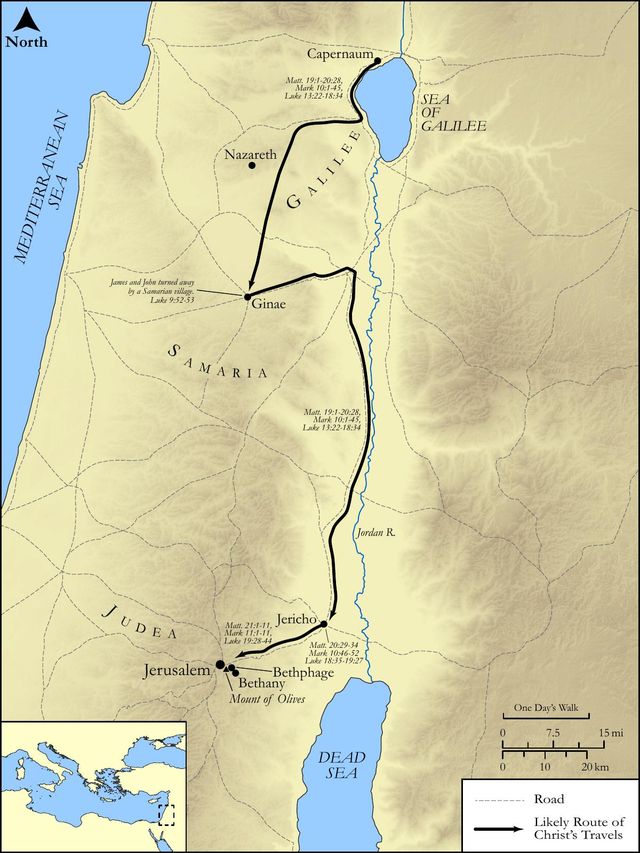
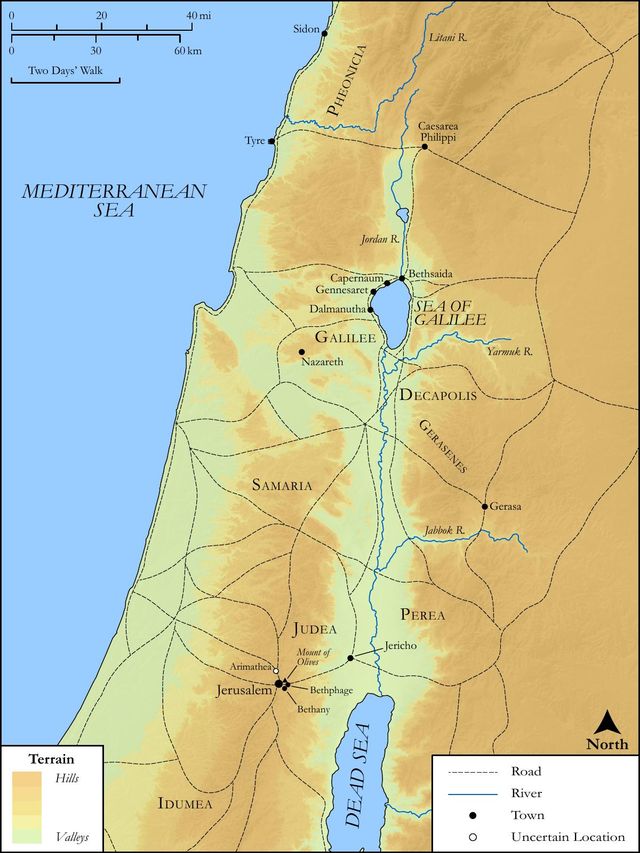
See on the biblical-era maps

Study this verse
Public-domain commentary
Matthew Henry
From his Commentary on the Whole Bible. Henry comments on passages, not single verses — this entry covers Mark 10:32–45. His three-level outline is real structure in the source text, so it is rendered as structure.
Here is, I. Christ's prediction of his own sufferings; this string he harped much upon, though in the ears of his disciples it sounded very harsh and unpleasing.
1.See here how bold he was; when they were going up to Jerusalem, Jesus went before them, as the captain of our salvation, that was now to be made perfect through sufferings, Mar 10:32. Thus he showed himself forward to go on with his undertaking, even when he came to the hardest part of it. Now that the time was at hand, he said, Lo, I come; so far was he from drawing back, that now, more than ever, he pressed forward. Jesus went before them, and they were amazed. They began now to consider what imminent danger they ran themselves into, when they went to Jerusalem; how very malicious the Sanhedrim which sat there was against their Master and them; and they were ready to tremble at the thought of it. To hearten them, therefore, Christ went before them. "Come," saith he, "surely you will venture where your Master ventures." Note, When we see ourselves entering upon sufferings, it is encouraging to see our Master go before us. Or, He went before them, and therefore they were amazed; they admired to see with what cheerfulness and alacrity he went on, though he knew he was going to suffer and die. Note, Christ's courage and constancy in going on with his undertaking for our salvation, are, and will be, the wonder of all his disciples.
2.See here how timorous and faint-hearted his disciples were; As they followed, they were afraid, afraid for themselves, as being apprehensive of their own danger; and justly might they be ashamed of their being thus afraid. Their Master's courage should have put spirit into them.
3.See here what method he took to silence their fears. He did not go about to make the matter better than it was, nor to feed them with hopes that he might escape the storm, but told them again what he had often told them before, the things that should happen to him. He knew the worst of it, and therefore went on thus boldly, and he will let them know the worst of it. Come, be not afraid; for,
(1.)There is no remedy, the matter is determined, and cannot be avoided.
(2.)It is only the Son of man that shall suffer; their time of suffering was now at hand, he will now provide for their security.
(3.)He shall rise again; the issue of his sufferings will be glorious to himself, and advantageous to all that are his, Mar 10:33, Mar 10:34. The method and particulars of Christ's sufferings are more largely foretold here than in any other of the predictions - that he shall first be delivered up by Judas to the chief priests and the scribes; that they shall condemn him to death, but, not having the power to put him to death, shall deliver him to the Gentiles, to the Roman powers, and they shall mock him, and scourge him, and spit upon him, and kill him. Christ had a perfect foresight, not only of his own death, but of all the aggravating circumstances of it; and yet he thus went forth to meet it.
II.The check he gave to two of his disciples for their ambitious request.
This story is much the same here as we had it Mat 20:20. Only there they are said to have made their request by their mother, here they are said to make it themselves; she introduced them, and presented their petition, and then they seconded it, and assented to it.
Note, 1. As, on the one hand, there are some that do not use, so, on the other hand, there are some that abuse, the great encouragements Christ has given us in prayer. He hath said, Ask, and it shall be given you; and it is a commendable faith to ask for the great things he has promised; but it was a culpable presumption in these disciples to make such a boundless demand upon their Master; We would that thou shouldest do for us whatsoever we shall desire. We had much better leave it to him to do for us what he sees fit, and he will do more than we can desire, Eph 3:20.
2.We must be cautious how we make general promises. Christ would not engage to do for them whatever they desired, but would know from them what it was they did desire; What would ye that I should do for you? He would have them go on with their suit, that they might be made ashamed of it.
3.Many have been led into a snare by false notions of Christ's kingdom, as if it were of this world, and like the kingdoms of the potentates of this world. James and John conclude, If Christ rise again, he must be a king, and if he be a king, his apostles must be peers, and one of these would willingly be the Primus par regni - The first peer of the realm, and the other next him, like Joseph in Pharaoh's court, or Daniel in Darius's.
4.Worldly honour is a glittering thing, with which the eyes of Christ's own disciples have many a time been dazzled. Whereas to be good should be more our care than to look great, or to have the pre-eminence.
5.Our weakness and short-sightedness appear as much in our prayers as in any thing. We cannot order our speech, when we speak to God, by reason of darkness, both concerning him and concerning ourselves. It is folly to prescribe to God, and wisdom to subscribe.
6.It is the will of Christ that we should prepare for sufferings, and leave it to him to recompense us for them. He needs not be put in mind, as Ahasuerus did, of the services of his people, nor can he forget their work of faith and labour of love. Our care must be, that we may have wisdom and grace to know how to suffer with him, and then we may trust him to provide in the best manner how we shall reign with him, and when, and where, and what, the degrees of our glory shall be.
III.The check he gave to the rest of the disciples, for their uneasiness at it.
They began to be much displeased, to have indignation about James and John, Mar 10:41. They were angry at them for affecting precedency, not because it did so ill become the disciples of Christ, but because each of them hoped to have it himself. When the Cynic trampled on Alexander's foot-cloth, with Calco fastum Alexandri - Now I tread on Alexander's pride, he was seasonably checked with Sed majori fastu - But with a greater pride of thine own. So these discovered their own ambition, in their displeasure at the ambition of James and John; and Christ took this occasion to warn them against it, and all their successors in the ministry of the gospel, Mar 10:42-44. He called them to him in a familiar way, to give them an example of condescension, then when he was reproving their ambition, and to teach them never to bid their disciples keep their distance. He shows them,
1.That dominion was generally abused in the world (Mar 10:42); That they seemed to rule over the Gentiles, that have the name and title of rulers, they exercise lordship over them, that is all they study and aim at, not so much to protect them, and provide for their welfare, as to exercise authority upon them; they will be obeyed, aim to be arbitrary, and to have their will in every thing. Sic volo, sic jubeo, stat pro ratione voluntas - Thus I will, thus I command; my good pleasure is my law. Their care is, what they shall get by their subjects to support their own pomp and grandeur, not what they shall do for them.
2.That therefore it ought not to be admitted into the church; "It shall not be so among you; those that shall be put under your charge, must be as sheep under the charge of the shepherd, who is to tend them and feed them, and be a servant to them, not as horses under the command of the driver, that works them and beats them, and gets his pennyworths out of them. He that affects to be great and chief, that thrusts himself into a secular dignity and dominion, he shall be servant of all, he shall be mean and contemptible in the eyes of all that are wise and good; he that exalteth himself shall be abased." Or rather, "He that would be truly great and chief, he must lay out himself to do good to all, must stoop to the meanest services, and labour in the hardest services. Those not only shall be most honoured hereafter, but are most honourable now, who are most useful." To convince them of this, he sets before them his own example (Mar 10:45); "The Son of man submits first to the greatest hardships and hazards, and then enters into his glory, and can you expect to come to it any other way; or to have more ease and honour than he has?" (1.) He takes upon him the form of a servant, comes not to be ministered to, and waited upon, but to minister, and wait to be gracious. (2.) He comes obedient to death, and to its dominion, for he gives his life a ransom for many; did he die for the benefit of good people, and shall not we study to live for their benefit?
Historical interpretation
Four Centuries of Reception
3 surviving comments on this verse. Each one is dated, so this reads as a timeline rather than a list.
Select a marker to jump to its quote. Markers stagger vertically where authors wrote within a few decades of each other.
(ubi sup.) In which He teaches, that he is the greater, who is the less, and that he becomes the lord, who is servant of all: vain, therefore, was it both for the one party to seek for immoderate things, aud the other to be annoyed at their desiring greater things, since we are to arrive at the height of virtue not by power but by humility. Then He proposes an example, that if they lightly regarded His words, His deeds might make them ashamed, saying, For even the Son of man came not to be ministered unto, but to minister, and to give his life a ransom for many.
(ubi sup.) He did not say, however, that He gave His life a ransom for all, but for many, that is, for those who would believe on Him.
But Jesus, calling them, said to them: You know that those who are considered to rule over the Gentiles lord it over them, and their great ones exercise authority over them. But it is not so among you, etc. Humble and meek teacher, he neither reproaches the two asking with excessive greed, nor does he rebuke the remaining ten with indignation and envy, but he sets such an example, by which he teaches that he is greater who is lesser, and that he becomes the master who is the servant of all. Therefore, in vain do those ask immoderately, or do these ones grieve over the desire for greatness, since one comes to the pinnacle of virtues not by power, but by humility. Finally, he proposes his own example, so that if his words were lightly esteemed, they might blush at his deeds. And he says:
The other Apostles are indignant at seeing James and John seeking for honour; wherefore it is said, And when the ten heard it, they began to be much displeased with James and John. For being influenced by human feelings, they were moved with envy; and their first displeasure arose from their seeing that they were not taken up by the Lord; before that time they were not displeased because they saw that they themselves were honoured before other men. At this time the Apostles were thus imperfect, but afterwards they yielded the chief place one to another. Christ however cures them; first indeed by drawing them to Himself in order to comfort them; and this is meant, when it is said, But Jesus called them to him; then by showing them that to usurp honour, and to desire the chief place, belongs to Gentiles. Wherefore there follows: And saith unto them, Ye know that they which are accounted to rule over the Gentiles exercise lordship; and their great ones exercise authority over them. The great ones of the Gentiles thrust themselves into the chief place tyrannically and as lords. It goes on: But so shall it not be among you.
Which is a greater thing than to minister. For what can be greater or more wonderful than that a man should die for him to whom he ministers? Nevertheless, this serving and condescension of humility was His glory, and that of all; for before He was made man, He was known only to the Angels; but now that He has become man and has been crucified, He not only has glory Himself, but also has taken up others to a participation in His glory, and ruled by faith over the whole world.
Continue studying Mark 10:42 across the web’s major study libraries — every link below opens this exact verse, chapter, or book on the destination site.
Read & Compare
 BibleGatewayThis verse in more than 200 translations and 70 languages.
 Bible.comThe YouVersion reader — hundreds of translations, reading plans, and highlights.
 ESV.orgCrossway's official English Standard Version reader.
 NET BibleThe NET translation with 60,000+ translators' notes on every rendering decision.
 STEP BibleTyndale House's free study tool — original text, vocabulary, and scholarly resources.
 BibliaLogos Bible Software's free web reader.
 USCCBThe New American Bible (Revised Edition) with the U.S. bishops' study notes.
Commentaries
 BibleHub CommentariesDozens of classic commentaries on this verse, gathered on one page.
 StudyLightMore than 100 commentary sets — the largest collection on the web.
 BibleRefPlain-English commentary on what this verse means, verse by verse.
 Enduring WordDavid Guzik's free commentary on this chapter, widely used by Bible teachers.
 Bible Study ToolsVerse commentary alongside Greek and Hebrew study aids.
Original Language & Research
- BibleHub InterlinearThe verse word by word — original language, transliteration, and English.
- BibleHub LexiconEvery word's original-language definition and Strong's entry.
 Blue Letter BibleDeep-study tools — Strong's numbers, concordance, and word studies.
 CNTR CollationThe earliest Greek manuscripts of this verse, collated letter by letter.
Sermons, Hymns & Audio


TrulyRandomVerse is not affiliated with these sites and doesn’t control their content. They’re linked because they’re genuinely useful.
Summary
Mark 10:42 captures Jesus' pivotal teaching on the nature of leadership, delivered in response to the ambitious request of James and John for positions of power in His coming kingdom. Jesus directly confronts the disciples' worldly understanding of authority by contrasting it with the prevailing model of Gentile rulers, who exercise their power through domination and control. This verse sets the stage for a radical redefinition of greatness within the Kingdom of God, challenging conventional notions of status and preparing His followers for a counter-cultural path of humble service.
Context
ShowHideLiterary Context
This verse is an immediate and direct response to the request of James and John, the sons of Zebedee, who had approached Jesus asking for the most prominent seats in His glory—one on His right hand and one on His left (Mark 10:35-37). This request, made despite Jesus' recent predictions of His suffering and death (Mark 10:32-34), reveals a profound misunderstanding of the nature of His kingdom and the path of discipleship. The other ten disciples were indignant at James and John's presumption (Mark 10:41), prompting Jesus to call all twelve together. He uses this moment to address not just the ambition of two, but the pervasive worldly mindset that tempted all of them, setting the stage for His revolutionary teaching on servant leadership in the verses that follow (Mark 10:43-45).
Historical & Cultural Context
Among the Gentiles of Jesus' time, power was typically exercised through a hierarchical system where rulers and "great ones" maintained their status through dominance, coercion, and the extraction of tribute or service from their subjects. The concept of "lordship" (κυριεύω, kyrieuō) and "authority" (ἐξουσιάζω, exousiazō) often implied a top-down, self-serving exercise of power, where leaders benefited from their position rather than serving those under them. This was the common experience for the Jewish people living under Roman occupation. Furthermore, within Jewish society, there were expectations of a Messiah who would establish a political kingdom, overthrowing Roman rule and restoring Israel's national glory. The disciples, like many of their contemporaries, likely held these conventional views of power and leadership, which Jesus directly challenges in this teaching.
Key Themes
ShowHideMark 10:42 is foundational to understanding several key themes in Mark's Gospel. Firstly, it highlights the contrast between worldly and Kingdom leadership, setting up Jesus' radical redefinition of greatness. While the world values status and control, Jesus will soon present a counter-cultural model of service and humility. Secondly, it exposes the misunderstanding of the disciples regarding the true nature of Jesus' mission and kingdom, demonstrating their lingering attachment to earthly ambitions despite their proximity to Christ. This theme of misunderstanding is recurrent throughout Mark. Finally, the verse introduces the theme of power and authority, not as an end in itself, but as a means to serve. Jesus' description of Gentile rulers' oppressive authority directly foreshadows His own example of self-emptying service, which culminates in His sacrificial death as a ransom for many (Mark 10:45).
Exposition and Analysis
ShowHideKey Word Analysis
ShowHideThis word implies thinking, seeming, or being reputed. In this context, it refers to those who are perceived or reputed to rule, highlighting the societal recognition of their status and power. It points to the outward appearance and human perception of authority.
Literally meaning "a race" or "a tribe," this term specifically refers to non-Jewish people, often with the implication of being pagan. Here, it denotes the nations outside of Israel, whose rulers operate by different principles than those of God's Kingdom. Jesus uses them as a stark example of worldly power dynamics.
This compound word combines kata (down, against) with kyrieuō (to be lord over, to rule as a master). The prefix kata intensifies the verb, suggesting a forceful, oppressive, or even subjugating form of dominion. It implies ruling down upon or against others, asserting control in a domineering manner.
Similarly, this word combines kata (down, against) with exousiazō (to have or wield full privilege or authority). The intensified form suggests a strong, perhaps even abusive, exertion of power. It speaks to the forceful application of one's position to control or dominate others, often for personal benefit rather than for the good of the governed.
Verse Breakdown
ShowHide"But Jesus called them [to him], and saith unto them,"
This opening clause emphasizes Jesus' initiative and authority. He doesn't wait for them to come to Him; He summons them, indicating the gravity and importance of the lesson He is about to impart. This is a deliberate act of teaching, not a casual observation.
"Ye know that they which are accounted to rule over the Gentiles"
Jesus appeals to their common knowledge and observation. He points to the familiar reality of how worldly power operates, specifically among the "Gentiles" (non-Jewish nations), which would have been a vivid and often oppressive reality for His Jewish audience living under Roman rule. The phrase "accounted to rule" highlights the societal recognition and perceived legitimacy of these rulers.
"exercise lordship over them;"
This describes the first aspect of Gentile rule: a domineering and controlling form of power. It signifies a master-servant relationship where the ruler asserts absolute control, often for their own benefit, over their subjects. The Greek word implies a forceful subjugation.
"and their great ones exercise authority upon them."
This second phrase reinforces the first, describing the powerful elite within Gentile society. "Great ones" refers to those in positions of high influence and power. The "exercise authority upon them" further emphasizes the top-down, often oppressive, application of power, where those in authority wield their influence over others, rather than serving them.
Literary Devices
ShowHideMark employs several literary devices in this verse to convey Jesus' message. The primary device is Contrast, as Jesus sets up a direct opposition between the prevailing model of Gentile leadership and the radical new paradigm He will introduce for His disciples. By vividly describing the domineering nature of worldly rulers, He creates a foil against which His teaching on servant leadership will shine more brightly. There is also an element of Didacticism, as Jesus is actively instructing His disciples, using a familiar cultural example to challenge their preconceived notions. His statement "Ye know" acts as a Rhetorical Question or an appeal to common knowledge, drawing the disciples into the conversation and preparing them for the counter-cultural truth He is about to reveal. Furthermore, the use of two distinct but complementary verbs, "exercise lordship" and "exercise authority," creates a sense of Emphasis through parallelism, underscoring the pervasive and often oppressive nature of worldly power.
Theological and Thematic Connections
ShowHideThis verse lays bare the fundamental incompatibility between the world's understanding of power and the divine principles of God's Kingdom. The Gentile model of leadership, characterized by domination and self-exaltation, stands in stark opposition to the self-giving, humble service exemplified by Christ. Theologically, it highlights the fallen nature of human authority when separated from God's design, often leading to oppression and injustice. It underscores that true greatness in God's eyes is not measured by the number of people one controls, but by the extent to which one serves and sacrifices for others. This teaching is a profound call to re-evaluate our own desires for status and control, aligning them instead with the counter-cultural values of the Gospel.
Reflection and Application
ShowHideMark 10:42 serves as a timeless mirror, reflecting the persistent temptation to embrace worldly models of power within any community, including the church and our personal lives. It challenges us to honestly examine our motivations for seeking influence or positions of leadership. Do we desire to "lord it over" others, to control or dominate, to be served, or to gain personal prestige? Or are we genuinely driven by a desire to serve, to uplift, and to empower those around us? This verse calls us to a radical reorientation of our understanding of authority, moving from a self-serving posture to one of self-sacrificial love. It reminds us that true impact and lasting influence in God's Kingdom are found not in asserting power, but in humbly laying down our lives for others, just as Christ did. This principle applies to every sphere of life—from parenting and professional roles to church leadership and community engagement—urging us to embody the counter-cultural spirit of servant leadership.
Questions for Reflection
ShowHideFAQ
ShowHideWhat is the significance of Jesus mentioning "Gentile" rulers specifically?
ShowHideJesus' specific mention of "Gentile" rulers is significant because it highlights a stark contrast between the prevailing, worldly model of leadership and the counter-cultural principles of His Kingdom. For His Jewish audience, "Gentile" rulers, particularly the Roman authorities, represented an oppressive, domineering, and often exploitative form of power. By pointing to this familiar example, Jesus underscores that His followers are called to a fundamentally different way of exercising influence—one that is antithetical to the self-serving, top-down approach common in the world. He is not merely describing a foreign system but explicitly rejecting its principles as unsuitable for His disciples.
How does this verse relate to leadership in the church today?
ShowHideThis verse is profoundly relevant for leadership in the church today, serving as a perpetual warning against adopting worldly power structures. It challenges church leaders—pastors, elders, deacons, and ministry heads—to resist the temptation to "lord it over" the flock or to "exercise authority" in a domineering or self-serving manner. Instead, it implicitly calls for a leadership style characterized by humility, service, and self-sacrifice, mirroring the example Jesus Himself would soon demonstrate (Mark 10:45). True spiritual authority in the church is not about control or status, but about empowering and nurturing others, fostering an environment where every member is valued and serves according to their gifts, as seen in passages like 1 Peter 5:2-3.
Christ-Centered Fulfillment
ShowHideMark 10:42, while descriptive of worldly leadership, serves as a crucial backdrop for understanding the radical nature of Christ's own kingship and the fulfillment of true authority. Jesus, the ultimate King, did not come to exercise lordship or authority in the oppressive manner of Gentile rulers. Instead, His entire life and ministry were a living embodiment of the alternative He proposed. He is the one who, though "in the form of God, did not count equality with God a thing to be grasped, but emptied himself, by taking the form of a servant" (Philippians 2:6-7). The very next verse in Mark's Gospel reveals the profound Christ-centered fulfillment: "For even the Son of Man came not to be served but to serve, and to give his life as a ransom for many" (Mark 10:45). Jesus' authority is not asserted through coercion but through self-sacrificial love, culminating in His death on the cross, where He truly "exercised authority" over sin and death by submitting to them. His reign is established not by dominating His subjects, but by liberating them through His humble service, inviting all who follow Him to participate in this same counter-cultural, cross-shaped pattern of leadership (John 13:14-15).