


2 Corinthians 3:8
Bible text: King James Version (1769 Blayney text) · Public domain
Bible text: Berean Standard Bible · Public domain
Bible text: American Standard Version (1901) · Public domain
Bible text: World English Bible, Messianic edition · Public domain
Bible text: Geneva Bible (1599) · Public domain
Bible text: Young's Literal Translation · Public domain
- πῶςpōshowG4459PRT-IInterrogative Particle Interrogative
- οὐχὶouchisurelyG3780PRT-NNegative Particle Negative
- μᾶλλονmallonmoreG3123ADVAdverb
- ἡhētheG3588T-NSFDefinite article Nominative Singular Feminine
- διακονίαdiakoniaministryG1248N-NSFNoun Nominative Singular Feminine
- τοῦtouof theG3588T-GSNDefinite article Genitive Singular Neuter
- πνεύματοςpneumatosSpiritG4151N-GSNNoun Genitive Singular Neuter
- ἔσταιestaiwill beG1510V-FDI-3SVerb Future Middle Deponent Indicative 3rd Singular
- ἐνeninG1722PREPPreposition
- δόξῃ;doxēglory?G1391N-DSFNoun Dative Singular Feminine
English is a literal word-by-word gloss of the Greek, not the KJV's wording. Why?
This is the original text the KJV's translators worked from — each Greek word with its own literal English meaning in this verse, prepared by scholars at Tyndale House, Cambridge. The KJV translates whole sentences, not word by word, so its wording differs: one Greek word can become several English words, and the KJV may choose “charity” where the gloss reads “love”. Both are faithful — they answer different questions. For the KJV's own rendering, switch to the KJV text.
Details
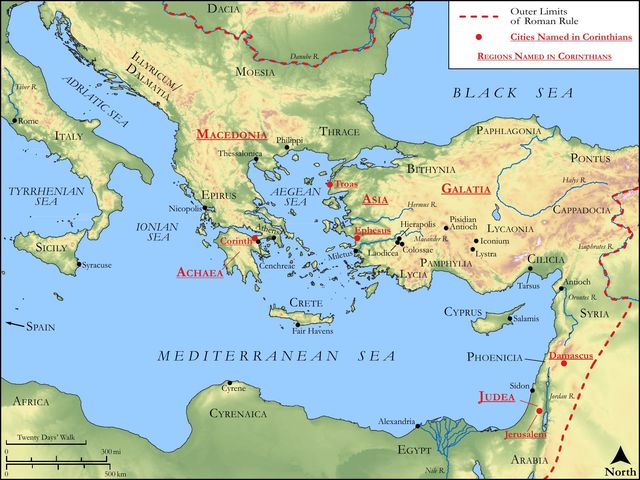
See on the biblical-era maps

Study this verse
Public-domain commentary
Matthew Henry
From his Commentary on the Whole Bible. Henry comments on passages, not single verses — this entry covers 2 Corinthians 3:6–11. His two-level outline is real structure in the source text, so it is rendered as structure.
Here the apostle makes a comparison between the Old Testament and the New, the law of Moses and the gospel of Jesus Christ, and values himself and his fellow-labourers by this, that they were able ministers of the New Testament, that God had made them so, Co2 3:6. This he does in answer to the accusations of false teachers, who magnify greatly the law of Moses.
I.He distinguishes between the letter and the spirit even of the New Testament, Co2 3:6.
As able ministers of the New Testament, they were ministers not merely of the letter, to read the written word, or to preach the letter of the gospel only, but they were ministers of the Spirit also; the Spirit of God did accompany their ministrations. The letter killeth; this the letter of the law does, for that is the ministration of death; and if we rest only in the letter of the gospel we shall be never the better for so doing, for even that will be a savour of death unto death; but the Spirit of the gospel, going along with the ministry of the gospel, giveth life spiritual and life eternal.
II.He shows the difference between the Old Testament and the New, and the excellency of the gospel above the law. For,
1.The Old Testament dispensation was the ministration of death (Co2 3:7), whereas that of the New Testament is the ministration of life. The law discovered sin, and the wrath and curse of God. This showed us a God above us and a God against us; but the gospel discovers grace, and Emmanuel, God with us. Upon this account the gospel is more glorious than the law; and yet that had a glory in it, witness the shining of Moses's face (an indication thereof) when he came down from the mount with the tables in his hand, that reflected rays of brightness upon his countenance.
2.The law was the ministration of condemnation, for that condemned and cursed every one who continued not in all things written therein to do them; but the gospel is the ministration of righteousness: therein the righteousness of God by faith is revealed. This shows us that the just shall live by his faith. This reveals the grace and mercy of God through Jesus Christ, for obtaining the remission of sins and eternal life. The gospel therefore so much exceeds in glory that in a manner it eclipses the glory of the legal dispensation, Co2 3:10. As the shining of a burning lamp is lost, or not regarded, when the sun arises and goes forth in his strength; so there was no glory in the Old Testament, in comparison with that of the New.
3.The law is done away, but the gospel does and shall remain, Co2 3:11. Not only did the glory of Moses's face go away, but the glory of Moses's law is done away also; yea, the law of Moses itself is now abolished. That dispensation was only to continue for a time, and then to vanish away; whereas the gospel shall remain to the end of the world, and is always fresh and flourishing and remains glorious.
Historical interpretation
Historical reception
3 surviving comments on this verse. Each one is dated, so this reads as a timeline rather than a list.
Select a marker to jump to its quote. Markers stagger vertically where authors wrote within a few decades of each other.
It is obvious that the grace of the law of faith is greater than that of the law of Moses. For although the law of Moses was intended to be beneficial, it became the law of death because it was flouted. Then, because there was no way it could make provision for sinners to be saved, there came the law of faith, which not only forgives sinners but also makes them righteous. There is therefore a great deal of difference between one law and the other.
For the Law was nothing else but letters: a certain succor was not found leaping forth from out the letters and inspiring them that combat, as is the case in Baptism; but pillars and writings bearing death to those who transgress the letters. Seest thou how in correcting the Jewish contentiousness, by his very expressions even he lessens its authority, speaking of stone and letters and a ministration of death, and adding that it was engraven? For hereby he declareth nothing else than this, that the Law was fixed in one place; not, as the Spirit, was present everywhere, breathing great might into all; or that the letters breathe much threatening, and threatening too which can not be effaced but remaineth for ever, as being engraved in stone. Then even whilst seeming to praise the old things, he again mixeth up accusation of the Jews. For having said, "written and engraven in stones, came with glory," he added, "so that the children of Israel could not look steadfastly upon the face of Moses;" which was a mark of their great weakness and grovelling spirit.
"How shall not rather the ministration of the Spirit be with glory?" for henceforth with confidence he extolleth the things of the New [Covenant] as indisputable. And observe what he doth. He opposed 'stone' to 'heart,' and 'letter' to 'spirit.' Then having shown the results of each, he doth not set down the results of each; but having set down the work of the latter, namely, death and condemnation, he setteth not down that of the spirit, namely, life and righteousness; but the Spirit Itself; which added greatness to the argument. For the New Covenant not only gave life, but supplied also 'The Spirit' Which giveth the life, a far greater thing than the life. Wherefore he said, "the ministration of the Spirit."
He said that the tables of Moses were of stone, as [also] they were written with letters; and that these were of flesh, I mean the hearts of the Apostles, and had been written on by the Spirit; and that the letter indeed killeth, but the Spirit giveth life. There was yet wanting to this comparison the addition of a further and not trifling particular, that of the glory of Moses; such as in the case of the New Covenant none saw with the eyes of the body. And even for this cause it appeared a great thing in that the glory was perceived by the senses; (for it was seen by the bodily eyes, even though it might not be approached;) but that of the New Covenant is perceived by the understanding.
Now by "ministration of death" he means the Law. And mark too how great the caution he uses in the comparison so as to give no handle to the heretics; for he said not, 'which causeth death,' but, "the ministration of death;" for it ministereth unto, but was not the parent of, death; for that which caused death was sin; but [the Law] brought in the punishment, and showed the sin, not caused it. For it more distinctly revealed the evil and punished it: it did not impel unto the evil: and it ministered not to the existence of sin or death, but to the suffering of retribution by the sinner. So that in this way it was even destructive of sin. For that which showeth it to be so fearful, it is obvious, maketh it also to be avoided. As then he that taketh the sword in his hands and cutteth off the condemned, ministers to the judge that passeth sentence, and it is not he that is his destruction, although he cutteth him off; nay, nor yet is it he who passeth sentence and condemneth, but the wickedness of him that is punished; so truly here also it is not that destroyeth, but sin. This did both destroy and condemn, but that by punishing undermined its strength, by the fear of the punishment holding it back.
Continue studying 2 Corinthians 3:8 across the web’s major study libraries — every link below opens this exact verse, chapter, or book on the destination site.
Read & Compare
 BibleGatewayThis verse in more than 200 translations and 70 languages.
 Bible.comThe YouVersion reader — hundreds of translations, reading plans, and highlights.
 ESV.orgCrossway's official English Standard Version reader.
 NET BibleThe NET translation with 60,000+ translators' notes on every rendering decision.
 STEP BibleTyndale House's free study tool — original text, vocabulary, and scholarly resources.
 BibliaLogos Bible Software's free web reader.
 USCCBThe New American Bible (Revised Edition) with the U.S. bishops' study notes.
Commentaries
 BibleHub CommentariesDozens of classic commentaries on this verse, gathered on one page.
 StudyLightMore than 100 commentary sets — the largest collection on the web.
 BibleRefPlain-English commentary on what this verse means, verse by verse.
 Enduring WordDavid Guzik's free commentary on this chapter, widely used by Bible teachers.
 Bible Study ToolsVerse commentary alongside Greek and Hebrew study aids.
Original Language & Research
- BibleHub InterlinearThe verse word by word — original language, transliteration, and English.
- BibleHub LexiconEvery word's original-language definition and Strong's entry.
 Blue Letter BibleDeep-study tools — Strong's numbers, concordance, and word studies.
 CNTR CollationThe earliest Greek manuscripts of this verse, collated letter by letter.
Sermons, Hymns & Audio


TrulyRandomVerse is not affiliated with these sites and doesn’t control their content. They’re linked because they’re genuinely useful.
Summary
Paul's rhetorical question in 2 Corinthians 3:8 serves as the climax of his argument contrasting the Old Covenant, characterized by the Law that brought condemnation, with the New Covenant, defined by the life-giving Spirit. He asserts that if the former, despite its glory, was a "ministration of death," then the latter, which imparts righteousness and life through the Holy Spirit, must inherently possess a far greater and more enduring glory, transforming believers from within.
Context
ShowHideLiterary Context
This verse is situated within Paul's profound theological discourse in 2 Corinthians 3, where he meticulously contrasts the Old Covenant (the "ministration of death" written on stone, 2 Corinthians 3:7) with the New Covenant (the "ministration of the spirit" and "ministration of righteousness," 2 Corinthians 3:8-9). Paul's argument builds from the fading glory on Moses' face, which reflected the glory of the Law, to the permanent, transforming glory of the Spirit that indwells believers. The preceding verses establish the fading nature of the Old Covenant's glory, setting the stage for the rhetorical question in 2 Corinthians 3:8 that emphasizes the superior and more enduring glory of the New Covenant.
Historical & Cultural Context
Paul's ministry in Corinth faced challenges from those who likely boasted in their adherence to the Mosaic Law and perhaps questioned Paul's apostolic authority or his emphasis on grace over law. Jewish tradition held the giving of the Law at Sinai in immense reverence, viewing it as the pinnacle of God's revelation and a source of national glory. Paul, a former Pharisee, understood this perspective intimately. His argument here is not to diminish the Law's divine origin or purpose but to demonstrate its temporary nature and preparatory role in light of the superior, life-giving reality of the New Covenant inaugurated by Christ. He leverages the widely respected image of Moses' veiled face after encountering God's glory (Exodus 34:29-35) to illustrate the fading glory of the Old Covenant compared to the unveiled, ever-increasing glory of the New Covenant.
Key Themes
ShowHideThe central theme of 2 Corinthians 3 is the superiority of the New Covenant over the Old. Paul highlights the ministry of the Spirit as the defining characteristic of this new era, contrasting it with the Law's inability to impart life or righteousness (Romans 8:3). This leads to the theme of surpassing glory, where the New Covenant, though less outwardly spectacular than Sinai, possesses an internal, transformative glory that far exceeds the external, fading glory of the Law. The Spirit's role in imparting life and righteousness is paramount, shifting the focus from external adherence to internal transformation (Ezekiel 36:26-27). Finally, the passage speaks to the unveiling of glory in Christ, allowing believers to behold and reflect the Lord's glory with unveiled faces (2 Corinthians 3:18).
Exposition and Analysis
ShowHideKey Word Analysis
ShowHideThis term, derived from diakonos (servant), denotes attendance, service, or ministry. In this context, it refers to the entire system or dispensation of the New Covenant, specifically the work carried out by God through the Holy Spirit. It emphasizes the active service and operation of the Spirit in bringing about God's purposes, rather than a passive state. It encompasses the entire scope of the Spirit's work in the lives of believers and in the church.
This word signifies a current of air, breath, or a spirit. Here, it specifically refers to the Holy Spirit, the third person of the Trinity. In contrast to the written Law, the Holy Spirit is the active agent of the New Covenant, imparting life, power, and righteousness. The "ministration of the spirit" is therefore the work and influence of the Holy Spirit, who indwells believers and empowers them for godly living and service.
From the base of dokeō (to seem, to think), dóxa refers to glory, dignity, honor, or praise, often implying something very apparent or magnificent. When applied to God, it speaks of His inherent majesty and splendor. In this verse, it describes the surpassing splendor and divine majesty associated with the New Covenant, particularly as it is administered by the Holy Spirit. It highlights the inherent excellence and divine approval of this new dispensation.
Verse Breakdown
ShowHide"How shall not the ministration of the spirit"
This phrase introduces a rhetorical question designed to elicit an obvious affirmative answer. Paul is arguing that if the Old Covenant, the "ministration of death" (2 Corinthians 3:7), had a certain glory, then the New Covenant, which is administered by the life-giving Holy Spirit, must logically possess an even greater, undeniable glory. The "ministration of the spirit" refers to the New Covenant dispensation, where the Holy Spirit is the active agent of God's work in humanity, writing God's laws on hearts and empowering believers.
"be rather glorious?"
The word "rather" (Greek, mâllon) emphasizes a comparative degree, indicating "more" or "in a greater degree." Paul is asserting that the glory of the Spirit's ministry is not just glorious, but more glorious, surpassingly glorious, compared to the fading glory of the Law. This glory is not merely external or temporary, but internal, transformative, and enduring, reflecting the very nature of God who is Spirit. It signifies the profound superiority and divine splendor of the New Covenant.
Literary Devices
ShowHidePaul employs Rhetorical Question to powerfully convey his argument. By asking "How shall not the ministration of the spirit be rather glorious?", he compels his audience to conclude that the Spirit's ministry is indeed more glorious, making his point undeniable. This device engages the reader directly and emphasizes the self-evident truth of his assertion. He also uses Contrast, setting the "ministration of death" (the Law) against the "ministration of the spirit" (the New Covenant). This stark juxtaposition highlights the fundamental differences in their effects and their respective degrees of glory. The Metaphor of "ministration" (diakonia) is used to describe both covenants as forms of divine service or administration, allowing for a direct comparison of their inherent qualities and outcomes. Finally, Hyperbole is subtly present in the emphasis on "rather glorious," suggesting an overwhelming and incomparable superiority of the New Covenant's glory.
Theological and Thematic Connections
ShowHideThe profound truth of 2 Corinthians 3:8 lies in its declaration of the New Covenant's unparalleled glory, rooted in the life-giving work of the Holy Spirit. Unlike the Old Covenant, which revealed sin and brought condemnation, the New Covenant, administered by the Spirit, brings righteousness, life, and transformation. This shift from external law to internal spiritual empowerment is central to Christian theology, demonstrating God's ultimate plan to write His law on human hearts and enable true obedience through the indwelling Spirit. It underscores the finished work of Christ, which made this new and better covenant possible, moving humanity from a veiled understanding of God's glory to an unveiled, participatory experience of it.
Reflection and Application
ShowHide2 Corinthians 3:8 invites us to profoundly appreciate the radical shift ushered in by the New Covenant. We no longer live under a system of external rules that condemn our failures, but under the empowering grace of the Holy Spirit who indwells us, transforming us from within. This means our spiritual growth is not about striving to meet impossible standards, but about yielding to the Spirit's work, allowing Him to produce righteousness and holiness in us. Our ministry, whether in formal roles or daily life, is therefore a "ministration of the Spirit," characterized by life, freedom, and an ever-increasing reflection of Christ's glory. This perspective should fill us with hope, humility, and a deep sense of gratitude for the surpassing glory of God's grace. It calls us to live by the Spirit, trusting in His power to enable us to live lives that truly honor God, rather than relying on our own strength or adherence to external codes.
Questions for Reflection
ShowHideFAQ
ShowHideWhat is the "ministration of the spirit" mentioned in 2 Corinthians 3:8?
ShowHideThe "ministration of the spirit" refers to the New Covenant, the new dispensation inaugurated by Jesus Christ, which is characterized by the active work and indwelling of the Holy Spirit. Unlike the Old Covenant (the Law), which was written on stone and revealed sin, leading to condemnation (hence, the "ministration of death" in 2 Corinthians 3:7), the New Covenant is administered by the Spirit. This means the Holy Spirit empowers believers, writes God's laws on their hearts, imparts righteousness, and brings spiritual life and transformation, making it a "ministration of life" and "righteousness" (2 Corinthians 3:6 and 2 Corinthians 3:9).
Christ-Centered Fulfillment
ShowHide2 Corinthians 3:8 finds its ultimate fulfillment in Jesus Christ, who is the very embodiment and mediator of this "ministration of the spirit." The Old Covenant, with its fading glory, pointed forward to Christ, who is the end of the Law for righteousness (Romans 10:4). It is through His perfect life, atoning death, and glorious resurrection that the New Covenant was established, and the Holy Spirit was poured out (Acts 2:33). Christ's work on the cross removed the veil that obscured God's glory under the Old Covenant, allowing believers to behold the Lord with unveiled faces and be transformed into His image by the Spirit (2 Corinthians 3:14-18). Thus, the "ministration of the spirit" is fundamentally a Christ-centered ministry, where the Spirit testifies of Christ (John 15:26), applies His redemptive work to believers, and empowers them to live lives that reflect the surpassing glory of God revealed in Jesus (John 1:14).