


Luke 1:40
- καὶkaiandG2532CONJConjunction
- εἰσῆλθενeisēlthenshe enteredG1525V-2AAI-3SVerb 2nd Aorist Active Indicative 3rd Singular
- εἰςeisintoG1519PREPPreposition
- τὸνtontheG3588T-ASMDefinite article Accusative Singular Masculine
- οἶκονoikonhouseG3624N-ASMNoun Accusative Singular Masculine
- ΖαχαρίουZachariouof ZechariahG2197N-GSM-PNoun Genitive Singular Masculine Individual
- καὶkaiandG2532CONJConjunction
- ἠσπάσατοēspasatogreetedG782V-ADI-3SVerb Aorist Middle Deponent Indicative 3rd Singular
- τὴνtēn<the>G3588T-ASFDefinite article Accusative Singular Feminine
- ἘλισάβετElisabetElizabethG1665N-ASF-PNoun Accusative Singular Feminine Individual
English is a literal word-by-word gloss of the Greek, not the KJV's wording. Why?
This is the original text the KJV's translators worked from — each Greek word with its own literal English meaning in this verse, prepared by scholars at Tyndale House, Cambridge. The KJV translates whole sentences, not word by word, so its wording differs: one Greek word can become several English words, and the KJV may choose “charity” where the gloss reads “love”. Both are faithful — they answer different questions. For the KJV's own rendering, switch to the KJV text.
Details
See on the biblical-era map
Study this verse
Public-domain commentary
Matthew Henry
From his Commentary on the Whole Bible. Henry comments on passages, not single verses — this entry covers Luke 1:39–56. His four-level outline is real structure in the source text, so it is rendered as structure.
We have here an interview between the two happy mothers, Elisabeth and Mary: the angel, by intimating to Mary the favour bestowed on her cousin Elisabeth (Luk 1:36), gave occasion for it; and sometimes it may prove a better piece of service that we think to bring good people together, to compare notes. Here is,
I.The visit which Mary made to Elisabeth.
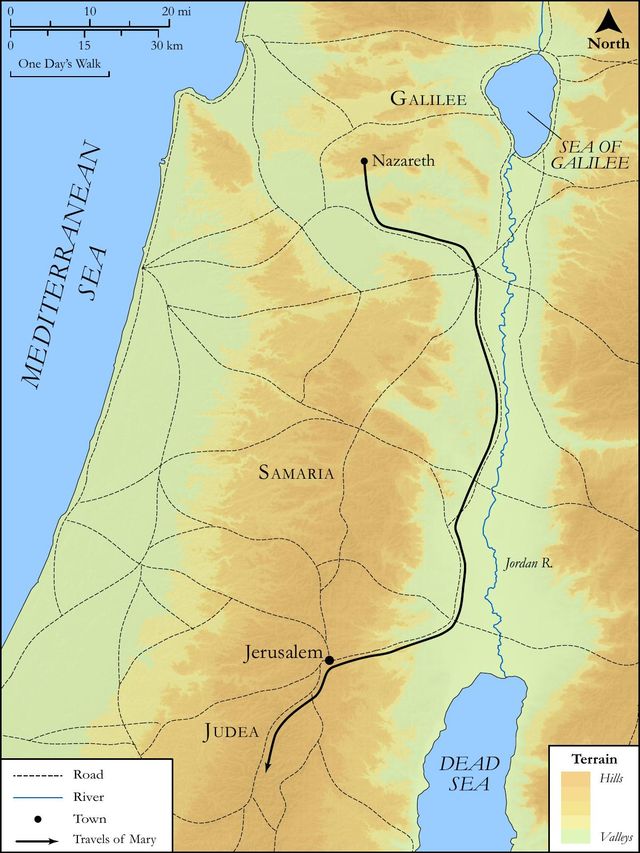
Mary was the younger, and younger with child; and therefore, if they must come together, it was fittest that Mary should take the journey, not insisting on the preference which the greater dignity of her conception gave her, Luk 1:39. She arose, and left her affairs, to attend this greater matter: in those days, at that time (as it is commonly explained, Jer 33:15; Jer 50:4), in a day or two after the angel had visited her, taking some time first, as it is supposed, for her devotion, or rather hastening away to her cousin's, where she would have more leisure, and better help, in the family of a priest. She went, meta spoudēs - with care, diligence, and expedition; not as young people commonly go abroad and visit their friends, to divert herself, but to inform herself: she went to a city of Judah in the hill-country; it is not named, but by comparing the description of it here with Jos 21:10, Jos 21:11, it appears to be Hebron, for that is there said to be in the hill-country of Judah, and to belong to the priests, the sons of Aaron; thither Mary hastened, though it was a long journey, some scores of miles.
1.Dr. Lightfoot offers a conjecture that she was to conceive our Saviour there at Hebron, and perhaps had so much intimated to her by the angel, or some other way; and therefore she made such haste thither. He thinks it probable that Shiloh, of the tribe of Judah, and the seed of David, should be conceived in a city of Judah and of David, as he was to be born in Bethlehem, another city which belonged to them both. In Hebron the promise was given to Isaac, circumcision was instituted. Here (saith he) Abraham had his first land, and David his first crown: here lay interred the three couples, Abraham and Sarah, Isaac and Rebecca, Jacob and Leah, and, as antiquity has held, Adam and Eve. He therefore thinks that it suits singularly with the harmony and consent which God uses in his works that the promise should begin to take place by the conception of the Messias, even among those patriarchs to whom it was given. I see no improbability in the conjecture, but add this for the support of it, that Elisabeth said (Luk 1:45), There shall be a performance; as if it were not performed yet, but was to be performed there.
2.It is generally supposed that she went thither for the confirming of her faith by the sign which the angel had given her, her cousin's being with child, and to rejoice with her sister-favourite. And, besides, she went thither, perhaps, that she might be more retired from company, or else might have more agreeable company than she could have in Nazareth. We may suppose that she did not acquaint any of her neighbours at Nazareth with the message she had received from heaven, yet longed to talk over a thing she had a thousand time thought over, and knew no person in the world with whom she could freely converse concerning it but her cousin Elisabeth, and therefore she hastened to her. Note, it is very beneficial and comfortable for those that have a good work of grace begun in their souls, and Christ in the forming there, to consult those who are in the same case, that they may communicate experiences one to another; and they will find that, as in water face answers to face, so doth the heart of man to man, of Christian to Christian.
II.The meeting between Mary and Elisabeth.
Mary entered into the house of Zacharias; but he, being dumb and deaf, kept his chamber, it is probable, and saw no company; and therefore she saluted Elisabeth (Luk 1:40), told her she was come to make her a visit, to know her state, and rejoice with her in her joy.
Now, at their first coming together, for the confirmation of the faith of both of them, there was something very extraordinary. Mary knew that Elisabeth was with child, but it does not appear that Elisabeth had been told any thing of her cousin Mary's being designed for the mother of the Messiah; and therefore what knowledge she appears to have had of it must have come by a revelation, which would be a great encouragement to Mary.
1.The babe leaped in her womb, Luk 1:41. It is very probable that she had been several weeks quick (for she was six months gone), and that she had often felt the child stir; but this was a more than ordinary motion of the child, which alarmed her to expect something very extraordinary, eskirtēse. It is the same word that is used by the Septuagint (Gen 25:22) for the struggling of Jacob and Esau in Rebecca's womb, and the mountains skipping, Psa 114:4. The babe leaped as it were to give a signal to his mother that he was now at had whose forerunner he was to be, about six months in ministry, as he was in being; or, it was the effect of some strong impression made upon the mother. Now began to be fulfilled what the angel said to his father (Luk 1:15), that he should be filled with the Holy Ghost, even from his mother's womb; and perhaps he himself had some reference to this, when he said (Joh 3:29), The friend of the Bridegroom rejoiceth greatly, because of the Bridegroom's voice, heard, though not by him, yet by his mother.
2.Elisabeth was herself filled with the Holy Ghost, or a Spirit of prophecy, by which, as well as by the particular suggestions of the Holy Ghost she was filled with, she was given to understand that the Messiah was at hand, in whom prophecy should revive, and by whom the Holy Ghost should be more plentifully poured out than ever, according to the expectations of those who waited for the consolation of Israel. The uncommon motion of the babe in her womb was a token of extraordinary emotion of her spirit under a divine impulse. Note, Those whom Christ graciously visits may know it by their being filled with the Holy Ghost; for, if any man have not the Spirit of Christ, he is none of his.
III.The welcome which Elisabeth, by the Spirit of prophecy, gave to Mary, the mother of our Lord; not as to a common friend making a common visit, but as to one of whom the Messiah was to be born.
1.She congratulates her on her honour, and, though perhaps she knew not of it till just now, she acknowledges it with the greatest assurance and satisfaction. She spoke with a loud voice, which does not at all intimate (as some think) that there was a floor or a wall between them, but that she was in a transport or exultation of joy, and said what she cared not who knew. She said, Blessed art thou among women, the same word that the angels had said (Luk 1:28); for thus this will of God, concerning honouring the Son, should be done on earth as it is done in heaven. But Elisabeth adds a reason, Therefore blessed art thou because blessed is the fruit of thy womb; thence it was that she derived this excelling dignity. Elisabeth was the wife of a priest, and in years, yet she grudges not that her kinswoman, who was many years younger than she, and every way her inferior, should have the honour of conceiving in her virginity, and being the mother of the Messiah, whereas the honour put upon her was much less; she rejoices in it, and is well pleased, as her son was afterwards, that she who cometh after her is preferred before her, Joh 1:27. Note, While we cannot but own that we are more favoured of God than we deserve, let us by no means envy that others are more highly favoured than we are.
2.She acknowledges her condescension, in making her this visit (Luk 1:43): Whence is this to me, that the mother of my Lord should come to me? Observe,
(1.)She calls the virgin Mary the mother of her Lord (as David in spirit, called the Messiah Lord, his Lord), for she knew he was to be Lord of all.
(2.)She not only bids her welcome to her house, though perhaps she came in mean circumstances, but reckons this visit a great favour, which she thought herself unworthy of. Whence is this to me? It is in reality, and not in compliment, that she saith, "This was a greater favour than I could have expected." Note, Those that are filled with the Holy Ghost have low thoughts of their own merits, and high thoughts of God's favours. Her son the Baptist spoke to the same purport with this, when he said, Comest thou to me? Mat 3:14.
3.She acquaints her with the concurrence of the babe in her womb, in this welcome to her (Luk 1:44): "Thou certainly bringest some extraordinary tidings, some extraordinary blessing, with thee; for as soon as the voice of thy salutation sounded in my ears, not only my heart leaped for joy, though I knew not immediately why or wherefore, but the babe in my womb, who was not capable of knowing, did so too." He leaped as it were for joy that the Messiah, whose harbinger he was to be, would himself come soon after him. This would serve very much to strengthen the faith of the virgin, that there were such assurances as these given to others; and it would be in part the accomplishment of what had been so often foretold, that there should be universal joy before the Lord, when he cometh, Psa 98:8, Psa 98:9.
4.She commends her faith, and encourages it (Luk 1:45): Blessed is she that believed. Believing souls are blessed souls, and will be found so at last; this blessedness cometh through faith, even the blessedness of being related to Christ, and having him formed in the soul. They are blessed who believe the word of God, for that Word will not fail them; there shall, without doubt, be a performance of those things which are told her from the Lord. Note, The inviolable certainty of the promise is the undoubted felicity of those that build upon it and expect their all from it. The faithfulness of God is the blessedness of the faith of the saints. Those that have experienced the performance of God's promises themselves should encourage others to hope that he will be as good as his word to them also: I will tell you what God has done for my soul.
IV.Mary's song of praise, upon this occasion.
Elisabeth's prophecy was an echo to the virgin Mary's salutation, and this song is yet a stronger echo to that prophecy, and shows her to be no less filled with the Holy Ghost than Elisabeth was. We may suppose the blessed virgin to come in, very much fatigued with her journey; yet she forgets that, and is inspired with new life, and vigour, and joy, upon the confirmation she here meets with of her faith; and since, by the sudden inspiration and transport, she finds that this was designed to be her errand hither, weary as she is, like Abraham's servant, she would neither eat nor drink till she had told her errand.
1.Here are the expressions of joy and praise, and God alone the object of the praise and centre of the joy. Some compare this song with that which her name-sake Miriam, the sister of Moses, sung, upon the triumphant departure of Israel out of Egypt, and their triumphant passage through the Red Sea; others think it better compared with the song of Hannah, upon the birth of Samuel, which, like this, passes from a family mercy to a public and general one. This begins, like that, My heart rejoiceth in the Lord, Sa1 2:1. Observe how Mary here speaks of God.
(1.)With great reverence of him, as the Lord: "My soul doth magnify the Lord; I never saw him so great as now I find him so good." Note, Those, and those only, are advanced in mercy, who are thereby brought to think the more highly and honourably of God; whereas there are those whose prosperity and preferment make them say, What is the Almighty, that we should serve him? The more honour God has any way put upon us, the more honour we must study to give to him; and then only are we accepted in magnifying the Lord, when our souls magnify him, and all that is within us. Praising work must be soul work.
(2.)With great complacency in him as her Saviour: My spirit rejoiceth in God my Saviour. This seems to have reference to the Messiah, whom she was to be the mother of. She calls him God her Saviour; for the angel had told her that he should be the Son of the Highest, and that his name should be Jesus, a Saviour; this she fastened upon, with application to herself: He is God my Saviour. Even the mother of our Lord had need of an interest in him as her Saviour, and would have been undone without it: and she glories more in that happiness which she had in common with all believers than in being his mother, which was an honour peculiar to herself, and this agrees with the preference Christ have to obedient believers above his mother and brethren; see Mat 12:50; Luk 11:27, Luk 11:28. Note, Those that have Christ for their God and Saviour have a great deal of reason to rejoice, to rejoice in spirit, that is rejoicing as Christ did (Luk 10:21), with spiritual joy.
2.Here are just causes assigned for this joy and praise.
(1.)Upon her own account, Luk 1:48, Luk 1:49. [1.] Her spirit rejoiced in the Lord, because of the kind things he had done for her: his condescension and compassion to her. He has regarded the low estate of his handmaiden; that is, he has looked upon her with pity, for so the word is commonly used. "He has chosen me to this honour, notwithstanding my great meanness, poverty, and obscurity." Nay, the expression seems to intimate, not only (to allude to that of Gideon, Jdg 6:15) that her family was poor in Judah, but that she was the least in her father's house, as if she were under some particular contempt and disgraced among her relations, was unjustly neglected, and the outcast of the family, and God put this honour upon her, to balance abundantly the contempt. I the rather suggest this, for we find something toward such honour as this put upon others, on the like consideration. Because God saw that Leah was hated, he opened her womb, Gen 29:31. Because Hannah was provoked, and made to fret, and insulted over, by Peninnah, therefore God gave her a son, Sa1 1:19. Whom men wrongfully depress and despise God doth sometimes, in compassion to them, especially if they have borne it patiently, prefer and advance; see Jdg 11:7. So in Mary's case. And, if God regards her low estate, he not only thereby gives a specimen of his favour to the whole race of mankind, whom he remembers in their low estate, as the psalmist speaks (Psa 136:23), but secures a lasting honour to her (for such the honour is that God bestows, honour that fades not away): "From henceforth all generations shall call me blessed, shall think me a happy woman and highly advanced." All that embrace Christ and his gospel will say, Blessed was the womb that bore him and the paps which he sucked, Luk 11:27. Elizabeth had once and again called her blessed: "But that is not all," saith she, "all generations of Gentiles as well as Jews shall call me so." [2.] Her soul magnifies the Lord, because of the wonderful things he had done for her (Luk 1:49): He that is mighty has done to me great things. A great thing indeed, that a virgin should conceive. A great thing indeed, that Messiah, who had been so long promised to the church, and so long expected by the church, should now at length be born. It is the power of the Highest that appears in this. She adds, and holy is his name; for so Hannah saith her song, There is none holy as the Lord, which she explains in the next words, for there is none beside thee, Sa1 2:2. God is a Being by himself, and he manifests himself to be so, especially in the work of our redemption. He that is mighty, even he whose name is holy, has done to me great things. Glorious things may be expected from him that is both mighty and holy; who can do every thing, and will do every thing well and for the best.
(2.)Upon the account of others. The virgin Mary, as the mother of the Messiah, is become a kind of public person, wears a public character, and is therefore immediately endued with another spirit, a more public spirit than before she had, and therefore looks abroad, looks about her, looks before her, and takes notice of God's various dealings with the children of men (Luk 1:50, etc.), as Hannah (Sa1 2:3, etc.). In this she has especially an eye to the coming of the Redeemer and God's manifesting himself therein.
[1.]It is a certain truth that God has mercy in store, mercy in reserve, for all that have a reverence for his majesty, and a due regard to his sovereignty and authority. But never did this appear so as in sending his Son into the world to save us (Luk 1:50): His mercy is on them that fear him; it has always been so; he has ever looked upon them with an eye of peculiar favour who have looked up to him with and eye of filial fear. But he hath manifested this mercy, so as never before, in sending his Son to bring in an everlasting righteousness, and work out an everlasting salvation, for them that fear him, and this from generation to generation; for there are gospel privileges transmitted by entail, and intended for perpetuity. Those that fear God, as their Creator and Judge, are encouraged to hope for mercy in him, through their Mediator and Advocate; and in him mercy is settled upon all that fear God, pardoning mercy, healing mercy, accepting mercy, crowning mercy, from generation to generation, while the world stands. In Christ he keepeth mercy for thousands.
[2.]It has been a common observation that God in his providence puts contempt upon the haughty and honour upon the humble; and this he has done remarkably in the whole economy of the work of man's redemption. As God had, with his mercy to her, shown himself mighty also (Luk 1:48, Luk 1:49), so he had, with his mercy on them that fear him, shown strength likewise with his arm. First, In the course of his providence, it is his usual method to cross the expectations of men, and proceed quite otherwise than they promise themselves. Proud men expect to carry all before them, to have their way and their will; but he scatters them in the imagination of their hearts, breaks their measures, blasts their projects, nay, and brings them low, and brings them down, by those very counsels with which they thought to advance and establish themselves. The mighty think to secure themselves by might in their seats, but he puts them down, and overturns their seats; while, on the other hand, those of low degree, who despaired of ever advancing themselves, and thought of no other than of being ever low, are wonderfully exalted. This observation concerning honour holds likewise concerning riches; many who were so poor that they had not bread for themselves and their families, by some surprising turn of Providence in favour of them, come to be filled with good things; while, on the other hand, those who were rich, and thought no other than that tomorrow should be as this day, that their mountain stood strong and should never be moved, are strangely impoverished, and sent away empty. Now this is the same observation that Hannah had made, and enlarged upon, in her song, with application to the case of herself and her adversary (Sa1 2:4-7), which very much illustrates this here. And compare also Psa 107:33-41; Psa 113:7-9; and Ecc 9:11. God takes a pleasure in disappointing their expectations who promise themselves great things in the world, and in out-doing the expectations of those who promise themselves but a little; as a righteous God, it is his glory to abase those who exalt themselves, and strike terror on the secure; and, as a good God, it is his glory to exalt those who humble themselves, and to speak comfort to those who fear before him. Secondly, This doth especially appear in the methods of gospel grace.
1.In the spiritual honours it dispenses. When the proud Pharisees were rejected, and Publicans and sinners went into the kingdom of heaven before them, - when the Jews, who followed after the law of righteousness, did not attain it, and the Gentiles, who never thought of it, attained to righteousness (Rom 9:30, Rom 9:31), - when God chose not the wise men after the flesh, not the mighty, or the noble, to preach the gospel, and plant Christianity in the world, but the foolish and weak things of the world, and things that were despised ( Co1 1:26, Co1 1:27) - then he scattered the proud, and put down the mighty, but exalted them of low degree. When the tyranny of the chief priests and elders were brought down, who had long lorded it over God's heritage, and hoped always to do so, and Christ's disciples, a company of poor despised fishermen, by the power they were clothed with, were made to sit on thrones, judging the twelve tribes of Israel, - when the power of the four monarchies was broken, and the kingdom of the Messiah, that stone cut out of the mountain without hands, is made to fill the earth, - then are the proud scattered, and those of low degree exalted.
2.In the spiritual riches it dispenses, Luk 1:53.
(1.)Those who see their need of Christ, and are importunately desirous of righteousness and life in him, he fills with good things, with the best things; he gives liberally to them, and they are abundantly satisfied with the blessings he gives. Those who are weary and heavy-laden shall find rest with Christ, and those who thirst are called to come to him and drink; for they only know how to value his gifts. To the hungry soul every bitter thing is sweet, manna is angels' food; and to the thirsty fair water is honey out of the rock.
(2.)Those who are rich, who are not hungry, who, like Laodicea, think they have need of nothing, are full of themselves and their own righteousness, and think they have a sufficiency in themselves, those he sends away from his door, they are not welcome to him, he sends them empty away, they come full of self, and are sent away empty of Christ. He sends them to the gods whom they served, to their own righteousness and strength which they trusted to.
[3.]It was always expected that the Messiah should be, in a special manner, the strength and glory of his people Israel, and so he is in a peculiar manner (Luk 1:54): He hath helped his servant Israel, antelabeto. He hath taken them by the hand, and helped them up that were fallen and could not help themselves. Those that were sunk under the burdens of a broken covenant of innocency are helped up by the blessings of a renewed covenant of grace. The sending of the Messiah, on whom help was laid for poor sinners, was the greatest kindness that could be done, the greatest help that could be provided for his people Israel, and that which magnifies it is,
First, That it is in remembrance of his mercy, the mercifulness of his nature, the mercy he has in store for his servant Israel. While this blessing was deferred, his people, who waited for it, were often ready to ask, Has God forgotten to be gracious? But now he made it appear that he had not forgotten, but remembered, his mercy. He remembered his former mercy, and repeated that to them in spiritual blessings which he had done formerly to them in temporal favours. He remembered the days of old. Where is he that brought them up out of the sea, out of Egypt? Isa 63:11. He will do the like again, which that was a type of.
Secondly, That it is in performance of his promise. It is a mercy not only designed, but declared (Luk 1:55); it was what he spoke to our fathers, that the Seed of the woman should break the head of the serpent; that God should dwell in the tents of Shem; and particularly to Abraham, that in his seed all the families of the earth shall be blessed, with the best of blessings, with the blessings that are for ever, and to the seed that shall be for ever; that is, his spiritual seed, for his carnal seed were cut off a little after this. Note, What God has spoken he will perform; what he hath spoken to the fathers will be performed to their seed; to their seed's seed, in blessings that shall last for ever.
Lastly, Mary's return to Nazareth (Luk 1:56), after she had continued with Elisabeth about three months, so long as to be fully satisfied concerning herself that she was with child, and to be confirmed therein by her cousin Elisabeth. Some think, though her return is here mentioned before Elisabeth's being delivered, because the evangelist would finish this passage concerning Mary before he proceeded with the story of Elisabeth, yet that Mary staid till her cousin was (as we say) down and up again; that she might attend on her, and be with her in her lying-in, and have her own faith confirmed by the full accomplishment of the promise of God concerning Elisabeth. But most bind themselves to the order of the story as it lies, and think she returned again when Elisabeth was near her time; because she still affected retirement, and therefore would not be there when the birth of this child of promise would draw a great deal of company to the house. Those in whose hearts Christ is formed take more delight than they used to do in sitting alone and keeping silence.
Historical interpretation
Ten Centuries of Reception
11 surviving comments on this verse. Each one is dated, so this reads as a timeline rather than a list.
Select a marker to jump to its quote. Markers stagger vertically where authors wrote within a few decades of each other.
Better men go to weaker men to give them some advantage by their visits. Thus the Savior came to John to sanctify John’s baptism.… Jesus was in her womb, and he hastened to sanctify John, who was still in his own mother’s womb. Before Mary came and greeted Elizabeth, the infant did not rejoice in her womb. But as soon as Mary spoke the word that the Son of God, in his mother’s womb, had supplied, “the infant [John] leaped in joy.” At that moment Jesus made his forerunner a prophet for the first time.
(vel Geometer.) Not only having obtained what he wished, but wondering at her virgin beauty, and the ripeness of her virtue.
Now she rightly calls the Lord the fruit of the virgin's womb, because He proceeded not from man, but from Mary alone. For they who are sown by their fathers are the fruits of their fathers.
The Angel, when he announced the hidden mysteries to the Virgin, that he might build up her faith by an example, related to her the conception of a barren woman. When Mary heard it, it was not that she disbelieved the oracle, or was uncertain about the messenger, or doubtful of the example, but rejoicing in the fulfilment of her wish, and consicentious in the observance of her duty, she gladly went forth into the hill country. For what could Mary now, filled with God, (plena Deo) but ascend into the higher parts with haste!
The grace of the Holy Spirit knows not of slow workings. Learn, ye virgins, not to loiter in the streets, nor mix in public talk.
But soon the blessed fruits of Mary's coming and our Lord's presence are made evident. For it follows, And it came to pass, that when Elisabeth heard the salutation of Mary, the babe leaped in her womb. Mark the distinction and propriety of each word. Elisabeth first heard the word, but John first experienced the grace. She heard by the order of nature, he leaped by reason of the mystery. She perceived the coming of Mary, he the coming of the Lord.
She who had hid herself because she conceived a son, began to glory that she carried in her womb a prophet, and she who had before blushed, now gives her blessing; as it follows, And she spake out with a loud voice, Blessed art thou among women. With a loud voice she exclaimed when she perceived the Lord's coming, for she believed it to be a holy birth. But she says, Blessed art thou among women. For none was ever partaker of such grace or could be, since of the one Divine seed, there is one only parent.
She says it not ignorantly, for she knew it was by the grace and operation of the Holy Spirit that the mother of the prophet should be saluted by the mother of his Lord, to the advancement and growth of her own pledge; but being aware that this was of no human deserving, but a gift of Divine grace, she therefore says, Whence is this to me, that is, By what right of mine, by what that I have done, for what good deeds?
You see that Mary doubted not but believed, and therefore the fruit of faith followed.
But happy are ye also who have heard and believed, for whatever soul hath believed, both conceives and brings forth the word of God, and knows His works.
(Hom. iv. in Matt.) Or else the Virgin kept to herself all those things which have been said, not revealing them to any one, for she did not believe that any credit would be given to her wonderful story; nay, she rather thought she would suffer reproach if she told it, as if wishing to screen her own guilt.
(super Ezech. lib. i. Hom. i. 8.) She was touched with the spirit of prophecy at once, both as to the past, present, and future. She knew that Mary had believed the promises of the Angel; she perceived when she gave her the name of mother, that Many was carrying in her womb the Redeemer of mankind; and when she foretold that all things would be accomplished, she saw also what was to follow in the future.
She went so that she could offer her congratulations concerning the gift which she had learned her fellow servant had received. This was not in order to prove the word of the angel by the attestation of a woman. Rather it was so that as an attentive young virgin she might commit herself to ministry to a woman of advanced age.
And she entered the house of Zechariah and greeted Elizabeth. Learn, O virgin, the humility of Mary, so that you may be chaste in body and devout in heart. The younger visits the elder, the virgin greets the wife. For it is fitting that the more chaste the virgin, the more humble she should be, and by deferring to elders, she may commend the habit of chastity with the testimony of humility. Alternatively: Mary to Elizabeth, the Lord came to John, so that this one might be filled with the Holy Spirit, and that one might consecrate baptism. The humility of the greater is indeed the exaltation of the lesser. Consequently, it follows:
Mary is blessed by Elisabeth with the same words as before by Gabriel, to show that she was to be reverenced both by men and angels.
This is the fruit which is promised to David, Of the fruit of thy body will I set upon thy throne. (Ps. 132:11.)
Nor is it to be wondered at, that our Lord, about to redeem the world, commenced His mighty works with His mother, that she, through whom the salvation of all men was prepared, should herself be the first to reap the fruit of salvation from her pledge.
But every soul which has conceived the word of God in the heart, straightway climbs the lofty summits of the virtues by the stairs of love, so as to be able to enter into the city of Juda, (into the citadel of prayer and praise, and abide as it were for three months in it,) to the perfection of faith, hope, and charity.
She went into the mountains, because Zacharias dwelt there. As it follows, To a city of Juda, and entered into the house of Zacharias. Learn, O holy women, the attention which ye ought to show for your kinswomen with child. For Mary, who before dwelt alone in the secret of her chamber, neither virgin modesty caused to shrink from the public gaze, nor the rugged mountains from pursuing her purpose, nor the tediousness of the journey from performing her duty. Learn also, O virgins, the lowliness of Mary. She came a kinswoman to her next of kin, the younger to the elder, nor did she merely come to her, but was the first to give her salutations; as it follows, And she saluted Elisabeth. For the more chaste a virgin is, the more humble she should be, and ready to give way to her elders. Let her then be the mistress of humility, in whom is the profession of chastity. Mary is also a cause of piety, in that the higher went to the lower, that the lower might be assisted, Mary to Elisabeth, Christ to John.
But because there have been other holy women who yet have borne sons stained with sin, she adds, And blessed is the fruit of thy womb. Or another interpretation is, having said, Blessed art thou among women, she then, as if some one enquired the cause, answers, And blessed is the fruit of thy womb: as it is said, Blessed be he that cometh in the name of the Lord. The Lord God, and he hath showed us light; (Ps. 118:26, 27.) for the Holy Scriptures often use and, instead of because.
The mother of our Lord had come to see Elisabeth, as also the miraculous conception, from which the Angel had told her should result the belief of a far greater conception, to happen to herself; and to this belief the words of Elisabeth refer, And blessed art thou who hast believed, for there shall be a performance of those things which were told thee from the Lord.
(Geometer.) But to Elisabeth alone she has recourse, as she was wont to do from their relationship, and other close bonds of union.
(Geometer.) For the Prophet sees and hears more acutely than his mother, and salutes the chief of Prophets; but as he could not do this in words, he leaps in the womb, which was the greatest token of his joy. Who ever heard of leaping at a time previous to birth? Grace introduced things to which nature was a stranger. Shut up in the womb, the soldier acknowledged his Lord and King soon to be born, the womb's covering being no obstacle to the mystical sight.
(Geometer.) This fruit alone then is blessed, because it is produced without man, and without sin.
(Severus.) From this place we derive the refutation of Eutyches, in that Christ is stated to be the fruit of the womb. For all fruit is of the same nature with the tree that bears it. It remains then that the virgin was also of the same nature with the second Adam, who takes away the sins of the world. But let those also who invent curious fictions concerning the flesh of Christ, blush when they hear of the real child-bearing of the mother of God. For the fruit itself proceeds from the very substance of the tree. Where too are those who say that Christ passed through the virgin as water through an aqueduct? Let these consider the words of Elisabeth who was filled with the Spirit, that Christ was the fruit of the womb. It follows, And whence is this to me, that the mother of my Lord should come to me?
Continue studying Luke 1:40 across the web’s major study libraries — every link below opens this exact verse, chapter, or book on the destination site.
Read & Compare
 BibleGatewayThis verse in more than 200 translations and 70 languages.
 Bible.comThe YouVersion reader — hundreds of translations, reading plans, and highlights.
 ESV.orgCrossway's official English Standard Version reader.
 NET BibleThe NET translation with 60,000+ translators' notes on every rendering decision.
 STEP BibleTyndale House's free study tool — original text, vocabulary, and scholarly resources.
 BibliaLogos Bible Software's free web reader.
 USCCBThe New American Bible (Revised Edition) with the U.S. bishops' study notes.
Commentaries
 BibleHub CommentariesDozens of classic commentaries on this verse, gathered on one page.
 StudyLightMore than 100 commentary sets — the largest collection on the web.
 BibleRefPlain-English commentary on what this verse means, verse by verse.
 Enduring WordDavid Guzik's free commentary on this chapter, widely used by Bible teachers.
 Bible Study ToolsVerse commentary alongside Greek and Hebrew study aids.
Original Language & Research
- BibleHub InterlinearThe verse word by word — original language, transliteration, and English.
- BibleHub LexiconEvery word's original-language definition and Strong's entry.
 Blue Letter BibleDeep-study tools — Strong's numbers, concordance, and word studies.
 CNTR CollationThe earliest Greek manuscripts of this verse, collated letter by letter.
Sermons, Hymns & Audio


TrulyRandomVerse is not affiliated with these sites and doesn’t control their content. They’re linked because they’re genuinely useful.
Summary
Luke 1:40 marks the pivotal moment of the Visitation, where Mary, freshly informed of her miraculous conception of Jesus, arrives at the home of her relative Elisabeth, who is also miraculously pregnant with John the Baptist. This verse describes Mary's physical entry into the house of Zacharias and her initial greeting to Elisabeth, setting the stage for a profound spiritual encounter that confirms God's unfolding redemptive plan through the lives of these two divinely chosen women.
Context
ShowHideLiterary Context
Luke 1:40 immediately follows Mary's hastened journey to the Judean hill country, as described in Luke 1:39. This journey is a direct response to the angelic announcement in Luke 1:26-38, where Gabriel not only foretold Jesus's birth but also offered Elisabeth's miraculous pregnancy as a sign of God's power (Luke 1:36). The act of Mary "entering" and "saluting" Elisabeth in verse 40 serves as the crucial trigger for the dramatic spiritual recognition and prophetic utterance that immediately follows in Luke 1:41-45. This verse, therefore, is the threshold to one of the most significant pre-birth encounters in the New Testament, linking the two miraculous conceptions and affirming the divine orchestration of events.
Historical & Cultural Context
In ancient Jewish society, kinship ties were extremely strong, and visiting relatives, especially those in need or experiencing significant life events like pregnancy, was a common and expected practice. The "hill country of Judah" was a rugged, often remote region, suggesting Mary's journey was not a casual stroll but a purposeful and perhaps arduous undertaking. The social stigma associated with barrenness (like Elisabeth's prior condition) meant her pregnancy was a profound reversal of fortune and a public sign of divine favor. Mary, a young, unwed woman facing an unprecedented pregnancy, would naturally seek the counsel and support of an older, trusted relative who also understood the miraculous hand of God. The greeting itself, as further analyzed, was far more than a casual "hello," carrying cultural weight of respect, affection, and acknowledgment of status.
Key Themes
ShowHideLuke 1:40 contributes significantly to several overarching themes within Luke's Gospel and the broader biblical narrative. It highlights the theme of Divine Confirmation, as Mary's visit provides tangible proof of Gabriel's words regarding Elisabeth, strengthening Mary's faith. It underscores the theme of God's Unexpected Ways, demonstrating how God uses humble individuals and seemingly ordinary human connections to advance His extraordinary plan, a theme prevalent throughout Luke's Gospel. Furthermore, the verse sets the stage for the theme of Prophetic Recognition and Messianic Anticipation, as the very presence of the Messiah (in Mary's womb) immediately elicits a spiritual response from John the Baptist (in Elisabeth's womb) in Luke 1:41, confirming Jesus's unique identity even before His birth. Finally, it subtly introduces the theme of Joy and Fellowship, as this encounter brings mutual encouragement and sets the stage for the Magnificat, Mary's song of praise, in Luke 1:46-55.
Exposition and Analysis
ShowHideKey Word Analysis
ShowHideFrom the Greek G1525, this verb signifies not merely a casual stepping across a threshold but a purposeful "coming in" or "going in." It implies a deliberate act of arrival and integration into a space. In this context, Mary's "entering" is an intentional movement, driven by divine instruction and personal faith, leading her into the very heart of Zacharias's household, a place where God's miraculous work was already evident.
The Greek G3624, oîkos, refers to more than just a physical dwelling. While it denotes a "dwelling," it also carries the broader implication of a "family" or "household." Thus, Mary is not just entering a building but becoming part of the intimate domestic sphere of Zacharias and Elisabeth, a place of shared life, faith, and now, miraculous pregnancies. This emphasizes the personal and relational nature of the encounter.
The Greek G782, aspázomai, is a rich term for greeting. It means "to enfold in the arms," implying a warm, affectionate greeting, often involving an embrace, a blessing, or a welcoming. It is far more profound than a simple "hello." Mary's "salutation" was not merely polite but carried a spiritual weight, signaling a heartfelt recognition and welcome that immediately triggered a divine response in Elisabeth and the child within her, as described in the subsequent verses.
Verse Breakdown
ShowHide"And entered into the house of Zacharias"
This clause describes Mary's arrival and penetration into the private sphere of her relatives. Her journey, undertaken "with haste" (Luke 1:39), culminates in this entry. The mention of "the house of Zacharias" emphasizes the patriarchal head of the household, but the focus quickly shifts to Elisabeth, the woman with whom Mary shares a unique spiritual bond and experience. This entry signifies the convergence of two miraculous pregnancies under one roof, orchestrated by God.
"and saluted Elisabeth"
This second clause describes Mary's immediate action upon entering. The act of "saluting" is the catalyst for the profound events that follow. As explored in the key word analysis, this was a warm, perhaps even embracing, greeting. It was not just a social formality but an act imbued with spiritual significance, as the presence of the Messiah in Mary's womb was carried into the presence of John the Baptist in Elisabeth's womb, eliciting an immediate and powerful prophetic response.
Literary Devices
ShowHideLuke 1:40, though concise, is rich with literary devices that amplify its significance. Foreshadowing is prominent, as Mary's greeting immediately precedes and sets the stage for the profound spiritual recognition and prophetic utterance of Elisabeth and John the Baptist in Luke 1:41-45. The humble act of a greeting foreshadows the divine revelation that is about to unfold. There is also subtle Juxtaposition between the two women: Mary, a young virgin, and Elisabeth, an elderly woman previously barren, both now miraculously pregnant by divine intervention. Their meeting highlights God's power to work through different circumstances and generations. The "house" itself functions as Symbolism, representing a sanctuary where divine promises converge and where the spiritual reality of God's plan becomes manifest through human interaction. The narrative employs Narrative Economy, conveying a significant turning point with simple, direct language, allowing the subsequent events to carry the full weight of the spiritual encounter.
Theological and Thematic Connections
ShowHideLuke 1:40 serves as a powerful testament to the importance of divine fellowship and the confirmation of God's work through human relationships. Mary, carrying the greatest news in history, does not retreat into isolation but actively seeks out a fellow believer, Elisabeth, who can understand and affirm her experience. This encounter underscores that God often uses community to provide comfort, strength, and validation for His purposes. It highlights the intergenerational nature of God's plan, where the old (Elisabeth, representing the fulfillment of Old Testament prophecy) and the new (Mary, representing the dawn of the New Covenant) come together in joyful recognition of the Messiah. The simple act of greeting becomes the conduit for a profound spiritual outpouring, demonstrating that even seemingly ordinary human interactions can be divinely charged.
Reflection and Application
ShowHideLuke 1:40, though a brief narrative detail, offers profound insights for contemporary believers. Mary's immediate action to visit Elisabeth, despite her own extraordinary circumstances, exemplifies humility, service, and the deep human need for spiritual connection and affirmation. In a world that often encourages isolation or self-reliance, Mary's example reminds us of the invaluable role of Christian community. When God does something miraculous or challenging in our lives, seeking out trusted, mature believers can provide essential encouragement, wisdom, and a shared space for processing divine revelation. This verse challenges us to consider: Who are our "Elisabeths" – those wise, godly individuals with whom we can share our spiritual journeys and receive confirmation? How might our simple acts of greeting, presence, and service open doors for God's Spirit to move powerfully, not just in our lives but in the lives of others? It teaches us that obedience to God's call often involves humble, relational steps that pave the way for greater divine manifestations.
Questions for Reflection
ShowHideFAQ
ShowHideWhy did Mary go to Elisabeth's house immediately after the Annunciation?
ShowHideMary's visit to Elisabeth, described in Luke 1:39-40, was prompted by two primary reasons. First, the angel Gabriel explicitly gave Elisabeth's miraculous pregnancy as a sign to Mary, confirming that "nothing will be impossible with God" (Luke 1:36-37). Mary's visit was likely an act of faith, seeking confirmation of this sign. Second, Mary, a young, unwed woman facing an unprecedented pregnancy, would naturally seek the comfort, counsel, and shared understanding of an older, trusted relative who was also experiencing a miraculous pregnancy. It was a journey for spiritual affirmation and mutual support.
What is the significance of Mary's "salutation" to Elisabeth?
ShowHideThe "salutation" (Greek: aspázomai) was far more than a casual greeting. It implies a warm, affectionate welcome, possibly involving an embrace, and carried deep spiritual significance. As soon as Mary's greeting reached Elisabeth's ears, John the Baptist "leaped in her womb" and Elisabeth was "filled with the Holy Spirit" (Luke 1:41). This immediate, divinely orchestrated reaction indicates that Mary's greeting, imbued with the presence of the Messiah, was the catalyst for a profound prophetic encounter, confirming the identities of both Jesus and John.
How does Luke 1:40 relate to the broader narrative of Luke's Gospel?
ShowHideLuke 1:40 is a crucial link in Luke's carefully constructed narrative of Jesus's birth and early life. It connects the two miraculous conceptions (John and Jesus), establishing their relationship and respective roles. It highlights Luke's emphasis on the Holy Spirit's work (Luke 1:41), the theme of joy (Luke 1:44), and the fulfillment of God's promises to Israel. This verse sets the stage for Mary's Magnificat (Luke 1:46-55), a pivotal theological statement that frames the entire Gospel. It underscores Luke's pastoral concern for the lowly and the role of women in God's redemptive plan.
Christ-Centered Fulfillment
ShowHideLuke 1:40, a seemingly simple account of a relative's visit, is profoundly Christ-centered in its implications. Mary's entry into Zacharias's house and her greeting to Elisabeth signify the arrival of the Messiah's presence into a new sphere, eliciting an immediate and undeniable spiritual response. This moment foreshadows Jesus's entire ministry: His physical presence brings the Spirit, joy, and prophetic recognition. Just as John the Baptist, still in the womb, "leaped for joy" at the sound of Mary's voice (Luke 1:44), so too would Jesus's later ministry bring spiritual awakening and joy to those who recognized Him as the Christ. His very presence, whether in the womb or walking the earth, is transformative, bringing light into darkness (John 1:4-5), truth to the lost (John 14:6), and ultimately, salvation to all who believe (John 3:16). The humble greeting in Luke 1:40 is a microcosm of the divine encounter that Jesus, the Lamb of God (John 1:29), would bring to the entire world, ushering in the kingdom of God and fulfilling centuries of messianic prophecy.