


Luke 1:38
- ΕἶπενEipenSaidG2036V-2AAI-3SVerb 2nd Aorist Active Indicative 3rd Singular
- δὲdethenG1161CONJConjunction
- Μαριάμ·MariamMaryG3137N-NSF-PNoun Nominative Singular Feminine Individual
- ἰδοὺidouBeholdG2400INJInterjection
- ἡhētheG3588T-NSFDefinite article Nominative Singular Feminine
- δούληdoulēhandmaidG1401N-NSFNoun Nominative Singular Feminine
- κυρίου·kuriouof [the] LordG2962N-GSM-TNoun Genitive Singular Masculine Title
- γένοιτόgenoitoWould [that] it happenG1096V-2ADO-3SVerb 2nd Aorist Middle Deponent Optative 3rd Singular
- μοιmoito meG3165P-1DSPersonal pronoun Dative 1st Singular
- κατὰkataaccording toG2596PREPPreposition
- τὸtotheG3588T-ASNDefinite article Accusative Singular Neuter
- ῥῆμάrhēmadeclarationG4487N-ASNNoun Accusative Singular Neuter
- σουsouof youG4771P-2GSPersonal pronoun Genitive 2nd Singular
- καὶkaiAndG2532CONJConjunction
- ἀπῆλθενapēlthendepartedG565V-2AAI-3SVerb 2nd Aorist Active Indicative 3rd Singular
- ἀπ᾽ap᾽fromG575PREPPreposition
- αὐτῆςautēsherG846P-GSFPersonal pronoun Genitive Singular Feminine
- ὁhotheG3588T-NSMDefinite article Nominative Singular Masculine
- ἄγγελοςangelosangelG32N-NSMNoun Nominative Singular Masculine
English is a literal word-by-word gloss of the Greek, not the KJV's wording. Why?
This is the original text the KJV's translators worked from — each Greek word with its own literal English meaning in this verse, prepared by scholars at Tyndale House, Cambridge. The KJV translates whole sentences, not word by word, so its wording differs: one Greek word can become several English words, and the KJV may choose “charity” where the gloss reads “love”. Both are faithful — they answer different questions. For the KJV's own rendering, switch to the KJV text.
Details
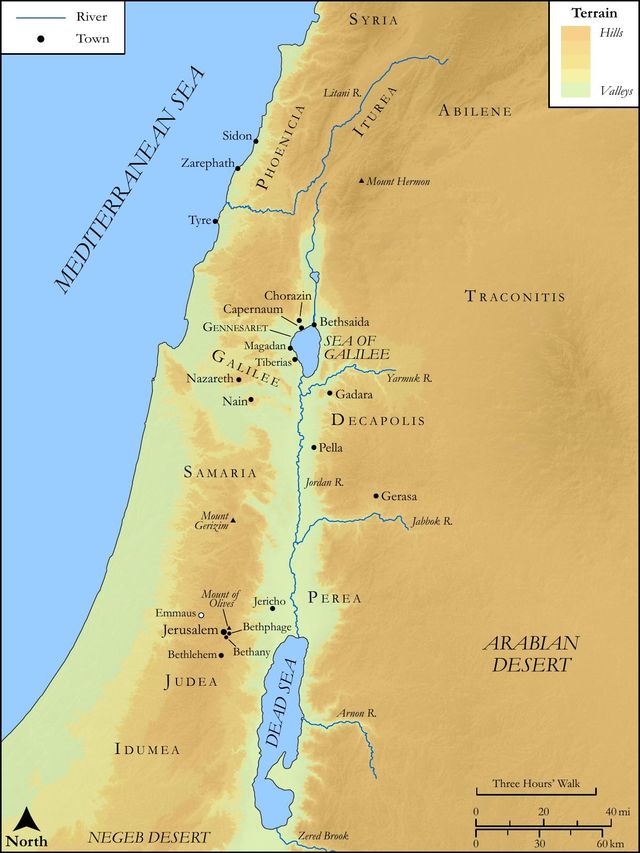
See on the biblical-era map
Study this verse
Public-domain commentary
Matthew Henry
From his Commentary on the Whole Bible. Henry comments on passages, not single verses — this entry covers Luke 1:26–38. His four-level outline is real structure in the source text, so it is rendered as structure.
We have here notice given us of all that it was fit we should know concerning the incarnation and conception of our blessed Saviour, six months after the conception of John. The same angel, Gabriel, that was employed in making known to Zacharias God's purpose concerning his son, is employed in this also; for in this, the same glorious work of redemption, which was begun in that, is carried on. As bad angels are none of the redeemed, so good angels are none of the redeemers; yet they are employed by the Redeemer as his messengers, and they go cheerfully on his errands, because they are his Father's humble servants, and his children's hearty friends and well-wishers.
I.We have here an account given of the mother of our Lord, of whom he was to be born, whom, though we are not to pray to, yet we ought to praise God for.
1.Her name was Mary, the same name with Miriam, the sister of Moses and Aaron; the name signifies exalted, and a great elevation it was to her indeed to be thus favoured above all the daughters of the house of David.
2.She was a daughter of the royal family, lineally descended from David, and she herself and all her friends knew it, for she went under the title and character of the house of David, though she was poor and low in the world; and she was enabled by God's providence, and the care of the Jews, to preserve their genealogies, to make it out, and as long as the promise of the Messiah was to be fulfilled it was worth keeping; but for those now, who are brought low in the world, to have descended from persons of honour, is not worth mentioning.
3.She was a virgin, a pure unspotted one, but espoused to one of the same royal stock, like her, however, of low estate; so that upon both accounts there was (as it was fit there should be) an equality between them; his name was Joseph; he also was of the house of David, Mat 1:20. Christ's mother was a virgin, because he was not to be born by ordinary generation, but miraculously; it was necessary that he should be so, that, though he must partake of the nature of man, yet not of the corruption of that nature: but he was born of a virgin espoused, made up to be married, and contracted, to put honour upon the married state, that that might not be brought into contempt (which was an ordinance in innocency) by the Redeemer's being born of a virgin.
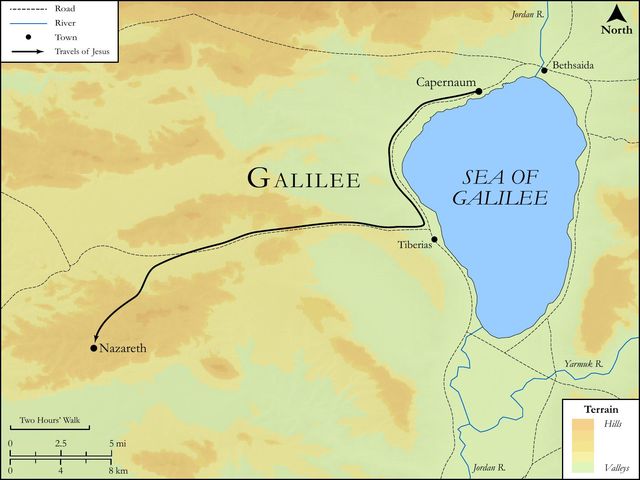
4.She lived in Nazareth, a city of Galilee, a remote corner of the country, and in no reputation for religion or learning, but which bordered upon the heathen, and therefore was called Galilee of the Gentiles. Christ's having his relations resident there intimates favour in reserve for the Gentile world. And Dr. Lightfoot observes that Jonah was by birth a Galilean, and Elijah and Elisha very much conversant in Galilee, who were all famous prophets of the Gentiles. The angel was sent to her from Nazareth. Note, No distance or disadvantage of place shall be a prejudice to those for whom God has favours in store. The angel Gabriel carries his message as cheerfully to Mary and Nazareth in Galilee as to Zacharias in the temple at Jerusalem.
II.The address of the angel to her, Luk 1:28.
We are not told what she was doing, or how employed, when the angel came unto her; but he surprised her with this salutation, Hail, thou art highly favoured. This was intended to raise in her,
1.A value for herself; and, though it is very rare that any need to have any sparks struck into their breast with such design, yet in some, who like Mary pore only on their low estate, there is occasion for it.
2.An expectation of great news, not from abroad, but from above. Heaven designs, no doubt, uncommon favours for one whom an angel makes court to with such respect, Hail thou, chaire - rejoice thou; it was the usual form of salutation; it expresses an esteem of her, and good-will to her and her prosperity.
(1.)She is dignified: "Thou art highly favoured. God, in his choice of thee to be the mother of the Messiah, has put an honour upon thee peculiar to thyself, above that of Eve, who was the mother of all living." The vulgar Latin translates this grati plena - full of grace, and thence gathers that she had more of the inherent graces of the Spirit than ever any had; whereas it is certain that this bespeaks no other than the singular favour done her in preferring her to conceive and bear our blessed Lord, an honour which, since he was to be the seed of the woman, some woman must have, not for personal merit, but purely for the sake of free grace, and she is pitched upon. Even so, Father, because it seemed good unto thee.
(2.)She has the presence of God with her: "The Lord is with thee, though poor and mean, and perhaps now forecasting how to get a livelihood and maintain a family in the married state." The angel with this word raised the faith of Gideon (Jdg 6:12): The Lord is with thee. Nothing is to be despaired of, not the performance of any service, not the obtaining of any favour, though ever so great, if we have God with us. This word might put her in mind of the Immanuel, God with us, which a virgin shall conceive and bear (Isa 7:14), and why not she?
(3.)She has the blessing of God upon her: "Blessed art thou among women; not only thou shalt be accounted so by men, but thou shalt be so. Thou that art so highly favoured in this instance mayest expect in other things to be blessed." She explains this herself (Luk 1:48), All generations shall call me blessed. Compare it with that which Deborah saith of Jael, another that was the glory of her sex (Jdg 5:24), Blessed shall she be above women in the tent.
III.The consternation she was in, upon this address (Luk 1:29).
When she saw him, and the glories with which he was surrounded, she was troubled at the sight of him, and much more at his saying. Had she been a proud ambitious young woman, that aimed high, and flattered herself with the expectation of great things in the world, she would have been pleased at his saying, would have been puffed up with it, and (as we have reason to think she was a young woman of very good sense) would have had an answer ready, signifying so much: but, instead of that, she is confounded at it, as not conscious to herself of any thing that either merited or promised such great things; and she cast in her mind what manner of salutation this should be. Was it from heaven or of men? Was it to amuse her? was it to ensnare her? was it to banter her? or was there something substantial and weighty in it? But, of all the thoughts she had as to what manner of salutation it should be, I believe she had not the least idea of its being ever intended or used for a prayer, as it is, and has been, for many ages, by the corrupt, degenerate, and anti-christian ages of the church, and to be ten times repeated for the Lord's prayer once; so it is in the church of Rome. But her thoughtfulness upon this occasion gives a very useful intimation to young people of her sex, when addresses are made to them, to consider and cast in their minds what manner of salutations they are, whence they come, and what their tendency is, that they may receive them accordingly, and may always stand on their guard.
IV.The message itself which the angel had to deliver to her.
Some time the angel gives her to pause; but, observing that this did but increase her perplexity, he went on with his errand, Luk 1:30. To what he had said she made no reply; he therefore confirms it: "Fear not, Mary, I have no other design than to assure thee that thou hast found favour with God more than thou thinkest of, as there are many who think they are more favoured with God than they really are." Note, Those that have found favour with God should not give way to disquieting distrustful fears. Doth God favour thee? Fear not, though the world frown upon thee. Is he for thee? No matter who is against thee.
1.Though she is a virgin, she shall have the honour of being a mother: "Thou shalt conceive in thy womb, and bring forth a son, and thou shalt have the naming of him; thou shalt call his name Jesus," Luk 1:31. It was the sentence upon Eve, that, though she should have the honour to be the mother of all living, yet this mortification shall be an allay to that honour, that her desire shall be to her husband, and he shall rule over her, Gen 3:16. But Mary has the honour without the allay.
2.Though she lives in poverty and obscurity, yet she shall have the honour to be the mother of the Messiah; her son shall be named Jesus - a Saviour, such a one as the world needs, rather than such one as the Jews expect.
(1.)He will be very nearly allied to the upper world. He shall be great, truly great, incontestably great; for he shall be called the Son of the Highest, the Son of God who is the Highest; of the same nature, as the son is of the same nature with the father; and very dear to him, as the son is to the father. He shall be called, and not miscalled, the Son of the Highest; for he is himself God over all, blessed for evermore, Rom 9:5. Note, Those who are the children of God, though but by adoption and regeneration, are truly great, and therefore are concerned to be very good, Jo1 3:1, Jo1 3:2.
(2.)He will be very highly preferred in the lower world; for, though born under the most disadvantageous circumstances possible, and appearing in the form of a servant, yet the Lord God shall give unto him the throne of his father David, Luk 1:32. He puts her in mind that she was of the house of David; and that therefore, since neither the Salique law, nor the right of primogeniture, took place in the entail of his throne, it was not impossible but that she might bring forth an heir to it, and therefore might the more easily believe it when she was told by an angel from heaven that she should do so, that after the sceptre had been long departed from that ancient and honourable family it should now at length return to it again, to remain in it, not by succession, but in the same hand to eternity. His people will not give him that throne, will not acknowledge his right to rule them; but the Lord God shall give him a right to rule them, and set him as his king upon the holy hill of Zion. He assures her,
[1.]That his kingdom shall be spiritual: he shall reign over the house of Jacob, not Israel according to the flesh, for they neither came into his interests nor did they continue long a people; it must therefore be a spiritual kingdom, the house of Israel according to the promise, that he must rule over.
[2.]That it shall be eternal: he shall reign for ever, and of his kingdom there shall be no end, as there had been long since of the temporal reign of David's house, and would shortly be of the state of Israel. Other crowns endure not to every generation, but Christ's doth, Pro 27:24. The gospel is the last dispensation, we are to look for no other.
V.The further information given her, upon her enquiry concerning the birth of this prince.
1.It is a just enquiry which she makes: "How shall this be? Luk 1:34. How can I now presently conceive a child" (for so the angel meant) "when I know not a man; must it therefore be otherwise than by ordinary generation? If so, let me now how?" She knew that the Messiah must be born of a virgin; and, if she must be his mother, she desires to know how. This was not the language of her distrust, or any doubt of what the angel said, but of a desire to be further instructed.
2.It is a satisfactory answer that is given to it, Luk 1:35. (1.) She shall conceive by the power of the Holy Ghost, whose proper work and office is to sanctify, and therefore to sanctify the virgin for this purpose. The Holy Ghost is called the power of the Highest. Doth she ask how this shall be? This is enough to help her over all the difficulty there appears in it; a divine power will undertake it, not the power of an angel employed in it, as in other works of wonder, but the power of the Holy Ghost himself.
(2.)She must ask no questions concerning the way and manner how it shall be wrought; for the Holy Ghost, as the power of the Highest, shall overshadow her, as the cloud covered the tabernacle when the glory of God took possession of it, to conceal it from those that would too curiously observe the motions of it, and pry into the mystery of it. The formation of every babe in the womb, and the entrance of the spirit of life into it, is a mystery in nature; none knows the way of the spirit, nor how the bones are formed in the womb of her that is with child, Ecc 11:5. We were made in secret, Psa 139:15, Psa 139:16. Much more was the formation of the child Jesus a mystery; without controversy, great was the mystery of godliness, God manifest in the flesh, Ti1 3:16. It is a new thing created in the earth (Jer 31:22), concerning which we must not covet to be wise above what is written.
(3.)The child she shall conceive is a holy thing, and therefore must not be conceived by ordinary generation, because he must not share in the common corruption and pollution of the human nature. He is spoken of emphatically, That Holy Thing, such as never was; and he shall be called the Son of God, as the Son of the Father by eternal generation, as an indication of which he shall now be formed by the Holy Ghost in the present conception. His human nature must be so produced, as it was fit that should be which was to be taken into union with the divine nature.
3.It was a further encouragement to her faith to be told that her cousin Elisabeth, though stricken in years, was with child, Luk 1:36. Here is an age of wonders beginning, and therefore be not surprised: here is one among thy own relations truly great, though not altogether so great as this; it is usual with God to advance in working wonders. Greater works than these shall ye do. Though Elisabeth was, on the father's side, of the daughters of Aaron (Luk 1:5), yet on the mother's side she might be of the house of David, for those two families often intermarried, as an earnest of the uniting of the royalty and the priesthood of the Messiah. This is the sixth month with her that was called barren. This intimates, as Dr. Lightfoot thinks, that all the instances in the Old Testament of those having children that had been long barren, which was above nature, were designed to prepare the world for the belief of a virgin's bearing a son, which was against nature. And therefore, even in the birth of Isaac, Abraham saw Christ's day, foresaw such a miracle in the birth of Christ. The angel assures Mary of this, to encourage her faith, and concludes with that great truth, of undoubted certainty and universal use, For with God nothing shall be impossible (Luk 1:37), and, if nothing, then not this. Abraham therefore staggered not at the belief of the divine promise, because he was strong in his belief of the divine power, Rom 4:20, Rom 4:21. No word of God must be incredible to us, as long as no work of God is impossible to him.
VI.Her acquiescence in the will of God concerning her, Luk 1:38. She owns herself,
1.A believing subject to the divine authority: "Behold, the handmaid of the Lord. Lord, I am at thy service, at thy disposal, to do what thou commandest me." She objects not the danger of spoiling her marriage, and blemishing her reputation, but leaves the issue with God, and submits entirely to his will.
2.A believing expectant of the divine favour. She is not only content that it should be so, but humbly desires that it may be so: Be it unto me according to thy word. Such a favour as this it was not for her to slight, or be indifferent to; and for what God has promised he will be sought unto; by prayer we must put our amen, or so be it, to the promise. Remember, and perform thy word unto thy servant, upon which thou has caused me to hope. We must, as Mary here, guide our desires by the word of God, and ground our hopes upon it. Be it unto me according to thy word; just so, and no otherwise.
Hereupon, the angel departed from her; having completed the errand he was sent upon, he returned, to give an account of it, and receive new instructions. Converse with angels was always a transient thing, and soon over; it will be constant and permanent in the future state. It is generally supposed that just at this instant the virgin conceived, by the overshadowing power of the Holy Ghost: but, the scripture being decently silent concerning it, it doth not become us to be inquisitive, much less positive.
Historical interpretation
Eighteen Centuries of Reception
14 surviving comments on this verse. Each one is dated, so this reads as a timeline rather than a list.
Select a marker to jump to its quote. Markers stagger vertically where authors wrote within a few decades of each other.
And hear again how Isaiah in express words foretold that He should be born of a virgin; for he spoke thus: "Behold, a virgin shall conceive, and bring forth a son, and they shall say for His name, `God with us.'" For things which were incredible and seemed impossible with men, these God predicted by the Spirit of prophecy as about to come to pass, in order that, when they came to pass, there might be no unbelief, but faith, because of their prediction. But lest some, not understanding the prophecy now cited, should charge us with the very things we have been laying to the charge of the poets who say that Jupiter went in to women through lust, let us try to explain the words. This, then, "Behold, a virgin shall conceive," signifies that a virgin should conceive without intercourse. For if she had had intercourse with any one whatever, she was no longer a virgin; but the power of God having come upon the virgin, overshadowed her, and caused her while yet a virgin to conceive. And the angel of God who was sent to the same virgin at that time brought her good news, saying, "Behold, thou shalt conceive of the Holy Ghost, and shalt bear a Son, and He shall be called the Son of the Highest, and thou shalt call His name Jesus; for He shall save His people from their sins," -as they who have recorded all that concerns our Saviour Jesus Christ have taught, whom we believed, since by Isaiah also, whom we have now adduced, the Spirit of prophecy declared that He should be born as we intimated before. It is wrong, therefore, to understand the Spirit and the power of God as anything else than the Word, who is also the first-born of God, as the foresaid prophet Moses declared; and it was this which, when it came upon the virgin and overshadowed her, caused her to conceive, not by intercourse, but by power. And the name Jesus in the Hebrew language means Σωτήρ (Saviour) in the Greek tongue. Wherefore, too, the angel said to the virgin, "Thou shalt call His name Jesus, for He shall save His people from their sins." And that the prophets are inspired by no other than the Divine Word, even you, as I fancy, will grant.
In accordance with this design, Mary the Virgin is found obedient, saying, "Behold the handmaid of the Lord; be it unto me according to your word." [Luke 1:38] But Eve was disobedient; for she did not obey when as yet she was a virgin. And even as she, having indeed a husband, Adam, but being nevertheless as yet a virgin (for in Paradise "they were both naked, and were not ashamed," [Genesis 2:25] inasmuch as they, having been created a short time previously, had no understanding of the procreation of children: for it was necessary that they should first come to adult age, and then multiply from that time onward), having become disobedient, was made the cause of death, both to herself and to the entire human race; so also did Mary, having a man betrothed [to her], and being nevertheless a virgin, by yielding obedience, become the cause of salvation, both to herself and the whole human race. And on this account does the law term a woman betrothed to a man, the wife of him who had betrothed her, although she was as yet a virgin; thus indicating the back-reference from Mary to Eve, because what is joined together could not otherwise be put asunder than by inversion of the process by which these bonds of union had arisen; so that the former ties be cancelled by the latter, that the latter may set the former again at liberty.
The handmaid of God dwells amid alien labours; and among these (labours), on all the memorial days of demons, at all solemnities of kings, at the beginning of the year, at the beginning of the month, she will be agitated by the odour of incense.
(vel Geometer.) Not only having obtained what he wished, but wondering at her virgin beauty, and the ripeness of her virtue.
(Carm. 18. de Geneal. Christi.) But some one will ask, How is Christ related to David, since Mary sprang from the blood of Aaron, the angel having declared Elisabeth to be her kinswoman? But this was brought about by the Divine counsel, to the end that the royal race might be united to the priestly stock; that Christ, Who is both King and Priest, might be descended from both according to the flesh. For it is written, that Aaron, the first High Priest according to the law, took from the tribe of Judah for his wife Elisabeth, the daughter of Aminadab. (Exod. 6:23.) And observe the most holy administration of the Spirit, in ordering that the wife of Zacharias should be called Elisabeth, so bringing us back to that Elisabeth whom Aaron married.
Behold now the humility, the devotion of the virgin. For it follows, But Mary said, Behold the handmaid of the Lord. She calls herself His handmaid, who is chosen to be His mother, so far was she from being exalted by the sudden promise. At the same time also by calling herself handmaid, she claimed to herself in no other way the prerogative of such great grace than that she might do what was commanded her. For about to bring forth One meek and lowly, she was bound herself to show forth lowliness. As it follows, Be it unto me according to thy word. You have her submission, you see her wish. Behold the handmaid of the Lord, signifies the readiness of duty. Be it unto me according to thy word, the conception of the wish.
(49 in Gen.) Seeing that his previous words had overcome the mind of the virgin, the angel drops his discourse to a humbler subject, persuading her by reference to sensible things. Hence he says, And, behold, Elisabeth thy cousin, &c. Mark the discretion of Gabriel; he did not remind her of Sarah, or Rebecca, or Rachel, because they were examples of ancient times, but he brings forward a recent event, that he might the more forcibly strike her mind. For this reason also he noticed the age, saying, She also hath conceived a son in her old age; and the natural infirmity also. As it follows, And this is the sixth month with her who was called barren. For not immediately at the beginning of Elisabeth's conception did he make this announcement, but after the space of six months, that the swelling of her womb might confirm its truth.
For the Lord of nature can do all things as He will, Who executes and disposes all things, holding the reins of life and death.
(sup.) Through an ineffable sacrament of a holy conception and a birth inviolable, agreeable to the truth of each nature, the same virgin was both the handmaid and mother of the Lord.
Now when the mediator between God and human beings appeared in the world, it was fitting that he had his physical origin from both tribes because, in the humanity which he assumed, he would possess the roles of both priest and king.
So it was then, lest the virgin should despair of being able to bear a son, that she received the example of one both old and barren about to bring forth, in order that she might learn that all things are possible with God, even those which seem to be opposed to the order of nature. Whence it follows, For there shall be no word (verbum) impossible with God.
Having received the consent of the virgin, the angel soon returns heavenward, as it follows, And the angel departed from her.
And the angel departed from her. Rising in those days, Mary went into the hill country with haste to a city of Judah. With the virgin's consent granted, the angel soon returned to the heavens, she sought the mountains. She hastens to visit Elizabeth, not as one who is incredulous about the oracle, nor doubtful about the example, but joyful for the vow, and devout for the duty. At the same time, she provides a typical example, that every soul which has conceived the word of God in the mind immediately ascends the lofty peaks of virtues with the step of love, so as to penetrate the city of Judah, that is, of confession and praise, and to be able to dwell as it were for three months in it, up to the perfection of faith, hope, and charity.
But Mary said: Behold the handmaid of the Lord. Let it be done to me according to your word. How great the humility with devotion, who wishes for the angel's promise to be fulfilled, and calls herself, though chosen to be the mother, the handmaid. She most explicitly insinuates that she claims no merit for herself in that she complies with the Lord's commands. Let it be (she says), conceived without a man's seed in the virgin, let it be born of the Holy Spirit in full flesh, let the Holy one be born from a mother woman without a human father, let him be called the Son of God.
(Victor Presbyter.) But observe, how the Angel has declared the whole Trinity to the Virgin, making mention of the Holy Spirit, the Power, and the Most High, for the Trinity is indivisible.c
(Geometer.) Some men will highly extol one thing, some another, in these words of the virgin. One man, for example, her constancy, another her willingness of obedience; one man her not being tempted by the great and glorious promises of the great archangel; another, her self-command in not giving an instant assent, equally avoiding both the heedlessness of Eve and the disobedience of Zacharias. But to me the depth of her humility is an object no less worthy of admiration
There is an activity of God displayed throughout creation, a wholesale activity let us say which men refuse to recognize. The miracles done by God incarnate, living as a man in Palestine, perform the very same things as this wholesale activity, but at a different speed and on a smaller scale. One of their chief purposes is that men, having seen a thing done by personal power on the small scale, may recognize, when they see the same thing done on the large scale, that the power behind it is also personal – is indeed the very same person who lived among us two thousand years ago. The miracles in fact are a retelling in small letters of the very same story which is written across the whole world in letters too large for some of us to see...
I can understand the man who denies the miraculous altogether; but what is one to make of the people who admit some miracles but deny the Virgin Birth? Is it that for all their lip service to the laws of Nature there is only one law of Nature that they really believe? Or is it that they see in this miracle a slur upon sexual intercourse which is rapidly becoming the one thing venerated in a world without veneration? No miracle is in fact more significant. What happens in ordinary generation? What is a father’s function in the act of begetting? A microscopic particle of matter from his body fertilizes the female: and with that microscopic particle passes, it may be, the color of his hair and his great grandfather’s hanging lip, and the human form in all its complexity of bones, liver, sinews, heart, and limbs, and pre-human form which the embryo will recapitulate in the womb. Behind every spermatozoon lies the whole history of the universe: locked within it is no small part of the world’s future. That is God’s normal way of making a man – a process that takes centuries, beginning with the creation of matter itself, and narrowing to one second and one particle at the moment of begetting. And once again men will mistake the sense impressions which this creative act throws off for the act itself or else refer it to some infinite being such as Genius. Once, therefore, God does it directly, instantaneously; without a spermatozoon, without the millenniums of organic history behind the spermatozoon. There was of course another reason. This time He was creating not simply a man, but the man who was to be Himself: the only true Man. The process which leads to the spermatozoon has carried down with it through the centuries much undesirable silt; the life which reaches us by that normal route is tainted. To avoid that taint, to give humanity a fresh start, he once short-circuited the process. There is a vulgar anti-God paper which some anonymous donor sends me every week. In it recently I saw the taunt that we Christians believe in a God who committed adultery with the wife of a Jewish carpenter. The answer to that is that if you describe the action of God in fertilizing Mary as “adultery” then, in that sense, God would have committed adultery with every woman who ever had a baby. For what He did once without a human father, He does always even when He uses a human father as His instrument. For the human father in ordinary generation is only a carrier, sometimes an unwilling carrier, always the last in a long line of carriers, of life that comes from the supreme life. Thus the filth that our poor, muddled, sincere, resentful enemies fling at the Holy One, either does not stick, or, sticking, turns into glory.
Continue studying Luke 1:38 across the web’s major study libraries — every link below opens this exact verse, chapter, or book on the destination site.
Read & Compare
 BibleGatewayThis verse in more than 200 translations and 70 languages.
 Bible.comThe YouVersion reader — hundreds of translations, reading plans, and highlights.
 ESV.orgCrossway's official English Standard Version reader.
 NET BibleThe NET translation with 60,000+ translators' notes on every rendering decision.
 STEP BibleTyndale House's free study tool — original text, vocabulary, and scholarly resources.
 BibliaLogos Bible Software's free web reader.
 USCCBThe New American Bible (Revised Edition) with the U.S. bishops' study notes.
Commentaries
 BibleHub CommentariesDozens of classic commentaries on this verse, gathered on one page.
 StudyLightMore than 100 commentary sets — the largest collection on the web.
 BibleRefPlain-English commentary on what this verse means, verse by verse.
 Enduring WordDavid Guzik's free commentary on this chapter, widely used by Bible teachers.
 Bible Study ToolsVerse commentary alongside Greek and Hebrew study aids.
Original Language & Research
- BibleHub InterlinearThe verse word by word — original language, transliteration, and English.
- BibleHub LexiconEvery word's original-language definition and Strong's entry.
 Blue Letter BibleDeep-study tools — Strong's numbers, concordance, and word studies.
 CNTR CollationThe earliest Greek manuscripts of this verse, collated letter by letter.
Sermons, Hymns & Audio


TrulyRandomVerse is not affiliated with these sites and doesn’t control their content. They’re linked because they’re genuinely useful.
Summary
Luke 1:38 records Mary's profound and pivotal response to the angel Gabriel's astonishing announcement that she would conceive the Son of God. Her declaration, "Behold the handmaid of the Lord; be it unto me according to thy word," encapsulates a spirit of deep humility, unwavering faith, and complete submission to God's divine and seemingly impossible plan, thereby setting in motion the miraculous incarnation of Jesus Christ.
Context
ShowHideLiterary Context
This verse serves as the climax of the Annunciation narrative, immediately following Gabriel's detailed revelation to Mary. The angel has just explained how the Holy Spirit will overshadow her, enabling her to conceive the Son of God, Jesus, despite her virginity Luke 1:35. Gabriel also offered a corroborating sign—the miraculous pregnancy of her elderly relative Elizabeth Luke 1:36—and concluded with the powerful affirmation that "with God nothing shall be impossible" Luke 1:37. Mary's response in verse 38 is her unreserved acceptance of this divine decree, a crucial moment that transitions from angelic proclamation to human cooperation, enabling the unfolding of God's redemptive plan. The angel's subsequent departure signifies the completion of his mission and the commencement of God's work in Mary.
Historical & Cultural Context
Mary, a young Jewish woman, was betrothed to Joseph, a carpenter. In ancient Jewish society, betrothal was a legally binding agreement, almost as serious as marriage itself, requiring a formal divorce for dissolution. An unmarried pregnancy carried immense social stigma, potential disgrace for her family, and even the risk of public shame or stoning under Mosaic Law, though by this period, divorce was the more common consequence. For Mary to accept a pregnancy outside of marriage, even one divinely ordained, was an act of profound courage that defied cultural norms and risked her reputation and future. Her self-identification as a "handmaid" (δούλη, doulē) reflects a deep understanding of servitude common in the ancient world, where a handmaid was a female bondservant, entirely at the disposal of her master. This term underscores her willing submission to God's authority and purpose, prioritizing His will above all personal and societal concerns.
Key Themes
ShowHideLuke 1:38 contributes significantly to several overarching themes within Luke's Gospel and the broader biblical narrative. It powerfully illustrates Divine Sovereignty, demonstrating God's absolute authority and ability to initiate and accomplish His purposes through chosen vessels, even in seemingly impossible circumstances. Mary's response highlights the theme of Human Obedience and Faith, showcasing how a humble "yes" to God's call can unleash divine power and fulfill ancient prophecies. Her declaration, "Behold the handmaid of the Lord," exemplifies Humility and Servanthood, presenting Mary as a model of complete surrender to God's will, a theme echoed in the life and teachings of Jesus himself Mark 10:45. Furthermore, this verse is central to the theme of Incarnation, as Mary's acceptance directly facilitates the miraculous conception and birth of Jesus, the Son of God, who is the fulfillment of God's promises to Israel and the world Luke 1:31-33.
Exposition and Analysis
ShowHideKey Word Analysis
ShowHideMeaning "a female slave (involuntarily or voluntarily)." Mary's use of this term signifies her complete and willing submission to God's will. It is not a forced servitude but a devoted commitment, indicating that she sees herself as entirely at God's disposal, ready to fulfill His purpose regardless of the personal cost or social implications.
A verb meaning "to cause to be ('gen'-erate), i.e. (reflexively) to become (come into being), used with great latitude (literal, figurative, intensive, etc.)." In Mary's statement, "be it unto me," this word is in the optative mood, expressing a wish or prayer. It's a powerful and active affirmation, "Let it happen to me," or "May it be done to me," indicating her full consent and desire for God's word to be actualized in her life.
Meaning "an utterance (individually, collectively or specially); by implication, a matter or topic (especially of narration, command or dispute)." Here, "thy word" refers specifically to the divine message and promise delivered by Gabriel. Mary's acceptance is not merely of a concept but of the specific, authoritative, and life-altering utterance from God.
Verse Breakdown
ShowHide"And Mary said,"
This simple introductory phrase highlights Mary's agency. Her response is not coerced but a conscious, verbal affirmation following Gabriel's astonishing announcement. It sets the stage for a moment of profound human decision in the face of divine revelation.
"Behold the handmaid of the Lord;"
This is Mary's self-identification and declaration of her status. By calling herself a "handmaid" (δούλη, doulē), she expresses deep humility, complete submission, and a willingness to be a servant entirely dedicated to God's will. "Behold" (ἰδού, idoú) draws attention to her posture of availability and readiness.
"be it unto me according to thy word."
This is the core of Mary's response, an active and profound act of faith and obedience. "Be it unto me" (γένοιτό μοι, genoito moi) is an optative verb, expressing a wish or prayer, signifying her full consent and desire for God's spoken word (ῥῆμά σου, rhēma sou) to be fulfilled in her. It is an unreserved "yes" to the divine plan, despite its incomprehensibility and potential personal cost.
"And the angel departed from her."
This concluding clause signifies the completion of Gabriel's mission. Mary's acceptance marks the transition point; the divine message has been delivered and received, and the stage is now set for God's miraculous work to begin. The angel's departure implies that the human response has been sufficient, and divine action will now follow.
Literary Devices
ShowHideLuke 1:38 is rich in literary significance, primarily showcasing Humility and Submission through Mary's self-designation as "the handmaid of the Lord." This title is not merely descriptive but performative, embodying her complete surrender to God's will. The phrase "be it unto me according to thy word" functions as a powerful declaration of Faith and Obedience, demonstrating Mary's trust in God's ability to accomplish what seems humanly impossible. It also serves as a moment of Prophetic Fulfillment, as Mary's "yes" facilitates the incarnation of the Messiah, implicitly fulfilling Old Testament prophecies regarding the virgin birth. Furthermore, there is a subtle Dramatic Irony in the scene; while Mary understands the immediate, challenging implications of her acceptance, the full cosmic significance of her "yes"—that it ushers in the Savior of the world—is far grander than she could fully grasp at that moment.
Theological and Thematic Connections
ShowHideMary's response in Luke 1:38 stands as a profound theological statement on the interplay between divine sovereignty and human free will. Her humble submission to God's extraordinary call demonstrates that while God's plans are immutable, He often chooses to work through the willing cooperation of humanity. Mary's faith, accepting a reality that defied natural law and societal expectation, models radical trust in God's power and goodness. This act of surrender is foundational to the Christian understanding of discipleship, where obedience to God's word, even when challenging, opens the door for His miraculous work in and through believers. It underscores that true greatness in God's kingdom is found not in self-assertion but in humble service and faithful responsiveness to His divine initiatives.
Reflection and Application
ShowHideMary's "yes" in Luke 1:38 offers a timeless blueprint for how believers are called to respond to God's will in their own lives. Her radical obedience, despite the immense personal and social cost, challenges us to examine our own willingness to surrender to divine purposes that may seem illogical, inconvenient, or even impossible from a human perspective. Just as Mary's "yes" opened the door for the Incarnation, our own acts of faithful obedience, however small, can become conduits for God's transformative work in the world. This verse invites us to cultivate a heart of humble servanthood, trusting that God's word is always true and His power limitless, even when our circumstances dictate otherwise. It reminds us that true faith is not merely intellectual assent but an active, willing participation in God's unfolding story, echoing Mary's profound declaration, "be it unto me according to thy word."
Questions for Reflection
ShowHideFAQ
ShowHideWas Mary fully aware of the implications of her "yes" in Luke 1:38?
ShowHideWhile Mary undoubtedly understood the immediate, profound, and potentially scandalous implications of conceiving a child as a virgin, it is unlikely she grasped the full cosmic and redemptive scope of her "yes." She knew she was to bear the Son of God, who would be great and reign over Jacob's house forever Luke 1:32-33, but the precise nature of Jesus's messianic mission, his suffering, death, and resurrection, would have unfolded gradually. Her response was one of profound faith and submission to the revealed will of God, trusting in His character even when the future was uncertain. Her later pondering of events in her heart Luke 2:19 suggests a process of ongoing understanding and revelation.
Why is Mary's declaration "Behold the handmaid of the Lord" so significant?
ShowHideThis declaration is profoundly significant because it encapsulates Mary's complete and willing surrender to God's will. The term "handmaid" (δούλη, doulē) signifies a female bondservant, someone entirely at the disposal of her master. By using this term, Mary expresses deep humility and a radical commitment to God's purpose, prioritizing His plan above her personal reputation, comfort, or societal expectations. It demonstrates that her "yes" was not a reluctant concession but an active embrace of her role in God's redemptive plan, setting a powerful example of faithful obedience for all believers.
Christ-Centered Fulfillment
ShowHideMary's humble and obedient "yes" in Luke 1:38 is the human pivot point for the ultimate Christ-centered fulfillment of God's redemptive plan. Her declaration, "Behold the handmaid of the Lord; be it unto me according to thy word," directly facilitates the Incarnation, the moment when the eternal Son of God took on human flesh within her womb. This act of divine condescension, enabled by Mary's faithful submission, is the very foundation of our salvation. Just as Mary, the handmaid, perfectly submitted to the Father's will, so too did her Son, Jesus, embody ultimate servanthood and obedience, even to the point of death on a cross Philippians 2:7-8. Mary's "let it be" foreshadows Christ's own prayer in Gethsemane, "Nevertheless, not my will, but yours, be done" Luke 22:42. Through Mary's obedient acceptance, the Word became flesh and dwelt among us John 1:14, inaugurating the new covenant and making possible our reconciliation with God. Her faithful response, therefore, is not merely a historical event but a vital link in the divine chain that culminates in Christ's saving work and the offer of eternal life to all who believe.