


Judges 11:7
Bible text: King James Version (1769 Blayney text) · Public domain
Bible text: King James Version with Strong's numbers · Public domain
Bible text: Berean Standard Bible · Public domain
Bible text: American Standard Version (1901) · Public domain
Bible text: World English Bible, Messianic edition · Public domain
Bible text: Geneva Bible (1599) · Public domain
Bible text: Young's Literal Translation · Public domain
- וַיֹּאמֶרvai·Yo·merand he saidH559Conj-w ¦ V-Qal-ConsecImperf-3msVerb Qal Consecutive Imperfect 3rd Singular Masculineוַandיֹּאמֶרhe said
- יִפְתָּחyif·TachJephthahH3316N-proper-mNoun Proper Masculine
- לְזִקְנֵיle·zik·Neito [the] elders ofH2205Prep-l ¦ Adj-mpcAdjective Plural Masculine Constructלְtoזִקְנֵי[the] elders of
- גִלְעָדgil·'AdGileadH1568N-properNoun Proper Location
- הֲלֹאha·Lo'¿ notH3808Interrog ¦ NegParticle Negativeהֲ¿לֹאnot
- אַתֶּם'a·TemyouH859Pro-2mpPronoun Personal 2nd Plural Masculine
- שְׂנֵאתֶםse·ne·Temdid you hateH8130V-Qal-Perf-2mpVerb Qal Perfect 2nd Plural Masculine
- אוֹתִי'o·Ti<obj.> meH853DirObjM ¦ 1csParticle Object Indicatorאוֹתִ<obj.>יme
- וַתְּגָרְשׁוּנִיva·te·ga·re·Shu·niand did you drive out? meH1644Conj-w ¦ V-Piel-ConsecImperf-2mp ¦ 1csVerb Piel Consecutive Imperfect 2nd Plural Masculineוַandתְּגָרְשׁוּdid you drive out?נִיme
- מִבֵּיתmi·Beitfrom [the] house ofH1004Prep-m ¦ N-mscNoun Singular Masculine Constructמִfromבֵּית[the] house of
- אָבִי'a·Vimy fatherH1N-msc ¦ 1csNoun Singular Masculine Constructאָבִfatherיmy
- וּמַדּוּעַu·ma·Du·a'and why?H4069Conj-w ¦ InterrogParticle Interrogativeוּandמַדּוּעַwhy?
- בָּאתֶםba·Temhave you comeH935V-Qal-Perf-2mpVerb Qal Perfect 2nd Plural Masculine
- אֵלַי'e·Laito meH413Prep ¦ 1csPreposition Definiteאֵלַtoיme
- עַתָּה'A·tahnowH6258AdvAdverb
- כַּאֲשֶׁרka·'a·Sherjust whenH834Prep-k ¦ RelParticle Relativeכַּjustאֲשֶׁרwhen
- צַרtzar[is] distressH6862N-csNoun Singular common gender Absolute
- לָכֶםla·Khemto <the> youPrep-l ¦ 2mpSuffix Personal 2nd Plural Masculineלָto <the>כֶםyou
English is a literal word-by-word gloss of the Hebrew, not the KJV's wording. Why?
This is the original text the KJV's translators worked from — each Hebrew word with its own literal English meaning in this verse, prepared by scholars at Tyndale House, Cambridge. The KJV translates whole sentences, not word by word, so its wording differs: one Hebrew word can become several English words, and the KJV may choose “the LORD” where the gloss reads “Yahweh”. Both are faithful — they answer different questions. For the KJV's own rendering, switch to the KJV text.
Details
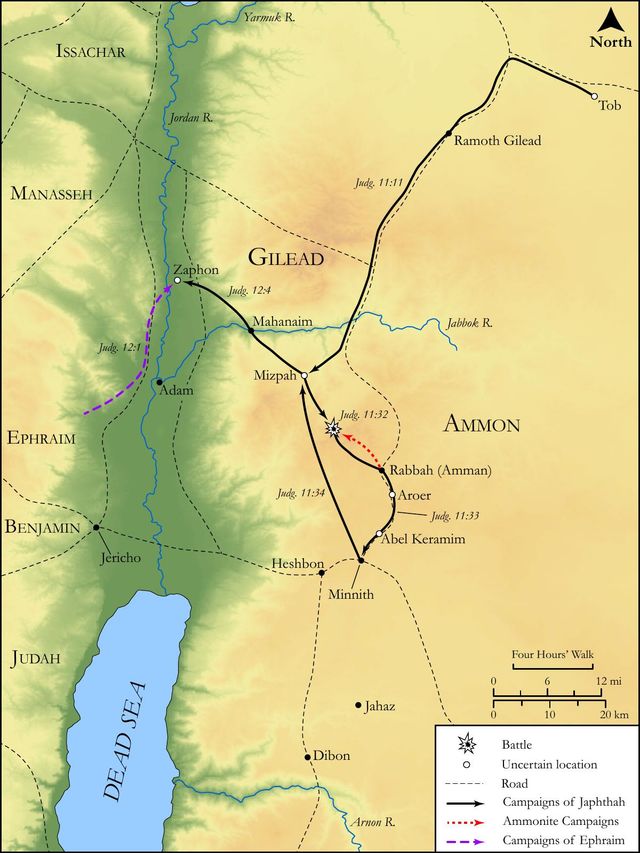
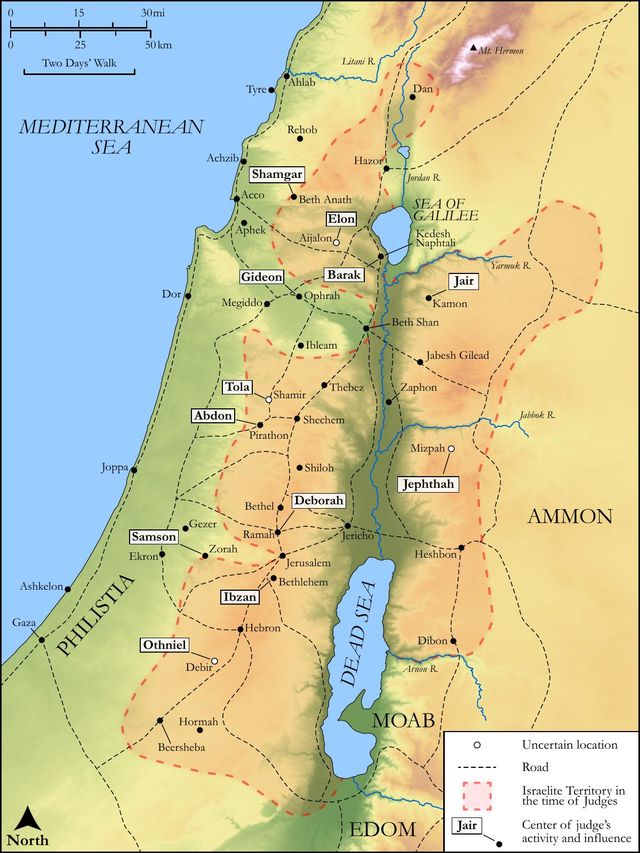
See on the biblical-era maps
Study this verse
Public-domain commentary
Matthew Henry
From his Commentary on the Whole Bible. Henry comments on passages, not single verses — this entry covers Judges 11:4–11. His two-level outline is real structure in the source text, so it is rendered as structure.
Here is, I. The distress which the children of Israel were in upon the Ammonites' invasion of their country, Jdg 11:4. Probably this was the same invasion with that mentioned, Jdg 10:17, when the children of Ammon were gathered together and encamped in or against Gilead. And those words, in process of time, refer to what goes immediately before of the expulsion of Jephthah; many days after he had been thus thrust out in disgrace was he fetched back again with honour.
II.The court which the elders made to Jephthah hereupon to come and help them.
They did not write or send a messenger to him, but went themselves to fetch him, resolving to have no denial, and the exigence of the case was such as would admit no delay. Their errand to him was, Come, and be our captain, Jdg 11:6. They knew none among themselves that was able to undertake that great trust, but in effect confessed themselves unfit for it; they know him to be a bold man, and inured to the sword, and therefore he must be the man. See how God prepared men for the service he designs them for, and makes their troubles work for their advancement. If Jephthah had not been put to his shifts by his brethren's unkindness, he would not have had such occasion as this gave him to exercise and improve his martial genius, and so to signalize himself and become famous. Out of the eater comes forth meat. The children of Israel were assembled and encamped, Jdg 10:17. But an army without a general is like a body without a head; therefore Come, say they, and be our captain, that we may fight. See the necessity of government; though they were hearty enough in the cause, yet they owned they could not fight without a captain to command them. So necessary is it to all societies that there be a pars imperans and a pars subdita, some to rule and others to obey, that any community would humbly beg the favour of being commanded rather than that every man should be his own master. Blessed be God for government, for a good government.
III.The objections Jephthah makes against accepting their offer:
Did you not hate me, and expel me? Jdg 11:7. It should seem that his brethren were some of these elders, or these elders by suffering his brethren to abuse him, and not righting him as they ought to have done (for their business is to defend the poor and fatherless, Psa 82:3, Psa 82:4), had made themselves guilty of his expulsion, and he might justly charge them with it. Magistrates, that have power to protect those that are injured, if they neglect to redress their grievances are really guilty of inflicting them. "You hated me and expelled me, and therefore how can I believe that you are sincere in this proposal, and how can you expect that I should do you any service?" Not but that Jephthah was very willing to serve his country, but he thought fit to give them a hint of their former unkindness to him, that they might repent of their sin in using him so ill, and might for the future be the more sensible of their obligations. Thus Joseph humbled his brethren before he made himself known to them. The particular case between the Gileadites and Jephthah was a resemblance of the general state of the case between Israel and God at this time. They had thrust God out by their idolatries, yet in their distress begged his help; he told them how justly he might have rejected them, and yet graciously delivered them. So did Jephthah. Many slight God and good men till they come to be in distress, and then they are desirous of God's mercy and good men's prayers.
IV.Their urgency with him to accept the government they offer him, Jdg 11:8.
"Therefore because we formerly did thee that wrong, and to show thee that we repent of it and would gladly atone for it, we turn again to thee now, to put such an honour upon thee as shall balance that indignity." Let this instance be,
1.A caution to us not to despise or trample upon any because they are mean, nor to be injurious to any that we have advantage against, because, whatever we think of them now, the time may come when we may have need of them, and may be glad to be beholden to them. It is our wisdom to make no man our enemy, because we know not how soon our distresses may be such as that we may be highly concerned to make him our friend.
2.An encouragement to men of worth that are slighted or ill-treated. Let them bear it with meekness and cheerfulness, and leave it to God to make their light shine out of obscurity. Fuller's remark on this story, in his "Pisgah Sight," is this: "Virtue once in an age will work her own advancement, and, when such as hate it chance to need it, they will be forced to prefer it," and then the honour will appear the brighter.
V.The bargain he makes with them.
He had mentioned the injuries they had formerly done him, but, perceiving their repentance, his spirit was too great and generous to mention them any more. God had forgiven Israel the affronts they had put upon him (Jdg 10:16), and therefore Jephthah will forgive. Only he thinks it prudent to make his bargain wisely for the future, since he deals with men that he had reason to distrust. 1. He puts to them a fair question, Jdg 11:9. He speaks not with too much confidence of his success, knowing how justly God might suffer the Ammonites to prevail for the further punishment of Israel; but puts an if upon it. Nor does he speak with any confidence at all in himself; if he do succeed, it is the Lord that delivers them into his hand, intending hereby to remind his countrymen to look up to God, as arbitrator of the controversy and the giver of victory, for so he did. "Now if, by the blessing of God, I come home a conqueror, tell me plainly shall I be your head? If I deliver you, under God, shall I, under him, reform you?" The same question is put to those who desire salvation by Christ. "If he save you, will you be willing that he shall rule you? for on no other terms will he save you. If he make you happy, shall he make you holy? If he be your helper, shall he be your head?" 2. They immediately give him a positive answer (Jdg 11:10): "We will do according to thy words; command us in war, and thou shalt command us in peace." They do not take time to consider of it. The case was too plain to need a debate, and the necessity too pressing to admit a delay. They knew they had power to conclude a treaty for those whom they represented, and therefore bound it with an oath, The Lord be witness between us. They appeal to God's omniscience as the judge of their present sincerity, and to his justice as an avenger if afterwards they should prove false. The Lord be a hearer, so the word is. Whatever we speak, it concerns us to remember that God is a hearer, and to speak accordingly. Thus was the original contract ratified between Jephthah and the Gileadites, which all Israel, it should seem, agreed to afterwards, for it is said (Jdg 12:7), he judged Israel. He hereupon went with them (Jdg 11:11) to the place where they were all assembled (Jdg 10:17), and there by common consent they made him head and captain, and so ratified the bargain their representatives had made with him, that he should be not only captain now, but head for life. Jephthah, to obtain this little honour, was willing to expose his life for them (Jdg 12:3), and shall we be discouraged in our Christian warfare by any of the difficulties we may meet with in it, when Christ himself has promised a crown of life to him that overcometh?
VI.Jephthah's pious acknowledgment of God in this great affair (Jdg 11:11):
He uttered all his words before the Lord in Mizpeh, that is, upon his elevation, he immediately retired to his devotions, and in prayer spread the whole matter before God, both his choice to the office and his execution of the office, as one that had his eye ever towards the Lord, and would do nothing without him, that leaned not to his own understanding or courage, but depended on God and his favour. He utters before God all his thoughts and cares in this matter; for God gives us leave to be free with him. 1. "Lord, the people have made me their head; wilt thou confirm the choice, and own me as thy people's head under thee and for thee?" God justly complains of Israel (Hos 8:4), they have set up kings, but not by me. "Lord," said Jephthah, "I will be no head of their making without thee. I will not accept the government unless thou give me leave." Had Abimelech done this, he might have prospered. 2. "Lord, they have made me their captain, to go before them in this war with the Ammonites; shall I have thy presence? Wilt thou go before me? If not, carry me not up hence. Lord, satisfy me in the justice of the cause. Assure me of success in the enterprise." This is a rare example, to be imitated by all, particularly by great ones; in all our ways let us acknowledge God, seek his favour, ask counsel at his mouth, and take him along with us; so shall we make our way prosperous. Thus Jephthah opened the campaign with prayer. That was likely to end gloriously which began thus piously.
Continue studying Judges 11:7 across the web’s major study libraries — every link below opens this exact verse, chapter, or book on the destination site.
Read & Compare
 BibleGatewayThis verse in more than 200 translations and 70 languages.
 Bible.comThe YouVersion reader — hundreds of translations, reading plans, and highlights.
 ESV.orgCrossway's official English Standard Version reader.
 NET BibleThe NET translation with 60,000+ translators' notes on every rendering decision.
 STEP BibleTyndale House's free study tool — original text, vocabulary, and scholarly resources.
 BibliaLogos Bible Software's free web reader.
 USCCBThe New American Bible (Revised Edition) with the U.S. bishops' study notes.
Commentaries
 BibleHub CommentariesDozens of classic commentaries on this verse, gathered on one page.
 StudyLightMore than 100 commentary sets — the largest collection on the web.
 BibleRefPlain-English commentary on what this verse means, verse by verse.
 Enduring WordDavid Guzik's free commentary on this chapter, widely used by Bible teachers.
 Bible Study ToolsVerse commentary alongside Greek and Hebrew study aids.
Original Language & Research
- BibleHub InterlinearThe verse word by word — original language, transliteration, and English.
- BibleHub LexiconEvery word's original-language definition and Strong's entry.
 Blue Letter BibleDeep-study tools — Strong's numbers, concordance, and word studies.
 SefariaThe Hebrew text with Rashi and centuries of Jewish commentary.
Sermons, Hymns & Audio


TrulyRandomVerse is not affiliated with these sites and doesn’t control their content. They’re linked because they’re genuinely useful.
Summary
Jephthah's sharp retort to the elders of Gilead in Judges 11:7 reveals the deep wound of his past rejection and exposes the profound hypocrisy of their desperate plea for his leadership. This verse encapsulates the tension between personal grievance and the urgent need for a deliverer, setting the stage for a complex narrative of reluctant leadership and divine purpose amidst human failings.
Context
ShowHideLiterary Context
Judges 11:7 is a pivotal moment following the detailed account of Jephthah's origins and expulsion. Judges 11:1-3 establishes him as the son of a harlot, driven out by his half-brothers from his father's house in Gilead, with the implicit consent of the community elders. He then becomes a leader of "worthless fellows" in the land of Tob, indicating a life outside the established community structure. The immediate narrative preceding this verse, Judges 11:4-6, describes the dire situation: the Ammonites are pressing Israel, specifically Gilead, into distress. In their desperation, having no other viable military leader, the elders journey to Tob to implore the very man they had cast out to become their commander. Jephthah's question in verse 7 is thus his initial, emotionally charged response to this audacious and self-serving appeal.
Historical & Cultural Context
Jephthah's status as the son of a harlot (a concubine or prostitute, depending on interpretation, but certainly outside the primary lineage) meant he had no legitimate claim to inheritance within his father's house. The expulsion by his half-brothers was likely driven by concerns over patrimony, a common issue in ancient Israelite society where land inheritance was crucial for tribal identity and economic stability. The elders' acquiescence reflects a societal norm that prioritized legitimate lineage and property rights, even at the expense of justice for an individual. Gilead itself was a region east of the Jordan River, often vulnerable to incursions from Ammonites, Moabites, and other eastern peoples. The elders' journey to Tob signifies their extreme desperation, highlighting the collapse of internal leadership and the existential threat posed by the Ammonites, which forced them to violate social norms and seek help from an outcast.
Key Themes
ShowHideThis verse powerfully contributes to several overarching themes within the book of Judges. It underscores the pervasive theme of Israel's spiritual decline and moral compromise, where even the leaders (elders) act out of self-interest rather than righteousness, only seeking divine intervention or capable leadership when in dire straits, as seen repeatedly throughout the book of Judges. It also highlights the theme of divine sovereignty in raising up unlikely deliverers. Despite Jephthah's ignoble birth, violent past, and the elders' hypocrisy, God uses this flawed individual to bring deliverance, echoing the pattern established in Judges 2:16. Furthermore, the verse introduces the complex theme of rejection and reconciliation, exploring the deep-seated pain of ostracism and the challenging path of overcoming bitterness for a greater purpose, a dynamic that recurs in various forms throughout biblical narrative, from Joseph to David.
Exposition and Analysis
ShowHideKey Word Analysis
ShowHideThis verb (H8130, שָׂנֵא) denotes a strong, active aversion, not merely dislike, but a deep-seated animosity or rejection that often results in hostile action. In this context, it implies that the elders and Jephthah's family actively disdained him and wished him ill, leading to his expulsion. It speaks to a deliberate and profound alienation, making their current appeal all the more galling.
The verb (H1644, גָּרַשׁ) means to drive out, cast out, or divorce. It signifies a forceful, definitive, and often violent removal from a place or relationship. Here, it emphasizes the absolute nature of Jephthah's banishment from his father's household and, by extension, from the community of Gilead. It was not a gentle departure but a decisive act of severance, reinforcing the severity of the injustice he endured.
This verb (H6887, צָרַר) means to cramp, bind, or be in a strait, leading to a state of severe pressure, trouble, or anguish. When used in the passive, as here ("ye are in distress"), it describes a condition of being afflicted or hard-pressed, often by external enemies or difficult circumstances. The elders' use of this term highlights their desperate vulnerability, which is the sole motivation for their sudden change of heart towards Jephthah, emphasizing the severity of their predicament.
Verse Breakdown
ShowHide"And Jephthah said unto the elders of Gilead,"
This opening clause immediately sets the scene, identifying the speaker and the audience. Jephthah, the outcast, is now in a position of power, confronting the very authorities who once sanctioned his rejection. His words are not a meek acceptance but a direct challenge, establishing his assertive and somewhat confrontational character.
"Did not ye hate me, and expel me out of my father's house?"
This is the first, highly charged rhetorical question. It serves as a direct accusation, forcing the elders to confront their past actions and the injustice they inflicted upon him. The use of "hate" and "expel" underscores the severity and deliberateness of their rejection. "Out of my father's house" specifies the personal and familial nature of the banishment, which carried profound social and economic implications in ancient Israel.
"and why are ye come unto me now when ye are in distress?"
This second rhetorical question exposes the elders' hypocrisy and opportunism. It highlights the stark contrast between their past hostility and their present desperate need. The phrase "when ye are in distress" reveals their self-serving motivation, implying that their appeal is not born of repentance or genuine reconciliation, but purely out of necessity. This question sets the stage for Jephthah's subsequent negotiation, where he seeks assurances of their commitment.
Literary Devices
ShowHideThe verse is rich in literary techniques that amplify its dramatic impact. The most prominent is Rhetorical Question, employed twice by Jephthah to confront the elders directly. These questions are not posed to elicit information but to make a forceful accusation and expose the elders' hypocrisy, leaving them no room for denial. There is also significant Irony at play: the very people who cast Jephthah out are now forced by circumstances to beg for his help, demonstrating the cyclical nature of human folly and divine providence. The structure of Jephthah's speech also employs a subtle form of Juxtaposition, contrasting the elders' past actions ("hate me, and expel me") with their present need ("come unto me now when ye are in distress"). This stark contrast underscores the moral bankruptcy of the elders and the profound shift in power dynamics. Furthermore, the verse serves as a form of Foreshadowing, hinting at the complex and often morally ambiguous character of Jephthah, whose past pain and pragmatic nature will shape his future leadership, including his controversial vow.
Theological and Thematic Connections
ShowHideJudges 11:7 offers a profound theological commentary on human nature, divine election, and the nature of leadership. It illustrates the pervasive human tendency towards self-interest and opportunism, where individuals or communities only seek help or acknowledge past wrongs when faced with dire consequences. Yet, even amidst such moral failings, God's sovereign plan of deliverance unfolds. Jephthah, a rejected outcast, is positioned by circumstances (and ultimately, by divine will) to become a deliverer for the very people who wronged him. This highlights a recurring biblical pattern: God often chooses and uses imperfect, even flawed, individuals from unexpected backgrounds to accomplish His purposes, demonstrating that His power is made perfect in weakness and that His methods transcend human expectations of righteousness or social standing.
Reflection and Application
ShowHideJephthah's initial response in Judges 11:7 confronts us with the enduring pain of rejection and the challenging path towards reconciliation. For those who have been wronged, it acknowledges the validity of their grievance and the natural human desire for justice or at least recognition of past harm. Yet, it also subtly invites reflection on the call to rise above personal bitterness for a greater purpose, recognizing that sometimes, our greatest opportunities for impact emerge from unexpected and even painful circumstances. For communities or individuals who have acted unjustly, this verse serves as a stark warning against hypocrisy and the tendency to exploit others only when convenient, without genuine repentance or a change of heart. It challenges us to consider how we treat those among the outcasts, those we might deem "unworthy," and whether our appeals for help are rooted in true humility or mere desperation. Ultimately, it encourages us to trust in God's ability to use any instrument, even a flawed one, to accomplish His redemptive plans, and to examine our own hearts for areas where we might be rejecting those whom God intends to use.
Questions for Reflection
ShowHideFAQ
ShowHideWhy did the elders of Gilead expel Jephthah in the first place?
ShowHideAs detailed in Judges 11:1-3, Jephthah was the son of Gilead by a harlot, making him an illegitimate son. His half-brothers, born of Gilead's legitimate wife, expelled him from their father's house to prevent him from inheriting any portion of the family's estate. In ancient Israelite society, inheritance was crucial, and the legitimate heirs would have seen Jephthah as a threat to their patrimony. The elders of Gilead, representing the community's legal and social structure, likely sanctioned or at least acquiesced to this expulsion, prioritizing the claims of the legitimate sons and maintaining social order, even if it meant injustice for Jephthah.
What does Jephthah's question reveal about his character?
ShowHideJephthah's sharp, rhetorical question in Judges 11:7 reveals a man deeply wounded by past injustice, yet also pragmatic and assertive. His words betray a lingering bitterness and a desire for accountability from those who wronged him. He is not a meek individual, but one who directly confronts hypocrisy and demands recognition of his past suffering. This initial exchange also foreshadows his strong will and negotiating prowess, which he later demonstrates in his dealings with the elders and the Ammonites. Despite his past as an outcast, he clearly possesses a keen intellect and a formidable presence.
How does this verse relate to the broader theme of leadership in the book of Judges?
ShowHideThis verse is highly significant for the theme of leadership in Judges. It demonstrates that God often raises up leaders from unexpected and unconventional backgrounds, even those who have been rejected by society. Like other judges (e.g., Gideon, Samson), Jephthah is a flawed individual with a complex past. The elders' desperate plea highlights the spiritual and moral bankruptcy of Israel's established leadership, forcing them to turn to an outsider. This pattern underscores God's sovereignty in providing deliverance even when His people are in a state of apostasy and their own leaders are inadequate, emphasizing that true leadership comes from divine appointment, not necessarily human merit or social standing, a theme woven throughout the book of Judges.
Christ-Centered Fulfillment
ShowHideJephthah's poignant confrontation with the elders of Gilead in Judges 11:7 profoundly foreshadows the ultimate rejection and subsequent vindication of Jesus Christ. Like Jephthah, Jesus was "despised and rejected by men" (Isaiah 53:3), a "stone the builders rejected" (Psalm 118:22), who came "unto his own, and his own received him not" (John 1:11). Yet, in their deepest distress, humanity, enslaved by sin and facing eternal judgment, had no other recourse but to turn to the very One they had crucified. Unlike Jephthah, who initially harbored resentment, Jesus, though wronged beyond measure, willingly offered Himself as the ultimate deliverer, not out of obligation, but out of boundless love (Romans 5:8). He did not merely save us from distress, but entered into our distress, bearing our sins on the cross (1 Peter 2:24). Thus, Jephthah's story, with its themes of rejection and a desperate plea for salvation, points to the greater reality of Christ, the truly rejected yet ultimately victorious King, who saves those who, in their utter spiritual distress, finally call upon His name.