


Revelation 11:11
Bible text: King James Version (1769 Blayney text) · Public domain
Bible text: King James Version with Strong's numbers · Public domain
Bible text: Berean Standard Bible · Public domain
Bible text: American Standard Version (1901) · Public domain
Bible text: World English Bible, Messianic edition · Public domain
Bible text: Geneva Bible (1599) · Public domain
Bible text: Young's Literal Translation · Public domain
- ΚαὶKaiAndG2532CONJConjunction
- μετὰmetaafterG3326PREPPreposition
- τὰςtastheG3588T-APFDefinite article Accusative Plural Feminine
- τρεῖςtreisthreeG5140A-APFAdjective Accusative Plural Feminine
- ἡμέραςhēmerasdaysG2250N-APFNoun Accusative Plural Feminine
- καὶkaiandG2532CONJConjunction
- ἥμισυhēmisua halfG2255A-ASNAdjective Accusative Singular Neuter
- πνεῦμαpneuma[the] spiritG4151N-NSNNoun Nominative Singular Neuter
- ζωῆςzōēsof lifeG2222N-GSFNoun Genitive Singular Feminine
- ἐκekfromG1537PREPPreposition
- τοῦtou<the>G3588T-GSMDefinite article Genitive Singular Masculine
- θεοῦtheouGodG2316N-GSM-TNoun Genitive Singular Masculine Title
- εἰσῆλθενeisēlthenenteredG1525V-2AAI-3SVerb 2nd Aorist Active Indicative 3rd Singular
- ἐνeninG1722PREPPreposition
- αὐτοῖςautoisthemG846P-DPMPersonal pronoun Dative Plural Masculine
- καὶkaiandG2532CONJConjunction
- ἔστησανestēsanthey stoodG2476V-2AAI-3PVerb 2nd Aorist Active Indicative 3rd Plural
- ἐπὶepiuponG1909PREPPreposition
- τοὺςtoustheG3588T-APMDefinite article Accusative Plural Masculine
- πόδαςpodasfeetG4228N-APMNoun Accusative Plural Masculine
- αὐτῶνautōnof themG846P-GPMPersonal pronoun Genitive Plural Masculine
- καὶkaiandG2532CONJConjunction
- φόβοςphobosfearG5401N-NSMNoun Nominative Singular Masculine
- μέγαςmegasgreatG3173A-NSMAdjective Nominative Singular Masculine
- ἐπέπεσενepepesenfellG1968V-2AAI-3SVerb 2nd Aorist Active Indicative 3rd Singular
- ἐπὶepiuponG1909PREPPreposition
- τοὺςtousthoseG3588T-APMDefinite article Accusative Plural Masculine
- θεωροῦνταςtheōrountasbeholdingG2334V-PAP-APMVerb Present Active Participle Accusative Plural Masculine
- αὐτούςautousthemG846P-APMPersonal pronoun Accusative Plural Masculine
English is a literal word-by-word gloss of the Greek, not the KJV's wording. Why?
This is the original text the KJV's translators worked from — each Greek word with its own literal English meaning in this verse, prepared by scholars at Tyndale House, Cambridge. The KJV translates whole sentences, not word by word, so its wording differs: one Greek word can become several English words, and the KJV may choose “charity” where the gloss reads “love”. Both are faithful — they answer different questions. For the KJV's own rendering, switch to the KJV text.
Details
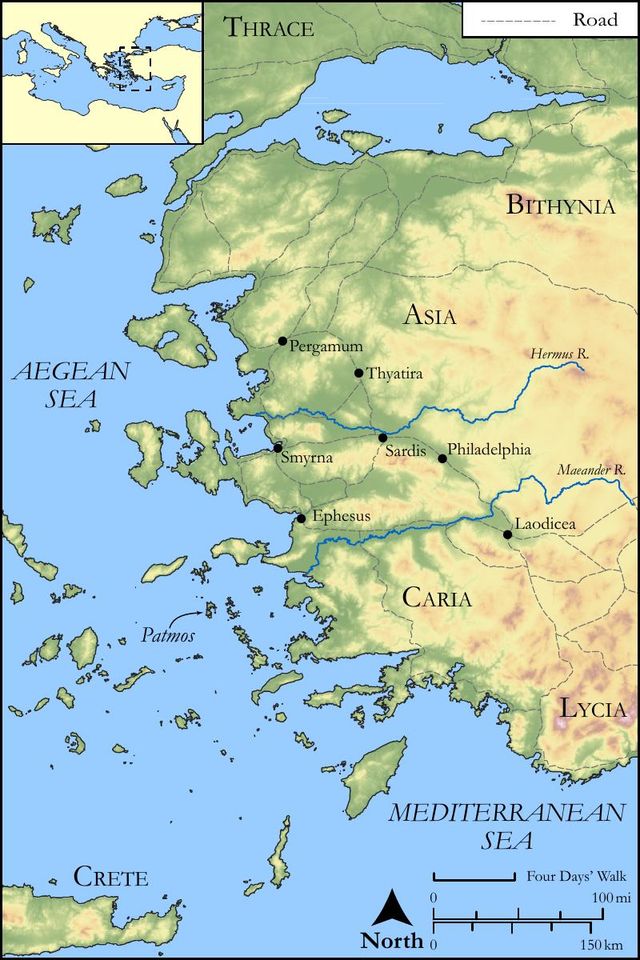
See on the biblical-era maps

Study this verse
Public-domain commentary
Matthew Henry
From his Commentary on the Whole Bible. Henry comments on passages, not single verses — this entry covers Revelation 11:3–13. His three-level outline is real structure in the source text, so it is rendered as structure.
In this time of treading down, God has reserved to himself his faithful witnesses, who will not fail to attest the truth of his word and worship, and the excellency of his ways. Here observe,
I.The number of these witnesses: it is but a small number and yet it is sufficient.
1.It is but small. Many will own and acknowledge Christ in times of prosperity who will desert and deny him in times of persecution; one witness, when the cause is upon trial, is worth many at other times.
2.It is a sufficient number; for in the mouth of two witnesses every cause shall be established. Christ sent out his disciples two by two, to preach the gospel. Some think these two witnesses are Enoch and Elias, who are to return to the earth for a time: others, the church of the believing Jews and that of the Gentiles: it should rather seem that they are God's eminent faithful ministers, who shall not only continue to profess the Christian religion, but to preach it, in the worst of times.
II.The time of their prophesying, or bearing their testimony for Christ.
A thousand two hundred and threescore days; that is (as many think), to the period of the reign of antichrist; and, if the beginning of that interval could be ascertained, this number of prophetic days, taking a day for a year, would give us a prospect when the end shall be.
III.Their habit, and posture:
they prophesy in sackcloth, as those that are deeply affected with the low and distressed state of the churches and interest of Christ in the world.
IV.How they were supported and supplied during the discharge of their great and hard work:
they stood before the God of the whole earth, and he gave them power to prophesy. He made them to be like Zerubbabel and Joshua, the two olive-trees and candlestick in the vision of Zechariah, Zac 4:2, etc. God gave them the oil of holy zeal, and courage, and strength, and comfort; he made them olive-trees, and their lamps of profession were kept burning by the oil of inward gracious principles, which they received from God. They had oil not only in their lamps, but in their vessels - habits of spiritual life, light, and zeal.
V.Their security and defence during the time of their prophesying:
If any attempted to hurt them, fire proceeded out of their mouths, and devoured them, Rev 11:5. Some think this alludes to Elias's calling for the fire from heaven, to consume the captains and their companies that came to seize him, Kg2 1:12. God promised the prophet Jeremiah (Jer 5:14), Behold, I will make my words in thy mouth fire, and this people shall be wood, and it shall devour them. By their praying and preaching, and courage in suffering, they shall gall and wound the very hearts and consciences of many of their persecutors, who shall go away self-condemned, and be even terrors to themselves; like Pashur, at the words of the prophet Jeremiah, Jer 20:4. They shall have that free access to God, and that interest in him, that, at their prayers, God will inflict plagues and judgments upon their enemies, as he did on Pharaoh, turning their rivers into blood, and restraining the dews of heaven, shutting heaven up, that no rain shall fall for many days, as he did at the prayers of Elias, Kg1 17:1. God has ordained his arrows for the persecutors, and is often plaguing them while they are persecuting his people; they find it hard work to kick against the pricks.
VI.The slaying of the witnesses.
To make their testimony more strong, they must seal it with their blood. Here observe,
1.The time when they should be killed: When they have finished their testimony. They are immortal, they are invulnerable, till their work be done. Some think it ought to be rendered, when they were about to finish their testimony. When they had prophesied in sackcloth the greatest part of the 1260 years, then they should feel the last effect of antichristian malice.
2.The enemy that should overcome and slay them - the beast that ascendeth out of the bottomless pit. Antichrist, the great instrument of the devil, should make war against them, not only with the arms of subtle and sophistical learning, but chiefly with open force and violence; and God would permit his enemies to prevail against his witnesses for a time.
3.The barbarous usage of these slain witnesses; the malice of their enemies was not satiated with their blood and death, but pursued even their dead bodies.
(1.)They would not allow them a quiet grave; their bodies were cast out in the open street, the high street of Babylon, or in the high road leading to the city. This city is spiritually called Sodom for monstrous wickedness, and Egypt for idolatry and tyranny; and here Christ in his mystical body has suffered more than in any place in the world.
(2.)Their dead bodies were insulted by the inhabitants of the earth, and their death was a matter of mirth and joy to the antichristian world, Rev 11:10. They were glad to be rid of these witnesses, who by their doctrine and example had teased, terrified, and tormented the consciences of their enemies; these spiritual weapons cut wicked men to the heart, and fill them with the greatest rage and malice against the faithful.
VII.The resurrection of these witnesses, and the consequences thereof. Observe,
1.The time of their rising again; after they had lain dead three days and a half (Rev 11:11), a short time in comparison of that in which they had prophesied. Here may be a reference to the resurrection of Christ, who is the resurrection and the life. Thy dead men shall live, together with my dead body shall they arise. Or there may be a reference to the resurrection of Lazarus on the fourth day, when they thought it impossible. God's witnesses may be slain, but they shall rise again: not in their persons, till the general resurrection, but in their successors. God will revive his work, when it seems to be dead in the world.
2.The power by which they were raised: The spirit of life from God entered into them, and they stood upon their feet. God put not only life, but courage into them. God can make the dry bones to life; it is the Spirit of life from God that quickens dead souls, and shall quicken the dead bodies of his people, and his dying interest in the world.
3.The effect of their resurrection upon their enemies: Great fear fell upon them. The reviving of God's work and witnesses will strike terror into the souls of his enemies. Where there is guilt, there is fear; and a persecuting spirit, though cruel, is not a courageous, but a cowardly spirit. Herod feared John the Baptist.
VIII.The ascension of the witnesses into heaven and the consequences thereof, Rev 11:12, Rev 11:13. Observe,
1.Their ascension. By heaven we may understand either some more eminent station in the church, the kingdom of grace in this world, or a high place in the kingdom of glory above. The former seems to be the meaning: They ascended to heaven in a cloud (in a figurative, not in a literal sense) and their enemies saw them. It will be no small part of the punishment of persecutors, both in this world and at the great day, that they shall see the faithful servants of God greatly honoured and advanced. To this honour they did not attempt to ascend, till God called them, and said, Come up hither. The Lord's witnesses must wait for their advancement, both in the church and in heaven, till God calls them; they must not be weary of suffering and service, nor too hastily grasp at the reward; but stay till their Master calls them, and then they may gladly ascend to him.
2.The consequences of their ascension - a mighty shock and convulsion in the antichristian empire and the fall of a tenth part of the city. Some refer this to the beginning of the reformation from popery, when many princes and states fell off from their subjection to Rome. This great work met with great opposition; all the western world felt a great concussion, and the antichristian interest received a great blow, and lost a great deal of ground and interest,
(1.)By the sword of war, which was then drawn; and many of those who fought under the banner of antichrist were slain by it.
(2.)By the sword of the Spirit: The fear of God fell upon many. They were convinced of their errors, superstition, and idolatry; and by true repentance, and embracing the truth, they gave glory to the God of heaven. Thus, when God's work and witnesses revive, the devil's work and witnesses fall before him.
Historical interpretation
Six Centuries of Reception
6 surviving comments on this verse. Each one is dated, so this reads as a timeline rather than a list.
Select a marker to jump to its quote. Markers stagger vertically where authors wrote within a few decades of each other.
“And they went up to heaven in a cloud.” The apostle spoke of this, saying, “We will be caught up in the clouds to meet Christ in the air.” It is written that this cannot happen to anyone before the coming of the Lord, since at his coming all flesh is approved to arise from their graves. And so the faulty idea of those is excluded who think that these two witnesses are only two men who ascend on the clouds before the coming of Christ. For how could those “who dwell on the earth” rejoice at the death of two men if they died in only one city? Or how do they “exchange presents” if in a short period of time those who threw their bodies in the streets were disquieted by their resurrection although shortly beforehand they were rejoicing at their death? Their courage and reason were stupefied because throughout the earth the announcement came not of their death but of their resurrection. What kind of joy would it be, or what kind of pleasure for those who are feasting would it be, if along with the feast there was the stench of the dead? “And a great fear fell on those who saw them.” He says this of those who are alive when they see the resurrection of those who sleep and are shaken by a horrible fear. “And their enemies saw them [ascend].” Here he separates the unrighteous from the righteous and those who were steadfast in faith from those who were timid.
Being dead for as many days as there were years of their prophecy, they will rise up and ascend into heaven on a cloud, that dominical chariot. And fear and perplexity will seize those who see it.
And great fear fell upon those who saw them. He spoke of all the living, for even the surviving righteous will be fearful at the resurrection of the sleeping.
And after three and a half days, the Spirit of life from God, etc. Until now, the angel has narrated what will happen, and now he introduces the event that is heard as future, that with the kingdom of the Antichrist destroyed, the saints will have risen in glory.
And after three days and a half, the spirit of life from God entered into them. And they stood upon their feet. In this place is declared the general resurrection of all the saints after that last persecution. The spirit of life from God entering into them does not mean that they will receive another spirit, but that they will get back the same that they had. Standing upon one's feet means not staggering with any changeableness of spiritual things any more. So, let us hear what happens to the reprobates when the saints awaken: and great fear fell upon them that saw them. It is not surprising if fear seizes the reprobates, since even the elect themselves will be scared, albeit with a serene fear.
Since all things are clearly evident and destined to occur perceptibly at that time, it is excessive to dwell on what has been acknowledged.
Continue studying Revelation 11:11 across the web’s major study libraries — every link below opens this exact verse, chapter, or book on the destination site.
Read & Compare
 BibleGatewayThis verse in more than 200 translations and 70 languages.
 Bible.comThe YouVersion reader — hundreds of translations, reading plans, and highlights.
 ESV.orgCrossway's official English Standard Version reader.
 NET BibleThe NET translation with 60,000+ translators' notes on every rendering decision.
 STEP BibleTyndale House's free study tool — original text, vocabulary, and scholarly resources.
 BibliaLogos Bible Software's free web reader.
 USCCBThe New American Bible (Revised Edition) with the U.S. bishops' study notes.
Commentaries
 BibleHub CommentariesDozens of classic commentaries on this verse, gathered on one page.
 StudyLightMore than 100 commentary sets — the largest collection on the web.
 BibleRefPlain-English commentary on what this verse means, verse by verse.
 Enduring WordDavid Guzik's free commentary on this chapter, widely used by Bible teachers.
 Bible Study ToolsVerse commentary alongside Greek and Hebrew study aids.
Original Language & Research
- BibleHub InterlinearThe verse word by word — original language, transliteration, and English.
- BibleHub LexiconEvery word's original-language definition and Strong's entry.
 Blue Letter BibleDeep-study tools — Strong's numbers, concordance, and word studies.
 CNTR CollationThe earliest Greek manuscripts of this verse, collated letter by letter.
Sermons, Hymns & Audio


TrulyRandomVerse is not affiliated with these sites and doesn’t control their content. They’re linked because they’re genuinely useful.
Summary
Revelation 11:11 marks a dramatic and pivotal moment in the apocalyptic narrative, depicting the miraculous resurrection of the two martyred witnesses. After their bodies lay lifeless for three and a half days, the divine "Spirit of life from God" supernaturally enters them, causing them to stand upright. This awe-inspiring display of God's sovereign power over death immediately instills profound fear in all who witness it, serving as a powerful vindication of God's faithful servants and a stark warning to His adversaries.
Context
ShowHideLiterary Context
This verse serves as the climax of a crucial interlude within the unfolding trumpet judgments in the book of Revelation. Immediately preceding this, the two prophetic witnesses, empowered by God, had completed their 1,260-day ministry, during which they prophesied and inflicted plagues upon the earth (Revelation 11:3-6). Their powerful testimony was met with fierce opposition, culminating in their brutal murder by the beast that ascends from the abyss (Revelation 11:7). The world, relieved by their demise, celebrated their deaths, exchanged gifts, and refused to allow their bodies to be buried, leaving them exposed in the street of the "great city" (spiritually identified with Sodom and Egypt, where their Lord was crucified, Revelation 11:8-10). Revelation 11:11 directly follows this global celebration, presenting a sudden and astonishing reversal that shatters the jubilation of God's enemies and sets the stage for the subsequent divine judgment and the sounding of the seventh trumpet.
Historical & Cultural Context
The period of "three days and an half" is significant. In Jewish culture, it was generally believed that the soul lingered near the body for three days after death, after which decay would set in, making resurrection impossible. By allowing the witnesses' bodies to remain unburied and exposed for this specific duration, the narrative emphasizes the absolute finality of their death from a human perspective, making their subsequent resurrection undeniably miraculous and divine. The public display of their corpses was a profound act of dishonor and triumph by their enemies, typical of ancient warfare where the bodies of defeated foes were left unburied to be scavenged, denying them a proper burial and the peace of the afterlife. The global rejoicing and exchange of gifts mirror ancient pagan festivals celebrating victory over enemies, highlighting the world's deep-seated animosity towards God's truth and His messengers. The location, "the street of the great city," is symbolically linked to Jerusalem, underscoring the spiritual rebellion found even in the place where God's presence was once most evident.
Key Themes
ShowHideThis verse powerfully contributes to several overarching themes in Revelation and biblical theology. First, it underscores Divine Sovereignty and Resurrection Power, demonstrating God's absolute authority over life and death, even in the face of overwhelming human and demonic opposition. It echoes other biblical accounts of God's life-giving power, such as the vision of the dry bones in Ezekiel 37, where the Spirit of God brings a vast army back to life. Second, it highlights the Vindication of God's Faithful Servants. The resurrection of the Two Witnesses serves as God's public declaration of their righteousness and the truth of their message, turning their apparent defeat into a glorious triumph and silencing their mockers. Finally, the "great fear" that falls upon the onlookers emphasizes the theme of Divine Judgment and Awe. This miraculous event forces the world to confront the reality of God's power and the certainty of His ultimate justice, demonstrating that His plans cannot be thwarted and His authority is supreme.
Exposition and Analysis
ShowHideKey Word Analysis
ShowHideThis term, derived from a word meaning "to blow" or "breathe," refers to a current of air, breath, or wind. In a theological sense, it denotes the vital principle, the rational soul, or, as here, a divine spirit. The phrase "the Spirit of life from God" explicitly identifies the source of the witnesses' reanimation as God Himself, emphasizing that this is not a natural resuscitation but a supernatural infusion of divine life, akin to the breath of life given at creation.
This word signifies life in its fullest, most essential sense, often referring to spiritual and eternal life as opposed to mere physical existence (which is often denoted by psychē). Its use here, in conjunction with "Spirit," underscores that the life restored to the witnesses is not merely a return to their previous mortal state but a demonstration of God's ultimate life-giving power, hinting at a quality of life that transcends human understanding of death.
This verb means "to come in," "to go in," or "to enter." Its active use here, "the Spirit... entered into them," conveys a direct, deliberate, and powerful action. It highlights the immediate and undeniable divine intervention, signifying that the resurrection was not a gradual process or a natural phenomenon, but an instantaneous act of God's will.
Verse Breakdown
ShowHide"And after three days and an half"
This specific timeframe underscores the public and undeniable nature of the witnesses' death, exceeding the period during which a natural resurrection might be conceivable. It highlights the world's certainty of their demise, making the subsequent resurrection all the more miraculous and impactful. This period also symbolically represents a limited time of tribulation or oppression, often seen as half of a perfect seven.
"the Spirit of life from God entered into them"
This is the core of the miracle. It explicitly identifies the source of their reanimation: the life-giving Spirit originating directly from God. This divine infusion of life is supernatural, demonstrating God's absolute sovereignty over death and His power to restore what is lost, echoing the creation of Adam when God breathed the breath of life into him.
"and they stood upon their feet"
This clause describes the immediate and physical manifestation of their resurrection. Their standing upright signifies not only life restored but also vindication, strength, and readiness for action. It is a public, undeniable spectacle, directly confronting the world's prior celebration of their death.
"and great fear fell upon them which saw them"
The reaction of the onlookers is one of profound terror and awe. This "great fear" (Greek, phóbos) is not merely fright but a deep, overwhelming sense of dread and reverence in the face of undeniable divine power. It signifies the sudden realization that they have defied not just two prophets, but the Almighty God Himself, whose power far surpasses their own.
Literary Devices
ShowHideRevelation 11:11 employs several powerful Literary Devices to convey its message. The narrative structure itself exhibits a profound Dramatic Reversal, moving from the world's triumphant celebration of the witnesses' death in the preceding verses to their instantaneous and public resurrection. This creates a stark Contrast between human power and divine omnipotence, highlighting the ultimate futility of opposing God. The "three days and an half" serves as Symbolism, representing a limited period of tribulation and emphasizing the finality of death from a human perspective, thereby magnifying the miraculous nature of God's intervention. The phrase "the Spirit of life from God" is a potent Metonymy, where "Spirit" stands for the divine, life-giving power and presence of God Himself, directly responsible for the reanimation. The entire scene is a powerful Theophany, a visible manifestation of God's power and presence, designed to evoke a sense of Awe and Terror in the witnesses, underscoring the unchallengeable authority and justice of the Almighty.
Theological and Thematic Connections
ShowHideRevelation 11:11 profoundly affirms God's ultimate sovereignty over life and death, serving as an undeniable testament to His power to vindicate His faithful servants and execute His divine plan. This miraculous resurrection demonstrates that no human or demonic power can thwart God's purposes or permanently silence His truth. It underscores the biblical truth that God is the source of all life and has the final word over all creation, including the grave. The fear that grips the onlookers is a theological response to the sudden, undeniable manifestation of divine power, a foretaste of the awe and terror that will grip all who have opposed God when His full judgment is revealed. This event also foreshadows the broader resurrection of believers, assuring God's people that their ultimate hope is secure in His life-giving power, even in the face of martyrdom.
Reflection and Application
ShowHideRevelation 11:11 offers both profound encouragement and a solemn warning. For believers, it is a powerful reminder that even in the darkest hours of persecution, apparent defeat, or death, God has the final word. Our hope is not in human strength or worldly success, but in the unfailing power of God who can raise the dead. This verse calls us to persevere in our witness, knowing that our faithfulness, even unto death, will ultimately be vindicated by God. It assures us that God's plan of salvation and judgment will unfold precisely as He has purposed, regardless of human opposition. For those who oppose God and His messengers, this scene serves as a sobering and terrifying warning. It reveals the immense power of the God they defy and the certainty of His ultimate justice. The "great fear" that fell upon the onlookers is a call to repentance, urging all to recognize God's supreme authority and to align themselves with His truth before the final judgment.
Questions for Reflection
ShowHideFAQ
ShowHideWho are the Two Witnesses mentioned in Revelation 11?
ShowHideThe identity of the Two Witnesses is a subject of much debate among biblical scholars. While some interpret them as literal individuals (e.g., Moses and Elijah, or Enoch and Elijah, due to their unique departures from earthly life and their association with specific miracles), others view them symbolically as representing the faithful church, the Law and the Prophets, or the entire body of believers bearing witness to Christ during a time of intense tribulation. Regardless of their precise identity, they embody the prophetic ministry of God's people, empowered by His Spirit to proclaim truth and judgment to a rebellious world, even unto martyrdom, as described in Revelation 11:3-6.
Why do the Two Witnesses remain dead for exactly "three days and an half"?
ShowHideThe period of "three days and an half" is highly symbolic in apocalyptic literature. It represents half of a perfect seven, often signifying a limited, incomplete, or truncated period of tribulation or oppression. In this context, it emphasizes the absolute finality of their death from a human perspective, as it extends beyond the typical three-day period after which decay would undeniably set in, making their resurrection undeniably miraculous. This specific duration also parallels the "time, times, and half a time" mentioned in Daniel 7:25 and Revelation 12:14, which equates to 3.5 years (1,260 days), the duration of their prophetic ministry. It highlights God's precise timing and His ultimate control over all events.
What is the significance of "the Spirit of life from God" in this verse?
ShowHideThe phrase "the Spirit of life from God" is profoundly significant as it explicitly identifies the divine source of the witnesses' resurrection. It emphasizes that their reanimation is not a natural event or a human achievement, but a direct, supernatural act of God's creative and life-giving power. This echoes the original act of creation when God breathed the "breath of life" into Adam (Genesis 2:7), signifying a divine re-creation and restoration. It underscores God's absolute sovereignty over death and His ability to bring life out of seemingly hopeless situations. This divine Spirit is the very power that gives life, both physical and spiritual, and its manifestation here serves as a powerful testament to God's ultimate authority.
Christ-Centered Fulfillment
ShowHideThe dramatic resurrection of the Two Witnesses in Revelation 11:11 finds its ultimate fulfillment and deepest meaning in the person and work of Jesus Christ. Just as the "Spirit of life from God" entered the witnesses, it was by the power of the Holy Spirit that Christ Himself was raised from the dead, demonstrating His divine sonship and conquering sin and death once and for all (Romans 1:4). Christ is the "firstfruits of those who have fallen asleep" (1 Corinthians 15:20), and His resurrection guarantees the future resurrection of all who believe in Him. The vindication of the Two Witnesses, standing triumphantly upon their feet, foreshadows the ultimate vindication of Christ, who was exalted to the highest place, and the future vindication of His church, which will reign with Him. The "great fear" that fell upon those who saw the witnesses' resurrection points to the universal recognition of Christ's supreme authority when every knee will bow and every tongue confess that Jesus Christ is Lord (Philippians 2:9-11). Thus, Revelation 11:11 is not merely an isolated miracle but a powerful echo of Christ's victory over the grave and a prophetic assurance of His ultimate triumph and the resurrection hope for all His followers.