


2 Peter 2:18
Bible text: King James Version (1769 Blayney text) · Public domain
Bible text: King James Version with Strong's numbers · Public domain
Bible text: Berean Standard Bible · Public domain
Bible text: American Standard Version (1901) · Public domain
Bible text: World English Bible, Messianic edition · Public domain
Bible text: Geneva Bible (1599) · Public domain
Bible text: Young's Literal Translation · Public domain
- ὙπέρογκαHuperogkaArrogantG5246A-APNAdjective Accusative Plural Neuter
- γὰρgarforG1063CONJConjunction
- ματαιότητοςmataiotētosof vanityG3153N-GSFNoun Genitive Singular Feminine
- φθεγγόμενοιphthengomenoispeaking wordsG5350V-PDP-NPMVerb Present Middle Deponent Participle Nominative Plural Masculine
- δελεάζουσινdeleazousinthey enticeG1185V-PAI-3PVerb Present Active Indicative 3rd Plural
- ἐνenwithG1722PREPPreposition
- ἐπιθυμίαιςepithumiais[the] passionsG1939N-DPFNoun Dative Plural Feminine
- σαρκὸςsarkosof [the] fleshG4561N-GSFNoun Genitive Singular Feminine
- ἀσελγείαιςaselgeiaisto sensualityG766N-DPFNoun Dative Plural Feminine
- τοὺςtousthoseG3588T-APMDefinite article Accusative Plural Masculine
- ὀλίγωςoligōsscarcelyADVAdverb
- ἀποφεύγονταςapopheugontasescapingG668V-PAP-APMVerb Present Active Participle Accusative Plural Masculine
- τοὺςtousfrom thoseG3588T-APMDefinite article Accusative Plural Masculine
- ἐνeninG1722PREPPreposition
- πλάνῃplanēerrorG4106N-DSFNoun Dative Singular Feminine
- ἀναστρεφομένουςanastrephomenouslivingG390V-PPP-APMVerb Present Passive Participle Accusative Plural Masculine
English is a literal word-by-word gloss of the Greek, not the KJV's wording. Why?
This is the original text the KJV's translators worked from — each Greek word with its own literal English meaning in this verse, prepared by scholars at Tyndale House, Cambridge. The KJV translates whole sentences, not word by word, so its wording differs: one Greek word can become several English words, and the KJV may choose “charity” where the gloss reads “love”. Both are faithful — they answer different questions. For the KJV's own rendering, switch to the KJV text.
Details
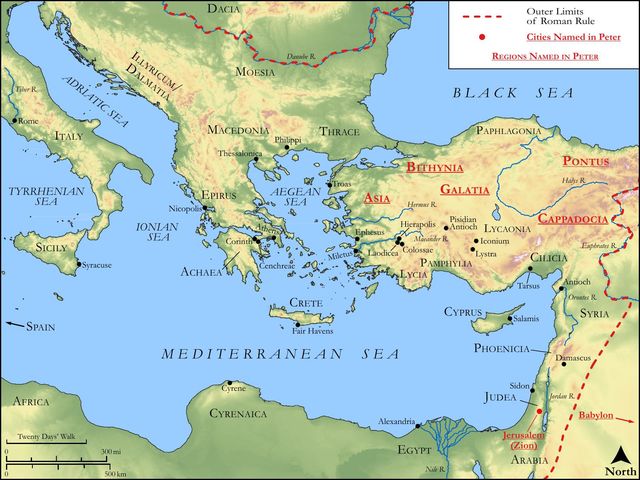
See on the biblical-era maps

Study this verse
Public-domain commentary
Matthew Henry
From his Commentary on the Whole Bible. Henry comments on passages, not single verses — this entry covers 2 Peter 2:10–22. His three-level outline is real structure in the source text, so it is rendered as structure.
The apostle's design being to warn us of, and arm us against, seducers, he now returns to discourse more particularly of them, and give us an account of their character and conduct, which abundantly justifies the righteous Judge of the world in reserving them in an especial manner for the most severe and heavy doom, as Cain is taken under special protection that he might be kept for uncommon vengeance. But why will God thus deal with these false teachers? This he shows in what follows.
I.These walk after the flesh; they follow the devices and desires of their own hearts, they give up themselves to the conduct of their own fleshly mind, refusing to make their reason stoop to divine revelation, and to bring every thought to the obedience of Christ; they, in their lives, act directly contrary to God's righteous precepts, and comply with the demands of corrupt nature. Evil opinions are often accompanied with evil practices; and those who are for propagating error are for improving in wickedness. They will not sit down contented in the measure of iniquity to which they have attained, nor is it enough for them to stand up, and maintain, and defend, what wickedness they have already committed, but they walk after the flesh, they go on in their sinful course, and increase unto more ungodliness and greater degrees of impurity and uncleanness too; they also pour contempt on those whom God has set in authority over them and requires them to honour. These therefore despise the ordinance of God, and we need not wonder at it, for they are bold and daring, obstinate and refractory, and will not only cherish contempt in their hearts, but with their tongues will utter slanderous and reproachful words of those who are set over them.
II.This he aggravates, by setting forth the very different conduct of more excellent creatures, even the angels, of whom observe,
1.They are greater in power and might, and that even than those who are clothed with authority and power among the sons of men, and much more than those false teachers who are slanderous revilers of magistrates and governors; the good angels vastly exceed us in all natural and moral excellences, in strength, understanding, and holiness too.
2.Good angels are accusers of sinful creatures, either of their own kind, or ours, or both. Those who are allowed to behold the face of God, and stand before his throne, cannot but have a zeal for his honour, and accuse and blame those who dishonour him.
3.Angels bring their accusations of sinful creatures before the Lord; they do not publish their faults, and tell their crimes to their fellow-creatures, in a way of calumny and slander; but it is before the Lord, who is the Judge, and will be the avenger, of all impiety and injustice.
4.Good angels mingle no bitter revilings nor base reproaches with any of the accusations or charges they bring against the wickedest and worst of criminals. Let us, who pray that God's will may be done on earth as it is in heaven, imitate the angels in this particular; if we complain of wicked men, let it be to God, and that not with rage and reviling, but with compassion and composedness of mind, that may evidence that we belong to him who is meek and merciful.
III.The apostle, having shown (Pe2 2:11) how unlike seducing teachers are to the most excellent creatures, proceeds (Pe2 2:12) to show how like they are to the most inferior: they are like the horse and mule, which have no understanding; they are as natural brute beasts, made to be taken and destroyed. Men, under the power of sin, are so far from observing divine revelation that they do not exercise reason, nor act according to the direction thereof. They walk by sight, and not by faith, and judge of things according to their senses; as these represent things pleasant and agreeable, so they must be approved and esteemed. Brute-creatures follow the instinct of their sensitive appetite, and sinful man follows the inclination of his carnal mind; these refuse to employ the understanding and reason God has given them, and so are ignorant of what they might and ought to know; and therefore observe,
1.Ignorance is the cause of evil-speaking; and,
2.Destruction will be the effect of it. These persons shall be utterly destroyed in their own corruption. Their vices not only expose them to the wrath of God in another world, but often bring them to misery and ruin in this life; and surely such impudent offenders, who glory in their shame, and to whom openness in sin is an improvement of the pleasure of sinning, most justly deserve all the plagues of this life and the pains of the next in the greatest extremity. Therefore whatever they meet with is the just reward of their unrighteousness. Such sinners as sport themselves in mischief deceive themselves and disgrace all they belong to, for by one sort of sins they prepare themselves for another; their extravagant feastings, their intemperance in eating and drinking, bring them to commit all manner of lewdness, so that their eyes are full of adultery, their wanton looks show their own impure lusts and are designed and directed to kindle the like in others; and this is what they cannot cease from - the heart is insatiate in lusting and the eye incessant in looking after what may gratify their unclean desires, and those who are themselves impudent and incessant in sin are very diligent and often successful in deceiving others and drawing others into the same excess of riot. But here observe who those are who are in the greatest danger of being led away into error and impiety, even the unstable. Those whose hearts are not established with grace are easily turned into the way of sin, or else such sensual wretches would not be able to prevail upon them, for these are not only riotous and lascivious, but covetous also, and these practices their hearts are exercised with; they pant after riches, and the desire of their souls is to the wealth of this world: it is a considerable part of their work to contrive to get wealth; in this their hearts are exercised, and then they execute their projects; and, if men abandon themselves to all sorts of lusts, we cannot wonder that the apostle should call them cursed children, for they are liable to the curse of God denounced against such ungodly and unrighteous men, and they bring a curse upon all who hearken and adhere to them.
IV.The apostle (Pe2 2:15, Pe2 2:16) proves that they are cursed children, even such covetous persons as the Lord abhors, by showing,
1.They have forsaken the right way; and it cannot be but such self-seekers must be out of the right way, which is a self-denying way.
2.They have gone into a wrong way: they have erred and strayed from the way of life, and gone over into the path which leads to death, and takes hold of hell; and this he makes out by showing it to be the way of Balaam, the son of Bosor.
(1.)That is a way of unrighteousness into which men are led by the wages of unrighteousness.
(2.)Outward temporal good things are the wages sinners expect and promise themselves, though they are often disappointed.
(3.)The inordinate love of the good things of this world turns men out of the way which leads to the unspeakably better things of another life; the love of riches and honour turned Balaam out of the way of his duty, although he knew that the way he took displeased the Lord.
(4.)Those who from the same principle are guilty of the same practices with notorious sinners are, in the judgment of God, the followers of such vile offenders, and therefore must reckon upon being at last where they are: they shall have their portion with those in another world whom they imitated in this.
(5.)Heinous and hardened sinners sometimes meet with rebukes for their iniquity. God stops them in their way, and opens the mouth of conscience, or by some startling providence startles and affrights them.
(6.)Though some more uncommon and extraordinary rebuke may for a little while cool men's courage, and hinder their violent progress in the way of sin, it will not make them forsake the way of iniquity and go over into the way of holiness. If rebuking a sinner for his iniquity could have made a man return to his duty, surely the rebuke of Balaam must have produced this effect; for here is a surprising miracle wrought: the dumb ass, in whose mouth no man can expect to meet with reproof, is enabled to speak, and that with a human voice, and to her owner and master (who is here called a prophet, for the Lord appeared and spoke sometimes to him, Num 22:23, Num 22:24, but indeed he was among the prophets of the Lord as Judas among the apostles of Jesus Christ), and she exposes the madness of his conduct and opposes his going on in this evil way, and yet all in vain. Those who will not yield to usual methods of reproof will be but little influenced by miraculous appearances to turn them from their sinful courses. Balaam was indeed restrained from actually cursing the people, but he had so strong a desire after the honours and riches that were promised him that he went as far as he could, and did his utmost to get from under the restraint that was upon him.
V.The apostle proceeds (Pe2 2:17) to a further description of seducing teachers, whom he sets forth,
1.As wells, or fountains, without water. Observe, (1.) Ministers should be as wells or fountains, where the people may find instruction, direction, and comfort; but (2.) False teachers have nothing of this to impart to those who consult them: the word of truth is the water of life, which refreshes the souls that receive it; but these deceivers are set upon spreading and promoting error, and therefore are set forth as empty, because there is no truth in them. In vain then are all our expectations of being fed and filled with knowledge and understanding by those who are themselves ignorant and empty.
2.As clouds carried with a tempest. When we see a cloud we expect a refreshing shower from it; but these are clouds which yield no rain, for they are driven with the wind, but not of the Spirit, but the stormy wind or tempest of their own ambition and covetousness. They espouse and spread those opinions that will procure most applause and advantage to themselves; and as clouds obstruct the light of the sun, and darken the air, so do these darken counsel by words without knowledge and wherein there is no truth; and, seeing these men are for promoting darkness in this world, it is very just that the mist of darkness should be their portion in the next. Utter darkness was prepared for the devil, the great deceiver, and his angels, those instruments that he uses to turn men from the truth, and therefore for them it is reserved, and that for ever; the fire of hell is everlasting, and the smoke of the bottomless pit rises up for ever and ever. And it is just with God to deal thus with them, because (1.) They allure those they deal with, and draw them into a net, or catch them as men do fish; and, (2.) It is with great swelling words of vanity, lofty expressions, which have a great sound, but little sense. (3.) They work upon the corrupt affections and carnal fleshly lusts of men, proposing what is grateful to them. And, (4.) They seduce persons who in reality avoided and kept at a distance from those who spread and those who embraced hurtful and destructive errors. Observe, [1.] By application and industry men attain a skilfulness and dexterity in promoting error. They are as artful and as successful as the fisher, who makes angling his daily employment. The business of these men is to draw disciples after them, and in their methods and management there are some things worth observing, how they suit their bait to those they desire to catch. [2.] Erroneous teachers have a peculiar advantage to win men over to them, because they have sensual pleasure to take them with; whereas the ministers of Christ put men upon self-denial, and the mortifying of those lusts that others gratify and please: wonder not therefore that truth prevails no more, or that errors spread so much. [3.] Persons who have for a while adhered to the truth, and kept clear of errors, may by the subtlety and industry of seducers be so far deceived as to fall into those errors they had for a while clean escaped. "Be therefore always upon your guard, maintain a godly jealousy of yourselves, search the scriptures, pray for the Spirit to instruct and establish you in the truth, walk humbly with God, and watch against every thing that may provoke him to give you up to a reprobate mind, that you may not be taken with the fair and specious pretences of these false teachers, who promise liberty to all who will hearken to them, not true Christian liberty for the service of God, but a licentiousness in sin, to follow the devices and desires of their own hearts." To prevent these men's gaining proselytes, he tells us that, in the midst of all their talk of liberty, they themselves are the vilest slaves, for they are the servants of corruption; their own lusts have gotten a complete victory over them, and they are actually in bondage to them, making provision for the flesh, to satisfy its cravings, comply with its directions, and obey its commands. Their minds and hearts are so far corrupted and depraved that they have neither power nor will to refuse the task that is imposed on them. They are conquered and captivated by their spiritual enemies, and yield their members servants of unrighteousness: and what a shame it is to be overcome and commanded by those who are themselves the servants of corruption, and slaves to their own lusts! This consideration should prevent our being led away by these seducers; and to this he adds another (Pe2 2:20): it is not only a shame and disgrace to be seduced by those who are themselves the slaves of sin, and led captive by the devil at his pleasure, but it is a real detriment to those who have clean escaped from those who live in error, for hereby their latter end is made worse than their beginning. Here we see, First, It is an advantage to escape the pollutions of the world, to be kept from gross and scandalous sins, though men are not thoroughly converted and savingly changed; for hereby we are kept from grieving those who are truly serious and emboldening those who are openly profane; whereas, if we run with others to the same excess of riot and abandon ourselves to the sins of the age, we afflict and dishearten those who endeavour to walk as becomes the gospel, and strengthen the hands of those who are already engaged in open rebellion against the Most High, as well as alienate ourselves more from God, and harden our hearts against him. Secondly, Some men are, for a time, kept from the pollutions of the world, by the knowledge of Christ, who are not savingly renewed in the spirit of their mind. A religious education has restrained many whom the grace of God has not renewed: if we receive the light of the truth, and have a notional knowledge of Christ in our heads, it may be of some present service to us; but we must receive the love of the truth, and hide God's word in our heart, or it will not sanctify and save us. Thirdly, Those who have, for a time, escaped the pollutions of the world, are at first ensnared and entangled by false teachers, who first perplex men with some plausible and specious objections against the truths of the gospel; and the more ignorant and unstable are hereby made to stagger, and brought to question the truth of doctrines they have received, because they cannot solve all the difficulties, nor answer all the objections, that are urged by these seducers. Fourthly, When men are once entangled, they are easily overcome; therefore should Christians keep close to the word of God, and watch against those who seek to perplex and bewilder them, and that because, if men who have once escaped are again entangled, the latter end is worse with them than the beginning.
VI.The apostle, in the last two verses of the chapter, sets himself to prove that a state of apostasy is worse than a state of ignorance; for it is a condemning of the way of righteousness, after they have had some knowledge of it, and expressed some liking to it; it carries in it a declaring that they have found some iniquity in the way of righteousness and some falsehood in the word of truth. Now to bring up such an evil report upon the good way of God, and such a false charge against the way of truth, must necessarily expose to the heaviest condemnation; the misery of such deserters of Christ and his gospel is more unavoidable and more intolerable than that of other offenders; for,
1.God is more highly provoked by those who by their conduct despise the gospel, as well as disobey the law, and who reproach and pour contempt upon God and his grace.
2.The devil more narrowly watches and more closely confines those whom he has recovered, after they had once gone off from him and professed to be the followers of the Lord Jesus Christ (Mat 12:45); they are kept under a stronger guard, and no wonder it should be so when they have licked up their own vomit again, returning to the same errors and impieties that they had once cast off and seemed to detest and loathe, and wallowing in that filthiness from which they appeared once to be really cleansed. Well, if the scripture gives such an account of Christianity on the one hand, and of sin on the other, as we have here in these two verses, we certainly ought highly to approve of the former and persevere therein, because it is a way of righteousness, and a holy commandment, and to loathe and keep at the greatest distance from the latter because it is set forth as most offensive and abominable.
Historical interpretation
Five Centuries of Reception
3 surviving comments on this verse. Each one is dated, so this reads as a timeline rather than a list.
Select a marker to jump to its quote. Markers stagger vertically where authors wrote within a few decades of each other.
Pride is always vain because it makes people stupid, as they are without God insofar as they are proud.
They are not punished merely for their ungodliness but for the enormity of it as well.
These are the springs lacking water, the clouds carried by the storm, by which the darkness of gloom has been preserved for eternity. Indeed, where the proud words of vanity have sounded, they ensnare through the lusts of the flesh in their desires, those who have truly fled, who were wandering in error, while promising them freedom, when they themselves are slaves of corruption. For by whom anyone is overcome, to him he is also enslaved.
While Peter was saying many things, among which he also brought up the example of Balaam, he again took up the discourse about the impure Gnostics, and compared them to sources lacking water, as those who have lost the water of life, that is, the purity of preaching and drinkable water: which when the Lord had, he promised that he would satisfy many who came to it. (Jn. 1:6) But he also compared them to clouds carried by the wind, in a contrary manner: for this reason, he also called the wind a storm, as one that turns and disturbs what is agitated: for this is what a storm usually does. Therefore, they are not radiant clouds like the saints, but mists full of darkness. (Isa. 60:2)
"by which the darkness of gloom has been preserved for eternity" (but it is said to be eternal judgment); and for what reason? Peter added the cause, that through proud words stemming from vanity, they ensnare those who have truly fled and who once wandered in error through fleshly desire in corruption. Therefore, those who commit these acts are subject to impurities, arrogance, and impiety. But also, Peter says, since they are of the aforementioned filth, which he rightly calls corruption, they promise freedom to those who are deceived, not indeed of true life, but of that which is according to indulgence. Therefore, he also adds a reason why they are slaves of sin, saying something remarkable, that whoever is led astray by any passion is also bound to this in slavery. Then Peter again confirms this with another example, showing how one who is overcome by someone else is also a slave to him, and he makes an argument based on this assumption.
Continue studying 2 Peter 2:18 across the web’s major study libraries — every link below opens this exact verse, chapter, or book on the destination site.
Read & Compare
 BibleGatewayThis verse in more than 200 translations and 70 languages.
 Bible.comThe YouVersion reader — hundreds of translations, reading plans, and highlights.
 ESV.orgCrossway's official English Standard Version reader.
 NET BibleThe NET translation with 60,000+ translators' notes on every rendering decision.
 STEP BibleTyndale House's free study tool — original text, vocabulary, and scholarly resources.
 BibliaLogos Bible Software's free web reader.
 USCCBThe New American Bible (Revised Edition) with the U.S. bishops' study notes.
Commentaries
 BibleHub CommentariesDozens of classic commentaries on this verse, gathered on one page.
 StudyLightMore than 100 commentary sets — the largest collection on the web.
 BibleRefPlain-English commentary on what this verse means, verse by verse.
 Enduring WordDavid Guzik's free commentary on this chapter, widely used by Bible teachers.
 Bible Study ToolsVerse commentary alongside Greek and Hebrew study aids.
Original Language & Research
- BibleHub InterlinearThe verse word by word — original language, transliteration, and English.
- BibleHub LexiconEvery word's original-language definition and Strong's entry.
 Blue Letter BibleDeep-study tools — Strong's numbers, concordance, and word studies.
 CNTR CollationThe earliest Greek manuscripts of this verse, collated letter by letter.
Sermons, Hymns & Audio


TrulyRandomVerse is not affiliated with these sites and doesn’t control their content. They’re linked because they’re genuinely useful.
Summary
Second Peter 2:18 serves as a stark warning against the insidious methods of false teachers who prey on the vulnerable, particularly new converts. These deceivers employ bombastic, empty rhetoric to appeal to base human desires, exploiting carnal appetites and promising a false sense of liberty that ultimately leads back to the very bondage from which believers had recently escaped. Peter exposes their deceptive allure, highlighting the danger they pose to those still establishing their spiritual footing.
Context
ShowHideLiterary Context
This verse is situated within Peter's fervent and extended polemic against false prophets and teachers that dominates 2 Peter chapter 2. Peter systematically dismantles their character, motives, and destructive influence, contrasting their ungodly ways with the righteousness of God. He begins by asserting their inevitable judgment, drawing parallels to past divine interventions against sin (2 Peter 2:4-9). Verses 10-17 further detail their depraved conduct, describing them as audacious, greedy, and morally corrupt, likening them to irrational animals and waterless springs. Verse 18 then zeroes in on their specific deceptive tactics, explaining how they ensnare their victims, setting the stage for the tragic outcome described in 2 Peter 2:19-22, where their false promises of freedom are revealed as a return to slavery.
Historical & Cultural Context
The early church, still in its nascent stages, faced significant internal challenges from various forms of heresy, including proto-Gnostic tendencies and antinomianism. These movements often emphasized a "superior knowledge" or a radical interpretation of Christian liberty that led to moral license. Such teachers might have argued that since believers were "under grace, not law," they were free to indulge in carnal desires without consequence. Peter's strong language reflects the serious threat these doctrines posed to the purity of the Gospel and the moral integrity of the Christian community. The appeal to "lusts of the flesh" and "wantonness" suggests a cultural environment where sensuality and moral laxity were prevalent, making such deceptive teachings particularly attractive to those seeking an easier path or a justification for ungodly living.
Key Themes
ShowHide2 Peter chapter 2 is saturated with several critical themes. Deception is paramount, as false teachers use cunning words to obscure truth and mislead. Their rhetoric, described as "great swelling words of vanity," is designed to impress rather than inform. This ties into the theme of Moral Corruption, as their teachings often cater to and encourage the "lusts of the flesh" and "wantonness," leading their followers away from holiness. Peter also highlights the theme of Divine Judgment, emphasizing that these teachers, despite their outward appearance, are destined for destruction (2 Peter 2:3). Crucially, the passage explores the contrast between True Freedom and False Liberty. While Christ offers genuine freedom from sin's bondage (John 8:36), these false teachers promise "liberty" that is, in fact, a return to slavery to corruption (2 Peter 2:19). The vulnerability of new converts is also a key concern, as they are specifically targeted due to their recent escape from "error."
Exposition and Analysis
ShowHideKey Word Analysis
ShowHideFrom the Strong's data, this word means "bulging over, i.e. (figuratively) insolent." It vividly describes speech that is inflated, bombastic, boastful, and arrogant. It suggests words that are disproportionately large or impressive in sound but lack genuine substance or humility. These are not words of truth or spiritual depth, but rather empty pronouncements designed to impress and deceive.
This term signifies "inutility; figuratively, transientness; morally, depravity." In the context of "words of vanity," it means that the speech of these false teachers is utterly empty, futile, useless, and devoid of truth or spiritual value. Despite their impressive sound, their words lead to nothing of lasting worth and are morally corrupting.
Derived from the base of dólos (deceit), this word means "to entrap, i.e. (figuratively) delude." It carries the connotation of baiting a hook or setting a snare, emphasizing the deceptive and manipulative nature of their persuasion. They don't simply teach; they entice and ensnare their victims, drawing them into a trap.
This term describes "licentiousness (sometimes including other vices)." It refers to unrestrained indulgence, sensuality, and a brazen disregard for moral boundaries and decency. It's not merely sin, but open, shameless, and often public displays of immorality, indicating a complete lack of self-control and a defiant attitude towards what is right.
Verse Breakdown
ShowHide"For when they speak great swelling [words] of vanity"
This clause introduces the deceptive rhetoric of the false teachers. Their speech is characterized by its inflated, pompous, and boastful nature ("great swelling"), yet it is ultimately empty, futile, and morally corrupting ("words of vanity"). They use impressive-sounding language to mask their lack of spiritual substance and truth.
"they allure through the lusts of the flesh"
This identifies the primary method of their appeal. The false teachers entice their victims by catering to their sinful desires and carnal appetites ("lusts of the flesh"). They exploit human weaknesses and ungodly cravings, offering a message that justifies or encourages indulgence rather than spiritual discipline.
"[through much] wantonness"
This phrase further specifies the nature of the fleshly lusts they exploit. The "much wantonness" refers to excessive, unrestrained, and shameless sensuality or licentiousness. Their teachings lead to a brazen disregard for moral boundaries, promoting a lifestyle of open indulgence and moral depravity.
"those that were clean escaped from them who live in error"
This identifies the specific target audience of these deceivers. They prey on individuals who have recently been converted to Christianity, having "clean escaped" (truly and completely departed) from a life of sin, false religion, or paganism ("them who live in error"). These new believers, still vulnerable and perhaps not yet fully grounded in sound doctrine, are susceptible to being drawn back into their former ways by the false teachers' enticing, yet destructive, promises.
Literary Devices
ShowHidePeter employs several powerful literary devices to underscore the danger of false teachers. The phrase "great swelling words of vanity" is a striking example of Oxy-moron or Paradox, as "swelling" implies fullness or importance, while "vanity" denotes emptiness. This highlights the deceptive nature of their rhetoric: it sounds impressive but is utterly hollow. The description of their speech also functions as a Metaphor for their inflated egos and lack of spiritual substance, akin to a balloon full of hot air. The entire verse, in its vivid portrayal of their manipulative tactics, serves as a form of Warning or Admonition, urging believers to exercise discernment. There is also an inherent Irony in the false teachers promising "liberty" while themselves being "slaves of corruption" (2 Peter 2:19), which is foreshadowed by their methods described in this verse.
Theological and Thematic Connections
ShowHideThe theological implications of 2 Peter 2:18 are profound, touching upon the nature of truth, the reality of spiritual warfare, and the necessity of discernment. It underscores that spiritual deception often comes disguised in appealing language, targeting our innate desires rather than challenging them. The false teachers' appeal to "lusts of the flesh" and "wantonness" reveals a core theological conflict: whether true freedom is found in unrestrained self-indulgence or in submission to God's righteous standards. Peter's warning is a timeless reminder that the battle for the soul is fought not only with overt persecution but also with subtle, enticing lies that promise an easier, more permissive path, ultimately leading away from God's transforming grace. This passage emphasizes the critical need for believers to be firmly rooted in sound doctrine and to cultivate spiritual maturity to withstand such alluring deceptions.
Reflection and Application
ShowHidePeter's warning in 2 Peter 2:18 remains acutely relevant for believers today. We live in a world saturated with appealing messages that often cater to our desires for comfort, ease, and self-gratification, sometimes even cloaked in spiritual language. This verse challenges us to critically evaluate all teachings, not by their eloquence or popularity, but by their fidelity to the unchanging truth of God's Word. It calls us to cultivate a robust spiritual discernment, recognizing that genuine freedom in Christ leads to holiness and self-control, not to moral license. For those who have recently come to faith, or are still growing, this passage serves as a vital caution to remain grounded in the fundamentals of the Gospel and to seek wise, biblically sound mentors, lest they be swayed back into the "error" from which they were delivered. Our responsibility is not only to guard our own hearts but also to protect and nurture those who are vulnerable, helping them build a firm foundation in Christ that can withstand the allure of deceptive promises.
Questions for Reflection
ShowHideFAQ
ShowHideWho are "them who live in error" from whom the new converts had escaped?
ShowHide"Them who live in error" refers to those who are still living in spiritual darkness, under the dominion of sin, or adhering to false religious systems. This could include pagans, those caught in various forms of idolatry, or individuals living in moral depravity outside of Christ. The phrase emphasizes a state of being fundamentally mistaken about God, truth, and righteousness. The new converts, having turned to Christ, had "clean escaped" from this former way of life, implying a genuine and complete break from their past spiritual and moral bondage. However, the false teachers seek to draw them back into a similar state of "error" through their deceptive teachings, which ultimately lead to a return to sin and spiritual slavery, as highlighted in 2 Peter 2:19-22.
Why are new converts particularly vulnerable to these false teachers?
ShowHideNew converts are particularly vulnerable because they are still establishing their spiritual foundations and may lack the deep theological understanding and discernment that comes with maturity. Having recently "escaped" from a life of error, they are still shedding old habits and ways of thinking. The false teachers exploit this transitional phase, presenting their deceptive messages in an appealing way that often caters to lingering fleshly desires or intellectual curiosity, promising an easier path or a more "enlightened" form of Christianity. Without a firm grounding in sound doctrine and a mature understanding of true Christian liberty, these new believers can easily be swayed back into patterns of sin or false belief, mistaking license for freedom, as warned in 2 Peter 2:20-22.
Christ-Centered Fulfillment
ShowHideSecond Peter 2:18, while a stark warning against false teachers, implicitly points to the absolute necessity and sufficiency of Christ as the source of truth and genuine freedom. The "great swelling words of vanity" spoken by deceivers stand in stark contrast to the Word made flesh, Jesus Christ, who is the embodiment of truth and grace (John 1:14). While false teachers "allure through the lusts of the flesh," Jesus calls His followers to deny themselves, take up their cross, and follow Him (Matthew 16:24). He offers true liberty from the bondage of sin, not a license for "wantonness," declaring that "if the Son makes you free, you shall be free indeed" (John 8:36). Christ is the Good Shepherd who protects His sheep from the wolves in sheep's clothing (Matthew 7:15), and through His Spirit, He empowers believers to live in holiness and discernment, guarding them from returning to the "error" from which He has redeemed them. Ultimately, Christ Himself is the fulfillment of all true teaching, the standard by which all other doctrines must be measured, and the only one who can truly set us free from the deception and corruption that Peter warns against.