


Luke 1:8
Bible text: King James Version (1769 Blayney text) · Public domain
Bible text: Berean Standard Bible · Public domain
Bible text: American Standard Version (1901) · Public domain
Bible text: World English Bible, Messianic edition · Public domain
Bible text: Geneva Bible (1599) · Public domain
Bible text: Young's Literal Translation · Public domain
- ἘγένετοEgenetoIt came to passG1096V-2ADI-3SVerb 2nd Aorist Middle Deponent Indicative 3rd Singular
- δὲdenowG1161CONJConjunction
- ἐνeninG1722PREPPreposition
- τῷtōtheG3588T-DSNDefinite article Dative Singular Neuter
- ἱερατεύεινhi'erateueinpriestly servingG2407V-PANVerb Present Active Infinitive
- αὐτὸνautonof himG846P-ASMPersonal pronoun Accusative Singular Masculine
- ἐνeninG1722PREPPreposition
- τῇtēatheG3588T-DSFDefinite article Dative Singular Feminine
- τάξειtaxeiorderG5010N-DSFNoun Dative Singular Feminine
- τῆςtēsof theG3588T-GSFDefinite article Genitive Singular Feminine
- ἐφημερίαςephēmeriasdivisionG2183N-GSFNoun Genitive Singular Feminine
- αὐτοῦautouof himG846P-GSMPersonal pronoun Genitive Singular Masculine
- ἔναντιenantibeforeG1725PREPPreposition
- τοῦtou<the>G3588T-GSMDefinite article Genitive Singular Masculine
- θεοῦtheouGodG2316N-GSM-TNoun Genitive Singular Masculine Title
English is a literal word-by-word gloss of the Greek, not the KJV's wording. Why?
This is the original text the KJV's translators worked from — each Greek word with its own literal English meaning in this verse, prepared by scholars at Tyndale House, Cambridge. The KJV translates whole sentences, not word by word, so its wording differs: one Greek word can become several English words, and the KJV may choose “charity” where the gloss reads “love”. Both are faithful — they answer different questions. For the KJV's own rendering, switch to the KJV text.
Details
See on the biblical-era maps
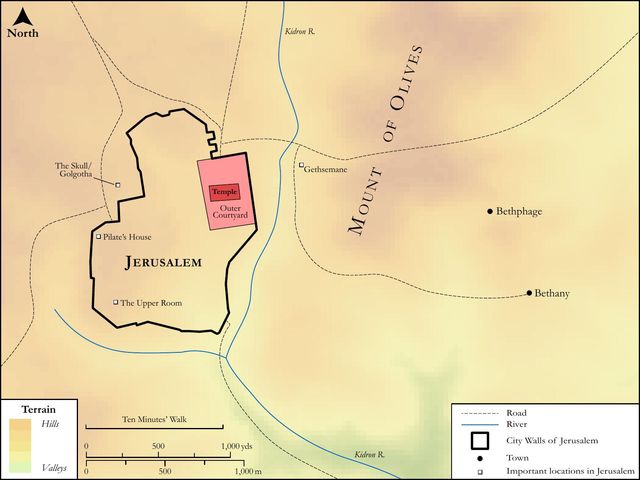
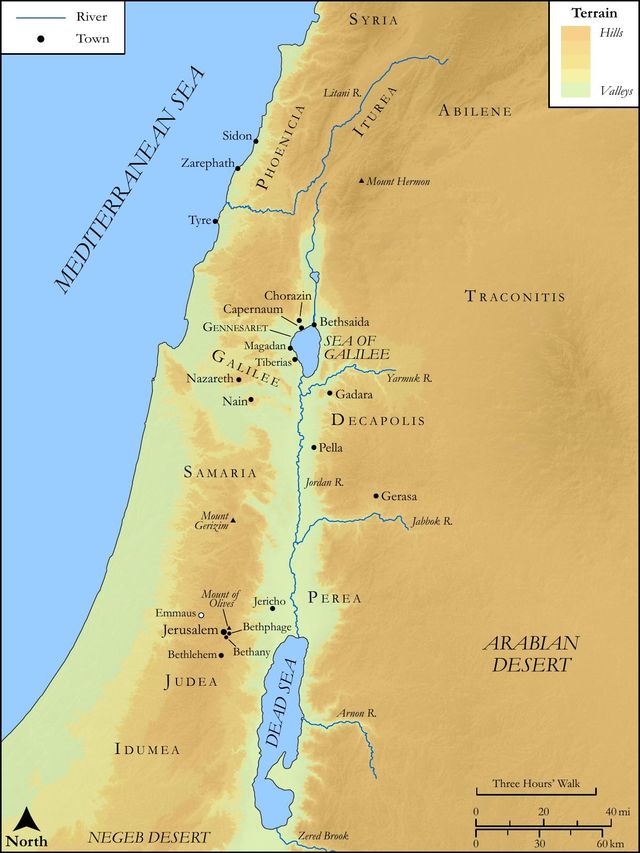
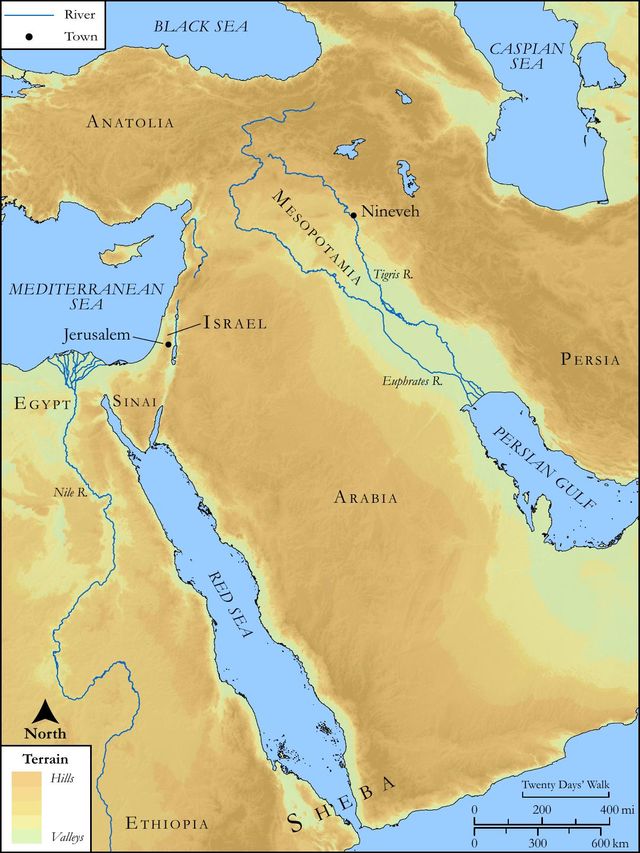
Study this verse
Public-domain commentary
Matthew Henry
From his Commentary on the Whole Bible. Henry comments on passages, not single verses — this entry covers Luke 1:5–25. His four-level outline is real structure in the source text, so it is rendered as structure.
The two preceding evangelists had agreed to begin the gospel with the baptism of John and his ministry, which commenced about six months before our Saviour's public ministry (and now, things being near a crisis, six months was a deal of time, which before was but a little), and therefore this evangelist, designing to give a more particular account than had been given of our Saviour's conception and birth, determines to do so of John Baptist, who in both was his harbinger and forerunner, the morning-star to the Sun of righteousness. The evangelist determines thus, not only because it is commonly reckoned a satisfaction and entertainment to know something of the original extraction and early days of those who afterwards prove great men, but because in the beginning of these there were many things miraculous, and presages of what they afterwards proved. In these verses our inspired historian begins as early as the conception of John Baptist. Now observe here,
I.The account given of his parents (v.
5): They lived in the days of Herod the king, who was a foreigner, and a deputy for the Romans, who had lately made Judea a province of the empire. This is taken notice of to show that the sceptre was quite departed from Judah, and therefore that now was the time for Shiloh to come, according to Jacob's prophecy, Gen. xlix. 10. The family of David was now sunk, when it was to rise, and flourish again, in the Messiah. Note, None ought to despair of the reviving and flourishing of religion, even when civil liberties are lost. Israel enslaved, yet then comes the glory of Israel.
Now the father of John Baptist was a priest, a son of Aaron; his name Zacharias. No families in the world were ever so honoured of God as those of Aaron and David; with one was made the covenant of priesthood, with the other that of royalty; they had both forfeited their honour, yet the gospel again puts honour upon both in their latter days, on that of Aaron in John Baptist, on that of David in Christ, and then they were both extinguished and lost. Christ was of David's house, his forerunner of Aaron's; for his priestly agency and influence opened the way to his kingly authority and dignity. This Zacharias was of the course of Abia. When in David's time the family of Aaron was multiplied, he divided them into twenty-four courses, for the more regular performances of their office, that it might never be either neglected for want of hands or engrossed by a few. The eighth of those was that of Abia (1 Chron. xxiv. 10), who was descended from Eleazar, Aaron's eldest son; but Dr. Lightfoot suggests that many of the families of the priests were lost in the captivity, so that after their return they took in those of other families, retaining the names of the heads of the respective courses. The wife of this Zacharias was of the daughters of Aaron too, and her name was Elisabeth, the very same name with Elisheba the wife of Aaron, Exod. vi. 23. The priests (Josephus saith) was very careful to marry within their own family, that they might maintain the dignity of the priesthood and keep it without mixture.
Now that which is observed concerning Zacharias and Elisabeth is,
1.That they were a very religious couple (v. 6): They were both righteous before God; they were so in his sight whose judgment, we are sure, is according to truth; they were sincerely and really so. They are righteous indeed that are so before God, as Noah in his generation, Gen. vii. 1. They approved themselves to him, and he was graciously pleased to accept them. It is a happy thing when those who are joined to each other in marriage are both joined to the Lord; and it is especially requisite that the priests, the Lord's ministers, should with their yoke-fellows be righteous before God, that they may be examples to the flock, and rejoice their hearts. They walked in all the commandments and ordinances of the Lord, blameless.
(1.)Their being righteous before God was evidenced by the course and tenour of their conversations; they showed it, not by their talk, but by their works; by the way they walked in and the rule they walked by.
(2.)They were of a piece with themselves; for their devotions and their conversations agreed. They walked not only in the ordinances of the Lord, which related to divine worship, but in the commandments of the Lord, which have reference to all the instances of a good conversation, and must be regarded.
(3.)They were universal in their obedience; not that they never did in any thing come short of their duty, but it was their constant care and endeavor to come up to it.
(4.)Herein, though they were not sinless, yet they were blameless; nobody could charge them with any open scandalous sin; they lived honestly and inoffensively, as ministers and their families are in a special manner concerned to do, that the ministry be not blamed in their blame.
2.That they had been long childless, v. 7. Children are a heritage of the Lord. But there are many of his heirs in a married state, that yet are denied this heritage; they are valuable desirable blessings; yet many there are, who are righteous before God, and, if they had children, would bring them up in his fear, who yet are not thus blessed, while the men of this world are full of children (Ps. xvii. 14), and send forth their little ones like a flock, Job xxi. 11. Elisabeth was barren, and they began to despair of ever having children, for they were both now well stricken in years, when the women that have been most fruitful leave off bearing. Many eminent persons were born of mothers that had been long childless, as Isaac, Jacob, Joseph, Samson, Samuel, and so here John Baptist, to make their birth the more remarkable and the blessing of it the more valuable to their parents, and to show that when God keeps his people long waiting for mercy he sometimes is pleased to recompense them for their patience by doubling the worth of it when it comes.
II.The appearing of an angel to his father Zacharias, as he was ministering in the temple, v.
8-11. Zechariah the prophet was the last of the Old Testament that was conversant with angels, and Zacharias the priest the first in the New Testament. Observe,
1.How Zacharias was employed in the service of God (v. 8): He executed the priest's office, before God, in the order of his course; it was his week of waiting, and he was upon duty. Though his family was not built up, or made to grow, yet he made conscience of doing the work of his own place and day. Though we have not desired mercies, yet we must keep close to enjoined services; and, in our diligent and constant attendance on them, we may hope that mercy and comfort will come at last. Now it fell to Zacharias's lot to burn incense morning and evening for that week of his waiting, as other services fell to other priests by lot likewise. The services were directed by lot, that some might not decline them and others engross them, and that, the disposal of the lot being from the Lord, they might have the satisfaction of a divine call to the work. This was not the high priest burning incense on the day of atonement, as some have fondly imagined, who have thought by that to find out the time of our Saviour's birth; but it is plain that it was the burning of the daily incense at the altar of incense (v. 11), which was in the temple (v. 9), not in the most holy place, into which the high priest entered. The Jews say that one and the same priest burned not incense twice in all his days (there were such a multitude of them), at least never more than one week. It is very probable that this was upon the sabbath day, because there was a multitude of people attending (v. 10), which ordinarily was not on a week day; and thus God usually puts honour upon his own day. And then if Dr. Lightfoot reckon, with the help of the Jewish calendars, that this course of Abia fell on the seventeenth day of the third month, the month Sivan, answering to part of May and part of June, it is worth observing that the portions of the law and the prophets which were read this day in synagogues were very agreeable to that which was doing in the temple; namely, the law of the Nazarites (Num. vi.), and the conception of Samson, Judg. xiii.
While Zacharias was burning incense in the temple, the whole multitude of the people were praying without, v. 10. Dr. Lightfoot says that there were constantly in the temple, at the hour of prayer, the priests of the course that then served, and, if it were the sabbath day, those of that course also that had been in waiting the week before, and the Levites that served under the priests, and the men of the station, as the Rabbin call them, who were the representatives of the people, in putting their hands upon the head of the sacrifices, and many besides, who, moved by devotion, left their employments, for that time, to be present at the service of God; and those would make up a great multitude, especially on sabbaths and feast-days: now these all addressed themselves to their devotions (in mental prayer, for their voice was not heard), when by the tinkling of a bell they had notice that the priest was gone in to burn incense. Now observe here, (1.) That the true Israel of God always were a praying people; and prayer is the great and principal piece of service by which we give honour to God, fetch in favours from him, and keep up our communion with him. (2.) That then, when ritual and ceremonial appointments were in full force, as this of burning incense, yet moral and spiritual duties were required to go along with them, and were principally looked at. David knew that when he was at a distance from the altar his prayer might be heard without incense, for it might be directed before God as incense, Ps. cxli. 2. But, when he was compassing the altar, the incense could not be accepted without prayer, any more than the shell without the kernel. (3.) That is not enough for us to be where God is worshipped, if our hearts do not join in the worship, and go along with the minister, in all the parts of it. If he burn the incense ever so well, in the most pertinent, judicious, lively prayer, if we be not at the same time praying in concurrence with him, what will it avail us? (4.) All the prayers we offer up to God here in his courts are acceptable and successful only in virtue of the incense of Christ's intercession in the temple of God above. To this usage in the temple-service there seems to be an allusion (Rev. viii. 1, 3, 4), where we find that there was silence in heaven, as there was in the temple, for half an hour, while the people were silently lifting up their hearts to God in prayer; and that there was an angel, the angel of the covenant, who offered up much incense with the prayers of all saints before the throne. We cannot expect an interest in Christ's intercession if we do not pray, and pray with our spirits, and continue instant in prayer. Nor can we expect that the best of our prayers should gain acceptance, and bring in an answer of peace, but through the mediation of Christ, who ever lives, making intercession.
2.How, when he was thus employed, he was honoured with a messenger, a special messenger sent from heaven to him (v. 11): There appeared unto him an angel of the Lord. Some observe, that we never read of an angel appearing in the temple, with a message from God, but only this one to Zacharias, because there God had other ways of making known his mind, as the Urim and Thummim, and by a still small voice from between the cherubim; but the ark and the oracle were wanting in the second temple, and therefore, when an express was to be sent to a priest in the temple, an angel was to be employed in it, and thereby the gospel was to be introduced, for that, as the law, was given at first very much by the ministry of angels, the appearance of which we often read of in the Gospels and the Acts, though the design both of the law and of the gospel, when brought to perfection, was to settle another way of correspondence, more spiritual, between God and man. This angel stood on the right side of the altar of incense, the north side of it, saith Dr. Lightfoot, on Zacharias's right hand; compare this with Zech. iii. 1, where Satan stands at the right hand of Joshua the priest, to resist him; but Zacharias had a good angel standing at his right hand, to encourage him. Some think that this angel appeared coming out of the most holy place, which led him to stand at the right side of the altar.
3.What impression this made upon Zacharias (v. 12): When Zacharias saw him, it was a surprise upon him, even to a degree of terror, for he was troubled, and fear fell upon him, v. 12. Though he was righteous before God, and blameless in his conversation, yet he could not be without some apprehensions at the sight of one whose visage and surrounding lustre bespoke him more than human. Ever since man sinned, his mind has been unable to bear the glory of such revelations and his conscience afraid of evil tidings brought by them; even Daniel himself could not bear it, Dan. x. 8. And for this reason God chooses to speak to us by men like ourselves, whose terror shall not make us afraid.
III.The message which the angel had to deliver to him, v.
13. He began his message, as angels generally did, with, Fear not. Perhaps it had never been Zacharias's lot to burn incense before; and, being a very serious conscientious man, we may suppose him full of care to do it well, and perhaps when he saw the angel he was afraid lest he came to rebuke him for some mistake or miscarriage; "No," saith the angel, "fear not; I have no ill tidings to bring thee from heaven. Fear not, but compose thyself, that thou mayest with a sedate and even spirit receive the message I have to deliver thee." Let us see what that is.
1.The prayers he has often made shall now receive an answer of peace: Fear not, Zacharias, for thy prayer is heard.
(1.)If he means his particular prayer for a son to build up his family, it must be the prayers he had formerly made for that mercy, when he was likely to have children; but we may suppose, now that he and his wife were both well stricken in years, as they had done expecting it, so they had done praying for it: like Moses, it sufficeth them, and they speak no more to God of that matter, Deut. iii. 26. But God will now, in giving this mercy, look a great way back to the prayers that he had made long since for and with his wife, as Isaac for and with his, Gen. xxv. 21. Note, Prayers of faith are filed in heaven, and are not forgotten, though the thing prayed for is not presently given in. Prayers made when we were young and coming into the world may be answered when we are old and going out of the world. But,
(2.)If he means the prayers he was now making, and offering up with his incense, we may suppose that those were according to the duty of his place, for the Israel of God and their welfare, and the performance of the promises made to them concerning the Messiah and the coming of his kingdom: "This prayer of thine is now heard: for thy wife shall shortly conceive him that is to be the Messiah's forerunner." Some of the Jewish writers themselves say that the priest, when he burnt incense, prayed for the salvation of the whole world; and now that prayer shall be heard. Or,
(3.)In general, "The prayers thou now makest, and all thy prayers, are accepted of God, and come up for a memorial before him" (as the angel said to Cornelius, when he visited him at prayer, Acts x. 30, 31); "and this shall be the sign that thou are accepted of God, Elisabeth shall bear thee a son." Note, it is very comfortable to praying people to know that their prayers are heard; and those mercies are doubly sweet that are given in answer to prayer.
2.He shall have a son in his old age, by Elisabeth his wife, who had been long barren, that by his birth, which was next to miraculous, people might be prepared to receive and believe a virgin's bringing forth of a son, which was perfectly miraculous. He is directed what name to give his son: Call him John, in Hebrew Johanan, a name we often meet in the Old Testament: it signifies gracious. The priests must beseech God that he will be gracious (Mal. i. 9), and must so bless the people, Num. vi. 25. Zacharias was now praying thus, and the angel tells him that his prayer is heard, and he shall have a son, whom, in token of an answer to his prayer, he shall call Gracious, or, The Lord will be gracious, Isa. xxx. 18, 19.
3.This son shall be the joy of his family and of all his relations, v. 14. He shall be another Isaac, thy laughter; and some think that is partly intended in his name, John. He shall be a welcome child. Thou for thy part shall have joy and gladness. Note, Mercies that have been long waited for, when they come at last, are the more acceptable. "He shall be such a son as thou shalt have reason to rejoice in; many parents, if they could foresee what their children will prove, instead of rejoicing at their birth, would wish they had never been; but I will tell thee what thy son will be, and then thou wilt not need to rejoice with trembling at his birth, as the best must do, but mayest rejoice with triumph at it." Nay, and many shall rejoice at his birth; all the relations of the family will rejoice in it, and all its well-wishers, because it is for the honour and comfort of the family, v. 58. All good people will rejoice that such a religious couple as Zacharias and Elisabeth have a son, because they will give him a good education, such as, it may be hoped, will make him a public blessing to his generation. Yea, and perhaps many shall rejoice by an unaccountable instinct, as a presage of the joyous days the gospel will introduce.
4.This son shall be a distinguished favourite of Heaven, and a distinguished blessing to the earth. The honour of having a son is nothing to the honour of having such a son.
(1.)He shall be great in the sight of the Lord; those are great indeed that are so in God's sight, not those that are so in the eye of a vain and carnal world. God will set him before his face continually, will employ him in his work and send him on his errands; and that shall make him truly great and honourable. He shall be a prophet, yea more than a prophet, and upon that account as great as any that every were born of women, Matt. xi. 11. He shall live very much retired from the world, out of men's sight, and, when he makes a public appearance, it will be very mean; but he shall be much, he shall be great, in the sight of the Lord.
(2.)He shall be a Nazarite, set apart to God from every thing that is polluting; in token of this, according to the law of Nazariteship, he shall drink neither wine nor strong drink,—or, rather, neither old wine nor new; for most think that the word here translated strong drink signifies some sort of wine, perhaps those that we call made wines, or any thing that is intoxicating. He shall be, as Samson was by the divine precept (Judg. xiii. 7), and Samuel by his mother's vow (1 Sam. i. 11), a Nazarite for life. It is spoken of as a great instance of God's favour to his people that he raised up of their sons for prophets, and their young men for Nazarites (Amos ii. 11), as if those that were designed for prophets were trained up under the discipline of the Nazarites; Samuel and John Baptist were; which intimates that those that would be eminent servants of God, and employed in eminent services, must learn to live a life of self-denial and mortification, must be dead to the pleasures of sense, and keep their minds from every thing that is darkening and disturbing to them.
(3.)He shall be abundantly fitted and qualified for those great and eminent services to which in due time he shall be called: He shall be filled with the Holy Ghost, even from his mother's womb, and as soon as it is possible he shall appear to have been so. Observe,
[1.]Those that would be filled with the Holy Ghost must be sober and temperate, and very moderate in the use of wine and strong drink; for that is it that fits him for this. Be not drunk with wine, but be filled with the Spirit, with which that is not consistent, Eph. v. 18.
[2.]It is possible that infants may be wrought upon by the Holy Ghost, even from their mother's womb; for John Baptist even then was filled with the Holy Ghost, who took possession of his heart betimes; and an early specimen was given of it, when he leaped in his mother's womb for joy, at the approach of the Saviour; and afterwards it appeared very early that he was sanctified. God had promised to pour out his Spirit upon the seed of believers (Isa. xliv. 3), and their first springing up in a dedication of themselves betimes to God is the fruit of it, v. 4, 5. Who then can forbid water, that they should not be baptized who for aught we know (and we can say no more of the adult, witness Simon Magus) have received the Holy Ghost as well as we, and have the seeds of grace sown in their hearts? Acts x. 47.
(4.)He shall be instrumental for the conversion of many souls to God, and the preparing of them to receive and entertain the gospel of Christ, v. 16, 17.
[1.]He shall be sent to the children of Israel, to the nation of the Jews, to whom the Messiah also was first sent, and not to the Gentiles; to the whole nation, and not the family of the priests only, with which, though he was himself of that family, we do not find he had any particular intimacy or influence.
[2.]He shall go before the Lord their God, that is, before the Messiah, whom they must expect to be, not their king, in the sense wherein they commonly take it, a temporal prince to their nation, but their Lord and their God, to rule and defend, and serve them in a spiritual way by his influence on their hearts. Thomas knew this, when he said to Christ, My Lord and my God, better than Nathanael did, when he said, Rabbi, thou are the king of Israel. John shall go before him, a little before him, to give notice of his approach, and to prepare people to receive him.
[3.]He shall go in the spirit and power of Elias. That is, First, He shall be such a man as Elias was, and do such work as Elias did,—shall, like him, preach the necessity of repentance and reformation to a very corrupt and degenerate age,—shall, like him, be bold and zealous in reproving sin and witnessing against it even in the greatest, and be hated and persecuted for it by a Herod and his Herodias, as Elijah was by an Ahab and his Jezebel. He shall be carried on in his work, as Elijah was, by a divine spirit and power, which shall crown his ministry with wonderful success. As Elias went before the writing prophets of the Old Testament, and did as it were usher in that signal period of the Old-Testament dispensation by a little writing of his own (2 Chron. xxi. 12), so John Baptist went before Christ and his apostles, and introduced the gospel dispensation by preaching the substance of the gospel doctrine and duty, Repent, with an eye to the kingdom of heaven. Secondly, He shall be that very person who was prophesied of by Malachi under the name of Elijah (Mal. iv. 5), who should be sent before the coming of the day of the Lord. Behold, I send you a prophet, even Elias, not Elias the Tishbite (as the LXX. has corruptly read it, to favour the Jews' traditions), but a prophet in the spirit and power of Elias, as the angel here expounds it.
[4.]He shall turn many of the children of Israel to the Lord their God, shall incline their hearts to receive the Messiah, and bid him welcome, by awakening them to a sense of sin and a desire of righteousness. Whatever has a tendency to turn us from iniquity, as John's preaching and baptism had, will turn us to Christ as our Lord and our God; for those who through grace are wrought upon to shake off the yoke of sin, that is, the dominion of the world and the flesh, will soon be persuaded to take upon them the yoke of the Lord Jesus.
[5.]Hereby he shall turn the hearts of the fathers to the children, that is, of the Jews to the Gentiles; shall help to conquer the rooted prejudices which the Jews have against the Gentiles, which was done by the gospel, as far as it prevailed, and was begun to be done by John Baptist, who came for a witness, that all through him might believe, who baptized and taught Roman soldiers as well as Jewish Pharisees, and who cured the pride and confidence of those Jews who gloried in their having Abraham to their father, and told them that God would out of stones raise up children unto Abraham (Matt. iii. 9), which would tend to cure their enmity to the Gentiles. Dr. Lightfoot observes, It is the constant usage of the prophets to speak of the church of the Gentiles as children to the Jewish church, Isa. liv. 5, 6, 13; lx. 4, 9; lxii. 5; lxvi. 12. When the Jews that embraced the faith of Christ were brought to join in communion with the Gentiles that did so too, then the heart of the fathers was turned to the children. And he shall turn the disobedient to the wisdom of the just, that is, he shall introduce the gospel, by which the Gentiles, who are now disobedient, shall be turned, no so much to their fathers the Jews, but to the faith of Christ, here called the wisdom of the just, in communion with the believing Jews; or thus, He shall turn the hearts of the fathers with the children, that is, the hearts of old and young, shall be instrumental to bring some of every age to be religious, to work a great reformation in the Jewish nation, to bring them off from a ritual traditional religion which that had rested in, and to bring them up to substantial serious godliness: and the effect of this will be, that enmities will be slain and discord made to cease; and they are at variance, being united in his baptism, will be better reconciled one to another. This agrees with the account Josephus gives of John Baptist, Antiq. 18. 117-118. "That he was a good man, and taught the Jews the exercise of virtue, in piety towards God, and righteous towards one another, and that they should convene and knit together in baptism." And he saith, "The people flocked after him, and were exceedingly delighted in his doctrine." Thus he turned the hearts of fathers and children to God and to one another, by turning the disobedient to the wisdom of the just. Observe, First, True religion is the wisdom of just men, in distinction from the wisdom of the world. It is both our wisdom and our duty to be religious; there is both equity and prudence in it. Secondly, It is not possible but that those who have been unbelieving and disobedient may be turned to the wisdom of the just; divine grace can conquer the greatest ignorance and prejudice. Thirdly, The great design of the gospel is to bring people home to God, and to bring them nearer to one another; and on this errand John Baptist is sent. In the mention that is twice made of his turning people, there seems to be an allusion to the name of the Tishbite, which is given to Elijah, which, some think, does not denote the country or city he was of, but has an appellative signification, and therefore the render it Elijah the converter, one that was much employed, and very successful, in conversion-work. The Elias of the New Testament is therefore said to turn or convert many to the Lord their God.
[6.]Hereby he shall make ready a people prepared for the Lord, shall dispose the minds of people to receive the doctrine of Christ, that thereby they may be prepared for the comforts of his coming. Note, First, All that are to be devoted to the Lord, and made happy in him, must first be prepared and made ready for him. We must be prepared by grace in this world for the glory in the other, by the terrors of the law for the comforts of the gospel, by the spirit of bondage for the Spirit of adoption. Secondly, Nothing has a more direct tendency to prepare people for Christ than the doctrine of repentance received and submitted to. When sin is thereby made grievous, Christ will become very precious.
IV.Zacharias's unbelief of the angel's prediction, and the rebuke he was laid under for that unbelief.
He heard all that the angel had to say, and should have bowed his head, and worshipped the Lord, saying, Be it unto thy servant according to the word which thou hast spoken; but it was not so. We are here told,
1.What his unbelief spoke, v. 18. He said to the angel, Whereby shall I know this? This was not a humble petition for the confirming of his faith, but a peevish objection against what was said to him as altogether incredible; as if he should say, "I can never be made to believe this." He could not but perceive that it was an angel that spoke to him; the message delivered, having reference to the Old-Testament prophecies, carried much of its own evidence along with it. There are many instances in the Old Testament of those that had children when they were old, yet he cannot believe that he shall have this child of promise: "For I am an old man, and my wife hath not only been all her days barren, but is now well stricken in years, and not likely ever to have children." Therefore he must have a sign given him, or he will not believe. Though the appearance of an angel, which had long been disused in the church, was sign enough,—though he had this notice given him in the temple, the place of God's oracles, where he had reason to think no evil angel would be permitted to come,—though it was given him when he was praying, and burning incense,—and though a firm belief of that great principle of religion that God has an almighty power, and with him nothing is impossible, which we ought not only to know, but to teach others, was enough to silence all objections,—yet, considering his own body and his wife's too much, unlike a son of Abraham, he staggered at the promise, Rom. iv. 19, 20.
2.How his unbelief was silenced, and he silenced for it.
(1.)The angel stops his mouth, by asserting his authority. Doth he ask, Whereby shall I know this? Let him know it by this, I am Gabriel, v. 19. He puts his name to his prophecy, doth as it were sign it with his own hand, teste meipso—take my word for it. Angels have sometimes refused to tell their names, as to Manoah and his wife; but his angel readily saith, I am Gabriel, which signifies the power of God, or the mighty one of God, intimating that the God who bade him say this was able to make it good. He also makes himself known by this name to put him in mind of the notices of the Messiah's coming sent to Daniel by the man Gabriel, Dan. viii. 16; ix. 21. "I am the same that was sent then, and am sent now in pursuance of the same intention." He is Gabriel, who stands in the presence of God, an immediate attendant upon the throne of God. The prime ministers of state in the Persian court are described by this, that they saw the king's face, Esth. i. 14. "Though I am now talking with thee here, yet I stand in the presence of God. I know his eye is upon me, and I dare not say any more than I have warrant to say. But I declare I am sent to speak to thee, sent on purpose to show thee these glad tidings, which, being so well worthy of all acceptation, thou oughtest to have received cheerfully."
(2.)The angel stops his mouth indeed, by exerting his power: "That thou mayest object no more, behold thou shalt be dumb, v. 20. If thou wilt have a sign for the support of thy faith, it shall be such a one as shall be also the punishment of thine unbelief; thou shalt not be able to speak till the day that these things shall be performed," v. 20. Thou shalt be both dumb and deaf; the same word signifies both, and it is plain that he lost his hearing as well as his speech, for his friends made signs to him (v. 62), as well as he to them, v. 22. Now, in striking him dumb,
[1.]God dealt justly with him, because he had objected against God's word. Hence we may take occasion to admire the patience of God and his forbearance toward us, that we, who have often spoken to his dishonour, have not been struck dumb, as Zacharias was, and as we had been if God had dealt with us according to our sins.
[2.]God dealt kindly with him, and very tenderly and graciously. For, First, Thus he prevented his speaking any more such distrustful unbelieving words. If he has thought evil, and will not himself lay his hands upon his mouth, nor keep it as with a bridle, God will. It is better not to speak at all than to speak wickedly. Secondly, Thus he confirmed his faith; and, by his being disabled to speak, he is enabled to think the better. If by the rebukes we are under for our sin we be brought to give more credit to the word of God, we have no reason to complain of them. Thirdly, Thus he was kept from divulging the vision, and boasting of it, which otherwise he would have been apt to do, whereas it was designed for the present to be lodged as a secret with him. Fourthly, It was a great mercy that God's words should be fulfilled in their season, notwithstanding his sinful distrust. The unbelief of man shall not make the promises of God of no effect, they shall be fulfilled in their season, and he shall not be for ever dumb, but only till the day that these things shall be performed, and then thy lips shall be opened, that thy mouth may show forth God's praise. Thus, though God chastens the iniquity of his people with the rod, yet his loving kindness he will not take away.
V.The return of Zacharias to the people, and at length to his family, and the conception of this child of promise, the son of his old age.
1.The people staid, expecting Zacharias to come out of the temple, because he was to pronounce the blessing upon them in the name of the Lord; and, though he staid beyond the usual time, yet they did not, as is too common in Christian congregations, hurry away without the blessing, but waited for him, marvelling that he tarried so long in the temple, and afraid let something was amiss, v. 21.
2.When he came out, he was speechless, v. 22. He was now to have dismissed the congregation with a blessing, but was dumb and not able to do it, that the people may be minded to expect the Messiah, who can command the blessing, who blesseth indeed, and in whom all the nations of the earth are blessed. Aaron's priesthood is now shortly to be silenced and set aside, to make way for the bringing in of a better hope.
3.He made a shift to give them to understand that he had seen a vision, by some awful signs he made, for he beckoned to them, and remained speechless, v. 22. This represents to us the weakness and deficiency of the Levitical priesthood, in comparison with Christ's priesthood and the dispensation of the gospel. The Old Testament speaks by signs, gives us some intimations of divine and heavenly things, but imperfect and uncertain; it beckons to us, but remains speechless. It is the gospel that speaks to us articulately, and gives us a clear view of that which the Old Testament was seen through a glass darkly.
4.He staid out the days of his ministration; for, his lot being to burn incense, he could do that, though he was dumb and deaf. When we cannot perform the service of God so well as we would, yet, if we perform it as well as we can, God will accept of us in it.
Historical interpretation
Nine Centuries of Reception
14 surviving comments on this verse. Each one is dated, so this reads as a timeline rather than a list.
Select a marker to jump to its quote. Markers stagger vertically where authors wrote within a few decades of each other.
Luke also, the follower and disciple of the apostles, referring to Zacharias and Elisabeth, from whom, according to promise, John was born, says: "And they were both righteous before God, walking in all the commandments and ordinances of the Lord blameless." [Luke 1:6] And again, speaking of Zacharias: "And it came to pass, that while he executed the priest's office before God in the order of his course, according to the custom of the priest's office, his lot was to burn incense;" and he came to sacrifice, "entering into the temple of the Lord." [Luke 1:8, etc.] Whose angel Gabriel, also, who stands prominently in the presence of the Lord, simply, absolutely, and decidedly confessed in his own person as God and Lord, Him who had chosen Jerusalem, and had instituted the sacerdotal office. For he knew of none other above Him; since, if he had been in possession of the knowledge of any other more perfect God and Lord besides Him, he surely would never — as I have already shown — have confessed Him, whom he knew to be the fruit of a defect, as absolutely and altogether God and Lord.
And now by certain of us the baptism of heretics is asserted to occupy the (like) ground, and, as if by a certain dislike of re-baptizing, it is counted unlawful to baptize after God's enemies. And this, although we find that they were baptized whom John had baptized: John, esteemed the greatest among the prophets; John, filled with divine grace even in his mother's womb; who was sustained with the spirit and power of Elias; who was not an adversary of the Lord, but His precursor and announcer; who not only foretold our Lord in words, but even showed Him to the eyes; who baptized Christ Himself by whom others are baptized.
Whenever the soul continues to be fearful, it is the enemy who is present. The evil spirits do not dispel the fear of their presence, as the great archangel Gabriel did for Mary and Zechariah.
Zacharias seems here to be designated High Priest, because into the second tabernacle went the High Priest alone once every year, not without blood, which he offered for himself and the sins of the people. (Heb. 9:7.)
This then is that High Priest who is still sought by lot, for as yet the true High Priest is unknown; for he who is chosen by lot is not obtained by man's judgment. That High Priest therefore was sought for, and another typified, the true High Priest for ever, who not by the blood of victims, but by His own blood, was to reconcile God the Father to mankind. Then indeed there were changes in the Priesthood, now it is unchangeable.
Well, these things are connected; for the spirit is never without virtue, nor is virtue without the spirit. And therefore, perhaps in the spirit and virtue of Elijah; for the holy Elijah had great power and grace: the power to turn the hearts of the people to faith from wickedness, the power of abstinence and patience, and the spirit of prophecy. In the wilderness, Elijah; in the wilderness, John: the former was fed by ravens, the latter in the bushes; and while he trampled on all the allurements of pleasure, he preferred frugality and despised luxury: he did not seek the favor of King Ahab, but spurned Herod's favor; he divided the Jordan, he turned it into a saving bath: he dwells on earth with the Lord, he appears in glory with the Lord: he is the precursor of the first advent of the Lord, he is the precursor of the second advent of the Lord: after three years of drought, he watered the earth with rain, and after three years he poured the rain of faith on the ground of our bodies.
Here, not the size of the body, but the greatness of the soul is declared. The magnitude of the soul is in the presence of the Lord, the magnitude of virtue: there is also the smallness of the soul, and the youthfulness of virtue. Therefore, John will be great not in the virtue of the body, but in the greatness of the soul. Ultimately, he did not propagate the boundaries of any empire, nor did he prefer any triumphs of war; but what is more, preaching in the desert, he suppressed the delights of men and the indulgence of the body with great virtue of the soul. Therefore, small in the world, great in spirit. Ultimately, like a great person, he did not change his steadfastness of conviction in the desire to live, captivated by the allurements of life. There is no doubt that this promise was true, for the holy John, while still in his mother's womb, recognized and received the grace of the Holy Spirit. For when neither his father nor his mother had yet done anything remarkable, he leaped in his mother's womb and announced the coming of the Lord to his mother. Thus you have what happened when the mother of the Lord came to Elizabeth, as she said: "Behold, as soon as the sound of your greeting came to my ears, the baby in my womb leaped for joy." For he did not yet have the spirit of life, but the spirit of grace. Indeed, in other instances we were able to anticipate the grace of sanctification preceding the living substance, as the Lord says: "Before I formed you in the womb I knew you, and before you were born I consecrated you; I appointed you a prophet to the nations." For another is the spirit of this life, another the spirit of grace.
This man Zechariah came into the Holy of Holies, to the innermost sanctuary, upon which he alone of all men had the right to look. Consider how he was equal in importance to all the people. When he offered prayers for the whole people, when he was making the Master propitious to his servants, he was serving as a mediator between God and men.
The priest was offering sacrifice on behalf of the people. The people were expecting the Christ. John was the one who would announce the Christ.
Allegorically, through Zacharias, the priesthood of the Jews is signified; through Elizabeth, the very law can be indicated, which, exercised by the teachings of the priests as if supported by a manly strength, ought to beget spiritual sons to God, but because of the insult of sterility, it was hardly able. Not that there were not many, both before the law and under the law, of the most perfect life, but because the law brought no one to perfection, which could not unlock the kingdom of heaven unless preceded by Christ. It is well said that both were righteous before God, because just as the law is good, and the commandment holy and just and good, so also the legal priesthood for the dispensation of that time is holy, good, and just. And what follows, that both walked in all the commandments and ordinances of the Lord blameless, may be so explained, that the legal devotion flourished, as if in the adolescence or youth of its time, from the periods of Moses and afterwards: but in the oncoming of the Savior, severe old age bowed it down, when both the order of the priesthood was confused by the ambitions and contentions of the high priests, and the law itself, torn by the traditions of the Pharisees, became less able to beget sons to God.
Both Elijah and John were celibate. Both wore rough dress. Both spent their lives in the wilderness. Both were heralds of the truth. Both underwent persecution for justice’s sake at the hands of a king and queen—the former at the hands of Ahab and Jezebel, the latter at the hands of Herod and Herodias. The former, lest he be killed by the wicked, was carried up to heaven in a fiery chariot. The latter, lest he be overcome by the wicked, sought the heavenly kingdom by his martyrdom, which was accomplished in spiritual combat.
Now it happened that while he was performing his priestly service before God in the order of his division, according to the custom of the priesthood. Indeed, through Moses the Lord appointed one high priest, who, after his death, commanded one to succeed in turn, and this was observed until the times of David, from whom it was decreed that there should be several (as we have said), nevertheless by the Lord's action, who, ministering in turns, during the time of their division, each would dedicate themselves to chastity, and would not touch their household at all. Thus now Zechariah is declared to have served in the priesthood in the order of his division.
The Lord appointed by the hand of Moses one High Priest, at whose death another was to succeed in due order. This was observed until the time of David, who by the command of the Lord increased the number of the Priests; and so at this time Zacharias is said to have been performing his Priest's office in the order of his course, as it follows: But it came to pass, when Zacharias was performing the Priest's office in the order of his course before God, according to the custom of the Priesthood, his lot was, &c.
It was not by a new lot that he was chosen when the incense was to be burnt, but by the old lot, whereby according to the order of his Priesthood he succeeded in the course of Abia. It follows, And all the multitude of the people, &c. Incense was ordered to be carried into the Holy of Holies by the High Priest, the whole people waiting without the temple. It was to be on the tenth day of the seventh month, and this day was to be called the day of expiation or propitiation, the mystery of which day the Apostle explaining to the Hebrews, points to Jesus as the true High Priest, who in His own blood has entered the secret places of heaven that he might reconcile the Father unto us, and intercede for the sins of those who still wait praying before the doors.
Whenever in the Scriptures a name is imposed or changed … by God, it is indicative of great praise and virtue. It was good that our Redeemer’s precursor was ordered to be called John. The name John means “the grace of the Lord” or “in whom there is grace.” He received a special grace beyond other saints, that of being Christ’s precursor. He came to proclaim a previously unheard of grace to the world, that of entry into heaven. Therefore he who was full of grace himself and who brought the good news of God’s grace to the rest of humankind expressed even by his name a proclamation of grace. It was rightly foretold that there was to be cause for exultation for many persons at his birth, since it was through him that the Author of their regeneration was manifested to the world.
And that you might learn that the law of God seeketh not a bodily increase of sons but a spiritual, both were far advanced, not only in the body but in the Spirit, "making ascents in their heartb," having their life as the day not as the night, and walking honestly as in the day. (Ps. 84:6, 1 Thess. 5:5.)
Continue studying Luke 1:8 across the web’s major study libraries — every link below opens this exact verse, chapter, or book on the destination site.
Read & Compare
 BibleGatewayThis verse in more than 200 translations and 70 languages.
 Bible.comThe YouVersion reader — hundreds of translations, reading plans, and highlights.
 ESV.orgCrossway's official English Standard Version reader.
 NET BibleThe NET translation with 60,000+ translators' notes on every rendering decision.
 STEP BibleTyndale House's free study tool — original text, vocabulary, and scholarly resources.
 BibliaLogos Bible Software's free web reader.
 USCCBThe New American Bible (Revised Edition) with the U.S. bishops' study notes.
Commentaries
 BibleHub CommentariesDozens of classic commentaries on this verse, gathered on one page.
 StudyLightMore than 100 commentary sets — the largest collection on the web.
 BibleRefPlain-English commentary on what this verse means, verse by verse.
 Enduring WordDavid Guzik's free commentary on this chapter, widely used by Bible teachers.
 Bible Study ToolsVerse commentary alongside Greek and Hebrew study aids.
Original Language & Research
- BibleHub InterlinearThe verse word by word — original language, transliteration, and English.
- BibleHub LexiconEvery word's original-language definition and Strong's entry.
 Blue Letter BibleDeep-study tools — Strong's numbers, concordance, and word studies.
 CNTR CollationThe earliest Greek manuscripts of this verse, collated letter by letter.
Sermons, Hymns & Audio


TrulyRandomVerse is not affiliated with these sites and doesn’t control their content. They’re linked because they’re genuinely useful.
Summary
Luke 1:8 sets the immediate scene for the miraculous announcement of John the Baptist's birth, focusing on Zacharias, his father, as he diligently performs his priestly duties in the Temple. This verse underscores the divine timing and context of God's intervention, revealing that even in the midst of routine, faithful service, God orchestrates pivotal moments in redemptive history, preparing the way for the fulfillment of His promises.
Context
ShowHideLiterary Context
This verse is the pivot point in Luke's opening narrative, transitioning from the introduction of Zacharias and Elisabeth's righteous character and barrenness in Luke 1:5-7 to the dramatic angelic encounter in Luke 1:9-13. It meticulously establishes the precise circumstances under which God chooses to break His long silence, highlighting the routine yet sacred nature of Zacharias's service as the backdrop for an extraordinary divine revelation. The detailed setting emphasizes the historical groundedness of these events, characteristic of Luke's careful historical methodology, as seen in his prologue in Luke 1:1-4.
Historical & Cultural Context
Zacharias belonged to the priestly "course of Abiah" (also spelled Abijah), one of 24 divisions of priests established by King David for Temple service, as recorded in 1 Chronicles 24:10. Each course served in the Jerusalem Temple twice a year for a week at a time, with additional service during major festivals. During their assigned week, priests would cast lots for various duties, one of the most highly esteemed being the offering of incense on the golden altar inside the Holy Place, a duty often performed only once in a priest's lifetime. This meticulous system ensured orderly worship and provided opportunities for all eligible priests to participate, making Zacharias's presence and specific duty entirely consistent with the established religious practices of Second Temple Judaism.
Key Themes
ShowHideLuke 1:8 contributes significantly to several key themes in the broader narrative. It highlights Faithfulness in Service, showing Zacharias diligently fulfilling his priestly responsibilities, even in his old age and despite his and Elisabeth's childlessness, which was often seen as a sign of divine displeasure. This underscores the importance of persistent, obedient service to God regardless of personal circumstances. Furthermore, the verse emphasizes Divine Appointment and Timing, as it was precisely during this routine act of service, "in the order of his course," that God chose to intervene dramatically, demonstrating His perfect sovereignty and how He often reveals His plans in the midst of human obedience. Finally, it subtly points to the Continuity of God's Plan, linking the established Old Testament priestly system and its rituals with the dawning of a new era, heralded by John the Baptist, who would prepare the way for Jesus Christ, as prophesied in Luke 1:17.
Exposition and Analysis
ShowHideKey Word Analysis
ShowHideThis verb signifies "to become," "to come into being," or "to happen." In this context, it functions as a common narrative connector, indicating the unfolding of events. It emphasizes the sequential, historical reality of what is about to transpire, grounding the miraculous in the flow of time and human activity.
Derived from the word for "priest" (hiereús), this verb specifically means "to be a priest" or "to perform priestly functions." It denotes Zacharias's active engagement in the sacred duties of his hereditary role, which included rituals like offering sacrifices, burning incense, and blessing the people. This word highlights the solemn and divinely ordained nature of his service.
This term refers to "diurnality" or a "daily rotation," and specifically, in this context, to the quotidian rotation or class of Jewish priests' service at the Temple, as distributed by families. It underscores the highly organized and systematic nature of Temple worship, where priestly duties were assigned by lot within a specific family's turn. This detail emphasizes the regularity and orderliness of Zacharias's presence in the Temple.
Verse Breakdown
ShowHide"And it came to pass,"
This introductory phrase, common in biblical narratives, signals a transition or the commencement of a significant event. It grounds the subsequent miraculous account in historical reality, emphasizing that these events truly "happened" within the flow of time.
"that while he executed the priest's office"
This clause identifies Zacharias's primary activity. He was not idly present but actively engaged in his sacred duties as a priest. This highlights his faithfulness and obedience to the Mosaic Law and the established Temple rituals, setting the stage for divine interaction during a moment of dedicated service.
"before God"
This phrase emphasizes the sacred context and the divine audience of Zacharias's service. His duties were not merely ceremonial or for human observation; they were performed in the presence and for the honor of God. This detail elevates the significance of his work and foreshadows the direct divine intervention that is about to occur.
"in the order of his course,"
This final clause specifies the precise timing and regulated nature of Zacharias's service. It refers to the predetermined schedule of priestly divisions, indicating that Zacharias was serving during his family's appointed week. This detail underscores the meticulous divine timing, as God chose this specific, routine, and orderly moment to initiate a new phase of His redemptive plan.
Literary Devices
ShowHideLuke 1:8 masterfully employs several literary devices to set the scene for the momentous events that follow. The verse uses Setting to establish the Jerusalem Temple as the sacred space where divine revelation will occur, imbuing the location with spiritual significance. This sacred setting contrasts with the mundane routine of priestly duties, creating a sense of anticipation. There is also a subtle Irony present: it is during a routine, highly ordered, and predictable act of service—one that Zacharias likely performed many times before—that the utterly extraordinary and unpredictable intervention of God takes place. This highlights God's sovereignty, breaking into human order at His chosen moment. Furthermore, the verse functions as Foreshadowing, subtly hinting at the divine encounter to come. The meticulous detail of Zacharias's service "before God" and "in the order of his course" prepares the reader for the profound significance of the angelic appearance and the subsequent birth of John the Baptist, signaling that this is not just another day in the Temple, but a divinely appointed moment in salvation history.
Theological and Thematic Connections
ShowHideLuke 1:8 profoundly illustrates the principle that God often meets His people in the midst of their faithful, even routine, obedience. Zacharias's diligent service in the Temple, though part of a long-established system, became the precise context for a groundbreaking divine encounter. This highlights God's sovereignty over time and circumstance, demonstrating that He orchestrates His redemptive plan not necessarily through grand human initiatives, but often by intersecting with the ordinary faithfulness of His servants. The verse also subtly points to the transition from the Old Covenant system of Temple worship, with its appointed priests and rituals, to the dawning of the New Covenant, where access to God would be through a different High Priest.
Reflection and Application
ShowHideLuke 1:8 offers a powerful encouragement for believers today: our faithfulness in seemingly mundane or routine responsibilities can be the very stage upon which God chooses to act in extraordinary ways. Zacharias was not seeking a miracle; he was simply doing his job, fulfilling his God-given duty. Yet, it was in this posture of humble obedience that God broke through with a life-altering, world-changing announcement. This reminds us that every task, however small or repetitive, when performed "before God" and with a heart of service, can become an opportunity for divine encounter and revelation. Our daily commitments—whether in our homes, workplaces, or churches—are not merely obligations but potential arenas for God's sovereign intervention and for the unfolding of His purposes in our lives and through us. We are called to be diligent stewards of the moments and responsibilities entrusted to us, trusting that God's timing is perfect and His plans often unfold in the midst of our consistent obedience.
Questions for Reflection
ShowHideFAQ
ShowHideWhat was the "priest's office" Zacharias was performing?
ShowHideZacharias was performing the duties of a Jewish priest, which included various sacred rituals within the Temple in Jerusalem. Specifically, as detailed in Luke 1:9, he had been chosen by lot to enter the Holy Place and burn incense on the golden altar. This was a highly esteemed duty, often performed only once in a priest's lifetime, symbolizing the prayers of the people ascending to God.
What does "in the order of his course" mean?
ShowHideThis phrase refers to the system of priestly divisions established by King David, as recorded in 1 Chronicles 24. The priesthood was divided into 24 "courses" or families, and each course took turns serving in the Temple for a week at a time, twice a year. Zacharias belonged to the "course of Abiah" (Luke 1:5), and he was serving during his family's appointed time, ensuring an orderly and continuous system of worship in the Temple.
Why is Zacharias's service significant in the broader biblical narrative?
ShowHideZacharias's faithful service is significant because it provides the precise historical and spiritual context for the angelic announcement of John the Baptist's birth. It demonstrates God's perfect timing, choosing a moment of routine, obedient worship to initiate a new phase of His redemptive plan. His role as a priest also links the Old Covenant system of worship to the dawning of the New Covenant, with John the Baptist preparing the way for Jesus, the ultimate High Priest and the fulfillment of all Temple sacrifices (Hebrews 7:27).
Christ-Centered Fulfillment
ShowHideLuke 1:8, though seemingly a simple statement of fact, is pregnant with Christ-centered significance, subtly pointing to the ultimate fulfillment found in Jesus. Zacharias, a priest serving in the earthly Temple, represents the Old Covenant system of worship, with its rituals and mediatorial roles. His act of offering incense, a symbol of prayer ascending to God, foreshadows the perfect intercession of Jesus Christ, our true and eternal High Priest. Unlike Zacharias, who served "in the order of his course" and had to cast lots for his duties, Jesus's priesthood is "not of a fleshy commandment, but of the power of an endless life" (Hebrews 7:16). He is the one who entered "not into temples made with hands...but into heaven itself, now to appear in the presence of God for us" (Hebrews 9:24). Furthermore, the Temple itself, where Zacharias served, was a temporary dwelling place for God's presence, ultimately replaced by Jesus, who declared, "Destroy this temple, and in three days I will raise it up," speaking of the temple of His body (John 2:19-21). Thus, Zacharias's diligent, routine service in the earthly Temple, leading to the announcement of John the Baptist who would prepare the way, ultimately highlights the glorious arrival of Jesus, the one who fulfills all priestly functions, embodies the true Temple, and grants direct access to God through His perfect sacrifice and eternal intercession (Hebrews 10:19-22).