


2 Chronicles 31:2
Bible text: King James Version (1769 Blayney text) · Public domain
Bible text: King James Version with Strong's numbers · Public domain
Bible text: Berean Standard Bible · Public domain
Bible text: American Standard Version (1901) · Public domain
Bible text: World English Bible, Messianic edition · Public domain
Bible text: Geneva Bible (1599) · Public domain
Bible text: Young's Literal Translation · Public domain
- וַיַּעֲמֵדvai·ya·'a·Medand he appointedH5975Conj-w ¦ V-Hiphil-ConsecImperf-3msVerb Hiphil Consecutive Imperfect 3rd Singular Masculineוַandיַּעֲמֵדhe appointed
- יְחִזְקִיָּהוּye·chiz·ki·Ya·huHezekiahH2396N-proper-mNoun Proper Masculine
- אֶת'et<obj.>H853DirObjMParticle Object Indicator
- מַחְלְקוֹתmach·le·Kot[the] divisions ofH4256N-fpcNoun Plural Feminine Construct
- הַכֹּהֲנִיםha·ko·ha·Nimthe priestsH3548Art ¦ N-mpNoun Plural Masculine Absoluteהַtheכֹּהֲנִיםpriests
- וְהַלְוִיִּםVe·hal·vi·yimand the LevitesH3881Conj-w ¦ Art ¦ N-mpNoun Gentilic Plural Masculine AbsoluteוְandהַtheלְוִיִּםLevites
- עַל'alonH5921PrepPreposition
- מַחְלְקוֹתָםmach·le·ko·Tamtheir divisionsH4256N-fpc ¦ 3mpNoun Plural Feminine Constructמַחְלְקוֹתָdivisionsםtheir
- אִישׁ'isheachH376N-msNoun Singular Masculine Absolute
- כְּפִיke·Fiaccording to [the] mouth ofH6310Prep-k ¦ N-mscNoun Singular Masculine Constructכְּaccording toפִי[the] mouth of
- עֲבֹדָתוֹa·vo·da·Tohis serviceH5656N-fsc ¦ 3msNoun Singular Feminine Constructעֲבֹדָתserviceוֹhis
- לַכֹּהֲנִיםla·ko·ha·Nimto the priestsH3548Prep-l ¦ N-mpNoun Plural Masculine Absoluteלַto theכֹּהֲנִיםpriests
- וְלַלְוִיִּםve·lal·vi·Yimand to the LevitesH3881Conj-w ¦ Prep-l ¦ N-mpNoun Gentilic Plural Masculine Absoluteוְandלַto theלְוִיִּםLevites
- לְעֹלָהle·'o·Lahfor burnt offeringH5930Prep-l ¦ N-fsNoun Singular Feminine Absoluteלְforעֹלָהburnt offering
- וְלִשְׁלָמִיםve·lish·la·Mimand for peace offeringsH8002Conj-w ¦ Prep-l ¦ N-mpNoun Plural Masculine Absoluteוְandלִforשְׁלָמִיםpeace offerings
- לְשָׁרֵתle·sha·Retto serveH8334Prep-l ¦ V-Piel-InfVerb Piel Infinitive Constructלְtoשָׁרֵתserve
- וּלְהֹדוֹתu·le·ho·Dotand to give thanksH3034Conj-w ¦ Prep-l ¦ V-Hiphil-InfVerb Hiphil Infinitive Constructוּandלְtoהֹדוֹתgive thanks
- וּלְהַלֵּלu·le·ha·Leland to praiseH1984Conj-w ¦ Prep-l ¦ V-Piel-InfVerb Piel Infinitive Constructוּandלְtoהַלֵּלpraise
- בְּשַׁעֲרֵיbe·sha·'a·Reiin [the] gates ofH8179Prep-b ¦ N-mpcNoun Plural Masculine Constructבְּinשַׁעֲרֵי[the] gates of
- מַחֲנוֹתma·cha·Not[the] camps ofH4264N-fpcNoun Plural Feminine Construct
- יְהוָהYah·wehYahwehH3068N-properNoun Proper Title
English is a literal word-by-word gloss of the Hebrew, not the KJV's wording. Why?
This is the original text the KJV's translators worked from — each Hebrew word with its own literal English meaning in this verse, prepared by scholars at Tyndale House, Cambridge. The KJV translates whole sentences, not word by word, so its wording differs: one Hebrew word can become several English words, and the KJV may choose “the LORD” where the gloss reads “Yahweh”. Both are faithful — they answer different questions. For the KJV's own rendering, switch to the KJV text.
Details
See on the biblical-era map
Study this verse
Public-domain commentary
Matthew Henry
From his Commentary on the Whole Bible. Henry comments on passages, not single verses — this entry covers 2 Chronicles 31:1–10. His two-level outline is real structure in the source text, so it is rendered as structure.
We have here an account of what was done after the passover. What was wanting in the solemnities of preparation for it before was made up in that which is better, a due improvement of it after. When the religious exercises of a Lord's day or a communion are finished we must not think that then the work is done. No, then the hardest part of our work begins, which is to exemplify the impressions of the ordinance upon our minds in all the instances of a holy conversation. So it was here; when all this was finished there was more to be done.
I.They applied themselves with vigour to destroy all the monuments of idolatry, Ch2 31:1.
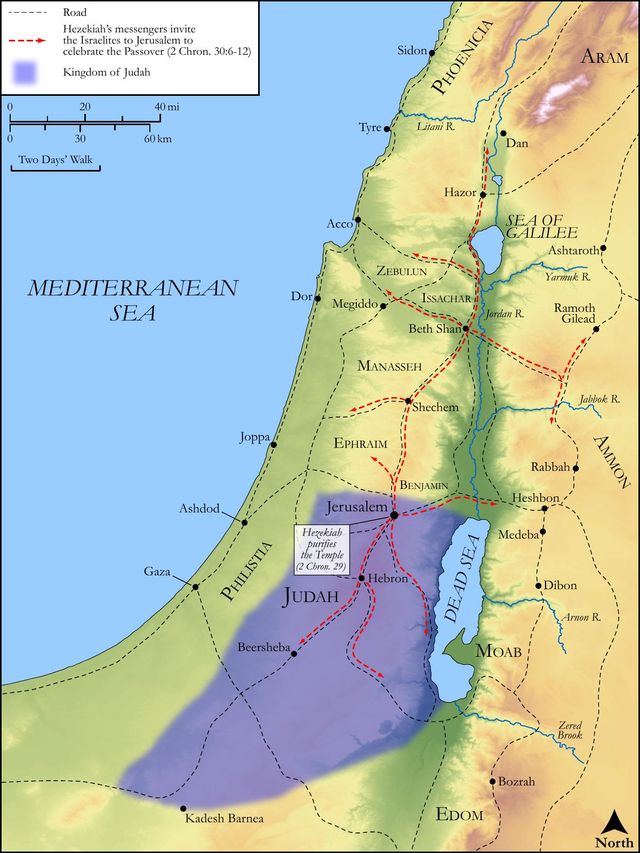
The king had done what he could of this kind (Kg2 18:4), but the people could discover those profane relics which escaped the eye of the king's officers, and therefore they went out to see what they could do, Ch2 31:1. This was done immediately after the passover. Note, The comfort of communion with God should kindle in us a holy zeal and indignation against sin, against every thing that is offensive to God. If our hearts have been made to burn within us at an ordinance, that spirit of burning will consume the dross of corruption. What have I now to do any more with idols? Their zeal here in destroying the images and groves, the high places and altars, appeared,
1.In that they did this, not only in the cities of Judah and Benjamin, but in those of Ephraim and Manasseh. Some think that those cities are meant which had come under the protection and the jurisdiction of the kings of Judah. Others think that, Hoshea king of Israel not forbidding it, their zeal carried them out to the destruction of idolatry even in many parts of his kingdom. At least those that came out of Ephraim and Manasseh to keep the passover (as many did, Ch2 30:18) destroyed all their own images and groves, and did the like for as many more as they had influence upon or could make interest in for leave to do it. We should not only reform ourselves, but do all we can to reform others too.
2.They destroyed all: they utterly destroyed all; they spared none through favour or affection either to the images or to their worshippers; though ever so ancient, ever so costly, ever so beautiful, and ever so well patronised, yet they must all be destroyed. Note, Those that sincerely set themselves against sin will set themselves against all sin.
3.They would not return to their houses, though they had been long absent, till this was done. They could not be easy, nor think themselves safe, in their cities, as long as the images and groves, those betrayers and destroyers of their country, were left standing. Perhaps the prophet Isaiah pointed to this when, a little before, he spoke of a day in which men should cast away the very idols that they themselves had made. So surprising was this blessed change, Isa 2:20; Isa 31:6, Isa 31:7.
II.Hezekiah revived and restored the courses of the priests and Levites, which David had appointed and which had of late been put out of course, Ch2 31:2. The temple service was put into its proper method again, to run in the old channel. Every man was made to know his work, his place, his time, and what was expected from him. Note, Good order contributes much to the carrying on of a good work. The priests were appointed in their courses for burnt-offerings and peace-offerings; the Levites in their courses were some to minister to the priests, others to give thanks and praise. See Ch1 23:4, Ch1 23:5. And all this in the gates or courts of the tents of the Lord. The temple is here called a tent because the temple privileges are movable things and this temple was shortly to be removed.
III.He appropriated a branch of the revenue of his crown to the maintenance and support of the altar.
Though the people were to be at the charge of the daily offerings, and those on the sabbaths, new moons, and feasts, yet, rather than they should be burdened with the expense, he allowed out of his own estate, or out of his exchequer, for all those offerings, Ch2 31:3. It was a generous act of piety, wherein he consulted both God's honour and his people's ease, as a faithful servant to him and a tender father to them. Let princes and great men reckon that well bestowed, and set out to the best interest, which they give for the support and encouragement of religion in their country.
IV.He issued out an order to the inhabitants of Jerusalem first, Ch2 31:4 (that those who were nearest the temple, and both saved and got by being so, might give a good example to others), but which was afterwards extended to, or at least admitted by, the cities of Judah, that they should carefully pay in their dues, according to the law, to the priests and Levites. This had been long neglected, which made the work to be neglected (for a scandalous maintenance makes a scandalous ministry); but Hezekiah, having himself been liberal, might with a good grace require his subjects to be just to the temple service. And observe the end he aims at in recovering and restoring to the priests and Levites their portion, that they might be encouraged in the law of the Lord, in the study of it, and in doing their duty according to it. Observe here,
1.It is fit that ministers should be not only maintained, but encouraged, that they should not only be kept to do their work, but that they should also have wherewith to live comfortably, that they may do it with cheerfulness.
2.Yet they are to be maintained, not in idleness, pride, and luxury, but in the law of the Lord, in their observance of it themselves and in teaching others the good knowledge of it.
V.The people thereupon brought in their tithes very readily.
They wanted nothing but to be called upon; and therefore, as soon as the commandment came abroad, the first-fruits and all the holy things were duly brought in, Ch2 31:5, Ch2 31:6. What the priests had occasion for, for themselves and their families, they made use of, and the overplus was laid in heaps, Ch2 31:6. All harvest-time they were increasing these heaps, as the fruits of the earth were gathered in; for God was to have his dues out of them all. Though a prescription may be pleaded for a modus decimandi - tenth proportion, yet it cannot be pleaded pro non decminado - for the omission of the tenth. When harvest ended they finished their heaps, Ch2 31:7. Now here we have,
1.The account given to Hezekiah concerning those heaps. He questioned the priests and Levites concerning them, why they did not use what was paid in, but hoarded it up thus, (Ch2 31:9), to which it was answered that they had made use of all they had occasion for, for the maintenance of themselves and their families and for their winter store, and that this was that which was left over and above, Ch2 31:10. They did not hoard these heaps for covetousness, but to show what plentiful provision God by his law had made for them, if they could but have it collected and brought in, and that those who conscientiously give God his dues out of their estates bring a blessing upon all they have: Since they began to bring in the offerings the Lord has blessed his people. See for this Hag 2:19. "Try me," says God, "if you will not otherwise trust me, whether, upon your bringing the tithes into the store-house, you have not a blessing poured out upon you," Mal 3:10, Mal 3:11; Eze 44:30.
2.The acknowledgment which the king and princes made of it, Ch2 31:8. They gave thanks to God for his good providence, which gave them something to bring, and his good grace, which gave them hearts to bring it. And they also blessed the people, that is, commended them for their doing well now, without reproaching them for their former neglects. It is observable that after they had tasted the sweetness of God's ordinance, in the late comfortable passover, they were thus free in maintaining the temple service. Those that experience the benefit of a settled ministry will not grudge the expense of it.
Continue studying 2 Chronicles 31:2 across the web’s major study libraries — every link below opens this exact verse, chapter, or book on the destination site.
Read & Compare
 BibleGatewayThis verse in more than 200 translations and 70 languages.
 Bible.comThe YouVersion reader — hundreds of translations, reading plans, and highlights.
 ESV.orgCrossway's official English Standard Version reader.
 NET BibleThe NET translation with 60,000+ translators' notes on every rendering decision.
 STEP BibleTyndale House's free study tool — original text, vocabulary, and scholarly resources.
 BibliaLogos Bible Software's free web reader.
 USCCBThe New American Bible (Revised Edition) with the U.S. bishops' study notes.
Commentaries
 BibleHub CommentariesDozens of classic commentaries on this verse, gathered on one page.
 StudyLightMore than 100 commentary sets — the largest collection on the web.
 BibleRefPlain-English commentary on what this verse means, verse by verse.
 Enduring WordDavid Guzik's free commentary on this chapter, widely used by Bible teachers.
 Bible Study ToolsVerse commentary alongside Greek and Hebrew study aids.
Original Language & Research
- BibleHub InterlinearThe verse word by word — original language, transliteration, and English.
- BibleHub LexiconEvery word's original-language definition and Strong's entry.
 Blue Letter BibleDeep-study tools — Strong's numbers, concordance, and word studies.
 SefariaThe Hebrew text with Rashi and centuries of Jewish commentary.
Sermons, Hymns & Audio


TrulyRandomVerse is not affiliated with these sites and doesn’t control their content. They’re linked because they’re genuinely useful.
Summary
King Hezekiah, in his zealous commitment to national spiritual renewal, meticulously re-established the divinely ordained order of worship in Judah. Following the cleansing of the Temple and the celebration of Passover, this verse details his administrative foresight in organizing the priestly and Levitical divisions ("courses") according to their prescribed duties. Their service encompassed the administration of burnt and peace offerings, alongside the vital functions of ministry, thanksgiving, and praise, all conducted within the sacred precincts of the Lord's house. This act underscored the importance of structured, purposeful, and heartfelt worship as central to the nation's restored covenant relationship with God.
Context
ShowHideLiterary Context
2 Chronicles 31:2 is situated within the broader narrative of King Hezekiah's comprehensive religious reforms, which began in chapter 29. After the apostasy and neglect under his father, King Ahaz, Hezekiah immediately initiated a spiritual revival. Chapters 29 and 30 meticulously describe the cleansing and reconsecration of the Temple, the restoration of the Levitical priesthood, and a magnificent, nationwide Passover celebration—an event of profound spiritual significance, especially given its delayed observance. Chapter 31 then pivots from the initial acts of purification and celebration to the practical, administrative measures Hezekiah implemented to sustain the restored worship. The preceding verse, 2 Chronicles 31:1, describes the people's spontaneous destruction of idolatrous altars and high places throughout Judah and Israel, indicating a widespread popular response to Hezekiah's reforms. Verse 2, therefore, marks Hezekiah's strategic move to institutionalize this revival by re-establishing the proper, day-to-day functioning of the Temple service, ensuring its continuity and adherence to divine law. This administrative action solidifies the spiritual momentum gained from the earlier reforms.
Historical & Cultural Context
Hezekiah reigned during a critical period in Judah's history (c. 715-686 BC), facing the looming threat of the Assyrian Empire. His father, Ahaz, had introduced widespread idolatry and even pagan child sacrifice, closing the Temple doors and abandoning the worship of Yahweh. Hezekiah's reforms were a radical departure, aiming to reverse decades of spiritual decline and restore Judah's covenant fidelity. The "courses" of priests and Levites refer to the organized divisions established by King David (as detailed in 1 Chronicles 23 and 1 Chronicles 24) to ensure continuous and orderly service in the Temple. This system involved rotating groups of priests and Levites serving for specific periods, ensuring that all necessary rituals, sacrifices, music, and maintenance were performed without interruption. Hezekiah's re-establishment of this system was not merely an administrative act but a profound theological statement: a return to the divinely sanctioned order for worship, emphasizing structure, discipline, and the dedicated roles of those consecrated for sacred service.
Key Themes
ShowHideThis verse powerfully underscores several key themes central to the book of Chronicles and biblical theology. Firstly, it highlights the theme of restoration and reform, showcasing Hezekiah's commitment to bringing Judah back into alignment with God's commands after a period of apostasy. His actions demonstrate that true revival involves not only spiritual fervor but also practical, orderly implementation of divine principles. Secondly, the verse emphasizes orderly worship and the importance of structure in serving God. The meticulous organization of the "courses" reflects the biblical principle that God is a God of order, not chaos, and that worship should be conducted with intentionality and reverence, as seen in passages like 1 Corinthians 14:40. Thirdly, it stresses dedicated service, with "every man according to his service" highlighting the specific and essential roles of both priests and Levites in facilitating the spiritual life of the nation through offerings, ministry, thanksgiving, and praise. This foreshadows the diverse gifts and ministries within the New Testament church, as described in Romans 12:4-8. Finally, the mention of "burnt offerings and for peace offerings" points to the core functions of Temple worship: atonement and fellowship with God, reminding the people of their need for reconciliation and the joy of communion with their Creator.
Exposition and Analysis
ShowHideKey Word Analysis
ShowHideThis verb (H5975) literally means "to stand," but in a causative sense, it signifies "to cause to stand," "to establish," "to ordain," or "to appoint." In this context, it emphasizes Hezekiah's authoritative and deliberate act of re-establishing a fixed, organized system. It implies a formal, intentional designation of roles and schedules, restoring the order that had been neglected. This was not a casual arrangement but a divinely guided, administrative decree to ensure the continuity and proper execution of sacred duties, setting them firmly in place.
This term (H4256) refers to "divisions, classes, or shifts." It denotes the highly organized system, originally instituted by David, by which the numerous priests and Levites were divided into groups that served in the Temple on a rotating basis. This system ensured that the vast and complex duties of Temple worship—from sacrifices to music to maintenance—were performed continuously and efficiently, preventing burnout and ensuring accountability. Hezekiah's re-establishment of these courses signifies a return to the established, divinely sanctioned structure for worship, ensuring its systematic and uninterrupted operation.
While the KJV translates this as "tents" (H4264), the Hebrew word machăneh can also mean "camp," "encampment," or by extension, "sacred courts" or "precincts." In the context of the permanent Temple structure built by Solomon, it is most accurately understood as referring to the various designated areas, courts, or stations within the sacred Temple complex where the priests and Levites performed their duties. It may also be a traditional or poetic echo of the Tabernacle, emphasizing the continuity of God's presence among His people from the wilderness to the permanent Temple, or simply a broad reference to the sacred area where the Lord's presence was manifested.
Verse Breakdown
ShowHide"And Hezekiah appointed the courses of the priests and the Levites after their courses"
This opening clause highlights King Hezekiah's direct and authoritative role in restoring order. "Appointed" signifies a deliberate, formal act of organization. The repetition of "courses...after their courses" emphasizes the meticulous re-establishment of the structured divisions for service, echoing the original Davidic arrangements (e.g., 1 Chronicles 24:1). This was a foundational step to ensure the proper functioning of Temple worship after years of neglect, bringing back a system of orderly rotation and responsibility.
"every man according to his service"
This phrase underscores the principle of individual responsibility and specialized function within the divinely ordered system. It implies that each priest and Levite had a specific, designated role, and they were expected to perform it diligently. This ensures efficiency, accountability, and the comprehensive execution of all necessary duties for the complex Temple rituals and activities, highlighting the importance of each person's unique contribution.
"the priests and Levites for burnt offerings and for peace offerings"
This specifies the primary sacrificial duties that were central to their roles. Burnt offerings (עֹלָה, 'olah) symbolized complete dedication to God and made atonement for sin, signifying total surrender and propitiation. Peace offerings (שְׁלָמִים, shelamim) were offerings of fellowship and thanksgiving, representing communion with God and shared blessings. These two types of offerings encapsulate the dual aspects of the covenant relationship: reconciliation and intimate fellowship, demonstrating the breadth of their sacrificial responsibilities.
"to minister, and to give thanks, and to praise"
Beyond the specific sacrificial duties, this clause broadens the scope of their service. "To minister" (לְשָׁרֵת, lesharat) refers to serving God in a general sense, encompassing all aspects of their sacred duties, from ritual performance to Temple maintenance. "To give thanks" (לְהוֹדוֹת, lehodot) and "to praise" (לְהַלֵּל, lehalel) highlight the vital role of worship as an expression of gratitude and adoration. This demonstrates that Temple service was not merely ritualistic but involved heartfelt, vocal expressions of devotion and acknowledgment of God's goodness and majesty.
"in the gates of the tents of the LORD"
This phrase designates the specific location of their service. As discussed in "Key Word Analysis," this likely refers to the various courts, entryways, or designated areas within the Temple complex. It emphasizes that their service was performed within the consecrated, sacred space where God's presence was manifested, underscoring the holiness and solemnity of their duties and the divine authority under which they operated.
Literary Devices
ShowHideThe verse employs several literary devices to convey its message effectively. Repetition is evident in "appointed the courses...after their courses," which emphasizes the meticulous and systematic re-establishment of the priestly and Levitical divisions, highlighting Hezekiah's unwavering commitment to restoring the precise, divinely ordained order. Merism is used in the phrase "burnt offerings and for peace offerings," where these two distinct types of sacrifices stand in for the entire range of offerings and sacrificial rites conducted in the Temple. This device signifies the comprehensive nature of the restored sacrificial system, encompassing both atonement and fellowship with God. There is also a subtle use of Synecdoche in "gates of the tents of the LORD," where "gates" and "tents" (or "camps") represent the entire sacred precinct or complex of the Temple, symbolizing the totality of the consecrated space where worship occurred and God's presence resided. Finally, the verse uses Emphasis to underscore the multi-faceted nature of worship, moving beyond mere ritual to include active "minister[ing]," heartfelt "thanks[giving]," and joyful "praise." This comprehensive description highlights the holistic and vibrant nature of the restored worship under Hezekiah, encompassing both duty and devotion.
Theological and Thematic Connections
ShowHideHezekiah's actions in 2 Chronicles 31:2 stand as a powerful testament to the biblical emphasis on orderly, intentional, and heartfelt worship. His administrative reforms underscore the principle that spiritual revival is not merely an emotional experience but requires structural integrity and diligent adherence to divine commands. The re-establishment of the "courses" reflects God's character as a God of order, who desires that His people serve Him with purpose and discipline, ensuring that every aspect of worship is conducted appropriately. The inclusion of both sacrificial duties and expressions of thanksgiving and praise reveals the comprehensive nature of true worship—it involves both atonement for sin and joyful communion with the Creator. This verse serves as a model for leadership that prioritizes spiritual health and for a community that understands the importance of dedicated service in facilitating a vibrant relationship with God, recognizing that all aspects of life and service should ultimately bring glory to Him.
Reflection and Application
ShowHideHezekiah's meticulous restoration of Temple service in 2 Chronicles 31:2 offers profound lessons for believers today. Just as Hezekiah recognized the necessity of order and intentionality for true worship to flourish, we are called to approach our spiritual lives and corporate gatherings with similar diligence. This verse prompts us to consider whether our worship, both individually and corporately, is merely habitual or if it is characterized by purposeful service, genuine thanksgiving, and heartfelt praise. Every believer is gifted by God and called to "service" within the body of Christ, and like the priests and Levites, we are to perform our roles with dedication and according to God's design. Furthermore, the emphasis on thanksgiving and praise reminds us that worship is not just about fulfilling duties or seeking atonement, but about expressing profound gratitude and adoration for God's boundless goodness and faithfulness. Leaders, like Hezekiah, bear the responsibility of fostering environments where such authentic worship can thrive, ensuring that the church functions in an orderly manner that facilitates spiritual growth and glorifies God in every aspect of its life and mission.
Questions for Reflection
ShowHideFAQ
ShowHideWhy does the KJV say "gates of the tents of the LORD" when the Temple was a permanent structure?
ShowHideThe phrase "gates of the tents of the LORD" (KJV) for the Temple is an interesting translation that has led to various interpretations. The Hebrew word for "tents" (מַחֲנוֹת, machanot, H4264) can also mean "camps" or "encampments," and by extension, "sacred courts" or "precincts." In this context, it is most likely a reference to the various courts, precincts, or designated stations within the permanent Temple complex in Jerusalem. It could be a poetic or traditional echo of the earlier Tabernacle, which was a "tent" or "tent of meeting," thereby emphasizing the continuity of God's sacred dwelling among His people from the wilderness period to the established Temple. Alternatively, it might simply be a broad, somewhat archaic way of referring to the entire sacred area where the Levites and priests performed their duties, including the outer courts and entry points. Regardless of the precise nuance, the phrase unequivocally points to the consecrated space of the Temple where the Lord's presence was manifested and where His worship was to be conducted. Exodus 40:34-35 describes the glory of the Lord filling the Tabernacle, and later 1 Kings 8:10-11 describes it filling the Temple, highlighting the continuity of divine presence in these sacred spaces.
What is the significance of "burnt offerings" and "peace offerings" specifically?
ShowHideThe mention of "burnt offerings" (עֹלָה, 'olah, H5930) and "peace offerings" (שְׁלָמִים, shelamim, H8002) is significant because these two types of sacrifices represent the core functions of Israelite worship and the spectrum of their relationship with God. The burnt offering was entirely consumed on the altar, symbolizing complete dedication, surrender, and atonement for sin. It was an act of propitiation and consecration, signifying the worshiper's desire to be wholly devoted to God. Leviticus 1 details its regulations. The peace offering, by contrast, was an offering of thanksgiving, fellowship, or a vow. Only a portion was burned on the altar, while the remainder was shared by the worshiper, the priests, and sometimes others, symbolizing communion and joyful fellowship with God. It was an expression of gratitude for blessings received and a celebration of the covenant relationship. Leviticus 3 outlines its procedures. Together, these two offerings encapsulate the two fundamental movements of worship: addressing sin and seeking reconciliation (burnt offering), and expressing gratitude and enjoying communion (peace offering), thus covering the full scope of the worshiper's interaction with God.
Christ-Centered Fulfillment
ShowHideThe meticulous re-establishment of the priestly and Levitical courses by Hezekiah, along with their duties of sacrifice, ministry, thanksgiving, and praise, finds its ultimate fulfillment and transformation in Jesus Christ. Hezekiah's reforms were a temporary restoration of a shadow, pointing forward to the perfect reality in Christ. The Levitical priesthood, with its rotating "courses" and daily sacrifices, constantly reminded Israel of their sin and need for atonement, but it could never truly take away sin (Hebrews 10:1-4). Jesus, however, is the eternal High Priest, appointed not by human lineage or temporary courses, but by divine oath, offering Himself as the perfect, once-for-all sacrifice for sin (Hebrews 7:23-27). His sacrifice on the cross fulfills all burnt offerings, securing complete atonement and consecration for those who believe (Hebrews 9:11-14), and His resurrected life establishes an eternal "peace offering," enabling perpetual fellowship and communion with God (Colossians 1:19-20). Furthermore, the "ministry, thanksgiving, and praise" performed by the Levites in the physical Temple are now offered by all believers, who are a "royal priesthood" (1 Peter 2:9), offering "spiritual sacrifices" through Christ (1 Peter 2:5)—sacrifices of praise, thanksgiving, and lives dedicated to His service (Hebrews 13:15-16). The "gates of the tents of the LORD" where the Levites served are transcended by Christ Himself, who is the true "gate" to God's presence (John 10:9) and the ultimate "tabernacle" where God dwells among humanity (John 1:14). Thus, Hezekiah's reforms, while commendable, were but a foreshadowing of the perfect and complete worship established by Christ, enabling all believers to draw near to God with confidence and offer Spirit-filled worship that is eternally pleasing in His sight.