


Daniel 4:14
- קָרֵאka·Re'[he was] proclaimingH7123V-Peal-Prtcpl-msVerb Peal Participle Singular Masculine Absolute
- בְחַיִלve·Cha·yilwith powerH2429Prep-b ¦ N-csNoun Singular common gender Absoluteבְwithחַיִלpower
- וְכֵןve·Khenand as followsH3652Conj-w ¦ AdvAdverbוְandכֵןas follows
- אָמַר'a·Mar[he was] sayingH560V-Peal-Prtcpl-msVerb Peal Participle Singular Masculine Absolute
- גֹּדּוּGo·ducut down!H1414V-Peal-Imp-2mpVerb Peal Imperative 2nd Plural Masculine
- אִילָנָא'i·la·Na'tree theH363N-cs ¦ ArtNoun Singular common gender Definiteאִילָנָtreeאthe
- וְקַצִּצוּve·ka·Tzi·tzuand cut off!H7113Conj-w ¦ V-Piel-Imp-2mpVerb Piel Imperative 2nd Plural Masculineוְandקַצִּצוּcut off!
- עַנְפוֹהִיan·Fo·hiits branchesH6056N-mpc ¦ 3msNoun Plural Masculine Constructעַנְפוֹbranchesהִיits
- אַתַּרוּ'a·Ta·rustrip off!H5426V-Aphel-Imp-2mpVerb Aphel Imperative 2nd Plural Masculine
- עָפְיֵהּ'a·fe·Yehits foliageH6074N-csc ¦ 3msNoun Singular common gender Constructעָפְיֵfoliageהּits
- וּבַדַּרוּu·va·Da·ruand scatter!H921Conj-w ¦ V-Piel-Imp-2mpVerb Piel Imperative 2nd Plural Masculineוּandבַדַּרוּscatter!
- אִנְבֵּהּ'in·Behits fruitH4N-csc ¦ 3msNoun Singular common gender Constructאִנְבֵּfruitהּits
- תְּנֻדte·Nudlet it fleeH5111V-Peal-Imperf-3fsVerb Peal Imperfect 3rd Singular Feminine
- חֵיוְתָאchei·ve·Ta'animal[s] theH2423N-fs ¦ ArtNoun Singular Feminine Definiteחֵיוְתָanimal[s]אthe
- מִןminfromH4481PrepPreposition
- תַּחְתּוֹהִיtach·To·hiunder itH8460N-mpc ¦ 3msNoun Plural Masculine Constructתַּחְתּוֹunderהִיit
- וְצִפְּרַיָּאve·tzi·pe·rai·Ya'and birds theH6853Conj-w ¦ N-mp ¦ ArtNoun Plural Masculine Definiteוְandצִפְּרַיָּbirdsאthe
- מִןminfromH4481PrepPreposition
- עַנְפוֹהִיan·Fo·hiits branchesH6056N-mpc ¦ 3msNoun Plural Masculine Constructעַנְפוֹbranchesהִיits
English is a literal word-by-word gloss of the Hebrew, not the KJV's wording. Why?
This is the original text the KJV's translators worked from — each Hebrew word with its own literal English meaning in this verse, prepared by scholars at Tyndale House, Cambridge. The KJV translates whole sentences, not word by word, so its wording differs: one Hebrew word can become several English words, and the KJV may choose “the LORD” where the gloss reads “Yahweh”. Both are faithful — they answer different questions. For the KJV's own rendering, switch to the KJV text.
Details
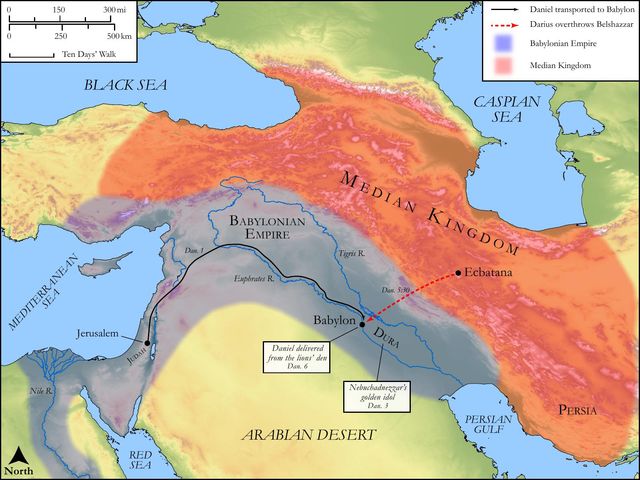
See on the biblical-era map
Study this verse
Public-domain commentary
Matthew Henry
From his Commentary on the Whole Bible. Henry comments on passages, not single verses — this entry covers Daniel 4:4–18. His four-level outline is real structure in the source text, so it is rendered as structure.
Nebuchadnezzar, before he relates the judgments of God that had been wrought upon him for his pride, gives an account of the fair warning he had of them before they came, a due regard to which might have prevented them. But he was told of them, and of the issue of them, before they came to pass, that, when they did come to pass, by comparing them with the prediction of them, he might see, and say, that they were the Lord's doing, and might be brought to believe that there is a divine revelation in the world, as well as a divine Providence, and that the works of God agree with his word.
Now, in the account he here gives of his dream, by which he had notice of what was coming, we may observe,
I.The time when this alarm was given to him (Dan 4:4); it was when he was at rest in his house, and flourishing in his palace.
He had lately conquered Egypt, and with it completed his victories, and ended his wars, and made himself monarch of all those parts of the world, which was about the thirty-fourth or thirty-fifth year of his reign, Eze 29:17. Then he had this dream, which was accomplished about a year after. Seven years his distraction continued, upon his recovery from which he penned this declaration, lived about two years after, and died in his forty-fifth year. He had undergone a long fatigue in his wars, had made many a tedious and dangerous campaign in the field; but now at length he is at rest in his house, and there is no adversary, nor any evil occurrent. Note, God can reach the greatest of men with his terrors even when they are most secure, and think themselves at rest and flourishing.
II.The impression it made upon him (Dan 4:5):
I saw a dream which made me afraid. One would think no little thing would frighten him that had been a man of war from his youth, and used to look the perils of war in the face without change of countenance; yet, when God pleases, a dream strikes a terror upon him. His bed, no doubt, was soft, and easy, and well-guarded, and yet his own thoughts upon his bed made him uneasy, and the visions of his head, the creatures of his own imagination, troubled him. Note, God can make the greatest of men uneasy even when they say to their souls, Take your ease, eat, drink, and be merry; he can make those that have been the troublers of the world, and have tormented thousands, to be their own troublers, their own tormentors, and those that have been the terror of the mighty a terror to themselves. By the consternation which this dream put him into, and the impression it made upon him, he perceived it to be, not an ordinary dream, but sent of God on a special errand.
III.His consulting, in vain, with the magicians and astrologers concerning the meaning of it.
He had not now forgotten the dream, as before, ch. 2. He had it ready enough, but he wanted to know the interpretation of it and what was prefigured by it, Dan 4:6. Orders are immediately given to summon all the wise men of Babylon that were such fools as to pretend by magic, divination, inspecting the entrails of beasts, or observations of the stars, to predict things to come: they must all come together, to see if any, or all of them in consultation, could interpret the king's dream. It is probable that these people had sometimes, in a like case, given the king some sort of satisfaction, and by the rules of their art had answered the king's queries so as to please him, whether it were right or wrong, hit or missed; but now his expectation from them was disappointed: He told them the dream (Dan 4:7), but they could not tell him the interpretation of it, though they had boasted, with great assurance (Dan 2:4, Dan 2:7), that, if they had but the dream told them, they would without fail interpret it. But the key of this dream was in a sacred prophecy (Eze 31:3, etc.), where the Assyrian is compared, as Nebuchadnezzar here, to a tree cut down, for his pride; and that was a book they had not studied, nor acquainted themselves with, else they might have been let into the mystery of this dream. Providence ordered it so that they should be first puzzled with it, that Daniel's interpreting it afterwards might redound to the glory of the God of Daniel. Now was fulfilled what Isaiah foretold (Isa 47:12, Isa 47:13), that when the ruin of Babylon was drawing on her enchantments and sorceries, her astrologers and star-gazers, should not be able to do her any service.
IV.The court he made to Daniel, to engage him to expound his dream to him:
At the last Daniel came in. Dan 4:8. Either he declined associating with the rest because of their badness, or they declined his company because of his goodness; or perhaps the king would rather that his own magicians should have the honour of doing it if they could than that Daniel should have it; or Daniel, being governor of the wise men (Dan 2:48), was, as is usual, last consulted. Many make God's word their last refuge, and never have recourse to it till they are driven off from all other succours. He compliments Daniel very highly, takes notice of the name which he had himself given him, in the choice of which he thinks he was very happy and that it was a good omen: "His name was Belteshazzar, from Bel, the name of my god." He applauds his rare endowments: He has the spirit of the holy gods, so he tells him to his face (Dan 4:9), with which we may suppose that Daniel was so far from being puffed up that he was rather very much grieved to hear that which he had by gift from the God of Israel, the true and living God, ascribed to Nebuchadnezzar's god, a dunghill deity. Here is a strange medley in Nebuchadnezzar, but such as is commonly found in those that side with their corruptions against their convictions.
1.He retains the language and dialect of his idolatry, and therefore, it is to be feared, is no convert to the faith and worship of the living God. He is an idolater, and his speech betrayeth him. For he speaks of many gods, and is brought to acquiesce in one as sufficient, no, not in him who is all-sufficient. And some think, when he speaks of the spirit of the holy gods, that he supposes there are some evil malignant deities, whom men are concerned to worship, only to prevent their doing them a mischief, and some who are good beneficent deities, and that by the spirit of the latter Daniel was animated. He also owns that Bel was his god still, though he had once and again acknowledged the God of Israel to be Lord of all, Dan 2:47; Dan 3:29. He also applauds Daniel, not as a servant of God, but as master of the magicians (Dan 4:9), supposing his knowledge to differ from theirs, not in kind, but only in degree; and he consulted him not as a prophet, but as a celebrated magician, so endeavouring to save the credit of the art when those blundered and were nonplussed who were masters of the art. See how close his idolatry sat to him. He has got a notion of many gods, and has chosen Bel for his god, and he cannot persuade himself to quit either his notion or his choice, though the absurdity of both had been evidenced to him, more than once, beyond contradiction. He, like other heathens, would not change his gods, though they were no gods, Jer 2:11. Many persist in a false way only because they think they cannot in honour leave it. See how loose his convictions sat, and how easily he had dropped them. He once called the God of Israel a God of gods, Dan 2:47. Now he sets him upon a level with the rest of those whom he calls the holy gods. Note, If convictions be not speedily prosecuted, it is a thousand to one but in a little time they will be quite lost and forgotten. Nebuchadnezzar, not going forward with the acknowledgements he had been brought to make of the sovereignty of the true God, soon went backwards, and relapsed to the same veneration he had always had for his false gods. And yet,
2.He professes a great opinion of Daniel, whom he knows to be a servant of the true God, and of him only. He looked upon him as one that had such an insight, such a foresight, as none of his magicians had: I know that no secret troubles thee. Note, The spirit of prophecy quite outdoes the spirit of divination, even the enemies themselves being judges; for so it was adjudged here, upon a fair trial of skill.
V.The particular account he gives him of his dream.
1.He saw a stately flourishing tree, remarkable above all the trees of the wood. This tree was planted in the midst of the earth (Dan 4:10), fitly representing him who reigned in Babylon, which was about the midst of the then known world. His dignity and eminency above all his neighbours were signified by the height of this tree, which was exceedingly great; it reached unto heaven. He over-topped those about him, and aimed to have divine honours given him; nay, he over-powered those about him, and the potent armies he had the command of, with which he carried all before him, are signified by the strength of this tree: it grew and was strong. And so much were Nebuchadnezzar and his growing greatness the talk of the nations, so much had they their eye upon him (some a jealous eye, all a wondering eye), that the sight of this tree is said to be to the end of all the earth. This tree had every thing in it that was pleasant to the eye and good for food (Dan 4:12); The leaves thereof were fair, denoting the pomp and splendour of Nebuchadnezzar's court, which was the wonder of strangers and the glory of his own subjects. Nor was this tree for sight and state only, but for use.
(1.)For protection; the boughs of it were for shelter both to the beasts and to the fowls. Princes should be a screen to their subjects from the heat and from the storm, should expose themselves to secure them, and study how to make them safe and easy. If the bramble be promoted over the trees, he invites them to come and trust in his shadow, such as it is, Jdg 9:15. It is protection that draws allegiance. The kings of the earth are to their subjects but as the shadow of a great tree; but Christ is to his subjects as the shadow of a great rock, Isa 32:2. Nay, because that, though strong, may be cold, they are said to be hidden under the shadow of his wings (Psa 17:8), where they are not only safe, but warm.
(2.)For provision, The Assyrian was compared to a cedar (Eze 31:6), which affords shadow only; but this tree here had much fruit - in it was meat for all and all flesh was fed of it. This mighty monarch, it should seem by this, not only was great, but did good; he did not impoverish, but enrich his country, and by his power and interest abroad brought wealth and trade to it. Those that exercise authority would be called benefactors (Luk 22:25), and the most effectual course they can take to support their authority is to be really benefactors. And see what is the best that great men, with their wealth and power can attain to, and that is to have the honour of having many to live upon them and to be maintained by them; for, as goods are increased, those are increased that eat them.
2.He heard the doom of this tree read, which he perfectly remembered, and related here, perhaps word for word as he heard it. The sentence was passed upon it by an angel, whom he saw come down from heaven, and heard proclaim this sentence aloud. This angel is here called a watcher, or watchman, not only because angels by their nature are spirits, and therefore neither slumber nor sleep, but because by their office they are ministering spirits, and attend continually to their ministrations, watching all opportunities of serving their great Master. They, as watchers, encamp round those that fear God, to deliver them, and bear them up in their hands. This angel was a messenger, or ambassador (so some read it), and a holy one. Holiness becomes God's house; therefore angels that attend and are employed by him are holy ones; they preserve the purity and rectitude of their nature, and are in every thing conformable to the divine will. Let us review the doom passed upon the tree.
(1.)Orders are given that it be cut down (Dan 4:14); now also the axe is laid to the root of this tree. Though it is ever so high, ever so strong, that cannot secure it when its day comes to fall; the beasts and fowls, that are sheltered in and under the boughs of it, are driven away and dispersed; the branches are cropped, the leaves shaken off, and the fruit scattered. Note, Worldly prosperity in its highest degree is a very uncertain thing; and it is no uncommon thing for those that have lived in the greatest pomp and power to be stripped of all that which they trusted to and gloried in. By the turns of providence, those who made a figure become captives, those who lived in plenty, and above what they had, are reduced to straits, and live far below what they had, and those perhaps are brought to be beholden to others who once had many depending upon them and making suit to them. But the trees of righteousness, that are planted in the house of the Lord and bring forth fruit to him, shall not be cut down, nor shall their leaf wither.
(2.)Care is taken that the root be preserved (Dan 4:15); "Leave the stump of it in the earth, exposed to all weathers. There let it lie neglected and buried in the grass. Let the beasts that formerly sheltered themselves under the boughs now repose themselves upon the stump; but that it may not be raked to pieces, nor trodden to dirt, and to show that it is yet reserved for better days, let it be hooped round with a band of iron and brass, to keep it firm." Note, God in judgment remembers mercy; and may yet have good things in store for those whose condition seems most forlorn. There is hope of a tree, if it be cut down, that it will sprout again, that through the scent of water it will bud, Job 14:7-9.
(3.)The meaning of this is explained by the angel himself to Nebuchadnezzar, Dan 4:16. Whoever is the person signified by this tree he is sentenced to be deposed from the honour, state, and dignity of a man, to be deprived of the use of his reason, and to be and live like a brute, till seven times pass over him. Let a beast's heart be given unto him. This is surely the saddest and sorest of all temporal judgments, worse a thousand times than death, and though, like it, least felt by those that lie under it, yet to be dreaded and deprecated more than any other. Nay, whatever outward affliction God is pleased to lay upon us, we have reason to bear it patiently, and to be thankful that he continues to us the use of our reason and the peace of our consciences. But those proud tyrants who set their heart as the heart of God (Eze 27:2) may justly be deprived of the heart of man, and have a beast's heart given them.
(4.)The truth of it is confirmed (Dan 4:17); This matter is by the decree of the watchers and the demand by the word of the holy ones. God has determined it, as a righteous Judge; he has signed this edict; pursuant to his eternal counsel, the decree has gone forth, And,
[1.]The angels of heaven have subscribed to it, as attesting it, approving it, and applauding it. It is by the decree of the watchers; not that the great God needs the counsel or concurrence of the angels in any thing he determines or does, but, as he uses their ministration in executing his counsels, so he is sometimes represented, after the manner of men, as if he consulted them. Whom shall I send? Isa 6:8. Who shall persuade Ahab? Kg1 22:20. So it denotes the solemnity of this sentence. The king's breves, or short writs, pass, Teste me ipso - in my presence; but charters used to be signed, His testibus - In the presence of us whose names are under-written; such was Nebuchadnezzar's doom; it was by the decree of the watchers.
[2.]The saints on earth petitioned for it, as well as the angels in heaven: The demand is by the word of the holy ones. God's suffering people, that had long groaned under the heavy yoke of Nebuchadnezzar's tyranny, cried to him for vengeance; they made the demand, and God gave this answer to it; for, when the oppressed cry to God, he will hear, Exo 22:27. Sentence was passed, in Ahab's time, that there should be no more rain, at Elijah's word, when he made intercession against Israel, Kg1 17:1.
(5.)The design of it is declared. Orders are given for the cutting down of this tree, to the intent that the living may know that the Most High rules. This judgment must be executed, to convince the unthinking, unbelieving, world, that verily there is a God that judges in the earth, a God that governs the world, that not only has a kingdom of his own in it, and administers the affairs of that kingdom, but rules also in the kingdom of men, in the dominion that one man has over another, and gives that to whomsoever he will; from him promotion comes, Psa 75:6, Psa 75:7. He advances men to power and dominion that little expected it, and crosses the projects of the ambitious and aspiring. Sometimes he sets up the basest of men, and serves his own purposes by them. He sets up mean men, as David from the sheepfold; he raises the poor out of the dust, to set them among princes, Psa 113:7, Psa 113:8. Nay, sometimes he sets up bad men, to be a scourge to a provoking people. Thus he can do, thus he may do, thus he often does, and gives not account of any of his matters. By humbling Nebuchadnezzar it was designed that the living should be made to know this. The dead know it, that have gone to the world of spirits, the world of retribution; they know that the Most High rules; but the living must be made to know it and lay it to heart, that they may make their peace with God before it be too late.
Thus has Nebuchadnezzar fully and faithfully related his dream, what he saw and what he heard, and then demands of Daniel the interpretation of it (Dan 4:18), for he found that no one else was able to interpret it, but was confident that he was: For the spirit of the holy gods is in thee, or of the Holy God, the proper title of the God of Israel. Much may be expected from those that have in them the Spirit of the Holy God. Whether Nebuchadnezzar had any jealousy that it was his own doom that was read by this dream does not appear; perhaps he was so vain and secure as to imagine that it was some other prince that was a rival with him, whose fall he had the pleasing prospect of given him in this dream; but, be it for him or against him, he is very solicitous to know the true meaning of it and depends upon Daniel to give it to him. Now, When God gives us general warnings of his judgments we should be desirous to understand his mind in them, to hear the Lord's voice crying in the city.
Historical interpretation
Historical reception
1 surviving comment on this verse from the historical church.
Verses 13, 14. "'And behold, a watchman and a holy one descended from heaven, and he cried out with a loud voice and spoke as follows: 'Cut down the tree and chop off its branches...'" Instead of "watchman" Theodotion uses the Chaldee word itself, hir, which is written with the three letters 'ayin, yodh, and resh. But it signifies the angels, because they ever keep watch and are prepared to carry out God's command. And so we too follow the example of the angels in their duties when we engage in frequent night-long vigils. Also it is said of the Lord: "He who keepeth Israel will neither slumber nor sleep" (Psalm 121:4). Lastly, we read a little later:
Continue studying Daniel 4:14 across the web’s major study libraries — every link below opens this exact verse, chapter, or book on the destination site.
Read & Compare
 BibleGatewayThis verse in more than 200 translations and 70 languages.
 Bible.comThe YouVersion reader — hundreds of translations, reading plans, and highlights.
 ESV.orgCrossway's official English Standard Version reader.
 NET BibleThe NET translation with 60,000+ translators' notes on every rendering decision.
 STEP BibleTyndale House's free study tool — original text, vocabulary, and scholarly resources.
 BibliaLogos Bible Software's free web reader.
 USCCBThe New American Bible (Revised Edition) with the U.S. bishops' study notes.
Commentaries
 BibleHub CommentariesDozens of classic commentaries on this verse, gathered on one page.
 StudyLightMore than 100 commentary sets — the largest collection on the web.
 BibleRefPlain-English commentary on what this verse means, verse by verse.
 Enduring WordDavid Guzik's free commentary on this chapter, widely used by Bible teachers.
 Bible Study ToolsVerse commentary alongside Greek and Hebrew study aids.
Original Language & Research
- BibleHub InterlinearThe verse word by word — original language, transliteration, and English.
- BibleHub LexiconEvery word's original-language definition and Strong's entry.
 Blue Letter BibleDeep-study tools — Strong's numbers, concordance, and word studies.
 SefariaThe Hebrew text with Rashi and centuries of Jewish commentary.
Sermons, Hymns & Audio


TrulyRandomVerse is not affiliated with these sites and doesn’t control their content. They’re linked because they’re genuinely useful.
Summary
Daniel 4:14 unveils a pivotal moment in King Nebuchadnezzar's prophetic dream, articulating a divine decree to dismantle a magnificent tree that vividly symbolizes the king's vast dominion and power. This solemn command, issued by a celestial "watcher" or "holy one," meticulously outlines the comprehensive stripping away of the tree's branches, leaves, and fruit, signifying the abrupt and total removal of Nebuchadnezzar's authority, influence, and the benefits derived from his extensive rule. Furthermore, it mandates the departure of the beasts and fowls that found shelter beneath it, illustrating his impending isolation and the loss of his subjects and beneficiaries, all serving as a stark and undeniable premonition of his profound humbling.
Context
ShowHideLiterary Context
Daniel 4:14 is intricately woven into King Nebuchadnezzar's deeply personal testimony, which encompasses the entirety of Daniel 4. The chapter commences with Nebuchadnezzar's heartfelt praise to the Most High God, as he recounts his extraordinary experience of divine humbling and subsequent restoration. This specific verse immediately follows the dramatic introduction of a "watcher and an holy one" descending from heaven in Daniel 4:13, who then issues this pronouncement against the great tree. The command in Daniel 4:14 serves as the central action of the dream's judgment, setting the stage for Daniel's subsequent interpretation, which reveals the tree represents Nebuchadnezzar himself, and the judgment signifies his temporary removal from power due to his overweening pride. The narrative then progresses to the precise fulfillment of this prophecy and Nebuchadnezzar's eventual restoration and renewed, humble acknowledgment of God's absolute sovereignty, as powerfully detailed in Daniel 4:34-37.
Historical & Cultural Context
The book of Daniel is set during the tumultuous period of the Babylonian exile, a time when the Neo-Babylonian Empire, under the formidable leadership of Nebuchadnezzar, stood as the preeminent world power. Nebuchadnezzar was renowned for his monumental building projects, his sweeping military conquests, and his autocratic rule, embodying the very pinnacle of earthly imperial might. In ancient Near Eastern cultures, the imagery of a great tree was a widely recognized and potent symbol for a powerful king, an expansive empire, or a flourishing nation, representing strength, prosperity, and the vital ability to provide shelter and sustenance to numerous peoples. This symbolism finds parallels in other biblical texts, such as the depiction of Assyria as a mighty cedar in Ezekiel 31 and the more universal imagery of the tree of life. The concept of "watchers" or "holy ones" (Aramaic: ʻiyr vᵉqaddish) reflects a deeply held belief in celestial beings who meticulously observe and actively execute divine decrees, profoundly underscoring God's direct and active involvement in human affairs, even those of the most powerful earthly rulers.
Key Themes
ShowHideThis verse profoundly contributes to several overarching and interconnected themes within the book of Daniel and the broader biblical narrative. Foremost among these is the theme of Divine Sovereignty, which emphatically asserts that even the most formidable and seemingly unassailable earthly rulers are ultimately subject to the absolute authority of God, who "rules in the kingdom of men" (Daniel 4:17). It starkly highlights the Consequences of Pride, demonstrating that Nebuchadnezzar's self-exaltation (later explicitly articulated in Daniel 4:30) directly precipitates this severe divine judgment. The vivid imagery of the tree's destruction also powerfully underscores the Temporary Nature of Earthly Power and glory, serving as a timeless reminder to those in authority that their dominion is divinely granted and can be just as swiftly removed by God. Furthermore, the deliberate partial destruction (leaving a stump, as seen in Daniel 4:15) subtly introduces the profound theme of Divine Mercy and Restoration, hinting that the judgment, while severe and necessary, is not final, allowing for a future return to power after a period of profound humbling and recognition of God's supremacy.
Exposition and Analysis
ShowHideKey Word Analysis
ShowHideThis Aramaic verb (H1414) literally means "to cut down." In the context of Daniel 4:14, it signifies a decisive, violent, and complete act of judgment. It is not merely a pruning or trimming, but a comprehensive felling of the tree, indicating the abrupt and total removal of Nebuchadnezzar's power and position. The command is absolute and unyielding, leaving no room for negotiation or delay, emphasizing the irreversible nature of the divine decree against his pride.
The Aramaic term (H363) refers to "a tree." Here, it is the central and most potent symbol in Nebuchadnezzar's dream, representing the king himself, his vast and flourishing Babylonian empire, and his immense power, influence, and dominion. The tree's magnificent size, its reach to the heavens, and its provision of shelter and sustenance for all creatures vividly underscore Nebuchadnezzar's global dominion and the pervasive benefits derived from his rule. Its felling signifies the dismantling of this empire and the profound humbling of its once-proud ruler.
This Aramaic word (H2423) denotes "an animal" or "beast." In the dream, the "beasts" and "fowls" (H6853) collectively represent the myriad nations, peoples, and individuals who found shelter, sustenance, or derived benefit and protection under Nebuchadnezzar's vast and powerful empire. Their command to "get away" (H5111) from under the tree symbolizes the immediate and complete loss of support, allegiance, and the tangible benefits that flowed from the king's rule, ultimately leaving him isolated, abandoned, and stripped of all that made his reign significant.
Verse Breakdown
ShowHide"He cried aloud, and said thus,"
This opening clause powerfully establishes the authoritative and public nature of the divine pronouncement. The "He" refers to the "watcher and an holy one" introduced in Daniel 4:13. The act of crying "aloud" (Aramaic: chayil, H2429, meaning "strength" or "power") indicates a powerful, public, and undeniable decree, emphasizing that this is a divine, non-negotiable command from the highest authority, intended to be heard and understood by all.
"Hew down the tree, and cut off his branches,"
This is the core command of judgment, a direct assault on the symbolic representation of Nebuchadnezzar's power. "Hew down the tree" (H1414, H363) signifies the felling of the king's dominion, a complete and abrupt cessation of his reign. "Cut off his branches" (H7113, H6056) represents the removal of his extended power, influence, and the very reach of his authority, symbolizing the dismantling of his administrative structures, the weakening of his military might, and the contraction of his political influence.
"shake off his leaves, and scatter his fruit:"
This clause further details the comprehensive and humiliating nature of the stripping. "Shake off his leaves" (H5426, H6074) implies the loss of outward glory, beauty, and vitality, which are the visible signs of a flourishing and prosperous kingdom. "Scatter his fruit" (H921, H4) refers to the destruction or dispersal of the benefits, produce, and resources that flowed from the king's rule, indicating the loss of prosperity, wealth, and the very means by which he sustained his kingdom and its subjects.
"let the beasts get away from under it, and the fowls from his branches:"
This final clause describes the immediate and profound consequences for those who benefited from the tree's shelter. The "beasts" (H2423) and "fowls" (H6853) symbolize the various peoples, nations, and even individuals who had sought refuge, sustenance, and prosperity under Nebuchadnezzar's vast dominion. Their departure signifies the king's utter isolation, the withdrawal of all support and allegiance, and the complete loss of his subjects and beneficiaries, leaving him utterly alone and stripped of all that had made his rule significant and widespread.
Literary Devices
ShowHideDaniel 4:14 is exceptionally rich in Symbolism and Metaphor. The most prominent and central symbol is the "tree" itself, which metaphorically represents King Nebuchadnezzar and his vast, powerful, and far-reaching empire. The series of actions commanded against the tree—"hew down," "cut off his branches," "shake off his leaves," and "scatter his fruit"—are powerful metaphors for the comprehensive and systematic stripping of Nebuchadnezzar's power, authority, glory, and the tangible benefits of his rule. The departure of "the beasts" and "the fowls" from the tree's protective shelter is a poignant metaphor for the loss of his subjects, allies, and all who had benefited from his reign, leading to his profound isolation. The vivid and visceral Imagery used throughout the verse—of a once-majestic tree being violently and thoroughly dismantled—serves to impress upon the reader the severity, totality, and inevitability of the divine judgment, making the abstract concept of a king's fall tangible and deeply impactful. The entire dream sequence, culminating in this decree, functions as an Allegory, where the narrative of the tree directly maps to the unfolding events in Nebuchadnezzar's life and the divine lesson he must learn.
Theological and Thematic Connections
ShowHideDaniel 4:14 powerfully articulates the foundational theological truth of God's absolute and unchallengeable sovereignty over all earthly kingdoms and rulers. It serves as a profound and enduring reminder that human power, no matter how vast, seemingly unassailable, or globally influential, is ultimately derivative, temporary, and entirely subject to the divine will. The severe judgment pronounced against Nebuchadnezzar's symbolic tree unequivocally underscores that unchecked pride, self-exaltation, and a failure to humbly acknowledge God as the ultimate source of all authority will inevitably lead to divine humbling and correction. This passage teaches with striking clarity that true and ultimate authority resides not in human might, military conquest, or grand accomplishments, but solely in the Most High God, who "removes kings and establishes kings." It stands as a timeless warning against the perils of human hubris and an urgent invitation to humility, a recognition of God's supreme and active reign over all creation and the intricate tapestry of human affairs.
Reflection and Application
ShowHideDaniel 4:14 offers a profound and challenging call to introspection for all who hold positions of influence, whether in government, business, the church, or within their families and communities. It serves as a stark and sobering reminder that all authority, privilege, and ability are ultimately delegated by God, and to forget or deny this foundational truth is to invite divine correction and humbling. For leaders, this passage compels a posture of profound humility, recognizing that their power is a sacred stewardship, not an inherent right, and that their ultimate accountability is to the sovereign God. For individuals, it encourages us to meticulously examine our own hearts for subtle, insidious forms of pride—whether in our achievements, possessions, intellectual prowess, or perceived self-sufficiency. This verse reminds us that true security, lasting significance, and enduring flourishing are found not in accumulating earthly power, wealth, or human recognition, but in humbly acknowledging God's supreme rule and aligning our lives, ambitions, and decisions with His divine will. It prompts us to consider deeply how we use whatever influence we possess—is it for self-exaltation, personal gain, or for the glory of God and the genuine benefit of others?
Questions for Reflection
ShowHideFAQ
ShowHideWhat does the "tree" in Daniel 4:14 symbolize?
ShowHideThe "tree" in Daniel 4:14 is a powerful and multi-layered symbol that represents King Nebuchadnezzar himself and his vast, flourishing Babylonian Empire. Its immense height, reaching to the heavens, and its provision of shelter and sustenance for all creatures symbolize his immense power, global dominion, and the widespread benefits derived from his rule. The command to "hew down the tree" signifies the divine judgment against Nebuchadnezzar's overweening pride and his temporary, yet profound, removal from his throne, stripping him of his authority and glory. This symbolism is a common motif in ancient Near Eastern literature, where mighty trees often represented powerful rulers or nations, as vividly seen in Ezekiel 31.
Who is the "watcher" who gives this command?
ShowHideThe "watcher" (Aramaic: ʻiyr) mentioned in Daniel 4:13 and who issues the command in Daniel 4:14 is understood to be a celestial being, specifically an angel or a member of God's heavenly court. The accompanying phrase "and an holy one" further emphasizes their divine origin and their crucial role as agents of God's sovereign will. These celestial beings are depicted as meticulously observing human affairs and actively executing God's decrees, particularly those concerning the rise and fall of earthly rulers and empires. This highlights the profound theological truth that God is not a distant, passive observer but is actively and intimately involved in the governance of the world, and that even the most powerful human leaders are ultimately subject to His supreme and unchallengeable authority.
Christ-Centered Fulfillment
ShowHideWhile Daniel 4:14 vividly portrays the humbling of a proud earthly king, it profoundly foreshadows the ultimate reign of a King whose kingdom is eternal and whose glory is paradoxically revealed in His profound humility. Nebuchadnezzar's catastrophic fall was a direct consequence of his pride and self-exaltation, a stark and illuminating contrast to the true King, Jesus Christ. Unlike Nebuchadnezzar, who grasped for and boasted of his power, Christ, though existing in the very form of God, "did not consider equality with God as something to be exploited, but emptied himself by taking the form of a servant, being born in human likeness" (Philippians 2:6-7). The temporary stripping of Nebuchadnezzar's dominion points to Christ's voluntary and radical surrender of His divine prerogatives to become human, to suffer, and to die on a cross, only to be supremely exalted to the highest place, where "at the name of Jesus every knee should bow, in heaven and on earth and under the earth" (Philippians 2:10). The divine judgment against the proud tree in Daniel 4:14 underscores the eternal principle that all earthly authority is transient and subject to God, ultimately finding its true and everlasting fulfillment in the universal and benevolent dominion of Christ, to whom "all authority in heaven and on earth has been given" (Matthew 28:18). His kingdom, unlike Nebuchadnezzar's, "shall never be destroyed, nor shall its dominion be left to another people" (Daniel 2:44), offering eternal shelter, unfailing sustenance, and perfect peace to all who humbly come under His righteous and compassionate rule.