


Daniel 2:48
Bible text: King James Version (1769 Blayney text) · Public domain
Bible text: King James Version with Strong's numbers · Public domain
Bible text: Berean Standard Bible · Public domain
Bible text: American Standard Version (1901) · Public domain
Bible text: World English Bible, Messianic edition · Public domain
Bible text: Geneva Bible (1599) · Public domain
Bible text: Young's Literal Translation · Public domain
- אֱדַיִן'e·Da·yinthenH116AdvAdverb
- מַלְכָּאmal·Ka'king theH4430N-cs ¦ ArtNoun Singular common gender Definiteמַלְכָּkingאthe
- לְדָנִיֵּאלle·da·ni·Yel<obj.> DanielH1841Prep-l ¦ N-proper-mNoun Proper Masculineלְ<obj.>דָנִיֵּאלDaniel
- רַבִּיra·Bihe made greatH7236V-Pael-Perf-3msVerb Pael Perfect 3rd Singular Masculine
- וּמַתְּנָןu·ma·te·Nanand giftsH4978Conj-w ¦ N-fpNoun Plural Feminine Absoluteוּandמַתְּנָןgifts
- רַבְרְבָןrav·re·VangreatH7260Adj-fpAdjective Plural Feminine Absolute
- שַׂגִּיאָןsa·gi·'AnmanyH7690Adj-fpAdjective Plural Feminine Absolute
- יְהַבye·havhe gaveH3052V-Peal-Perf-3msVerb Peal Perfect 3rd Singular Masculine
- לֵהּLehto himPrep-l ¦ 3msSuffix Personal 3rd Singular Masculineלֵtoהּhim
- וְהַשְׁלְטֵהּve·Hash·le·Tehand he made ruler himH7981Conj-w ¦ V-Hiphil-Perf-3ms ¦ 3msVerb Hiphil Perfect 3rd Singular Masculineוְandהַשְׁלְטֵhe made rulerהּhim
- עַל'aloverH5922PrepPreposition
- כָּלkolallH3606N-cscNoun Singular common gender Construct
- מְדִינַתme·di·Nat[the] province ofH4083N-fscNoun Singular Feminine Construct
- בָּבֶלba·VelBabylonH895N-properNoun Proper Location
- וְרַבve·ravand chief ofH7229Conj-w ¦ N-cscNoun Singular common gender Constructוְandרַבchief of
- סִגְנִיןsig·NinprefectsH5460N-mpNoun Plural Masculine Absolute
- עַל'aloverH5922PrepPreposition
- כָּלkolallH3606N-cscNoun Singular common gender Construct
- חַכִּימֵיcha·ki·Mei[the] wise men ofH2445Adj-mpcAdjective Plural Masculine Construct
- בָבֶלva·VelBabylonH895N-properNoun Proper Location
English is a literal word-by-word gloss of the Hebrew, not the KJV's wording. Why?
This is the original text the KJV's translators worked from — each Hebrew word with its own literal English meaning in this verse, prepared by scholars at Tyndale House, Cambridge. The KJV translates whole sentences, not word by word, so its wording differs: one Hebrew word can become several English words, and the KJV may choose “the LORD” where the gloss reads “Yahweh”. Both are faithful — they answer different questions. For the KJV's own rendering, switch to the KJV text.
Details
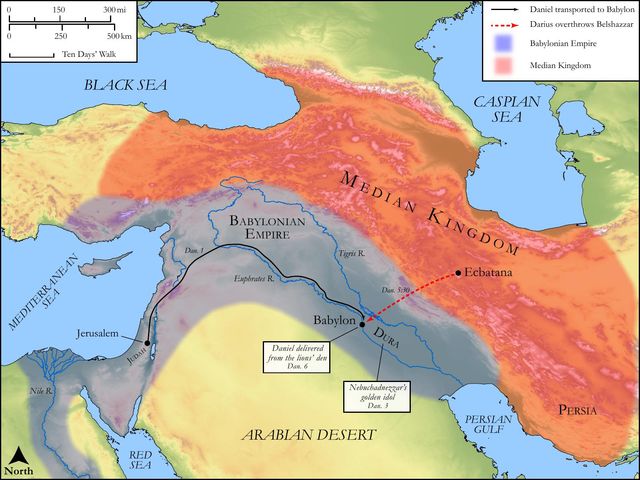
See on the biblical-era map
Study this verse
Public-domain commentary
Matthew Henry
From his Commentary on the Whole Bible. Henry comments on passages, not single verses — this entry covers Daniel 2:46–49.
One might have expected that when Nebuchadnezzar was contriving to make his own kingdom everlasting he would be enraged at Daniel, who foretold the fall of it and that another kingdom of another nature should be the everlasting kingdom; but, instead of resenting it as an affront, he received it as an oracle, and here we are told what the expressions were of the impressions it made upon him. 1. He was ready to look upon Daniel as a little god. Though he saw him to be a man, yet from this wonderful discovery which he had made both of his secret thoughts, in telling him the dream, and of things to come, in telling him the interpretation of it, he concluded that he had certainly a divinity lodged in him, worthy his adoration; and therefore he fell upon his face and worshipped Daniel, Dan 2:46. It was the custom of the country by prostration to give honour to kings, because they have something of a divine power in them (I have said, You are gods); and therefore this king, who had often received such veneration from others, now paid the like to Daniel, whom he supposed to have in him a divine knowledge, which he was so struck with an admiration of that he could not contain himself, but forgot both that Daniel was a man and that himself was a king. Thus did God magnify divine revelation and make it honourable, extorting from a proud potentate such a veneration but for one glimpse of it. He worshipped Daniel, and commanded that they should offer an oblation to him, and burn incense. Herein he cannot be justified, but may in some measure be excused, when Cornelius was thus ready to worship Peter, and John the angel, who both knew better. But, though it is not here mentioned, yet we have reason to think that Daniel refused these honours that he paid him, and said, as Peter to Cornelius, Stand up, I myself also am a man, or, as the angel to St. John, See thou do it not; for it is not said that the oblation was offered unto him, though the king commanded it, or rather said it, for so the word is. He said, in his haste, Let an oblation be offered to him. And that Daniel did say something to him which turned his eyes and thoughts another way is intimated in what follows (Dan 2:47), The king answered Daniel. Note, It is possible for those to express a great honour for the ministers of God's word who yet have no true love for the word. Herod feared John, and heard him gladly, and yet went on in his sins, Mar 6:20. 2. He readily acknowledged the God of Daniel to be the great God, the true God, the only living and true God. If Daniel will not suffer himself to be worshipped, he will (as Daniel, it is likely, directed him) worship God, by confessing (Dan 2:47), Of a truth your God is a God of gods, such a God as there is no other, above all gods in dignity, over all gods in dominion. He is a Lord of kings, from whom they derive their power and to whom they are accountable; and he is both a discoverer and a revealer of secrets; what is most secret he sees and can reveal, and what he has revealed is what was secret and which none but himself could reveal, Co1 2:10. 3. He preferred Daniel, made him a great man, Dan 2:48. God made him a great man indeed when he took him into communion with himself, a greater man than Nebuchadnezzar could make him; but, because God had magnified him, therefore the king magnified him. Does wealth make men great? The king gave him many great gifts; and he had no reason to refuse them, when they all put him into so much the greater capacity of doing good to his brethren in captivity. These gifts were grateful returns for the good services he had done, and not aimed at, nor bargained for, by him, as the rewards of divination were by Balaam. Does power make a man great? He made him ruler over the whole province of Babylon, which no doubt had great influence upon the other provinces; he made him likewise chancellor of the university, chief of the governors over all the wise men of Babylon, to instruct those whom he had thus outdone; and, since they could not do what the king would have them do, they shall be obliged to do what Daniel would have them do. Thus it is fit that the fool should be servant to the wise in heart. Seeing Daniel could reveal this secret (Dan 2:47), the king thus advanced him. Note, It is the wisdom of princes to advance and employ those who receive divine revelation, and are much conversant with it, who, as Daniel here, show themselves to be well acquainted with the kingdom of heaven. Joseph, like Daniel here, was advanced in the court of the king of Egypt for his interpreting his dreams; and he called him Zaphnath-paaneah - a revealer of secrets, as the king of Babylon here calls Daniel; so that the preambles to their patents of honour are the same - for, and in consideration of, their good services done to the crown in revealing secrets. 4. He preferred his companions for his sake, and upon his special instance and request, Dan 2:49. Daniel himself sat in the gate of the king, as president of the council, chief-justice, or prime-minister of state, or perhaps chamberlain of the household; but he used his interest for his friends as became a good man, and procured places in the government for Shadrach, Meshach, and Abednego. Those that helped him with their prayers shall share with him in his honours, such a grateful sense had he even of that service. The preferring of them would be a great stay and help to Daniel in his place and business. And these pious Jews, being thus preferred in Babylon, had great opportunity of serving their brethren in captivity, and of doing them many good offices, which no doubt they were ready to do. Thus, sometimes, before God brings his people into trouble, he prepares it, that it may be easy to them.
Historical interpretation
Two Centuries of Reception
3 surviving comments on this verse. Each one is dated, so this reads as a timeline rather than a list.
Select a marker to jump to its quote. Markers stagger vertically where authors wrote within a few decades of each other.
"Then the king made Daniel a great man." For as he had humbled himself, and presented himself as the least among all men, God made him great, and the king established him as ruler over the whole land of Babylon. Just as also Pharaoh did to Joseph, appointing him then to be ruler over the whole laud of Egypt.
Verse 48. "Then the king elevated Daniel to a high position, and gave him many great gifts and set him up as governor over all the provinces of Babylon..." In this matter also the slanderous critic of the Church has ventured to castigate the prophet because he did not reject the gifts and because he willingly accepted honor of the Babylonians. He fails to consider the fact that it was for this very purpose that the king had beheld the dream and that the secrets of its interpretation were revealed by a mere lad, that Daniel might increase in importance and that in the place of captivity he might become ruler over all the Chaldeans, to the end that the omnipotence of God might be made known. We read that this same thing happened in the case of Joseph at the court of Pharaoh and in Egypt (Genesis 41:38-43), and also in the case of Mordecai at the court of Ahasuerus (Esther 8:1-2). The purpose was that the Jews, as captives and sojourners in each of these nations, might receive encouragement as they beheld men of their own nation constituted as governors over the Egyptians or the Chaldeans, as the case might be.
This is itself divine guidance. It is most fitting that the subjects benefit from the piety of the ruler: so also at one point God had done the same with Joseph.… He sent a man before them; Joseph was sold as a slave.
Continue studying Daniel 2:48 across the web’s major study libraries — every link below opens this exact verse, chapter, or book on the destination site.
Read & Compare
 BibleGatewayThis verse in more than 200 translations and 70 languages.
 Bible.comThe YouVersion reader — hundreds of translations, reading plans, and highlights.
 ESV.orgCrossway's official English Standard Version reader.
 NET BibleThe NET translation with 60,000+ translators' notes on every rendering decision.
 STEP BibleTyndale House's free study tool — original text, vocabulary, and scholarly resources.
 BibliaLogos Bible Software's free web reader.
 USCCBThe New American Bible (Revised Edition) with the U.S. bishops' study notes.
Commentaries
 BibleHub CommentariesDozens of classic commentaries on this verse, gathered on one page.
 StudyLightMore than 100 commentary sets — the largest collection on the web.
 BibleRefPlain-English commentary on what this verse means, verse by verse.
 Enduring WordDavid Guzik's free commentary on this chapter, widely used by Bible teachers.
 Bible Study ToolsVerse commentary alongside Greek and Hebrew study aids.
Original Language & Research
- BibleHub InterlinearThe verse word by word — original language, transliteration, and English.
- BibleHub LexiconEvery word's original-language definition and Strong's entry.
 Blue Letter BibleDeep-study tools — Strong's numbers, concordance, and word studies.
 SefariaThe Hebrew text with Rashi and centuries of Jewish commentary.
Sermons, Hymns & Audio


TrulyRandomVerse is not affiliated with these sites and doesn’t control their content. They’re linked because they’re genuinely useful.
Summary
Daniel 2:48 records the profound and immediate exaltation of Daniel by King Nebuchadnezzar, following Daniel's divinely inspired interpretation of the king's forgotten dream. This pivotal verse marks Daniel's dramatic transition from a captive Judean exile to a man of immense power and influence within the Babylonian Empire, being made a great man, receiving lavish gifts, and appointed ruler over the entire province of Babylon, as well as chief over all the wise men of the kingdom.
Context
ShowHideLiterary Context
Daniel 2:48 serves as the climactic resolution to the narrative arc initiated by Nebuchadnezzar's troubling dream and his subsequent demand for its revelation and interpretation. The king's decree to execute all the wise men of Babylon for their failure, a dire pronouncement found in Daniel 2:12, sets the stage for Daniel's miraculous intervention. Daniel, along with his faithful companions, sought divine wisdom through prayer (Daniel 2:17-18), and upon receiving the revelation, he humbly attributed all glory and insight to God alone (Daniel 2:27-30). The king's astonished and reverent response in Daniel 2:46-47—falling prostrate and acknowledging Daniel's God as "God of gods, and Lord of kings, and a revealer of secrets"—directly precedes and necessitates Daniel's subsequent elevation described in this verse. This immediate and comprehensive promotion solidifies Daniel's position and influence, setting the stage for his continued prophetic ministry and service in the Babylonian and later Persian courts, impacting the very structure of the empire.
Historical & Cultural Context
The setting is the formidable Neo-Babylonian Empire under Nebuchadnezzar II (605-562 BC), a period characterized by immense imperial power, military conquest, and sophisticated cultural achievements. Babylon was renowned for its intellectual elite, comprising astrologers, magicians, diviners, and Chaldeans, collectively referred to as "wise men" (Aramaic: chakkîym). These individuals held significant positions as royal advisors and interpreters of omens and celestial phenomena, making their collective failure to interpret the king's dream a matter of grave personal and political consequence. For Daniel, a foreign captive who had been deported from Judah during the first siege of Jerusalem, as documented in Daniel 1:1-6, to be elevated to such a high office was truly extraordinary. While unusual, such rapid ascent for capable individuals, even foreigners, was not entirely without precedent, as exemplified by Joseph's rise in Egypt (Genesis 41:39-44). Nebuchadnezzar's absolute monarchical authority allowed him to grant such power, wealth, and status instantaneously, reflecting his profound awe and gratitude.
Key Themes
ShowHideThis verse powerfully illustrates several key themes central to the overarching message of the book of Daniel. Firstly, Divine Sovereignty is paramount, demonstrating God's ultimate control over human kingdoms, rulers, and historical events. He humbles the proud and exalts the humble according to His divine purpose, orchestrating even the rise and fall of empires. Secondly, the theme of Divine Wisdom vs. Human Wisdom is starkly highlighted; the "wise men" of Babylon, with all their accumulated occult knowledge and intellectual prowess, were utterly helpless and faced execution, while Daniel's God-given wisdom proved uniquely effective, superior, and life-saving (Daniel 2:10-11). Thirdly, Faithfulness and Divine Favor are profoundly evident, as Daniel's unwavering commitment to the one true God and his humble attribution of all glory to Him directly resulted in his unprecedented elevation. This echoes the timeless biblical principle that those who honor God will be honored by Him. Finally, the narrative showcases God's Ability to Use His Servants in Pagan Environments, demonstrating that even in a hostile, idolatrous empire, God can raise up and empower His faithful people to bear witness to His truth, influence the course of history, and demonstrate His power to the most powerful of earthly rulers.
Exposition and Analysis
ShowHideKey Word Analysis
ShowHideThis term refers to Nebuchadnezzar, the powerful and absolute monarch of the Neo-Babylonian Empire. His actions in this verse underscore his immense authority and the profound, transformative impact of Daniel's divinely inspired revelation on him. The king's recognition of Daniel's God as supreme, leading to such a dramatic elevation, is a testament to the undeniable divine power at work through Daniel.
Derived from a root meaning "to increase" or "to make great," this word signifies a dramatic and significant elevation in Daniel's status, influence, and authority. It implies not merely the bestowal of a title but a substantial increase in power, respect, and personal standing, transforming him from a captive to a highly esteemed and indispensable figure in the royal court, directly reflecting the king's favor and the perceived divine backing.
This term refers to the professional class of advisors, diviners, astrologers, and magicians who comprised the intellectual and spiritual elite of Babylon. Daniel's appointment as "chief of the governors over all the wise [men] of Babylon" signifies the ultimate triumph of God's revealed wisdom over the limited, fallible, and ultimately powerless human and occult wisdom of the Babylonian court. It represents a profound and public shift in the hierarchy of intellectual and spiritual authority within the empire, with Daniel, a servant of the true God, now presiding over those who had previously held the highest positions of counsel.
Verse Breakdown
ShowHide"Then the king made Daniel a great man,"
This clause immediately follows Nebuchadnezzar's awe-struck confession of Daniel's God, marking a profound and instantaneous shift in Daniel's status. It signifies a complete reversal of Daniel's previous position as a captive exile, elevating him to a position of immense personal prestige, honor, and influence within the Babylonian court, demonstrating the king's profound gratitude and respect.
"and gave him many great gifts,"
These gifts were not mere tokens but lavish, tangible expressions of the king's profound gratitude, favor, and personal endorsement. In the royal courts of that day, such presents were symbols of high honor, immense wealth, and the king's personal trust, solidifying Daniel's new elevated standing and ensuring his material well-being as a royal appointee.
"and made him ruler over the whole province of Babylon,"
This grants Daniel significant administrative and political authority, placing him in a position of immense secular power. The "province of Babylon" was a vast and crucial administrative division of the empire, encompassing the capital city itself and its surrounding territories, effectively making Daniel the chief administrator, second only to the king himself within that region.
"and chief of the governors over all the wise [men] of Babylon."
This final appointment is profoundly significant, representing the pinnacle of Daniel's elevation and the ultimate vindication of divine wisdom. Daniel, a Hebrew exile who relied solely on the one true God, is now placed in a supervisory and authoritative role over the very class of court advisors—the astrologers, magicians, and soothsayers—who had failed the king and represented the pinnacle of pagan wisdom. This demonstrates the decisive triumph of God's wisdom over all human and occult knowledge, publicly affirming Daniel's God as supreme.
Literary Devices
ShowHideThe verse employs several potent literary devices to emphasize the dramatic and divinely orchestrated shift in Daniel's fortunes. Juxtaposition is prominently featured, starkly contrasting Daniel's former status as a captive and a member of a conquered people with his new, unprecedented position as a powerful ruler and chief over the very intellectual elite of the conquering empire. This highlights the unexpected and divinely orchestrated nature of his elevation, defying all human expectations. The use of hyperbole or exaggeration in phrases like "many great gifts," "whole province of Babylon," and "chief of the governors over all the wise [men]" underscores the extraordinary magnitude and comprehensiveness of Daniel's promotion, emphasizing the king's overwhelming gratitude and the vastness of Daniel's newly bestowed authority. Furthermore, there is a strong sense of irony in Daniel, a foreign exile from a conquered nation, being placed in charge of the indigenous intellectual and spiritual elite of the conquering empire. This profound reversal of roles powerfully illustrates God's sovereign hand at work, overturning human hierarchies and demonstrating His ability to elevate the humble and confound the wise of the world.
Theological and Thematic Connections
ShowHideDaniel's dramatic elevation in Daniel 2:48 serves as a profound theological statement about God's sovereignty, His faithfulness to His servants, and the undeniable superiority of divine wisdom over all human knowledge and occult practices. God demonstrates His absolute power to raise up individuals from obscurity to positions of great influence, not through human machinations or worldly power plays, but through divine revelation, humble obedience, and unwavering integrity. This event underscores that true authority, lasting success, and genuine wisdom come from God alone, who orchestrates the affairs of nations and individuals to accomplish His righteous purposes. Daniel's experience is a powerful testament to the truth that when we honor God by faithfully serving Him and attributing all glory to Him, He honors us, often in ways far beyond our imagination or perceived merit, using us as instruments for His glory in the world.
Reflection and Application
ShowHideDaniel's story in this verse offers profound encouragement and practical lessons for believers today, particularly in navigating complex and often secular environments. It reminds us that our true worth and potential for influence are not determined by our circumstances, social standing, or worldly achievements, but by our unwavering relationship with God and our willingness to be faithful to Him, even when it is difficult or unpopular. When we prioritize seeking God's wisdom, humbly acknowledge His sovereignty, and faithfully use the gifts and opportunities He provides for His glory, He can open doors and grant us influence in unexpected places, even in environments that may seem hostile, unspiritual, or overtly secular. Daniel's example challenges us to trust God's timing and methods, understanding that His ways are higher than our ways, and He can elevate us to impact our spheres of influence for His kingdom, demonstrating His truth, power, and character to a watching world that desperately needs to see it. It encourages us to live with integrity and courage, knowing that God can use us to bring light into darkness.
Questions for Reflection
ShowHideFAQ
ShowHideWhy did King Nebuchadnezzar elevate Daniel so dramatically?
ShowHideKing Nebuchadnezzar was utterly astonished and deeply impressed by Daniel's unique ability to not only reveal the forgotten dream but also provide its accurate and profound interpretation. No other wise man in his kingdom, with all their accumulated knowledge and magical arts, could accomplish this feat. The king recognized that Daniel's insight came from a divine source, leading him to acknowledge Daniel's God as "a God of gods, and a Lord of kings, and a revealer of secrets" (Daniel 2:47). This profound and public recognition of God's supreme power, demonstrated through Daniel, compelled the king to bestow such immense honor, authority, and lavish gifts upon him, solidifying Daniel's indispensable position within the empire.
Does this mean Daniel became a pagan leader or compromised his faith by serving in Babylon?
ShowHideNo, Daniel did not become a pagan leader or compromise his faith. While he served in a pagan court and held high office within the Babylonian Empire, the book of Daniel consistently shows his unwavering devotion to the one true God. His position allowed him to bear witness to God's power, truth, and sovereignty within a pagan system, influencing the most powerful ruler of his time and later kings. Subsequent chapters, such as Daniel 6, clearly demonstrate his continued faithfulness, even when it meant risking his life and defying royal decrees. His service was a testament to God's ability to use His servants as agents of light and truth even in challenging, non-ideal, and idolatrous environments, without requiring them to abandon their convictions.
What was the significance of Daniel becoming "chief of the governors over all the wise [men] of Babylon"?
ShowHideThis appointment was profoundly significant on multiple levels. It symbolized the ultimate triumph of divine wisdom over human and occult knowledge. The "wise men of Babylon" represented the pinnacle of their culture's intellectual, spiritual, and magical understanding, yet they failed completely and faced execution where Daniel, through God's direct revelation, succeeded. By placing Daniel in charge of them, Nebuchadnezzar effectively declared the superiority of Daniel's God and His wisdom over all the gods and wisdom of Babylon. It was a public vindication of God's truth, a profound humbling of the proud, self-proclaimed wise, and a clear demonstration that true insight and power come from the God of Israel alone, not from human ingenuity or pagan practices.
Christ-Centered Fulfillment
ShowHideDaniel's dramatic elevation from captive to ruler in Babylon, marked by the king's recognition of his divine wisdom and the bestowal of vast authority, powerfully foreshadows the ultimate exaltation of Jesus Christ. Daniel, an exile who faithfully served God and revealed divine truth, became a channel through whom the most powerful earthly king acknowledged the supreme God. This points profoundly to Christ, who, though He "emptied himself, by taking the form of a servant, being born in the likeness of men" (Philippians 2:7), was ultimately "highly exalted and given the name that is above every name" (Philippians 2:9). Daniel's God-given wisdom, which surpassed all human wisdom and confounded the wise of Babylon, anticipates Christ, who is Himself the wisdom of God and "in whom are hidden all the treasures of wisdom and knowledge" (Colossians 2:3). Just as Daniel was made ruler over a vast province and chief over the wise men, Christ has been given all authority in heaven and on earth, and He reigns as King of Kings and Lord of Lords, far above all earthly powers, principalities, and human wisdom, fulfilling the prophetic pattern of God's humble servants being exalted to positions of ultimate dominion and glory.