


John 5:38
Bible text: King James Version (1769 Blayney text) · Public domain
Bible text: Berean Standard Bible · Public domain
Bible text: American Standard Version (1901) · Public domain
Bible text: World English Bible, Messianic edition · Public domain
Bible text: Geneva Bible (1599) · Public domain
Bible text: Young's Literal Translation · Public domain
- καὶkaiAndG2532CONJConjunction
- τὸνtontheG3588T-ASMDefinite article Accusative Singular Masculine
- λόγονlogonwordG3056N-ASMNoun Accusative Singular Masculine
- αὐτοῦautouof HimG846P-GSMPersonal pronoun Genitive Singular Masculine
- οὐκouknotG3756PRT-NNegative Particle Negative
- ἔχετεecheteyou haveG2192V-PAI-2PVerb Present Active Indicative 2nd Plural
- ἐνeninG1722PREPPreposition
- ὑμῖνhuminyouG4771P-2DPPersonal pronoun Dative 2nd Plural
- μένονταmenontaabidingG3306V-PAP-ASMVerb Present Active Participle Accusative Singular Masculine
- ὅτιhotiforG3754CONJConjunction
- ὃνhonwhomG3739R-ASMRelative pronoun Accusative Singular Masculine
- ἀπέστειλενapesteilensentG649V-AAI-3SVerb Aorist Active Indicative 3rd Singular
- ἐκεῖνοςekeinosHeG1565D-NSMDemonstrative pronoun Nominative Singular Masculine
- τούτῳtoutōin HimG3778D-DSMDemonstrative pronoun Dative Singular Masculine
- ὑμεῖςhumeisyou yourselvesG4771P-2NPPersonal pronoun Nominative 2nd Plural
- οὐounotG3756PRT-NNegative Particle Negative
- πιστεύετεpisteuetebelieveG4100V-PAI-2PVerb Present Active Indicative 2nd Plural
English is a literal word-by-word gloss of the Greek, not the KJV's wording. Why?
This is the original text the KJV's translators worked from — each Greek word with its own literal English meaning in this verse, prepared by scholars at Tyndale House, Cambridge. The KJV translates whole sentences, not word by word, so its wording differs: one Greek word can become several English words, and the KJV may choose “charity” where the gloss reads “love”. Both are faithful — they answer different questions. For the KJV's own rendering, switch to the KJV text.
Details
See on the biblical-era maps
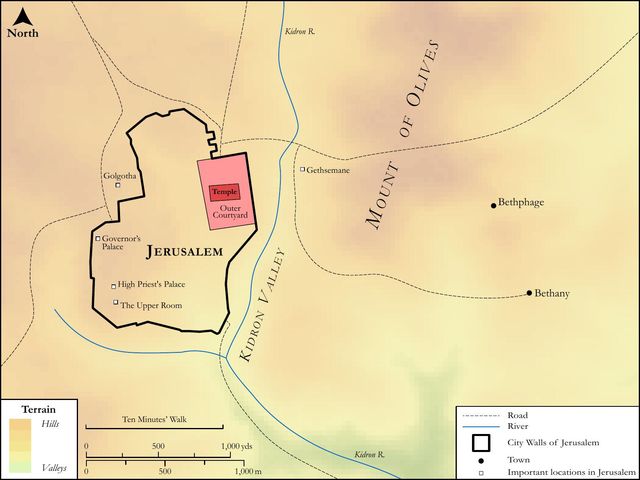
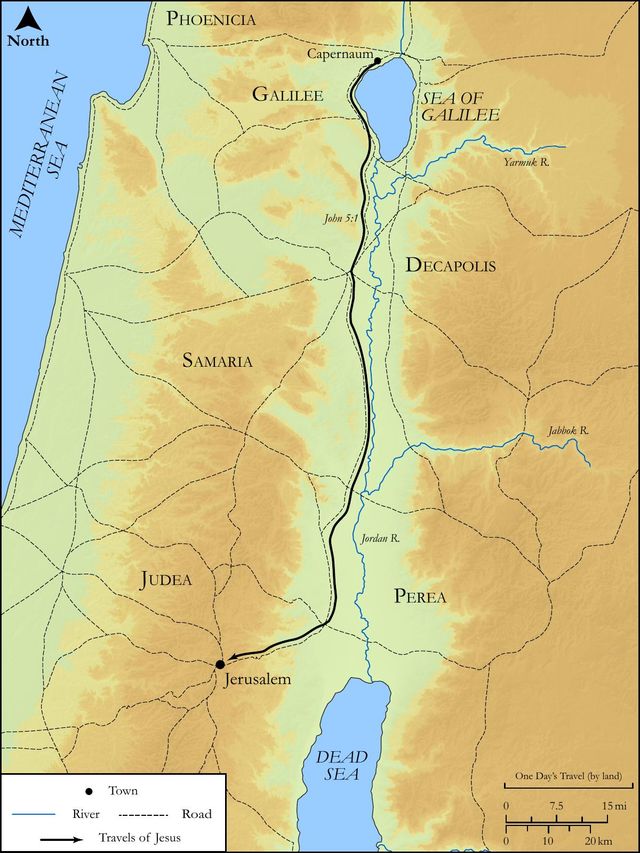
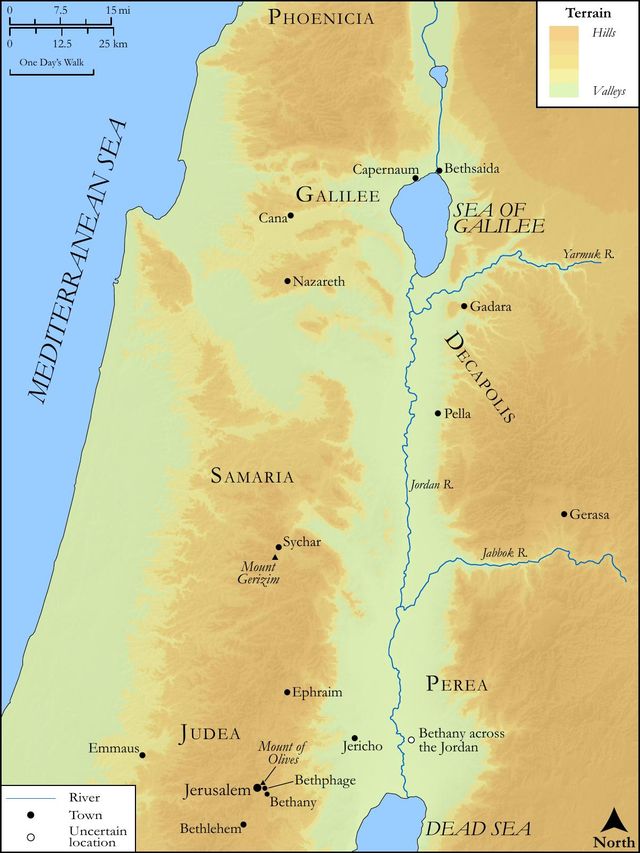
Study this verse
Public-domain commentary
Matthew Henry
From his Commentary on the Whole Bible. Henry comments on passages, not single verses — this entry covers John 5:31–47. His four-level outline is real structure in the source text, so it is rendered as structure.
In these verses our Lord Jesus proves and confirms the commission he had produced, and makes it out that he was sent of God to be the Messiah.
I.He sets aside his own testimony of himself (v.
31): "If I bear witness of myself, though it is infallibly true (ch. viii. 14), yet, according to the common rule of judgment among men, you will not admit it as legal proof, nor allow it to be given in evidence." Now,
1.This reflects reproach upon the sons of men, and their veracity and integrity. Surely we may say deliberately, what David said in haste, All men are liars, else it would never have been such a received maxim that a man's testimony of himself is suspicious, and not to be relied on; it is a sign that self-love is stronger than the love of truth. And yet,
2.It reflects honour on the Son of God, and bespeaks his wonderful condescension, that, though he is the faithful witness, the truth itself, who may challenge to be credited upon his honour, and his own single testimony, yet he is pleased to waive his privilege, and, for the confirmation of our faith, refers himself to his vouchers, that we may have full satisfaction.
II.He produces other witnesses that bear testimony to him that he was sent of God.
1.The Father himself bore testimony to him (v. 32): There is another that beareth witness. I take this to be meant of God the Father, for Christ mentions his testimony with his own (ch. viii. 18): I bear witness of myself, and the Father beareth witness of me. Observe,
(1.)The seal which the Father put to his commission: He beareth witness of me, not only has done so by a voice from heaven, but still does so by the tokens of his presence with me. See who they are to whom God will bear witness.
[1.]Those whom he sends and employs; where he gives commissions he give credentials.
[2.]Those who bear witness to him; so Christ did. God will own and honour those that own and honour him.
[3.]Those who decline bearing witness of themselves; so Christ did. God will take care that those who humble and abase themselves, and seek not their own glory, shall not lose by it.
(2.)The satisfaction Christ had in this testimony: "I know that the witness which he witnesseth of me is true. I am very well assured that I have a divine mission, and do not in the least hesitate concerning it; thus he had the witness in himself." The devil tempted him to question his being the Son of God, but he never yielded.
2.John Baptist witnessed to Christ, v. 33, &c. John came to bear witness of the light (ch. i. 7); his business was to prepare his way, and direct people to him: Behold the Lamb of God.
(1.)Now the testimony of John was, [1.] A solemn and public testimony: "You sent an embassy of priests and Levites to John, which gave him an opportunity of publishing what he had to say; it was not a popular, but a judicial testimony." [2.] It was a true testimony: He bore witness to the truth, as a witness ought to do, the whole truth, and nothing but the truth. Christ does not say, He bore witness to me (though every one knew he did), but, like an honest man, He bore witness to the truth. Now John was confessedly such a holy, good man, so mortified to the world, and so conversant with divine things, that it could not be imagined he should be guilty of such a forgery and imposture as to say what he did concerning Christ if it had not been so, and if he had not been sure of it.
(2.)Two things are added concerning John's testimony:—
[1.]That it was a testimony ex abundanti—more than he needed to vouch (v. 34): I receive not testimony from man. Though Christ saw fit to quote John's testimony, it was with a protestation that it shall not be deemed or construed so as to prejudice the prerogative of his self-sufficiency. Christ needs no letters or commendation, no testimonials or certificates, but what his own worth and excellency bring with him; why then did Christ here urge the testimony of John? Why, these things I say, that you may be saved. This he aimed at in all this discourse, to save not his own life, but the souls of others; he produced John's testimony because, being one of themselves, it was to be hoped that they would hearken to it. Note, First, Christ desires and designs the salvation even of his enemies and persecutors. Secondly, The word of Christ is the ordinary means of salvation. Thirdly, Christ in his word considers our infirmities and condescends to our capacities, consulting not so much what it befits so great a prince to say as what we can bear, and what will be most likely to do us good.
[2.]That it was a testimony ad hominem—to the man, because John Baptist was one whom they had a respect for (v. 35): He was a light among you.
First, The character of John Baptist: He was a burning and a shining light. Christ often spoke honourably of John; he was now in prison under a cloud, yet Christ gives him his due praise, which we must be ready to do to all that faithfully serve God. 1. He was a light, not phos—lux, light (so Christ was the light), but lyknos—lucerna, a luminary, a derived subordinate light. His office was to enlighten a dark world with notices of the Messiah's approach, to whom he was as the morning star. 2. He was a burning light, which denotes sincerity; painted fire may be made to shine, but that which burns is true fire. It denotes also his activity, zeal, and fervency, burning in love to God and the souls of men; fire is always working on itself or something else, so is a good minister. 3. He was a shining light, which denotes either his exemplary conversation, in which our light should shine (Matt. v. 16), or an eminent diffusive influence. He was illustrious in the sight of others; though he affected obscurity and retirement, and was in the deserts, yet such were his doctrine, his baptism, his life, that he became very remarkable, and attracted the eyes of the nation.
Secondly, The affections of the people to him: you were willing for a season to rejoice in his light. 1. It was a transport that they were in, upon the appearing of John: "You were willing— ethelesate, you delighted to rejoice in his light; you were very proud that you had such a man among you, who was the honour of your country; you were willing agalliasthenai—willing to dance, and make a noise about this light, as boys about a bonfire." 2. It was but transient, and soon over: "You were fond of him, pros horan—for an hour, for a season, as little children are fond of a new thing, you were pleased with John awhile, but soon grew weary of him and his ministry, and said that he had a devil, and now you have him in prison." Note, Many, that seem to be affected and pleased with the gospel at first, afterwards despise and reject it; it is common for forward and noisy professors to cool and fall off. These here rejoiced in John's light, but never walked in it, and therefore did not keep to it; they were like the stony ground. While Herod was a friend to John Baptist, the people caressed him; but when he fell under Herod's frowns he lost their favours: "You were willing to countenance John, pros horan that is, for temporal ends" (so some take it); "you were glad of him, in hopes to make a tool of him, by his interest and under the shelter of his name to have shaken off the Roman yoke, and recovered the civil liberty and honour of your country." Now, (1.) Christ mentions their respect to John, to condemn them for their present opposition to himself, to whom John bore witness. If they had continued their veneration for John, as they ought to have done, they would have embraced Christ. (2.) He mentions the passing away of their respect, to justify God in depriving them, as he had now done, of John's ministry, and putting that light under a bushel.
3.Christ's own works witnessed to him (v. 36): I have a testimony greater than that of John; for if we believe the witness of men sent of God, as John was, the witness of God immediately, and not by the ministry of men, is greater, 1 John v. 9. Observe, Though the witness of John was a less cogent and less considerable witness, yet our Lord was pleased to make use of it. We must be glad of all the supports that offer themselves for the confirmation of our faith, though they may not amount to a demonstration, and we must not invalidate any, under pretence that there are others more conclusive; we have occasion for them all. Now this greater testimony was that of the works which his Father had given him to finish. That is,
(1.)In general the whole course of his life and ministry—his revealing God and his will to us, setting up his kingdom among men, reforming the world, destroying Satan's kingdom, restoring fallen man to his primitive purity and felicity, and shedding abroad in men's hearts the love of God and of one another—all that work of which he said when he died, It is finished, it was all, from first to last, opus Deo dignum—a work worthy of God; all he said and did was holy and heavenly, and a divine purity, power, and grace shone in it, proving abundantly that he was sent of God.
(2.)In particular. The miracles he wrought for the proof of his divine mission witnessed of him. Now it is here said,
[1.]That these works were given him by the Father, that is, he was both appointed and empowered to work them; for, as Mediator, he derived both commission and strength from his Father.
[2.]They were given to him to finish; he must do all those works of wonder which the counsel and foreknowledge of God had before determined to be done; and his finishing them proves a divine power; for as for God his work is perfect.
[3.]These works did bear witness of him, did prove that he was sent of God, and that what he said concerning himself was true; see Heb. ii. 4; Acts ii. 22. That the Father had sent him as a Father, not as a master sends his servant on an errand, but as a father sends his son to take possession for himself; if God had not sent him, he would not have seconded him, would not have sealed him, as he did by the works he gave him to do; for the world's Creator will never be its deceiver.
4.He produces, more fully than before, his Father's testimony concerning him (v. 37): The Father that sent me hath borne witness of me. The prince is not accustomed to follow his ambassador himself, to confirm his commission viva voce—by speaking; but God was pleased to bear witness of his Son himself by a voice from heaven at his baptism (Matt. iii. 17): This is my ambassador, This is my beloved Son. The Jews reckoned Bath-kol;—the daughter of a voice, a voice from heaven, one of the ways by which God made known his mind; and in that way he had owned Christ publicly and solemnly, and repeated it, Matt. xvii.
5.Note,
(1.)Those whom God sends he will bear witness of; where he gives a commission, he will not fail to seal it; he that never left himself without witness (Acts xiv. 17) will never leave any of his servants so, who go upon his errand.
(2.)Where God demands belief, he will not fail to give sufficient evidence, as he has done concerning Christ. That which was to be witnessed concerning Christ was chiefly this, that the God we had offended was willing to accept of him as a Mediator. Now concerning this he has himself given us full satisfaction (and he was fittest to do it), declaring himself well-pleased in him; if we be so, the work is done. Now, it might be suggested, if God himself thus bore witness of Christ, how came it to pass that he was not universally received by the Jewish nation and their rulers? To this Christ here answers that it was not to be thought strange, nor could their infidelity weaken his credibility, for two reasons:—[1.] Because they were not acquainted with such extraordinary revelations of God and his will: You have neither heard his voice at any time, nor seen his shape, or appearance. They showed themselves to be as ignorant of God, though they professed relation to him, as we are of a man we never either saw or heard. "But why do I talk to you of God's bearing witness of me? He is one you know nothing of, nor have any acquaintance or communion with." Note, Ignorance of God is the true reason of men's rejecting the record he has given concerning his Son. A right understanding of natural religion would discover to us such admirable congruities in the Christian religion as would greatly dispose our minds to the entertainment of it. Some give this sense of it: "The Father bore witness of me by a voice, and the descent of a dove, which is such an extraordinary thing that you never saw or heard the like; and yet for my sake there was such a voice and appearance; yea, and you might have heard that voice, you might have seen that appearance, as others did, if you had closely attended the ministry of John, but by slighting it you missed of that testimony." [2.] Because they were not affected, no, not with the ordinary ways by which God had revealed himself to them: You have not his word abiding in you, v. 38. They had the scriptures of the Old Testament; might they not by them be disposed to receive Christ? Yes, if they had had their due influence upon them. But, First, The word of God was not in them; it was among them, in their country, in their hands, but not in them, in their hearts; not ruling in their souls, but only shining in their eyes and sounding in their ears. What did it avail them that they had the oracles of God committed to them (Rom. iii. 2), when they had not these oracles commanding in them? If they had, they would readily have embraced Christ. Secondly, It did not abide. Many have the word of God coming into them, and making some impressions for awhile, but it does not abide with them; it is not constantly in them, as a man at home, but only now and then, as a wayfaring man. If the word abide in us, if we converse with it by frequent meditation, consult with it upon every occasion, and conform to it in our conversation, we shall then readily receive the witness of the Father concerning Christ; see ch. vii. 17. But how did it appear that they had not the word of God abiding in them? It appeared by this, Whom he hath sent, him ye believe not. There was so much said in the Old Testament concerning Christ, to direct people when and where to look for him, and so to facilitate the discovery of him, that, if they had duly considered these things, they could not have avoided the conviction of Christ's being sent of God; so that their not believing in Christ was a certain sign that the word of God did not abide in them. Note, The in-dwelling of the word, and Spirit, and grace of God in us, is best tried by its effects, particularly by our receiving what he sends, the commands, the messengers, the providences he sends, especially Christ whom he hath sent.
5.The last witness he calls is the Old Testament, which witnessed of him, and to it he appeals (v. 39, &c.): Search the scriptures, ereunate.
(1.)This may be read, either, [1.] "You search the scriptures, and you do well to do so; you read them daily in your synagogues, you have rabbies, and doctors, and scribes, that make it their business to study them, and criticize upon them." The Jews boasted of the flourishing of scripture-learning in the days of Hillel, who died about twelve years after Christ's birth, and reckoned some of those who were then members of the sanhedrim the beauties of their wisdom and the glories of their law; and Christ owns that they did indeed search the scriptures, but it was in search of their own glory: "You search the scriptures, and therefore, if you were not wilfully blind, you would believe in me." Note, It is possible for men to be very studious in the letter of the scripture, and yet to be strangers to the power and influence of it. Or, [2.] As we read it: Search the scriptures; and so, First, It was spoken to them in the nature of an appeal: "You profess to receive and believe the scripture; here I will join issue with you, let this be the judge, provided you will not rest in the letter" (hærere in cortice), "but will search into it." Note, when appeals are made to the scriptures, they must be searched. Search the whole book of scripture throughout, compare one passage with another, and explain one by another. We must likewise search particular passages to the bottom, and see not what they seem to say prima facie—at the first appearance, but what they say indeed. Secondly, It is spoken to us in the nature of an advice, or a command to all Christians to search the scriptures. Note, All those who would find Christ must search the scriptures; not only read them, and hear them, but search them, which denotes, 1. Diligence in seeking, labour, and study, and close application of mind. 2. Desire and design of finding. We must aim at some spiritual benefit and advantage in reading and studying the scripture, and often ask, "What am I now searching for?" We must search as for hidden treasures (Prov. ii. 4), as those that sink for gold or silver, or that dive for pearl, Job xxviii. 1-11. This ennobled the Bereans, Acts xvii. 11.
(2.)Now there are two things which we are here directed to have in our eye, in our searching the scripture: heaven our end, and Christ our way.
[1.]We must search the scriptures for heaven as our great end: For in them you think you have eternal life. The scripture assures us of an eternal state set before us, and offers to us an eternal life in that state: it contains the chart that describes it, the charter that conveys it, the direction in the way that leads to it, and the foundation upon which the hope of it is built; and this is worth searching for where we are sure to find it. But to the Jews Christ saith only, You think you have eternal life in the scriptures, because, though they did retain the belief and hope of eternal life, and grounded their expectations of it upon the scriptures, yet herein they missed it, that they looked for it by the bare reading and studying of the scripture. It was a common but corrupt saying among them, He that has the words of the law has eternal life; they thought they were sure of heaven if they could say by heart, or rather by rote, such and such passages of scripture as they were directed to by the tradition of the elders; as they thought all the vulgar cursed because they did not thus know the law (ch. vii. 49), so they concluded all the learned undoubtedly blessed.
[2.]We must search the scriptures for Christ, as the new and living way that leads to this end. These are they, the great and principal witnesses, that testify of me. Note, First, The scriptures, even those of the Old Testament, testify of Christ, and by them God bears witness to him. The Spirit of Christ in the prophets testified beforehand of him (1 Pet. i. 11), the purposes and promises of God concerning him, and the previous notices of him. The Jews knew very well that the Old Testament testified of the Messiah, and were critical in their remarks upon the passages that looked that way; and yet were careless, and wretchedly overseen, in the application of them. Secondly, Therefore we must search the scriptures, and may hope to find eternal life in that search, because they testify of Christ; for this is life eternal, to know him; see 1 John v. 11. Christ is the treasure hid in the field of the scriptures, the water in those wells, the milk in those breasts.
(3.)To this testimony he annexes a reproof of their infidelity and wickedness in four instances; particularly,
[1.]Their neglect of him and his doctrine: "You will not come tome, that you might have life, v. 40. You search the scriptures, you believe the prophets, who you cannot but see testify of me; and yet you will not come to me, to whom they direct you." Their estrangement from Christ was the fault not so much of their understandings as of their wills. This is expressed as a complaint; Christ offered life, and it was not accepted. Note, First, There is life to be had with Jesus Christ for poor souls; we may have life, the life of pardon and grace, and comfort and glory: life is the perfection of our being, and inclusive of all happiness; and Christ is our life. Secondly, Those that would have this life must come to Jesus Christ for it; we may have it for the coming for. It supposes an assent of the understanding to the doctrine of Christ and the record given concerning him; it lies in the consent of the will to his government and grace, and it produces an answerable compliance in the affections and actions. Thirdly, The only reason why sinners die is because they will not come to Christ for life and happiness; it is not because they cannot, but because they will not. They will neither accept the life offered, because spiritual and divine, nor will they agree to the terms on which it is offered, nor apply themselves to the use of the appointed means: they will not be cured, for they will not observe the methods of cure. Fourthly, The wilfulness and obstinacy of sinners in rejecting the tenders of grace are a great grief to the Lord Jesus, and what he complains of. Those words (v. 41), I receive not honour from men, come in a parenthesis, to obviate an objection against him, as if he sought his own glory, and made himself the head of a party, in obliging all to come to him, and applaud him. Note, 1. He did not covet nor court the applause of men, did not in the least affect that worldly pomp and splendour in which the carnal Jews expected their Messiah to appear. He charged those whom he cured not to make him known, and withdrew from those that would have made him king. 2. He had not the applause of men. Instead of receiving honour from men, he received a great deal of dishonour and disgrace from men, for he made himself of no reputation. 3. He needed not the applause of men; it was no addition to his glory whom all the angels of God worship, nor was he any otherwise pleased with it than as it was according to his Father's will, and for the happiness of those who, in giving honour to him, received much greater honour from him.
[2.]Their want of the love of God (v. 42): "I know you very well, that you have not the love of God in you. Why should I wonder that you do not come to me, when you want even the first principle of natural religion, which is the love of God?" Note, The reason why people slight Christ is because they do not love God; for, if we did indeed love God, we should love him who is his express image, and hasten to him by whom only we may be restored to the favour of God. He charged them (v. 37) with ignorance of God, and here with want of love to him; therefore men have not the love of God because they desire not the knowledge of him. Observe, First, The crime charged upon them: You have not the love of God in you. They pretended a great love to God, and thought they proved it by their zeal for the law, the temple, and the sabbath; and yet they were really without the love of God. Note, There are many who make a great profession of religion who yet show they want the love of God by their neglect of Christ and their contempt of his commandments; they hate his holiness and undervalue his goodness. Observe, It is the love of God in us, that love seated in the heart, a living active principle there, that God will accept; the love shed abroad there, Rom. v. 5. Secondly, The proof of this charge, by the personal knowledge of Christ, who searches the heart (Rev. ii. 23) and knows what is in man: I know you. Christ sees through all our disguises, and can say to each of us, I know thee. 1. Christ knows men better than their neighbours know them. The people thought that the scribes and Pharisees were very devout and good men, but Christ knew that they had not the love of God in them. 2. Christ knows men better than they know themselves. These Jews had a very good opinion of themselves, but Christ knew how corrupt their inside was, notwithstanding the speciousness of their outside; we may deceive ourselves, but we cannot deceive him. 3. Christ knows men who do not, and will not, know him; he looks on those who industriously look off from him, and calls by their own name, their true name, those who have not known him.
[3.]Another crime charged upon them is their readiness to entertain false Christs and false prophets, while they obstinately opposed him who was the true Messias (v. 43): I am come in my Father's name, and you receive me not. If another shall come in his own name, him you will receive. Be astonished, O heavens, at this (Jer. ii. 12, 13); for my people have committed two evils, great evils indeed. First, They have forsaken the fountain of living waters, for they would not receive Christ, who came in his Father's name, had his commission from his Father, and did all for his glory. Secondly, They have hewn out broken cisterns, they hearken to every one that will set up in his own name. They forsake their own mercies, which is bad enough; and it is for lying vanities, which is worse. Observe here, 1. Those are false prophets who come in their own name, who run without being sent, and set up for themselves only. 2. It is just with God to suffer those to be deceived with false prophets who receive not the truth in the love of it. 2 Thess. ii. 10, 11. The errors of antichrist are the just punishment of those who obey not the doctrine of Christ. They that shut their eyes against the true light are by the judgment of God given up to wander endlessly after false lights, and to be led aside after every ignis fatuus. 3. It is the gross folly of many that, while they nauseate ancient truths, they are fond of upstart errors; they loathe manna, and at the same time feed upon ashes. After the Jews had rejected Christ and his gospel, they were continually haunted with spectres, with false Christs and false prophets (Matt. xxiv. 24), and their proneness to follow such occasioned those distractions and seditions that hastened their ruin.
[4.]They are here charged with pride and vain-glory, and unbelief, the effect of them, v. 44. Having sharply reproved their unbelief, like a wise physician, he here searches into the cause, lays the axe to the root. They therefore slighted and undervalued Christ because they admired and overvalued themselves. Here is,
First, Their ambition of worldly honour. Christ despised it, v. 41. They set their hearts upon it: You receive honour one of another; that is, "You look for a Messiah in outward pomp, and promise yourselves worldly honour by him." You receive honour:—1. "You desire to receive it, and aim at this in all you do." 2. "You give honour to others, and applaud them, only that they may return it, and may applaud you." Petimus dabimusque vicissim—We ask and we bestow. It is the proud man's art to throw honour upon others only that it may rebound upon himself. 3. "You are very careful to keep all the honours to yourselves, and confine them to your own party, as if you had the monopoly of that which is honourable." 4. "What respect is shown to you you receive yourselves, and do not transmit to God, as Herod." Idolizing men and their sentiments, and affecting to be idolized by them and their applauses, are pieces of idolatry as directly contrary to Christianity as any other.
Secondly, Their neglect of spiritual honour, called here the honour that comes from God only; this they sought not, nor minded. Note, 1. True honour is that which comes from God only, that is real and lasting honour; those are honourable indeed whom he takes into covenant and communion with himself. 2. This honour have all the saints. All that believe in Christ, through him receive the honour that comes from God. He is not partial, but will give glory wherever he gives grace. 3. This honour that comes from God we must seek, must aim at it, and act for it, and take up with nothing short of it (Rom. ii. 29); we must account it our reward, as the Pharisees accounted the praise of men. 4. Those that will not come to Christ, and those that are ambitious of worldly honour, make it appear that they seek not the honour that comes from God, and it is their folly and ruin.
Thirdly, The influence this had upon their infidelity. How can you believe who are thus affected? Observe here, 1. The difficulty of believing arises from ourselves and our own corruption; we make our work hard to ourselves, and then complain it is impracticable. 2. The ambition and affectation of worldly honour are a great hindrance to faith in Christ. How can they believe who make the praise and applause of men their idol? When the profession and practice of serious godliness are unfashionable, are every where spoken against,—when Christ and his followers are men wondered at, and to be a Christian is to be like a speckled bird (and this is the common case),—how can they believe the summit of whose ambition is to make a fair show in the flesh?
6.The last witness here called is Moses, v. 45, &c. The Jews had a great veneration for Moses, and valued themselves upon their being the disciples of Moses, and pretended to adhere to Moses, in their opposition to Christ; but Christ here shows them,
(1.)That Moses was a witness against the unbelieving Jews, and accused them to the Father: There is one that accuses you, even Moses. This may be understood either,
[1.]As showing the difference between the law and the gospel. Moses, that is, the law, accuses you, for by the law is the knowledge of sin; it condemns you, it is to those that trust to it a ministration of death and condemnation. But it is not the design of Christ's gospel to accuse us: Think not that I will accuse you. Christ did not come into the world as a Momus, to find fault and pick quarrels with every body, or as a spy upon the actions of men, or a promoter, to fish for crimes; no, he came to be an advocate, not an accuser; to reconcile God and man, and not to set them more at variance. What fools were they then that adhered to Moses against Christ, and desired to be under the law! Gal. iv. 21. Or,
[2.]As showing the manifest unreasonableness of their infidelity: "Think not that I will appeal from your bar to God's and challenge you to answer there for what you do against me, as injured innocency usually does; no, I do not need; you are already accused, and cast, in the court of heaven; Moses himself says enough to convict you of, and condemn you for, your unbelief." Let them not mistake concerning Christ; though he was a prophet, he did not improve his interest in heaven against those that persecuted him, did not, as Elias, make intercession against Israel (Rom. vi. 2), nor as Jeremiah desire to see God's vengeance on them. Nor let them mistake concerning Moses, as if he would stand by them in rejecting Christ; no, There is one that accuses you, even Moses in whom you trust. Note, First, External privileges and advantages are commonly the vain confidence of those who reject Christ and his grace. The Jews trusted in Moses, and thought their having his laws and ordinances would save them. Secondly, Those that confide in their privileges, and do not improve them, will find not only that their confidence is disappointed, but that those very privileges will be witnesses against them.
(2.)That Moses was a witness for Christ and to his doctrine (v. 46, 47): He wrote of me. Moses did particularly prophesy of Christ, as the Seed of the woman, the Seed of Abraham, the Shiloh, the great Prophet; the ceremonies of the law of Moses were figures of him that was to come. The Jews made Moses the patron of their opposition to Christ; but Christ here shows them their error, that Moses was so far from writing against Christ that he wrote for him, and of him. But,
[1.]Christ here charges it on the Jews that they did not believe Moses. He had said (v. 45) that they trusted in Moses, and yet here he undertakes to make out that they did not believe Moses; they trusted to his name, but they did not receive his doctrine in its true sense and meaning; they did not rightly understand, nor give credit to, what there was in the writings of Moses concerning the Messiah.
[2.]He proves this charge from their disbelief of him: Had you believed Moses, you would have believed me. Note, First, The surest trial of faith is by the effects it produces. Many say that they believe whose actions give their words the lie; for had they believed the scriptures they would have done otherwise than they did. Secondly, Those who rightly believe one part of scripture will receive every part. The prophecies of the old Testament were so fully accomplished in Christ that those who rejected Christ did in effect deny those prophecies, and set them aside.
[3.]From their disbelief of Moses he infers that it was not strange that they rejected him: If you believe not his writings, how shall you believe my words? How can it be thought that you should? First, "If you do not believe sacred writings, those oracles which are in black and white, which is the most certain way of conveyance, how shall you believe my words, words being usually less regarded?" Secondly, "If you do not believe Moses, for whom you have such a profound veneration, how is it likely that you should believe me, whom you look upon with so much contempt?" See Exod. vi. 12. Thirdly, "If you believe not what Moses spoke and wrote of me, which is a strong and cogent testimony for me, how shall you believe me and my mission?" If we admit not the premises, how shall we admit the conclusion? The truth of the Christian religion, it being a matter purely of divine revelation, depends upon the divine authority of the scripture; if therefore we believe not the divine inspiration of those writings, how shall be receive the doctrine of Christ?
Historical interpretation
Four Centuries of Reception
6 surviving comments on this verse. Each one is dated, so this reads as a timeline rather than a list.
Select a marker to jump to its quote. Markers stagger vertically where authors wrote within a few decades of each other.
(vi. de Trin. c. 27) The Only-begotten God shows Himself to be the Son, on the testimony not of man only, but of His own power. The works which He does, bear witness to His being sent from the Father. Therefore the obedience of the Son and the authority of the Father are set forth in Him who was sent. But the testimony of works not being sufficient evidence, it follows, And the Father Himself which hath sent Me, hath borne witness of Me. Open the Evangelic volumes, and examine their whole range: no testimony of the Father to the Son is given in any of the books, other than that He is the Son. So what a calumny is it in men now saying that this is only a name of adoption: thus making God a liar, and names unmeaning.
It is most appropriate that he joins the “Word” to the “form” here to show that the Word of God is himself the image and expression and form of his Father. The Jews who did not receive the one who spoke to them thus did not receive the Word, which is the form of God. This too was who the patriarch Jacob saw when he received a blessing from him and the name of Israel instead of Jacob. … And this is he who said, “He who has seen me has seen the Father,” and “I in the Father and the Father in me” and “I and the Father are one.” For in this way God is one and so is the faith in the Father and the Son. For even though the Word is God, the Lord our God is one Lord.
"But why," He saith, "name I these things? Not only have ye 'neither heard His voice nor seen His shape,' but it is not even in your power to assert that of which you most boast and of which you are all most fully assured, namely, that ye have received and keep His commandments." Wherefore He addeth, "And ye have not His word abiding in you." That is, the ordinances, the commandments, the Law, and the Prophets. For even if God ordained these, still they are not with you, since ye believe not on Me. Because, if the Scriptures everywhere say that it is necessary to give heed to Me, and yet ye believe not, it is quite clear that His word is removed from you. Wherefore again He addeth, "For whom He hath sent, Him ye believe not."
(Hom. xl. 3) But it was impossible for them to declare that they had received, and obeyed God's commands: and therefore He adds, Ye have not His word abiding in you; i. e. the commandments, the law, and the prophets; though God instituted them, ye have them not. For if the Scriptures every where tell you to believe on Me, and ye believe not, it is manifest that His word is gone from you: For whom He hath sent, Him ye believe not.
CHAPTER II. That the Son is the Image of God the Father, wherein also is an exposure of the Jews as not understanding the words darkly uttered by Moses.
One may see that not simple is the arrangement of ideas poured forth upon the passage before under consideration, but that it is a swarm of hidden contemplations, which very easily escapes the mind of uncritical hearers, and haply admits of being seen by those only who investigate more keenly. For what was it (will one perchance say) that induced Jesus, when He was saying that He was borne witness to by His God-befitting Operation, to come to something most exceeding remote as though it belonged to the subject? I mean that the Pharisees had neither at any time heard the Voice of God the Father nor seen His Form nor yet had His Word abiding in them. And I will agree, and so I suppose will every one else, that not without some cause is this their difficulty. What sense then we shall adapt to the passage before us, and what again we, on all sides holding by the truth, searching shall provide ourselves with, by the Operation and grace of the Spirit I will endeavour to tell forth.
It is the custom of the Saviour Christ, when often making useful discourses with the unskilled Pharisees, to gaze into the depths of their heart, and to consider in God-befitting manner the reasonings still dumbly revolved and stirred up in their mind, and to these in particular to direct both His answers and words and exposures, and He does not altogether keep the thread of His own words unpassed, but to what they are counselling and imagining in themselves, to this He keenly replies, and by it shows that He is by Nature God, as knowing what lies in the depth and searching the hearts and reins. If any one will, let him receive the most clear demonstration hereof, from the other Evangelists, I mean Luke and his companions. It is written then in the Gospels, that there were once gathered together from all the region round about Judea, Pharisees and doctors of the law. And, behold (he says) men bearing on a bed a man which was taken with a palsy, and they were seeking to bring him in and to lay him before him; and when they found not by what way they might bring him in because of the multitude, they went upon the housetop, and let him down through the tiling with his couch into the midst before Jesus. And when He saw their faith, He said unto him, Man, thy sins are forgiven thee. And the scribes and the Pharisees began to reason saying, Who is This which speak-eth blasphemies? who can forgive sins but One, God? But when Jesus perceived (it says) their thoughts, He answering said unto them, What are ye reasoning in your hearts? whether is easier to say, Thy sins be forgiven thee, or to say, Rise and walk? Seest thou how He not waiting their answer or murmuring in utterance of words, answers as God their inward thoughts? You will find again another example too, fashioned after this same manner. For thus says the blessed Luke, And it came to pass also on another sabbath that He entered into the Synagogue and taught, and there was a man there whose right hand was withered. And the Scribes and Pharisees watched Him whether He would heal on the sabbath day, that they might find an accusation against Him: but He knew (it says) their thoughts and said to the man which had the withered hand, Rise up and stand forth in the midst. And he arose and stood forth. And Jesus said unto them, I will ask you, Is it lawful on the sabbath day to do good or to do evil? Seest thou again evidently herein, that He framed His words as looking into the very heart of those who were foolishly trying to accuse Him? Something of this sort again in the passage too before us we will suppose to have been seen by the Saviour in the hearts of the Pharisees. But you will see that the discourse does not spurn the right line, or order of the subject, if you do not shrink from going over again each of those things which have been already said.
This great long discourse with them took its beginning about the man that was healed on the Sabbath Day, and by manifold devices and arguments was Christ endeavouring to persuade those who were waywardly vexed at the healing on the sabbath, that it is lawful even to have compassion on the sabbath, and to do good to all, and besides, that the Law made the rest of the sabbath a shadow of a most note-worthy reality; moreover having in their judgement broken the honour of the sabbath, and hereby specially transgressed the law, He was affirming and that very strongly, that He had been sent by God the Father, and further was clearly telling them that He was borne witness unto by Him, and was well-pleasing to Him in all that He did. To these things (as far at least as the evidence of the arguments goes) the Pharisees again are reasoning with themselves (as waiting on the writings of the law, and ever holding out as a pretext the commands through Moses, and saying they had read) What does this Man say? how will God the Father be well-pleased with one who breaks the Law? when has He testified, or what judgement did He give concerning Him? For we know from the Mosaic writings that God descended upon Mount Sinai, and His Face was seen by the fathers, and His Voice (say they) was heard: He spake to the whole Synagogue, and commanded them to keep the Sabbath Day, clearly commanding thus. Remember the sabbath day to keep it holy, six days shalt thou labour and do all thy work, but on the seventh day is a holy sabbath to the Lord thy God: in it thou shalt not do any work. And none other (say they) heard we saying these things: the multitude of the fathers was ear-witness to the Voice from God, and after them the Word of God was in us: But who is This?
When He perceived that they were thus imagining, He exposes them as keenly ignorant, saying, Ye have neither heard His Voice at any time nor seen His Form, and ye have not His Word abiding in you, for whom HE sent, Him YE believe not. For the things done in a type at that time, and why the descent of God upon Mount Sinai was figured out to them, these things they knowing nothing of, received them not as images of spiritual realities, but were imagining that the Divine Nature could actually be seen with the eyes of the body, and believed that He used a bodily voice. But that the Word of the Saviour to them was true, and that they neither at any time heard the Voice of God the Father, nor had any one with bodily vision seen His Form, that is, the Word in all things like unto Him, I think that we ought again to show clearly, bringing to spiritual investigation and test the things written in Exodus. It says thus, And Moses brought forth the people out of the camp to meet with God; and they stood at the nether part of the mount. And mount Sinai was altogether on a smoke, because the Lord descended upon it in fire, and the smoke thereof was going up as the smoke of a furnace, and the whole people quaked greatly. And the voices of the trumpet sounded, going forth exceeding mighty, Moses spake, and God answered him by a voice. Thus far then the oracle of the all-wise Moses: but I think we ought now too to convict the Jews of stumbling into a most absurd idea of God, imagining that they had both seen His Form, and heard the Voice actually inherent in the Divine Nature.
Come then taking courage in the bounty and grace of the Saviour, let us refine the grossness of the letter of the law into spiritual contemplation: for so will that be shown to be true which was said to the Pharisees of God; Ye have neither heard His Voice at any time nor seen His Form. The people then being brought forth by Moses to meet God, as it is written, will be a manifest sign and token as in enigma, that none can unled and uninstructed come to God, but by the law are they led to the knowledge of the things which they seek to learn. For Moses will be understood to be put for the Law, according as is said by a certain one, They have Moses and the Prophets. But the standing by under the mount, when God had now descended and was on it, signifies the readiness of disposition and resolve of those who are called to serve Him, not refusing in any way to apply themselves even to things above their power and superior to their nature, while God is with them. Such in all respects are they who are partakers of the Saviour. Wherefore they practising manliness above men say, Who shall separate us from the Love of Christ? shall tribulation or distress or persecution or famine or nakedness or peril or sword? for all dreadful things are tolerable to the godly for love of Christ, and though tribulation should rise up as a mountain, they will rise superior against all danger, and will not withdraw their mind from love to God. But God is said to come down, not upon any low ground, but somewhere on high and on a mountain is He seen, that you may think some such thing as this with yourself, that although the Divine Nature condescending to our understandings, brings Itself to our conception, yet is It exceeding far above us, both in words and thoughts. For the height and intensity of the doctrines respecting It, are signified by the mountain, which he tells us was wholly darkened with smoke. For keen indeed and not very clear to us are words respecting the Godhead, wounding like smoke the eyes of the understanding. Therefore the most wise Paul testified that we see through a glass and darkly: the Psalmist again says that He, that is, God, made darkness His secret place, under the name of darkness hinting the Incomprehensibleness around Him, whereof the smoke about the fire on the mount may well be taken as a type. But the Godhead Itself descended in the form of fire, at that particular time, fittingly and of necessity for the nature of the thing. For it behoved, it behoved that He Who called Israel unto bondage and understanding through the law that should be put forth, should appear as an Enlightener and an Avenger. And both these ends are accomplished by fire. Yea, and the voices of the trumpet (saith he) sounded, going forward exceeding mighty, that some such effect of ideas again may be wrought for us: for the Law too was proclaimed by God, yet not continuously at first, by reason of the infirmity of the pupils, but stammeringly, so to say, and not with the whole force of the trumpeter. Wherefore Moses too called himself slow of speech. But as time advances, and carries forward the believers in Christ from the shadow in the letter to the spiritual worship, the voices of the Divine trumpet waxed exceeding mighty, the saving and Gospel preaching resounding in a way through the whole earth. For not as the Law, feeble-voiced and petty-heralding, was this heard in the country of the Jews only, or proclaimed from Dan to Beersheba, but rather, Their voice went forth into all the earth, as it is written. And what besides? Moses spake (saith he) and God answered him by a voice.
Keen be again the mind of the more studious, accurately let it observe the stability inherent in the Divine Oracles. For Moses speaks, and God answers him by a voice, not surely by His Own Voice, for this it does not say, but simply and absolutely by a voice, wrought wondrously in more human wise by sound of words. For in respect of what work will God be powerless? What that God wills shall He not perform, and that full readily? Therefore Moses spake, and God answered him by a voice. Herein is the type, let us see the truth. You have therefore in the holy Gospels the Lord speaking, Father, glorify Thy Son 2, and the Father answering by a voice, I both glorified, and will glorify again. The Saviour showed that this is not truly the voice of God the Father, by saying to those who were then present, This voice was made not because of Me, but for your sakes. Thou seest how He clearly affirmed that the Voice was made, since it is not meet to suppose that the Divine Nature useth a voice with a sound, though It conform Itself to our needs and speak like us, economically.
These considerations were of necessity brought into our present discourse: we deemed it altogether needful that Jesus should be shown to the readers speaking truth, when He is found saying of His Father, Ye have neither heard His Voice at any time nor seen His shape, and ye have not His Word abiding in you, for Whom HE hath sent, Him yE believe not. That the Pharisees puffed up unto strange boasting, were wont to pretend that the Divine Word was with them and in them, and therefore foolishly affirmed that they had advanced to marvellous wisdom, the Spirit Itself will testify, since Christ says by the Prophet Jeremiah unto them, How do ye say, WE are wise, and the word of the Lord is with us? For nought to the scribes became their lying pen; the wise men were ashamed, were dismayed and taken; what wisdom is in them? because they rejected the word of the Lord. For how are they not taken rejecting the Living and Hypostatic Word of God, receiving not the faith to Him-ward, but dishonouring the Impress of God the Father, and refusing to behold His most true Form (so to say) through His God-befitting Authority and Power? For the Divine and Ineffable Nature is in no other wise apprehended (so far as may be) by us, than through what It effects and works, therefore Paul directs us to go from the greatness and beauty of the creatures proportionably unto the contemplation of the Creator, the Saviour again leads us to the apprehending of Himself, saying, If I do not the works of My Father, believe Me not; but if I do, though ye believe not Me, believe My works. And with great reason did He blame His own disciple (this was Philip) who imagined thoughtlessly that he could in any other way attain to the contemplation of God the Father, albeit it was in his power to consider His Uncreated Image, which shows accurately in Himself Him Who begat Him. Wherefore He said, So long time am I with you, and hast thou not known Me Philip? he that hath seen Me hath seen the Father.
For it is not by the carnal ear, but by the spiritual understanding, through the grace of the Holy Spirit, that God is heard. And they did not hear the spiritual voice, because they did not love or obey Him, nor saw they His shape; inasmuch as that is not to be seen by the outward eye, but by faith and love.
Continue studying John 5:38 across the web’s major study libraries — every link below opens this exact verse, chapter, or book on the destination site.
Read & Compare
 BibleGatewayThis verse in more than 200 translations and 70 languages.
 Bible.comThe YouVersion reader — hundreds of translations, reading plans, and highlights.
 ESV.orgCrossway's official English Standard Version reader.
 NET BibleThe NET translation with 60,000+ translators' notes on every rendering decision.
 STEP BibleTyndale House's free study tool — original text, vocabulary, and scholarly resources.
 BibliaLogos Bible Software's free web reader.
 USCCBThe New American Bible (Revised Edition) with the U.S. bishops' study notes.
Commentaries
 BibleHub CommentariesDozens of classic commentaries on this verse, gathered on one page.
 StudyLightMore than 100 commentary sets — the largest collection on the web.
 BibleRefPlain-English commentary on what this verse means, verse by verse.
 Enduring WordDavid Guzik's free commentary on this chapter, widely used by Bible teachers.
 Bible Study ToolsVerse commentary alongside Greek and Hebrew study aids.
Original Language & Research
- BibleHub InterlinearThe verse word by word — original language, transliteration, and English.
- BibleHub LexiconEvery word's original-language definition and Strong's entry.
 Blue Letter BibleDeep-study tools — Strong's numbers, concordance, and word studies.
 CNTR CollationThe earliest Greek manuscripts of this verse, collated letter by letter.
Sermons, Hymns & Audio


TrulyRandomVerse is not affiliated with these sites and doesn’t control their content. They’re linked because they’re genuinely useful.
Summary
In John 5:38, Jesus delivers a scathing indictment against the Jewish religious leaders, revealing the profound spiritual chasm between their outward religiosity and their inner spiritual state. He asserts that their failure to recognize and believe in Him, the very One sent by God the Father, stems from a fundamental lack of the Father's word truly abiding within them, demonstrating a deep-seated spiritual disconnect that renders them incapable of discerning divine truth.
Context
ShowHideLiterary Context
This verse is situated within Jesus' extensive and confrontational discourse in John 5, following His miraculous healing of an invalid at the Pool of Bethesda on the Sabbath. This act provoked fierce opposition from the Jewish authorities, who accused Him of violating the Sabbath law and, more significantly, of blasphemy by claiming equality with God. Jesus' subsequent defense (John 5:19-47) systematically dismantles their objections, presenting multiple witnesses to His divine identity and authority. Prior to John 5:38, Jesus has already cited the Father's direct testimony (John 5:37), the witness of John the Baptist (John 5:33-35), and even their own Scriptures (John 5:39) as evidence. Verse 38 specifically targets their internal spiritual condition, explaining why they fail to accept this overwhelming evidence.
Historical & Cultural Context
The Jewish religious leaders, primarily the Pharisees and Sadducees, were the custodians of the Mosaic Law and the oral traditions that had developed around it. They prided themselves on their meticulous adherence to the Law and their knowledge of the Scriptures. For them, the Sabbath was a cornerstone of their religious identity, and any perceived violation was a grave offense. Their expectation of the Messiah was often tied to a political or military deliverer, rather than a humble servant who would challenge their established authority and traditions. Jesus' statement in John 5:38 directly confronts their self-perception, implying that despite their outward religiosity, they lacked a true, internal relationship with God and His word. This would have been a deeply offensive and challenging accusation to those who believed they were God's most faithful representatives.
Key Themes
ShowHideJohn 5:38 powerfully underscores several core themes within the Gospel of John. Firstly, it highlights the theme of Spiritual Blindness and Unbelief, demonstrating that intellectual knowledge of Scripture is insufficient without a receptive heart. The leaders, despite "searching the Scriptures" (John 5:39), failed to recognize the one to whom the Scriptures testified. Secondly, the verse emphasizes the Authority of Jesus as the Father's Sent One. Jesus consistently presents Himself as the divine emissary, and rejection of Him is tantamount to rejection of the Father who sent Him (John 12:44-45). Thirdly, it introduces the crucial concept of the Abiding Word. The phrase "his word abiding in you" points to a deep, transformative indwelling of God's truth, which is distinct from mere intellectual assent or external adherence to religious rules. This internal reception of God's word is essential for true faith and recognition of God's ultimate revelation in Jesus.
Exposition and Analysis
ShowHideKey Word Analysis
ShowHideWhile lógos broadly means "something said," "reasoning," or "discourse," in the context of John's Gospel, especially when referring to God's "word" or "His word," it carries profound theological weight. As the Ground Truth Strong's data notes, "specially, (with the article in John) the Divine Expression (i.e. Christ)." Here, "his word" refers to the Father's divine revelation, His truth, and ultimately, the very essence of His communication to humanity, which culminates in the person of Jesus Christ Himself. The leaders' failure to have this lógos abiding in them means they lacked a true, internal grasp of God's self-disclosure.
This verb signifies to "stay," "remain," "dwell," or "continue." It implies a deep, permanent indwelling, not merely a fleeting visit or superficial acquaintance. When Jesus states that the Father's word is not "abiding" in them, He is not suggesting they are ignorant of the Scriptures, but rather that God's truth has not taken root deeply within their hearts and minds, transforming their character and shaping their worldview. This lack of internal dwelling prevents genuine spiritual discernment.
To "have faith (in, upon, or with respect to, a person or thing), i.e. credit; by implication, to entrust (especially one's spiritual well-being to Christ)." This word points to active trust and commitment, not just intellectual acknowledgment. The Jewish leaders' failure to pisteúō in Jesus, the One sent by the Father, reveals their fundamental lack of faith, which is directly linked to the absence of the Father's word abiding within them. Their unbelief is a spiritual, not merely an intellectual, failing.
Verse Breakdown
ShowHide"And ye have not his word abiding in you:"
This opening clause presents the core accusation. Jesus asserts that despite their outward religious devotion and scriptural knowledge, the Jewish leaders lack a true, internal reception of God the Father's word. This "word" refers not merely to the written Torah, but to the living, active revelation of God's character and will. The absence of this "abiding" word signifies a spiritual emptiness or resistance, preventing genuine understanding and spiritual responsiveness.
"for whom he hath sent, him ye believe not."
This second clause provides the reason and consequence of the first. Their failure to have the Father's word truly dwelling within them directly explains their inability to believe in Jesus. Jesus is the ultimate "sent one" (apostle) of the Father, the embodiment of God's word and revelation. Their rejection of Jesus, therefore, is not merely a rejection of a man, but a profound rejection of God the Father Himself and His ultimate divine communication to humanity. Their unbelief in the Son is the direct fruit of their spiritual disconnect from the Father's abiding word.
Literary Devices
ShowHideThe verse employs striking Contrast and profound Irony. The contrast is evident between the Jewish leaders' self-perception as guardians of God's word and Jesus' accusation that they do not truly possess it "abiding" within them. This highlights the chasm between external religiosity and internal spiritual reality. The irony lies in the fact that those who meticulously studied the Scriptures, which testified to the coming Messiah, were precisely the ones who failed to recognize and believe in Him when He stood before them. Furthermore, the concept of God's "word abiding" functions as a Metaphor for deep spiritual internalization and transformation, suggesting that true faith is not merely intellectual assent but a profound indwelling of divine truth that shapes one's entire being.
Theological and Thematic Connections
ShowHideJohn 5:38 is a stark reminder that true faith is not merely intellectual assent or outward religious practice, but a deep, internal reception of God's living word that transforms the heart and enables recognition of His ultimate revelation in Jesus Christ. The Jewish leaders' failure to believe in Jesus, despite their zealous study of the Scriptures, underscores the critical truth that without the Spirit's work enabling God's word to "abide" within us, we remain spiritually blind to His truth, even when it stands directly before us. This verse lays bare the spiritual bankruptcy of a religion devoid of genuine relationship with God through His Son.
Reflection and Application
ShowHideJohn 5:38 serves as a timeless mirror for all who claim to follow God. It challenges us to move beyond mere intellectual knowledge of Scripture or outward religious performance and to cultivate a heart where God's word truly "abides." This means allowing the truth of God to penetrate our deepest being, shaping our thoughts, desires, and actions, and transforming us from the inside out. When God's word genuinely dwells within us, it cultivates a spiritual sensitivity that enables us to recognize and embrace His truth, particularly as it is revealed in Jesus Christ. This verse prompts us to ask whether our faith is merely a set of beliefs we affirm, or a living reality that continually transforms us and compels us to trust and obey the One whom the Father has sent.
Questions for Reflection
ShowHideFAQ
ShowHideWhat does it mean for God's word to "abide" in someone?
ShowHideFor God's word to "abide" (Greek: ménō) in someone means much more than simply knowing or memorizing Scripture. It implies a deep, continuous, and transformative indwelling of divine truth within one's heart, mind, and spirit. It means allowing God's word to take root, to dwell permanently, and to shape one's entire being, influencing thoughts, values, and actions. It's an active, living relationship with the truth of God, leading to spiritual discernment and obedience, rather than a superficial acquaintance or intellectual assent. This abiding allows one to recognize and respond to God's ultimate revelation, Jesus Christ, as seen in John 15:7.
Why was it so significant that the Jewish leaders did not believe the One whom the Father had sent?
ShowHideThis was profoundly significant because Jesus was not merely a prophet or a teacher; He was the unique Son of God, the ultimate revelation of the Father, and the fulfillment of all God's promises. As Jesus states elsewhere, "Whoever sees me sees him who sent me" (John 12:45). By rejecting Jesus, the Jewish leaders were, in essence, rejecting God the Father Himself. Their unbelief in the "sent one" demonstrated a fundamental spiritual disconnect from God's will and truth, despite their outward religious zeal. It revealed that their understanding of God's word was incomplete and distorted, preventing them from recognizing the very Messiah they claimed to await.
Christ-Centered Fulfillment
ShowHideJohn 5:38 finds its profound Christ-centered fulfillment in understanding Jesus as the living embodiment of God's "word." The Jewish leaders lacked the Father's word abiding in them, leading to their unbelief in the One He sent. Yet, Jesus Himself is the ultimate "Word made flesh" (John 1:14), the perfect expression and revelation of the Father. To have God's word "abiding in you" ultimately means to have Christ Himself dwelling within you through faith, as He is the very essence of God's truth and revelation. The New Testament consistently presents Jesus as the One sent by the Father to accomplish salvation (John 3:16-17), and belief in Him is the singular path to eternal life (John 6:40). Thus, the failure of the leaders to believe in the "sent one" highlights their rejection of God's ultimate provision and the very person of Christ, whose indwelling presence is now the means by which God's word truly abides in believers (Colossians 3:16).