


John 12:47
Bible text: King James Version (1769 Blayney text) · Public domain
Bible text: King James Version with Strong's numbers · Public domain
Bible text: Berean Standard Bible · Public domain
Bible text: American Standard Version (1901) · Public domain
Bible text: World English Bible, Messianic edition · Public domain
Bible text: Geneva Bible (1599) · Public domain
Bible text: Young's Literal Translation · Public domain
- καὶkaiAndG2532CONJConjunction
- ἐάνeanifG1437CONDConjunction
- τίςtisanyoneG5100X-NSMIndefinite pronoun Nominative Singular Masculine
- μουmouMyG3165P-1GSPersonal pronoun Genitive 1st Singular
- ἀκούσῃakousēshall hearG191V-AAS-3SVerb Aorist Active Subjunctive 3rd Singular
- τῶνtōn<the>G3588T-GPNDefinite article Genitive Plural Neuter
- ῥημάτωνrhēmatōndeclarationsG4487N-GPNNoun Genitive Plural Neuter
- καὶkaiandG2532CONJConjunction
- μὴmēnotG3361PRT-NNegative Particle Negative
- φυλάξῃphulaxēshall keep [them]G5442V-AAS-3SVerb Aorist Active Subjunctive 3rd Singular
- ἐγὼegōI myselfG1473P-1NSPersonal pronoun Nominative 1st Singular
- οὐounotG3756PRT-NNegative Particle Negative
- κρίνωkrinōdo judgeG2919V-PAI-1SVerb Present Active Indicative 1st Singular
- αὐτόν·autonhimG846P-ASMPersonal pronoun Accusative Singular Masculine
- οὐounotG3756PRT-NNegative Particle Negative
- γὰρgarforG1063CONJConjunction
- ἦλθονēlthonI cameG2064V-2AAI-1SVerb 2nd Aorist Active Indicative 1st Singular
- ἵναinathatG2443CONJConjunction
- κρίνωkrinōI may judgeG2919V-AAS-1SVerb Aorist Active Subjunctive 1st Singular
- τὸνtontheG3588T-ASMDefinite article Accusative Singular Masculine
- κόσμονkosmonworldG2889N-ASMNoun Accusative Singular Masculine
- ἀλλ᾽all᾽butG235CONJConjunction
- ἵναinathatG2443CONJConjunction
- σώσωsōsōI may saveG4982V-AAS-1SVerb Aorist Active Subjunctive 1st Singular
- τὸνtontheG3588T-ASMDefinite article Accusative Singular Masculine
- κόσμονkosmonworldG2889N-ASMNoun Accusative Singular Masculine
English is a literal word-by-word gloss of the Greek, not the KJV's wording. Why?
This is the original text the KJV's translators worked from — each Greek word with its own literal English meaning in this verse, prepared by scholars at Tyndale House, Cambridge. The KJV translates whole sentences, not word by word, so its wording differs: one Greek word can become several English words, and the KJV may choose “charity” where the gloss reads “love”. Both are faithful — they answer different questions. For the KJV's own rendering, switch to the KJV text.
Details
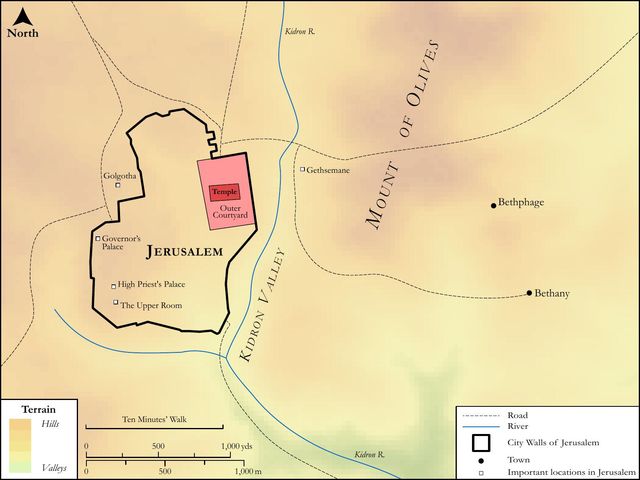
See on the biblical-era maps


Study this verse
Public-domain commentary
Matthew Henry
From his Commentary on the Whole Bible. Henry comments on passages, not single verses — this entry covers John 12:44–50. His four-level outline is real structure in the source text, so it is rendered as structure.
We have here the honour Christ not assumed, but asserted, to himself, in the account he gave of his mission and his errand into the world. Probably this discourse was not at the same time with that before (for them he departed, Joh 12:36), but some time after, when he made another public appearance; and, as this evangelist records it, it was Christ's farewell sermon to the Jews, and his last public discourse; all that follows was private with his disciples. Now observe how our Lord Jesus delivered this parting word: he cried and said. Doth not wisdom cry (Pro 8:1), cry without? Pro 1:20. The raising of his voice and crying intimate, 1. His boldness in speaking. Though they had not courage openly to profess faith in his doctrine, he had courage openly to publish it; if they were ashamed of it, he was not, but set his face as a flint, Isa 50:7. 2. His earnestness in speaking. He cried as one that was serious and importunate, and in good earnest in what he said, and was willing to impart to them, not only the gospel of God, but even his own soul. 3. It denotes his desire that all might take notice of it. This being the last time of the publication of his gospel by himself in person, he makes proclamation, "Whoever will hear me, let them come now." Now what is the conclusion of the whole matter, this closing summary of all Christ's discourses? It is much like that of Moses (Deu 30:15): See, I have set before you life and death. So Christ here takes leave of the temple, with a solemn declaration of three things: -
I.The privileges and dignities of those that believe; this gives great encouragement to us to believe in Christ and to profess that faith.
It is a thing of such a nature that we need not be shy either of doing it or of owning it; for,
1.By believing in Christ we are brought into an honourable acquaintance with God (Joh 12:44, Joh 12:45): He that believes on me, and so sees me, believes on him that sent me, and so sees him. He that believes on Christ,
(1.)He does not believe in a mere man, such a one as he seemed to be, and was generally taken to be, but he believes in one that is the Son of God and equal in power and glory with the Father. Or rather,
(2.)His faith does not terminate in Christ, but through him it is carried out to the Father, that sent him, to whom, as our end, we come by Christ as our way. The doctrine of Christ is believed and received as the truth of God. The rest of a believing soul is in God through Christ as Mediator; for its resignation to Christ is in order to being presented to God. Christianity is made up, not of philosophy nor politics, but pure divinity. This is illustrated, Joh 12:45. He that sees me (which is the same with believing in him, for faith is the eye of the soul) sees him that sent me; in getting an acquaintance with Christ, we come to the knowledge of God. For,
[1.]God makes himself known in the face of Christ (Co2 4:6), who is the express image of his person, Heb 1:3.
[2.]All that have a believing sight of Christ are led by him to the knowledge of God, whom Christ has revealed to us by his word and Spirit. Christ, as God, was the image of his Father's person; but Christ, as Mediator, was his Father's representative in his relation to man, the divine light, law, and love, being communicated to us in and through him; so that in seeing him (that is, in eying him as our Saviour, Prince, and Lord, in the right of redemption), we see and eye the Father as our owner, ruler, and benefactor, in the right of creation: for God is pleased to deal with fallen man by proxy.
2.We are hereby brought into a comfortable enjoyment of ourselves (Joh 12:46): I am come a light into the world, that whoever believes in me, Jew or Gentile, should not abide in darkness. Observe,
(1.)The character of Christ: I am come a light into the world, to be a light to it. This implies that he had a being, and a being as light, before he came into the world, as the sun is before it rises; the prophets and apostles were made lights to the world, but it was Christ only that came a light into this world, having before been a glorious light in the upper world, Joh 3:19.
(2.)The comfort of Christians: They do not abide in darkness.
[1.]They do not continue in that dark condition in which they were by nature; they are light in the Lord. They are without any true comfort, or joy, or hope, but do not continue in that condition; light is sown for them.
[2.]Whatever darkness of affliction, disquietment, or fear, they may afterwards be in, provision is made that they may not long abide in it.
[3.]They are delivered from that darkness which is perpetual, and which abideth for ever, that utter darkness where there is not the least gleam of light nor hope of it.
II.The peril and danger of those that believe not, which gives fair warning to take heed of persisting in unbelief (Joh 12:47, Joh 12:48):
"If any man hear my words, and believe not, I judge him not, not I only, or not now, lest I should be looked upon as unfair in being judge in my own cause; yet let not infidelity think therefore to go unpunished, though I judge him not, there is one that judgeth him." So that we have here the doom of unbelief. Observe,
1.Who they are whose unbelief is here condemned: those who hear Christ's words and yet believe them not. Those shall not be condemned for their infidelity that never had, nor could have, the gospel; every man shall be judged according to the dispensation of light he was under: Those that have sinned without law shall be judged without law. But those that have heard, or might have heard, and would not, lie open to this doom.
2.What is the constructive malignity of their unbelief: not receiving Christ's word; it is interpreted (Joh 12:48) a rejecting of Christ, ho athetōn eme. It denotes a rejection with scorn and contempt. Where the banner of the gospel is displayed, no neutrality is admitted; every man is either a subject or an enemy.
3.The wonderful patience and forbearance of our Lord Jesus, exercised towards those who slighted him when he was come here upon earth: I judge him not, not now. Note, Christ was not quick or hasty to take advantage against those who refused the first offers of his grace, but continued waiting to be gracious. He did not strike those dumb or dead who contradicted him, never made intercession against Israel, as Elias did; though he had authority to judge, he suspended the execution of it, because he had work of another nature to do first, and that was to save the world.
(1.)To save effectually those that were given him before he came to judge the degenerate body of mankind.
(2.)To offer salvation to all the world, and thus far to save them that it is their own fault if they be not saved. He was to put away sin by the sacrifice of himself. Now the executing of the power of a judge was not congruous with that undertaking, Act 8:33. In his humiliation his judgment was taken away, it was suspended for a time.
4.The certain and unavoidable judgment of unbelievers at the great day, the day of the revelation of the righteous judgment of God: unbelief will certainly be a damning sin. Some think when Christ saith, I judge no man, he means that they are condemned already. There needs no process, they are self-judged; no execution, they are self-ruined; judgment goes against them of course, Heb 2:3. Christ needs not appear against them as their accuser, they are miserable if he do not appear for them as their advocate; however, he tells them plainly when and where they will be reckoned with.
(1.)There is one that judgeth them. Nothing is more dreadful than abused patience, and grace trampled on; though for awhile mercy rejoiceth against judgment, yet there will be judgment without mercy.
(2.)Their final judgment is reserved to the last day; to that day of judgment Christ here binds over all unbelievers, to answer then for all the contempts they have put upon him. Divine justice has appointed a day, and adjourns the sentence to that day, as Mat 26:64.
(3.)The word of Christ will judge them then: The words that I have spoken, how light soever you have made of them, the same shall judge the unbeliever in the last day; as the apostles, the preachers of Christ's word, are said to judge, Luk 22:30. Christ's words will judge unbelievers two ways: - [1.] As the evidence of their crime, they will convict them. Every word Christ spoke, every sermon, every argument, every kind offer, will be produced as a testimony against those who slighted all he said. [2.] As the rule of their doom, they will condemn them; they shall be judged according to the tenour of that covenant which Christ procured and published. That word of Christ, He that believes not shall be damned, will judge all unbelievers to eternal ruin; and there are many such like words.
III.A solemn declaration of the authority Christ had to demand our faith, and require us to receive his doctrine upon pain of damnation, Joh 12:49, Joh 12:50, where observe,
1.The commission which our Lord Jesus received from the Father to deliver his doctrine to the world (Joh 12:49): I have not spoken myself, as a mere man, much less as a common man; but the Father gave me a commandment what I should say. This is the same with what he said Joh 7:16. My doctrine is,
(1.)Not mine, for I have not spoken of myself. Christ, as Son of man, did not speak that which was of human contrivance or composure; as Son of God, he did not act separately, or by himself alone, but what he said was the result of the counsels of peace; as Mediator, his coming into the world was voluntary, and with his full consent, but not arbitrary, and of his own head. But,
(2.)It was his that sent him. God the Father gave him,
[1.]His commission. God sent him as his agent and plenipotentiary, to concert matters between him and man, to set a treaty of peace on foot, and to settle the articles.
[2.]His instructions, here called a commandment, for they were like those given to an ambassador, directing him not only what he may say, but what he must say. The messenger of the covenant was entrusted with an errand which he must deliver. Note, Our Lord Jesus learned obedience himself, before he taught it to us, though he was a Son. The Lord God commanded the first Adam, and he by his disobedience ruined us; he commanded the second Adam, and he by his obedience saved us. God commanded him what he should say and what he should speak, two words signifying the same thing, to denote that every word was divine. The Old Testament prophets sometimes spoke of themselves; but Christ spoke by the Spirit at all times. Some make this distinction: He was directed what he should say in his set sermons, and what he should speak in his familiar discourses. Others this: He was directed what he should say in his preaching now, and what he should speak in his judging at the last day; for he had commission and instruction for both.
2.The scope, design, and tendency of this commission: I know that his commandment is life everlasting, Joh 12:50. The commission given to Christ had a reference to the everlasting state of the children of men, and was in order to their everlasting life and happiness in that state: the instructions given to Christ as a prophet were to reveal eternal life (Jo1 5:11); the power, given to Christ as a king was to give eternal life, Joh 17:2. Thus the command given him was life everlasting. This Christ says he knew: "I know it is so," which intimates how cheerfully and with what assurance Christ pursued his undertaking, knowing very well that he went upon a good errand, and that which would bring forth fruit unto life eternal. It intimates likewise how justly those will perish who reject Christ and his word. Those who disobey Christ despise everlasting life, and renounce it; so that not only Christ's words will judge them, but even their own; so shall their doom be, themselves have decided it; and who can except against it?
3.Christ's exact observance of the commission and instructions given him, and his steady acting in pursuance of them: Whatsoever I speak, it is as the Father said unto me. Christ was intimately acquainted with the counsels of God, and was faithful in discovering so much of them to the children of men as it was agreed should be discovered, and kept back nothing that was profitable. As the faithful witness delivers souls, so did he, and spoke the truth, the whole truth, and nothing but the truth. Note,
(1.)This is a great encouragement to faith; the sayings of Christ, rightly understood, are what we may venture our souls upon.
(2.)It is a great example of obedience. Christ said as he was bidden, and so must we, communicated what the Father had said to him, and so must we. See Act 4:20. In the midst of all the respect paid to him, this is the honour he values himself upon, that what the Father had said to him that he spoke, and in the manner as he was directed so he spoke. This was his glory, that, as a Son, he was faithful to him that appointed him; and, by an unfeigned belief of every word of Christ, and an entire subjection of soul to it, we must give him the glory due to his name.
Historical interpretation
Three Centuries of Reception
7 surviving comments on this verse. Each one is dated, so this reads as a timeline rather than a list.
Select a marker to jump to its quote. Markers stagger vertically where authors wrote within a few decades of each other.
For the goodness and the loving-kindness of God, and His boundless riches, hold righteous and sinless the man who, as Ezekiel tells, repents of sins; and reckons sinful, unrighteous, and impious the man who fails away from piety and righteousness to unrighteousness and ungodliness. Wherefore also our Lord Jesus Christ said, 'In whatsoever things I shall take you, in these I shall judge you.'
He judges not, and do you judge? He says that “whoever believes in me may not remain in darkness,” that is, that if he is in darkness he may not remain that way but may amend his error, correct his fault and keep my commandments. For I have said, “I do not desire the death of the wicked, but their conversion.” I said above that he who believes on me is not judged, and I keep to this: “For I have not come to judge the world, but that the world may be saved through me.” I pardon willingly, I quickly forgive. “I will have mercy rather than sacrifice,” because by sacrifice the just is rendered more acceptable, by mercy the sinner is redeemed.
(Hom. lxix. 1) And to show that He does not let His despisers go unpunished, from want of power, He adds, And if any man hear My words and believe not, I judge him not.
(Hom. lxix. 2) But that this might not serve to encourage sloth, He warns men of a terrible judgment coming; He that rejecteth Me, and heareth not My words, hath one that judgeth him.
(Hom. lxviii. 2) Or, I judge him not, i. e. I am not the cause of his destruction, but he is himself, by despising my words. The words that I have just said, shall be his accusers, and deprive him of all excuse; the word that I have spoken, the same shall judge him.
"If any man hear not Me, and believe not, I judge him not, for I came not to judge the world, but to save the world."
For lest they should think, that for want of power He passed by the despisers, therefore spake He the, "I came not to judge the world." Then, in order that they might not in this way be made more negligent, when they had learned that "he that believeth is saved, and he that disbelieveth is punished," see how He hath also set before them a fearful court of judgment.
"He that rejecteth Me, and receiveth not My words, hath One to judge him." "If the Father judgeth no man, and thou art not come to judge the world, who judgeth him?" "The word that I have spoken, the same shall judge him." For since they said, "He is not from God," He saith this, that, "they shall not then be able to say these things, but the words which I have spoken now, shall be in place of an accuser, convicting them, and cutting off all excuse." "And the word which I have spoken." What manner of word?
"And if any man," He says, "hear my words, and keep them not, I judge him not." Remember what I know you have heard in former lessons; and if any of you have forgotten, recall it: and those of you who were absent then, but are present now, hear how it is that the Son saith, "I judge him not," while in another place He says, "The Father judgeth no man, but hath committed all judgment unto the Son;" namely, that thereby we are to understand, It is not now that I judge him. And why not now? Listen to the sequel: "For I am not come," He says, "to judge the world, but to save the world;" that is, to bring the world into a state of salvation. Now, therefore, is the season of mercy, afterwards will be the time for judgment: for He says, "I will sing to Thee, O Lord, of mercy and judgment."
(Tr. liv. 5, 6) i. e. I judge him not now. He does not say, I judge him not at the last day, for that would be contrary to the sentence above, The Father hath committed all judgment unto the Son. (5:22) And the reason follows, why He does not judge now; For I came not to judge the world, but to save the world. Now is the time of mercy, afterward will be the time of judgment.
Those who refuse to hear Jesus and accept saving faith will condemn themselves, for he who came to illumine came not to judge but to save. Therefore, he who disobeys and subjects himself to the greatest miseries can only blame himself as justly punished.
Continue studying John 12:47 across the web’s major study libraries — every link below opens this exact verse, chapter, or book on the destination site.
Read & Compare
 BibleGatewayThis verse in more than 200 translations and 70 languages.
 Bible.comThe YouVersion reader — hundreds of translations, reading plans, and highlights.
 ESV.orgCrossway's official English Standard Version reader.
 NET BibleThe NET translation with 60,000+ translators' notes on every rendering decision.
 STEP BibleTyndale House's free study tool — original text, vocabulary, and scholarly resources.
 BibliaLogos Bible Software's free web reader.
 USCCBThe New American Bible (Revised Edition) with the U.S. bishops' study notes.
Commentaries
 BibleHub CommentariesDozens of classic commentaries on this verse, gathered on one page.
 StudyLightMore than 100 commentary sets — the largest collection on the web.
 BibleRefPlain-English commentary on what this verse means, verse by verse.
 Enduring WordDavid Guzik's free commentary on this chapter, widely used by Bible teachers.
 Bible Study ToolsVerse commentary alongside Greek and Hebrew study aids.
Original Language & Research
- BibleHub InterlinearThe verse word by word — original language, transliteration, and English.
- BibleHub LexiconEvery word's original-language definition and Strong's entry.
 Blue Letter BibleDeep-study tools — Strong's numbers, concordance, and word studies.
 CNTR CollationThe earliest Greek manuscripts of this verse, collated letter by letter.
Sermons, Hymns & Audio


TrulyRandomVerse is not affiliated with these sites and doesn’t control their content. They’re linked because they’re genuinely useful.
Summary
John 12:47 encapsulates the profound purpose of Jesus' first advent, declaring that His mission was not to condemn humanity but to offer salvation. This statement, made at the culmination of His public ministry, highlights God's immense grace and desire to rescue a fallen world, setting the stage for the redemptive events of His passion, death, and resurrection, and distinguishing His initial saving purpose from His future role as judge.
Context
ShowHideLiterary Context
John 12:47 serves as a poignant summary and concluding statement to Jesus' public ministry in the Gospel of John, specifically following His last public discourse. Leading up to this verse, Jesus has been teaching openly about His identity as the Light of the world and urging people to believe in Him while He is still present. The verses immediately preceding (John 12:44-46) emphasize that belief in Jesus is belief in the Father who sent Him, and that He came as light so that those who believe would not remain in darkness. This particular declaration in verse 47 contrasts Jesus' immediate purpose with the common expectation of a judging Messiah, setting the stage for His withdrawal from public teaching (John 12:36) before the final Passover events and His subsequent private discourses with His disciples.
Historical & Cultural Context
In the first century, Jewish expectations for the Messiah often included a powerful, conquering king who would come to judge Israel's enemies and establish an earthly kingdom, restoring Israel to its former glory. This expectation was deeply rooted in prophetic texts that spoke of a day of judgment and the Lord's coming to rule. Jesus' statement in John 12:47 directly challenges and redefines this popular understanding for His first coming. He presents a Messiah whose initial mission is one of mercy and redemption, not immediate condemnation. The "world" (Greek: kosmos) in this context refers to humanity in its fallen, sinful state, alienated from God, yet the object of God's profound love and saving initiative, as famously articulated in John 3:16.
Key Themes
ShowHideThis verse powerfully contributes to several overarching themes in John's Gospel. Firstly, it underscores the theme of Divine Love and Grace, revealing God's benevolent heart towards humanity, sending His Son not to destroy but to rescue. Secondly, it highlights the Nature of Jesus' First Advent, clarifying that His primary purpose in His incarnation was salvific, distinguishing it from His future role as the ultimate judge, a role also affirmed by John (e.g., John 5:22). Thirdly, it implicitly emphasizes the Critical Importance of Belief and Unbelief. While Jesus states He does not judge those who hear His words and do not believe at this time, their unbelief has profound and eternal consequences, as the very purpose of His words and presence is to lead to salvation through faith. This aligns with the broader Johannine emphasis on faith as the gateway to eternal life, as seen in passages like John 6:40).
Exposition and Analysis
ShowHideKey Word Analysis
ShowHideThis word (G191) means to perceive sounds, but also to understand, to give audience, or to hearken. In this context, it implies not merely the physical act of hearing Jesus' words, but an attentive listening that leads to comprehension and a decision. It suggests an encounter with the truth of His message.
The term (G2919) properly means to distinguish, decide, or determine. By implication, it can mean to try, condemn, or punish. Here, Jesus uses it in the sense of pronouncing a verdict of condemnation or executing a sentence. His declaration that He does not "judge" signifies that His immediate mission is not one of condemnation or sentencing.
This verb (G4982) means to deliver, protect, preserve, or make whole. It encompasses physical healing, spiritual deliverance from sin and its consequences, and the bestowal of eternal life. It underscores the life-giving, redemptive, and restorative nature of Jesus' primary purpose for coming into the world.
Verse Breakdown
ShowHide"And if any man hear my words, and believe not"
This clause sets up a conditional scenario, highlighting the human response to Jesus' divine revelation. "My words" refers to Jesus' entire teaching, His self-revelation, and the truth about God and salvation that He embodies. The phrase "believe not" indicates a deliberate rejection or a failure to put faith in Him, despite having heard His message. It points to a lack of saving faith, which is the necessary response to His offer.
"I judge him not"
This is a profound statement of Jesus' immediate posture during His first advent. It means that His current mission is not to pronounce a sentence of condemnation or to execute judgment upon those who reject Him. Instead, His focus is on extending an offer of grace and salvation, even to those who are unresponsive. This does not negate future judgment, but rather clarifies the nature of His initial coming.
"for I came not to judge the world, but to save the world."
This is the explanatory clause, providing the divine rationale for Jesus' non-judgmental stance. The conjunction "for" (Greek: gár, G1063) introduces the reason. Jesus explicitly states His purpose: His incarnation was fundamentally redemptive. He came to rescue humanity from sin and its eternal consequences, offering reconciliation with God. The repetition of "the world" (Greek: kósmos, G2889) emphasizes the universal scope of His saving mission, encompassing all humanity. The contrast between "judge" and "save" is central to understanding His benevolent intent.
Literary Devices
ShowHideThe primary literary device employed in John 12:47 is Antithesis (or Contrast). Jesus directly contrasts His purpose for coming ("not to judge the world, but to save the world"). This stark opposition highlights the core nature of His mission, emphasizing salvation as the dominant theme of His first advent over immediate condemnation. The repetition of "the world" in both parts of the contrasting statement further underscores the universal scope of both the potential judgment and the offered salvation. This rhetorical choice serves to clarify Jesus' identity and mission, challenging prevailing expectations and revealing the depth of God's redemptive love.
Theological and Thematic Connections
ShowHideJohn 12:47 stands as a cornerstone for understanding the fundamental nature of God's character and the purpose of Christ's incarnation. It reveals a God whose primary disposition towards a fallen humanity is one of love and a desire for reconciliation, not immediate retribution. This verse underscores that salvation is a free gift, offered universally, contingent upon a response of faith. While justice and judgment are integral aspects of God's character and will be fully manifested in Christ's second coming, His first advent was marked by an overwhelming outpouring of grace and an invitation to life. This truth offers immense comfort, reminding us that God's heart is for our redemption, providing a path to escape the condemnation that sin justly deserves.
Reflection and Application
ShowHideJohn 12:47 offers both immense comfort and a profound challenge to every hearer. It reassures us of God's boundless grace and His fervent desire for our salvation, not our destruction. This verse reminds us that Jesus stepped into human history not as an immediate executioner of judgment, but as the divine rescuer, offering reconciliation and a pathway to eternal life through His sacrifice. For those who have heard His words, the call is to respond in faith, embracing this glorious offer of salvation. It compels us to examine our own hearts: have we truly believed His words, trusting in His saving mission? Furthermore, this verse shapes our understanding of evangelism. We are called to extend the same message of salvation, not condemnation, to a world in need. While His first coming was not for judgment, our response to His saving message in this present age determines our eternal standing when He comes again in glory as the righteous Judge.
Questions for Reflection
ShowHideFAQ
ShowHideDoes this verse mean Jesus will never judge anyone?
ShowHideNo, John 12:47 refers specifically to the purpose of Jesus' first coming. It clarifies that His initial advent was not to execute final judgment, but to offer salvation. The Bible is clear that Jesus will indeed serve as the ultimate judge in His second coming. For example, John 5:22 states, "For the Father judgeth no man, but hath committed all judgment unto the Son." Similarly, Acts 17:31 declares that God "hath appointed a day, in the which he will judge the world in righteousness by that man whom he hath ordained; whereof he hath given assurance unto all men, in that he hath raised him from the dead." Thus, while His first coming was characterized by grace and salvation, His second coming will be characterized by righteous judgment.
What are "my words" that one must hear and believe, according to this verse?
ShowHide"My words" refers to the entirety of Jesus' teachings, His divine revelation, and the truth about God's character and plan of salvation that He embodied and proclaimed. This includes His claims of divinity, His teachings on the Kingdom of God, His commandments, and His revelation of the Father's will. To "hear" implies more than just physical perception; it means to listen attentively, to understand, and to receive His message as truth. To "believe" His words means to place one's faith and trust in Him as the Son of God and the only means of salvation. As Jesus Himself stated in John 6:63, "the words that I speak unto you, they are spirit, and they are life." Ultimately, these words lead to eternal life for those who embrace them in faith, as highlighted in John 14:23.
Christ-Centered Fulfillment
ShowHideJohn 12:47 finds its profound Christ-centered fulfillment in the very essence of Jesus' incarnation, death, and resurrection. He is the ultimate embodiment of God's saving purpose, the Lamb of God who came to take away the sin of the world, not to condemn it (John 1:29). His entire life, culminating in His sacrificial death on the cross, was the means by which God's saving love was fully expressed and enacted. Through His atoning work, Jesus bore the judgment that humanity deserved, thereby making salvation available to all who believe (Romans 5:8). He came to reconcile a fallen world to God, offering peace where there was enmity (2 Corinthians 5:18-19). While He did not come to judge in His first advent, His very presence and the response to His words establish the basis for future judgment; those who reject His saving offer stand condemned already by their unbelief (John 3:18). Thus, John 12:47 is a testament to the compassionate heart of the Father, perfectly revealed in the Son, who came to seek and to save that which was lost, fulfilling the divine plan to redeem humanity through His own perfect sacrifice. He is now our great High Priest, interceding for us (Hebrews 7:25), but will return as the righteous judge, confirming the eternal destiny of all based on their response to His saving grace (Revelation 20:11-15).