


Exodus 10:4
Bible text: King James Version (1769 Blayney text) · Public domain
Bible text: Berean Standard Bible · Public domain
Bible text: American Standard Version (1901) · Public domain
Bible text: World English Bible, Messianic edition · Public domain
Bible text: Geneva Bible (1599) · Public domain
Bible text: Young's Literal Translation · Public domain
- כִּיkithatH3588PrtParticle Conditional
- אִם'imexceptH518PrtParticle Conditional
- מָאֵןma·'En[are] refusingH3986V-Piel-Prtcpl-msVerb Piel Participle Singular Masculine Absolute
- אַתָּה'a·TahyouH859Pro-2msPronoun Personal 2nd Singular Masculine
- לְשַׁלֵּחַle·sha·Le·achto let goH7971Prep-l ¦ V-Piel-InfVerb Piel Infinitive Constructלְtoשַׁלֵּחַlet go
- אֶת'et<obj.>H853DirObjMParticle Object Indicator
- עַמִּי'a·Mimy peopleH5971N-msc ¦ 1csNoun Singular Masculine Constructעַמִּpeopleיmy
- הִנְנִיhi·Nihere IH2005Prt ¦ 1csParticle InterjectionהִנְhereנִיI
- מֵבִיאme·Vi'[am] about to bringH935V-Hiphil-Prtcpl-msVerb Hiphil Participle Singular Masculine Absolute
- מָחָרma·ChartomorrowH4279N-msNoun Singular Masculine Absolute
- אַרְבֶּה'ar·Behlocust[s]H697N-msNoun Singular Masculine Absolute
- בִּגְבֻלֶךָbig·vu·Le·khain your territoryH1366Prep-b ¦ N-msc ¦ 2msNoun Singular Masculine Constructבִּinגְבֻלֶterritoryךָyour
English is a literal word-by-word gloss of the Hebrew, not the KJV's wording. Why?
This is the original text the KJV's translators worked from — each Hebrew word with its own literal English meaning in this verse, prepared by scholars at Tyndale House, Cambridge. The KJV translates whole sentences, not word by word, so its wording differs: one Hebrew word can become several English words, and the KJV may choose “the LORD” where the gloss reads “Yahweh”. Both are faithful — they answer different questions. For the KJV's own rendering, switch to the KJV text.
Details
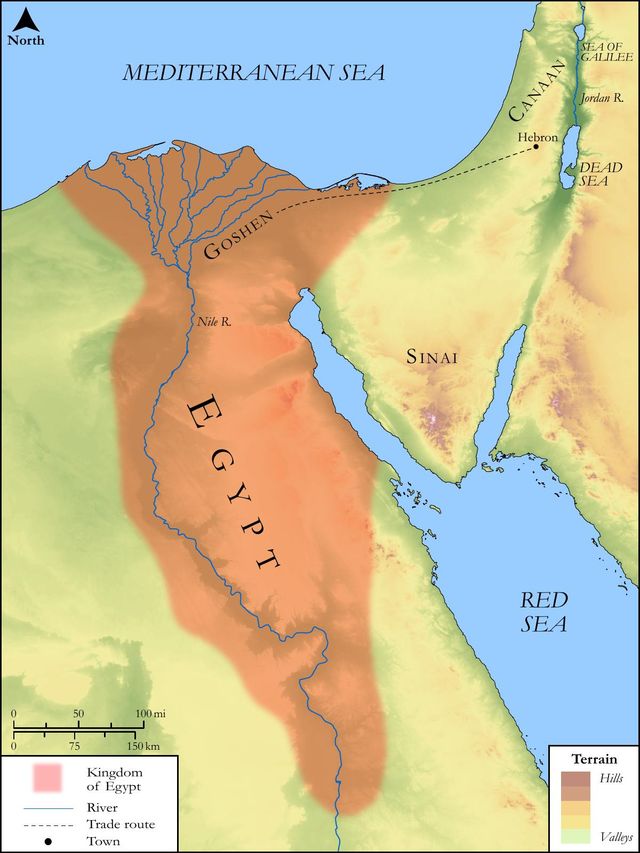
See on the biblical-era maps

Study this verse
Public-domain commentary
Matthew Henry
From his Commentary on the Whole Bible. Henry comments on passages, not single verses — this entry covers Exodus 10:1–11.
Here, I. Moses is instructed. We may well suppose that he, for his part, was much astonished both at Pharaoh's obstinacy and at God's severity, and could not but be compassionately concerned for the desolations of Egypt, and at a loss to conceive what this contest would come to at last. Now here God tells him what he designed, not only Israel's release, but the magnifying of his own name: That thou mayest tell in thy writings, which shall continue to the world's end, what I have wrought in Egypt, Exo 10:1, Exo 10:2. The ten plagues of Egypt must be inflicted, that they may be recorded for the generations to come as undeniable proofs, 1. Of God's overruling power in the kingdom of nature, his dominion over all the creatures, and his authority to use them either as servants to his justice or sufferers by it, according to the counsel of his will. 2. Of God's victorious power over the kingdom of Satan, to restrain the malice and chastise the insolence of his and his church's enemies. These plagues are standing monuments of the greatness of God, the happiness of the church, and the sinfulness of sin, and standing monitors to the children of men in all ages not to provoke the Lord to jealousy nor to strive with their Maker. The benefit of these instructions to the world sufficiently balances the expense.
II.Pharaoh is reproved (Exo 10:3):
Thus saith the Lord God of the poor, despised, persecuted, Hebrews, How long wilt thou refuse to humble thyself before me? Note, It is justly expected from the greatest of men that they humble themselves before the great God, and it is at their peril if they refuse to do it. This has more than once been God's quarrel with princes. Belshazzar did not humble his heart, Dan 5:22. Zedekiah humbled not himself before Jeremiah, Ch2 36:12. Those that will not humble themselves God will humble. Pharaoh had sometimes pretended to humble himself, but no account was made of it, because he was neither sincere nor constant in it.
III.The plague of locusts is threatened, Exo 10:4-6.
The hail had broken down the fruits of the earth, but these locusts should come and devour them: and not only so, but they should fill their houses, whereas the former inroads of these insects had been confined to their lands. This should be much worse than all the calamities of that king which had ever been known. Moses, when he had delivered his message, not expecting any better answer than he had formerly, turned himself and went out from Pharaoh, Exo 10:6. Thus Christ appointed his disciples to depart from those who would not receive them, and to shake off the dust of their feet for a testimony against them; and ruin is not far off from those who are thus justly abandoned by the Lord's messengers, Sa1 15:27, etc.
IV.Pharaoh's attendants, his ministers of state, or privy-counsellors, interpose, to persuade him to come to some terms with Moses, Exo 10:7.
They, as in duty bound, represent to him the deplorable condition of the kingdom (Egypt is destroyed), and advise him by all means to release his prisoners (Let the men go); for Moses, they found, would be a snare to them till it was done, and it were better to consent at first than to be compelled at last. The Israelites had become a burdensome stone to the Egyptians, and now, at length, the princes of Egypt were willing to be rid of them, Zac 12:3. Note, It is a thing to be regretted (and prevented, if possible) that a whole nation should be ruined for the pride and obstinacy of its princes, Salus populi suprema lex - To consult the welfare of the people is the first of laws.
V.A new treaty is, hereupon, set on foot between Pharaoh and Moses, in which Pharaoh consents for the Israelites to go into the wilderness to do sacrifice; but the matter in dispute was who should go, Exo 10:8. 1. Moses insists that they should take their whole families, and all their effects, along with them, Exo 10:9. note, Those that serve God must serve him with all they have. Moses pleads, "We must hold a feast, therefore we must have our families to feast with, and our flocks and herds to feast upon, to the honour of God." 2. Pharaoh will by no means grant this: he will allow the men to go, pretending that this was all they desired, though this matter was never yet mentioned in any of the former treaties; but, for the little ones, he resolves to keep them as hostages, to oblige them to return, Exo 10:10, Exo 10:11. In a great passion he curses them, and threatens that, if they offer to remove their little ones, they will do it at their peril. Note, Satan does all he can to hinder those that serve God themselves from bringing their children in to serve him. He is a sworn enemy to early piety, knowing how destructive it is to the interests of his kingdom; whatever would hinder us from engaging our children to the utmost in God's service, we have reason to suspect the hand of Satan in it. 3. The treaty, hereupon, breaks off abruptly; those that before went out from Pharaoh's presence (Exo 10:6) were now driven out. Those will quickly hear their doom that cannot bear to hear their duty. See Ch2 25:16. Quos Deus destruet eos dementat - Whom God intends to destroy he delivers up to infatuation. Never was man so infatuated to his own ruin as Pharaoh was.
Historical interpretation
Historical reception
1 surviving comment on this verse from the historical church.
In the eighth place locusts are mentioned. Some interpreters think that this sort of plague confutes the inconstancy of the human race, filled with dissent and discord. In another sense, the locusts can be interpreted as representing flittering mobility, like the pleasures of this world in a restless and skittish soul.
Continue studying Exodus 10:4 across the web’s major study libraries — every link below opens this exact verse, chapter, or book on the destination site.
Read & Compare
 BibleGatewayThis verse in more than 200 translations and 70 languages.
 Bible.comThe YouVersion reader — hundreds of translations, reading plans, and highlights.
 ESV.orgCrossway's official English Standard Version reader.
 NET BibleThe NET translation with 60,000+ translators' notes on every rendering decision.
 STEP BibleTyndale House's free study tool — original text, vocabulary, and scholarly resources.
 BibliaLogos Bible Software's free web reader.
 USCCBThe New American Bible (Revised Edition) with the U.S. bishops' study notes.
Commentaries
 BibleHub CommentariesDozens of classic commentaries on this verse, gathered on one page.
 StudyLightMore than 100 commentary sets — the largest collection on the web.
 BibleRefPlain-English commentary on what this verse means, verse by verse.
 Enduring WordDavid Guzik's free commentary on this chapter, widely used by Bible teachers.
 Bible Study ToolsVerse commentary alongside Greek and Hebrew study aids.
Original Language & Research
- BibleHub InterlinearThe verse word by word — original language, transliteration, and English.
- BibleHub LexiconEvery word's original-language definition and Strong's entry.
 Blue Letter BibleDeep-study tools — Strong's numbers, concordance, and word studies.
 SefariaThe Hebrew text with Rashi and centuries of Jewish commentary.
Sermons, Hymns & Audio


TrulyRandomVerse is not affiliated with these sites and doesn’t control their content. They’re linked because they’re genuinely useful.
Summary
Exodus 10:4 delivers God's precise and unyielding warning to Pharaoh through Moses: continued refusal to release the Israelites will result in an unprecedented and devastating plague of locusts descending upon Egypt "to morrow," consuming every remaining green thing left by the hail. This declaration underscores God's unwavering resolve, Pharaoh's escalating defiance, and the inevitable, comprehensive consequences of resisting divine will, setting the stage for one of the most destructive judgments yet.
Context
ShowHideLiterary Context
Exodus 10:4 is strategically positioned within the escalating narrative of the ten plagues, following seven prior judgments that have progressively devastated Egypt and exposed the impotence of its gods. Immediately preceding this verse, Moses and Aaron have just confronted Pharaoh after the severe hail plague, demanding the full release of God's people. Pharaoh, though momentarily shaken by the hail's severity, still attempts to negotiate, offering to let only the men go, a partial concession Moses vehemently rejects, insisting on the departure of all, with their flocks and herds (Exodus 10:1-3). This verse, therefore, is God's direct, non-negotiable response to Pharaoh's continued stubbornness and his attempts to dictate terms to the Almighty. Following this explicit warning, Exodus 10:5-6 vividly describes the unprecedented scale and destructive power of the coming locust plague, and Exodus 10:7-11 shows Pharaoh's exasperated officials urging him to relent, only for Pharaoh to again refuse the full release, leading to the plague's immediate onset.
Historical & Cultural Context
Locust plagues were a known, terrifying natural phenomenon in Egypt and the lands round about, capable of wiping out entire harvests and causing widespread famine. Ancient Egyptian agriculture, heavily reliant on the Nile's annual inundation and the subsequent fertile land, would have been particularly vulnerable to such a catastrophe. What distinguished this plague, as with all the Exodus plagues, was its divine orchestration: its precise timing ("to morrow"), its unprecedented scale (covering the entire land), its specific target (consuming what the hail had left, thus ensuring total agricultural ruin), and its precise beginning and end at God's command. The phrase "into thy coast" (KJV) or "within your borders" (ESV) signifies that the plague would affect the entire territory of Egypt, emphasizing the comprehensive nature of God's judgment and His absolute sovereignty over all creation, including the natural world that the Egyptians often deified. This plague would have been particularly devastating as it targeted the very food supply that remained after the prior plagues, striking at the heart of Egypt's economic and social stability and demonstrating the futility of relying on their own gods for provision.
Key Themes
ShowHideExodus 10:4 contributes significantly to several overarching themes within the book of Exodus. Foremost is the theme of God's absolute sovereignty over creation and human rulers, demonstrating His power to command natural forces to execute His will against even the most powerful empire. It further highlights the theme of divine judgment against sin and oppression, as Pharaoh's persistent refusal to release God's people incurs increasingly severe consequences. This verse also underscores Pharaoh's hardened heart and the escalating nature of his rebellion against God's clear commands, a central motif throughout the plague narrative that ultimately serves to magnify God's glory (Exodus 9:16). Finally, it reinforces God's covenant faithfulness to His people, Israel, as He systematically dismantles the power of their oppressor to fulfill His promise of liberation and lead them to the promised land (Exodus 6:6-8).
Exposition and Analysis
ShowHideExodus 10:4 delivers a potent message through its concise language, revealing God's character and Pharaoh's obstinacy.
Key Word Analysis
ShowHideThis term (H697) refers specifically to the winged, swarming locust, known for its destructive capacity. Derived from a root meaning "to be many" or "to multiply," ʼarbeh denotes a creature that appears in vast numbers, devouring all vegetation and leaving nothing behind. The emphasis here is not just on an insect infestation but on a complete agricultural desolation, targeting the very sustenance of Egypt. This plague would consume what the previous hail plague had spared, ensuring total ruin and demonstrating God's comprehensive judgment.
This seemingly simple phrase (H4279) highlights God's precision, patience, and purpose. Properly meaning "deferred" or "the morrow," its use here signifies a forewarned judgment, not an immediate, impulsive act. This specific timing gives Pharaoh one last, clear opportunity to repent and obey, underscoring God's justice and His desire for humanity to choose obedience, even in the face of impending judgment. It removes any doubt that the plague is a direct, deliberate consequence of Pharaoh's refusal, emphasizing God's control over time and events.
The Hebrew verb used here (H3986) denotes a strong, persistent unwillingness or obstinacy. It's not a mere hesitation but an active, determined rejection of God's command. This word encapsulates Pharaoh's hardened heart, a recurring theme throughout the Exodus narrative, emphasizing his active choice to defy the Almighty despite overwhelming evidence of divine power and the suffering of his own people. It highlights the moral culpability of Pharaoh in the face of God's clear will.
Verse Breakdown
ShowHideThe verse can be broken down into a clear conditional statement and its severe consequence:
Literary Devices
ShowHideExodus 10:4 masterfully employs several literary devices to convey its powerful message. The most prominent is the cause-and-effect structure, directly linking Pharaoh's obstinate refusal to God's impending judgment, thereby emphasizing divine justice and human accountability. The use of direct address ("thou") creates a sense of personal confrontation between God (speaking through Moses) and Pharaoh, highlighting the high stakes of this divine-human conflict. The phrase "behold, to morrow" functions as a powerful declarative statement, underscoring God's absolute authority, the certainty of His word, and His control over time. Furthermore, this verse is part of an escalating literary pattern of plagues, each more severe than the last, which serves to illustrate God's persistent pursuit of His purpose and Pharaoh's deepening, self-inflicted rebellion. The vivid imagery of "locusts into thy coast" also employs foreshadowing, hinting at the complete devastation that is about to befall Egypt.
THEOLOGICAL AND THEMATIC CONNECTIONS
ShowHideExodus 10:4 reveals profound theological truths about God's nature, humanity's response, and the inevitable consequences of rebellion. It teaches us about God's sovereignty over all creation, demonstrating His power to command the forces of nature to achieve His purposes. He is not merely a regional deity or one among many, but the Lord of all the earth, capable of bringing comprehensive judgment upon even the most powerful human empire. This verse also highlights God's justice and patience, as He provides clear warnings and opportunities for repentance before unleashing full judgment. His declaration of "to morrow" is a testament to His desire for Pharaoh to relent, even though He knows Pharaoh's heart will remain hardened. It showcases divine long-suffering even in the face of profound human defiance.
Thematically, this verse connects to the broader biblical narrative of divine judgment against sin and oppression and God's unwavering covenant faithfulness to His people. Pharaoh's stubbornness is a prime example of the human heart's capacity for active rebellion against God, a theme echoed throughout Scripture. God's ultimate purpose is to liberate His people and demonstrate His glory, even if it requires severe and widespread judgment, proving His unmatched power to both deliver and judge.
Reflection and Application
ShowHideExodus 10:4 offers timeless lessons for contemporary believers, serving as a powerful reminder that God's warnings, whether spoken through Scripture, the prompting of conscience, or the circumstances of life, are serious and demand immediate attention. Pharaoh's escalating defiance is a profound cautionary tale against the spiritual dangers of a hardened heart—how repeated resistance to God's clear will can lead to spiritual blindness, increasing callousness, and ultimately, increasingly severe consequences. This verse calls us to cultivate a posture of humility and responsiveness to God's voice, recognizing that His ultimate purposes will prevail, regardless of human resistance. It encourages us to trust in God's absolute sovereignty, even when circumstances seem overwhelming, knowing that He is in control and works all things for His glory and the good of His people. For those who are in Christ, it is a reminder of the grace that has saved us from the judgment due to our own stubbornness, and a call to live in joyful obedience.
Questions for Reflection
ShowHideFAQ
ShowHideWhy did God give Pharaoh a "tomorrow" warning if He knew Pharaoh would refuse?
ShowHideGod's warnings, like the "tomorrow" in Exodus 10:4, serve multiple profound purposes. Firstly, they demonstrate God's inherent justice and boundless patience; He does not act arbitrarily but gives clear notice and ample opportunity for repentance, even to the most defiant oppressors. This ensures that Pharaoh's subsequent suffering is clearly understood as a direct and just consequence of his own persistent choices, removing any pretense of ignorance or excuse. Secondly, these repeated warnings further highlight the depth of Pharaoh's profound stubbornness and the extent of his rebellion, making God's power and glory all the more evident when His judgments finally fall. Thirdly, they build the narrative tension and demonstrate God's absolute control over time and events, showcasing His ability to bring about judgments precisely as declared, thus confirming His divine authority and faithfulness to His word.
Were the plagues just natural disasters that Moses cleverly predicted?
ShowHideWhile some plagues (like locusts, hail, or darkness) have natural counterparts in Egypt, the biblical account consistently emphasizes their supernatural timing, unprecedented intensity, and precise specificity as undeniable evidence of divine intervention. In Exodus 10:4, the plague is not merely a common swarm of locusts, but one explicitly "brought" by God, specifically "to morrow," and its unprecedented scale and destructive power (consuming everything left after the hail) far exceeded typical natural occurrences. Moreover, the fact that the plagues often affected Egyptians but miraculously spared Israelites, even those living in close proximity (Exodus 8:22-23), unequivocally points to their miraculous, divinely directed nature, rather than mere coincidence or a clever prediction of natural phenomena.
What is the significance of God repeatedly hardening Pharaoh's heart throughout the Exodus narrative?
ShowHideThe concept of God hardening Pharaoh's heart is a complex theological theme that underscores divine sovereignty. In many instances, Pharaoh first hardens his own heart through defiant choices, and then God confirms or intensifies that hardening as a righteous judgment. This serves several crucial purposes: it demonstrates God's absolute sovereignty over human will, even in rebellion, showing that no human defiance can thwart His ultimate plan; it allows God to display His power and glory more fully through a prolonged series of judgments, so that "Egyptians shall know that I am the Lord" (Exodus 7:5); and it provides the necessary context for the great redemption of Israel, showing that their deliverance was entirely God's miraculous work, not a result of Pharaoh's eventual willingness or negotiation. It also serves as a profound theological statement that even human evil and resistance can be incorporated into God's larger redemptive and revelatory plan.
Christ-Centered Fulfillment
ShowHideExodus 10:4, with its depiction of divine judgment against an oppressive ruler and the promise of ultimate deliverance for God's people, finds profound fulfillment in the person and work of Jesus Christ. The plagues, including the devastating locusts, demonstrate God's power over all creation and His ultimate victory over forces that oppose His will. This foreshadows Christ's ultimate triumph over sin, death, and the spiritual powers of darkness, which hold humanity in a far greater bondage than Pharaoh held Israel. Jesus, as the true and ultimate Deliverer, liberates His people not from physical slavery in Egypt, but from the spiritual slavery to sin and death, declaring, "If the Son therefore shall make you free, ye shall be free indeed" (John 8:34-36). The plagues served as a powerful demonstration of God's authority and judgment; similarly, Christ's life, death, and resurrection are the ultimate demonstration of God's power and justice, culminating in the decisive defeat of the ultimate oppressor, Satan, and his dominion (Colossians 2:15). Just as God brought judgment upon Egypt to secure the release of His people, Christ bore the full judgment of God on the cross to secure the release and eternal redemption of all who believe. The "refusal" of Pharaoh to let God's people go is mirrored in humanity's inherent rebellion and refusal to acknowledge God's authority and repent of sin, yet in Christ, God provides the way for true freedom and reconciliation, offering a liberation far more profound and eternal than the Exodus from Egypt.