


Jonah 1:17
“Jonah in the Great Fish: His Prayer and Deliverance”Jonah 1:17–2:10
Bible text: King James Version (1769 Blayney text) · Public domain
Bible text: Berean Standard Bible · Public domain
Bible text: American Standard Version (1901) · Public domain
Bible text: World English Bible, Messianic edition · Public domain
Bible text: Geneva Bible (1599) · Public domain
Bible text: Young's Literal Translation · Public domain
- וַיְמַןvay·Manand he appointedH4487Conj-w ¦ V-Piel-ConsecImperf-3msVerb Piel Consecutive Imperfect 3rd Singular Masculineוַandיְמַןhe appointed
- יְהוָהYah·wehYahwehH3068N-properNoun Proper Title
- דָּגdaga fishH1709N-msNoun Singular Masculine Absolute
- גָּדוֹלga·DolgreatH1419Adj-msAdjective Singular Masculine Absolute
- לִבְלֹעַliv·Lo·a'to swallowH1104Prep-l ¦ V-Qal-InfVerb Qal Infinitive Constructלִtoבְלֹעַswallow
- אֶת'et[obj.]H853DirObjMParticle Object Indicator
- יוֹנָהyo·NahJonahH3124N-proper-mNoun Proper Masculine
- וַיְהִיvay·Hiand he wasH1961Conj-w ¦ V-Qal-ConsecImperf-3msVerb Qal Consecutive Imperfect 3rd Singular Masculineוַandיְהִיhe was
- יוֹנָהyo·NahJonahH3124N-proper-mNoun Proper Masculine
- בִּמְעֵיbim·'Eiin [the] inward parts ofH4578Prep-b ¦ N-mpcNoun Plural Masculine Constructבִּinמְעֵי[the] inward parts of
- הַדָּגha·Dagthe fishH1709Art ¦ N-msNoun Singular Masculine Absoluteהַtheדָּגfish
- שְׁלֹשָׁהshe·lo·ShahthreeH7969N-csNoun Singular common gender Absolute
- יָמִיםya·MimdaysH3117N-mpNoun Plural Masculine Absolute
- וּשְׁלֹשָׁהu·she·lo·Shahand threeH7969Conj-w ¦ N-csNoun Singular common gender Absoluteוּandשְׁלֹשָׁהthree
- לֵילוֹתlei·LotnightsH3915N-fpNoun Plural (-ôt ending) Absolute
English is a literal word-by-word gloss of the Hebrew, not the KJV's wording. Why?
This is the original text the KJV's translators worked from — each Hebrew word with its own literal English meaning in this verse, prepared by scholars at Tyndale House, Cambridge. The KJV translates whole sentences, not word by word, so its wording differs: one Hebrew word can become several English words, and the KJV may choose “the LORD” where the gloss reads “Yahweh”. Both are faithful — they answer different questions. For the KJV's own rendering, switch to the KJV text.
Words in [ ] are added by the English.
Details
See on the biblical-era map
Study this verse
Public-domain commentary
Matthew Henry
From his Commentary on the Whole Bible. Henry wrote on whole passages, and this entry covers Jonah 1:11–17. He set out his notes in a two-level outline, kept here as he numbered it.
It is plain that Jonah is the man for whose sake this evil is upon them, but the discovery of him to be so was not sufficient to answer the demands of this tempest; they had found him out, but something more was to be done, for still the sea wrought and was tempestuous (Jonah 1:11), and again (Jonah 1:13), it grew more and more tempestuous (so the margin reads it); for if we discover sin to be the cause of our troubles, and do not forsake it, we do but make bad worse. Therefore they went on with the prosecution.
I.They enquired of Jonah himself what he thought they must do with him (Jonah 1:11):
What shall we do unto thee, that the sea may be calm to us? They perceived that Jonah is a prophet of the Lord, and therefore will not do any thing, no, not in his own case, without consulting him. He appears to be a delinquent, but he appears also to be a penitent, and therefore they will not insult over him, nor offer him any rudeness. Note, We ought to act with great tenderness towards those that are overtaken in a fault and are brought into distress by it. They would not cast him into the sea if he could think of any other expedient by which to save the ship. Or, perhaps, thus they would show how plain the case was, that there was no remedy but he must be thrown overboard; let him be his own judge as he had been his own accuser, and he himself will say so. Note, When sin has raised a storm, and laid us under the tokens of God's displeasure, we are concerned to enquire what we shall do that the sea may be calm; and what shall we do? We must pray and believe, when we are in a storm, and study to answer the end for which it was sent, and then the storm shall become a calm. But especially we must consider what is to be done to the sin that raised the storm; that must be discovered, and penitently confessed; that must be detested, disclaimed, and utterly forsaken. What have I to do any more with it? Crucify it, crucify it, for this evil it has done.
II.Jonah reads his own doom (Jonah 1:12):
Take me up, and cast me forth into the sea. He would not himself leap into the sea, but he put himself into their hands, to cast him into the sea, and assured them that then the sea would be calm, and not otherwise. He proposed this, in tenderness to the mariners, that the might no suffer for his sake. "Let thy hand be upon me" (says David, 1 Chronicles 21:17), "who am guilty; let me die for me own sin, but let not the innocent suffer for it." This is the language of true penitents, who earnestly desire that none but themselves may ever smart, or fare the worse, for their sins and follies. He proposed it likewise in submission to the will of God, who sent this tempest in pursuit of him; and therefore judged himself to be cast into the sea, because to that he plainly saw God judging him, that he might not be judged of the Lord to eternal misery. Note, Those who are truly humbled for sin will cheerfully submit to the will of God, even in a sentence of death itself. If Jonah sees this to be the punishment of his iniquity, he accepts it, he subjects himself to it, and justifies God in it. No matter though the flesh be destroyed, no matter how it is destroyed, so that the spirit may be but saved in the day of the Lord Jesus, 1 Corinthians 5:5. The reason he gives is, For I know that for my sake this great tempest is upon you. See how ready Jonah is to take all the guilt upon himself, and to look upon all the trouble as theirs: "It is purely for my sake, who have sinned, that this tempest is upon you; therefore cast me forth into the sea; for," 1. "I deserve it. I have wickedly departed from my God, and it is upon my account that he is angry with you. Surely I am unworthy to breathe in that air which for my sake has been hurried with winds, to live in that ship which for my sake has been thus tossed. Cast me into the sea after the wares which for my sake you have thrown into it. Drowning is too good for me; a single death is punishment too little for such a complicated offence." 2. "Therefore there is no way of having the sea calm. If it is I that have raised the storm, it is not casting the wares into the sea that will lay it again; no, you must cast me thither." When conscience is awakened, and a storm raised there, nothing will turn it into a calm but parting with the sin that occasioned the disturbance, and abandoning that. It is not parting with our money that will pacify conscience; no, it is the Jonah that be thrown overboard. Jonah is herein a type of Christ, that he gives his life a ransom for many; but with this material difference, that the storm Jonah gave himself up to still was of his own raising, but that storm which Christ gave himself up to still was of our raising. Yet, as Jonah delivered himself up to be cast into a raging sea that it might be calm, so did our Lord Jesus, when he died that we might live.
III.The poor mariners did what they could to save themselves from the necessity of throwing Jonah into the sea, but all in vain (Jonah 1:13):
They rowed hard to bring the ship to the land, that, if they must part with Jonah, they might set him safely on shore; but they could not. All their pains were to no purpose; for the sea wrought harder than they could, and was tempestuous against them, so that they could by no means make the land. If they thought sometimes that they had gained their point, they were quickly thrown off to sea again. Still their ship was overladen; their lightening it of the wares made it never the lighter as long as Jonah was in it. And, besides, they rowed against wind and tide, the wind of God's vengeance, the tide of his counsels; and it is in vain to contend with God, in vain to think of saving ourselves any other way than by destroying our sins. By this it appears that these mariners were very loth to execute Jonah's sentence upon himself, though they knew it was for his sake that this tempest was upon them. They were thus very backward to it partly from a dread of bringing upon themselves the guilt of blood, and partly from a compassion they could not but have for poor Jonah, as a good man, as a man in distress, and as a man of sincerity. Note, The more sinners humble and abase themselves, judge and condemn themselves, the more likely they are to find pity both with God and man. The more forward Jonah was to say, Cast me into the sea, the more backward they were to do it.
IV.When they found it necessary to cast Jonah into the sea they first prayed to God that the guilt of his blood might not lie upon them, nor be laid to their charge, Jonah 1:14. When they found it in vain to row hard they quitted their oars and went to their prayers: Wherefore they cried unto the Lord, unto Jehovah, the true and living God, and no more to the gods many. and lords many, that the had cried to, Jonah 1:5. They prayed to the God of Israel, being now convinced, by the providences of God concerning Jonah and the information he had given them, that he is God alone. Having determined to cast Jonah into the sea, they first enter a protestation in the court of heaven that they do not do it willingly, much less maliciously, or with any design to be revenged upon him because it was for his sake that this tempest was upon them. No; his god forgive him, as they do! But they are forced to do it se defendendo - in self-defence, having no other way to save their own lives; and they do it as ministers of justice, both God and himself having sentenced him to so great a death. They therefore present a humble petition to the God whom Jonah feared, that they might not perish for his life. See,
1.What a fear they had of contracting the guilt of blood, especially the blood of one that feared God, and worshipped him, and had fellowship with him, as they perceived Jonah had, though in a single instance he had been faulty. Natural conscience cannot but have a dread of blood-guiltiness, and make men very earnest in prayer, as David was, to be delivered from it, Psalm 51:14. So they were here: We beseech thee, O Lord! we beseech thee, lay not upon us innocent blood. They are now as earnest in praying to be saved from the peril of sin as they were before in praying to be saved from the peril of the sea, especially because Jonah appeared to them to be no ordinary person, but a very good man, a man of God, a worshipper of the great Creator of heaven and earth, upon which account even these rude mariners conceived a veneration for him, and trembled at the thought of taking away his life. Innocent blood is precious, but saints' blood, prophets' blood, is much more precious, and so those will find to their cost that any way bring themselves under the guilt of it. The mariners saw Jonah pursued by divine vengeance, and yet could not without horror think of being his executioners. Though his God has a controversy with him, yet, think they, Let not our hand be upon him. The Israelites were at this time killing the prophets for doing their duty (witness Jezebel's late persecution), and were prodigal of their lives, which is aggravated by the tenderness these heathens had for one whom they perceived to be a prophet, though he was now out of the way of his duty.
2.What a fear they had of incurring the wrath of God; they were jealous lest he should be angry if they should be the death of Jonah, for he had said, Touch not my anointed, and do my prophets no harm; it is at your peril if you do. "Lord," say they, "let us not perish for this man's life. Let it not be such a fatal dilemma to us. We see we must perish if we spare his life; Oh let us not perish for taking away his life." And their plea is good: "For thou, O Lord! hast done as it pleased thee; thou had laid us under a necessity of doing it; the wind that pursued him, the lot that discovered him, were both under thy direction, which we are herein governed by; we are but the instruments of Providence, and it is sorely against our will that we do it; but we must say, The will of the Lord be done." Note, When we are manifestly led by Providence to do things contrary to our own inclinations, and quite beyond our own intentions, it will be some satisfaction to us to be able to say, Thou, O Lord! has done as it pleased thee. And, if God please himself, we ought to be satisfied though he do not please us.
V.Having deprecated the guilt they dreaded, they proceeded to execution (Jonah 1:15):
They took up Jonah, and cast him forth into the sea. They cast him out of their ship, out of their company, and cast him into the sea, a raging stormy sea, that cried, "Give, give; surrender the traitor, or expect no peace." We may well think what confusion and amazement poor Jonah was in when he saw himself ready to be hurried into the presence of that God as a Judge whose presence as a Master he was now fleeing from. Note, Those know not what ruin they run upon that run away from God. Woe unto them! for they have fled from me. When sin is the Jonah that raises the storm, that must thus be cast forth into the sea; we must abandon it, and be the death of it, must drown that which otherwise will drown us in destruction and perdition. And if we thus by a thorough repentance and reformation cast our sins forth into the sea, never to recall them or return to them again, God will by pardoning mercy subdue our iniquities, and cast them into the depths of the sea too, Micah 7:19.
VI.The throwing of Jonah into the sea immediately put an end to the storm.
The sea has what she came for, and therefore rests contended; she ceases from her raging. It is an instance of the sovereign power of God that he can soon turn the storm into a calm, and of the equity of his government that when the end of an affliction is answered and attained the affliction shall immediately be removed. He will not contend for ever, will not contend any longer till we submit ourselves and give up the cause. If we turn from our sins, he will soon turn from his anger.
VII.The mariners were hereby more confirmed in their belief that Jonah's God was the only true God (Jonah 1:16):
Then the men feared the Lord with a great fear, were possessed with a deep veneration for the God of Israel, and came to a resolution that they would worship him only for the future; for there is no other God that can destroy, that can deliver, after this sort. When they saw the power of God in raising and laying the tempest, when they saw his justice upon Jonah his own servant, and when they saw his goodness to them in saving them from the brink of ruin, then they feared the Lord, Jeremiah 5:22. As an evidence of their fear of him, they offered sacrifice to him when they came ashore again in the land of Israel, and for the present made vows that they would do so, in thankfulness for their deliverance, and to make atonement for their souls. Or, perhaps, they had something yet on board which might be for a sacrifice to God immediately. Or it may be meant of the spiritual sacrifices of prayer and praise, with which God is better pleased than with that of an ox or bullock that has horns and hoofs. See Psalm 107:2, etc. We must make vows, not only when we are in the pursuit of mercy, but, which is much more generous, when we have received mercy, as those that are still studying what we shall render.
VIII.Jonah's life, after all, is saved by a miracle, and we shall hear of him again for all this.
In the midst of judgment God remembers mercy. Jonah shall be worse frightened than hurt, not so much punished for his sin as reduced to his duty. Though he flees from the presence of the Lord, and seems to fall into his avenging hands, yet God has more work for him to do, and therefore has prepared a great fish to swallow up Jonah (Jonah 1:17), a whale our Saviour calls it (Matthew 12:40), one of the largest sorts of whales, that have wider throats than others, in the belly of which has sometimes been found the dead body of a man in armour. Particular notice is taken, in the history of creation, of God's creating great whales (Genesis 1:21) and the leviathan in the waters made to play therein, Psalm 104:26. But God finds work for this leviathan, has prepared him, has numbered him (so the word is), has appointed him to be Jonah's receiver and deliverer. Note, God has command of all the creatures, and can make any of them serve his designs of mercy to his people, even the fishes of the sea, that are most from under man's cognizance, even the great whales, that are altogether from under man's government. This fish was prepared, lay ready under water close by the ship, that he might keep Jonah from sinking to the bottom, and save him alive, though he deserved to die. Let us stand still and see this salvation of the Lord, and admire his power, that he could thus save a drowning man, and his pity, that he would thus save one that was running from him and had offended him. It was of the Lord's mercies that Jonah was not now consumed. The fish swallowed up Jonah, not to devour him, but to protect him. Out of the eater comes forth meat; for Jonah was alive and well in the belly of the fish three days and three nights, not consumed by the heat of the animal, nor suffocated for want of air. It is granted that to nature this was impossible, but not to the God of nature, with whom all things are possible. Jonah by this miraculous preservation was designed to be made,
1.A monument of divine mercy, for the encouragement of those that have sinned, and gone away from God, to return and repent.
2.A successful preacher to Nineveh; and this miracle wrought for his deliverance, if the tidings of it reached Nineveh, would contribute to his success.
3.An illustrious type of Christ, who was buried and rose again according to the scriptures (1 Corinthians 15:4), according to this scripture, for, as Jonah was three days and three nights in the whale's belly, so was the Son of man three days and three nights in the heart of the earth, Matthew 12:40. Jonah's burial was a figure of Christ's. God prepared Jonah's grave, so he did Christ's, when it was long before ordained that he should make his grave with the rich, Isaiah 53:9. Was Jonah's grave a strange one, a new one? So was Christ's, one in which never man before was laid. Was Jonah there the best part of three days and three nights? So was Christ; but both in order to their rising again for the bringing of the doctrine of repentance to the Gentile world. Come, see the place where the Lord lay.
Historical interpretation
Two Centuries of Reception
5 surviving comments on this verse. Each one is dated, so this reads as a timeline rather than a list.
Select a marker to jump to its quote. Markers stagger vertically where authors wrote within a few decades of each other.
Did Jonah, then, on this account, think that repentance was unnecessary for the pagan Ninevites, when he tried to avoid his duty of preaching? Or was it not, rather, that he foresaw that the mercy of God would be poured out on the heathen also, and so feared it would prove him a false prophet? Actually it was because of a pagan city, which did not yet know God and which sinned in ignorance, that the prophet was almost lost. And he would have been lost, were it not for the fact that what he endured was a type of the Lord’s suffering, by which pagan penitents also would be redeemed.
It is also your duty, O bishop, to follow the examples of those that have gone before and to apply their judgments skillfully to the cases of those who want words of severity or of consolation. Besides, it is reasonable that in your administration of justice you should follow the will of God. As God deals with sinners and with those who return, you should act accordingly in your judging. Now did not God by Nathan admonish David for his offense? And yet as soon as he said he repented, God delivered him from death, saying, “Be of good cheer; you shall not die.” So also, when God had caused Jonah to be swallowed up by the sea and the whale upon his refusal to preach to the Ninevites, when yet he prayed to God out of the belly of the whale, he retrieved his life from corruption.
They further object: A dead man recently deceased was raised by the living; but show us that it is possible for a man dead and buried for three days to rise again. The testimony we seek is supplied by the Lord Jesus himself in the Gospels, when he says, “For even as Jonah was in the belly of the fish three days and three nights, so will the Son of man be three days and three nights in the heart of the earth.” Now when we study the story of Jonah the force of the resemblance becomes striking. Jesus was sent to preach repentance. So was Jonah. Though Jonah fled, not knowing what was to come, Jesus came willingly, to grant repentance for salvation. Jonah slumbered in the ship and was fast asleep amid the stormy sea; while Jesus by God’s will was sleeping, the sea was stirred up, for the purpose of manifesting thereafter the power of him who slept. They said to Jonah, “What are you doing asleep? Rise up, call upon your God, that God may save us,” but the apostles say, “Lord, save us!” In the first instance they said, Call upon your God, and in the second, save us. In the first Jonah said to them, “Pick me up and throw me into the sea, that it may quiet down for you”; in the other Christ himself “rebuked the wind and the sea, and there came a great calm.” Jonah was cast into the belly of a great fish, but Christ of his own will descended to the abode of the invisible fish of death. He went down of his own will to make death disgorge those it had swallowed up, according to the Scripture: “I shall deliver them from the power of the nether world, and I shall redeem them from death.”
"Now the LORD had prepared a great fish to swallow up Jonah." LXX: 'and the Lord ordered a great fish to swallow Jonah'. The Lord commanded death and the underworld to receive the prophet. To the eager jaws of death he seemed a prey: she had such joy in swallowing him, and such sadness in spitting him out. Thus happened what is written in Hosea: "I will be your death, O Death! I will be your bite, Hell!" [Hos. 13:14]. In the Hebrew we read "a great fish", which the Septuagint and the Lord in the Gospel call a whale, to explain the matter in short. For the Hebrew says dag gadol that we translate as 'a big fish'. Evidently this means a whale. We must note too that where he awaited death, he found his salvation. And when it says, "he had prepared", this is even right at the beginning of creation, the animal which is mentioned in the psalm: "this dragon which you have created to play with him" [Ps. 103:26]. Or even he makes a fish come near to the ship to take in its belly Jonah who has been thrown over board, and to provide his rescue not his death. So he who felt the wrath of God in the boat was to feel his benevolence in his death.
"And Jonah was in the belly of the fish three days and three nights." LXX: 'and Jonah was in the belly of the whale for three days and three nights'. The Lord shows in the Gospel the symbolism of this passage [Mt. 12:40], and it is superfluous to say in the same terms or even in other terms what he who has suffered has already said. But we ask ourselves this: how was he three days and three nights in the belly of the earth. Some scholars take the view according to paraskeuen, because of the solar eclipse from the sixth to the ninth hour when night followed day, this would be two days and nights, and adding the Sabbath, believe that we should count this as three days and three nights. But I prefer to understand this by reason of synecdoche, seeing the whole as a part: where he is dead in paraskeuen [Lk. 23:54], let us count one day and one night; two with the Sabbath; the third night which arises from the day of the Lord, let us take that as the beginning of the next day, for, in Genesis [Genesis 1:5-8] the night is not of the preceding day, but of the following day, that is to say the beginning of the next day, not the end of the previous. To understand this better I will say it more simply: if a man leaves his house at nine and the next day he arrives at his other house at three. And if I say that he has been two days in travelling, I will not be reprimanded as a liar, because he has not used all the hours of two days, but only a part for his journey. Nonetheless this seems to me to be the interpretation. If someone does not agree with this, and he can explain the meaning in a clearer way, then we should follow his interpretation.
The last question is about Jonah, and it is not put as if it were taken from Porphyry but as if it were a laughingstock of the pagans. It is expressed thus: “Please tell me what we are to think about Jonah, who is said to have been three days in the belly of a whale. It is improbable and unbelievable that he should have been swallowed up with his clothing and should have been inside the fish. If it is figuratively said, please explain it.… I have noticed that this sort of question is a matter of much jest and much laughter to pagans. The answer to this is that either all the divine miracles are to be disbelieved or there is no reason why they should not be believed. We should not believe in Christ himself and that he rose on the third day, if the faith of the Christians feared the laughter of the pagans.
Continue studying Jonah 1:17 across the web’s major study libraries — every link below opens this exact verse, chapter, or book on the destination site.
Read & Compare
 BibleGatewayThis verse in more than 200 translations and 70 languages.
 Bible.comThe YouVersion reader — hundreds of translations, reading plans, and highlights.
 ESV.orgCrossway's official English Standard Version reader.
 NET BibleThe NET translation with 60,000+ translators' notes on every rendering decision.
 STEP BibleTyndale House's free study tool — original text, vocabulary, and scholarly resources.
 BibliaLogos Bible Software's free web reader.
 USCCBThe New American Bible (Revised Edition) with the U.S. bishops' study notes.
Commentaries
 BibleHub CommentariesDozens of classic commentaries on this verse, gathered on one page.
 StudyLightMore than 100 commentary sets — the largest collection on the web.
 BibleRefPlain-English commentary on what this verse means, verse by verse.
 Enduring WordDavid Guzik's free commentary on this chapter, widely used by Bible teachers.
 Bible Study ToolsVerse commentary alongside Greek and Hebrew study aids.
Original Language & Research
- BibleHub InterlinearThe verse word by word — original language, transliteration, and English.
- BibleHub LexiconEvery word's original-language definition and Strong's entry.
 Blue Letter BibleDeep-study tools — Strong's numbers, concordance, and word studies.
 SefariaThe Hebrew text with Rashi and centuries of Jewish commentary.
Sermons, Hymns & Audio


TrulyRandomVerse is not affiliated with these sites and doesn’t control their content. They’re linked because they’re genuinely useful.
Written with AI assistance. Always check it against Scripture.
This verse
The LORD appoints a great fish to swallow Jonah as he sinks in the sea, so that the creature keeps alive the prophet who fled, and Jonah stays inside it three days and three nights.
“Now the LORD had prepared a great fish”
The LORD appointed (mânâh) the fish for this task. It is “great” (gâdôwl) in size, and the book names its species nowhere.
“to swallow up Jonah.”
Bâlaʻ is the usual word for swallowing, and here the swallowing saves Jonah from drowning.
“And Jonah was in the belly of the fish three days and three nights.”
The span of time Jesus named as the sign of his own burial and rising (Matthew 12:38–41).
Passage studyJonah 1:17–2:10
Jonah’s Prayer from the Belly of the Fish
Summary
Jonah has run from the LORD’s command, been thrown into the sea, and is sinking to his death. The LORD has appointed a great fish to swallow him, and there, in its belly for three days and three nights, Jonah prays. His prayer is a psalm of thanksgiving. He tells how God cast him into the deep, how the waters closed over him and he went down to the roots of the mountains, and how the LORD heard him and brought his life up from the pit. He turns again toward God’s holy temple, says that those who cling to empty idols forsake the mercy that could be theirs, promises to give thanks and pay his vows, and confesses, “Salvation is of the LORD.” Then the LORD speaks to the fish, and it puts Jonah out on dry land. Jesus later took these three days and three nights as the sign of his own death, burial and rising.
The LORD prepared a great fish
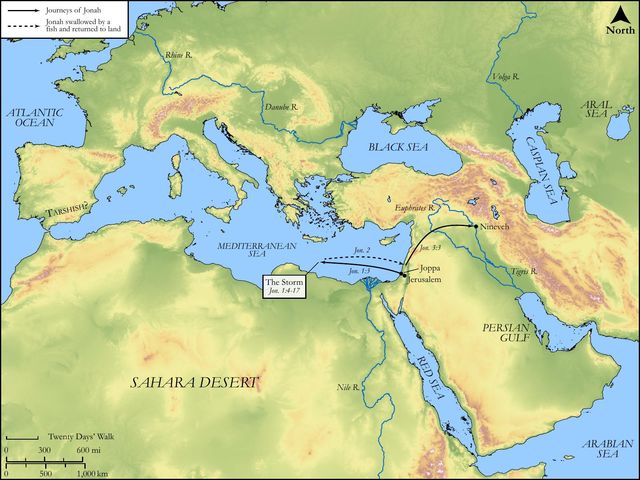
The story so far fills Jonah 1. The LORD told Jonah to go and preach to Nineveh, and he took ship for Tarshish, away from the presence of the LORD (Jonah 1:1–3). Nineveh was the capital of Assyria, a cruel and feared enemy of Israel, and the book is set in the reign of Jeroboam II, a time of prosperity in Israel and of spiritual decline. Tarshish lay far to the west, probably in Spain. The LORD sent a great storm, and when Jonah owned that it had come because of him, the sailors threw him overboard at his own word and the sea grew calm (Jonah 1:4–16).
Death in the sea would have been the just end of his flight, and God answered it with a rescue: “Now the LORD had prepared a great fish to swallow up Jonah.” The verb mânâh means to count or number, and in the form used here to appoint, so the LORD appointed this fish for this work. Gâdôwl, “great”, tells us it was large, large enough to take a man whole. Bâlaʻ, “swallow up”, is the usual word for swallowing, and it can also mean to destroy. Here the swallowing keeps Jonah alive. The fish is at once his prison and his shelter, and inside it he has time to face his rebellion and seek God’s face.
The same LORD who sent the storm rules the creatures of the deep, as a psalm praises him for doing whatever he pleases in the seas and all deep places (Psalm 135:6). His first answer to his disobedient servant is mercy, the compassion that is new every morning (Lamentations 3:22–23).
“And Jonah was in the belly of the fish three days and three nights.” The belly is mêʻeh, the inward parts. Jesus took up this very span of time as the sign of his own burial, as we shall see below.
What kind of fish was it?
The Hebrew dâg gâdôwl means a great fish, and the book names the species of it nowhere. Where Jesus speaks of it, the KJV reads “the whale’s belly” (Matthew 12:40), and the Greek word there, kētos, means a sea monster or huge fish. The weight of the account rests on the God who prepared the fish and later commanded it. That Jonah lived three days inside it is a miracle, an act of God’s own power, and Scripture leaves the biology unexplained.
Did it really happen?
The book of Jonah is told as history, in the same way as the other prophetic books, and God’s people have long received it that way. Jesus himself spoke of Jonah’s time in the fish as an event that took place, and set it beside his own burial: “For as Jonas was three days and three nights in the whale’s belly; so shall the Son of man be three days and three nights in the heart of the earth.” The miracle is part of the history, a work of God’s power in the real world.
Jonah prays from the fish’s belly
“Then Jonah prayed unto the LORD his God out of the fish’s belly.” Until now Jonah has fled, slept and been thrown overboard. Here, for the first time, he turns to God. The verb pâlal, in the form used here, means to pray or to intercede, and its root sense is probably to step in or intervene. He prays to Yᵉhôvâh, the LORD, the covenant name of the God of Israel, the self-existent and eternal one, and he calls him “his God”. After all his running, the bond still holds, and the God he tried to escape is the God he calls on.
In this verse the fish is dâgâh, the feminine form of the word for fish in 1:17 and 2:10, with the same meaning. Its belly is mêʻeh again, the word of 1:17, which can also stand for the inner self.
Jonah has learned what David asked: “Whither shall I go from thy spirit? or whither shall I flee from thy presence?” Even in the uttermost parts of the sea, God’s hand leads and holds his own (Psalm 139:7–10). Another psalm says in a single line what Jonah is about to say: “In my distress I cried unto the LORD, and he heard me” (Psalm 120:1).
Did Jonah really pray inside the fish?
Verse 1 says that he prayed “out of the fish’s belly”, so the prayer that follows is the prayer he prayed there. It is poetry, shaped like Israel’s psalms of lament and thanksgiving, and it looks back over what has happened to him. Its past tenses, “he heard me” and “yet hast thou brought up my life”, show Jonah giving thanks while he is still inside the fish, sure that the God who kept him alive in the deep has heard him, before his deliverance is complete.
Heard from the belly of hell
“I cried by reason of mine affliction unto the LORD, and he heard me.” The verb qârâʼ, “cried”, means to call out to someone, to address him by name, and Jonah calls directly on the LORD. “Affliction” is tsârâh, which properly means tightness, and so trouble or distress. It fits a man hemmed in on every side.
The verse then says the same thing again, as Hebrew poetry often does, and the second line is stronger: “out of the belly of hell cried I, and thou heardest my voice.” The English repeats “cried” and “heard”, while the Hebrew uses other verbs in this line: shâvaʻ, to cry out for help, and shâmaʻ, to hear and attend. Jonah also turns from speaking about God (“he heard me”) to speaking to him (“thou heardest”). His cry was heard, and he says so twice.
“Belly” here is beṭen, the belly or womb, the hollow inner part of anything, a different word from the fish’s belly in verse 1. “Hell” is shᵉʼôwl, Sheol.
David spoke the same way when the sorrows of death and hell compassed him, and in his distress he called upon the LORD, who heard his voice out of his temple (Psalm 18:4–6). “Out of the depths have I cried unto thee, O LORD,” says another psalm (Psalm 130:1–2). In Lamentations the waters flow over the prophet’s head, he calls on the LORD’s name out of the low dungeon, and the LORD hears him, says “Fear not”, and redeems his life (Lamentations 3:54–58).
Was Jonah in hell?
Sheol, shᵉʼôwl, is the world of the dead, pictured as a place beneath the earth where all the dead go, and the KJV renders it “hell” or “the grave”. Jonah was in the belly of the fish, and he calls it the belly of Sheol because he was as good as dead, cut off from the land of the living and as helpless as a man already in the grave. The phrase tells us how near to death he came, and it makes God’s hearing all the more wonderful. Jonah is describing his distress here, and the verse is no description of the place of final punishment.
God cast me into the deep
“For thou hadst cast me into the deep, in the midst of the seas.” The sailors’ hands threw Jonah over the side, and Jonah knows whose will stood behind them. Shâlak means to cast, throw or hurl, often with a sense of throwing away. “The deep” is mᵉtsôwlâh, a deep place of water or mud, the very bottom. “The midst of the seas” is in Hebrew the heart, lêbâb, of the seas, their innermost part.
“And the floods compassed me about.” Nâhâr, “floods”, is the word for a stream or river, used here for the currents of the sea, and çâbab, “compassed”, means to go around or surround. Then: “all thy billows and thy waves passed over me.” Mishbâr is a breaker, a wave as it crashes, and gal is a wave that rolls. Jonah calls them “thy” billows and “thy” waves. Every one of them belonged to God, under his command and serving his purpose. A psalm uses almost the same words in its own distress, “all thy waves and thy billows are gone over me” (Psalm 42:7), and another cries, “Save me, O God; for the waters are come in unto my soul” (Psalm 69:1–2).
Was this a punishment from God?
Jonah’s plunge into the deep came as the direct result of his disobedience, and it is best understood as discipline, severe and also meant for his good, to bring him back to God and to his mission. Jonah himself owns God’s hand in it (“thou hadst cast me”), and the God who cast him down is the God who brings him up in verse 6. Scripture tells us that the Lord disciplines those he loves, so that they may share his holiness (Hebrews 12:5–11).
The waters closed over me
“The waters compassed me about, even to the soul.” Mayim is the ordinary word for water, here the whole mass of the sea, and “compassed me about” is ʼâphaph, to surround. “Soul” is nephesh, from a root meaning to breathe: a breathing creature, a life, a self. The waters came up to his very life and breath, and he was at the point of death.
“The depth closed me round about.” “Depth” is tᵉhôwm, the abyss, the surging mass of the deep sea, the word for the deep waters at creation (Genesis 1:2). “Closed me round about” is çâbab, the same verb as “compassed” in verse 3, and it pictures the deep sealing him in.
“The weeds were wrapped about my head.” Çûwph means a reed or rush, a word probably of Egyptian origin, and here the weeds of the sea. Châbash means to wrap or bind, the word for winding a turban, so the weeds were wound around his head like a headdress as he sank.
“I went down to the bottoms of the mountains.” Qetseb means a shape as if cut out, and so the base or bottom of a thing. Jonah pictures the roots of the mountains beneath the sea, as low as a man can go. “The earth with her bars was about me for ever.” Bᵉrîyach is a bar or bolt, the beam that secures a gate. The earth has become a prison with its gates bolted behind him, like the gates of the grave. “For ever”, ʻôwlâm, properly means what is hidden from sight, time beyond reckoning, and it gives his sense that the bars would hold him for good.
Then comes the turn of the whole prayer: “yet hast thou brought up my life from corruption, O LORD my God.” “Brought up” answers “went down”. Jonah went down, and God brought him up. “Corruption” is shachath, a pit, especially a pit dug as a trap, and so destruction and the grave. God reached him there and lifted his life out. A psalm speaks of the same hope, that God will not leave his soul in hell nor suffer his Holy One to see corruption (Psalm 16:10). He calls God “O LORD my God”, the same personal claim on him that verse 1 makes.
Is the language of the deep literal?
It is both history and poetry. Jonah was really in the sea and then in the fish, and he tells it in the language of Israel’s laments, which speak of coming near death as drowning and being swallowed by the deep. The weeds about his head may well have been real seaweed, and they are also a picture of being bound and smothered. “The bottoms of the mountains” and “the earth with her bars” picture the grave itself, the deepest and most final confinement there is, and they describe how it felt to be there more than they give a place on a map. That is what makes the “yet” of verse 6 so great: God brought him back from what felt like the underworld itself.
Cast out of thy sight, yet looking toward the temple
“Then I said, I am cast out of thy sight.” “Cast out” is gârash, to drive out or expel, the word used for driving a people from their land and for divorcing a wife. It is a different verb from the “cast” of verse 3. Jonah felt sent away from God like a wife put away, banished from his favour and from the care of his eye. The man who fled from the presence of the LORD now fears that he has lost it.
“Yet I will look again toward thy holy temple.” Nâbaṭ means to look intently at something, and also to regard it with favour or care. With yâçaph, to add or to do again, it means that he will look once more. “Holy” is qôdesh, what is sacred or set apart to God, and “temple” is hêykâl, a palace or temple, a large public building. Here it is the temple at Jerusalem, the place of God’s presence among his people, of sacrifice and atonement, and of prayer. Israelites far from it prayed toward it, as Daniel did with his windows open toward Jerusalem (Daniel 6:10), and a psalm says, “in thy fear will I worship toward thy holy temple” (Psalm 5:7). From the belly of the fish Jonah’s look is the turning of his heart, and “yet” is the hinge of the verse. He feels driven away, and he turns back all the same.
“When my soul fainted within me I remembered the LORD.” ʻÂṭaph means to shroud or cover, and from the idea of darkness, to languish and grow faint. His nephesh, his life, was ebbing away, as verse 5 has described. Zâkar, “remembered”, means to remember, and for Jonah it was a turning of heart and mind back to the LORD and all he knew of his power and faithfulness.
“And my prayer came in unto thee, into thine holy temple.” Tᵉphillâh is prayer or supplication, and bôwʼ, “came in”, means to come or go in. His prayer entered God’s presence. “Holy temple” comes back from verse 4: the place he resolved to look toward is the place his prayer reached. Some take the temple of verse 7 to be the house in Jerusalem, as in verse 4. Others take it to be God’s dwelling in heaven, the sanctuary of which the earthly holy places were figures (Hebrews 9:24). On either reading his prayer reached God himself, from the bottom of the sea.
Was Jonah’s prayer true repentance?
His prayer is a mixture of lament, desperation and real turning. It is a cry for help from a man in mortal danger, and “yet I will look again toward thy holy temple” shows a heart turned back toward God. God’s answer in verse 10 shows that he received the prayer, and when the word of the LORD came to Jonah a second time, he went (Jonah 3:1–3).
Lying vanities and the mercy they forsake
“They that observe lying vanities forsake their own mercy.” Shâmar, “observe”, properly means to hedge about as with thorns, to guard, keep or watch over. Those who observe lying vanities give them their attention and loyalty, and guard them as if they were precious. “Lying” is shâvᵉʼ, evil as destructive, ruin, deceit, and so idolatry or what is useless and in vain. “Vanities” is hebel, whose base sense is breath or vapour, and which in use means futility or a worthless idol. Together they describe idols as deceitful emptiness, things that promise and cannot deliver.
ʻÂzab, “forsake”, means to loosen, let go, leave. “Mercy” is cheçed, kindness, lovingkindness, mercy, favour, one of the richest words in the Old Testament for God’s steadfast and loyal love. “Their own mercy” is the mercy that could have been theirs, God’s kindness held out to them, which they let go when they hold on to idols.
The prophets and psalms say the same about idols. They have mouths and eyes and cannot speak or see, and those who make them become like them (Psalm 115:4–8). God’s people forsook him, the fountain of living waters, for broken cisterns that can hold no water (Jeremiah 2:13). What God desires is mercy, cheçed, and the knowledge of himself (Hosea 6:6).
The verse speaks first of idols, the gods of the nations around Israel. It also fits Jonah’s own story. His flight to Tarshish rested on a false hope, that he could escape God’s command and find peace in disobedience (Jonah 1:3), and it brought him to the brink of death. He fled the mercy God was showing through his command, and found himself in desperate need of that very mercy. The same holds for anything trusted in God’s place, such as wealth, status, power or self-reliance. All of them are lying vanities, and Isaiah’s call to the wicked holds for all of them: return unto the LORD, and he will have mercy (Isaiah 55:7).
Salvation is of the LORD
“But I will sacrifice unto thee with the voice of thanksgiving.” Zâbach means to slaughter an animal, usually in sacrifice. “Voice” is qôwl, the same word as in verse 2, “thou heardest my voice”, so the voice God heard crying from the deep will be raised in thanks. “Thanksgiving” is tôwdâh, properly an extension of the hand, and so confession, thanksgiving, a thanksgiving choir or a thank offering. The thank offering was a kind of peace offering, eaten as a meal, brought to thank God for a deliverance or blessing (Leviticus 7:12–15). In the fish Jonah had no animal to offer, and his sacrifice begins as praise spoken with his voice, the offering God has always looked for. “Offer unto God thanksgiving; and pay thy vows unto the most High,” says a psalm (Psalm 50:14). Hosea calls Israel to return and render “the calves of our lips” (Hosea 14:2), and David says that “the sacrifices of God are a broken spirit” (Psalm 51:17).
“I will pay that that I have vowed.” To pay is shâlam, to make complete, and to vow is nâdar, to promise to do or give something to God. Jonah sets his thanksgiving beside a vow, as a psalm does, and the word tôwdâh itself means thanksgiving. A vow was a solemn promise to God, often made in distress, and keeping it was a serious duty (Deuteronomy 23:21–23, Ecclesiastes 5:4–5). The book leaves the content of Jonah’s vow unrecorded. Since he had fled from God’s command, it most likely concerned his obedience, perhaps going to Nineveh at last, or giving himself more fully to God’s service.
“Salvation is of the LORD.” Yᵉshûwʻâh means something saved, deliverance, help, victory. Scripture uses it for rescue that comes through human hands as well, as when Jonathan “hath wrought this great salvation in Israel”, and it traces every rescue back to the LORD. Jonah’s own rescue from the deep was entirely God’s doing, owed to his grace and power alone. Here is the heart of the prayer and of the book. A psalm says the same (Psalm 3:8), Moses told Israel at the sea to stand still and see the salvation of the LORD (Exodus 14:13), and the apostles preached that “neither is there salvation in any other: for there is none other name under heaven given among men, whereby we must be saved” (Acts 4:12).
The LORD spoke, and the fish obeyed
“And the LORD spake unto the fish, and it vomited out Jonah upon the dry land.” ʼÂmar, “spake”, is the everyday verb for saying, and it also covers commanding, as here. The LORD who prepared the fish now commands it, and his word alone sets Jonah free. In this book the wind (Jonah 1:4), the fish, and later a plant and a worm (Jonah 4:6–7) all do as God directs. The fish is dâg again, as in 1:17.
Qôwʼ, “vomited out”, means to vomit or spue out. It is a blunt word for a sudden, undignified release, and it marks the end of Jonah’s confinement. Yabbâshâh is dry ground. From the depths of the sea and the belly of the fish, Jonah comes to solid ground, to safety and a new beginning. Scripture tells of other deliverances that ended on dry ground, when Israel crossed the Red Sea (Exodus 14:21) and the Jordan (Joshua 3:17), and a psalm praises the God who hears those who cry to him at sea, makes the storm a calm, and “bringeth them unto their desired haven” (Psalm 107:25–30).
The deliverance comes straight after the prayer, and it opens the second half of the book. Jonah is given another chance to obey (Jonah 3), Nineveh repents, and God shows the same mercy to the city that he has shown to the prophet (Jonah 3:5–10).
The sign of Jonah and the risen Christ
When some asked Jesus for a sign, he said that the only sign given would be the sign of the prophet Jonah, and named Jonah’s three days and three nights in the fish as the picture of the Son of man three days and three nights in the heart of the earth (Matthew 12:38–41). Christ died for our sins, was buried, and rose again the third day (1 Corinthians 15:3–4). Jonah went down into what he called Sheol and was brought up. Christ went down into death itself, descending into the lower parts of the earth and then ascending far above all heavens (Ephesians 4:9–10), and God raised him up, having loosed the pains of death (Acts 2:24).
The likeness has its differences, and they show how much greater Christ is. Jonah went down because he disobeyed, and Christ went down in perfect obedience, to save us. The waves that passed over Jonah picture the judgment Christ bore when God made him to be sin for us, who knew no sin (2 Corinthians 5:21). Jonah cried from the depths and was heard, and Christ prayed in agony in Gethsemane (Luke 22:42–44) and cried out on the cross (Matthew 27:46). Jonah was rescued, while Christ conquered death and triumphed over the powers of darkness (Colossians 2:15). Those who belong to him are buried with him and raised to walk in newness of life (Romans 6:4), and the Spirit of the God who raised Jesus will give life to their mortal bodies too (Romans 8:11).
Jonah’s longing for the holy temple has its answer in Christ too. Jesus spoke of the temple of his body, which he would raise in three days (John 2:19–21). Through his blood we have boldness to enter the holiest by a new and living way (Hebrews 10:19–22), for he has entered the true sanctuary as our high priest (Hebrews 9:11–12), and we come boldly to the throne of grace to obtain mercy (Hebrews 4:16).
“Salvation is of the LORD” is fulfilled in Jesus, the Lamb of God, which taketh away the sin of the world (John 1:29), the way, the truth and the life (John 14:6). We are saved by grace through faith, as God’s gift (Ephesians 2:8–9), and whoever confesses Jesus as Lord and believes that God raised him from the dead will be saved (Romans 10:9–10). Where lying vanities come only to rob and destroy, Christ came that we might have life abundantly (John 10:10). And Jonah’s journey to the Gentiles of Nineveh looks ahead to the gospel going to all nations (Matthew 28:19).
What the prayer from the deep shows of God
This prayer shows us a God who pursues his servants, even when they run from him, and whose discipline is aimed at their return. He hears a cry from the bottom of the sea, from a man who had brought his trouble on himself, and he answers it. The waves belong to him, and so does the fish, and so does the dry land. The same God who cast Jonah down brought his life up from the pit.
It also gives us words for our own low places. Jonah’s prayer is made of the language of the psalms, the prayers he had learned, and in his distress they came back to him. His turning point was a single resolve, “yet I will look again toward thy holy temple”, made while he still felt cast out. God works all things together for good to those who love him (Romans 8:28), and his compassions fail not. And at the end of every rescue stands the confession that sums up Jonah’s prayer and the whole gospel: “Salvation is of the LORD.”
Jonah 1:17 This verse
“Now the LORD had prepared a great fish”
The LORD appointed (mânâh) the fish for this task. It is “great” (gâdôwl) in size, and the book names its species nowhere.
“to swallow up Jonah.”
Bâlaʻ is the usual word for swallowing, and here the swallowing saves Jonah from drowning.
“And Jonah was in the belly of the fish three days and three nights.”
The span of time Jesus named as the sign of his own burial and rising (Matthew 12:38–41).
Jonah 2:1
“Then Jonah prayed”
The first time in the book that Jonah turns to God. Pâlal means to pray or intercede.
“unto the LORD his God”
Jonah still calls the LORD his own God, after all his flight.
“out of the fish’s belly,”
Here the fish is dâgâh, the feminine form of the word, with the same meaning. The prayer was prayed inside the fish.
Jonah 2:2
“And said, I cried by reason of mine affliction unto the LORD, and he heard me;”
“Affliction” (tsârâh) is tightness, distress, the state of being hemmed in. Jonah speaks of being heard while he is still in the fish.
“out of the belly of hell cried I,”
“Hell” is Sheol, the world of the dead, and “belly” is beṭen, the hollow inner part. Jonah had come as near to death as a living man can.
“and thou heardest my voice.”
Jonah now speaks to God directly. “Voice” (qôwl) comes back in verse 9, lifted in thanksgiving.
Jonah 2:3
“For thou hadst cast me into the deep,”
The sailors threw him, and Jonah knows that God’s hand was behind them.
“in the midst of the seas;”
Literally “in the heart of the seas”, their innermost part.
“and the floods compassed me about:”
The currents of the sea surrounded him on every side.
“all thy billows and thy waves passed over me.”
“Thy” claims every breaker and every rolling wave as God’s own.
Jonah 2:4
“Then I said, I am cast out of thy sight;”
Gârash is the word for driving out or divorcing. Jonah felt banished from God’s presence.
“yet I will look again”
“Yet” is the hinge of the verse. He resolves to look once more (nâbaṭ with yâçaph).
“toward thy holy temple.”
The temple in Jerusalem, toward which Israelites far away turned to pray.
Jonah 2:5
“The waters compassed me about, even to the soul:”
The water rose to his very life and breath (nephesh).
“the depth closed me round about,”
Tᵉhôwm is the great deep, and the verb is the one used for “compassed” in verse 3.
“the weeds were wrapped about my head.”
Weeds wound around his head like a turban as he sank.
Jonah 2:6
“I went down to the bottoms of the mountains;”
As low as a man can go, to the roots of the mountains under the sea.
“the earth with her bars was about me for ever:”
The earth pictured as a prison with its gates bolted, and “for ever” (ʻôwlâm) his sense that there was no way back.
“yet hast thou brought up my life from corruption, O LORD my God.”
“Brought up” answers “went down”. Shachath is the pit, the grave.
Jonah 2:7
“When my soul fainted within me”
ʻÂṭaph pictures life shrouded and growing faint.
“I remembered the LORD:”
At the point of death he turned his mind and heart back to God.
“and my prayer came in unto thee, into thine holy temple.”
The temple he looked toward in verse 4 is the place his prayer reached, God’s own presence.
Jonah 2:8
“They that observe lying vanities”
Those who guard and keep (shâmar) idols, deceitful and empty things (shâvᵉʼ, hebel).
“forsake their own mercy.”
They let go (ʻâzab) of God’s steadfast love (cheçed), the kindness that could have been theirs.
Jonah 2:9
“But I will sacrifice unto thee with the voice of thanksgiving;”
Tôwdâh is thanksgiving and the thank offering. Jonah’s offering begins as praise from his lips.
“I will pay that that I have vowed.”
He will keep the promise he made to God, whose content the book leaves unrecorded.
“Salvation is of the LORD.”
The heart of the prayer: deliverance (yᵉshûwʻâh) belongs to the LORD.
Jonah 2:10
“And the LORD spake unto the fish,”
The God who prepared the fish commands it, and it obeys.
“and it vomited out Jonah”
Qôwʼ is a blunt word for a sudden release, the end of his confinement.
“upon the dry land.”
Yabbâshâh, dry ground: safety, and a fresh start on the mission he fled.
Last revised