


Jonah 2:3
Bible text: King James Version (1769 Blayney text) · Public domain
Bible text: Berean Standard Bible · Public domain
Bible text: American Standard Version (1901) · Public domain
Bible text: World English Bible, Messianic edition · Public domain
Bible text: Geneva Bible (1599) · Public domain
Bible text: Young's Literal Translation · Public domain
- וַתַּשְׁלִיכֵנִיva·tash·li·Khe·niand you have thrown meH7993Conj-w ¦ V-Hiphil-ConsecImperf-2ms ¦ 1csVerb Hiphil Consecutive Imperfect 2nd Singular Masculineוַandתַּשְׁלִיכֵyou have thrownנִיme
- מְצוּלָהme·tzu·Lah[the] deepH4688N-fsNoun Singular Feminine Absolute
- בִּלְבַבbil·Vavin [the] heart ofH3824Prep-b ¦ N-mscNoun Singular Masculine Constructבִּinלְבַב[the] heart of
- יַמִּיםya·Mim[the] seasH3220N-mpNoun Plural Masculine Absolute
- וְנָהָרve·na·Harand a riverH5104Conj-w ¦ N-msNoun Singular Masculine Absoluteוְandנָהָרa river
- יְסֹבְבֵנִיye·soe·Ve·niit surrounds meH5437V-Piel-Imperf-3ms ¦ 1csVerb Piel Imperfect 3rd Singular Masculineיְסֹבְבֵit surroundsנִיme
- כָּלkolallH3605N-mscNoun Singular Masculine Construct
- מִשְׁבָּרֶיךָmish·ba·Rei·khayour breakersH4867N-mpc ¦ 2msNoun Plural Masculine Constructמִשְׁבָּרֶיbreakersךָyour
- וְגַלֶּיךָve·ga·Lei·khaand your wavesH1530Conj-w ¦ N-mpc ¦ 2msNoun Plural Masculine Constructוְandגַלֶּיwavesךָyour
- עָלַי'a·Laiover meH5921Prep ¦ 1csPreposition Definiteעָלַoverיme
- עָבָרוּ'a·Va·ruthey have passedH5674V-Qal-Perf-3cpVerb Qal Perfect 3rd Plural common gender
English is a literal word-by-word gloss of the Hebrew, not the KJV's wording. Why?
This is the original text the KJV's translators worked from — each Hebrew word with its own literal English meaning in this verse, prepared by scholars at Tyndale House, Cambridge. The KJV translates whole sentences, not word by word, so its wording differs: one Hebrew word can become several English words, and the KJV may choose “the LORD” where the gloss reads “Yahweh”. Both are faithful — they answer different questions. For the KJV's own rendering, switch to the KJV text.
Details
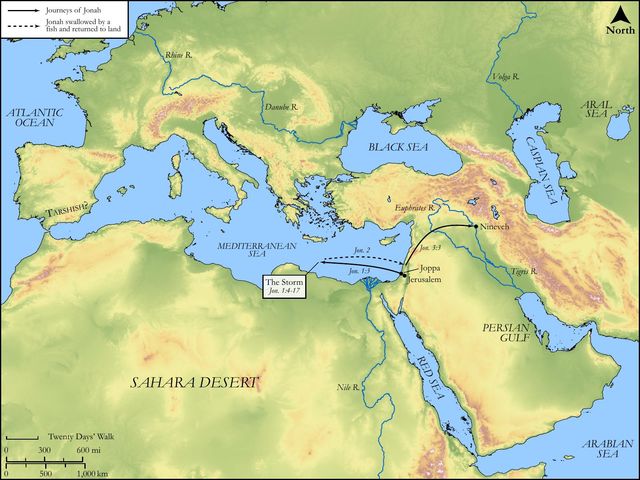
See on the biblical-era map
Study this verse
Historical interpretation
Four Centuries of Reception
2 surviving comments on this verse. Each one is dated, so this reads as a timeline rather than a list.
Select a marker to jump to its quote. Markers stagger vertically where authors wrote within a few decades of each other.
"For you had cast me into the deep, in the midst of the seas; and the floods compassed me about." LXX: 'you cast me into the deep of the heart from the sea, and the waves surrounded me'. The interpretation of the person of Jonah is not difficult: from the moment when he was closed in the stomach of the whale and found himself at the deepest and middle of the sea, he was surrounded by waves. For the Lord, the Saviour, prefiguring psalm 68 in which he says, "I am enshrouded in the deep mud where there is no ground. I have come to the deepest part of the sea and the storm engulfs me" [Ps. 68:3]. It is said of him in another psalm: "but you, you have rejected, despised and disquieted your Christ; you have cursed the covenant of your master, you have dishonoured his sacred place on earth, you have destroyed all its walls" [Ps. 88:39-41], and so on. For in this comparison of divine blessing and that place about which is written, "his home is in sacred peace" [Ps. 75:3], all habitation on earth is full of waves, full of storms. And the "heart of the sea" means hell, for which we read in the Gospel, "in the heart of the earth" [Mt. 12:40]. For just as the heart is at the middle of animal, so we say that hell is in the middle of the earth. Or according to anagoge he recalls that he is "in the heart of the sea", that is in the middle of temptations. However, although he has been among the bitter waters and been tempted by all things without sin, he has not felt the bitter waters, but has been surrounded by the waves about which we read elsewhere, "an impetuous wave rejoices in the city of God" [Ps. 45:5]. Others drank the salty waves; myself, surrounded by temptation, I endured sweeter currents. And do not think what the Lord says now is impious: "you have cast me into the deep", who says in the psalm, "for they have followed him that you smote" [Ps. 68:27], according to the phrase which in Zechariah is spoken by the Father: "I will smite the shepherd, and the flocks will be scattered" [Zechariah 13:7].
"All thy billows and thy waves passed over me." LXX: 'all your whirlwinds and your waves passed over me'. No one can doubt that the swelling waves of the sea encompassed Jonah, that there was fierce thunder in the storm. But we ask how all the whirlwinds, billows and the waves of God encompassed the Saviour. "The life of men on earth is temptation" [Job 7:1], or as there is in the Hebrew, "a military service", for we serve here to be crowned elsewhere. There is no man who can sustain all the temptations, except him who has been tempted by all, in our image, except sin [Heb. 4:15]. This is why it is said in Corinthians, "no temptation will take you, I hope, unless it is human. God is faithful, he will not let you try beyond your ability, but he will produce an exit that you may hold on to." [1 Cor. 10 ,13] And like all persecutions and all wicked things that happen to us they do not happen without the will of God, we speak of whirlwinds and waves of God, which have not crushed Jesus, but have come down upon him with a simple threat of shipwreck which does not happen. Thus all persecutions and whirlwinds which tortured mankind and broke all the ships have passed thundering on my head. And myself, I have sustained storms and broken whirlwinds which were raging, to allow others to sail more easily.
he cried with the whole passion of his heart, according to the Apostle who says, "You have received a spirit of adoption as sons, by virtue of which we cry, 'Abba, Father!'"
Continue studying Jonah 2:3 across the web’s major study libraries — every link below opens this exact verse, chapter, or book on the destination site.
Read & Compare
 BibleGatewayThis verse in more than 200 translations and 70 languages.
 Bible.comThe YouVersion reader — hundreds of translations, reading plans, and highlights.
 ESV.orgCrossway's official English Standard Version reader.
 NET BibleThe NET translation with 60,000+ translators' notes on every rendering decision.
 STEP BibleTyndale House's free study tool — original text, vocabulary, and scholarly resources.
 BibliaLogos Bible Software's free web reader.
 USCCBThe New American Bible (Revised Edition) with the U.S. bishops' study notes.
Commentaries
 BibleHub CommentariesDozens of classic commentaries on this verse, gathered on one page.
 StudyLightMore than 100 commentary sets — the largest collection on the web.
 BibleRefPlain-English commentary on what this verse means, verse by verse.
 Enduring WordDavid Guzik's free commentary on this chapter, widely used by Bible teachers.
 Bible Study ToolsVerse commentary alongside Greek and Hebrew study aids.
Original Language & Research
- BibleHub InterlinearThe verse word by word — original language, transliteration, and English.
- BibleHub LexiconEvery word's original-language definition and Strong's entry.
 Blue Letter BibleDeep-study tools — Strong's numbers, concordance, and word studies.
 SefariaThe Hebrew text with Rashi and centuries of Jewish commentary.
Sermons, Hymns & Audio


TrulyRandomVerse is not affiliated with these sites and doesn’t control their content. They’re linked because they’re genuinely useful.
Summary
Jonah 2:3 is a poignant confession from the prophet Jonah, spoken from the depths of the great fish, acknowledging God's absolute sovereignty over his dire circumstances. This verse vividly portrays the overwhelming despair and physical peril Jonah experienced after being cast into the tumultuous sea, recognizing that his suffering was not accidental but a direct, disciplinary act of God. It highlights his profound sense of being submerged and encompassed by forces that were ultimately instruments of divine will, leading him to a desperate yet hopeful cry for deliverance.
Context
ShowHideLiterary Context
Jonah 2:3 is part of Jonah's prayer of thanksgiving and lament, recorded in Jonah 2. This prayer follows the dramatic events of Jonah 1, where Jonah disobeys God's command to go to Nineveh and instead flees to Tarshish. God responds by sending a great storm, leading the mariners to cast Jonah overboard at his own insistence to save the ship. Immediately, a great fish swallows Jonah, where he remains for three days and three nights. His prayer, beginning in Jonah 2:2, reflects on his near-death experience and expresses his conviction that God heard his cry from the "belly of hell." Verse 3 specifically details the physical sensations of being overwhelmed by the sea, directly attributing these overwhelming forces to God's action, setting the stage for his subsequent vows and expressions of trust.
Historical & Cultural Context
Seafaring peoples such as the Phoenicians held a deep respect and fear for the sea, often viewing it as a chaotic, unpredictable, and even monstrous realm, sometimes associated with forces of evil or divine judgment. The "deep" (Hebrew: mᵉtsôwlâh) would evoke primordial chaos, a place of no return. The act of being cast into the sea was often a form of divine judgment or sacrifice to appease angry deities, as seen with the mariners' actions in Jonah 1:12. Jonah's experience, therefore, taps into a primal fear of the unknown and the overwhelming power of nature, yet subverts it by showing God's absolute control even over these chaotic elements. His survival within the fish, a miraculous intervention, further underscores God's unique power, contrasting with pagan deities who might demand such sacrifices.
Key Themes
ShowHideThis verse powerfully contributes to several overarching themes in the book of Jonah. Foremost is the theme of Divine Sovereignty, as Jonah explicitly acknowledges that God "hadst cast me into the deep" and that "all thy billows and thy waves passed over me." This highlights God's absolute control over creation, even using natural elements as instruments of His will, a truth echoed in Psalm 107:25. Secondly, the verse underscores the Consequences of Disobedience. Jonah's profound distress and near-death experience are direct results of his rebellion against God's clear command to go to Nineveh, illustrating that attempting to flee God's presence or purpose leads to severe and overwhelming circumstances, as seen throughout Jonah 1. Finally, the imagery of being "in the midst of the seas" and "the floods compassed me about" powerfully conveys Despair and Overwhelm, yet within this extreme distress, Jonah's prayer begins, setting the stage for his eventual repentance and turning back to God, demonstrating that even in the deepest pits of despair, God's presence and power are undeniable, as he cries out from the "belly of hell" in Jonah 2:2.
Exposition and Analysis
ShowHideKey Word Analysis
ShowHideThis primitive root (H7993) means "to throw out, down or away (literally or figuratively)." Jonah's use of "thou hadst cast me" is crucial. It's not merely that he was thrown by the mariners, but that God, in His sovereign will, was the ultimate agent behind his being hurled into the abyss. This verb emphasizes divine initiative and control over his predicament.
This word (H4688) refers to "a deep place (of water or mud); bottom, deep, depth." It signifies the lowest, most profound parts of the sea, emphasizing the overwhelming and inescapable nature of Jonah's situation. It evokes a sense of being utterly submerged and beyond human rescue, a place of potential death or Sheol.
Derived from a root meaning "to break," this term (H4867) specifically denotes "a breaker (of the sea); billow, wave." The word vividly describes the crashing, destructive force of large waves. The possessive "thy" before "billows" and "waves" (H1530, gal) is highly significant, indicating that these powerful, destructive forces were not random natural occurrences but instruments directly under God's command, executing His purpose.
Verse Breakdown
ShowHide"For thou hadst cast me into the deep"
This opening clause is a direct confession and acknowledgment of God's sovereign hand in Jonah's suffering. Jonah understands that his being thrown into the sea and descending to its depths was not merely the act of the sailors, but God's direct intervention and judgment for his disobedience. The "deep" signifies a place of profound danger and isolation, bordering on death.
"in the midst of the seas; and the floods compassed me about"
These phrases further intensify the imagery of being overwhelmed and submerged. "In the midst of the seas" conveys a sense of being utterly surrounded, with no solid ground or escape. The "floods" (Hebrew: nâhâr, referring to a stream or river, but here used metaphorically for overwhelming waters) "compassed me about," indicating a complete engulfment by the powerful, swirling currents, leaving Jonah helpless and vulnerable.
"all thy billows and thy waves passed over me"
This final clause powerfully reiterates God's direct involvement. The "billows" (mishbâr) and "waves" (gal) are explicitly identified as "thy" (God's), emphasizing that every terrifying surge and crash of water was under divine command. This imagery evokes a sense of being utterly overwhelmed by God's disciplinary hand, yet also implies that these forces, though destructive, were controlled and served a divine purpose.
Literary Devices
ShowHideJonah 2:3 is rich in Imagery, painting a vivid picture of Jonah's desperate plight. Words like "deep," "seas," "floods," "billows," and "waves" create a powerful sensory experience of being submerged and overwhelmed. The repeated use of "thy" (thy billows, thy waves) is a striking example of Personification and Theological Attribution, as Jonah attributes the natural forces of the sea directly to God's agency, transforming them from mere elements into instruments of divine will. This also functions as a form of Hyperbole, exaggerating the extent of his suffering to convey the profound sense of despair and near-death experience. Furthermore, the verse employs Metaphor, where the overwhelming waters serve as a powerful symbol of God's judgment and the severe consequences of disobedience, echoing similar metaphors for distress found elsewhere in scripture.
Theological and Thematic Connections
ShowHideJonah 2:3 serves as a profound theological statement on God's absolute sovereignty, even over the chaotic elements of creation and the rebellious choices of humanity. Jonah's acknowledgment that God "cast" him and that "all thy billows and thy waves passed over me" reveals a deep understanding that his suffering was not random, but divinely ordained discipline. This perspective allows him to move from despair to a posture of prayer and eventual repentance, recognizing God's ultimate control and purpose even in the midst of extreme adversity. It underscores the biblical truth that God uses all circumstances, including the most terrifying, to bring about His will and to draw His people back to Himself.
Reflection and Application
ShowHideJonah 2:3 offers a powerful lens through which to view our own moments of overwhelming distress. When life's "floods" and "billows" threaten to engulf us, this verse calls us to recognize God's sovereign hand, even in the midst of our suffering. It challenges us to move beyond a victim mentality and to acknowledge that God can use difficult circumstances—whether self-inflicted through disobedience or permitted for our growth—as instruments of His divine purpose. Like Jonah, we are invited to confess His authority, even when His discipline feels severe. This recognition is the first step toward true repentance and a renewed trust in His unfailing power to deliver. Our deepest trials can become the very places where we encounter God most profoundly, learning to lean on His strength when our own fails, and finding hope in His control over all things.
Questions for Reflection
ShowHideFAQ
ShowHideWas Jonah's suffering in the sea a punishment from God?
ShowHideWhile the Bible does not explicitly use the word "punishment," Jonah's experience in the sea was undoubtedly a direct consequence of his disobedience to God's command to go to Nineveh (Jonah 1:1-3). Jonah himself acknowledges God's active role, stating, "For thou hadst cast me into the deep" (Jonah 2:3). This can be understood as divine discipline, a severe but ultimately redemptive act designed to bring Jonah to repentance and back into alignment with God's will. It was not merely punitive, but purposed for his spiritual correction and the fulfillment of God's mission.
Christ-Centered Fulfillment
ShowHideJonah's experience in the belly of the great fish, particularly his descent into the "deep" and being "compassed about" by overwhelming waters, serves as a powerful Old Testament foreshadowing of Christ's death, burial, and resurrection. Just as Jonah was "cast into the deep" and spent three days and three nights in the fish, Jesus himself declared that "as Jonah was three days and three nights in the whale's belly; so shall the Son of man be three days and three nights in the heart of the earth" (Matthew 12:40). The "floods" and "billows" that passed over Jonah metaphorically represent the overwhelming judgment and wrath of God for sin. In Christ, however, the ultimate "casting into the deep" occurred when He bore the full weight of humanity's sin on the cross, experiencing separation from God and the depths of suffering on our behalf (2 Corinthians 5:21). His resurrection from the "heart of the earth" after three days is the ultimate deliverance from the "deep," signifying His triumph over sin and death, offering true salvation and restoration to all who believe, fulfilling the sign of Jonah not merely as a miraculous escape, but as the victory over the ultimate "deep" of sin and death (Romans 6:4).