


Jonah 1:15
Bible text: King James Version (1769 Blayney text) · Public domain
Bible text: Berean Standard Bible · Public domain
Bible text: American Standard Version (1901) · Public domain
Bible text: World English Bible, Messianic edition · Public domain
Bible text: Geneva Bible (1599) · Public domain
Bible text: Young's Literal Translation · Public domain
- וַיִּשְׂאוּvai·yis·'Uand they picked upH5375Conj-w ¦ V-Qal-ConsecImperf-3mpVerb Qal Consecutive Imperfect 3rd Plural Masculineוַandיִּשְׂאוּthey picked up
- אֶת'et<obj.>H853DirObjMParticle Object Indicator
- יוֹנָהyo·NahJonahH3124N-proper-mNoun Proper Masculine
- וַיְטִלֻהוּvay·ti·Lu·huand they threw himH2904Conj-w ¦ V-Hiphil-ConsecImperf-3mp ¦ 3msVerb Hiphil Consecutive Imperfect 3rd Plural Masculineוַandיְטִלֻthey threwהוּhim
- אֶל'elintoH413PrepPreposition
- הַיָּםhai·Yamthe seaH3220Art ¦ N-msNoun Singular Masculine Absoluteהַtheיָּםsea
- וַיַּעֲמֹדvai·ya·'a·Modand it stoppedH5975Conj-w ¦ V-Qal-ConsecImperf-3msVerb Qal Consecutive Imperfect 3rd Singular Masculineוַandיַּעֲמֹדit stopped
- הַיָּםhai·Yamthe seaH3220Art ¦ N-msNoun Singular Masculine Absoluteהַtheיָּםsea
- מִזַּעְפּוֹmi·za'·Pofrom its stormingH2197Prep-m ¦ N-msc ¦ 3msNoun Singular Masculine Constructמִfromזַּעְפּstormingוֹits
English is a literal word-by-word gloss of the Hebrew, not the KJV's wording. Why?
This is the original text the KJV's translators worked from — each Hebrew word with its own literal English meaning in this verse, prepared by scholars at Tyndale House, Cambridge. The KJV translates whole sentences, not word by word, so its wording differs: one Hebrew word can become several English words, and the KJV may choose “the LORD” where the gloss reads “Yahweh”. Both are faithful — they answer different questions. For the KJV's own rendering, switch to the KJV text.
Details
See on the biblical-era map
Study this verse
Public-domain commentary
Matthew Henry
From his Commentary on the Whole Bible. Henry comments on passages, not single verses — this entry covers Jonah 1:11–17. His two-level outline is real structure in the source text, so it is rendered as structure.
It is plain that Jonah is the man for whose sake this evil is upon them, but the discovery of him to be so was not sufficient to answer the demands of this tempest; they had found him out, but something more was to be done, for still the sea wrought and was tempestuous (Jon 1:11), and again (Jon 1:13), it grew more and more tempestuous (so the margin reads it); for if we discover sin to be the cause of our troubles, and do not forsake it, we do but make bad worse. Therefore they went on with the prosecution.
I.They enquired of Jonah himself what he thought they must do with him (Jon 1:11):
What shall we do unto thee, that the sea may be calm to us? They perceived that Jonah is a prophet of the Lord, and therefore will not do any thing, no, not in his own case, without consulting him. He appears to be a delinquent, but he appears also to be a penitent, and therefore they will not insult over him, nor offer him any rudeness. Note, We ought to act with great tenderness towards those that are overtaken in a fault and are brought into distress by it. They would not cast him into the sea if he could think of any other expedient by which to save the ship. Or, perhaps, thus they would show how plain the case was, that there was no remedy but he must be thrown overboard; let him be his own judge as he had been his own accuser, and he himself will say so. Note, When sin has raised a storm, and laid us under the tokens of God's displeasure, we are concerned to enquire what we shall do that the sea may be calm; and what shall we do? We must pray and believe, when we are in a storm, and study to answer the end for which it was sent, and then the storm shall become a calm. But especially we must consider what is to be done to the sin that raised the storm; that must be discovered, and penitently confessed; that must be detested, disclaimed, and utterly forsaken. What have I to do any more with it? Crucify it, crucify it, for this evil it has done.
II.Jonah reads his own doom (Jon 1:12):
Take me up, and cast me forth into the sea. He would not himself leap into the sea, but he put himself into their hands, to cast him into the sea, and assured them that then the sea would be calm, and not otherwise. He proposed this, in tenderness to the mariners, that the might no suffer for his sake. "Let thy hand be upon me" (says David, Ch1 21:17), "who am guilty; let me die for me own sin, but let not the innocent suffer for it." This is the language of true penitents, who earnestly desire that none but themselves may ever smart, or fare the worse, for their sins and follies. He proposed it likewise in submission to the will of God, who sent this tempest in pursuit of him; and therefore judged himself to be cast into the sea, because to that he plainly saw God judging him, that he might not be judged of the Lord to eternal misery. Note, Those who are truly humbled for sin will cheerfully submit to the will of God, even in a sentence of death itself. If Jonah sees this to be the punishment of his iniquity, he accepts it, he subjects himself to it, and justifies God in it. No matter though the flesh be destroyed, no matter how it is destroyed, so that the spirit may be but saved in the day of the Lord Jesus, Co1 5:5. The reason he gives is, For I know that for my sake this great tempest is upon you. See how ready Jonah is to take all the guilt upon himself, and to look upon all the trouble as theirs: "It is purely for my sake, who have sinned, that this tempest is upon you; therefore cast me forth into the sea; for," 1. "I deserve it. I have wickedly departed from my God, and it is upon my account that he is angry with you. Surely I am unworthy to breathe in that air which for my sake has been hurried with winds, to live in that ship which for my sake has been thus tossed. Cast me into the sea after the wares which for my sake you have thrown into it. Drowning is too good for me; a single death is punishment too little for such a complicated offence." 2. "Therefore there is no way of having the sea calm. If it is I that have raised the storm, it is not casting the wares into the sea that will lay it again; no, you must cast me thither." When conscience is awakened, and a storm raised there, nothing will turn it into a calm but parting with the sin that occasioned the disturbance, and abandoning that. It is not parting with our money that will pacify conscience; no, it is the Jonah that be thrown overboard. Jonah is herein a type of Christ, that he gives his life a ransom for many; but with this material difference, that the storm Jonah gave himself up to still was of his own raising, but that storm which Christ gave himself up to still was of our raising. Yet, as Jonah delivered himself up to be cast into a raging sea that it might be calm, so did our Lord Jesus, when he died that we might live.
III.The poor mariners did what they could to save themselves from the necessity of throwing Jonah into the sea, but all in vain (Jon 1:13):
They rowed hard to bring the ship to the land, that, if they must part with Jonah, they might set him safely on shore; but they could not. All their pains were to no purpose; for the sea wrought harder than they could, and was tempestuous against them, so that they could by no means make the land. If they thought sometimes that they had gained their point, they were quickly thrown off to sea again. Still their ship was overladen; their lightening it of the wares made it never the lighter as long as Jonah was in it. And, besides, they rowed against wind and tide, the wind of God's vengeance, the tide of his counsels; and it is in vain to contend with God, in vain to think of saving ourselves any other way than by destroying our sins. By this it appears that these mariners were very loth to execute Jonah's sentence upon himself, though they knew it was for his sake that this tempest was upon them. They were thus very backward to it partly from a dread of bringing upon themselves the guilt of blood, and partly from a compassion they could not but have for poor Jonah, as a good man, as a man in distress, and as a man of sincerity. Note, The more sinners humble and abase themselves, judge and condemn themselves, the more likely they are to find pity both with God and man. The more forward Jonah was to say, Cast me into the sea, the more backward they were to do it.
IV.When they found it necessary to cast Jonah into the sea they first prayed to God that the guilt of his blood might not lie upon them, nor be laid to their charge, Jon 1:14. When they found it in vain to row hard they quitted their oars and went to their prayers: Wherefore they cried unto the Lord, unto Jehovah, the true and living God, and no more to the gods many. and lords many, that the had cried to, Jon 1:5. They prayed to the God of Israel, being now convinced, by the providences of God concerning Jonah and the information he had given them, that he is God alone. Having determined to cast Jonah into the sea, they first enter a protestation in the court of heaven that they do not do it willingly, much less maliciously, or with any design to be revenged upon him because it was for his sake that this tempest was upon them. No; his god forgive him, as they do! But they are forced to do it se defendendo - in self-defence, having no other way to save their own lives; and they do it as ministers of justice, both God and himself having sentenced him to so great a death. They therefore present a humble petition to the God whom Jonah feared, that they might not perish for his life. See,
1.What a fear they had of contracting the guilt of blood, especially the blood of one that feared God, and worshipped him, and had fellowship with him, as they perceived Jonah had, though in a single instance he had been faulty. Natural conscience cannot but have a dread of blood-guiltiness, and make men very earnest in prayer, as David was, to be delivered from it, Psa 51:14. So they were here: We beseech thee, O Lord! we beseech thee, lay not upon us innocent blood. They are now as earnest in praying to be saved from the peril of sin as they were before in praying to be saved from the peril of the sea, especially because Jonah appeared to them to be no ordinary person, but a very good man, a man of God, a worshipper of the great Creator of heaven and earth, upon which account even these rude mariners conceived a veneration for him, and trembled at the thought of taking away his life. Innocent blood is precious, but saints' blood, prophets' blood, is much more precious, and so those will find to their cost that any way bring themselves under the guilt of it. The mariners saw Jonah pursued by divine vengeance, and yet could not without horror think of being his executioners. Though his God has a controversy with him, yet, think they, Let not our hand be upon him. The Israelites were at this time killing the prophets for doing their duty (witness Jezebel's late persecution), and were prodigal of their lives, which is aggravated by the tenderness these heathens had for one whom they perceived to be a prophet, though he was now out of the way of his duty.
2.What a fear they had of incurring the wrath of God; they were jealous lest he should be angry if they should be the death of Jonah, for he had said, Touch not my anointed, and do my prophets no harm; it is at your peril if you do. "Lord," say they, "let us not perish for this man's life. Let it not be such a fatal dilemma to us. We see we must perish if we spare his life; Oh let us not perish for taking away his life." And their plea is good: "For thou, O Lord! hast done as it pleased thee; thou had laid us under a necessity of doing it; the wind that pursued him, the lot that discovered him, were both under thy direction, which we are herein governed by; we are but the instruments of Providence, and it is sorely against our will that we do it; but we must say, The will of the Lord be done." Note, When we are manifestly led by Providence to do things contrary to our own inclinations, and quite beyond our own intentions, it will be some satisfaction to us to be able to say, Thou, O Lord! has done as it pleased thee. And, if God please himself, we ought to be satisfied though he do not please us.
V.Having deprecated the guilt they dreaded, they proceeded to execution (Jon 1:15):
They took up Jonah, and cast him forth into the sea. They cast him out of their ship, out of their company, and cast him into the sea, a raging stormy sea, that cried, "Give, give; surrender the traitor, or expect no peace." We may well think what confusion and amazement poor Jonah was in when he saw himself ready to be hurried into the presence of that God as a Judge whose presence as a Master he was now fleeing from. Note, Those know not what ruin they run upon that run away from God. Woe unto them! for they have fled from me. When sin is the Jonah that raises the storm, that must thus be cast forth into the sea; we must abandon it, and be the death of it, must drown that which otherwise will drown us in destruction and perdition. And if we thus by a thorough repentance and reformation cast our sins forth into the sea, never to recall them or return to them again, God will by pardoning mercy subdue our iniquities, and cast them into the depths of the sea too, Mic 7:19.
VI.The throwing of Jonah into the sea immediately put an end to the storm.
The sea has what she came for, and therefore rests contended; she ceases from her raging. It is an instance of the sovereign power of God that he can soon turn the storm into a calm, and of the equity of his government that when the end of an affliction is answered and attained the affliction shall immediately be removed. He will not contend for ever, will not contend any longer till we submit ourselves and give up the cause. If we turn from our sins, he will soon turn from his anger.
VII.The mariners were hereby more confirmed in their belief that Jonah's God was the only true God (Jon 1:16):
Then the men feared the Lord with a great fear, were possessed with a deep veneration for the God of Israel, and came to a resolution that they would worship him only for the future; for there is no other God that can destroy, that can deliver, after this sort. When they saw the power of God in raising and laying the tempest, when they saw his justice upon Jonah his own servant, and when they saw his goodness to them in saving them from the brink of ruin, then they feared the Lord, Jer 5:22. As an evidence of their fear of him, they offered sacrifice to him when they came ashore again in the land of Israel, and for the present made vows that they would do so, in thankfulness for their deliverance, and to make atonement for their souls. Or, perhaps, they had something yet on board which might be for a sacrifice to God immediately. Or it may be meant of the spiritual sacrifices of prayer and praise, with which God is better pleased than with that of an ox or bullock that has horns and hoofs. See Psa 107:2, etc. We must make vows, not only when we are in the pursuit of mercy, but, which is much more generous, when we have received mercy, as those that are still studying what we shall render.
VIII.Jonah's life, after all, is saved by a miracle, and we shall hear of him again for all this.
In the midst of judgment God remembers mercy. Jonah shall be worse frightened than hurt, not so much punished for his sin as reduced to his duty. Though he flees from the presence of the Lord, and seems to fall into his avenging hands, yet God has more work for him to do, and therefore has prepared a great fish to swallow up Jonah (Jon 1:17), a whale our Saviour calls it (Mat 12:40), one of the largest sorts of whales, that have wider throats than others, in the belly of which has sometimes been found the dead body of a man in armour. Particular notice is taken, in the history of creation, of God's creating great whales (Gen 1:21) and the leviathan in the waters made to play therein, Psa 104:26. But God finds work for this leviathan, has prepared him, has numbered him (so the word is), has appointed him to be Jonah's receiver and deliverer. Note, God has command of all the creatures, and can make any of them serve his designs of mercy to his people, even the fishes of the sea, that are most from under man's cognizance, even the great whales, that are altogether from under man's government. This fish was prepared, lay ready under water close by the ship, that he might keep Jonah from sinking to the bottom, and save him alive, though he deserved to die. Let us stand still and see this salvation of the Lord, and admire his power, that he could thus save a drowning man, and his pity, that he would thus save one that was running from him and had offended him. It was of the Lord's mercies that Jonah was not now consumed. The fish swallowed up Jonah, not to devour him, but to protect him. Out of the eater comes forth meat; for Jonah was alive and well in the belly of the fish three days and three nights, not consumed by the heat of the animal, nor suffocated for want of air. It is granted that to nature this was impossible, but not to the God of nature, with whom all things are possible. Jonah by this miraculous preservation was designed to be made,
1.A monument of divine mercy, for the encouragement of those that have sinned, and gone away from God, to return and repent.
2.A successful preacher to Nineveh; and this miracle wrought for his deliverance, if the tidings of it reached Nineveh, would contribute to his success.
3.An illustrious type of Christ, who was buried and rose again according to the scriptures (Co1 15:4), according to this scripture, for, as Jonah was three days and three nights in the whale's belly, so was the Son of man three days and three nights in the heart of the earth, Mat 12:40. Jonah's burial was a figure of Christ's. God prepared Jonah's grave, so he did Christ's, when it was long before ordained that he should make his grave with the rich, Isa 53:9. Was Jonah's grave a strange one, a new one? So was Christ's, one in which never man before was laid. Was Jonah there the best part of three days and three nights? So was Christ; but both in order to their rising again for the bringing of the doctrine of repentance to the Gentile world. Come, see the place where the Lord lay.
Historical interpretation
Historical reception
2 surviving comments on this verse. Each one is dated, so this reads as a timeline rather than a list.
"So they took up Jonah, and cast him forth into the sea: and the sea ceased from her raging." LXX: 'and they took Jonah and they threw him into the sea, and the sea became ceased from its agitation'. He did not say, they grabbed him and threw him but they raised him up as if they were carrying him with respect and honour, and they threw him into the sea without him struggling, but rather he went willingly. And the sea ceased because it had found the man it was searching for. Just as when you pursue a fugitive, and running, catch up with him, then stop to grab hold of him; so too the sea was wild without Jonah, and then when it had in its lap what it desired it rejoiced in having him and cherished him, and the calm returned by this joy. If we consider before the suffering of Christ, the confessions of the world, the contrary winds of different opinions, the ship and all human kind, that is all creation to be in danger, then, after the suffering of Christ there is the calm of faith, the peace of the world, universal safety, conversion to God, and we will see how after Jonah has been thrown overboard the sea ceases from its raging.
The text does not say they seized him or that they threw him in, but that they took him, carrying him as one [deserving] respect and honor. They discharged him into the sea not in repugnance; rather, he submitted himself of his own volition into their hands. And the sea ceased [its turmoil] because it found what it sought. When one continues as a fugitive and keeps running away as fast as one can, sooner or later he is caught and stops his running, and whatever was chasing him stands still. It is the same way with the sea, which, absent Jonah, was irritated. But as soon as it lays hold of what is at the center of its desire it rejoices to have it, and from that joy it returns to tranquillity. If we will give consideration to the time before the passion of Christ, [we will see that time as one disturbed by] the errors of the world and the headwinds of various opinions. The entire boat of humanity, that is, the creation of the Lord, was in peril. But then, after his passion, we see a world where there is the calm of faith, a world at peace and secure for everyone. We see a turning toward God. In this way we may understand how, after Jonah goes into the sea, the sea is alleviated of its turmoil.
Continue studying Jonah 1:15 across the web’s major study libraries — every link below opens this exact verse, chapter, or book on the destination site.
Read & Compare
 BibleGatewayThis verse in more than 200 translations and 70 languages.
 Bible.comThe YouVersion reader — hundreds of translations, reading plans, and highlights.
 ESV.orgCrossway's official English Standard Version reader.
 NET BibleThe NET translation with 60,000+ translators' notes on every rendering decision.
 STEP BibleTyndale House's free study tool — original text, vocabulary, and scholarly resources.
 BibliaLogos Bible Software's free web reader.
 USCCBThe New American Bible (Revised Edition) with the U.S. bishops' study notes.
Commentaries
 BibleHub CommentariesDozens of classic commentaries on this verse, gathered on one page.
 StudyLightMore than 100 commentary sets — the largest collection on the web.
 BibleRefPlain-English commentary on what this verse means, verse by verse.
 Enduring WordDavid Guzik's free commentary on this chapter, widely used by Bible teachers.
 Bible Study ToolsVerse commentary alongside Greek and Hebrew study aids.
Original Language & Research
- BibleHub InterlinearThe verse word by word — original language, transliteration, and English.
- BibleHub LexiconEvery word's original-language definition and Strong's entry.
 Blue Letter BibleDeep-study tools — Strong's numbers, concordance, and word studies.
 SefariaThe Hebrew text with Rashi and centuries of Jewish commentary.
Sermons, Hymns & Audio


TrulyRandomVerse is not affiliated with these sites and doesn’t control their content. They’re linked because they’re genuinely useful.
Summary
Jonah 1:15 narrates the dramatic climax of the storm sent by God, where the mariners, at Jonah's own instruction, reluctantly cast him into the tumultuous sea. The verse highlights the immediate and profound consequence of this act: "the sea ceased from her raging," signifying the instant cessation of divine wrath and the restoration of peace to the furious waters, a clear demonstration of God's absolute sovereignty.
Context
ShowHideLiterary Context
This verse serves as the pivotal turning point in the opening narrative of Jonah. It follows Jonah's direct disobedience to God's command to preach to Nineveh, his subsequent flight to Tarshish aboard a ship, and God's powerful intervention through a great storm. The terrified pagan sailors, after exhausting all human efforts to save the ship and themselves (Jonah 1:13), cast lots which identified Jonah as the cause of their peril (Jonah 1:7). Jonah's confession of his identity as a Hebrew prophet fleeing his God, coupled with his instruction to throw him overboard to appease the storm (Jonah 1:12), sets the stage for this verse. The immediate calm of the sea directly confirms Jonah's words and God's power, leading directly into the miraculous preservation of Jonah by the great fish (Jonah 1:17).
Historical & Cultural Context
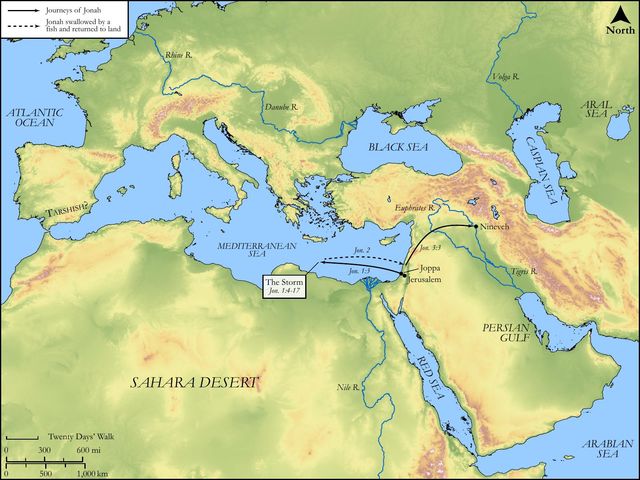
The historical setting is ancient Israel, likely during the reign of Jeroboam II (8th century BC), when Jonah was a prophet. Mariners of that day were highly superstitious and deeply reliant on the whims of the sea and the gods they believed controlled it. Storms were often interpreted as divine judgment or the manifestation of angry deities. The sailors' initial reluctance to throw Jonah overboard, despite his confession, underscores their moral compass and their fear of incurring guilt for taking an innocent life (Jonah 1:14). Their desperate prayer to the Lord before casting Jonah out indicates a profound shift in their understanding of the true God, moved by the overwhelming evidence of His power and Jonah's testimony. This event takes place in the Mediterranean Sea, a known route for ancient maritime trade.
Key Themes
ShowHideJonah 1:15 powerfully contributes to several overarching themes within the book of Jonah. Foremost is the theme of Divine Sovereignty, demonstrating God's absolute control over creation, including the elements and the destinies of individuals and nations. The storm itself was a divine instrument, and its immediate cessation upon Jonah's expulsion underscores that it was not a natural phenomenon but a direct expression of God's will. Another key theme is the Consequences of Disobedience, as the entire ordeal, from the storm to Jonah being cast overboard, is a direct result of Jonah's rebellion against God's command to go to Nineveh (Jonah 1:1-3). The verse also subtly introduces the theme of Substitutionary Atonement, as Jonah is "sacrificed" to bring peace and salvation to the sailors, foreshadowing a greater sacrifice. Finally, the Revelation of God to Gentiles is evident, as the pagan sailors witness and respond to the power of the God of Israel, culminating in their fear and sacrifice (Jonah 1:16).
Exposition and Analysis
ShowHideKey Word Analysis
ShowHideA primitive root meaning "to pitch over or reel; hence (transitively) to cast down or out." This word emphasizes a forceful, decisive action. It's not a gentle placement but a violent expulsion, reflecting the desperate circumstances and the sailors' final, reluctant compliance with Jonah's instruction, driven by their own peril.
A primitive root meaning "to stand, in various relations... to cease, confirm, continue, dwell, establish, remain, repair, stand." In this context, it denotes an immediate and complete cessation of movement or activity. The sea "stood still" or "stopped" its raging, indicating an abrupt and absolute end to the storm, not a gradual dying down.
Meaning "anger; indignation, rage(-ing), wrath." This word describes the intense fury and violent agitation of the sea, personifying it as being in a state of wrath or indignation. Its cessation implies that the "anger" or "wrath" that manifested as the storm was satisfied or removed, linking the storm directly to divine displeasure.
Verse Breakdown
ShowHide"So they took up Jonah,"
This clause describes the physical act of the mariners lifting Jonah, preparing to carry out the drastic measure he himself proposed. It highlights their reluctant obedience to Jonah's instruction, despite their initial efforts to row to shore.
"and cast him forth into the sea:"
This is the decisive action. The mariners, having prayed to the Lord not to hold them accountable for Jonah's death, now fulfill the prophet's request. This act is not merely human agency but a divinely orchestrated event, as God had prepared the storm and would now prepare a fish.
"and the sea ceased from her raging."
This is the immediate and miraculous consequence. The cessation of the storm is instantaneous and complete, demonstrating God's absolute sovereignty over creation. The "raging" of the sea, previously a manifestation of divine wrath against Jonah's disobedience, immediately subsides once Jonah, the object of that wrath, is cast into the waters, according to God's plan.
Literary Devices
ShowHideJonah 1:15 is rich in literary devices that amplify its theological message. The most prominent is Divine Intervention, where God's power is overtly displayed through the immediate calming of the sea, signaling that the storm was not a natural occurrence but a direct act of divine judgment and its cessation a direct act of divine mercy. Personification is evident in "the sea ceased from her raging," attributing human emotion and action ("raging") to the sea, making its sudden calm more dramatic and indicative of a sentient force (God) at work behind it. There is also a powerful Contrast between the violent, life-threatening storm and the sudden, profound peace, emphasizing the miraculous nature of the event and the absolute control of God. Finally, the act of casting Jonah into the sea carries profound Symbolism, representing both the consequence of sin and, typologically, a substitutionary sacrifice that brings peace and salvation to others.
Theological and Thematic Connections
ShowHideJonah 1:15 profoundly illustrates God's absolute sovereignty over creation and human affairs. The immediate cessation of the storm upon Jonah's expulsion is a powerful demonstration that the tempest was not a random act of nature but a divinely orchestrated instrument of judgment against Jonah's disobedience. Once the object of God's wrath (Jonah, in his state of rebellion) was "removed" into the sea according to God's plan, the divine displeasure manifested in the storm subsided. This highlights the principle that God's justice is precise and His mercy is immediate once His purposes are fulfilled. The verse also serves as a critical typological foreshadowing, where Jonah's willing (though coerced) sacrifice to save others points forward to the ultimate sacrifice.
Reflection and Application
ShowHideJonah 1:15 offers profound lessons for contemporary believers. It reminds us that God is sovereign over all circumstances, even the most chaotic and threatening storms in our lives. Just as He commanded the sea to rage and then to be still, He can bring peace and order to our personal turmoil, financial distress, relational conflicts, or spiritual struggles. This verse challenges us to consider our own obedience to God's call; Jonah's ordeal underscores that disobedience carries significant consequences, and God, in His loving discipline, may use difficult circumstances to redirect us back to His perfect will. Ultimately, it encourages a posture of trust and submission, recognizing that true peace—both internal and external—is found not in fleeing God's presence or resisting His commands, but in yielding to His divine plan, even when it involves personal sacrifice or discomfort.
Questions for Reflection
ShowHideFAQ
ShowHideWhy did the sea immediately calm down after Jonah was cast into it?
ShowHideThe immediate cessation of the storm was a powerful, undeniable sign of God's direct intervention and absolute sovereignty. The storm was not a natural weather event but a divinely sent judgment specifically against Jonah's disobedience. Once Jonah, the object of God's wrath, was "removed" from the ship and given over to the sea (according to God's plan, which included the great fish), God's immediate purpose for the storm was fulfilled. The sea's instant calm demonstrated that the storm was directly tied to God's displeasure and that His wrath was satisfied or redirected. It served as a clear confirmation to the mariners (and to Jonah) that the God of Israel was the true God, in control of all creation, and that the storm was His doing, not a random act of nature. This miraculous calm led the sailors to fear the Lord greatly and offer sacrifices (Jonah 1:16).
Christ-Centered Fulfillment
ShowHideJonah 1:15, while a historical narrative, functions profoundly as a type pointing to the person and work of Jesus Christ. Just as Jonah was "cast forth" into the raging sea as a "sacrifice" to bring peace and salvation to the imperiled Gentile mariners, so too was Jesus, the ultimate Lamb of God, willingly "cast forth" into the depths of death and judgment to bring peace and salvation to a world drowning in sin. Jonah's three days and three nights in the belly of the great fish (Jonah 1:17) are explicitly cited by Jesus Himself as the "sign of Jonah," foreshadowing His own death, burial, and resurrection on the third day (Matthew 12:40). The immediate calm that follows Jonah's descent into the waters prefigures the profound peace that Christ's sacrifice brings: peace with God (Romans 5:1), peace from the storm of God's wrath (Romans 5:9), and the inner peace that surpasses all understanding (Philippians 4:7). Jonah's "substitutionary" act, though imperfect, finds its perfect fulfillment in Christ, who truly laid down His life for His friends (John 15:13) and for the world (John 3:16), bringing ultimate reconciliation and eternal calm.