


Jonah 2:5
- אֲפָפוּנִי'a·fa·Fu·nithey have encompassed meH661V-Qal-Perf-3cp ¦ 1csVerb Qal Perfect 3rd Plural common genderאֲפָפוּthey have encompassedנִיme
- מַיִםma·yimwatersH4325N-mpNoun Plural Masculine Absolute
- עַד'adtoH5704PrepPreposition
- נֶפֶשׁNe·fesh[the] neckH5315N-fsNoun Singular Feminine Absolute
- תְּהוֹםte·Hom[the] deepH8415N-fsNoun Singular Feminine Absolute
- יְסֹבְבֵנִיye·soe·Ve·niit surrounds meH5437V-Piel-Imperf-3ms ¦ 1csVerb Piel Imperfect 3rd Singular Masculineיְסֹבְבֵit surroundsנִיme
- סוּףsufrush[es]H5488N-msNoun Singular Masculine Absolute
- חָבוּשׁcha·Vush[is] wrapped roundH2280V-Qal-PassPrtcpl-msVerb Qal Participle Passive Singular Masculine Absolute
- לְרֹאשִׁיle·ro·Shito my headH7218Prep-l ¦ N-msc ¦ 1csNoun Singular Masculine Constructלְtoרֹאשִׁheadיmy
English is a literal word-by-word gloss of the Hebrew, not the KJV's wording. Why?
This is the original text the KJV's translators worked from — each Hebrew word with its own literal English meaning in this verse, prepared by scholars at Tyndale House, Cambridge. The KJV translates whole sentences, not word by word, so its wording differs: one Hebrew word can become several English words, and the KJV may choose “the LORD” where the gloss reads “Yahweh”. Both are faithful — they answer different questions. For the KJV's own rendering, switch to the KJV text.
Details
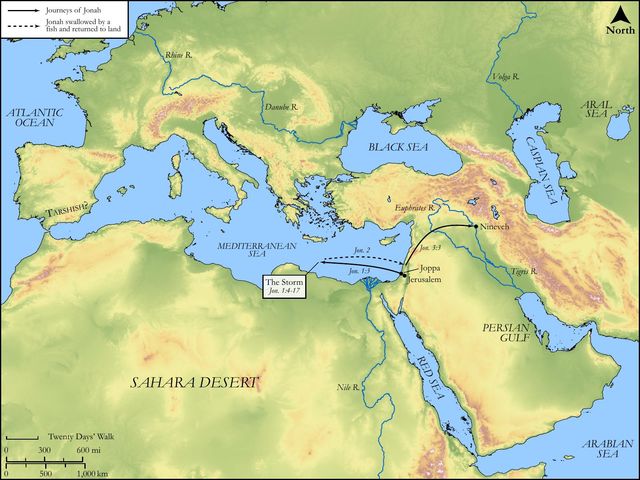
See on the biblical-era map
Study this verse
Historical interpretation
Seven Centuries of Reception
4 surviving comments on this verse. Each one is dated, so this reads as a timeline rather than a list.
Select a marker to jump to its quote. Markers stagger vertically where authors wrote within a few decades of each other.
If any one imagine it impossible that men should survive for such a length of time, and that Elias was not caught up in the flesh, but that his flesh was consumed in the fiery chariot, let him consider that Jonah, when he had been cast into the deep, and swallowed down into the whale's belly, was by the command of God again thrown out safe upon the land. Neither the nature of any created thing, therefore, nor the weakness of the flesh, can prevail against the will of God. For God is not subject to created things, but created things to God; and all things yield obedience to His will. Wherefore also the Lord declares, "The things which are impossible with men, are possible with God."
"the weeds were wrapped about my head. I went down to the bottoms of the mountains; the earth with her bars was about me for ever:" LXX: 'my head has penetrated to the base of mountains; I descended to into the earth whose bars are eternal bonds'. No one doubts that the ocean covered Jonah's head, that he went down to the roots of mountains and came to the depths of the earth by which as bars and columns by the will of God the earthly sphere is supported. This earth about which is said elsewhere, "I consolidated her columns" [Ps. 74:4]. With regard to the Lord Saviour, according to the two editions, this seems to me to be what is meant. His heart and his head, that is the spirit that he thought worthy to take with a body for our safety, went down to the base of the mountains which were covered by waves; they were restrained by the will of God, the deep covered them, they were parted by the majesty of God. His spirit then went down into hell, into those places to which in the last of the mud, the spirits of sinners were held, so too the psalmist says: "they will go down to the depths of the earth, they will be the lot of wolves" [Ps. 62:10.11]. These are the bars of the earth and like the locks of a final prison and tortures, which do not let the captive spirits out of hell. This is why the Septuagint has translated this is a pertinent way: "eternal bonds", that is, wanting to keep in all those whom it had once captured. But our Lord, about which we read these lines of Cyrus in Isaiah: "I will break the bronze bars, I will crack the iron bars" [Is. 45:2], He went down to the roots of the mountains, and was enclosed by eternal bars to free all the prisoners.
"The waters compassed me about, even to the soul: the depth closed me round about," LXX: 'the water ran about me up to my spirit; the last depth closed around me'. These waters, near to the deep, which cycle and slide about the earth, which drag much mud with them, tend to kill not the body but the soul, for they are friendly to the body and warmed by its desires. This is why, according to that which I have said above, the Lord says in the psalm, "save me, Lord, because the waters have penetrated even to my soul" [Ps. 68:2], and in another passage, "my soul has passed a torrent" [Ps. 123:5], and, "let not the well press its mouth on me" [Ps. 68:16], let hell not imprison me! Let it not refuse me an exit! I freely made the descent; so let me make the ascent back again freely. I became a captive voluntarily, I ought to free the captives so that this verse is fulfilled: "ascending into the higher parts he led the captives" [Eph. 4:8]. For those who were beforehand captives in death, he brought them to life again. We must heed certain wicked forces in the deep, or the specific powers in torture and supplication; demons, in the Gospel, ask not to be forced to go to them [Mt. 8:30; Mk. 5:10; Lk. 8:31]. This is why "the darkness was over the deep" [Gen. 1,2]. Sometimes the deep is taken to mean the sacraments in a deeper sense, the judgements of God: "the judgements of the Lord are a great abyss" [Ps. 35:7], and "the deep cries out to the deep in a cry of your cataracts." [Ps. 41:8]
Jonah either says this wishfully, or with a certain trust he promises himself that he will return to Jerusalem and see the temple of the Lord.
Continue studying Jonah 2:5 across the web’s major study libraries — every link below opens this exact verse, chapter, or book on the destination site.
Read & Compare
 BibleGatewayThis verse in more than 200 translations and 70 languages.
 Bible.comThe YouVersion reader — hundreds of translations, reading plans, and highlights.
 ESV.orgCrossway's official English Standard Version reader.
 NET BibleThe NET translation with 60,000+ translators' notes on every rendering decision.
 STEP BibleTyndale House's free study tool — original text, vocabulary, and scholarly resources.
 BibliaLogos Bible Software's free web reader.
 USCCBThe New American Bible (Revised Edition) with the U.S. bishops' study notes.
Commentaries
 BibleHub CommentariesDozens of classic commentaries on this verse, gathered on one page.
 StudyLightMore than 100 commentary sets — the largest collection on the web.
 BibleRefPlain-English commentary on what this verse means, verse by verse.
 Enduring WordDavid Guzik's free commentary on this chapter, widely used by Bible teachers.
 Bible Study ToolsVerse commentary alongside Greek and Hebrew study aids.
Original Language & Research
- BibleHub InterlinearThe verse word by word — original language, transliteration, and English.
- BibleHub LexiconEvery word's original-language definition and Strong's entry.
 Blue Letter BibleDeep-study tools — Strong's numbers, concordance, and word studies.
 SefariaThe Hebrew text with Rashi and centuries of Jewish commentary.
Sermons, Hymns & Audio


TrulyRandomVerse is not affiliated with these sites and doesn’t control their content. They’re linked because they’re genuinely useful.
Summary
Jonah 2:5 vividly portrays the prophet's harrowing experience within the great fish, expressing profound physical and spiritual despair. This verse, part of Jonah's desperate prayer of repentance and plea for deliverance, captures his perception of being utterly consumed by the overwhelming waters and the encroaching grasp of death, highlighting his complete helplessness and the terrifying reality of his predicament.
Context
ShowHideLiterary Context
This verse is situated at the heart of Jonah's remarkable prayer, recorded in Jonah chapter 2. Following his deliberate disobedience to God's command to preach in Nineveh (Jonah 1:2), Jonah attempted to flee to Tarshish (Jonah 1:3). A divinely sent storm threatened the ship, leading the sailors to cast Jonah overboard after he confessed his culpability. Miraculously, God "prepared a great fish" (Jonah 1:17) to swallow Jonah, saving him from drowning but placing him in a unique, terrifying confinement. From this dark, watery abyss, Jonah cries out to the Lord, and this verse details the immediate, overwhelming sensations of his near-death experience before he articulates his hope in God's salvation.
Historical & Cultural Context
While the book of Jonah is a prophetic narrative, its setting evokes the ancient Near Eastern understanding of the sea as a place of chaos, danger, and often, the realm of death. For ancient mariners, being cast into the open ocean was a certain death sentence, and the "depth" (Hebrew: tehom) often carried connotations of the primordial abyss, a place of no return, akin to Sheol or the grave. The imagery of being "wrapped about" by weeds further emphasizes a complete and inescapable entanglement, a common fear for those drowning. Jonah's experience, therefore, taps into universal human fears of drowning, suffocation, and being consumed by forces beyond one's control, amplified by the cultural understanding of the sea as a hostile, life-ending environment.
Key Themes
ShowHideJonah 2:5 powerfully contributes to several overarching themes within the book of Jonah and broader biblical theology. It underscores the theme of Divine Discipline and Sovereignty, demonstrating that even in Jonah's flight and subsequent peril, God remains in control, using extraordinary means to bring His prophet to repentance. The verse also highlights Profound Despair and Human Helplessness, as Jonah's vivid description of being "compassed... to the soul" and "closed... round about" portrays a complete physical and existential engulfment, where he is utterly at the mercy of his circumstances. Yet, paradoxically, this extreme despair serves as a catalyst for Desperate Prayer and Trust, leading Jonah to turn to the Lord from the "belly of Sheol" (Jonah 2:2), implicitly acknowledging God's power to deliver even from such impossible depths.
Exposition and Analysis
ShowHideKey Word Analysis
ShowHideThis term, typically referring to water, is used here to denote the overwhelming, life-threatening mass of the ocean. In the context of Jonah's prayer, mayim represents not just a physical liquid but a force of chaos and death, engulfing him completely and threatening his very existence.
More than just the spiritual part of a person, nephesh in Hebrew thought often refers to the whole person, their life, vitality, or inner being. When the waters compassed Jonah "to the soul," it signifies that his entire being – his life force, his consciousness, his very breath – was on the brink of extinction, overwhelmed by the terror and despair of his situation.
This word signifies an abyss, a surging mass of water, or the deep sea. It often carries connotations of the primordial chaos (as in Genesis 1:2), the grave, or the underworld. For Jonah, tᵉhôwm is not merely deep water but a symbolic representation of Sheol, the realm of the dead, from which he cries out, reinforcing the sense of being in a place of no return.
This primitive root means "to wrap firmly," "to bind up," or "to gird about." In this context, it vividly describes the weeds ensnaring Jonah's head, suggesting an inescapable, suffocating embrace. It emphasizes the physical entrapment and the feeling of being utterly bound and helpless, unable to break free from the grasp of death.
Verse Breakdown
ShowHide"The waters compassed me about, [even] to the soul:"
Jonah begins by describing the overwhelming physical sensation of the waters surrounding him. The phrase "compassed me about" (Hebrew: ʼâphaph, H661, and çâbab, H5437) conveys a complete encirclement, an inescapable embrace. The addition of "even to the soul" (Hebrew: nephesh, H5315) elevates this physical peril to an existential threat. It means the waters had not merely reached him physically, but had penetrated to the core of his being, threatening his very life, breath, and inner vitality. He felt utterly consumed, his life ebbing away.
"the depth closed me round about,"
This clause intensifies the previous image, moving from being surrounded by "waters" to being enclosed by "the depth" (Hebrew: tᵉhôwm, H8415). The "depth" here is more than just deep water; it evokes the primordial abyss, a place of chaos and death. The verb "closed me round about" (Hebrew: çâbab, H5437) reinforces the idea of being sealed within, with no escape. This suggests a sense of suffocation and being entombed, as if the very abyss had become his prison, cutting him off from the world of the living.
"the weeds were wrapped about my head."
This final phrase adds a chilling, specific detail to Jonah's ordeal. The "weeds" (Hebrew: çûwph, H5488, often referring to reeds or seaweed) are not just floating but "wrapped about" (Hebrew: châbash, H2280) his head. This imagery paints a vivid picture of entanglement and suffocation, highlighting his helplessness. It suggests that he was not merely floating but sinking, becoming ensnared by the vegetation of the deep, a final, suffocating embrace of death that would prevent him from surfacing or breathing.
Literary Devices
ShowHideJonah 2:5 is rich with vivid Imagery, painting a terrifying scene of Jonah's near-death experience. The description of "waters compassed me about," "depth closed me round about," and "weeds were wrapped about my head" appeals directly to the senses, allowing the reader to viscerally feel Jonah's suffocation and entrapment. The use of Hyperbole is evident in the intensity of his language, as he describes being engulfed "to the soul" and the "depth" closing around him, emphasizing the extremity of his despair and the perceived certainty of his demise. Furthermore, there is an element of Personification as the "waters" and "depth" are depicted as active agents, "compassing" and "closing" around him, almost as if they are living entities seeking to consume him. This contributes to the overwhelming sense of being attacked and swallowed by the forces of chaos and death, making his predicament feel even more menacing and inescapable.
Theological and Thematic Connections
ShowHideJonah 2:5 powerfully articulates the depths of human despair and the overwhelming nature of divine discipline, yet it simultaneously lays the groundwork for a profound theological truth: God's sovereignty extends even to the most dire circumstances, and His ear is open to the cries of the repentant, even from what appears to be the very gates of death. Jonah's experience serves as a stark reminder that while the consequences of disobedience can be severe, they are ultimately intended to lead to a turning back to God. His prayer from the abyss demonstrates that no situation is too deep or too dark for God's presence and power to reach. This verse underscores the biblical theme that God can use even the most terrifying and seemingly hopeless situations to humble His servants, refine their faith, and prepare them for renewed obedience and service. It is a testament to the God who hears and saves, even when all human hope is lost.
Reflection and Application
ShowHideJonah's raw and visceral description in Jonah 2:5 offers a profound point of connection for anyone who has felt utterly overwhelmed by life's circumstances, whether by the consequences of their own choices, the weight of despair, or seemingly insurmountable challenges. When we feel as though the "waters" of anxiety, grief, or failure have "compassed us about, even to the soul," and the "depth" of our problems has "closed us round about," Jonah's prayer reminds us that we are not alone in such feelings. His experience teaches us that even in our lowest, most suffocating moments, when we feel entangled by the "weeds" of hopelessness, God is still present and accessible. This verse invites us to acknowledge the full extent of our despair without reservation, yet also to recognize that such a rock-bottom experience can be the very catalyst that compels us to cry out to God with unreserved dependence. It is a powerful call to turn from self-reliance to divine reliance, trusting that the God who prepared the fish can also prepare a way out of our own seemingly inescapable predicaments, leading us from the brink of despair to the shores of deliverance.
Questions for Reflection
ShowHideFAQ
ShowHideWhat does "to the soul" mean in this context?
ShowHideWhen Jonah says the waters compassed him "even to the soul," it signifies more than just a physical threat. The Hebrew word for "soul" (nephesh) refers to the entire person, including their life force, breath, inner being, and vitality. Therefore, "to the soul" means that the overwhelming waters were threatening his very existence, his consciousness, and his ability to live. It conveys a sense of complete engulfment, not just physically but existentially, indicating that he felt his life ebbing away and his inner being consumed by the terror and despair of his situation. It highlights the profound depth of his peril and his feeling of being on the absolute brink of death.
Is Jonah's description in this verse meant to be taken literally or is it poetic language?
ShowHideJonah's description in Jonah 2:5 employs vivid, highly poetic, and metaphorical language, even though it describes a literal event. While Jonah was literally in the water and then in the fish, the phrases like "waters compassed me about, even to the soul" and "the depth closed me round about" use imagery common in biblical laments and psalms (e.g., Psalm 42:7), which often describe overwhelming distress and proximity to death in terms of drowning or being swallowed by the deep. The "weeds wrapped about my head" could be a literal description of seaweed entanglement, but it also serves as powerful imagery for suffocation and inescapable entrapment. So, it's a blend: a literal experience described with rich, evocative poetic language that amplifies the sense of despair and the miraculous nature of his survival.
How does Jonah's experience in this verse relate to God's discipline?
ShowHideJonah 2:5 directly relates to God's discipline as it describes the dire consequences of Jonah's disobedience. God "prepared a great fish" (Jonah 1:17) to swallow Jonah after he fled from God's command to go to Nineveh. The overwhelming waters, the suffocating depth, and the entangling weeds are the immediate, terrifying realities of God's severe but redemptive discipline. This intense suffering was designed not to destroy Jonah, but to bring him to a point of repentance and complete reliance on God. It was through this experience of profound despair and near-death that Jonah was humbled and compelled to cry out to the Lord, ultimately leading to his deliverance and renewed obedience to God's mission in Jonah chapter 3.
Christ-Centered Fulfillment
ShowHideJonah's harrowing experience in Jonah 2:5, particularly his descent into the overwhelming "depth" and his three days and three nights in the belly of the great fish, serves as a profound Old Testament type pointing directly to the death, burial, and resurrection of Jesus Christ. Just as Jonah was swallowed by the fish and emerged alive, so too did Jesus descend into the "depths" of death and the grave, only to triumphantly rise again on the third day. Jesus Himself explicitly drew this parallel, stating, "For just as Jonah was three days and three nights in the belly of the great fish, so will the Son of Man be three days and three nights in the heart of the earth" (Matthew 12:40). While Jonah's experience was a consequence of his disobedience, Christ's descent was a voluntary act of perfect obedience, a journey into the "depths" of human sin and death to secure our salvation. The "waters" and "depth" that threatened to consume Jonah foreshadow the spiritual and physical agony Christ endured, bearing the full weight of God's wrath against sin. Yet, unlike Jonah who was merely delivered, Jesus conquered death, emerging from the grave not just to be set free, but to offer eternal life to all who believe, demonstrating His ultimate victory over the powers of darkness and the grave (Colossians 2:15). Thus, Jonah's cry from the abyss finds its ultimate answer and fulfillment in the resurrected Christ, who truly descended into the depths so that we might be raised to new life (Ephesians 4:9-10).