


Jonah 2:10
Bible text: King James Version (1769 Blayney text) · Public domain
Bible text: Berean Standard Bible · Public domain
Bible text: American Standard Version (1901) · Public domain
Bible text: World English Bible, Messianic edition · Public domain
Bible text: Geneva Bible (1599) · Public domain
Bible text: Young's Literal Translation · Public domain
- וַיֹּאמֶרvai·Yo·merand he spokeH559Conj-w ¦ V-Qal-ConsecImperf-3msVerb Qal Consecutive Imperfect 3rd Singular Masculineוַandיֹּאמֶרhe spoke
- יְהוָהYah·wehYahwehH3068N-properNoun Proper Title
- לַדָּגla·Dagto the fishH1709Prep-l ¦ N-msNoun Singular Masculine Absoluteלַto theדָּגfish
- וַיָּקֵאvai·ya·Ke'and it vomited upH6958Conj-w ¦ V-Hiphil-ConsecImperf-3msVerb Hiphil Consecutive Imperfect 3rd Singular Masculineוַandיָּקֵאit vomited up
- אֶת'et<obj.>H853DirObjMParticle Object Indicator
- יוֹנָהyo·NahJonahH3124N-proper-mNoun Proper Masculine
- אֶל'eltoH413PrepPreposition
- הַיַּבָּשָׁהhai·ya·ba·Shahthe dry landH3004Art ¦ N-fsNoun Singular Feminine Absoluteהַtheיַּבָּשָׁהdry land
English is a literal word-by-word gloss of the Hebrew, not the KJV's wording. Why?
This is the original text the KJV's translators worked from — each Hebrew word with its own literal English meaning in this verse, prepared by scholars at Tyndale House, Cambridge. The KJV translates whole sentences, not word by word, so its wording differs: one Hebrew word can become several English words, and the KJV may choose “the LORD” where the gloss reads “Yahweh”. Both are faithful — they answer different questions. For the KJV's own rendering, switch to the KJV text.
Details
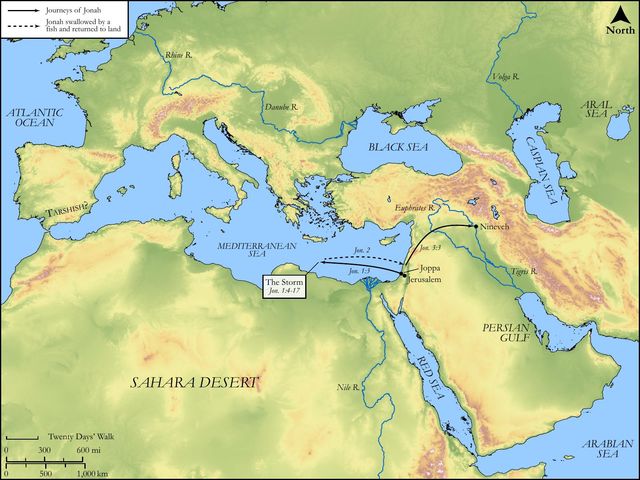
See on the biblical-era map
Study this verse
Historical interpretation
Seven Centuries of Reception
7 surviving comments on this verse. Each one is dated, so this reads as a timeline rather than a list.
Select a marker to jump to its quote. Markers stagger vertically where authors wrote within a few decades of each other.
If, however, any one imagines it is impossible that people should survive for such a length of time, and that Elijah was not caught up in the flesh but that flesh was consumed in the fiery chariot, let them consider that Jonah, when he had been cast into the deep and swallowed down into the whale’s belly, was by the command of God again thrown out safe upon the land.
Jonah was swallowed by the monster of the deep, in whose belly whole ships were devoured, and after three days he was vomited out again safe and sound. Enoch and Elijah, who even now, without experiencing a resurrection (because they have not even encountered death), are learning to the full what it is for the flesh to be exempted from all humiliation, and all loss, and all injury and all disgrace. They have been translated from this world and from this very cause are already candidates for everlasting life. To what faith do these notable events bear witness, if not to that which ought to inspire in us the belief that they are proofs and documents of our own future and our completed resurrection? To borrow the apostle’s phrase, these were “figures of ourselves.” They are written that we may believe that the Lord is more powerful than all natural laws about the body.
Hence he is tempest-tossed, and falls asleep, and is wrecked, and aroused from sleep, and taken by lot, and confesses his flight, and is cast into the sea, and swallowed but not destroyed by the whale.
Hence he is tempesttossed, and falls asleep, and is wrecked, and aroused from sleep, and taken by lot, and confesses his flight, and is cast into the sea, and swallowed but not destroyed by the whale. In Defense of His Flight to Pontus, Oration
Jonah did not escape the sea by the power of his birth, but by the hidden divine command he was thrown overboard, and a whale received him, vomited him out after three days as a sign of future mystery, and reserved him by the merit of prophetic grace.
"And the LORD spoke unto the fish, and it vomited out Jonah upon the dry land." LXX: 'and he ordered the whale to vomit Jonah out onto the dry land'. That which we read above as being about Jonah, the Lord prayed for in the stomach of the whale about which Job speaks in an unclear way: "let he who curses this day curse him, he who will capture the great whale" [Job. 3:8 LXX]. The great whale, the deep and hell are then ordered to give back the Lord to the dry earth; thus he who had died to free those detained by the chains of death, can lead with him many others towards life. With regard to the expression 'vomited' we must take this to be said in a very emphatic way, to mean that triumphant life has emerged from the deepest and most impenetrable parts of death.
The prophet is animated with good hope, and now secure about his liberation, he promises that he will sacrifice thanksgiving and that he will fulfill all vows.
Continue studying Jonah 2:10 across the web’s major study libraries — every link below opens this exact verse, chapter, or book on the destination site.
Read & Compare
 BibleGatewayThis verse in more than 200 translations and 70 languages.
 Bible.comThe YouVersion reader — hundreds of translations, reading plans, and highlights.
 ESV.orgCrossway's official English Standard Version reader.
 NET BibleThe NET translation with 60,000+ translators' notes on every rendering decision.
 STEP BibleTyndale House's free study tool — original text, vocabulary, and scholarly resources.
 BibliaLogos Bible Software's free web reader.
 USCCBThe New American Bible (Revised Edition) with the U.S. bishops' study notes.
Commentaries
 BibleHub CommentariesDozens of classic commentaries on this verse, gathered on one page.
 StudyLightMore than 100 commentary sets — the largest collection on the web.
 BibleRefPlain-English commentary on what this verse means, verse by verse.
 Enduring WordDavid Guzik's free commentary on this chapter, widely used by Bible teachers.
 Bible Study ToolsVerse commentary alongside Greek and Hebrew study aids.
Original Language & Research
- BibleHub InterlinearThe verse word by word — original language, transliteration, and English.
- BibleHub LexiconEvery word's original-language definition and Strong's entry.
 Blue Letter BibleDeep-study tools — Strong's numbers, concordance, and word studies.
 SefariaThe Hebrew text with Rashi and centuries of Jewish commentary.
Sermons, Hymns & Audio


TrulyRandomVerse is not affiliated with these sites and doesn’t control their content. They’re linked because they’re genuinely useful.
Summary
Jonah 2:10 marks the dramatic climax of Jonah's ordeal within the great fish, detailing God's direct intervention to deliver the disobedient prophet. After three days and three nights in the belly of the sea creature, following his fervent prayer of repentance and thanksgiving, the Lord sovereignly commands the fish to release Jonah onto dry land, demonstrating divine control over creation and God's unwavering mercy and patience in offering a second chance.
Context
ShowHideLiterary Context
This verse serves as the powerful resolution to Jonah's desperate prayer and a pivotal turning point in the narrative. Immediately preceding it, Jonah 2:1-9 records Jonah's profound lament and confession from the depths of the fish's belly. His prayer, though offered from an impossible situation, is marked by a clear understanding of God's power to save and a commitment to fulfill his vows. Verse 10 is God's immediate and miraculous response, demonstrating that Jonah's prayer was heard and answered. This act of deliverance sets the stage for the second half of the book, where Jonah is given another opportunity to obey God's original command to preach to Nineveh. The narrative structure highlights the cause-and-effect relationship between Jonah's repentance and God's merciful intervention.
Historical & Cultural Context
The book of Jonah is set during the reign of Jeroboam II (793-753 BC) in Israel, a period of relative prosperity but also spiritual decline. Nineveh, the capital of Assyria, was a formidable and notoriously cruel empire, a major oppressor of Israel. For a prophet like Jonah to be commanded to preach to such an enemy nation would have been deeply unpalatable, culturally and politically. The concept of a "great fish" or sea monster was not uncommon in the myths of the nations round about, often associated with chaos or divine judgment. However, the biblical account presents it not as a mythical beast but as a divinely appointed instrument of God's will, demonstrating His absolute sovereignty over all creation, including the natural world and its most fearsome creatures. The act of being "vomited out" onto "dry land" would have been understood as a clear sign of divine intervention, a reversal of the natural order, and a symbol of new life or a second chance.
Key Themes
ShowHideJonah 2:10 powerfully encapsulates several core themes prevalent throughout the book of Jonah and broader biblical theology. Foremost is God's Absolute Sovereignty, as the Lord directly commands a natural creature to perform His will, illustrating His control over all creation, from the storm that swallowed Jonah (Jonah 1:4) to the plant that provided shade (Jonah 4:6) and the worm that destroyed it (Jonah 4:7). Another key theme is Divine Mercy and Deliverance, highlighting God's willingness to rescue and restore even a disobedient prophet, demonstrating His steadfast love that extends beyond human merit, as seen in His compassion for the repentant Ninevites in Jonah 3:10. The verse also underscores the Efficacy of Prayer, as Jonah's deliverance immediately follows his heartfelt prayer, reinforcing the biblical truth that God hears and responds to the cries of His people from any depth of despair (Psalm 18:6). Finally, it powerfully illustrates the theme of Second Chances and Redemption, as God's act of deliverance prepares Jonah for his renewed mission, symbolizing God's patience and desire for individuals to return to His will after failure, a theme echoed in the New Testament's emphasis on repentance and restoration.
Exposition and Analysis
ShowHideKey Word Analysis
ShowHideThis is the covenant name of God, often translated as "Jehovah" or "the Lord." Derived from the Hebrew verb "to be," it signifies God's self-existence, eternal nature, and covenant faithfulness. The use of this name here emphasizes that it is the personal, sovereign God of Israel who is directly intervening and exercising His absolute authority over creation to fulfill His purposes, demonstrating His unwavering commitment to His plan despite human disobedience.
This primitive root verb carries a broad range of meanings, including "to say," "to command," "to declare," or "to utter." In this context, it denotes a direct, authoritative, and effective verbal command from God. It is not merely a suggestion or a thought, but a potent word that brings about immediate and complete obedience from the fish, highlighting God's power to speak creation into action.
This term is a general word for "fish" or "sea creature," often used collectively. It does not specify a particular species like a whale. The emphasis is not on the biological classification of the creature, but on its nature as a divinely appointed instrument. The word's potential connection to "prolific" or "squirming" might subtly allude to the creature's natural habitat and its responsive movement to God's command, but its primary significance here is simply "a fish" that God prepared and commanded.
This primitive root means "to vomit" or "to spue out." It vividly describes the forceful expulsion of Jonah from the fish's belly. The use of this word underscores the miraculous and somewhat undignified nature of Jonah's deliverance, emphasizing that it was not a gentle release but a powerful, almost violent, act orchestrated by God, signifying the end of his confinement and the beginning of his new opportunity.
This term refers to "dry ground" or "dry land," as opposed to water. Its inclusion is crucial as it signifies a complete reversal of Jonah's circumstances—from the watery depths of the sea and the belly of the fish to solid ground. This transition symbolizes rescue, safety, and the restoration of life, preparing Jonah for his re-engagement with the world and his divine mission.
Verse Breakdown
ShowHide"And the LORD spake unto the fish"
This clause highlights God's absolute sovereignty and direct intervention. The use of "the LORD" (Yahweh) emphasizes His covenant relationship and omnipotent authority. His "speaking" is a powerful, effective command, demonstrating that all creation, even a massive sea creature, is subject to His will and obeys instantly. This divine word is the sole catalyst for Jonah's deliverance.
"and it vomited out Jonah"
This describes the immediate and physical consequence of God's command. The fish, having served its purpose as both a prison and a preserver, expels Jonah. The verb "vomited out" is graphic, underscoring the miraculous and perhaps unpleasant nature of the release, but undeniably effective. It signifies the end of Jonah's confinement and the fulfillment of God's plan for his rescue.
"upon the dry [land]"
This final phrase specifies the location of Jonah's deliverance. From the depths of the sea and the belly of the fish, Jonah is returned to solid ground. This detail is significant, symbolizing safety, stability, and the ability to resume normal life and, crucially, his prophetic mission. It marks a complete reversal of his previous state of being lost at sea and swallowed.
Literary Devices
ShowHideThe verse employs several powerful Literary Devices. Personification is evident in "the LORD spake unto the fish," attributing to the fish the capacity to receive and obey a verbal command, emphasizing God's absolute control over even non-human creation. The entire event is a profound example of Divine Intervention, where God directly acts in the natural world to achieve His purposes, showcasing His omnipotence. The contrast between Jonah's previous state (in the belly of the fish, in the depths of the sea) and his new state (on "dry land") creates a strong sense of Juxtaposition, highlighting the miraculous nature of his rescue and the transition from death to life. Furthermore, the act of being "vomited out" serves as a vivid Metaphor for a dramatic and undeniable expulsion, signifying the end of a period of judgment and the beginning of a new opportunity. The narrative also functions as a Type, foreshadowing the resurrection of Christ, as explicitly referenced in the New Testament.
Theological and Thematic Connections
ShowHideJonah 2:10 stands as a profound testament to God's boundless mercy, unwavering sovereignty, and the transformative power of repentance. It demonstrates that even in the face of profound disobedience, God's redemptive plan for His people, and indeed for all nations, will prevail. His control extends to the most minute and massive elements of creation, orchestrating events to bring about His will and offer second chances. This verse reassures us that no situation is beyond God's reach, and His ear is always open to the cries of those who turn to Him, even from the deepest despair.
Reflection and Application
ShowHideJonah 2:10 offers immense spiritual encouragement and practical lessons for believers today. It powerfully reminds us that our God is a God of second chances, whose mercy triumphs over judgment. Even when we stray far from His will, rebel against His commands, or find ourselves in circumstances of our own making, His grace is sufficient to deliver us. This verse calls us to profound humility, recognizing that our lives are entirely in His sovereign hands. It challenges us to trust in His timing and His methods, no matter how unusual or uncomfortable they may seem. Furthermore, it underscores the vital importance of prayer, demonstrating that even from the most desperate and seemingly hopeless situations, a sincere cry to God can bring about miraculous intervention and deliverance. We are invited to reflect on areas where we might be resisting God's call, knowing that His patience and redemptive power are always available to bring us back to His purpose.
Questions for Reflection
ShowHideFAQ
ShowHideWas Jonah swallowed by a whale, or just a large fish?
ShowHideThe Hebrew text of Jonah 2:10 uses the word dâg (דָּג), which is a general term for "fish" or "sea creature." It does not specifically mean "whale." While the King James Version uses "whale" in Matthew 12:40, the Greek word there, kētos (κῆτος), also means "sea monster" or "huge fish," not exclusively a whale. The biblical emphasis is not on the biological classification of the creature, but on the fact that God "prepared" it (Jonah 1:17) and commanded it, highlighting His absolute sovereignty over all creation. So, it was a divinely appointed great fish or sea creature.
What is the significance of Jonah being on "dry land" after his deliverance?
ShowHideThe return to "dry land" is highly significant. It marks a complete reversal of Jonah's circumstances, symbolizing his transition from the watery depths of judgment and near-death to safety, life, and stability. In biblical narratives, dry land often represents a place of security and divine provision, contrasting with the chaotic and dangerous sea. For Jonah, it signified the end of his confinement and the beginning of his opportunity to fulfill his mission, much like the Israelites crossing the Red Sea onto dry ground (Exodus 14:21) or the Jordan River (Joshua 3:17). It underscores the completeness of God's deliverance and His readiness to restore Jonah to his purpose.
Christ-Centered Fulfillment
ShowHideJonah 2:10, while a historical account of a prophet's miraculous deliverance, finds its ultimate and profound fulfillment in the person and work of Jesus Christ. Jesus Himself explicitly pointed to Jonah's three days and three nights in the fish's belly as a prophetic "sign" of His own death, burial, and resurrection (Matthew 12:40). Just as Jonah was swallowed by death (symbolized by the fish) and then miraculously delivered to "dry land," so too was Christ swallowed by death in the tomb and then raised triumphantly on the third day, emerging victorious over sin and the grave. The "dry land" for Jonah represents a new beginning and a second chance; for humanity, Christ's resurrection is the ultimate new beginning, offering salvation and eternal life to all who believe. The Lord's sovereign command to the fish to "vomit out" Jonah foreshadows God the Father's ultimate act of raising Jesus from the dead, demonstrating His supreme authority over life and death (Romans 8:11). Thus, Jonah's deliverance is a powerful type, pointing to the greater deliverance offered through the resurrection of the Lamb of God, who takes away the sin of the world!.