


Revelation 17:13
- οὗτοιhoutoiTheseG3778D-NPMDemonstrative pronoun Nominative Plural Masculine
- μίανmianoneG1520A-ASFAdjective Accusative Singular Feminine
- γνώμηνgnōmēnmindG1106N-ASFNoun Accusative Singular Feminine
- ἔχουσινechousinhaveG2192V-PAI-3PVerb Present Active Indicative 3rd Plural
- καὶkaiandG2532CONJConjunction
- τὴνtēntheG3588T-ASFDefinite article Accusative Singular Feminine
- δύναμινdunaminpowerG1411N-ASFNoun Accusative Singular Feminine
- καὶkaiandG2532CONJConjunction
- τὴνtēntheG3588T-ASFDefinite article Accusative Singular Feminine
- ἐξουσίανexousianauthorityG1849N-ASFNoun Accusative Singular Feminine
- αὐτῶνautōnof themG846P-GPMPersonal pronoun Genitive Plural Masculine
- τῷtōto theG3588T-DSNDefinite article Dative Singular Neuter
- θηρίῳthēriōbeastG2342N-DSNNoun Dative Singular Neuter
- διδόασινdidoasinthey give upG1325V-PAI-3PVerb Present Active Indicative 3rd Plural
English is a literal word-by-word gloss of the Greek, not the KJV's wording. Why?
This is the original text the KJV's translators worked from — each Greek word with its own literal English meaning in this verse, prepared by scholars at Tyndale House, Cambridge. The KJV translates whole sentences, not word by word, so its wording differs: one Greek word can become several English words, and the KJV may choose “charity” where the gloss reads “love”. Both are faithful — they answer different questions. For the KJV's own rendering, switch to the KJV text.
Details
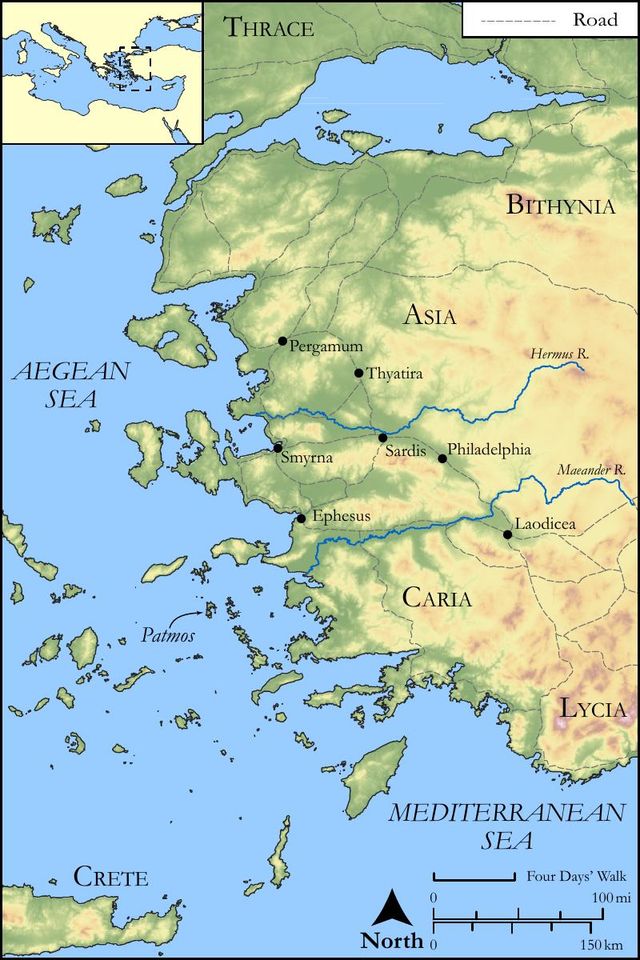
See on the biblical-era map

Study this verse
Public-domain commentary
Matthew Henry
From his Commentary on the Whole Bible. Henry comments on passages, not single verses — this entry covers Revelation 17:7–13.
Here we have the mystery of this vision explained. The apostle wonders at the sight of this woman: the angel undertakes to open this vision to him, it being the key of the former visions; and he tells the apostle what was meant by the beast on which the woman sat; but it is so explained as still to need further explanation. 1. This beast was, and is not, and yet is; that is, it was a seat of idolatry and persecution; and is not, that is, not in the ancient form, which was pagan; and yet it is, it is truly the seat of idolatry and tyranny, though of another sort and form. It ascends out of the bottomless pit (idolatry and cruelty are the issue and product of hell), and it shall return thither and go into perdition. 2. This beast has seven heads, which have a double signification. (1.) Seven mountains - the seven hills on which Rome stands; and (2.) Seven kings - seven sorts of government. Rome was governed by kings, consuls, tribunes, decemviri, dictators, emperors who were pagan, and emperors who were Christian. Five of these were extinct when this prophecy was written; one was then in being, that is, the pagan emperor; and the other, that is, the Christian emperor, was yet to come, Rev 17:10. This beast, the papacy, makes an eighth governor, and sets up idolatry again. 3. This beast had ten horns; which are said to be ten kings which have as yet received no kingdoms; as yet, that is, as some, shall not rise up till the Roman empire be broken in pieces; or, as others, shall not rise up till near the end of antichrist's reign, and so shall reign but as it were one hour with her, but shall for that time be very unanimous and very zealous in that interest, and entirely devoted to it, divesting themselves of their prerogatives and revenues (things so dear to princes), out of an unaccountable fondness for the papacy.
Historical interpretation
Seven Centuries of Reception
5 surviving comments on this verse. Each one is dated, so this reads as a timeline rather than a list.
Select a marker to jump to its quote. Markers stagger vertically where authors wrote within a few decades of each other.
"And the beast which thou sawest is of the seven." Since before those kings Nero reigned.
"And he is the eighth." He says only when this beast shall come, reckon it the eighth place, since in that is the completion. He added:-
"And shall go into perdition." For that ten kings received royal power when he shall move from the east, he says. He shall be sent from the city of Rome with his armies. And Daniel sets forth the ten horns and the ten diadems. And that these are eradicated from the former ones,-that is, that three of the principal leaders are killed by Antichrist: that the other seven give him honour and wisdom and power, of whom he says:-
"These shall hate the whore, to wit, the city, and shall burn her flesh with fire." Now that one of the heads was, as it were, slain to death, and that the stroke of his death was directed, he speaks of Nero. For it is plain that when the cavalry sent by the senate was pursuing him, he himself cut his throat. Him therefore, when raised up, God will send as a worthy king, but worthy in such a way as the Jews merited. And since he is to have another name, He shall also appoint another name, that so the Jews may receive him as if he were the Christ. Says Daniel: "He shall not know the lust of women, although before he was most impure, and he shall know no God of his fathers: for he will not be able to seduce the people of the circumcision, unless he is a judge of the law." Finally, also, he will recall the saints, not to the worship of idols, but to undertake circumcision, and, if he is able, to seduce any; for he shall so conduct himself as to be called Christ by them. But that he rises again from hell, we have said above in the word of Isaiah: "Water shall nourish him, and hell hath increased him; "who, however, must come with name unchanged, and doings unchanged, as says the Spirit.
It now says clearly that that power that they had received with the beast they will hand over to the beast, that is, to that head that seemed to have died and to have come to life again. For by a common consent and will they will give to him every worship of their desire and effort and exhibit their servitude.… Although it is describing the power of this adversarial body, it now rightly foretells the victory of the Lamb. And to indicate that he will triumph in his followers, it adds, “And those with him, the elect, the faithful and the called.” And with good reason does it mention the elect first, for the Lord said, “Many are called, but few are chosen.”
Indeed! For “no one can serve two masters.” And so those who conspire together with an evil agreement and ally themselves with the antichrist will oppose themselves to Christ. However, the Lamb of God who was slain for us will conquer them. For he was not deprived of his kingdom and lordship over all things when he became man, so that he might acquire even his elect as participants in his own rule.
These have one mind, etc. That is, with equal consent, they fully intend to fight for the devil, which is what it means to receive the kingdom after the beast, by imitating the devil and opposing Christ.
He says that "they have one mind, and give their power and authority to the beast." For though the ten kings will be opposed to one another in their opinions, yet in this they will have "one mind": in giving "their power and authority to the beast", that is, to the Antichrist. For they will be defeated by him, and he alone of all will rule over the rest. But even if they are defeated contrary to their will, since the ten suffer the same fate of defeat and removal, he said they "have one mind"; therefore, he was saying that as by agreement and unanimity the ten will be defeated by the Antichrist.
Continue studying Revelation 17:13 across the web’s major study libraries — every link below opens this exact verse, chapter, or book on the destination site.
Read & Compare
 BibleGatewayThis verse in more than 200 translations and 70 languages.
 Bible.comThe YouVersion reader — hundreds of translations, reading plans, and highlights.
 ESV.orgCrossway's official English Standard Version reader.
 NET BibleThe NET translation with 60,000+ translators' notes on every rendering decision.
 STEP BibleTyndale House's free study tool — original text, vocabulary, and scholarly resources.
 BibliaLogos Bible Software's free web reader.
 USCCBThe New American Bible (Revised Edition) with the U.S. bishops' study notes.
Commentaries
 BibleHub CommentariesDozens of classic commentaries on this verse, gathered on one page.
 StudyLightMore than 100 commentary sets — the largest collection on the web.
 BibleRefPlain-English commentary on what this verse means, verse by verse.
 Enduring WordDavid Guzik's free commentary on this chapter, widely used by Bible teachers.
 Bible Study ToolsVerse commentary alongside Greek and Hebrew study aids.
Original Language & Research
- BibleHub InterlinearThe verse word by word — original language, transliteration, and English.
- BibleHub LexiconEvery word's original-language definition and Strong's entry.
 Blue Letter BibleDeep-study tools — Strong's numbers, concordance, and word studies.
 CNTR CollationThe earliest Greek manuscripts of this verse, collated letter by letter.
Sermons, Hymns & Audio


TrulyRandomVerse is not affiliated with these sites and doesn’t control their content. They’re linked because they’re genuinely useful.
Summary
Revelation 17:13 vividly portrays an unprecedented alignment of global power in the end times, revealing that a coalition of ten kings will willingly surrender their independent sovereignty, military might, and political influence to the formidable figure known as "the beast." This verse underscores a chilling unity of purpose among these earthly rulers, demonstrating their complete agreement and voluntary submission to a singular, dominant entity, thereby consolidating immense power in opposition to God's divine plan.
Context
ShowHideLiterary Context
This verse is an integral part of John's profound vision in Revelation chapter 17. The chapter graphically depicts the judgment of "Babylon the Great," a symbolic entity often interpreted as a corrupt global system embodying political, economic, and religious apostasy. The immediate preceding verse, Revelation 17:12, introduces "ten kings, which have received no kingdom as yet; but receive power as kings one hour with the beast." Verse 13 then clarifies the nature of their relationship and future disposition: they will share a common objective and willingly cede their distinct authority to the beast. This beast, a central antagonist in prophetic literature, was first introduced in Revelation 13:1, representing a powerful, anti-God political and spiritual force. The narrative flow in Revelation 17 builds towards the ultimate confrontation between God's kingdom and these unified forces of evil.
Historical & Cultural Context
As an apocalyptic book, Revelation employs rich symbolism that would have resonated with its original first-century audience, living under the shadow of the Roman Empire. The imagery of powerful beasts and kings, while pointing to future events, often drew parallels from historical empires and their oppressive rule, such as those seen in the prophecies of Daniel. The concept of centralized power and imperial cults, where rulers demanded absolute allegiance, provides a backdrop for understanding the profound nature of the kings' submission to the beast. While specific historical identifications are debated, the underlying cultural context highlights the perpetual human temptation to consolidate power and rebel against divine authority, a theme that transcends any single historical period and finds its ultimate expression in the end-time scenario described here.
Key Themes
ShowHideRevelation 17:13 contributes significantly to several major themes within the book of Revelation and broader biblical prophecy. The phrase "have one mind" signifies a deliberate, shared, and malevolent purpose among these kings. Their unity is not for the common good or divine purposes, but for consolidating power under the beast, ultimately in direct opposition to Christ and His coming kingdom. This foreshadows the climactic battle described in Revelation 19:19, where these unified forces directly challenge the returning Christ. Furthermore, the kings "shall give their power and strength unto the beast," indicating a voluntary and complete surrender of their independent authority, military might, and national resources. This suggests an unprecedented level of global political and military centralization under a single, dominant entity, which stands in stark contrast to the fragmented nature of earthly powers throughout history. This centralization of power facilitates the beast's rise to unparalleled global influence and sets the stage for the final confrontation between God's kingdom and the forces of evil, as the beast's temporary dominion is ultimately overcome by the Lamb, as stated in Revelation 17:14.
Exposition and Analysis
ShowHideKey Word Analysis
ShowHideMeaning "cognition, i.e. (subjectively) opinion, or (objectively) resolve (counsel, consent, etc.)." In this context, it signifies a deep, shared purpose and deliberate agreement among the kings. It's not merely a casual alliance but a unified resolve, a single will driving their actions. This highlights the intentionality of their submission to the beast.
Meaning "force (literally or figuratively); specially, miraculous power... ability, might, strength." This refers to the inherent capacity, military might, and physical strength of these kings and their kingdoms. By giving their dýnamis to the beast, they are surrendering their raw, intrinsic ability to wage war, enforce laws, and exert influence.
Meaning "privilege, i.e. (subjectively) force, capacity, competency, freedom, or (objectively) mastery... delegated influence:--authority, jurisdiction, liberty, power, right." While often translated similarly to "power," exousía here denotes their legitimate authority, jurisdiction, and right to rule. It's the sovereign right to exercise control. The kings are not just giving their physical might (dýnamis) but also their very right to govern and command (exousía), transferring their independent sovereignty to the beast.
Verse Breakdown
ShowHide"These have one mind"
This clause emphasizes the astonishing unity and singular purpose among the ten kings. Despite their individual kingdoms and potential for rivalry, they achieve a complete consensus (μίαν γνώμην, mian gnōmēn) regarding their allegiance and actions. This "one mind" implies a deliberate, conscious decision to align their wills, strategies, and objectives, indicating a profound spiritual and political harmony in their rebellion against God and their support for the beast.
"and shall give their power and strength"
This phrase describes the active and voluntary surrender of their inherent capabilities and sovereign authority. "Power" (dýnamis) refers to their inherent might, military capacity, and resources, while "strength" (exousía) denotes their rightful jurisdiction, freedom to act, and delegated authority. The use of "shall give" (διδόασιν, didóasin, present tense indicating a future certainty or ongoing action) underscores the deliberate and decisive nature of this transfer. They are not merely coerced but willingly cede their independent rule and means of enforcement.
"unto the beast"
This specifies the recipient of this unprecedented transfer of power and authority. The "beast" is the central figure of anti-Christ power in Revelation, representing a global political and spiritual system animated by Satan. The kings' voluntary submission elevates the beast to a position of unparalleled global dominance, making him the supreme authority over their combined territories and resources, thus setting the stage for his final, albeit temporary, reign and ultimate confrontation with God.
Literary Devices
ShowHideRevelation 17:13 is rich in Symbolism. The "ten kings" are symbolic of a coalition of earthly powers or nations in the end times, not necessarily a literal count of ten specific individuals, but rather a representation of a unified global political force. The "beast" is a powerful symbol of an anti-God political and spiritual system, ultimately controlled by Satan, embodying rebellion and opposition to divine authority. The act of "giving their power and strength" is symbolic of the complete and voluntary surrender of national sovereignty and military might to this central, malevolent entity. The phrase "one mind" employs Synecdoche, where "mind" represents the entire unified will and purpose of these kings. Furthermore, the entire passage serves as Foreshadowing, setting the stage for the final global conflict between the forces of evil, united under the beast, and the returning Christ, culminating in the beast's ultimate defeat.
Theological and Thematic Connections
ShowHideThis verse profoundly illustrates the nature of unified rebellion against God, a recurring theme throughout biblical history, from the Tower of Babel to the kings of the earth arraying themselves against the Lord and His Anointed. It highlights humanity's perennial temptation to consolidate power and establish a kingdom apart from God, ultimately leading to idolatry and opposition to divine rule. The voluntary surrender of sovereignty by these kings to the beast reveals the seductive allure of centralized power and the willingness of human leaders to compromise their autonomy for a shared, ungodly agenda. Theologically, it underscores the spiritual battle for allegiance, where earthly kingdoms choose to align with the forces of darkness rather than submit to the rightful reign of God. Yet, even this formidable alliance operates within the confines of God's sovereign plan, serving His ultimate purpose to bring about the final triumph of Christ's kingdom.
Reflection and Application
ShowHideRevelation 17:13 serves as a sobering reminder of the spiritual realities at play in our world and the critical need for discernment. While the full manifestation of this prophecy lies in the future, the principles it embodies are timeless. We are called to be vigilant against any form of unity or power consolidation that seeks to undermine truth, liberty, or the worship of God. This verse challenges us to examine our own allegiances: do we align our minds with worldly systems that promise power and security, or do we commit our "power and strength" to the kingdom of God? It reminds us that true unity is found in Christ, not in unholy alliances. In a world increasingly drawn to centralized control and global governance, believers are called to stand firm in their faith, to discern the spirits, and to recognize that all earthly power is temporary and ultimately subject to the sovereign will of God. Our hope is not in political systems or human leaders, but in the Lamb who ultimately conquers all.
Questions for Reflection
ShowHideFAQ
ShowHideWho are the "ten kings" mentioned in Revelation 17:13?
ShowHideThe "ten kings" are generally understood as a symbolic representation of a future coalition of world leaders or nations that will emerge in the end times. While some interpretations suggest a literal ten kings, the number often signifies completeness or a significant number of allied powers. They are depicted as receiving authority alongside the beast for a short period, indicating a unified political and military alliance that willingly subordinates itself to the beast's agenda. Their identity remains veiled, but their purpose—to empower the beast—is clearly revealed.
What does it mean for these kings to "have one mind" and give their power to the beast?
ShowHideTo "have one mind" (μίαν γνώμην, mian gnōmēn) signifies a complete and deliberate unity of purpose, will, and intention among these kings. It implies a shared resolve and a collective decision to align their individual interests and strategies under the beast's leadership. This unity is not accidental but a conscious choice to consolidate their collective "power" (dýnamis, inherent might) and "strength" (exousía, rightful authority/jurisdiction) and voluntarily transfer it to the beast. This act of giving away their sovereignty highlights an unprecedented level of global political and military centralization under an anti-God figure, enabling the beast to wield immense, unified influence on the world stage.
How does this verse relate to the broader prophetic narrative of Revelation?
ShowHideRevelation 17:13 is a crucial piece in the prophetic puzzle of Revelation, detailing the political and military support system for the "beast" (often understood as the Antichrist or a final global empire). It explains how the beast will achieve such unparalleled global dominance: through the willing submission and unified support of a powerful coalition of world leaders. This verse sets the stage for the climactic confrontation between the beast and his allies against Christ, as described in Revelation 19, and ultimately underscores the temporary nature of their power before God's ultimate and eternal victory.
Christ-Centered Fulfillment
ShowHideWhile Revelation 17:13 describes a chilling picture of earthly powers uniting in rebellion against God, its ultimate Christ-centered fulfillment lies in the stark contrast it presents to the true and eternal King, Jesus Christ. The beast's temporary reign, empowered by the voluntary submission of worldly kings, highlights the counterfeit nature of his authority, which is ultimately destined for destruction. In contrast, Christ's authority is inherent and eternal, for "all authority in heaven and on earth has been given to Me," as He declares in Matthew 28:18. The "one mind" of the kings aligned with the beast stands in stark opposition to the true unity found in the body of Christ, where believers are called to have the "mind of Christ" (1 Corinthians 2:16) and to submit to His loving Lordship. Ultimately, the beast and his allies, despite their consolidated power, will be utterly defeated by the Lamb, who is "King of kings and Lord of lords" (Revelation 17:14). This verse, therefore, magnifies the absolute sovereignty of Christ, whose kingdom is not of this world (John 18:36), but will ultimately crush all earthly opposition and establish an everlasting dominion where every knee will bow and every tongue confess that Jesus Christ is Lord, to the glory of God the Father (Philippians 2:9-11).