


Revelation 17:9
Bible text: King James Version (1769 Blayney text) · Public domain
Bible text: Berean Standard Bible · Public domain
Bible text: American Standard Version (1901) · Public domain
Bible text: World English Bible, Messianic edition · Public domain
Bible text: Geneva Bible (1599) · Public domain
Bible text: Young's Literal Translation · Public domain
- ὧδεhōdeHere [is]G5602ADVAdverb
- ὁhotheG3588T-NSMDefinite article Nominative Singular Masculine
- νοῦςnousmindG3563N-NSMNoun Nominative Singular Masculine
- ὁhowhichG3588T-NSMDefinite article Nominative Singular Masculine
- ἔχωνechōnis havingG2192V-PAP-NSMVerb Present Active Participle Nominative Singular Masculine
- σοφίανsophianwisdomG4678N-ASFNoun Accusative Singular Feminine
- αἱhaiTheG3588T-NPFDefinite article Nominative Plural Feminine
- ἑπτὰheptasevenG2033A-NUIAdjective
- κεφαλαὶkephalaiheadsG2776N-NPFNoun Nominative Plural Feminine
- ἑπτὰheptasevenG2033A-NUIAdjective
- ὄρηorēmountainsG3735N-NPNNoun Nominative Plural Neuter
- εἰσίνeisinareG1510V-PAI-3PVerb Present Active Indicative 3rd Plural
- ὅπουhopouwhereG3699PREPPreposition
- ἡhētheG3588T-NSFDefinite article Nominative Singular Feminine
- γυνὴgunēwomanG1135N-NSFNoun Nominative Singular Feminine
- κάθηταιkathētaisitsG2521V-PNI-3SVerb Present Middle Or Passive Deponent Indicative 3rd Singular
- ἐπ᾽ep᾽onG1909PREPPreposition
- αὐτῶνautōnthemG846P-GPNPersonal pronoun Genitive Plural Neuter
English is a literal word-by-word gloss of the Greek, not the KJV's wording. Why?
This is the original text the KJV's translators worked from — each Greek word with its own literal English meaning in this verse, prepared by scholars at Tyndale House, Cambridge. The KJV translates whole sentences, not word by word, so its wording differs: one Greek word can become several English words, and the KJV may choose “charity” where the gloss reads “love”. Both are faithful — they answer different questions. For the KJV's own rendering, switch to the KJV text.
Details
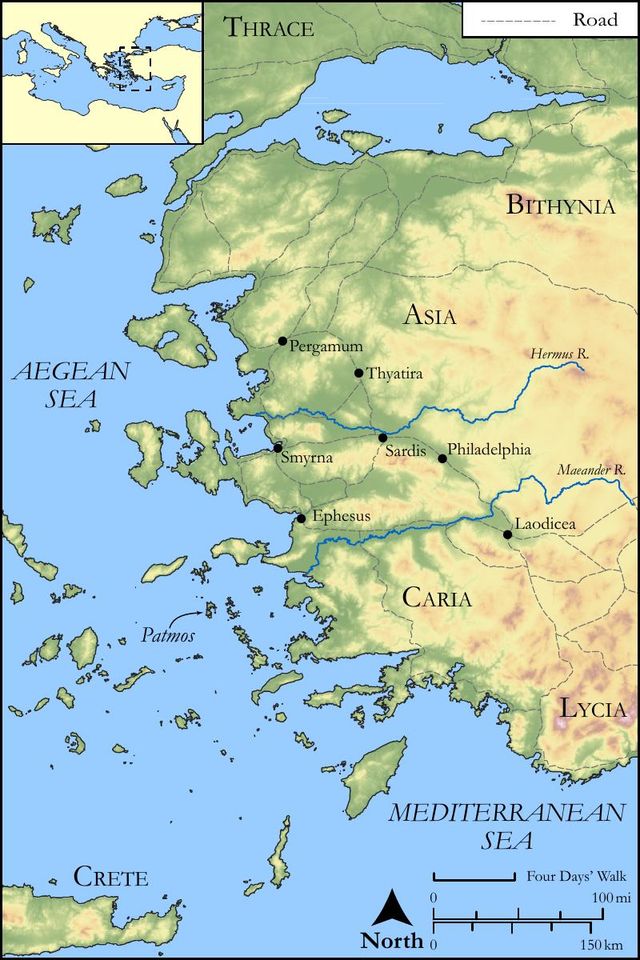
See on the biblical-era maps

Study this verse
Public-domain commentary
Matthew Henry
From his Commentary on the Whole Bible. Henry comments on passages, not single verses — this entry covers Revelation 17:7–13.
Here we have the mystery of this vision explained. The apostle wonders at the sight of this woman: the angel undertakes to open this vision to him, it being the key of the former visions; and he tells the apostle what was meant by the beast on which the woman sat; but it is so explained as still to need further explanation. 1. This beast was, and is not, and yet is; that is, it was a seat of idolatry and persecution; and is not, that is, not in the ancient form, which was pagan; and yet it is, it is truly the seat of idolatry and tyranny, though of another sort and form. It ascends out of the bottomless pit (idolatry and cruelty are the issue and product of hell), and it shall return thither and go into perdition. 2. This beast has seven heads, which have a double signification. (1.) Seven mountains - the seven hills on which Rome stands; and (2.) Seven kings - seven sorts of government. Rome was governed by kings, consuls, tribunes, decemviri, dictators, emperors who were pagan, and emperors who were Christian. Five of these were extinct when this prophecy was written; one was then in being, that is, the pagan emperor; and the other, that is, the Christian emperor, was yet to come, Rev 17:10. This beast, the papacy, makes an eighth governor, and sets up idolatry again. 3. This beast had ten horns; which are said to be ten kings which have as yet received no kingdoms; as yet, that is, as some, shall not rise up till the Roman empire be broken in pieces; or, as others, shall not rise up till near the end of antichrist's reign, and so shall reign but as it were one hour with her, but shall for that time be very unanimous and very zealous in that interest, and entirely devoted to it, divesting themselves of their prerogatives and revenues (things so dear to princes), out of an unaccountable fondness for the papacy.
Historical interpretation
Eight Centuries of Reception
5 surviving comments on this verse. Each one is dated, so this reads as a timeline rather than a list.
Select a marker to jump to its quote. Markers stagger vertically where authors wrote within a few decades of each other.
These things, beloved, we impart to you with fear, and yet readily, on account of the love of Christ, which surpasseth all. For if the blessed prophets who preceded us did not choose to proclaim these things, though they knew them, openly and boldly, lest they should disquiet the souls of men, but recounted them mystically in parables and dark sayings, speaking thus, "Here is the mind which hath wisdom," how much greater risk shall we run in venturing to declare openly things spoken by them in obscure terms! Let us look, therefore, at the things which are to befall this unclean harlot in the last days; and (let us consider) what and what manner of tribulation is destined to visit her in the wrath of God before the judgment as an earnest of her doom.
"The seven heads are the seven hills, on which the woman sitteth." That is, the city of Rome.
Since what is to be interpreted is spiritual, there is need, it says, for a spiritual wisdom, not a worldly wisdom to understand what is being said.… We believe that the seven heads and the seven mountains are to be interpreted as seven places that excel the rest in excellence and worldly power. In these places we recognize that at various times the kingdom of the world is established, such as at first the rule of the Assyrians in Nineveh. Second, in Ecbatana there was the power of the Medians who from the time of Arbakes seized power from the Assyrians whose king, Sardanapal, Arbakes is said to have destroyed. After these there was the power of the Chaldeans in Babylon, whose king was Nebuchanezzar. Then after their fall the rule of the Persians in Susa was initiated by Cyrus. And after the destruction of this kingdom by Alexander, there was the rule of the Macedonians. After these there was in old Rome the power of the Romans that was sovereign under Augustus Caesar and its recent emperors and consuls and was possessed by wicked men until Constantine. After the fall of these, the royal powers of emperors favorable to Christ were transferred to new Rome.
The seven heads are seven mountains, etc. The heads of the beast, he says, are the kings of the world, equated to lofty mountains because of their pride. In these impiety wantonly rests, to oppress with force and to deceive with fraud.
Therefore, he says, "here is the mind that has wisdom." Therefore, so says the mind that has been made wise: let the riddle be known how it "was and is not", and is about to ascend from the abyss. For even for that which departs from being into non-being, the thing that is about to ascend again from the abyss seems to be contradictory, unless someone should apprehend it in some other way, as has already been said.
"The seven heads" he says "are seven mountains, on which the woman sits." From this most clearly it is shown that what has been said refers to Rome; for it is related that she herself sits on seven mountains, and there is no other city.
Continue studying Revelation 17:9 across the web’s major study libraries — every link below opens this exact verse, chapter, or book on the destination site.
Read & Compare
 BibleGatewayThis verse in more than 200 translations and 70 languages.
 Bible.comThe YouVersion reader — hundreds of translations, reading plans, and highlights.
 ESV.orgCrossway's official English Standard Version reader.
 NET BibleThe NET translation with 60,000+ translators' notes on every rendering decision.
 STEP BibleTyndale House's free study tool — original text, vocabulary, and scholarly resources.
 BibliaLogos Bible Software's free web reader.
 USCCBThe New American Bible (Revised Edition) with the U.S. bishops' study notes.
Commentaries
 BibleHub CommentariesDozens of classic commentaries on this verse, gathered on one page.
 StudyLightMore than 100 commentary sets — the largest collection on the web.
 BibleRefPlain-English commentary on what this verse means, verse by verse.
 Enduring WordDavid Guzik's free commentary on this chapter, widely used by Bible teachers.
 Bible Study ToolsVerse commentary alongside Greek and Hebrew study aids.
Original Language & Research
- BibleHub InterlinearThe verse word by word — original language, transliteration, and English.
- BibleHub LexiconEvery word's original-language definition and Strong's entry.
 Blue Letter BibleDeep-study tools — Strong's numbers, concordance, and word studies.
 CNTR CollationThe earliest Greek manuscripts of this verse, collated letter by letter.
Sermons, Hymns & Audio


TrulyRandomVerse is not affiliated with these sites and doesn’t control their content. They’re linked because they’re genuinely useful.
Summary
Revelation 17:9 serves as a crucial interpretive key within John's vision of the "great harlot" and the beast. It explicitly states that understanding the profound symbolism of the beast's seven heads requires spiritual wisdom, revealing that these heads represent "seven mountains" upon which the mysterious woman is seated. This declaration immediately directs the reader towards a deeper, divinely-granted insight into the nature of the beast's power and the woman's pervasive influence, setting the stage for the unfolding judgment of "Babylon the Great."
Context
ShowHideLiterary Context
Revelation 17 is a pivotal chapter, initiating a detailed exposition of the judgment upon "Babylon the Great," a symbolic entity introduced earlier in the book. Following the vision of the seven bowls of wrath in Revelation 16, an angel invites John to witness the judgment of the "great harlot" who sits on many waters (Revelation 17:1). The narrative then describes the woman, arrayed in opulent and blasphemous attire, riding a scarlet beast with seven heads and ten horns (Revelation 17:3-6). The angel promises to explain the "mystery of the woman, and of the beast that carrieth her" (Revelation 17:7). Verse 9, therefore, is the beginning of this promised explanation, providing the first interpretive clue regarding the beast's heads, emphasizing that this understanding is not for the intellectually curious alone but requires divine wisdom.
Historical & Cultural Context
John wrote Revelation during a period of intense persecution of Christians, likely under the Roman Emperor Domitian (c. AD 95). The Roman Empire was the dominant global superpower, known for its vast infrastructure, military might, and pervasive pagan cults, including emperor worship. Rome itself was famously built upon seven hills, a well-known geographical feature that would have been immediately recognizable to John's audience. Furthermore, in prophetic literature, "mountains" or "hills" were often used symbolically to represent powerful kingdoms, empires, or significant centers of authority (e.g., Isaiah 2:2; Jeremiah 51:25). This dual understanding—literal and symbolic—would have informed the early readers' interpretation of John's cryptic vision, pointing to both a specific historical power and a broader spiritual reality.
Key Themes
ShowHideRevelation 17:9 significantly contributes to several overarching themes in the book of Revelation. Firstly, it underscores the necessity of divine wisdom and discernment for interpreting God's prophetic word, a theme echoed in Revelation 13:18 concerning the number of the beast. Secondly, it introduces a crucial layer to the identity and nature of the beast and the harlot, linking them to specific geographical or political realities ("seven mountains") while maintaining a symbolic ambiguity that allows for broader application. This ties into the theme of worldly power in opposition to God, illustrating how such power, whether imperial Rome or any subsequent anti-God system, is characterized by spiritual harlotry and idolatry. Finally, by providing an interpretive key, the verse subtly reinforces the theme of God's sovereign control over history and prophecy, assuring believers that even the most complex and intimidating manifestations of evil are ultimately understood and judged by Him.
Exposition and Analysis
ShowHideKey Word Analysis
ShowHideThis term refers to the intellect, encompassing thought, feeling, and will. In this context, it signifies not merely intellectual capacity but a spiritual understanding or discernment. John emphasizes that comprehending the profound mysteries of Revelation requires a divinely-granted insight, an inner faculty attuned to spiritual truth, rather than just human cleverness.
This refers to a female, often a wife. In Revelation 17, this "woman" is explicitly identified as "Babylon the Great, the Mother of Harlots and Abominations of the Earth" (Revelation 17:5). Her "sitting" on the mountains signifies her dominion, influence, or reliance upon these powerful entities, symbolizing her pervasive control over or integration with worldly systems that oppose God.
This word literally means a mountain or hill. However, in biblical prophecy, "mountains" frequently symbolize powerful kingdoms, nations, or centers of political and spiritual authority. The dual meaning here is crucial, allowing for both a literal geographical interpretation (e.g., Rome's seven hills) and a broader symbolic understanding of dominant world powers.
Verse Breakdown
ShowHide"And here is the mind which hath wisdom."
This opening phrase serves as a direct address to the reader, a parenthetical interjection from the narrator (John or the angel). It signals that the following interpretation is not straightforward but requires spiritual insight and discernment. It's a call to attentiveness and a recognition that divine truth often demands more than superficial understanding.
"The seven heads are seven mountains,"
This clause provides the first explicit interpretive key for the beast's seven heads, identifying them as "seven mountains." This statement immediately connects the symbolic heads to a concrete, albeit still potentially symbolic, reality. The use of "are" (Greek: eisí) here is declarative, equating the heads with the mountains, thereby narrowing the interpretive possibilities and pointing towards a specific understanding.
"on which the woman sitteth."
This final clause clarifies the relationship between the woman (Babylon the Great) and the "seven mountains." Her "sitting" (Greek: káthēmai) implies a position of authority, dominion, or stable residence. It indicates that the woman's power and influence are intrinsically linked to, and perhaps derived from or supported by, these "seven mountains," whether they represent literal hills, specific empires, or a succession of global powers.
Literary Devices
ShowHideRevelation 17:9 masterfully employs Symbolism and Metaphor to convey profound theological truths. The "seven heads" are explicitly identified as "seven mountains," which itself is a Metaphor for powerful kingdoms or centers of authority. This layered symbolism requires the reader to engage with the text on multiple levels, moving beyond a literal interpretation to grasp the deeper spiritual and political realities being depicted. The phrase "here is the mind which hath wisdom" acts as a Direct Address or Apostrophe, drawing the reader into the interpretive process and emphasizing the need for divine illumination. This rhetorical device underscores that the understanding of these symbols is not merely an intellectual exercise but a spiritual discernment, highlighting the Didactic purpose of the passage. The imagery of the woman "sitting" on these mountains is also highly symbolic, representing her pervasive influence, control, or reliance upon these worldly powers.
Theological and Thematic Connections
ShowHideRevelation 17:9 is a pivotal verse that bridges the symbolic language of prophecy with concrete interpretive clues, emphasizing that God's revelation, while mysterious, is ultimately understandable through divine wisdom. It highlights the pervasive nature of worldly power that opposes God, whether manifested as a specific historical empire or as a recurring pattern of human rebellion. The woman "sitting" on the mountains signifies the deep entanglement of spiritual harlotry (idolatry, rebellion against God) with political and economic systems. This verse sets the stage for understanding the ultimate downfall of this anti-God system, demonstrating that no earthly power, however formidable, can withstand God's righteous judgment. It calls believers to discern the true nature of worldly influence and to remain separate from its corrupting allure, trusting in God's ultimate sovereignty.
Reflection and Application
ShowHideRevelation 17:9 challenges us to approach God's Word, especially prophetic texts, with a posture of humility and a hunger for spiritual wisdom. It reminds us that true understanding comes not from human intellect alone, but from the Holy Spirit, who illuminates the Scriptures and grants discernment. In an age saturated with information and competing ideologies, this verse calls us to critically evaluate the "mountains" of influence in our own time—the dominant cultural narratives, political systems, economic forces, and media—and to discern where the "woman" of worldly rebellion might be sitting. We are to recognize the subtle and overt ways in which these powers seek to draw humanity away from God, often cloaked in allure and perceived stability. Ultimately, this verse encourages us to trust in God's sovereign plan, knowing that He has revealed these truths so that His people might not be deceived, but might stand firm in faith, awaiting the ultimate triumph of His kingdom over all earthly opposition.
Questions for Reflection
ShowHideFAQ
ShowHideWhat is the primary interpretation of the "seven mountains" in Revelation 17:9?
ShowHideThe "seven mountains" in Revelation 17:9 are widely understood in two primary ways, both rooted in the historical and symbolic context of the Bible. The most prominent historical interpretation identifies them with the seven literal hills upon which the city of Rome was built, making the "woman" a direct symbol of imperial Rome, known for its persecution of Christians and its pervasive paganism. This view is supported by the fact that Rome was the dominant world power at the time John wrote Revelation. However, a broader, more symbolic interpretation understands "mountains" as representing powerful kingdoms, empires, or centers of authority throughout history, a common prophetic motif (e.g., Isaiah 2:2; Daniel 2:35). Under this view, the "seven mountains" could symbolize a succession of world empires that oppose God, or the totality of worldly power that stands in opposition to divine rule. Both interpretations acknowledge the "woman" as "Babylon the Great" (Revelation 17:5), representing a spiritual system of idolatry and rebellion against God that is deeply intertwined with worldly political and economic structures.
Christ-Centered Fulfillment
ShowHideWhile Revelation 17:9 focuses on the nature of anti-God worldly power, its ultimate fulfillment points to the absolute supremacy of Christ. The "mind which hath wisdom" ultimately leads to knowing Christ, for He is "the wisdom of God" (1 Corinthians 1:24). The "seven mountains" and the woman who sits upon them represent all earthly powers and systems that set themselves against God's rule, culminating in the final, futile rebellion against the Lamb. Yet, it is Christ, the Lamb who was slain, who is worthy to open the scroll and reveal these mysteries (Revelation 5:1-5). He is the true King, whose kingdom is not of this world (John 18:36), and who will ultimately judge and utterly destroy all opposing "mountains" and the harlot system they support (Revelation 19:11-21). The wisdom imparted in Revelation 17:9 is a wisdom that grounds believers in the eternal victory of Christ, assuring them that His reign will endure long after all earthly powers have crumbled, and He will establish His righteous rule forever (Revelation 11:15).