


Old Testament · Minor Prophets · Book 30 of 66
Amos
A herdman of Tekoa carries the LORD’s word to Israel at Bethel: judgment on the nations and on Israel, then the fallen tabernacle of David raised.
- 9 chapters
- 146 verses
- About 19 minutes to read
- The Hebrew Prophets, c. 800–400 BC
Amos was a herdman from Tekoa in Judah, sent north to prophesy in the days of Jeroboam the son of Joash, when Israel’s border ran again “from the entering of Hamath unto the sea of the plain” (2 Kings 14:25) and its great men lay “upon beds of ivory” (Amos 6:4). The book opens with the LORD roaring from Zion and a judgment on each of six nations around Israel, then on Judah. Israel comes eighth, and its charge is the longest.
Israel did not neglect worship: Bethel and Gilgal were full. But the LORD calls the pilgrimage itself transgression, “Come to Bethel, and transgress” (4:4), and the same worshippers took a bribe in the gate and sold with false balances. Watch also for his patience: five calamities, each followed by “yet have ye not returned unto me” (4:6–11); two visions of judgment turned aside at the prophet’s prayer; and the call “Seek ye me, and ye shall live” (5:4). The last five verses turn from the sieve to the house of David rebuilt, which James read at Jerusalem of the Gentiles (Acts 15:15–17).
But let judgment run down as waters, and righteousness as a mighty stream.
Amos 5:24 KJV
How Amos is laid out
8 movements · 39 passages · 146 verses
1:1–2:5 · 20 verses
Three transgressions, and four
The words of Amos open with the LORD roaring from Zion. Six nations around Israel are judged in turn, Damascus, Gaza, Tyre, Edom, Ammon and Moab, each under the same sentence, “I will not turn away the punishment thereof,” each for cruelty to another people, and each with fire devouring its palaces. Judah is seventh, “because they have despised the law of the LORD.”
2:6–16 · 11 verses
Israel the eighth
The same sentence falls on Israel, and the charge runs long: they “sold the righteous for silver, and the poor for a pair of shoes,” and lay on pledged clothes by every altar. The LORD recalls the Amorite destroyed, the exodus, the prophets and Nazarites he raised, and how Israel gave the Nazarites wine and silenced the prophets. In that day the swift and the strong will not escape.
Chapters 3–4 · 28 verses
You only have I known
“Hear this word”: the LORD has known Israel alone of all the families of the earth, and therefore will punish all its iniquities. The lion has roared, and the prophet must speak. Samaria’s palaces store up violence, its “kine of Bashan” crush the needy, its shrines multiply transgression. Famine, drought, blight, pestilence and overthrow came in turn, and Israel did not return. “Prepare to meet thy God, O Israel.”
8 passages
- 3:1–2 Israel's Unique Relationship and Imminent Judgment
- 3:3–8 The Certainty of Cause and Effect
- 3:9–12 Foreign Nations Witness Samaria's Doom
- 3:13–15 Destruction of Idolatry and Luxury
- 4:1–3 Judgment on the Oppressive Women
- 4:4–5 Satire of Formalistic Worship
- 4:6–11 Five Warnings Rejected by Israel
- 4:12–13 Prepare to Meet Your God
Chapter 5 · 27 verses
Seek the LORD, and live
A lament for the fallen virgin of Israel, and a call: seek the LORD, not Bethel, Gilgal or Beersheba. The courts hate him that rebukes in the gate and turn aside the poor. Those who desire the day of the LORD will find it “darkness, and not light.” He hates their feasts, asks for judgment to run down as waters, and threatens captivity beyond Damascus.
Chapter 6 · 14 verses
At ease in Zion
Woe to the notable men at ease in Zion and trusting in the mountain of Samaria, who lie on beds of ivory and drink wine in bowls, but “are not grieved for the affliction of Joseph.” The LORD swears by himself that he abhors the excellency of Jacob. They will go captive first, and a nation will afflict Israel from Hamath to the river of the wilderness.
Chapter 7 · 17 verses
The plumbline and Bethel
Three visions. At the locusts and at the fire Amos prays, “by whom shall Jacob arise? for he is small,” and the LORD relents. The third, a plumbline, has no reprieve: “I will not again pass by them any more.” Amaziah the priest of Bethel reports Amos to Jeroboam and sends him home to Judah, and Amos answers with his call and the priest’s sentence.
8:1–9:10 · 24 verses
The end is come
A basket of summer fruit: “The end is come upon my people of Israel.” The LORD swears against traders who wait for the sabbath to pass so they may cheat with false balances. The sun will go down at noon, and there will be a famine “of hearing the words of the LORD.” Last, the Lord stands upon the altar: none escape, yet Israel is sifted, not utterly destroyed.
9:11–15 · 5 verses
The tabernacle of David raised
“In that day” the LORD raises the fallen tabernacle of David, closes its breaches, and builds it “as in the days of old,” that it may possess the remnant of Edom and all the nations called by his name. The plowman overtakes the reaper, the captivity of Israel is brought again, and the people are planted in their land: “they shall no more be pulled up.”
The words Amos turns on
The nations’ oracles run on transgression, fire and palaces; Israel’s on the needy and the poor. The LORD will not turn back his sentence, because Israel would not return.
What Amos teaches
yâdaʻ · known
Known, and therefore punished
Six nations are judged first, each for what it did to another people: Damascus “threshed Gilead with threshing instruments of iron” (1:3), and Edom “did pursue his brother with the sword” (1:11). They had not received the law, and none is charged under it (Romans 2:12). Judah is judged by it, “because they have despised the law of the LORD” (2:4), and Israel most of all: “You only have I known of all the families of the earth: therefore I will punish you for all your iniquities” (3:2). To be known by the LORD, brought out of Egypt and given prophets, was not a shelter from judgment but its measure. The exodus gave no immunity: the LORD who “brought up Israel out of the land of Egypt” brought “the Philistines from Caphtor, and the Syrians from Kir” as well (9:7).
mishpâṭ · judgment
Judgment in the gate
The gate was the town’s court. It was the old custom that the elders should sit at the gate to make out by judicial trial the quarrels of persons at strife
, as Gregory the Great explained. In Israel’s gates “they take a bribe, and they turn aside the poor in the gate from their right” (5:12), and have “turned judgment into gall” (6:12). The market is no better, “making the ephah small, and the shekel great” to “buy the poor for silver” (8:5–6). The law said a poor man’s pledge must go back to him by sundown (Deuteronomy 24:12–13); Israel lay on such clothes beside its altars (2:8). Hence the command: “establish judgment in the gate” (5:15), and “let judgment run down as waters, and righteousness as a mighty stream” (5:24).
dârash · seek
Seek me, and ye shall live
The verb for seek, dârash, also means to frequent a place, and to worship there. Israel frequented Bethel and Gilgal, with sacrifices every morning, tithes and free offerings (4:4–5), and swore, “Thy god, O Dan, liveth” (8:14): Bethel and Dan held the golden calves of Jeroboam the son of Nebat (1 Kings 12:28–29). The LORD sets himself against the shrines: “Seek ye me, and ye shall live: But seek not Bethel, nor enter into Gilgal” (5:4–5). He is the Maker, “him that maketh the seven stars and Orion” (5:8), and to seek him is to “Seek good, and not evil” (5:14). He refuses worship kept beside the bribe and the false balance: “I hate, I despise your feast days” (5:21).
çukkâh · tabernacle
The tabernacle of David raised
The book ends on a booth. “In that day will I raise up the tabernacle of David that is fallen” (9:11): the word means a booth, and David’s royal house has fallen to that. The LORD rebuilds it himself, that it may possess “the remnant of Edom, and of all the heathen, which are called by my name” (9:12). Christians have read the fulfilment two ways. James cited the passage at Jerusalem for Gentiles turned to God (Acts 15:14–19), and Cyril of Alexandria saw it done when Christ rose: the Father raised the tent of David, and rebuilt its ruins
. Others take James’s “After this I will return” (Acts 15:16) to set the Gentiles’ calling first, and look also for Israel planted in its land, where “they shall no more be pulled up” (9:15), when “all Israel shall be saved” (Romans 11:26).
Christ in Amos
When the church at Jerusalem met to decide whether Gentiles who believed must keep the law of Moses, James answered from this book: “And to this agree the words of the prophets” (Acts 15:15). He quoted the raised tabernacle of David and “all the Gentiles, upon whom my name is called” (Acts 15:17), and gave his sentence, “that we trouble not them” (15:19). The fallen house is raised in David’s Son: “the Lord God shall give unto him the throne of his father David” (Luke 1:32). Chrysostom read the tabernacle as the flesh the Son took and keeps: He dwells always in this tabernacle, for he put on our flesh, not to put it off again but to have it always with him.
Amos also foretold a day when “I will cause the sun to go down at noon,” and the land would mourn “as the mourning of an only son” (8:9–10). On the day of the crucifixion “there was darkness over all the land unto the ninth hour” (Matthew 27:45), and Lactantius, telling of that darkness, wrote: The prophet Amos bears witness to this.
People
By how many verses name them
Places
36 named
- EgyptWhence the LORD brought Israel; called to witness Samaria’s sins7
- BethelThe king’s chapel, where Amaziah forbids Amos to prophesy6
- EdomJudged for pursuing his brother; its remnant named in 9:125
- SamariaIsrael’s capital; its palaces store up violence and robbery4
- DamascusSyria’s capital, judged first; Israel’s captivity goes beyond it3
- AshdodPhilistine city judged with Gaza; its palaces called to witness Samaria2
- CarmelIts top withers when the LORD roars; no hiding place2
- GazaPhilistine city judged for delivering a whole captivity to Edom2
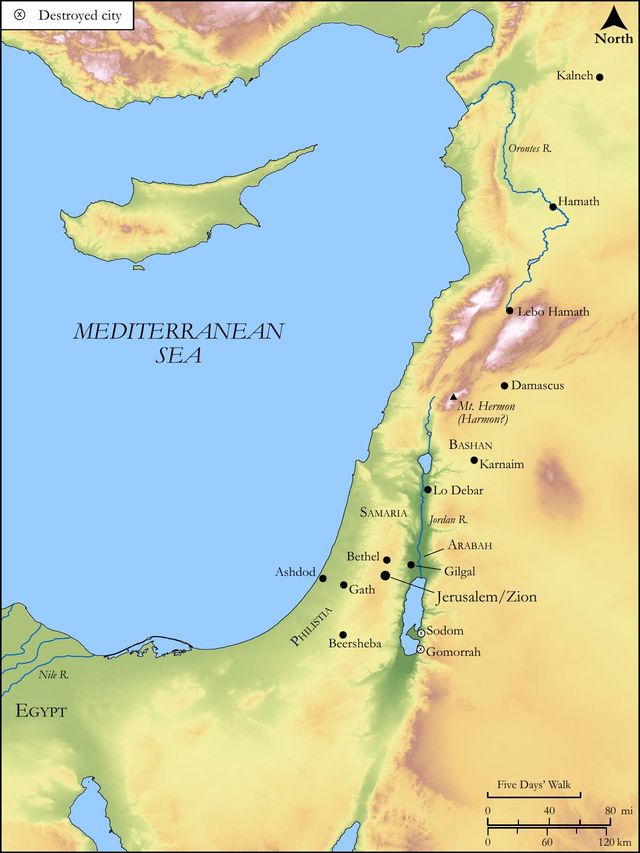
Where Amos reaches
The passages it leans on, and the ones that lean on it
The LORD roars from Zion: words near the close of Joel open Amos.
A poor man’s pledge was to go back at sundown; Israel lay on it by the altars.
Amos 5:21–24 1 Samuel 15:22 Micah 6:8
To obey is better than sacrifice: Samuel, Amos and Micah ask the same of worshippers.
Stephen quotes Amos on the idols Israel carried in the wilderness.
James cites the raised tabernacle of David for Gentiles who turn to God.
Books Amos links to most
The Church Fathers on Amos
157 quotations from 27 writers before AD 800 · the ten most quoted, in date order
- Clement215
- Tertullian220
- Origen253
- Basil379
- Ambrose397
- Chrysostom407
- Jerome420
- Augustine430
- Cyril444
- Gregory604
Jerome set Amos beside Hosea and Joel by the people each was sent to.
Therefore, the first prophet Hosea speaks to the ten tribes called Ephraim, Samaria, the house of Joseph, and Israel. The second prophet Joel, prophesies to Jerusalem and the two tribes called Judah and Jerusalem, with no mention at all of Israel. The third Amos, not at all in Jerusalem, which was ruled by the tribe of Judah, but in Israel in Samaria, preaches.
Chrysostom on why Amos told Amaziah he was no prophet.
Amos also said, “I was no prophet, nor the son of a prophet, but only a herdsman, a gatherer of sycamore fruit. And God took me.” He did not say this to exalt himself but to stop their mouths that suspected him as no prophet, and to show that he is no deceiver, and what he says does not come from his own mind.
John of Damascus on “shall there be evil in a city, and the LORD hath not done it?”
even when it goes so far as to say that God “creates evil” and that “there is not evil in a city which the Lord has not done,” it still does not show God to be the author of evil. … at other times it means what is evil and painful in relation to our sensibility, which is to say, tribulation and distress.
Theodoret on those who longed for the day of the LORD.
Since there were some buoyed up by audacity and temerity who resisted the prophetic oracles, raging against them, calling the divine pronouncements false and demanding the fulfillment of the prophecies, the Lord declares these people lamentable for longing to see darkness instead of light.
Keep studying
Articles