


Old Testament · Minor Prophets · Book 31 of 66
Obadiah
A vision against Edom, the nation of Esau, for its violence against its brother Jacob, closing with deliverance on mount Zion.
- 1 chapter
- 21 verses
- About 3 minutes to read
- The Hebrew Prophets, c. 800–400 BC
Obadiah is the shortest book of the Old Testament: twenty-one verses, one vision, one nation. The nation is Edom, the people of Esau, and the charge is “thy violence against thy brother Jacob” (Obadiah 1:10). When foreigners entered Jerusalem’s gates and cast lots upon the city, Edom stood aloof and was “as one of them.” The LORD answers in kind: “as thou hast done, it shall be done unto thee” (Obadiah 1:15).
Watch the two mountains. Edom trusts its heights and its wise men, but “though thou set thy nest among the stars, thence will I bring thee down” (1:4). Against the mount of Esau stands mount Zion, where “shall be deliverance, and there shall be holiness” (1:17). Watch the word day as well: Judah’s day of calamity becomes “the day of the LORD” upon all the nations. The vision closes beyond Edom altogether: “the kingdom shall be the LORD’S” (1:21).
For the day of the LORD is near upon all the heathen: as thou hast done, it shall be done unto thee: thy reward shall return upon thine own head.
Obadiah 1:15 KJV
Before you read
- Who wrote it
- Obadiah, whose name means “serving Jah”. The book names him once, “The vision of Obadiah” (Obadiah 1:1), and says nothing more; Ephrem the Syrian recorded that
Obadiah of Sichem was born in the tribe of Ephraim
. - When it was written
- No king or year is named. The date is read from verse 11, the day foreigners “cast lots upon Jerusalem” with Edom among them. Verses 1–9 run close to Jeremiah 49:7–22, which fits either date.
Ephrem the Syrian, and others who date it early Obadiah
seems to be a contemporary of Hosea, Joel, Amos and Isaiah
. Joel’s “in mount Zion … shall be deliverance, as the LORD hath said” (Joel 2:32) may then cite verse 17, and verse 11 is an earlier sack of Jerusalem, or the Babylonian one foreseen.Grounds Ephrem the Syrian 373 · Commentary On ObadiahJoel 2:322 Chronicles 21:16–17
Those who date it just after Jerusalem fell Verse 11 looks back on the Babylonian capture of Jerusalem in 586 BC, soon after which the book was written. Psalm 137 charges Edom with that day: “Remember, O LORD, the children of Edom in the day of Jerusalem” (Psalm 137:7); so does Lamentations (4:21–22).
- Where
- Edom, Esau’s nation in the mountains south of the Dead Sea: “Thus dwelt Esau in mount Seir: Esau is Edom” (Genesis 36:8). The vision ends on mount Zion.
How Obadiah is laid out
3 movements · 5 passages · 21 verses
Edom brought down
1:1–9 · 9 verses
An ambassador rouses the nations against Edom. Edom dwells “in the clefts of the rock” and asks, “Who shall bring me down to the ground?” The LORD will. Thieves would take only enough, but Esau will be searched out; its allies deceive it, and its wise men and the mighty men of Teman fail.
The day of thy brother
1:10–16 · 7 verses
The charge is “violence against thy brother Jacob.” When foreigners cast lots upon Jerusalem, Edom was “as one of them.” Eight times the prophet names what Edom should not have done, from looking on to handing over the survivors. The day of the LORD is near upon all the nations, and Edom will be repaid in kind.
Deliverance upon mount Zion
1:17–21 · 5 verses
Upon mount Zion “shall be deliverance, and there shall be holiness.” Jacob is a fire, Joseph a flame, Esau stubble, with none remaining. Israel takes the land on every side, the captives as far as Zarephath. Saviours come up on mount Zion to judge the mount of Esau, and the kingdom is the LORD’s.
The words Obadiah turns on
Esau’s mount and mount Zion face each other; Judah’s day of distress becomes the day of the LORD; Jacob, Edom’s brother, will possess the mount of Esau.
What Obadiah teaches
nâshâʼ · deceive
Pride that deceives
Edom’s confidence was its height: “thou that dwellest in the clefts of the rock, whose habitation is high” (1:3). The prophet names what lay beneath it: “The pride of thine heart hath deceived thee.” The same verb, nâshâʼ, returns in verse 7: “the men that were at peace with thee have deceived thee.” Deceived first by its own heart, Edom is then deceived by its friends. Its question, “Who shall bring me down to the ground?”, has its answer: “thence will I bring thee down, saith the LORD” (1:4). The boast is close to that of the king of Babylon, “I will exalt my throne above the stars of God” (Isaiah 14:13), and so is the end (14:15).
ʼâch · brother
Violence against a brother
One charge is laid against Edom: “thy violence against thy brother Jacob” (1:10). The enmity is as old as Esau’s vow, “then will I slay my brother Jacob” (Genesis 27:41), yet the law kept the bond: “Thou shalt not abhor an Edomite; for he is thy brother” (Deuteronomy 23:7). On the day of Judah’s calamity Edom chose its side: “even thou wast as one of them” (1:11). Amos makes the same charge, that Edom “did pursue his brother with the sword, and did cast off all pity” (Amos 1:11). And the LORD counts the wrong as done to him: the gate Edom entered was “the gate of my people” (1:13).
yôwm · day
As thou hast done
Verses 11–14 say “day” ten times, each a day of Judah’s distress. Then verse 15 turns the word: “For the day of the LORD is near upon all the heathen: as thou hast done, it shall be done unto thee” (1:15). The repayment follows Edom’s deeds word for word. Edom stood in the crossway “to cut off those of his that did escape” (1:14); on mount Zion “shall be deliverance” (1:17), and that word is the feminine of the word for those who escape: the remnant Edom hunted is kept on Zion. Edom delivered up “those of his that did remain”; of Esau “there shall not be any remaining” (1:18). Jesus gives the same measure: “with what measure ye mete, it shall be measured to you again” (Matthew 7:2).
Christ in Obadiah
No New Testament writer quotes Obadiah, but Hebrews sets its two names side by side. It holds up Esau, “who for one morsel of meat sold his birthright” (Hebrews 12:16), and tells the church, “ye are come unto mount Sion … and to Jesus the mediator of the new covenant” (12:22–24). The deliverance and holiness promised on mount Zion are given in him.
The promise that the south “shall possess the mount of Esau” (Obadiah 1:19) has its twin in Amos: “That they may possess the remnant of Edom, and of all the heathen, which are called by my name” (Amos 9:12). James read that prophecy as fulfilled when God visited the Gentiles “to take out of them a people for his name” (Acts 15:14–17). And the book’s last words, “the kingdom shall be the LORD’S”, are heard again in heaven: “The kingdoms of this world are become the kingdoms of our Lord, and of his Christ” (Revelation 11:15).
People
By how many verses name them
Places
11 named
- EsauThe mount of Esau: Edom’s high country, judged from mount Zion4
- EdomThe nation of Esau, addressed throughout the vision2
- JerusalemThe city whose gates foreigners entered, Edom among them2
- Negeb“They of the south” will possess the mount of Esau2
- ZionThe mount of deliverance and holiness, set against Esau’s2
- GileadAcross the Jordan; Benjamin will possess it1
- SamariaIts fields, with Ephraim’s, will be possessed again1
- SepharadWhere “the captivity of Jerusalem” is held1
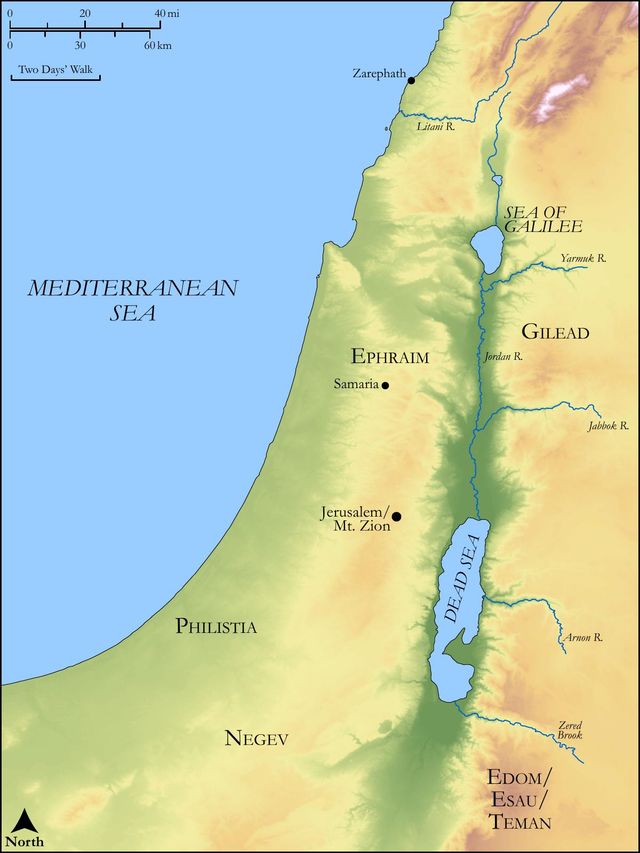
Where Obadiah reaches
The passages it leans on, and the ones that lean on it
Obadiah 1:1–9 Jeremiah 49:7–22
Jeremiah’s oracle on Edom, parallel to verses 1–9 and often nearly word for word.
Obadiah 1:11 Psalms 137:7 Lamentations 4:21–22
The same charge against Edom, for “the day of Jerusalem”, in a psalm and in Lamentations.
The hatred behind the charge: Esau’s “then will I slay my brother Jacob.”
Obadiah 1:19 Amos 9:12 Acts 15:17
The remnant of Edom possessed along with “all the heathen”; James reads it of the Gentiles.
“The kingdom shall be the LORD’S”, and in heaven the kingdoms of this world become Christ’s.
Books Obadiah links to most
The Church Fathers on Obadiah
40 quotations from 8 writers before AD 800
Ephrem, who dated Obadiah early, read Edom’s fall to the Chaldeans as prophecy.
He prophesies that the people of Esau had to be pillaged by the Chaldeans with incredible zeal and then even deported to captivity.
Ambrose made verse 12 a bishop’s prayer.
And first grant that I may know how with inmost affection to mourn with those who sin; for this is a very great virtue, since it is written: "And thou shall not rejoice over the children of Judah in the day of their destruction, and speak not proudly in the day of their trouble."
Theodoret saw Zion’s holiness carried to the whole earth by the cross.
“On Mount Zion there will be salvation, and there will be holiness.” For God is saying through the prophet, “I will bring them back from their captivity, and I will rebuild the sacred temple.” And there is Obadiah, who prophesies the cause of salvation to all in Zion. From there God will disperse holiness into the entire inhabited earth through the saving cross.
Augustine read the saviours as the apostles, and Mount Esau as the Gentiles.
It is quite evident that this was fulfilled when the redeemed out of Mount Zion (that is, the believers in Christ from Judea, of whom the apostles are chiefly to be acknowledged) went up to defend Mount Esau. How could they defend it except by making safe through the preaching of the gospel those who believed that they might be "delivered from the power of darkness and translated into the kingdom of God."
Keep studying
Articles