


Old Testament · Minor Prophets · Book 38 of 66
Zechariah
Eight night visions encourage the exiles rebuilding the temple; two burdens then foretell Zion’s lowly King, the smitten shepherd, and the LORD king over all the earth.
- 14 chapters
- 211 verses
- About 29 minutes to read
- The Hebrew Prophets, c. 800–400 BC
Zechariah first spoke two months after Haggai, to exiles home from Babylon who had just taken up the building of the LORD’s house again. His first word is the ground of the rest: “Turn ye unto me, saith the LORD of hosts, and I will turn unto you” (Zechariah 1:3). Eight visions follow by night: horsemen among myrtle trees, horns and carpenters, a measuring line, the high priest stripped of filthy garments, a golden candlestick, a flying roll, a woman in an ephah, four chariots. Together they say that the LORD has returned to Jerusalem with mercies, and that his house will be finished “not by might, nor by power, but by my spirit” (4:6).
The last six chapters look further. Zion’s King comes lowly, riding upon an ass; a shepherd is valued at thirty pieces of silver; the LORD says, “they shall look upon me whom they have pierced”; and the book ends with the LORD king over all the earth. The Gospels turn to these chapters for Christ’s last week: his entry into Jerusalem, the price of his betrayal, the scattering of his disciples and his pierced side.
Rejoice greatly, O daughter of Zion; shout, O daughter of Jerusalem: behold, thy King cometh unto thee: he is just, and having salvation; lowly, and riding upon an ass, and upon a colt the foal of an ass.
Zechariah 9:9 KJV
Before you read
- Who wrote it
- Zechariah, “the son of Berechiah, the son of Iddo” (1:1). Ezra names him with Haggai among the prophets who helped the rebuilding (Ezra 5:1–2), and Nehemiah lists a Zechariah as head of the priestly house of Iddo (Nehemiah 12:16).
- When it was written
- Three dates fall in the reign of Darius: the eighth month of his second year (1:1); the twenty-fourth day of the eleventh month, Sebat, in the same year (1:7); and the ninth month, Chisleu, of his fourth year (7:1). Chapters 9–14 carry no date.
- When it happens
- Jerusalem, among the exiles returned from Babylon, while the temple was rebuilt under Zerubbabel and Joshua the high priest. The elders “prospered through the prophesying of Haggai the prophet and Zechariah the son of Iddo”, and the house was finished in Darius’s sixth year (Ezra 6:14–15).
How Zechariah is laid out
8 movements · 45 passages · 211 verses
Turn ye unto me
1:1–6 · 6 verses
In the eighth month of Darius’s second year the word of the LORD comes to Zechariah. The LORD was sore displeased with the fathers of this people, who would not hear the former prophets until his words took hold of them. Now he calls the children: “Turn ye unto me, saith the LORD of hosts, and I will turn unto you.”
1 passages
Horsemen, horns and a measuring line
1:7–2:13 · 28 verses
Three months later the visions begin. Horsemen among the myrtle trees find the earth at rest, and the angel of the LORD asks how long Jerusalem must wait; the LORD is returned to her with mercies. Four carpenters come to fray the horns that scattered Judah. A man goes to measure Jerusalem, which the LORD will wall with fire, and the exiles are called out of Babylon.
The high priest and the candlestick
Chapters 3–4 · 24 verses
Joshua the high priest stands before the angel of the LORD in filthy garments, with Satan at his right hand to resist him. The LORD rebukes Satan, Joshua is clothed with change of raiment, and the LORD promises “my servant the BRANCH.” A golden candlestick stands between two olive trees: Zerubbabel will finish the house, “not by might, nor by power, but by my spirit.”
Roll, ephah, chariots and crowns
Chapters 5–6 · 26 verses
A flying roll carries the curse into the house of the thief and of the false swearer. Wickedness, a woman shut in an ephah under a weight of lead, is carried away to the land of Shinar. Four chariots go out through the earth. Crowns of silver and gold are set on Joshua’s head, and the man named The BRANCH “shall be a priest upon his throne.”
Fasts turned to feasts
Chapters 7–8 · 37 verses
In Darius’s fourth year men come to ask whether the fast of the fifth month should be kept. The LORD asks whether their seventy years of fasting were kept for him, and repeats the former prophets: execute true judgment and shew mercy. Promise follows promise: he is returned to Zion, the fasts become cheerful feasts, and men of all languages take hold of a Jew’s skirt.
9 passages
- 7:1–3 Delegation Asks About Continuing the Fasts
- 7:4–7 God Challenges the Motivation for Fasting
- 7:8–10 The Requirement of True Justice
- 7:11–14 Past Rebellion and Divine Judgment
- 8:1–8 The Lord's Jealousy for Zion
- 8:9–15 Encouragement for the Builders
- 8:16–17 Requirements for a Holy People
- 8:18–19 Fasting Will Turn to Feasting
- 8:20–23 Nations Will Seek the Lord
The lowly King and the shepherds
Chapters 9–11 · 46 verses
The first burden falls on Hadrach, Damascus, Tyre and the cities of the Philistines. Then Zion’s King comes, just and lowly, riding upon an ass, and speaks peace to the heathen. The LORD will gather his scattered flock. The shepherd he sends breaks both his staves, Beauty and Bands, and is valued at thirty pieces of silver; a foolish shepherd follows.
11 passages
- 9:1–8 Judgment on Syria and Phoenicia
- 9:9–10 The Arrival of the Humble King
- 9:11–12 Covenant Restoration and Victory
- 9:13–17 The LORD’s Victory Over the Nations
- 10:1–2 Seek the Lord for Provision
- 10:3–5 Judgment on False Shepherds
- 10:6–12 The Gathering and Strengthening of Israel
- 11:1–3 Prophecy of Devastation and Judgment
- 11:4–6 Commission to Feed the Doomed Flock
- 11:7–14 The Symbolic Acts of the True Shepherd
- 11:15–17 The Coming of the Worthless Shepherd
The pierced one and the fountain
Chapters 12–13 · 23 verses
The second burden: the LORD makes Jerusalem a burdensome stone to all people and defends its inhabitants. He pours on them the spirit of grace and of supplications; they look upon “me whom they have pierced” and mourn, every family apart. A fountain is opened for sin and uncleanness, idols and lying prophets are cut off, the shepherd is smitten, and a third part is refined.
King over all the earth
Chapter 14 · 21 verses
All nations gather against Jerusalem, and half the city goes into captivity. Then the LORD goes forth to fight; his feet stand on the mount of Olives, which cleaves in two. Living waters go out from Jerusalem, the LORD is king over all the earth, the survivors of the nations go up yearly to keep the feast of tabernacles, and even the pots are holiness unto the LORD.
The words Zechariah turns on
Angel belongs to the visions of chapters 1–6, shepherd to chapters 10–13, and day, in “in that day,” to the last three chapters.
What Zechariah teaches
shûwb · return
Turn, and I will turn
The book’s first word to the people joins a command to a promise: “Turn ye unto me, saith the LORD of hosts, and I will turn unto you” (1:3). It was spoken to men already home from Babylon. The return the LORD asked for was a turning of heart, and their fathers had refused it until his words took hold of them; then “they returned and said, Like as the LORD of hosts thought to do unto us … so hath he dealt with us” (1:6). The same verb is used of the LORD himself: “I am returned to Jerusalem with mercies: my house shall be built in it” (1:16), and again, “I am returned unto Zion, and will dwell in the midst of Jerusalem” (8:3).
tsemach · branch
My servant the BRANCH
Twice the LORD names a man to come. To Joshua and his fellows, “men wondered at,” he says, “I will bring forth my servant the BRANCH” (3:8), the name Jeremiah gave the righteous Branch raised unto David (Jeremiah 23:5). Then crowns made from the exiles’ silver and gold are set on Joshua the high priest, and the word comes, “Behold the man whose name is The BRANCH; and he shall grow up out of his place, and he shall build the temple of the LORD” (6:12). The throne belonged to David’s house and the priesthood to Aaron’s, but the Branch holds both: he “shall sit and rule upon his throne; and he shall be a priest upon his throne: and the counsel of peace shall be between them both” (6:13).
râʻâh · shepherd
The shepherd and the flock
The second half of the book turns on shepherds. The people went their way as a flock, troubled “because there was no shepherd” (10:2), and the LORD’s anger was kindled against the shepherds they had (10:3). The prophet is told, “Feed the flock of the slaughter” (11:4). He feeds it with two staves, Beauty and Bands, and his wages are weighed out as thirty pieces of silver, which the LORD calls “a goodly price that I was prised at of them” (11:13). To refuse the shepherd was to refuse the LORD who sent him. Then the LORD calls the sword against “my shepherd, and against the man that is my fellow” (13:7). The sheep are scattered, and a third part, refined as silver, says, “The LORD is my God” (13:9).
yôwm · day
In that day
The last three chapters return again and again to “that day.” In it Jerusalem becomes “a burdensome stone for all people” (12:3), a fountain is opened “for sin and for uncleanness” (13:1), the LORD’s feet stand upon the mount of Olives (14:4), and “the LORD shall be king over all the earth” (14:9). It is “not day, nor night: but it shall come to pass, that at evening time it shall be light” (14:7). Cyril of Jerusalem read the verse of the day of the crucifixion, with its darkness from the sixth hour to the ninth: That day is neither day nor night. What then shall we call it? The gospel interprets it, telling of the event.
Ambrose read the same passage of the Lord who shall come with his saints to enlighten us by his second advent.
Christ in Zechariah
Matthew and John both read Christ’s entry into Jerusalem as the fulfilment of Zechariah 9:9 (John 12:15): “Behold, thy King cometh unto thee, meek, and sitting upon an ass” (Matthew 21:5). On the night he was betrayed, Jesus took 13:7 to himself: “I will smite the shepherd, and the sheep of the flock shall be scattered abroad” (Matthew 26:31). The thirty pieces of silver cast “to the potter in the house of the LORD” (11:12–13) are matched in the price of his betrayal: Judas cast the silver down in the temple, and the chief priests bought with it the potter’s field (Matthew 27:3–7). When a soldier pierced his side, John wrote, “They shall look on him whom they pierced” (John 19:37), and Revelation sees every eye look on him at his coming (Revelation 1:7).
The book also joins in one man the offices Israel kept apart: the BRANCH is “a priest upon his throne” (6:13). Hebrews names Christ such a priest, “set on the right hand of the throne of the Majesty in the heavens” (Hebrews 8:1).
People
By how many verses name them
- JoshuaA son of Jehozadak; father of Joiakim6
- ZechariahA son of Berechiah4
- ZerubbabelSon of Shealtiel, or of Pedaiah (1 Chronicles 3:19)4
- Darius3
- Satan2
- BerechiahA son of Iddo; father of Zechariah2
- IddoFather of Berechiah2
- Helem2
9 more are named.
Places
30 named
- JerusalemThe city the LORD returns to, measures, defends and makes holy37
- ZionBidden to rejoice: her King comes, and the LORD dwells in her8
- EgyptA land the scattered return from; it too must keep tabernacles4
- AssyriaWith Egypt, a land of exile whose pride is brought down2
- BabylonExiles still live there; others bring silver and gold from it2
- EkronA Philistine city whose remnant will belong to Israel’s God2
- LebanonIts cedars burn, and the shepherds howl for their spoiled glory2
- TyreHeaps up silver as dust, yet will be devoured with fire2
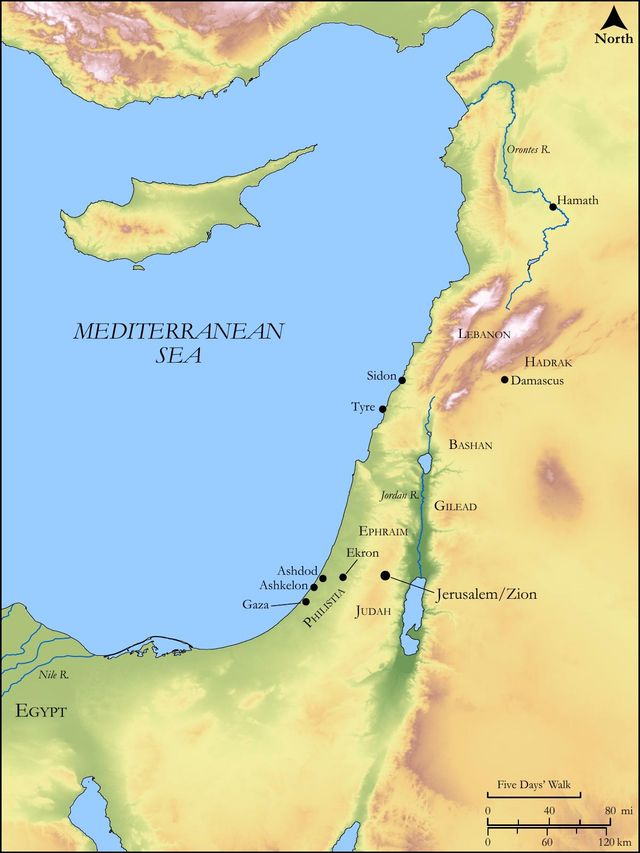
Where Zechariah reaches
The passages it leans on, and the ones that lean on it
The same call and promise in the last of the prophets: “Return unto me, and I will return unto you.”
Michael answers the devil with the words spoken to Satan over Joshua: “The Lord rebuke thee.”
Zechariah 9:9 Matthew 21:5 John 12:15
The lowly King on an ass’s colt, fulfilled in Christ’s entry into Jerusalem.
Zechariah 12:10 John 19:37 Revelation 1:7
The pierced one, looked on at the cross and again at his coming, when “every eye shall see him.”
Zechariah 14:8 John 7:38 Revelation 22:1
Living waters out of Jerusalem, the rivers Christ promised, and the river of the water of life.
Books Zechariah links to most
The Church Fathers on Zechariah
197 quotations from 32 writers before AD 800 · the ten most quoted, in date order
- Justin Martyr165
- Tertullian220
- Origen253
- Ephrem373
- Cyril386
- Gregory395
- Ambrose397
- Chrysostom407
- Jerome420
- Augustine430
Theodore of Mopsuestia, on how the night visions are to be read.
It is quite clear that all the things shown to the prophet were tokens of certain realities … In exactly the same way the prophet also sees these things by divine revelation, and each of the things shown him contained some sign or indication of a reality.
Theodoret read Joshua before the accuser as a figure of Christ the high priest.
Just as the avenging and wicked devil was very opposed to Joshua for being high priest and making intercession to God on behalf of the people, so in turn this same enemy was an opponent of Jesus the great high priest in the order of Melchizedek … It was, however, not Joshua the son of Jehozadak that rebuked him, but Joshua’s Lord
Justin Martyr, arguing with Trypho, on the shepherd smitten and the sheep scattered.
Moreover, the prophet Zechariah foretold that this same Christ would be smitten, and His disciples scattered: which also took place.
Augustine, on the body that will be seen at Christ’s coming.
If they will see him whom they have pierced, they will see the same body that they thrust through with a spear
Keep studying
Articles